Student’s Reactions to the Use of CALL (Computer Assisted
Language Learning) in their English Studies.
Mark Deadman
Keywords
Computer Assisted Language Learning (CALL), Moodle, English, online learning
Abstract
This study is significant in that it evaluates student’s reactions to the use of computer assisted language learning in their English studies. The digital age is growing and expanding quickly in all walks of life. University students appear to be very familiar and confident using new technological devices such as smart phones, tablet computers, and personal computers. Sergeant (2001, p241) states that ‘…many students rank acquisition of computer skills alongside the acquisition of English language as essential for survival in the modern world’. However, many students haven’t been exposed to Computer Assisted Language Learning (CALL) very much and it is important to know how students perceive and react to the use of one such example of CALL, Moodle, in their English language learning.
Introduction
Jennings (2007), in his report "Discussing the future of the English Course Curriculum’ at Maebashi Kyoai Gakuen College (here in after ‘Kyoai Gakuen College’, and additionally the location for this research paper), notes that the best practice to adopt at the college is a communicative curriculum (Jennings emphasis) where all parties are consulted to bring about a focus on how to best help students be able to function within the target language environment. This basically follows a social constructivist pedagogy of learning. In addition, Pennington (2005) states that the English course at Kyoai Gakuen College “is very much geared towards English for international communication”, with one of the goals of the course to reach a score of 730 on the TOIEC test, a test which measures skills in English as a second language,
and being able to communicate in everyday situations. Hopefully this research paper, with a focus on Moodle usage amongst a set of students, contributes to the issues raised by the English communicative curriculum at the college. I believe that Moodle offers a new perspective and valuable opportunity for both teachers and students in language learning. Principally the aim of this study is to aid my development as a teacher, passing new skills and the ability to participate in “international communication” and communicate in everyday situations.
This paper investigates the use and application of ‘Moodle’, an Open Source Course Management System (CMS), also known as a Learning Management System (LMS) or a Virtual Learning Environment (VLE) (Moodle, 2013a), that is used by students at Maebashi Kyoai Gakuen College. The Moodle website states that the software has become very popular among educators around the world as a tool for creating online dynamic web sites for their students. Moodle is used by 1.3 million teachers and 70 million users around the world, with 126 million posts, and 67 million resources (Moodle, 2013b).
Moodle.org (2013a) states in its philosophy that the design and development of Moodle is guided by “social constructionist pedagogy". Under this philosophy it is necessary to focus on the experiences that would be best for learning from the learner's point of view, rather than just publishing and assessing the information that a teacher thinks they need to know. This is also in keeping with the aim outlined by Jennings for Kyoai Gakuen College. It can also help the teacher realize how each participant in a course can be a teacher as well as a learner. The role of the 'teacher' can change from being 'the source of knowledge' to being an influencer and role model of class culture, connecting with students in a personal way that addresses their own learning needs, and moderating discussions and activities in a way that collectively leads students towards the learning goals of the class.
Moodle has been used at Maebashi Kyoai Gakuen College as a learning resource in a variety of ways, but typically it is used to augment face-to-face courses (known as blended learning). It is also used for activity modules (such as forums, databases and wikis), and as a way to deliver content to students and assess learning using assignments or quizzes. Specific to this research location, Kyoai Gakuen College, and the use of Moodle, Pennington (2011), detailed a particular use of Moodle through the colleges Extensive Reading Program. Pennington notes that such a program could only be realized in an effective way due to the widespread use of personal computers, high speed internet connectivity, and the advent of the Learning Management System (LMS), such as Moodle. The ‘Moodle Reader’ is a Moodle module for the purpose of providing
randomized quizzes from a selection of over six hundred books, providing a wealthy source of self-study materials for English language learning students. Pennington (2011, p48) notes that although there were a few minor problems to be dealt with, “the first attempt at a full-fledged Extensive Program…was a complete success”. Pennington also reports that the program can also be considered a success as there was a high continuation rate amongst students in the program.
In this paper I will take the lead from Moodle contributor German Valero (Moodle, 2013a) who outlined the above pedagogy or Moodle philosophy that is in line with a ‘social constructivism’ approach to learning. Valero outlined five factors that he suggested applied to a sound system of education in general. These themes will then be applied to my research into Moodle usage at Maebashi Kyoai Gakuen College, and then determined whether they apply to current Moodle usage in the courses I teach for both myself and the students.
It is important to outline the five themes that are central to the spine of this study.
Theme 1 All of us are potential teachers as well as learners - in a true collaborative environment we are both.
As outlined above, in “social constructionist pedagogy", it is important for the teacher to realize how each participant in a course can be a teacher as well as a learner.
Theme 2 We learn particularly well from the act of creating or expressing something for others to see.
The act of expressing and presenting posts, projects, assignments, constructions for others to see ensures that a lot of self-checking and reflection takes place that increases learning.
Theme 3 We learn a lot by just observing the activity of our peers.
Valero notes that humans are good at watching each other and learning what to do in a given situation through cues from others. Theme 4 By understanding the contexts of others, we can teach in a more
transformational way.
There are many different ways to find out about people and their learning habits.
Theme 5 A learning environment needs to be flexible and adaptable, so that it can quickly respond to the needs of the participants within it.
Giving students tailored opportunities to share ideas, ask questions and express their knowledge, requires an environment which is flexible, both in time and space.
BACKGROUND LITERATURE
Jarvis (2013) details the rise of Computer Assisted Language Learning (CALL) over the last forty years and notes that the heart of this notion is that a desktop or laptop computer explicitly helps students with input and/or practice activities in order to learn, hence the ‘assisted learning` part of the CALL acronym. In addition to these ‘traditional’ CALL devices, a whole host of other devices are now being employed to access computer learning sources themselves, such as smartphones and tablet devices.
Jarvis (2013, p192) notes that in the 1970s and early 1980s, students would typically work on a mainframe computer, working on one text-based program installed on the hard drive of each computer. Owing its origin to Behaviorism, the notion of repetition and ‘practice makes perfect’ was the prevalent framework of thinking. This was represented in the fundamental approach to English language learning or education in Japan, which was grounded in the predominance of text-centered and grammar-centered practices, which did not provide a basis for the student-centered, fluency focused, and problem-solving activities, represented by people interactions in normal day-to-day conversations and activities (McCormick, R. and Murphy, 2008).
Behaviorism gave way to cognitivism, or a communicative way of thinking, that saw learning as comprised of thinking, constructing or working things out. At that time CALL entailed inputting responses into the computer and then responding to output from the computer. Since the 1990s, due to technological developments, CALL has incorporated multi-media, hypertext, and now broadband has shifted activity to the internet. This has led to the development of virtual learning environments like Moodle,
Hot Potatoes and Blackboard. Such developments are in line with socio-cognitive
views of learning, as prescribed by Vygotsky that emphasized the role of social-interaction in learning (Jarvis, 2013). In addition, The Asian EFL Journal (2013), a journal for second language research, states that the future of ELT is moving towards Internet Technology (IT) based learning. The classroom and teacher will never be replaced but will be enhanced and supported by IT. The Journal notes that the ELT market now has one billion students worldwide with an estimated 2 billion by the year
2020. Demand for I.T. products to help academics and teachers reach this growing market will dominate the future.
This notion of social-interaction stems from the research of the Russian psychologist Lev Vygotsky, who made claims about the relationship between language and thought, and between individual and society (Mercer, 2000). Vygotsky described language as having two main functions; as a communicative or cultural tool we use for sharing, and for jointly developing knowledge. Vygotsky said instruction is only useful when it moves ahead of development, drawing learners just beyond their existing capabilities to ‘stretch’ their intellect and so help them to develop (Mercer, 2000). Teaching should be appropriate to the students potential, rather than actual achievements. To achieve this we need to provide a ‘scaffold’ for learning. CALL can provide this scaffold as students and teachers are now able to interact with each other and between each other in ways that were unavailable previously.
Concerning the use of technology in the classroom, Awad and Alkaraki (2013) looked at the Attitudes of EFL students towards using computers in learning English at public schools in Jordan. Their chief findings were that;
1. Students agree that computers allow them to increase the skills and creativity, 2. Whatever the background of the student (age, gender, computer literate), they held
a positive attitude toward using computers in the classroom,
3. Factors that influenced student’s positive attitude towards computers included the benefits of computer mediated communication, feeling of personal empowerment, and the enhancement of learning opportunities.
Markee (2001) discusses the diffusion of innovation in language teaching and states that typically teachers are implementers, students are clients, curriculum and materials designers are suppliers, but points out that in practice these roles are not mutually exclusive. It is quite likely that the same person will play different roles, sometimes simultaneously, sometimes in varying times during the course of a project. Markee (2001, p119) quotes Fulla, who proposed a sequence of four steps in the adoption of an innovation: (as for me and my students, Moodle represents an innovation in our classes) initiation, implementation, continuation, and outcome. Markee also details Rogers, a rural sociologist, who suggested that there are five steps in the decision-making process in the acceptance of an innovation.
1. Gaining knowledge about an innovation 2. Being persuaded of its value
4. Implementing their decision to adopt
5. Confirming their decision to continue using the innovation
Following on from this Markee ascertains that all innovations are a risky business and that close to three-quarters of educational innovation are likely to fail over time. It is essential that innovations like Moodle are fully adopted or survive the confirmation stage outlined above.
Knutzen and Kennedy (2013) examine how an Online Learning Environment (OLE) can transform teacher’s perceptions of their own pedagogical practices. The findings indicate that teachers with more teaching experience may have more confidence to use OLEs in a constructivist way. In this study, OLEs, especially with the use of Web 2.0 tools, were expected to provide a process for negotiation of student control and expression in a way that motivates students and supports learning. They note that the exponential growth in popularity of OLE is a driving change in many aspects of teaching and learning; course design, delivery methods, teacher-student interaction, design of student tasks and assessment. Knutzen and Kennedy (2013) imply that OLEs designed from a constructivist perspective may lead to a more active learning environment for students. This is exemplified by the fact that a constructivist OLE design should allow the student to access the material in the sequence and depth that best suits their needs and interests.
As both the teacher and student become familiar with the interface and mechanics of working in an OLE, the teacher can step out of the spotlight, and become more of a moderator and observer. Knutzen and Kennedy (2013) even go further and state that ideally the level of student engagement can become so fervent that the teacher essentially gets “out of the way”, allowing students to take complete ownership of their learning.
Knutzen and Kennedy (2013) relate how teachers can be grouped according to the strategies they use, either using a transmission teaching strategy or transformative teaching strategy (Figure 1).
Figure 1 ~ Teaching strategies linked by learning outcomes
Teaching strategies linked by learning outcomes
Transmission Transformative
Knowledge transmitted from teacher to student
Teacher structures student learning Student learning facilitated by the teacher
Outcome: Surface learning Outcome: Deep learning
Source: Knutzen and Kennedy (2013, p3)
Echoing traditional classroom practices, a transmissive teaching strategy is based on reproduction of taught material, resulting in surface learning. The student passively receives the information with very little cognitive processing, the focus is on reproducing the content later with a minimum of errors. In contrast, a transformative strategy is based upon a perception that learning is knowledge constructed by the student. This method is designed to engage students in actively constructing their own knowledge in order to develop a deeper understanding of concepts. Learning activities should help students recognize frames of reference and use their imaginations to redefine problems from a different perspective.
Following on from these ideas, Sergeant (2001, p240) warns that “while there
seems to be little doubt of the potential of IT (information technology), it is difficult to specify the nature of the new learning opportunities”. Sergeant further states that “students, who are the recipients of CALL, are the least consulted during the decision-making process. They are the ones who are most disadvantaged if CALL is not effectively implemented”. Writing in 2001, Sergeant suggested that due to the additional
complexity of the computer medium compared with normal classrooms activities, a high standard of teacher expertise is essential, otherwise CALL becomes a form of ‘electronic baby-sitting’.
Methodology
The research looks to analyze whether both myself as the teacher of four different English courses, and the students in these classes, adhere to the themes outlined above. This is to lead both myself and the students to a higher state of learning in social constructivist pedagogy. The aim is to help students become better students through self-centered learning and peer-learning.
The data collection stage involved the construction and distribution of two online Moodle surveys, posted to the Moodle courses asking students to voluntarily complete a short questionnaire. Two questionnaires were designed, one course survey for all four classes, and one questionnaire for one class only, based on a particular activity of the
course.
The four classes were made of three classes of intermediate English language speakers, and one class of Advanced Listening students. The first questionnaire was completed by 59 respondents, a participation rate of 71% across the four classes. The questionnaire was completed in June 2013 near the end of the first semester. The second questionnaire was submitted to the Advanced Listening class in July 2013 immediately after the completion of a workshop activity. The participation rate for this questionnaire was 70% (21/30). Both questionnaires therefore represented a majority sample of the students.
The questionnaires were entirely administered on Moodle, with minimal instruction from myself, but with clear and concise instructions as a detailed description on the activity information box. This was to check the students’ actual ability to navigate the task successfully. The questionnaires were completed on a voluntary basis. In addition, the questions were set up to allow students and their responses to remain anonymous, as indicated to students in the instructions, to reduce student concerns about anonymity, confidence and allow them to answer freely. The student’s perceived usage of Moodle could be checked against the actual usage of Moodle from the scheduled course and topic activities. The questions set were a mixture of multiple choice, multiple selection, and short answer questions.
Results
Questionnaire 1 (First Semester Moodle Survey)
As stated above, this first survey was conducted in June 2013, amongst four classes taught by myself. The classes are broken down as follows;
Table 1 Class breakdown
Label Class Name Typical class breakdown
A1 Advanced Listening 4th year students
B4 Spoken English 1st/2nd year students
B5 English for Global Issues 1st/2nd year students
C Written English 1st year students
Question 1 ~ How long have you studied at Kyoai Gakuen College?
It can be seen from Figure 2 that the two classes Writing (C), and Spoken English (B5), have on average less than 2 years’ experience using Moodle, with the Global Issues (B4) class actually using Moodle for the first time in their first semester of study at the college. Altogether, twenty students out of the survey total of fifty nine students (33.9%) of all students were first year students, using Moodle for the first time. The Listening (A) class was mostly comprised of fourth-year students, with an average of 3.87 years using Moodle in various classes.
From these results, I expect the Listening class to have a greater awareness of both Moodle itself and motivation for the application of it to their studies. This was the only demographic asked as I didn’t consider it important to differentiate on an age or gender basis, as outlined by Awad and Alkaraki (2013) who reported that “student’s proficient
in using computers has no relation with their age as well as sex”. However, a student’s
length of study at the college was considered a much more definite representation of a student’s ability, motivation and willingness to use Moodle as they will typically be exposed to more technology than they were in high school, with particular exposure to Moodle through various classes, college administration, and college news and information.
Figure 3: Question 2 ~ When do you use Moodle? 0 5 10 15 20 25 A1 (Listening) B4 (Spoken English) B5 (Global English) C (Writing)
In and out of class In class
The majority of students (57.6%) use Moodle both in and out of class, compared to 42.4% who use Moodle only in class time. This shows that most students see the need for Moodle usage outside of class time, principally for homework tasks.
Question 3 ~ How many days a week do you use Moodle?
An average of two days was recorded for Moodle usage per week, across the four classes. Assuming that the students have included my classes in this figure, leaving at best one extra day of Moodle usage per week, with other teachers at Kyoai Gakuen College, this indicates that there are potentially more opportunities to use it.
Question 4 ~ How many classes do you take a week?
Students across the four classes stated that they study on average thirteen classes a week. However, as seen above in Question 3, students reported that that they use Moodle about twice a week. There may be many classes where Moodle isn’t included in the class plan, but has the potential to be.
Question 5 ~ In how many of the classes you take at college, do you use Moodle? Nobody answered! However, the usefulness of this question with the lack of
answers across the board indicates that either the instruction was too confusing on my part or the students didn’t understand. However, nobody asked me about the meaning. Only after the survey did students query the question, but I deliberately closed the survey at this time to avoid taking up too much time and to see how students coped with any ambiguity. Nobody seemed to care that they couldn’t answer the question, and everybody skipped the question and moved on. This indicates that students are flexible in their access to technology, knowing that they can probably work on the question later if confusion arises.
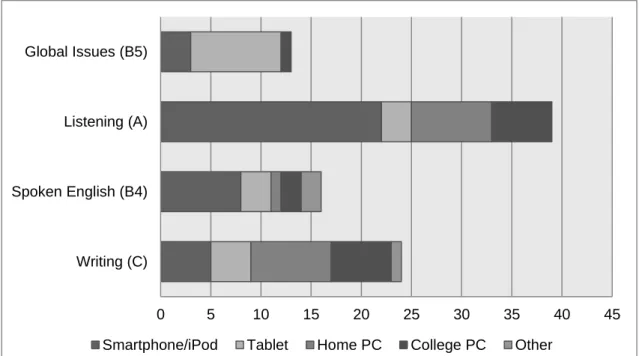
Figure 4: Question 6 ~ How do you access Moodle?
0 5 10 15 20 25 30 35 40 45 Writing (C)
Spoken English (B4) Listening (A) Global Issues (B5)
Smartphone/iPod Tablet Home PC College PC Other
Note Students could answers as many different methods as possible.
The overwhelming majority of students (61.6%) access Moodle through their own personal smartphones/iPods, and/or handheld tablet computers they were provided with as they entered college. Only 34.8% of students used the more traditional home personal computer (PC), or college PC. Students are very comfortable using the newer mediums of communication, such as smartphones and iPods, in line with the ubiquitous nature of cell phone usage in Japan. This shows a transition period in the uptake of newer technology. As technology improves in the future, more opportunities will be made available to the student’s in different forms of technology, hardware and software.
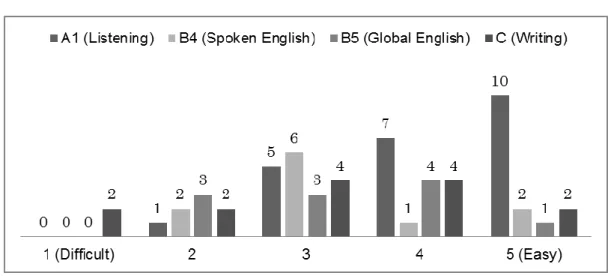
Figure 5: Question 7 ~ How easy was it to use Moodle?
Figure 5 shows a lop-sided perception that Moodle is relatively easy to use, with 83% of students finding Moodle moderately to easy to use (grade 3-5). As expected, fourth-year students found Moodle the easiest to use due to their longer exposure to the software. Amongst the first and second year students of the other three classes, 75% of these students found it manageable to use. Students on the whole are therefore comfortable using Moodle, even for the relative newcomers represented by the first year students in their first semester.
Table 2: Question 8 ~ How is Moodle used in your studies?
Class Total Activity W ritin g (C ) S p ok en E n gli sh ( B 4) Gl ob al Is su es (B5) L iste n in g (A ) % Homework 11.0 9.0 4.0 20.0 44.0 22.6% Homework answers 5.0 5.0 7.0 20.0 37.0 19.0% Homework check 5.0 7.0 1.0 11.0 24.0 12.3% Test check 1.0 6.0 3.0 11.0 21.0 10.8% Lesson notes 5.0 0.0 2.0 2.0 9.0 4.6% Quizzes 0.0 2.0 3.0 15.0 20.0 10.3% Assignments 0.0 2.0 2.0 9.0 13.0 6.7%
Chat 0.0 0.0 0.0 0.0 0.0 0.0% YouTube videos 1.0 3.0 2.0 3.0 9.0 4.6% Email 0.0 1.0 0.0 2.0 3.0 1.5% Lesson video 0.0 3.0 0.0 6.0 9.0 4.6% Lesson audio 0.0 3.0 0.0 2.0 5.0 2.6% Online learning 0.0 1.0 0.0 0.0 1.0 0.5% Total 28.0 42.0 24.0 101.0 195.00 100.0%
Note: Students could choose more than one box
This question ascertained the student’s perceived use of Moodle in their studies. The impact of each activity would indicate how they perceived Moodle usage in the first semester. This is important in determining how the students see technology and Moodle in particular as part of the studies. Overwhelmingly, students see Moodle usage as principally for homework related tasks and activities (homework, homework checks, homework answers, and assignments) accounting for 60.7% of all responses. Due to the nature of the course and the weekly submission of draft and finalized writing assignments through Moodle, the Writing class reported that homework related activities accounted for 75% of their Moodle usage. Similarly, Sergeant (2001, p243) reports form his investigation that 57% of perceived CALL use was accounted for by two programs, questioning whether this represents a missed opportunity in students learning. However, apart from homework task and activities, Moodle was also used for test checks (10.7%), quizzes (10.2%), YouTube and TED (online Technology, Entertainment and Design talk website), videos (4.6%), and lesson videos (4.6%) from the student’s textbooks. These latter functions show the increasing reliance on multi-media uses of computer-aided language learning.
The actual use of Moodle as reported by the log reports from the Moodle website for my courses indicates a slightly different picture to that perceived by the students, as seen in Table 3.
Table 3: Students perceived and real activity use (Kyoai Gakuen College)
Activity Perceived activity use Actual activity use Mode* Student responses % Log report (4 classes) %
Homework 44 22.6 17 15% Institutional 2 2% Revelatory Homework answers 37 19.0 10 9% Institutional
Homework check 24 12.3 16 14% Institutional
Test check 21 10.8 6 5% Institutional
Lesson notes 9 4.6 8 7% Institutional
Quizzes 20 10.3 3 3% Institutional Assignments 13 6.6 0 0% Institutional 20 18% Revelatory 9 8% Emancipatory Chat 0 0.0 3 3% Conjectural TED/YouTube videos 9 4.6 8 7% Institutional
Email (forum) 3 1.5 2 2% Conjectural
Lesson video 9 4.6 7 6% Institutional
Lesson audio 5 2.6 2 2% Institutional
Online learning 1 0.5 0 0% Institutional
Total 195 100 113 100.0
Source: Sergeant (2001, p244)
Notes:
Perceived activity use: from student responses in the questionnaire Actual activity use: instances of an activity present on Moodle.
Sergeant (2001) details the notion of “missed opportunities” inspired by the research of two different studies Kemmis et al, and Phillips. He adapts their work to detail four different modes of learning as detailed in the right-hand column of Table 3 (above); institutional, revelatory, conjectural and emancipatory. In an institutional mode of learning, the learner recalls what has been taught. In a revelatory mode, the learner takes part in a relatively structured learning situation or simulation. Conjectural learning involves the learner engaging in tasks with open-ended and unpredictable solutions. Lastly, an emancipatory mode allows the learner to engage in authentic activities, which is what students at Kyoai should strive for, as per Kyoai ambition for its students as stated above that students should have the ability to participate in “international communication” and communicate in everyday situations.
The Writing class accounted for the highest number of activities or instances out the revelatory mode in assignments. They were not considered institutionalized modes of assignments as although the students had been taught in class the style of the writing theme on a weekly basis, they were free to write their own ideas and thoughts, giving them the opportunity to write in a relatively unstructured learning situation.
In addition, there were three workshop activities assigned to three of the classes, which have been listed as “assignments” in an emancipatory mode as the students were required to make a presentation based on a theme but were required to make questionnaires, surveys for the data collection and present the results as they saw fit. They were therefore engaged in authentic activities, whereby they held the decisions over questionnaire design, implementation, collection and presentation of the results. As the teacher with the traditional role of power and authority, I remained out of all the decision-making processes to prevent this as much as possible. Each emancipatory assignment was split between the data collected itself, the presentation of the results and the peer-grading exercise. This latter activity is an important step towards more emancipation in the class. In addition, I thought it was necessary to split the grading between myself and the students. The students were instructed about how to grade each other, but were free to grade each other in the presentation. This peer-grading activity is important as an authentic activity whereby some of the power (grading) is given to the students rather than the teacher solely. Peer grading is also useful to allow students to set the level of expectations in the class.
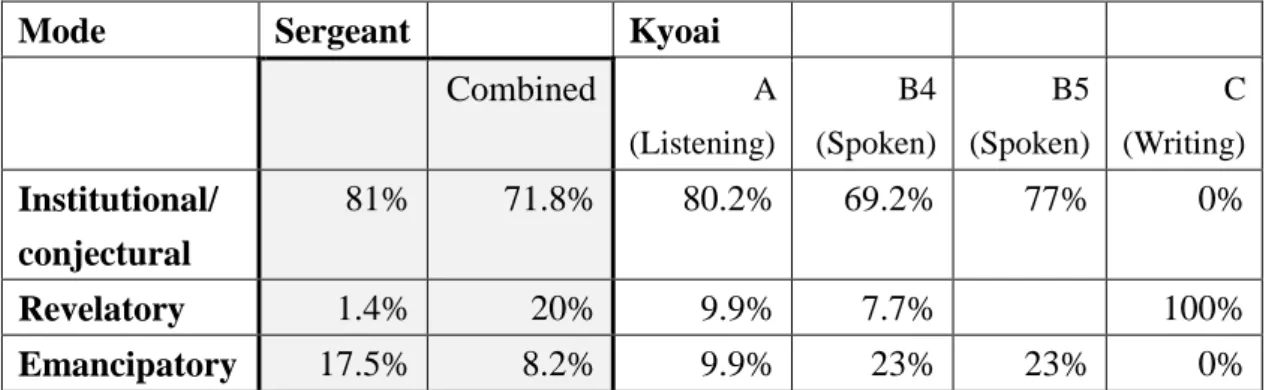
There is a marked difference between perceived and actual activity use in the four courses studied that use Moodle as an integral part of their course. Comparing the modes from Table 4, it can be seen that the Institutional/conjectural is predominant in usage, both in Sergeant’s study and in this one.
Table 4: Activities utilized by mode type
Mode Sergeant Kyoai
Combined A (Listening) B4 (Spoken) B5 (Spoken) C (Writing) Institutional/ conjectural 81% 71.8% 80.2% 69.2% 77% 0% Revelatory 1.4% 20% 9.9% 7.7% 100% Emancipatory 17.5% 8.2% 9.9% 23% 23% 0%
Sergeant found that CALL activities were predominantly instructional or conjectural in design. Sergeant notes that the aim of the majority of activities is to provide text which has been pre-determined before the activity began. They involve the manipulation of language in ways which do not involve any exchange of meaning. Transformation exercises and controlled pattern practice are activities which involve the production of language but not the use of language. This approach is at odds with current communicative language teaching (CLT) methodology which asserts that people learn a language by using the language to achieve real meanings and outcomes. Sergeant quotes Underwood’s claim that CALL in this mode tries to simulate what the teacher does in the classroom, to be exact, the least interesting things. It tends to be authoritarian, evaluative and overly structured. The shortfalls between the potential learning opportunities that could be realized and the reality of the way programs are frequently underused is obvious.
Several emancipatory activities were conducted after the survey was carried out, as part of the final assessment, but before the questionnaires were carried out. These activities were emancipatory as they allowed the learners to engage in the authentic activity of a group led presentation. The theme of the presentation was to cover one theme from the student textbook from Semester 1, but students were allowed to decide upon the content, display, production and delivery of the presentations by themselves.
This authentic activity mirrors the real world career activities that they may face in the future. The workplace is a presentation arena for many workers, in the forms of meetings, presentations, interviews, and this kind of activity allows students to express their ideas in their own ideas, with little direction from the teacher. The limited requirements for the presentation allow students to decide on their own parameters and guidelines. It was actually observed that the first time this instruction was used, some of the students produced computer aided displays through software such as Microsoft Word and Microsoft PowerPoint, whereas other students relied on traditional paper poster presentation. This was facilitated by the request in the assignment to upload or scan their work to Moodle. The subsequent viewing of each other’s presentations and peer grading quickly set a level of expected work by the students themselves. Students or groups that had utilized software packages and uploaded their work to Moodle, allowing for an easier presentation of their ideas on the classroom projector. The students themselves are pushing along the speed of their own learning and skills, to a higher state of consciousness as advocated by Vygotsky.
The chat function wasn’t recorded as being used at all by the students, although the log report shows that for advanced listening course it was utilized three times.
Perhaps this function wasn’t utilized as a chat function in the student’s perception. The chat activities throughout the course were seen as stand-alone tasks to be completed for homework, with only a few follow up chat messages for each entry. Students haven’t seen the need to participate fully in this function in their studies and see it as a required task. This function isn’t considered essential by the students for their own learning, even though it is carried out in English. The paradox is that students are more than comfortable ‘chatting’ with friends on their cell phones, but that this ubiquitous function hasn’t been carried over to the learning environment. A potential future task is how to transfer student’s unbounded attention from cellphones to class activities.
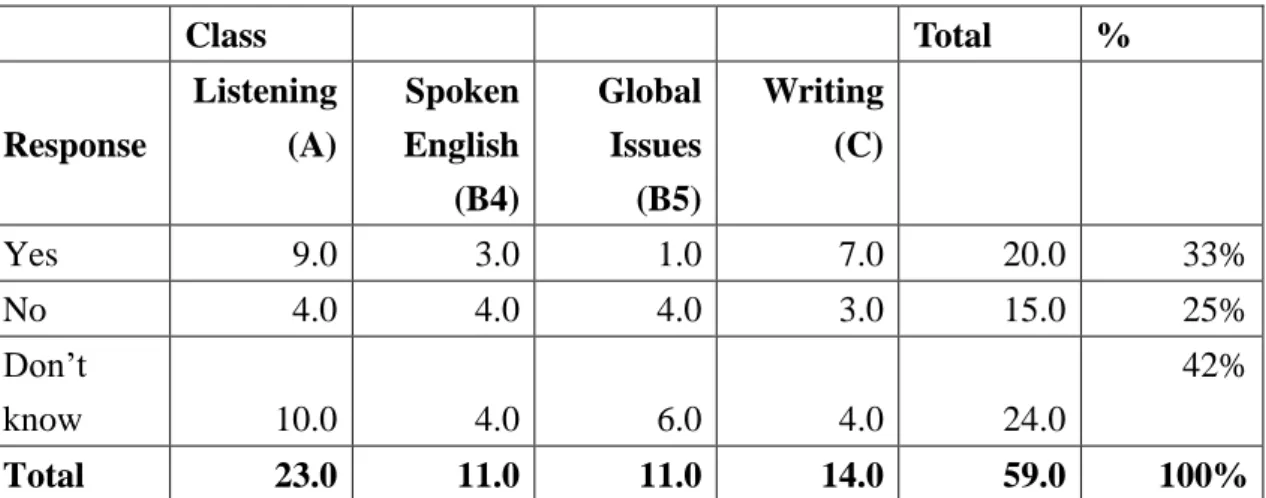
Table 5: Question 9 ~ Do you like using Moodle?
Class Total % Response Listening (A) Spoken English (B4) Global Issues (B5) Writing (C) Yes 9.0 3.0 1.0 7.0 20.0 33% No 4.0 4.0 4.0 3.0 15.0 25% Don’t know 10.0 4.0 6.0 4.0 24.0 42% Total 23.0 11.0 11.0 14.0 59.0 100%
Perhaps the most important question within the survey asked whether the students actually liked using Moodle as a learning tool and resource. On average, 33% of the students across the four classes responded that they enjoyed using Moodle, with 25% responding unfavorably, and 42% undecided. The two classes that used Moodle the most, the Writing class and Listening Class, were the most positive in their reactions, with rates of 50% and 39% respectively. These results indicate that although some students are not as positive in their views about Moodle, with familiarity and greater usage as shown by the Listening and Writing classes, they appear to become more positive in their feelings towards the application.
Question 10 ~ If you answered YES to question 8, why do you like using Moodle? Question 11 ~ If you answered NO to question 8, why don`t you like using Moodle?
Question 9 was followed by two questions asking for evaluative and free response answers as to why students either liked or didn’t like Moodle. Seventeen responses were garnered for positive reactions to Moodle including reported attributes such as
convenience, usefulness, paperless nature, and ease to submit homework.
However, seven responses were elicited from those dissatisfied, including responses such as not actually liking computers, not being able to use computers in general, and not knowing how to use Moodle. These negative views tend to relate more to users lack of skills or expertise in using both computers and software applications. These kinds of student concerns can be addressed through better awareness and instruction. No responses were made concerning motivational factors or the inconvenience or usefulness of the program.
Table 6: Question 12 ~ How useful is Moodle in your studies at Kyoai? (1= not useful, 5 useful) Class Total Value Listening (A) Spoken English (B4) Global Issues (B5) Writing (C) % 1 0 0 0 0 0.0 0.0% 2 2 3 5 2 12.0 20.3% 3 8 6 3 6 23.0 39.0% 4 5 2 2 3 12.0 20.3% 5 8 0 1 3 12.0 20.3% Total 23 11 11 14 59 100.0%
The results show that 41% of the students found Moodle useful in their studies with the highest response from the Advanced Listening class (56.5%). Only 20% of the students thought Moodle was not so useful, but no one voted it as having no value in their studies. These answers confirm that although students may have answered that they were not so keen on using Moodle, as detailed in Question 9, they indicated in these responses that they consider it useful in their studies. Again, this provides confirmation that it is more of an issue that students need more familiarity and better instruction for using Moodle.
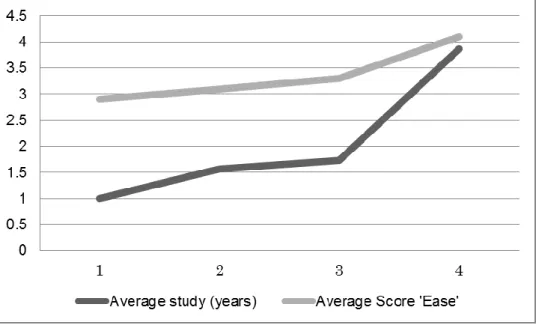
The following graph illustrates this point that, as the average length of study increases for a typical student, the higher their view that Moodle is easy to use. This boils down to exposure and familiarity with the software. Greater awareness, familiarity, and use with this medium will enable students to see its benefits more clearly and utilize the technology for their own purposes.
Figure 6: Length of study at college measured against the ‘ease’ of using Moodle.
Question 13 ~ How would you like to see Moodle used more in class?
This open ended question allowed students to detail how they wish to see Moodle used more in class. A few responses were elicited, including “Moodle is very useful, so
more classes should use it”, and “I think that it is better than papers but we need enough care”, and to perhaps a more obvious answer “I want to watch movies!” This
last response shows that at least the students are aware of the capability of presenting multi-media through Moodle, incorporating real-world elements into the classroom.
Questionnaire 2 – Advanced Listening Class Moodle Survey
This second questionnaire/Moodle survey concerned one group of the students from questionnaire one, and their reaction to a TED workshop activity held in July 2013, at the end of the first semester. It was conducted one month after the first questionnaire. This activity and subsequent Moodle survey targeted the Advanced Listening class only. Students were asked to make project groups to carry out a task relating to a listening activity. The task called for students to select an appropriate TED video, from the online ‘talk’ website TED.com, related to the theme of ‘Education’ that had been studied as part of the course textbook material. Students were able to freely choose their own groups, roles within the group and the ‘talk’ itself. Students had to select a talk from the TED website, watch and digest the talk themselves as a listening comprehension activity, then drew up comprehension questions for other students to answer as a
homework activity, posting the questions in a Moodle Workshop activity. In addition, the students needed to decide who would actually research the talk, produce the questions and answers, and upload both the link to the video/talk and the questions, either directly on to the Moodle page or by attaching a MS Word document. The participation rate for this questionnaire was 70% (21/30).
Question 1 ~ How did you find the TED workshop task? Question 2 ~ Was it easy to use Moodle as a group?
Figures 7 & 8: The complexity of the task set (Figure 7) and the complexity of group work (Figure 8).
0% 33% 52% 10% 5%
Question 1 ~
Task Complexity
1 (dfficult) 2 3 4 5 (easy) 76% 10% 14%Question 2 ~
Was it easy to use
Moodle as a group?
Yes No
The results show that students found this task much more difficult than typical Moodle tasks that they had been given before in the first semester. Overall 33% of students found it slightly difficult and 52% found it neither easier nor more difficult than previous tasks. Only 14% found it a little easier or easier than normal tasks. This question was posed in the same way to the same set of students in Questionnaire 1, detailed above, and the responses in this second questionnaire suggests that this task was harder than what the students typically encountered as a Moodle task in Semester 1. However, students responded to Question 2, that as a group it was easy to complete the task, with 76% of students positively attesting to group work for this activity
Question 3 ~ Would this task be easier or more difficult on paper? (1 less - 5 more) With an average score of 3.2, on a scale of increasing level of difficulty from 1-5, students generally supported the notion that this task would be more difficult on paper, than by Moodle and computer.
Question 4 ~ How many hours did you spend on this task? (E.g. 2 hours)
Interestingly, students stated that they had spent an average of 2.15 hours on the task on an individual basis. For a group of five members this is a cumulative ten hours of study. This would suggest that students spent much more time on the task than most other homework tasks and that perhaps group work supports greater focus and study time.
Table 6: Question 5 ~ How did you access Moodle for this task? (You can choose more than 1 answer)
Smartphone Tablet Home PC College PC Other
14 6 8 6 0
66.67% 28.57% 38.10% 28.57% 0.00%
As noted above, smartphones devices offer students instant portable access to study tasks and the associated information needed. As with the first questionnaire, 66% of the students used their smartphones principally for watching the TED video. After they used personal computers at home or in the college to complete the second part of the task, they constructed comprehension questions and uploaded these to Moodle.
Moodle?
(1= difficult, 5= easy)
Grade 1 2 3 4 5
Responses 1 3 6 2 4
% 6.25% 18.75% 37.50% 12.50% 25.00%
Note: A score of ‘0’ allowed students to indicate that they weren’t responsible for uploading their work on to Moodle, another group member was. As such, they didn’t need to answer this question.
It was observed in class during an allotted time for group collaboration work on the task, that some members found the process of navigating the Workshop tasks a little difficult, hence the 33% response rate in Question 1 that the task was a little difficult. However, peer teaching was enabled at this point as groups and individuals helped each other out. Students were very supportive of each other in this session, explaining how to utilize Moodle and actually teaching each other by using Moodle. Only 25% of the respondents to this question found the process of uploading data to the relevant Moodle activity a little difficult. This is an example of a ‘teacher’, in this case a peer, scaffolding the learning of another learner, in order to successfully complete the task. The learner will then be able to build on this new knowledge and either complete a similar task with less or no help, or help another student in subsequent activities.
Table 8: Question 7 ~ This task required Moodle. How else would you like to use Moodle more in class? (You can tick more than 1 box)
Activity Responses % Homework 15 22.4% Homework answers 12 17.9% Homework check 5 7.5% Test check 3 4.5% Lesson Notes 2 3% Quizzes 10 14.9% Assignments 4 6% Chat 1 1.5% TED/YouTube videos 3 4.5% E-mail 3 4.5% Lesson videos 5 7.5%
Lesson audio 1 1.5%
Online learning 3 4.5%
67 100%
The questionnaires were carried out within a one month period between June and July 2013. This second questionnaire shows a market positivity and awareness of Moodle within just a short time. Although students noted the subject of the second questionnaire, a presentation task, was more difficult and complex in its process of data collection, production and presentation.
Even though homework is the biggest activity for Moodle, students would still value more homework being set on Moodle. Homework is administered through Moodle at present. Students complete activities, with the answers automatically stored in a Moodle activity such as ‘quizzes’ or ‘choice’. This saves time in class for other activities, rather than plenary marking and grading. In addition, the students can complete homework early and get the results in advance. By completing homework online, students can also be safe in the knowledge that their grades are counted towards their final grades, and that illness or absence won’t affect their submission or grading. Table 9: Question 8 ~ Do you think Moodle made this task more interesting?
Positively, the students thought that using Moodle as the task platform, made it more interesting, with only one student disagreeing. About 30% of the students had no opinion either way. It’s noteworthy that students found this task more challenging
(expressed in questions 1 and 2), and time-consuming (Question 4) but that they responded to this question positively. This highlights the fact that the task was successfully pitched or scaffold, to borrow from Vygotsky and Mercer (Mercer, 2000), at an appropriate level for student development, adhering to Mercer’s claim that tasks should be aimed at the students potential, rather than actual achievements, and Vygotsky’s view that “instruction is only useful when it moves ahead of development”, drawing leaners just beyond their existing capabilities to “stretch their intellect and so help them develop” (Mercer, 2000). This was also supported by the responses to Question 11: How useful is Moodle in your studies at Kyoai? (1= not useful, 5 useful). Over 57% of the students responded graded Moodle as either 4 or 5 on the above scale, indicating that it is considered useful by the majority of the class.
In addition, students were asked in Questions 9 and 10, why they liked using or didn’t like using Moodle, respectively. Positive replies included responses such as “I
was the easiest way to upload something.”, “It is easier than writing”, and “It is easy to understand.”’. However, no negative responses were recorded, even though 33% of
students found this particular task difficult. Therefore, the wording of question 1 would be better suited to ‘challenging’ and not ‘difficult’. The questionnaire design by this author makes it apparent that labels attached to questions may be inappropriate and may unduly influence student’s responses. Such wording concerns should be noted in questionnaire designs. As a follow up, students could be asked how they perceive Moodle though a list of common adjectives, such as useful, good, bad, difficult, and challenging. The resultant selection may indicate their true feelings towards the medium being used.
Conclusion and Future Direction
Evaluating the two sets of questionnaires regarding the students perceived usage of Moodle, combined with the activity mode reports, and my own personal experience of setting up and administering the Moodle courses, the four courses have shown a general progression in complexity through the first semester and a general enhancement of empowerment from the teacher to the students. This emancipatory transfer has facilitated a positive view of Moodle and has allowed the students to gain more than just using computers, smartphones or tablet devices for information gathering or dispersal. The end of the first semester is a turning point for both students and this teacher, allowing students to progress at a faster rate in their English studies through this technology. Increased student learning will be facilitated by their positivity and new skills in using Moodle. This was most evident in the end of semester presentations made
by the B5 group, from basic instructions requiring a presentation based on one themed unit from their textbook, they were able to make PowerPoint and word presentations uploaded to Moodle. It must be remembered that this group were the least enthused by the use of Moodle in class from the questionnaire results just four weeks prior. The questionnaire was conducted before the Workshop activity, so perhaps follow up research will show that their value of Moodle for learning English and classroom related activities may have increased with the greater familiarity gained through one of the final tasks of the semester. The focus of Semester 2 and all future courses from this point on is to transfer the student’s skills to actual Moodle activities such as Wiki, Workshop and other such functions, to allow a more student-centered approach to learning. Through some basic direction by me as the teacher and self-discovery by the themselves, the students will be able to utilize Moodle activities and functions that will allow greater interactive content, facilitate the combination of activities into sequences, where results feed later activities, and use peer-review modules like Workshop, giving students more control over grading and even structuring the course in some ways.
Continuing on from this point, my Moodle incorporated syllabi will represent less a focus in presenting classroom options to learners in terms of methods, but more a focus on form, as prescribed by Long (2001). Long stresses the fact that most linguists continue to advocate teaching and testing isolated linguistic units of one kind or another, in one way or another. Thus, while process and task-based alternatives are available, the overwhelming majorities of syllabi are still structural, notional-functional or a hybrid of different methods. Often linguistics items are taught one at a time, in building block fashion, with classroom practices adopting grammar and vocabulary explanations, display questions, fill-in-the-blank exercises, dialog memorization, drills and error correction, all entailing the treatment of the language as an object, seeing language teaching and instruction as a linear, additive syllabus and methodology, or a program with no overt focus on linguistic forms at all. Similarly, Sergeant (2001) warns that often teachers take a technocentric viewpoint and assume that the minimum task imposed by the program, whether gap-filling, test reconstruction, or interacting at a basic level with a simulation, constitutes a worthwhile task. He further states that the risk of failure in setting up programs, or the complexity of programs may deter teachers from investing time and effort into their implementation. In addition, Sergeant also warns about certain factors that mitigate against the use of more time-consuming integrated activities such as simulations, which involve the class and the teacher in learning how to use a program that has less repeat value and time in terms of pre-CALL and post-CALL activities in the classroom. Also there is the need to complete the
textbook material prescribed for the lesson. There is the danger of overusing a small number of programs and requiring students to use the same program repeatedly. However, it has been seem in both the student’s perceived usage of Moodle and the actual scheduled activities and material available on Moodle that these concerns have been and will continue to be addressed. A focus on form, as outlined by Long (2001), is an important design feature for institutional methodologies and settings. Long states that rather than focusing on a method as the key to teaching and learning, we would do better to think in terms of psycholinguistically relevant design features of learning environments, from a wide range of syllabus types, methods, material, tasks and tests.
Moodle incorporated syllabi can adhere to the notion that language is a communicative or cultural tool we use for sharing, and for jointly developing knowledge, and as a psychological tool for organizing our individual thoughts, for reasoning, planning, and reviewing our actions. Tasks must give opportunities for talk, including sharing information, joint planning, presenting of ideas to the group, joint reasoning, evaluation and decision-making. Collaboration is also learning to participate, this talk cannot be separated from what is being talked about; the community of practice will have a language that reflects the domain of the practice.
At the start of this study it was important to outline the five themes that are central to the spine of this study. Following the analysis of the questionnaires and log reports, it is evident that these points have been met, but also need more focus in the future.
Theme 1 All of us are potential teachers as well as learners - in a true collaborative environment we are both. Group work, forum posts and
follow up messaging, and peer grading of tasks enabled students to collaborate with each other in the learning process. In particular the workshops created for the courses allowed students in groups to collaborate on a chosen theme and direct their own learning and presentations.
Theme 2 We learn particularly well from the act of creating or expressing something for others to see. The assigned presentations and group
work ensured that students could present their own ideas, not verbatim from the course materials. Themed units allowed students to express their own ideas within the content, but Moodle expanded their repertoire through new opportunities.
like assignment submissions and quiz attempts allowed students to get some sense that other students were active in the course, giving positive peer pressure to those who needed it. The cumulative work presented by students throughout the semester raised the bar in quality and standards, allowing those who weren’t meeting those standards to improve their own work.
Theme 4 By understanding the contexts of others, we can teach in a more transformational way. As a teacher, the log reports and forum posts
allowed me to see which students were active in the course. The depth and range to student’s posts and activity was positive in that it was seen that most students contributed to the experience. For many of these students this is their first instance to get deeply involved in such learning, so the initial first signs show a positive expectation to build on.
Theme 5 A learning environment needs to be flexible and adaptable, so that it can quickly respond to the needs of the participants within it. In the
first semester Moodle allowed for an environment which was flexible, both in time and space. The course page itself was the main tool for me as the teacher, allowing me to add/remove and structure activities as necessary. This allows course design, assignments, tasks, and materials to be tailored much faster and more appropriately than a non-Moodle system would allow.
Students are not passive receptors of information, but given the opportunity and basic skills can become active self-learners of English. Students need to be given such resources to progress at their own discretion, speed and confidence. Students who are motivated will benefit greatly from such virtual learning environments.
I believe that as students gain more expertise and confidence in using Moodle, they will be able to self-administer their own learning, taking control of the learning process. To mirror Sergeant (2001), despite a small number of negative reactions of concerns about technology in general, using computers to learn English is seen as enjoyable as well as educational. The familiarity gained within a course will allow them to refine and deepen their understanding of both the technology on hand, in this case Moodle, and the subject material in the form of course content, through not only printed materials, but more importantly through computer aided language learning. Biggs (in
Knutzen and Kennedy, 2013, p3) likens this to horizontal connections in understanding formed with other topics and subjects, and vertical connections prior and subsequent learning in the same topic. This can be at the theme level, semester level, course level and full study level.
Park (2006) notes that the dizzy speed of technological development has driven the education market to pile up a huge number of software programs without any serious methodological concern and consideration of their application. Through this study, Moodle has been seen to address these concerns, through its well-defined theoretical base in socio-linguistic theory that allows it to be centered on the student, with the inherent flexibility of the software allowing individual teachers to tailor their courses for their students, rather than following a pre-determined one-fit-for-all program. Each course can be tailored accordingly, depending on a plethora of variables that may arise before and during the course. Park also states that software programs are primarily based on the reviewers’ subjective opinions rather than on operationally defined variables that the lack of expertise in software evaluation amongst the majority of teachers results in the lack of reliability and subsequently leads evaluators to rely on their subjective set of personal rules. However, from the outset of Moodle usage, Kyoai Gakuen College set out guidelines for the structure of the English curriculum that naturally incorporates the Moodle software program. Both the English course and Moodle are grounded in socio-linguistic theory, enabling teachers to rely on a sound system of learning, which has at its root innovation, flexibility and constant attention to improvement for learning and teaching. The ease of construction of course pages and activities, allows even this teacher to successfully conduct computer aided language learning for the students.
This echoes the teaching of Vygotsky that learners can collaborate, and learn and teach from one another. As such, each learners potential for improvement, their zone of proximal development as theorized by Vygotsky, is improved greatly. Moodle has been positively adopted by the students in the study, and it has transformed the way they think, study and learn. This demonstrates that it is a powerful tool for self-development. The outcome of this is ‘deep’ learning, in that the learning gains a better understanding and comprehension of something learnt, rather than simply ‘surface’ learning of information received but not committed to memory.
The next stage in this research, taken from the notions set out by Graves (2001), is to help students conceptualize the content of their syllabi and courses because of the view that one teaches learners, not just language. This emphasis on the learner has introduced other important elements into what I, as a teacher will actually teach, the
learners effect, which includes attitudes, self-confidence, and motivation, and the learners approach to learning, which includes both understanding and developing learning skills. Markee (2001, p125) notes that the most important characteristic of emerging ‘post-communicative approaches’ is the extent to which teachers actually use new materials and approaches, and the degree to which they actually reconstruct their pedagogical values. In addition, which leaves a lasting impression on myself, Sergeant (2001, p241) quotes Paisley “an education organization is operated by the persons who are themselves the instruments of change, without their willingness and participation, there will be no change”.
Awad and Alkaraki (2013) ask the important question, “What is the role of an English teacher in the digital age?” This will form the basis of my next research connected to computer assisted language learning.
References
Asian EFL Journal (2013). Retrieved from http://asian-efl-journal.com/tech-projects/.
Awad, A.K.A., and Alkaraki, S.M.S. (2013).’ Attitudes of EFL students towards using computers in learning English. English for Specific Purposes, 13 (37), 1-20.
Graves, K. (2001). Course Development Processes. In Hall and Hewings (Eds.), Innovation in English language Teaching (pp178-196). The Open University, Oxfordshire, Routeledge
Jarvis, H. (2013). Computer Assisted Language Learning (CALL): Asian learners and users going beyond traditional frameworks. Asian EFL Journal, 15 (1) 190-201.
Jennings, S. (2007). Discussing the future of the English Course curriculum, Maebashi Kyoai Gakuen College Journal.
Knutzen, B. and Kennedy, D.M. (2013). Can Learning to Use Moodle Alter Teachers’ Approaches to Teaching? Moodle Research Library, 1-13. Retrieved from
http://research.moodle.net/mod/data/view.php?d=1&rid=102.
Long, M.H. (2001). Focus on Form: A Design Feature in Language teaching Methodology. In Candlin, C.N., and Mercer, N. (Eds.). English Language Teaching in its social context. The Open University, Oxfordshire: Routeledge
Hall and Hewings (Eds.), Innovation in English language Teaching (pp118-126). The Open University, Oxfordshire, Routeledge
McCormick, R. and Murphy, P. (2008). Curriculum: The Case For A Focus On Learning. In Murphy, P. and Hall, K. (Eds.), Learning and Practice Agency and Identities (pp3-18). Oxford: The Open University, Sage Publications
Mercer, N. (2000). Words and Minds. Oxford: Routeledge Moodle (2013a), Retrieved from https://moodle.org/about/. Moodle (2013b), Retrieved from https://moodle.org/about/.
Park, J.S. (2006). Language learning software: evaluation top down or bottom up. Retrieved from http://asian-efl-journal.com/teaching-articles. Pennington, W. (2005). Kyoai no kyoiku. Maebashi Kyoai Gakuen College Pennington, W. (2011). Using the Moodle Reader Module to facilitate an
Extensive Reading Program. Maebashi Kyoai Gakuen College
Sergeant, P. (2001). CALL innovation in the ELT curriculum. In Hall and Hewings (Eds.), Innovation in English language Teaching (pp240-252). The Open University, Oxfordshire, Routeledge
要旨 学生英語の研究における CALL の使用 (コンピュータ支援言語学習)の反応 デッドマン マーク 本研究では、英語の生徒の研究では、技術、コンピュータソフトウェアプログラム」の Moodle」の使用の増加を見た。学生は、アンケートに記入してもらった。アンケートは、 「Moodle の'を使用して彼らの経験についての質問をした。本研究では、英語の学生は、ま すます彼らの研究に新しい技術を採用していることが示されている。学生は、最初のレジ スト技術があります。しかし、露出や親しみやすさと、彼らはそのような技術に向けた陽 性の兆候を示しています。四年の学生は英語の授業での技術の使用に最も肯定的なフィー ドバックを示した。初年度の学生は、少なくとも陽性であった。しかし、アンケートでは、 学生がその利点を理解していることを明らかにした。教師はクラスでより多くの技術を使 用する必要があります。このような Moodle のようなソフトウェアは、学生が学習の新しい 方法を開発し、彼らの学習のためのより多くの責任を取ることができます。