Magnetic Properties of MnCo_{1−x}Fe_{x}Ge (x
= 0.08, 0.12)
journal or
publication title
Reports of the Faculty of Science, Kagoshima
University
volume
49
page range
11-15
year
2016-12-30
Magnetic Properties of MnCo
1−xFexGe (x = 0.08, 0.12)
Masahira ONOUE1), Kosuke OZONO1), Yoshifuru MITSUI1), Masahiko HIROI1),
Rie Y UMETSU2), Yoshiya UWATOKO3), Keiichi KOYAMA1),*
Abstract:
Magnetization and Mössbauer spectroscopy measurements were performed for MnCo1−xFexGe (x = 0.08, 0.12) to clarify
its fundamental properties of the magnetism. The magnetic moments m for x = 0.08 was estimated to be 3.70 µB/f.u. at 10 K. The compound showed a first-order magnetic transition (FOMT) from the martensitic phase with high magnetic moment to the parent phase with low magnetic moment in the vicinity of Tt = 275 K with increasing temperature under magnetic field of μ0H = 1 T. From Mössbauer measurement for x = 0.12, the valence of Fe atom was found to be Fe2+. The obtained results were discussed on the basis of the mean-field calculation for the parent and martensitic phases.
Keywords: Magnetism in Solids, mean-field calculation, first order transition, Mössbauer effect
1. Introduction
Ferromagnetic MnCoGe-based compounds are magnetic functional materials which show the magnetic-field-induced martensitic transition. When the first order magnetic transition (FOMT) was accompanied by the martensitic transition, the magnetovolume and magnetocaloric effects were observed.1–3) MnCoGe-based compound exhibits a martensitic
transformation from a hexagonal Ni2In-type (P-phase) to orthorhombic TiNiSi-type structure (M-phase). The martensitic
transition temperature TM is extremely sensitive to the stoichiometly of MnCoGe4). It has been reported that the Curie
tempeature TC and TM of the MnCoGe-based compounds were controlled by substitution of Al5) or V6) for Co,
off-stoichiometric composition1,7,8), interstitially modified9) and external pressure7).
Recently, it was reported that TM and TC decreased by a small amount of iron substitution for Co in MnCoGe10–12).
MnCo0.94Fe0.06Ge showed a FOMT at T ~ 275 K10). The FOMT is accompanied by large entropy change ΔS of −27.5 J
kg−1 K−110). By the Mössbauer measurement, it was revealed that substituted iron atoms prefer to occupy Co site to Mn
site11). Ozono et al. reported that the FOMT of MnCo
1-xFexGe occurs simultaneously with the martensitic transformation for 0.08 ≤ x ≤ 0.09 in the vicinity of room temperature12).
In this study, we performed magnetization and Mössbauer spectroscopy for MnCo1−xFexGe (x = 0.08, 0.12) measurements in order to understand the magnetic properties.
2. Experimental
Polycrystalline MnCo1−xFexGe (x = 0.08, 0.12) compounds were prepared by arc-melting the pure consistent elements (Mn, 3N; Co, 3N; Fe, 4N; Ge, 5N) in an argon atmosphere. The obtained button shaped sample was sealed in an evacuated quartz tube, and was then heat treated at 1123 K for 120 h for homogenization. After the heat treatment, the sample was slowly cooled to room temperature (RT) for 10 h. The quality of the sample was examined by X-ray powder diffraction (XRD) measurements at RT. Magnetization measurements were performed using a superconducting quantum interference device magnetometer (Quantum Design) at 10 –390 K and magnetic field µ0H up to 5 T.
57Fe Mössbauer spectroscopy measurements were performed using a triangular wave drive motion of 57Co resonance
1) Graduate School of Science and Engineering, Kagoshima University, Kagoshima 890-0065, Japan
2) Institute for Materials Research, Tohoku University, Sendai, 980-8577, Japan 3) Institute for Solid State Physics, The University of Tokyo, Kashiwa 277-8581, Japan * Corresponding author:
鹿児島大学大学院理工学研究科 物理・宇宙専攻 小山佳一 〒890-0065 鹿児島県鹿児島市郡元2丁目21-35
12 Masahira ONOUE, Kosuke OZONO, Yoshifuru MITSUI, Masahiko HIROI, Rie Y UMETSU, Yoshiya UWATOKO, Keiichi KOYAMA source at 290 K. The velocity scale was calibrated by α-Fe, which is hyperfine magnetic field (Hhf) = 33.1 T, and the
offset value of the isomer shift (IS) = 0.07 mm/sec. The Mössbauer spectra were analyzed by least-squares method using the hyperfine parameters.
3. Results and discussion
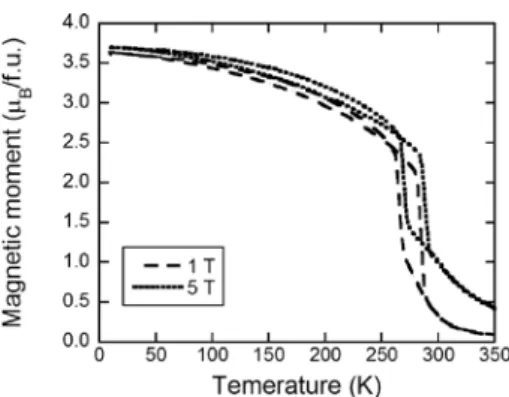
Fig. 1 shows the temperature T dependence of the magnetic moment m (m-T curve) of MnCo0.92Fe0.08Ge under
magnetic fields of µ0H = 1 T and 5 T. The FOMT was observed between 250 K and 300 K. The transition temperature
was determined to be Tt = 275 K for µ0H = 1 T, which increases with increasing H. The magnetic moment m was
determined to be 3.70 µB/f.u. at 10 K for µ0H = 5 T, which is consistent with the results of neutron diffraction experiments
(2.8 µB/Mn and 1.0 µB/Co)13) and electronic structure calculations (2.98 µB/Mn and 0.78 µB/Co)14) for the martensitic
phase (M-phase) of MnCoGe.
Fig. 1. Temperature dependence of the magnetic moment of MnCo0.92Fe0.08Ge under magnetic fields of µ0H = 1 T (broken line) and 5 T (dotted line).
In order to understand the observed FOMT, we calculated the temperature dependence of the magnetic moment m in various magnetic fields on the basis of a simple mean-field model for the P-phase with low magnetic moment and M-phase with a high magnetic moment. Here, we assumed that the orbital angular momentum was quenched, and m originated from the thermal average of the total spin angular momentum S of the magnetic atoms. In this model, m(T,H) at temperature T and applied magnetic field H was expressed as follow:
m(T, H) = 2S µBBJ(α), (1)
where
α = 2S µB(λNm + µ0H)
kBT , (2)
and N is the number of magnetic atoms per unit volume, BJ(α) the Brillouin function, λ the molecular field constant,
and kB the Boltzmann constant15). For P- and M-phases, m of MnCoGe was reported to be 2.92 µB/f.u. and 3.76 µB/f.u,
respectively14). In this study, therefore, the calculation was performed by using the parameter of S = 3/2 for the P-phase
and S = 2 for the M-phase.
Fig. 2 shows the temperature dependence of the reduced magnetic moment m(T)/m(0) for the calculated magnetic moments of the M-phase, mM(T), and P-phase, mP(T), for µ0H = 1 T (a) and for 5 T (b). Here, the calculated m(T)/m(0)
of the M-phase and P-phase is normalized by the value of mM(T) at 10 K, mM(10K). The experimental data deduced
from Fig. 1 are also presented. In this calculation, using the parameters λ = 177 K for M-phase and λ = 220 K for
that the FOMT of MnCo0.92Fe0.08Ge is the transformation between the M-phase with high m and high TC, and the P-phase
with low m and low TC.
Fig. 2. Temperature dependence of the reduced magnetic moment m(T)/m(0) for the calculated magnetic moments of the M-phase,
mM(T), P-phase, mP(T), and the experimental data (Fig. 1) for µ0H = 1 T (a) and for 5 T (b). The calculated m(T)/m(0) of the M-phase and P-phase is normalized by the value of mM(T) at 10 K. Solid curves and broken (or dotted) curves indicates the calculated and experimental curves, respectively.
The magnetic entropy change ΔSm during FOMT was estimated from the temperature dependence of the magnetization
M (M-T curves) of MnCo0.92Fe0.08Ge through the Maxwell relation,
∆Sm= H 0 δM δT HdH. (3)
Fig. 3 shows the magnetic entropy change ΔSm vs. temperature curves. Here, ΔSm was evaluated using the M-T data
under a magnetic field µ0H from 0.5 T to 5 T for the 0.5 T/step. The inset of Fig. 3 shows the M-T curves for various
magnetic field of 1 ≤ µ0H ≤ 5 T in the vicinity of Tt. The estimated ΔSm was −14 Jkg−1K−1 at 5 T, which was lower than
the other Fe-substituted MnCoGe system for ΔSm = −27.5 Jkg−1K−1 at 5 T10).
Fig. 3. Magnetic entropy change ΔSm vs. temperature curves. Here, ΔSm was evaluated using the M-T data as shown in the inset.
In order to estimate the contribution of ΔSm at Tt, we calculated the magnetic free energy on the basis of the simple
mean field model. The magnetic free energy per molecule F of the system is expressed by
F = kBT1nZ − m(λNm + µ0H), (4)
14 Masahira ONOUE, Kosuke OZONO, Yoshifuru MITSUI, Masahiko HIROI, Rie Y UMETSU, Yoshiya UWATOKO, Keiichi KOYAMA Z = Trexp −2µ BS (λNm + µ0H) kBT . (5)
The free energy F and the magnetic entropy Sm (= −ΔF/ΔT) were calculated by eqs. (4) and (5). Fig.5 shows the
temperature dependence of the calculated Sm of M-phase and P-phase. The maximum ΔSm was estimated to be −8.6
Jkg−1K−1 at 264 K for 5 T, which is approximately 61% of the experimental value (−14 Jkg−1K−1) MnCo
0.92Fe0.08Ge
exhibits the large volume change of 4.1% at Tt12). These results indicate that the contribution of the magnetic entropy
change to the total entropy change is smaller than the entropy change due to the structural transition.
Fig. 4. Temperature dependence of the calculated Sm of M-phase and P-phase The maximum ΔSm from the M- to P-phase was estimated to be −8.6 Jkg−1K−1 at 264 K.
Fig. 5 shows Mössbauer spectrum of MnCo0.88Fe0.12Ge at 290 K. The crystal structure of MnCo0.88Fe0.12Ge was
hexagonal (P-phase), and the Curie temperature was 275 K12). Assuming that Fe atoms occupy 69% in Co-site and 31%
in Mn-site in the hexagonal structure (P-phase), the experimental spectrum was represented well by the calculation. The previous report of Mössbauer spectroscopy for MnCo0.96Fe0.04Ge showed that Fe atoms occupy 80% in Co-site and
20% in Mn-site in the orthorhombic structure (M-phase)11). Our result for the hexagonal structure is consistent with the
previous report for the orthorhombic structure. The isomer shift (IS) and the quadrupole splitting (QS) for hexagonal MnCo0.88Fe0.12Ge were evaluated to be IS = 0.12 mm/s and QS = 0.82 mm/s of Co-Site, and IS =0.25 mm/s and QS =
0.91 mm/s of Mn-Site, respectively. The obtained results suggested that Fe2+ ions with S = 0 state (low spin state) exist
in MnCo1−xFexGe compound with the hexagonal P-phase.
4. Conclusion
Magnetic properties of MnCo1−xFexGe (x = 0.08, 0.12) were investigated. MnCo0.92Fe0.08Ge exhibited a first order
magnetic transition (FOMT) in the vicinity of 275 K. In order to understand the FOMT, the magnetizations for the P- and M-phases were calculated by a simple mean-field theory. The calculated magnetizations indicated that the FOMT is due to the transformation between the P-phase with small m and low TC, and the M-phases with large m and high
TC. The magnetic entropy change of the FOMT was estimated to be −14 Jkg−1K−1. From Mössbauer spectroscopy for
MnCo0.88Fe0.12Ge (P-phase) suggested that Fe atoms occupy 69% in Co-site and 31% in Mn-site in the hexagonal
structure, and Fe2+ atoms with S = 0 state existed in the compound.
Acknowledgments
The magnetization measurements were carried out at the Institute for Solid State Physics, the University of Tokyo. The Mössbauer spectroscopy experiments were performed at Division of Isotope Science, Natural Science Centre for Research and Education, Kagoshima University. This work was supported in part by the KAKENHI 16H04547 and 16K14374.
REFERENCES
1) K. Koyama, M. Sakai, T. Kanomata, K. Watanabe: J. Appl. Phys. 43 (2004) 8036-8039.
2) J.T. Wang, D.S. Wang, C.F. Chen, O. Nashima, T. Kanomata, H. Mizuseki, Y. Kawazoe: Appl. Phys. Lett. 89 (2006) 262504.
3) E.K. Liu, W. Zhu, L. Feng, J.L. Chen, W.H. Wang, G.H. Wu, H.Y. Liu, F.B. Meng, H.Z. Luo, Y.X. Li: EPL. 91 (2010) 17003.
4) Johnson V: Inorg. Chem. 14 (1975) 1117–1120.
5) W. Zhang, O. Tegus, Y. Wu, Yirgeltu, H. Yan, S. Lin: J. Mater. Sci. Technol. 25 (2009) 781–784. 6) G.H. Meng, O. Tegus, W.G. Zhang, L. Song, J.L. Huang: J. Alloy. Compd. 497 (2010) 14–16.
7) T. Kanomata, H. Ishigaki, T. Suzuki, H. Yoshida, S. Abe, T. Kaneko: J. Magn. Magn. Mater. 140-144 (1995) 131–132.
8) P.E. Markin, N.V. Mushnikov, E.G. Gerasimov, A.V. Proshkin, A.S. Volegov: Phys. Metals. Metallogr. 114 (2013) 893–903.
9) N.T. Trung, L. Zhang, L. Caron, K.H.J. Buschow, E. Brück: Appl. Phys. Lett. 96 (2010) 172504.
10) G.J. Li, E.K. Liu, H.G. Zhang, Y.J. Zhang, J.L. Chen, W.H. Wang, H.W. Zhang, G.H. Wu, S.Y. Yu: J. Magn. Magn. Mater. 332 (2013) 146–150.
11) Q.Y. Ren, W.D. Hutchison, J.L. Wang, R. Cobas, J.M. Cadogan, S.J. Campbell: Hyperfine Interact. 231 (2015) 75–84.
12) K. Ozono, Y. Mitsui, M. Hiroi, R.Y. Umetsu, K. Takahashi, K. Matsubayashi, Y. Uwatoko, K. Koyama: Mater. Trans. 57 (2016) 316–320.
13) S. Niziol, A. Bombik, W. Bazela, A. Szytula, D. Fruchart: J. Magn. Magn. Mater. 27 (1982) 281–292. 14) S. Kaprzyk, S. Niziol: J. Magn. Magn. Mater. 87 (1990) 267–275.