Ilistaya 1 sites in the Russian Far East
著者
Anatoly M.Kuznetsov, Kanomata Yoshitaka, Aoki
Yosuke
journal or
publication title
Bulletin of the Tohoku University Museum
volume
19
page range
51-81
year
2020-03
Use-wear analysis at the Gorbatka 3 and Ilistaya 1 sites in
the Russian Far East
Anatoly M. Kuznetsov
1), Yoshitaka Kanomata
2)*and Yosuke Aoki
2)1) Far Eastern Federal University 2) Tohoku University
* corresponding author
Abstract: This paper aims at understanding not only the technologies and functions of lithic tools but also site function at the Gorbatka 3 and Ilistaya 1 sites. One of the goals of our research is the comparative evaluation of technology and function in the microblade industries between the Russian Far East and the Japanese archipelago.
Regarding site functions, the use of end scrapers distinguishes these two sites. There were more than twice the number of end scrapers at Gorbatka 3 than at the Ilistaya 1 site. In addition, 60% of the end scrapers were utilized for hide scraping at Gorbatka 3, although 5.4% of end scrapers had use-wear at the Ilistaya 1 site. Therefore, the hide scraping needed for longer stable settlements was chiefly carried out at the Gorbatka 3 site. Ten times more boat-shaped tools were discovered at Gorbatka 3 than at Ilistaya 1. They may be used as blanks for end scrapers in some cases. In lithic assemblage, bipolar cores and microblade spalls were mainly excavated from the Ilistaya 1 site, not from Gorbatka 3. These differences characterize the site functions of the sites. Burins were commonly used for bone/antler planing/whittling at both sites. Microblade removal and bone/antler tool manufacture coexisted because of composite tool production. This activity was organized as a basic component in their subsistence technology and hunting strategy.
1. Introduction
The Gorbatka 3 and Ilistaya 1 sites in the Maritime region were discovered by one of the authors, Anatoly Kuznetsov, in 1977 (Kuznetsov 1992, 1996). These sites were excavated in 1970s and 1980s. The Final Palaeolithic artefacts were discovered at the Gorbatka 3 site in 1979,’82, ’85, and ’86, and at the Ilistaya 1 site in 1978, ’87, ’88, and ’89. The Gorbatka 3 site was re-excavated in 2003 but the materials in 2003 were out of our research scope in this paper.
From 19 April to 29 May 2019, use–wear research of lithic artefacts at the Gorbatka 3 and Ilistaya 1 sites was carried out by the second author (Kanomata), who studied many microblade industries in Japan from the viewpoint of lithic function. Technological analysis was also practiced by the third author (Aoki), who is studying microblade technologies in the northeastern region of the Japanese archipelago. Therefore, one of the goals of our research is the comparative evaluation of technology and function in the microblade industries between the Russian Far East and the Japanese archipelago. In addition, the present
paper aims at understanding not only the technologies and functions of lithic tools but also site function at these sites. A traceological approach is very useful for getting information about what has happened at the site.
2. Experimental archaeology on local raw materials
in the Russian Far East
Concerning the use–wear analysis, there is a problem to face in this region because of absence of basic experimental data. Since the main raw material here was local siliceous tuff, which has several characteristics that are different from siliceous shale in the Japanese Islands, it is probable that use–wear traces on siliceous tuff also has characteristics different from those on siliceous shale. Therefore, one of the authors (Kanomata) carried out experiments about use wear on local raw materials in the Russian Far East. Green and white siliceous tuff cobbles were collected from the riverbed near Ustinovka sites on 18 May 2019. After that, replicated lithic tools were manufactured at Far Eastern Federal University, and use experiments were conducted from 20–28 May 2019. Shell, antler, cowhide, reed grass, wood,
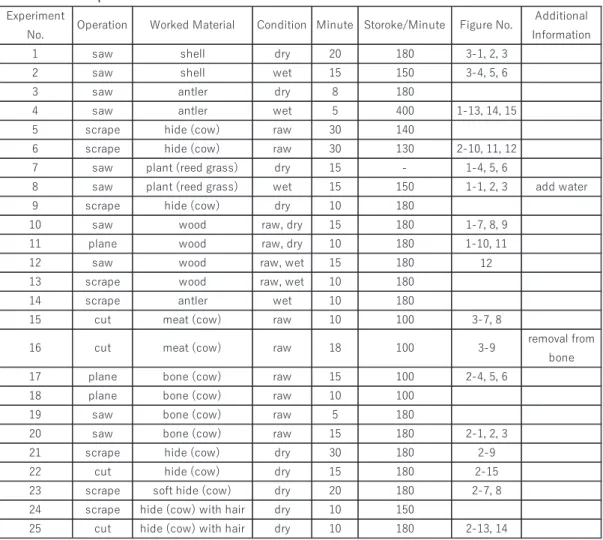
cow meat, and cow bone were selected as object materials. Twenty-five lithic tools were selected for these experiments. The results of experiments were summed up in Table 1 and Figures 1-3.
So-called ‘corn gloss’ was observed on an experimental flake, which was utilized to saw reed grass in a wet condition (Figs. 1-1 to 1-3). This polish is very bright, smooth, and shiny. It is accompanied with numerous dark pits and filled-in striations that show the direction of operation. In a dry condition, the use polish is not developed, as shown in photos (Figs. 1-4 to 1-6).
Wood polishes were caused by several wood operations. This polish is bright and smooth. Inner and outer contrasts are as high as corn gloss. The shape of the polish looks domed. In the case of sawing, parallel striations were limitedly recognized, and the polish development area connects the parallel zone to the use edge (Figs. 1-7 to 1-9). In contrast, the planing operation produced the same type of polish with vertical striations. It is situated near the edge (Figs. 1-10 to 1-12).
Bone and antler workings often produce similar types of polish. Antler sawing in wet conditions produced polish that is a little darker and rougher than corn gloss (Figs. 1-13 to 1-15). So inner and outer contrast are not so high as corn gloss. Raw bone sawing caused rugged polish with parallel striations (Figs. 2-1 to 2-3). Planing activity produced the same polish, accompanied by vertical striations (Figs. 2-4 to 2-6).
Dry hide scraping produced a rugged surface and round edges with vertical striations (Figs. 2-7 to 2-9). In contrast, the same activity in rawhide caused a less round edge and a darker polish (Figs. 2-10 to 2-12). It is characterized as dull, low contrast, greasy, and lustrous. Cutting dry hide made a similar polish with parallel striations (Figs. 2-13 to 2-15).
Dry shell sawing produced a flatter and higher contrast polish with a severely high density of striations (Figs. 3-1 to 3-3). In wet condition, the same activity made a similar polish (Figs. 3-4 to 3- 6).
Cutting raw meat caused the dullest polish (Figs. 3-7 to 3-9). Inner and outer contrasts are small, and striations are
Experiment
No. Operation Worked Material Condition Minute Storoke/Minute Figure No.
Additional Information 1 saw shell dry 20 180 3-1, 2, 3
2 saw shell wet 15 150 3-4, 5, 6 3 saw antler dry 8 180
4 saw antler wet 5 400 1-13, 14, 15 5 scrape hide (cow) raw 30 140
6 scrape hide (cow) raw 30 130 2-10, 11, 12 7 saw plant (reed grass) dry 15 - 1-4, 5, 6
8 saw plant (reed grass) wet 15 150 1-1, 2, 3 add water 9 scrape hide (cow) dry 10 180
10 saw wood raw, dry 15 180 1-7, 8, 9 11 plane wood raw, dry 10 180
12 saw wood raw, wet 15 180 13 scrape wood raw, wet 10 180 14 scrape antler wet 10 180
15 cut meat (cow) raw 10 100 3-7, 8
16 cut meat (cow) raw 18 100 3-9 removal from bone 17 plane bone (cow) raw 15 100 2-4, 5, 6
18 plane bone (cow) raw 10 100 19 saw bone (cow) raw 5 180
20 saw bone (cow) raw 15 180 2-1, 2, 3 21 scrape hide (cow) dry 30 180 2-9 22 cut hide (cow) dry 15 180 2-15 23 scrape soft hide (cow) dry 20 180 2-7, 8 24 scrape hide (cow) with hair dry 10 150
25 cut hide (cow) with hair dry 10 180 2-13, 14
Table 1 List of experiments
12 1-10, 11
1 wet plant, saw, 15min., 200x 2 wet plant, saw, 15min., 200x 3 wet plant, saw, 15min., 200x
4 dry plant, saw, 15min., 200x 5 dry plant, saw, 15min., 200x 6 dry plant, saw, 15min., 200x
7 raw wood, saw, 15min., 200x 8 raw wood, saw, 15min., 200x 9 raw wood, saw, 15min., 200x
10 raw wood, plane, 10min., 400x 11 raw wood, plane, 10min., 200x 12 raw wood, saw, 15min., 200x
13 wet antler, saw, 5min., 200x 14 wet antler, saw, 5min., 200x 15 wet antler, saw, 5min., 200x
Fig.1 Use-wear polishes on experimental lithic tools.
1 raw bone, saw, 15min., 200x 2 raw bone, saw, 15min., 400x 3 raw bone, saw, 15min., 200x
4 raw bone, plane, 15min., 200x 5 raw bone, plane, 15min., 200x 6 raw bone, plane, 15min., 200x
7 dry hide, scrape, 20min., 200x 8 dry hide, scrape, 20min., 200x 9 dry hide, scrape, 30min., 200x
10 raw hide, scrape, 30min., 200x 11 raw hide, scrape, 30min., 200x 12 raw hide, scrape, 30min., 200x
13 dry hide, cut, 10min., 200x 14 dry hide, cut, 10min., 200x 15 dry hide, cut, 15min., 200x
Fig.2 Use-wear polishes on experimental lithic tools.
not clear.
As a result, use polish on siliceous tuff formed in a few minutes with more than one hundred strokes per minute. Though characteristics of use–wear polishes on siliceous tuff are basically the same as those on siliceous shale in Japan (Akoshima & Hong 2017, 2018 etc.), they are somewhat flatter and smoother than polishes on shale. Since these differences are so small, the author could apply the method of use–wear analysis in Japan.
3. Outline of the Gorbatka 3 and Ilistaya 1 sites
These sites are located on the terrace-like surfaces of the left bank of the Gorbatka River in the Russian Far East (Fig. 4). Stratigraphy in the Ilistaya River area is basically composed of light loam (whitish-greyish-yellow in color, 8 to 30 cm thick) in the upper layer and heavy loam (brownish-blackish, 80 cm thick) in the lower layer. The most complete stratigraphic sequence was discovered in a central part ofthe Gorbatka 3 site. Because water-worn artefacts were found at the Gorbatka 3 and Ilistaya 1 sites in the same stratigraphy position, a kind of water effect was caused in these sites. For example, stratigraphy at the Gorbatka 3 site is composed of a first layer (humus, 8–15 cm thick, without cultural remains), a second layer (greyish-white light loam, 10–25 cm thick, with numerous Palaeolithic artefacts and a number of pot sherds of the Bronze and early Iron Ages), a third layer (brown, brown-black, red-brown, and black heavy loams, 80 cm thick, with Palaeolithic artefacts), a fourth layer (yellow loam, 40–60 cm thick, without cultural remains), and a fifth layer (detritus mantle–basalt bedrock). The excavated area at the Gorbatka 3 site was 400 m2 in total. In addition,
Palaeolithic artefacts were contained in the second layer and in ice-wedge deposits that crushed the upper part of the heavy loam unit of the excavated area of 400m2 at the
Gorbatka 3 site.
Several radiocarbon ages were proposed in these sites. The 14C date of the charcoal from light loam at Gorbatka
1 dry shell, saw, 20min., 200x 2 dry shell, saw, 20min., 400x 3 wet shell, saw, 15min., 200x
4 wet shell, saw, 15min., 200x 5 wet shell, saw, 15min., 200x 6 dry antler, saw, 8min., 200x
7 raw meat cut, 10min., 200x 8 raw meat cut, 10min., 200x 9 raw meat cut, 18min., 200x
3 is 2,590 ±85 BP (SOAN-1921), and the 14C date from
the bottom of the dark heavy loam unit is 13,500 ±200 BP (SOAN-1922). In addition, the 14C date from the light loam
at the Ilistaya 1 site is 7,840 ±60 BP (Ki-3163). Therefore, the chronological position of lithic materials from these sites would be between 7,840 ±60 and 13,500 ±200 BP, which ranges from the end of Pleistocene to the early Holocene.
Basic lithic assemblage was reported in an earlier article (Kuznetsov 1996). The number of total materials in the upper layer of the Gorbatka 3 site is 38,272, and 84% of the total are flakes. The total number of the lower layer of the Gorbatka 3 site is 6,238, and flakes occupied 77% of the total. Lithic artefacts from the Ilistaya 1 site is 24,781, and flakes occupied 87% of the total. In addition, there were numerous blade cores and bipolar cores in these sites. These lithic assemblages simply represent that these sites were formed as lithic manufacture workshops. There was no organic material in these sites except for some charcoal. Therefore, it is impossible to reconstruct the utilization of animal and botanical resources at the site.
4. Research objects
The first aim of our research is to understand the actual functions of lithic tools, especially burins and end scrapers, at the Gorbatka 3 and Ilistaya 1 sites by the practice of use–wear analysis. In these sites, the classification of items between microblade core, burin, and end scraper is occasionally confused because simplified microblade removal technologies were carried out to cope with the
unsuitable size and form of their blanks, which were sometimes produced from a bipolar manufacture sequence. In addition, the so-called “Togeshita-type” microblade core and burin, the “Horoka-type” microblade core, the boat-shaped tool, and the end scraper have similar technological sequences in some cases. Therefore, the precise classification of tool types needs to be constructed not only from a technological perspective but also from a functional aspect through microscopic observation. Concerned to raw materials, silicified tuff, rhyolite, obsidian, chert, and jasper were utilized in these sites. There was no local raw material in these areas. Obsidian sources were in the upper part of the Ilistaya River valley. The relationships between raw materials and lithic assemblages represent their foraging strategies and raw material exploitations. Since the size and quality must have influenced lithic manufacture technologies, each manufacturing sequence must be understood according to differences in raw materials. Finally, the authors propose a new insight to evaluate the chronological position of the microblade industry in the Primorye region from the perspective of Northeast Asia, including northern China and the Japanese archipelago.
5. Research procedure
The objects of this study are materials from the Gorbatka 3 and Ilistaya 1 sites excavated from 1978 to 1989. Chief artefacts except for flakes and irregular cores were selected by the previous studies. At the first step of our research, we counted the number of stone tools in each box according to
Fig.4 Map of the Gorbatka 3 and Ilistaya 1 sites
▲▲
Gorbatka 3 Ilistaya 1
Vladivostok
Tool type Bipolar core End scraperBlade Boat shaped tool Micro blade core Side
scraperCore Burin Flake Biface Cobble Retou ched blade Retou ched flake Micro blade end/side scraper Microbl ade core preform Bifaci al point Bifac ial knife Bifac ial tool Ski spall Total Number 321 180 173 168 84 64 59 45 26 13 9 9 7 5 3 3 2 1 1 1 1174
Table 2 Lithic assemblage at the Gorbatka 3 site
Table 3 Use wear of lithic tools at the Gorbatka 3 site
Tool type Artifact
no. Raw material
Location of facet
independent
use zone Polish Striation Microfl
aking Use
degree Figure
69 obsidian left(u&l) burin facet - vertical - heavy 6-5,6,7
302 green
siiceous tuff left(u&l) - - - 5-1
307 chert left and right burin facet - - + -
-328 chert left and right left facet bone/
antler vertical - light 5-2,3,4
366 obsidian left burin facet - vertical - light 6-1,2
1105 obsidian left burin facet - vertical - light 5-7,8,9,10
1182 obsidian left burin facet - vertical - - 6-8
1194 obsidian left burin facet - vertical + light 6-3,4
1977 obsidian left burin facet - vertical - light 7-1
3646 green
siliceous tuff left burin facet bone/an
tler vertical - light 7-4,5
B1-1-6 obsidian left - - -
-B1-1-18 obsidian left burin facet - vertical - heavy 6-9,10,11
B1-1-29 chert
left(right-small) - - -
-B1-1-34 obsidian left - - -
-B1-1-55 siliceous tuff left burin facet ?
parallel & vertical
- light 7-2,3
113 agate - scraper edge ?hide vertical - light 8-4,5,6,7
139 green
siiceous tuff - scraper edge ?hide vertical - light 10-9,10
211 obsidian - scraper edge ? vertical - light 10-3,4
323 chert - scraper edge dry hide vertical - heavy 8-8,9,10,11,12
426 chert left and right scraper edge dry hide vertical - heavy 7-6,7,8
431 chalsedony - scraper edge ? vertical - light
-1220 obsidian - scraper edge dry hide vertical - heavy 9-5,6,7
1642 obsidian - scraper edge wood vertical - light 9-8,9
3644 siliceous tuff - scraper edge dry hide vertical - heavy 10-7,8
B5-2-1 chert - scraper edge hide vertical - light 7-9,10,11
B5-2-2 chert - scraper edge dry hide vertical - heavy 8-1,2,3
B5-2-9 chert - scraper edge dry hide vertical + heavy 9-1,2,3,4
B5-2-42 obsidian - scraper edge ? vertical - light 9-10,11
B5-2-44 obsidian - scraper edge ? vertical - light 10-1,2
B5-2-65 obsidian - scraper edge ? vertical - light 10-5,6
3605 green
siiceous tuff right - - -
-B1-1-1 obsidian right - - - 5-5,6
B1-1-2 obsidian left and right left facet - vertical - light
-end scraper
microblade core burin
raw material and tool type (Tables 2 and 4), and took photos of all the materials.
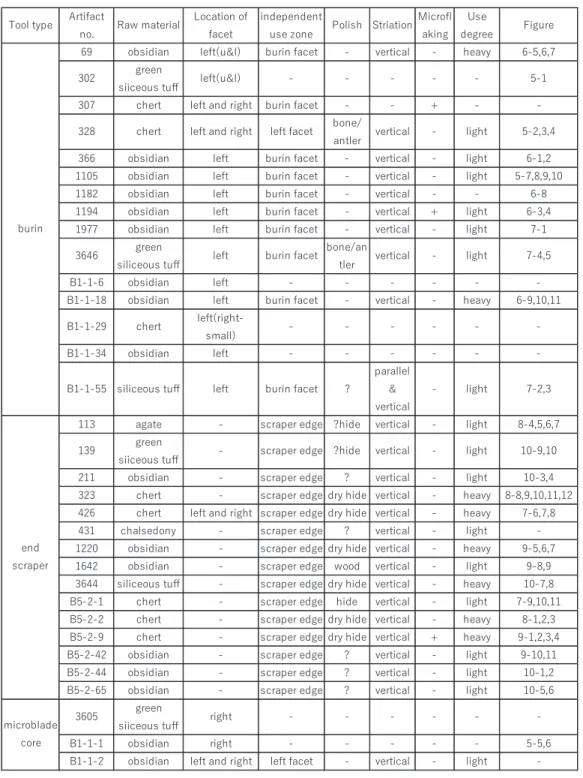
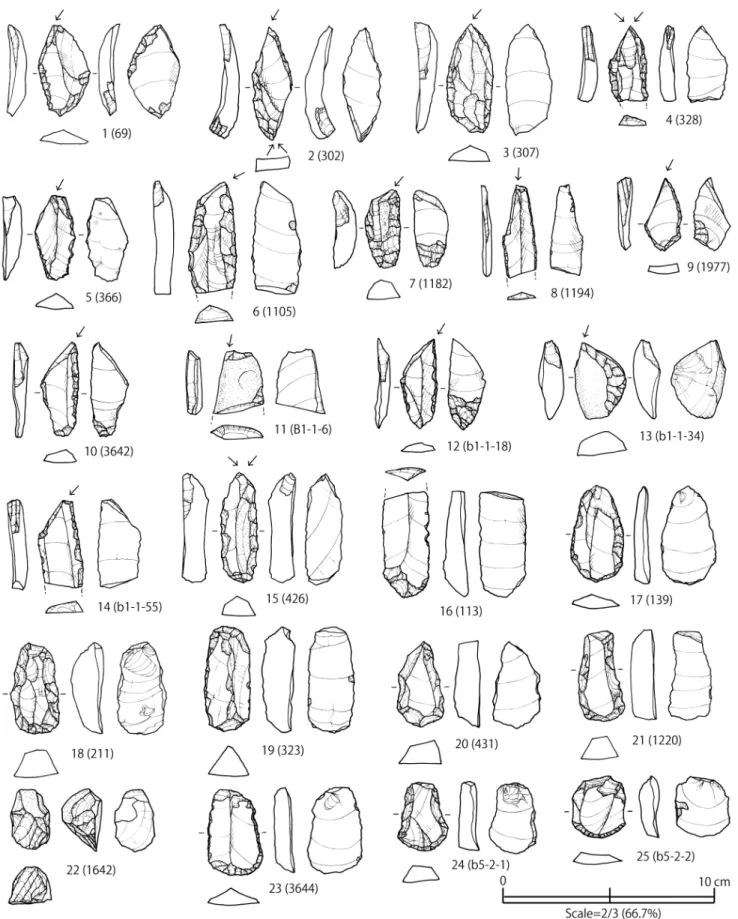
Then, lithic artefacts were selected for technological and use–wear analyses. Microblade technologies were grasped objectively by one of the authors (Aoki). A functional analysis of lithic tools was conducted by another author (Kanomata) with a metallurgical microscope (Olympus BHM). The result is summed up in Tables 3 and 5. We also made drawings of lithic artefacts needed for the analyses (Figs. 17 to 20).
6. Analyses at the Gorbatka 3 site
a. Technological analysis
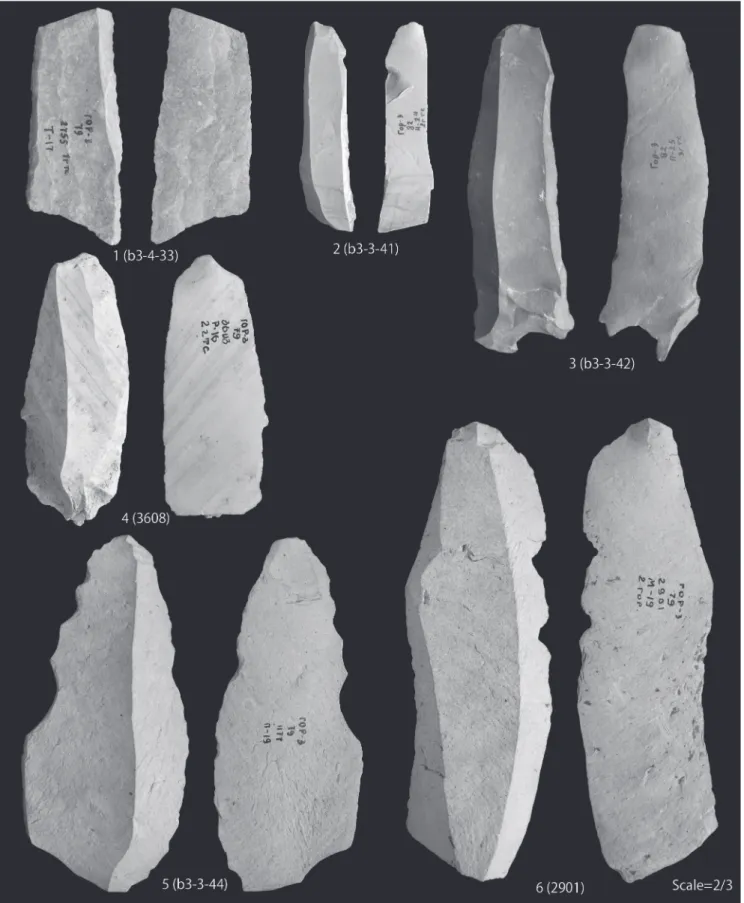
In total, 1,174 lithic materials were selected from the Gorbatka 3 site for this study. The assemblage of selected materials at Gorbatka 3 is as follows (Table 2): bifacial tools (N=17), bipolar cores (321), microblade cores (84), microblade core preforms (3), blades (173), microblades (5), boat-shaped tools (168), burins (45), cores (59), end-scrapers (180), end/side end-scrapers (3), side end-scrapers (64), flakes (26), cobbles (9), retouched blades (9), retouched flakes (7), and a ski spall (1).
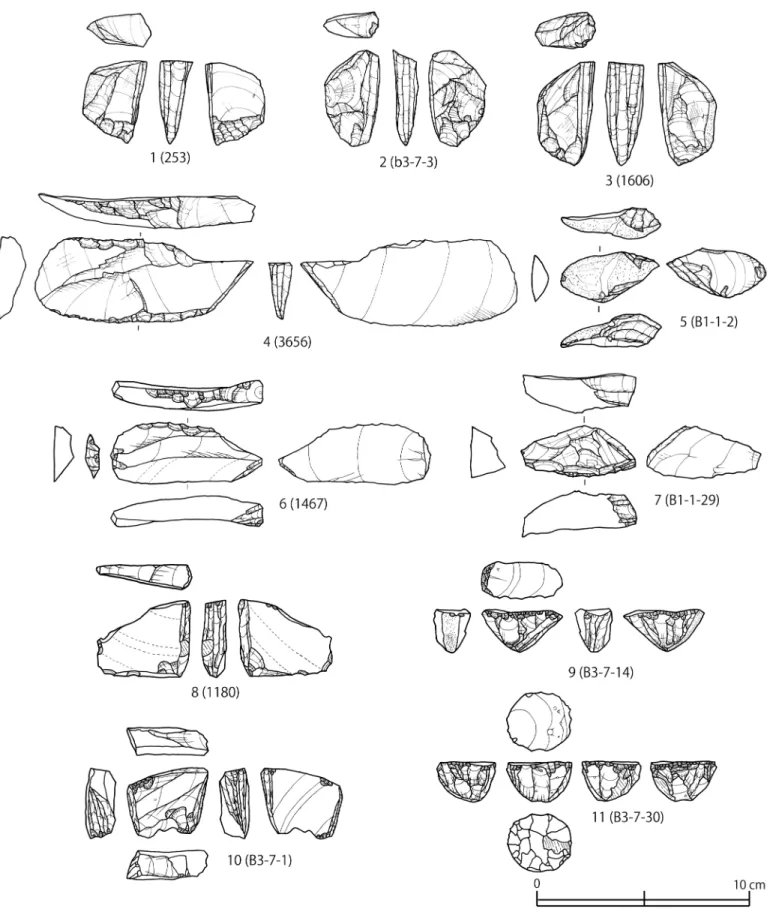
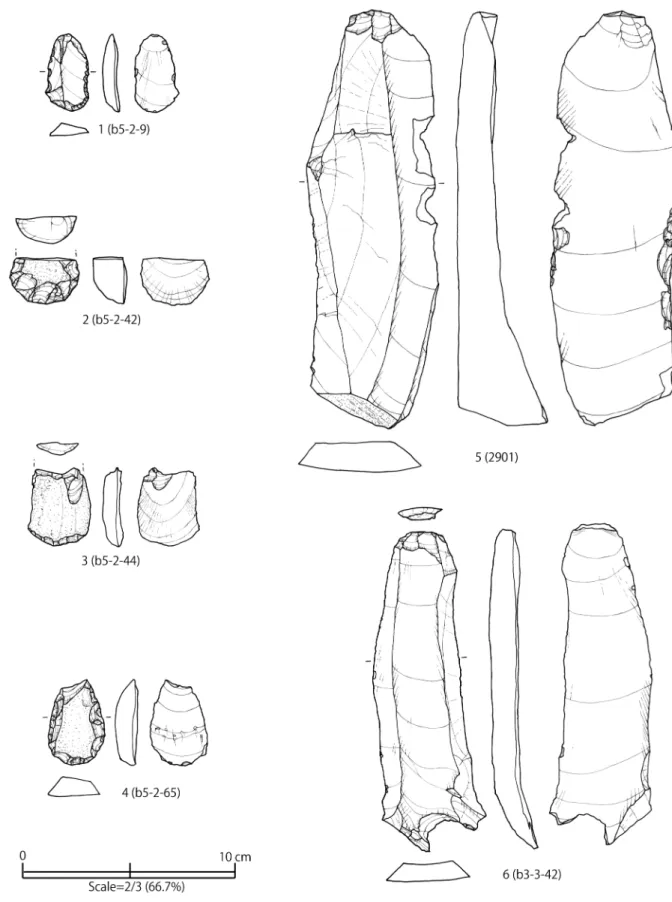
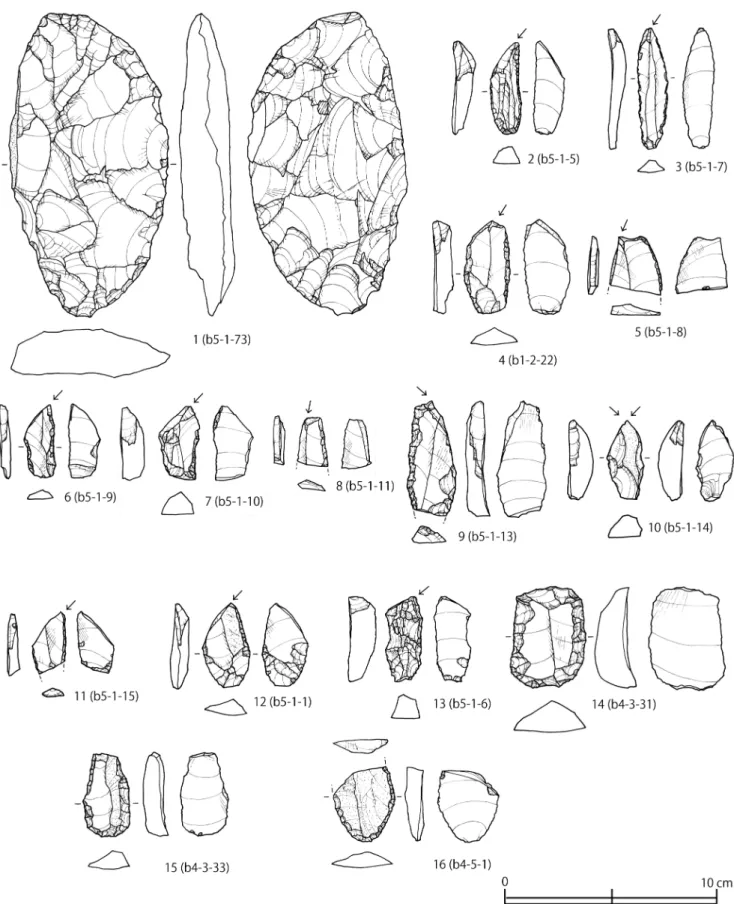
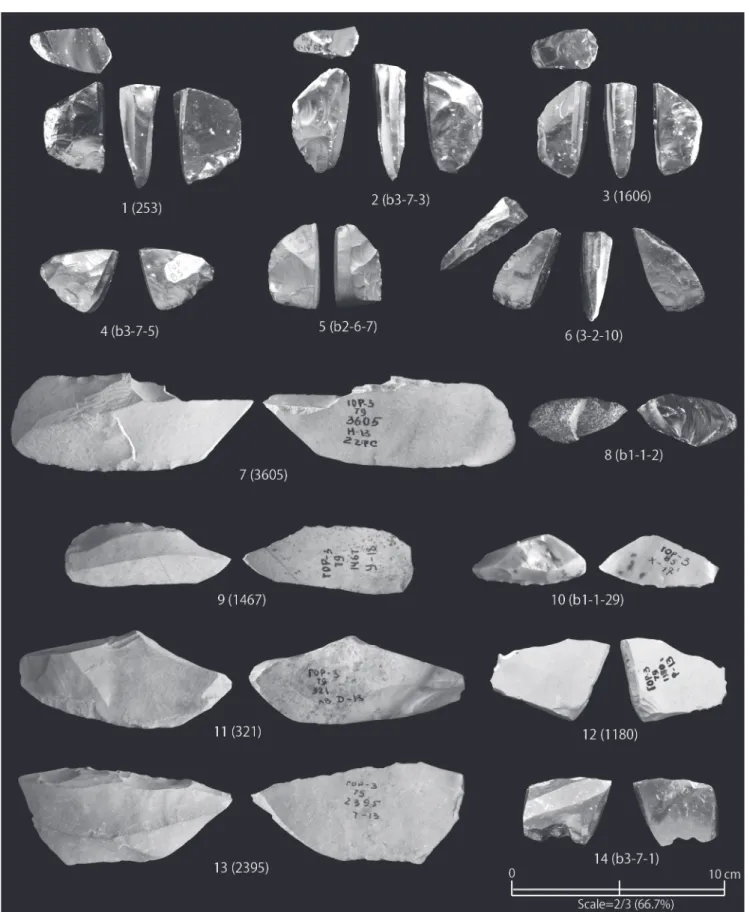
We looked at 84 microblade cores and three microblade preforms. From the viewpoint of Japanese archaeologists, microblade core types were composed of Togeshita (Figs. 16-4, 16-6, 20-7, 20-9, 20-11 and 20-13), Horoka (Figs. 16-9 to 16-11), wedge-shaped (Figs. 16-1 to 16-3, 20-1 to 20-4 and 20-6), and those made from blank flake without a secondary retouch (Figs. 16-8, 16-10, 20-12 and 20-14). The number of simple microblade removal technology is so outstanding that we had a problem classifying microblade cores from burins. This problem will be considered in a cooperative analysis between technological and functional studies. To be precise, the microblade core type should be strongly related with a special chronological and regional position. Therefore, we can point out similarities but should reconstruct each microblade technology individually.
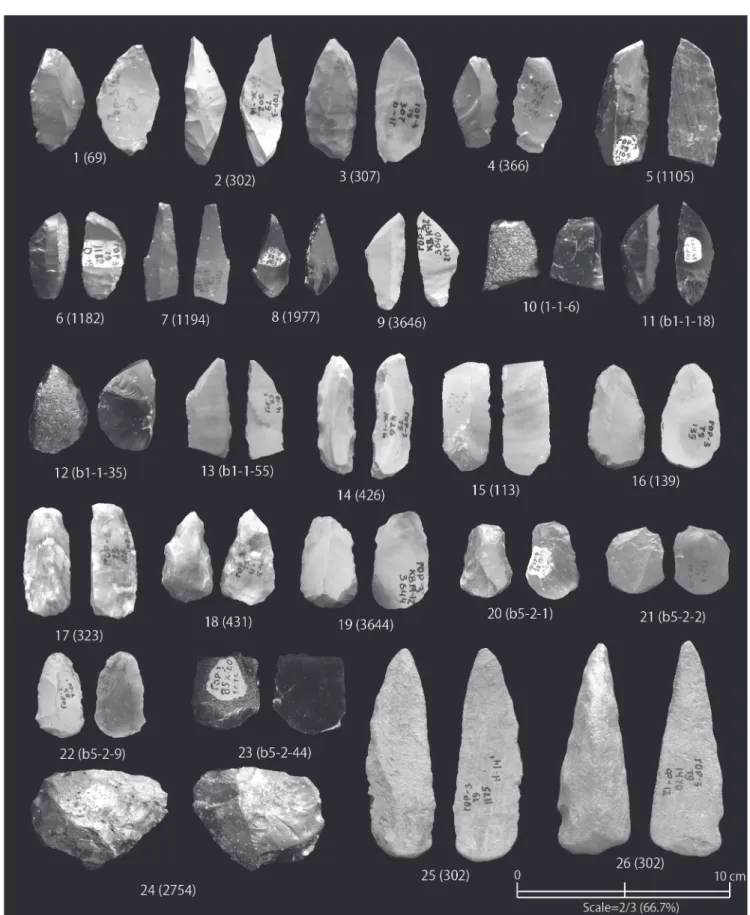
Average size of end scraper is 36.2 mm in length, 21.9 mm in width, 8.86 mm in thickness (Figs. 17-16 to 17-25, 18-1 to 18-4, 21-14 to 21-23). The average edge angle is 69.3°. Average size of burin is 36.5 mm in length, 18.1 mm in width and 6.7 mm in thickness (Figs. 17-1 to 17-24, 21-1 to 21-13). The average edge angle between burin facet and ventral face is 97.9°.
The most frequently produced material are bipolar cores (N=321). Small obsidian pebbles (from 3 to 6 cm in diameter) were the main raw material for the bipolar technique. They must have been taken from the Ilistaya River gravel. The experimental workshop on the bipolar technique was carried out in Tohoku University in November 2019. We will reconsider the characteristics of bipolar technology at the Gorbatka 3 and Ilistaya 1 sites in the next
paper. Blade technology is characterized by the existence of platform preparation retouch and crested ridge formation (Fig. 22). Relatively larger blades were produced in this site.
b. Use–wear analyses
There are several kinds of raw materials at the Gorbatka 3 site. The quality and sustainability against post-depositional surface modification relate to how suitable the raw material is for use–wear analysis. The most suitable raw material is chert and/or chalcedony. Because their surface sustains the original, worked material and the direction of operation can be assumed. The second one is highly silicified green tuff that worked material, and the direction of operation can be also assumed. In the case of obsidian, the direction of operation can be assumed on a limited basis except for a few obsidian samples that kept their original surfaces. The usual siliceous white/grey tuff that occupied the larger portion of the raw materials is not suitable for use–wear analysis because their original surfaces were completely changed in the post-depositional modification. Rhyolite and andesite are commonly unsuitable for a use–wear analysis. Therefore, our object materials were restricted.
In total, 15 utilized end scrapers and 11 used burins were found at the Gorbatla 3 site by microscopic observation (Table 3). Then, 26 lithic tools with use wear became objects of precise observation under a microscope from a traceological viewpoint. The most utilized tool at the site was the end scraper. The edge was used for scraping (N=10) and worked material would be dry hide (N=6), hide (N=3), and wood (N=1). Burins were chiefly utilized to whittle/plane (N=9). Only one worked material was assumed to be of the bone/antler variety (N=2). The use rate of the end scraper is higher (60.3%), and that of burin is not as high (44%).
Figure 5-1 shows a photo of the edge of lithic artefact no. 302. This tool has three burin facets (Fig. 17-2) and no use-wear on all these facets. Burin (no. 328) made from chert has the D1-type of micro polish accompanied by vertical striations (Figs. 5-2 to 5-4). This burin must have been utilized for planing bone/antler.
Obsidian tools have unfamiliar striations in our research experience. Numerous striations composed of a line of pits were recognized on the edge between the burin facet and the ventral surface (Figs. 5-5 and 5-6). These traces must have been caused by post-depositional effects. Usual use– wear striations on obsidian tools were as shown in the photos (Figs. 5-7 and 5-8). On the base of this burin (no. 1105), wider striations were formed probably by hafting activity (Figs. 5-9 to 5-11).
Striations composed by a line of pits were commonly observed on burins nos. 366, 1194, 69, 1977, and b1-1-18 (Figs. 6-1 to 6-6, and 7-1). Such striations extend to the opposite side of the burin facet (Figs. 6-9 to 6-11). No use–
wear polish is recognized accompanying these striations. It would be related to post-depositional effects and the use degree of each tool. A relatively apparent polish was found on the burin edge of no. 1182 (Fig. 6-8). Vertical and density striations were formed on the light and flat micro polish. This kind of polish is usually formed by the contact with a hard material such as bone/antler.
Use-wear on silicified tuff has similar characteristics. The distribution of polish was limited on the edge between the burin facet and the ventral face. Striations were basically vertical to the edge. The polish profile is principally flat with minute, dense striations (Figs. 7-2 to 7-5). These burins might have been used for planing bone/antler.
An end scraper with two burin facets was excavated from the Gorbatka 3 site. It is difficult to classify whether this was a burin or an end scraper. Despite the absence of use wear on the burin facets (Fig. 7-6), a well-developed polish with vertical striations was recognized on the distal end of the scraper edge (Figs. 7-7 and 7-8). Micro polish is characterized by the existence of numerous micro pits, a rough surface, and a round profile. This polish (the E2-type) has a strong relationship with dry hide working.
End scrapers were generally utilized for scraping hide. In case of end scrapers made from chert, silicified tuff, and chalcedony, the E2-type of micro polishes were situated on the distal end of scraper edges (Figs. 7-9 to 7-11, 8-1 to 8-12, 9-3, 9-4, 10-7 to 10-10). This polish type is generally caused by scraping dry hide. Abrasive wear and bright spots were occasionally formed on the base and the middle of lateral edges (Figs. 8-4 to 8-9, 9-1 and 9-2).
Vertical striations were often recognized on the use edge of obsidian end scrapers (Figs. 5-10, 5-11, 6-1 to 6-4). Striations were sometimes composed of continuous pits. Abrasive polish accompanying numerous pits were found on several end scrapers (Figs. 9-5, 9-6, 10-5 and 10-6). This is an E-type of polish that is basically caused by the contact with hide/leather. Round and bright polish is found on the edge of end scraper no. 1642 (Figs. 9-8 and 9-9). Since distribution of the polish is limited near the edge, and its border is clearly lined, this polish is regarded as a B-type, usually caused by woodworking. In addition, vertical and narrow striations in the polish on this scraper would be utilized for scraping wood. Wide and apparent striations were crossed on the base of some end scrapers (Fig. 9-7). Such traces would be caused by hafting activities.
47 microblade cores (56% of the total) also became objects of precise observation under a microscope. 15 of them were unsuitable for the analysis because of the post-depositional surface modification. 34 microblade cores have no use-wear on their expected use edges. That is to say, microblade cores weren’t utilized basically and had a role limitedly for microblade manufacture.
7. Analyses at the Ilistaya 1 site
a. Technological analysis
In total, 1,406 lithic materials were selected from the Ilistaya 1 site for this study. The assemblage at the Ilistaya 1 site is as follows (Table 4): bifacial tools (N=36), bipolar cores (596), and microblade cores (72), microblade core preforms (15), cores (3), blades (11), microblades (41), boat-shaped tools (16), burins (52), burin spalls (22), end-scrapers (68), a pointed scraper (1), side end-scrapers (53), drills (4), flakes (179), pebbles (6), chunks (122), a perforated flake (1), a hummer stone (1), retouched flakes (16), first spalls (47), ski spalls (43) and an unifacial tool (1).
We observed 72 microblade cores and 15 microblade core preforms. Although microblade technologies in Ilistaya 1 were basically similar to those in Gorbatka 3 site, the Hirosato-type of microblade core was absent from this site.
Microblade cores were typologically composed of Horoka (N=20) (Figs. 23-9, 23-12, 24-1 and 24-2), Togeshita (N=3) (Figs. 1 and 4), wedge-shaped (N=12) (Figs.2, 23-3, 23-5, 23-7, 23-8, 23-10 and 23-11), and simple flake blank (N=36). Although wedge-shaped microblade cores were regarded as cores made using the Yubetsu technique in some previous papers (Pantukhina 2007 etc.), we regarded it as one of the final shapes using Fukui technique known in Kyushu island around 15,000 calibration BP. We recognized retouching on the platform at the top of the microblade removal face and removal of core tablets to renew the platform on such cores.
Compared to the assemblage at the Gorbatka 3 site, there are larger number of bipolar cores, microblade core preforms, and microblade spalls (first and ski spalls). In contrast, the numbers of end scrapers and boat-shaped tools at Ilistaya 1 were smaller than those at the Gorbatka 3 site. It must be reflected by the difference in site function and/or distance from raw material sources.
Average size of end scraper is 35.9 mm in length, 24.5 mm in width and 8.68 mm in thickness (Figs. 19-14 to 19-16, 24-3 to 24-16). Average edge angle of end scraper is 70.3°. Average size of burin is 34.4 mm in length, 17.7 mm in width and 6.8 mm in thickness (Figs. 19-2, to 19-16, 17 to 24-19). Average edge angle between burn facet and ventral face is 98.3°.
b. Use–wear analysis
In total, 37 end scrapers, 22 burins, and a utilized retouched flake became objects of the analysis from a traceological viewpoint under a microscope at the Ilistaya 1 site. Then, 15 lithic tools (two end scrapers, 12 burins, and a retouched flake) with use-wear were recognized. Therefore, the most utilized tool was the burin at this site (use rate = 48%). Despite the discovery of numerous end scrapers, they
were seldom used in the site (use rate = 5.4%). Compared with the Gorbatka 3 site, the absence of end scraper utilization is the most apparent feature at the Ilistaya 1 site.
Figure 11 shows use traces of burins made of chert, green siliceous tuff, and jasper. It is possible to distinguish the micro-polish type on the burins made from these raw materials. Use–wear polish is commonly flat and bright with vertical and narrow striations (Figs. 11-1, 11-5 to 11-10). They would be used for whittling/planing bone/antler. A burin with a sharp edge of burin facet was utilized for cutting/ sawing bone/antler (Figs. 11-3 and 11-4).
Figure 12 shows use wear on obsidian burins at the
Ilistaya 1 site. In the case of obsidian, micro-polish is not apparent because of post-depositional effects and developed striations. Vertical striations were commonly observed on the edge between the burin facet and the ventral face (Figs. 12-2 to 12-10, 13-1 to 13-6). Micro-polish was recognized to a limited extent on the edge of a better condition (Fig. 12-1). Hafting traces as wide striations and abrasion were occasionally formed on the base of the burin (Fig.12-8).
The E2-type of polish was recognized on the use edge of an end scraper (Figs. 13-7 and 13-8). This would have been used for scraping dry hide. Vertical striations were formed on the edge of an obsidian end scraper (Figs. 9 and
13-Table 4 Lithic assemblage at the Ilistaya 1 site
Tool typeBipolar
core Flake Chunk Microbla de core End scraper Side scraperBurin First spall Ski spall Micro blade Biface Burin spall Boat shaped tool Retouched flake Microbla de core perform BladeBifacial point Pebble Bifacial point preform Ilistaya1 596 176 122 72 68 53 52 47 43 41 23 22 16 16 15 11 6 6 6
Tool type Drill Core Retouch flake from MC Bifacial tool Hummer stone Perforated flake Pointed scraper Unifaci al tool Total Ilistaya1 4 3 3 1 1 1 1 1 1406
Table 4 Lithic assemblage at the Ilistaya 1 site
Table 5 Use wear of lithic tools at the Ilistaya 1 site
Tool type Artifact no. Raw material Location of facet Independent
use zone Polish Striation
Microflak ing Use degree Figure B5-1-1 green siliceous tuff
left burin facet ?bone/antler vertical - light 11-5,6 B5-1-5 chert left burin facet bone/antler vertical - light 11-1 B5-1-6
green siliceous
tuff
left burin facet ?bone/antler vertical - light 11-7,8
B5-1-7 chert left tip of burin
facet bone/antler parallel - heavy 11-2,3,4 B5-1-8 obsidian left burin facet - vertical - light 12-1,2 B5-1-9 obsidian left burin facet - vertical - heavy 12-3,4 B5-1-10 obsidian left burin facet - vertical - light 12-5,6,7,8 B5-1-11 obsidian left burin facet - vertical - light 12-9,10 B5-1-13 obsidian right burin facet - vertical - light 13-1,2 B5-1-14 obsidian right burin facet - vertical - light 13-3,4 B5-1-15 obsidian right burin facet - vertical - light 13-5,6 B1-2-22 jasper left burin facet ?bone/antler vertical - light 11-9,10 B4-3-31 obsidian - scraper edge hide vertical + light 13-9,10 B4-3-33 chert - scraper edge dry hide vertical - light 13-7,8 retouced
flake B4-5-1 agate
-broken face like burin
facet
wood vertical - light 14-1,2,3,4 burin
end scraper
10). This was also used for scraping activity.
A retouched flake has a broken face like a burin facet. Since this edge has a B-type polish (Figs. 14-1 and 14-2), this would have been used for planing wood. The other edge with retouch has a D1-type polish with vertical striations. This edge would be used for whittling/planing bone/antler. This was a multi-function tool.
8. Considerations
Technological approaches at these sites presented us with some criteria to distinguish between microblade cores (of the Hirosato and Tougeshita-types) and burins. When a blank is a flake or blade, they sometimes have similar morphological characteristics (Fig. 15). The angle between the ventral face and the burin facet (microblade removal face, in the case of a microblade core) is one of the most important criteria. The average angle of the microblade core is 135.5° and that of the burin is 97.9° at the Gorbatka 3 site. The edge angle of burins at Ilistaya 1 site is 98.3°on average. The second criterion is the position of the burin facet and the microblade removal face. The facet of the burin is situated on the left shoulder of a blank flake/blade. In contrast, the microblade removal face is basically located on the right shoulder of the blank flake/blade. From a functional aspect, there is no use-wear on the microblade removal face. Traces of use are found a half of burin facets.
Short and thick flakes were used for the microblade core and end scraper blanks. Since both the scraper edge and
the microblade removal face are situated on the distal end of the blank, it is sometimes difficult to distinguish between the microblade core (Horoka-type) and the end scraper. From a technological aspect, microblades were removed by the pressure technique, and end scraper edges were retouched by direct percussion with organic hummers. The angle between the microblade removal face and the ventral face of a blank flake is about 50°on average. In contrast, the edge angle of end scrapers is around 70° on average. Functionally, there is no use-wear on the edge of microblade cores. More than a half of the use edges of end scrapers have use-wear. Through these approaches, microblade cores, burins, and end scrapers were correctly categorized.
Regarding site functions, the use of end scrapers distinguishes these two sites. There were more than twice the number of end scrapers at Gorbatka 3 (N=180) than at the Ilistaya 1 site (N=68). In addition, 60% of the end scrapers were utilized for hide scraping at Gorbatka 3, although 5.4% of end scrapers had use-wear at the Ilistaya 1 site. Therefore, the hide scraping needed for longer stable settlements was chiefly carried out at the Gorbatka 3 site. Ten times more boat-shaped tools were discovered at Gorbatka 3 than at Ilistaya 1 (Fig. 24-22). They may be used as blanks for end scrapers in some cases. In lithic assemblage, bipolar cores and microblade spalls were mainly excavated from the Ilistaya 1 site, not from Gorbatka 3 (Figs. 24-21, 24-23 and 24-24). These differences characterize the site functions of the sites. Burins were commonly used for bone/antler planing/whittling at both Fig.14 Use-wear on lithic tool at the Ilistaya 1 site.
sites. Microblade removal and bone/antler tool manufacture coexisted because of composite tool production. This activity was organized as a basic component in their subsistence technology and hunting strategy.
Acknowledgement
We would like to express our sincere appreciation to Dr. A. N. Popov (Far Eastern Federal University) for unique opportunity to observe the collections of artefacts at the Archaeology Laboratory in Far Eastern Federal University. Special thanks are due to our Russian colleagues, B. V. Lazin and M. K. Rudenko (Far Eastern Federal University). Researches were supported by Grant-in Aid for Scientific Research from the Japan Society for the Promotion of Science (No. 16KK0020) and Research Funds for DIARE (Division for Interdisciplinary Advanced Research and
Education) doctoral course students, Tohoku University.
References
Akoshima K. and H. Hong 2017 Standard use-wear chart of TUMRT (3): Microwear Polish (1). Bulletin of the Tohoku University
Museum, no. 16, pp. 69-86
Akoshima K. and H. Hong 2018 Standard use-wear chart of TUMRT (4): Microwear Polish (2). Bulletin of the Tohoku University
Museum, no. 17, pp. 115-138
Kuznetsov A.M. 1992 Late Palaeolithic of the East-Southern
Primorye (in Russian). Vladivostok Far Eastern University Press
Kuznetsov A. M. 1996 Late Palaeolithic sites of the Russian Maritime Province Primorye. American Beginnings: Prehistory
and Palaeoecology of Beringia. (edited by F. H. West) pp.267-282 The University of Chicago Press.
Pantukhina I. 2007 The Role of Raw Material in Microblade Technology at Three Late Palaeolithic Sites, Russian Far East.
Indo-Pacific Prehistory Association Bulletin, 27, pp. 144-153
↓
↓
microblade core
↓
↓↓
burin
end scraper microblade core
Fig.15 Characteristics of burins, end scrapers and microblade cores
left shoulder use wearedge angle 98° right shoulder no use wear
edge angle 135° use wear edge angle 70° no use wear edge angle 50° ⇔ ⇔ ⇔ wider wider