Standard use-wear chart of TUMRT (1):
Microflaking (1)
著者
Akoshima Kaoru, Hong Hyewon
journal or
publication title
Bulletin of the Tohoku University Museum
volume
13
page range
43-76
year
2014-03-26
Bull. Tohoku Univ. Museum, No. 13, pp. 43–76, 2014 © by The Tohoku University Museum
Standard use-wear chart of TUMRT (1): Microflaking (1)
Kaoru Akoshima, Hyewon Hong
Department of Archaeology, Graduate School of Arts and Letters, Tohoku University
INTRODUCTION
The study of prehistoric lithic artifacts entails three fundamental realms of research, namely, typological, technological, and functional analysis. All these areas need to establish robust methods of meaning assignment to any observed patterns in archaeological records, according to the principle of the Middle Range Theory which was proposed by Binford (1981, pp.21-30). In the case of the use-wear analysis, experimental replication plays an important role for bridging arguments between wear patterns and human activities, in other words, between the statics and the dynamics. It is essentially important to construct extensive databases of experimental use-wear formation for the purpose of reliable interpretation of archaeological patterns.
The present paper introduces essential criteria of micro-wear interpretation accumulated by TUMRT (that is, Tohoku University Microwear Research Team) since 1976. The team was initiated by the late Prof. Chosuke Serizawa and has been active up to the present (for its history, e.g., Akoshima 2008). This is to be the first of a series of presentations resulting from the TUMRT inferential criteria. We need to apologize for not having presented our inferential standards due to various circumstances since 1983, although we were repeatedly requested to publish openly our criteria for functional interpretation especially by use-wear analysts nationwide. The data presented here is a portion of microflaking (or micro-scale chipping) replication. Although the inferential method of microflaking was published in a summary fashion (e.g., Akoshima 1987 in English, after Akoshima 1981 in Japanese), and a number of actual analysis of excavated artifacts have been conducted widely in Japan, basic database for interpretation has yet to be fully presented. We hope the microphotographs presented in the article will assume a role of standard use-wear chart for functional studies in prehistory.
EXPERIMENTS AND RESULTS
of TUMRT project directed by Serizawa until his retirement from Tohoku University in 1983. Experiments were conducted mainly by Akoshima and Kajiwara using raw materials of Shale, Chert, and Obsidian. Microflaking data were analyzed by Akoshima (Akoshima 1981, 1989) and the data have been utilized by TUMRT members since then. Microphotographs were printed and served on file at the Department of Archaeology, Faculty of Arts and Letters.
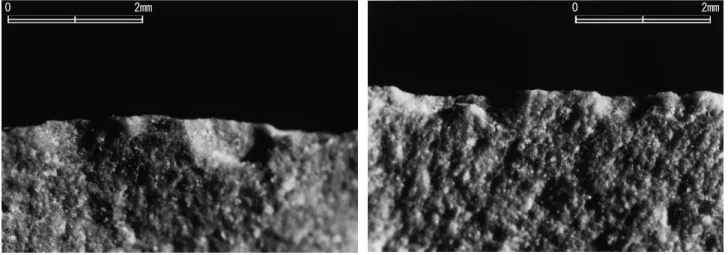
For the present publication, the paper photo-micrographs were scanned (at 600 dpi) and colour digitized for adjusting gray tones, and representative images were selected for presentation of “typical microflaking patterns” which were numerically described in statistical graphs in Akoshima (1987). The pictures here are, in other words, the photographic version of inferential criteria. They are shown as Figure 1 to Figure 28. They are arranged in the order from working soft materials (meat, rawhide, leather, soft plant) to medium (wood, bamboo), to hard materials (bone, antler). Within the category of similar hardness, they are sub-divided and arranged by the method of use, from parallel motions (cutting, sawing) to perpendicular motions (scraping, whittling).
The raw materials presented here are the shale. The shale in the Japanese terminology of lithic analysis denotes a type of fine grained sedimentary rock with breaking feature of conchoidal fracture (no laminar breakage feature). They somewhat look like European flint or American chert, but they are of different rock type. The shale was in wide use throughout prehistory in northeastern part of the Honshu Island of Japan. Out of about 160 experimental artifacts, 80 specimens were selected for the photo presentation. They are flake tools which were utilized without secondary retouch along the edge. Thus, the micro-sized scars seen on these photos are all produced by utilization only.
The order of arranging these microphotographs are as follows. Basically, they are arranged so that the general patterns of groups of microflaking scars are recognized according to the numerical presentation as in Akoshima (1987). The Figures are captioned with the category of worked materials and working edge motions. From Figure 1,
44
1. Meat, 1.1 cattle (beef), 1.2 pig (pork), 1.3 lamb (mutton), 1.4 duck, 1.5 chicken
2. Plant, 2.1 grass, 2.2 wheat crop, 2.3 rice crop, 2.4 reed, 2.5 pampas grass
3. Hide, 3.1 rawhide, 3.2 half dried hide, 3.3 dry hide
4. Wood, 4.1 paulownia, 4.2 cedar, 4.3 pine, 4.4 alder, 4.5 zelkova, 4.6 others
5. Bamboo 6. Gourd 7. Shell
8. Bone, 8.1 raw, fresh, 8.2 wet and boiled, 8.3 boiled 9. Antler, 9.1 soaked, 9.2 dry, 9.3 others
For the third digit of each photo caption number, the type of motion in use is indicated as follows.
Longitudinal, -1 cutting, -2 sawing Transversal, -3 whittling, -4 scraping Varied, -5 chopping, -6 butchering Incising, -7 graving
Microphotographs were taken using a macro-photo equipment of Olympus OM-2 camera system. The magnification shown in the caption is at the time of photography. Actual scale bar is shown in each photo image.
In the photo caption, “d” means the dorsal surface, while “v” means the ventral surface of the working edge.
For the analysis of resultant microflaking scars, a variety of attributes were recorded and classified. A total of 3840 flaking scars were counted one by one and recorded for 72 specimens. They were statistically investigated and summary published in Akoshima (1987). Major attributes of analytical interests are, the shape of microflaking scar, the size of microflaking scar, the initiation of microflaking scar breakage, the termination of microflaking scar breakage, the density of microflaking scar per centimeter, the degree of concentration of scars to one face of the tool, ventral or dorsal.
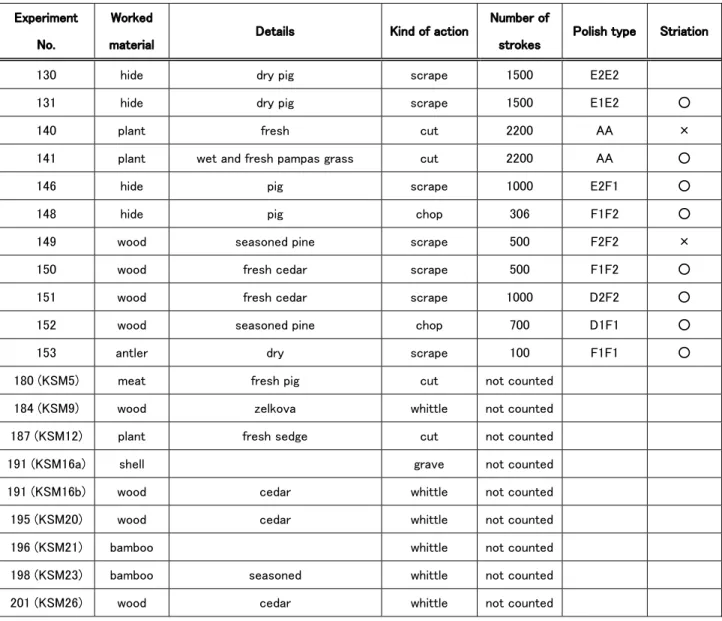
The summary of conducted experiments is shown in Table 1 to Table 3. Other than the information in the table for each controlled experiment, thirty conditions were recorded on experiment recording sheets which are on file at Tohoku University. They are as follows:
1. Experiment number (SH#) 2. Worked material
3. Kind of action (cutting, sawing, whittling, scraping, boring, chopping, grooving, varied -and reason why)
4. Number of strokes of tool usage 5. Place of experiment
6. Date of experiment 7. Experimenter Tool
8. Shape of the tool, (both ventral and dorsal in illustration) 9. Edge angle of the tool (measured with a protractor)
11. Secondary retouch (the hammer, stone or antler) (method of retouch, percussion or pressure flaking) (no retouch on edge)
Activity
12. Direction of activity (indicated in illustration, such as M ) 13. Contact angle 1. (the angle between the edge line and
the worked material) (<20 degrees, 30, 45, 60, >80) 14. Contact angle 2. (the angle between the ventral surface
and the worked material) (<20 degrees, 30, 45, 60, >80) 15. Method of prehension (bare hand, gloved, hafted –type
and method)
16. Which hand was used? (right, left) 17. Duration of experiment (in minutes)
18. Rate of work (number of strokes of tool use, per minute) 19. Approximate length of each stroke, ( ) cm/1 stroke
(distance of tool movement) Worked Material
20. Species name
21. Which part of the worked material was worked? (descriptive)
22. Shape, diameter, thickness, etc. of the worked material (descriptive)
23. Detailed conditions of the worked material, at least indicating, (dry, wet), (fresh, boiled, seasoned, soaked, frozen, tanned)
24. Place of the experimental work (in detail such as laboratory or field conditions)
25. Sand, soil, dirt, etc. involved during experiment 26. Water conditions during experiment
27. What kind of backing was used under the worked material? (cutting board, flat stone, for example)
28. How was the tool during experiment? (sharpness, breakage, utilization retouch, fat, etc., descriptive) 29. Location of the working edge (in 8 division polar coordinate)
(1 2 3 4 5 6 7 8)
30. Which surface was in contact with the worked material? (ventral, dorsal)
In the figures and tables, the experiment numbers of KSM# which accompany SH tool numbers mean “the Kusumoto experiment number” (carried out by Mr. Masasuke Kusumoto in Ishinomaki City, Miyagi Prefecture). They were the specimens utilized for the blind test of functional determination by the method of use wear analysis. The blind test results are published in Kajiwara and Akoshima (1981). However, detailed conditions of the blind test experiments were not disclosed, and some blanks remain in the table.
CONCLUSIONS
The databases presented here are to be utilized as basic reference materials for microflaking interpretation. The Kaoru AKOSHIMA and Hyewon HONG
45 from soft to hard, and for various tool use movements
from longitudinal to transversal motion. Picture samples are selected here for representative microflaking types and disposition, as were reported in the past publications (Akoshima, 1981, 1987). It is emphasized that the actual appearances of microflaking scars show a wide range of variability, in cases where the tools were put to the same kind of use. The variability of scars is recognized even along the same edge of a particular experimental artifact. Akoshima (1989) adopted a statistical approach to reduce such points of weakness. The variability in actual appearances of the groups of microflaking scars will be presented in our next article to be continued. We wish the phenomenon of micro-scale chipping on the edge of lithic artifacts will be evaluated as important clues to the study of human cultural adaptations. Microflaking has been considered as a major criterion for functional interpretation since the inception of experimental research (e.g., Tringham, et al. 1974) in American archaeology (e.g., Odell 1996), and in Asian countries (e.g., Gao and Chen eds. 2008). We sincerely hope that also in Japan, this category of use-wear will play an important role as integrated with other categories of wears such as microwear polishes and striations.
ACKNOWLEDGEMENT
Prof. Hiroshi Kajiwara of Tohoku Fukushi University conducted many of the replicative experiments together with the first author while he was at Tohoku University. We are grateful to Prof. Toshio Yanagida of the Tohoku University Museum for providing publication pages in its Bulletin series. The database building of this sort sometimes faces difficulties to find necessary places to be accommodated in terms of the volume. We sincerely hope that in the future
Bulletin series, essential parts of TUMRT research standards may find their places. Additionally, the Bulletin series are available for download through the Internet (may be referred to the Tohoku University Museum for current situations).
This article is a result of KAKENHI (2013, number 25370885), granted to Akoshima.
REFERENCES
Akoshima, K. 1981, An Experimental Study of Microflaking. Kokogaku Zasshi, (Journal of the Archaeological Society of Nippon), vol. 66, no. 4, pp. 1-27. (in Japanese)
Akoshima, K. 1987, Microflaking Quantification. The Human Uses of Flint and Chert, edited by Sieveking, G. de G., and M. H. Newcomer, pp. 71-79. Cambridge University Press.
Akoshima, K. 1989, Use-wear of Stone Tools. Archaeological Library 56, New Science Co. (in Japanese)
Akoshima, K. 2008, Emergence of High-power Microwear Analysis in Japan, 1976 to 1983: Prof. Serizawa’s Legacy and beyond. Papers in Archaeology, Ethnology, and History, in Memory of Prof. Chosuke Serizawa. Rokuichi Shobo.
Gao, Xing, and Chen Shen, eds. 2008, Archaeological Study of Lithic Use-wear Experiments. Science Press, Beijing. (in Chinese with English summary)
Binford, L. R. 1981, Bones: Ancient Men and Modern Myths. Academic Press.
Kajiwara, H., and K. Akoshima 1981, An Experimental Study of Microwear Polish on Shale Artifacts. Kokogaku Zasshi, vol. 67, no. 1, pp. 1-36. (in Japanese)
Odell, G.H. 1996, Stone Tools and Mobility in the Illinois Valley: from Hunter-Gatherer Camps to Agricultural Villages. International Monographs in Prehistory, Archaeological Series, 10. Ann Arbor, Michigan.
Tringham, R., G. Cooper, G. Odell, B. Voytek, and A. Whitman 1974, Experimentation in the Formation of Edge Damage: A New Approach to Lithic Analysis. Journal of Field Archaeology, vol. 1, pp. 171-196.
(5) 1.2-1. meat cut 1300st (SH54v) 8x (6) 1.2-1. meat cut 1600st (SH55d) 8x (1) 1.1-1. meat cut 800st (SH26d) 8x (2) 1.1-1. meat cut 800st (SH26v) 8x
(4) 1.2-1. meat cut 1300st (SH54v) 8x (3) 1.2-1. meat cut 1300st (SH54d) 8x 0 2mm 0 2mm 0 2mm 0 2mm 0 2mm 0 2mm
(5) 1.3-1. meat cut 500st (SH15v) 8x (6) 1.3-1. meat cut 1000st (SH17d) 8x (1) 1.2-1. meat cut 1600st (SH55v) 8x (2) 1.2-4. meat scrape 1100st (SH57d) 8x
(3) 1.2-6. meat butcher (KSM5d) 8x (4) 1.3-1. meat cut 500st (SH15d) 8x
0 2mm 0 2mm
0 2mm 0 2mm
0 2mm 0 2mm
47 Standard use-wear chart of TUMRT (1): Microflaking (1)
(5) 1.4-6. meat butcher (SH108d) 8x (6) 1.4-6. meat butcher (SH108v) 8x (1) 1.3-1. meat cut 1000st (SH17v) 8x (3) 1.4-1. meat cut 700st (SH97v) 8x (2) 1.4-1. meat cut 700st (SH97d) 8x (4) 1.4-1. meat cut 700st (SH97v) 8x 0 2mm 0 2mm 0 2mm 0 2mm 0 2mm 0 2mm
(5) 2.1-1. plant cut 2200st (SH140d) 8x (6) 2.1-1. plant cut 2200st (SH140v) 8x (1) 1.5-6. meat butcher 1020st (SH56d) 8x (2) 1.5-6. meat butcher 1020st (SH56v) 8x
(3) 2.1-1. plant cut 1700st (SH20d) 8x (4) 2.1-1. plant cut 1700st (SH20v) 5x
0 2mm
0 2mm 0 2mm
0 2mm
0 2mm 0 2mm
49 Standard use-wear chart of TUMRT (1): Microflaking (1)
(5) 2.3-1. plant cut 3000st (SH43d) 8x (6) 2.3-1. plant cut 3000st (SH43v) 8x (1) 2.2-1. plant cut 15m (SH1d) 8x (2) 2.2-1. plant cut 15m (SH1v) 8x
(3) 2.2-1. plant cut 25m (SH11d) 8x (4) 2.2-1. plant cut 25m (SH11v) 8x
0 2mm 0 2mm
0 2mm 0 2mm
0 2mm 0 2mm
(5) 2.4-1. plant cut 2650st (SH42d) 8x (6) 2.4-1. plant cut 2650st (SH42v) 8x (1) 2.3-1. plant cut 3000st (SH45d) 8x (2) 2.3-1. plant cut 3000st (SH45v) 8x
(3) 2.4-1. plant cut 3000st (SH40d) 8x (4) 2.4-1. plant cut 3000st (SH40v) 8x
0 2mm 0 2mm
0 2mm 0 2mm
0 2mm 0 2mm
51 Standard use-wear chart of TUMRT (1): Microflaking (1)
(5) 3.1-4. hide scrape 2000st (SH120A) 8x (6) 3.1-4. hide scrape 2000st (SH121d) 8x (1) 2.5-1. plant cut 800st (SH66d) 8x (2) 2.5-1. plant cut 800st (SH66v) 8x
(3) 2.5-1. plant cut 2200st (SH141d) 8x (4) 2.5-1. plant cut 2200st (SH141v) 8x
0 2mm 0 2mm
0 2mm 0 2mm
0 2mm 0 2mm
(5) 3.1-4. hide scrape 2000st (SH123v) 8x (6) 3.1-4. hide scrape 800st (SH124d) 8x (1) 3.1-4. hide scrape 2000st (SH121v) 8x (2) 3.1-4. hide scrape 2000st (SH122d) 8x
(3) 3.1-4. hide scrape 2200st (SH122v) 8x (4) 3.1-4. hide scrape 2000st (SH123d) 8x
0 2mm 0 2mm
0 2mm 0 2mm
0 2mm 0 2mm
53 Standard use-wear chart of TUMRT (1): Microflaking (1)
(5) 3.1-4. hide scrape 2000st (SH126v) 8x (6) 3.2-4. hide scrape 2000st (SH128d) 8x (1) 3.1-4. hide scrape 800st (SH124v) 8x (2) 3.1-4. hide scrape 2000st (SH125) 8x
(3) 3.1-4. hide scrape 2000st (SH125) 8x (4) 3.1-4. hide scrape 2000st (SH126d) 8x
0 2mm 0 2mm
0 2mm 0 2mm
0 2mm 0 2mm
(5) 3.3-2. hide saw 5000st (SH76d) 8x (1) 3.2-4. hide scrape 2000st (SH128v) 8x (3) 3.2-4. hide scrape 4000st (SH129v) 8x (2) 3.2-4. hide scrape 4000st (SH129d) 8x (4) 3.2-4. hide scrape 4000st (SH129v) 8x (6) 3.3-2. hide saw 5000st (SH76v) 8x 0 2mm 0 2mm 0 2mm 0 2mm 0 2mm 0 2mm 55 Standard use-wear chart of TUMRT (1): Microflaking (1)
(5) 3.3-4. hide scrape 1000st (SH146v) 8x (6) 3.3-5. hide chop 306st (SH148d) 8x (2) 3.3-4. hide scrape 1500st (SH130) 8x
(3) 3.3-4. hide scrape 1500st (SH131) 8x (4) 3.3-4. hide scrape 1000st (SH146d) 8x (1) 3.3-4. hide scrape 1500st (SH130) 8x
0 2mm 0 2mm
0 2mm 0 2mm
0 2mm 0 2mm
(5) 4.1-3. wood whittle 1000st (SH114v) 8x (6) 4.1-4. wood scrape 1000st (SH111d) 8x (1) 3.3-5. hide chop 306st (SH148v) 8x (2) 4.1-1. wood cut (KSM12d) 8x
(3) 4.1-2. wood saw 1000st (SH115d) 3x (4) 4.1-2. wood saw 1000st (SH115v) 3x
0 2mm
0 2mm
0 2mm 0 2mm
0 2mm 0 2mm
57 Standard use-wear chart of TUMRT (1): Microflaking (1)
(5) 4.2-3. wood whittle (KSM26) 8x (6) 4.2-3. wood whittle (KSM26v) 8x (1) 4.1-4. wood scrape 1000st (SH111d) 8x (2) 4.1-4. wood scrape 1000st (SH111v) 8x
(3) 4.2-3. wood whittle (KSM16Bd) 8x (4) 4.2-3. wood whittle (KSM20d) 8x
0 2mm 0 2mm
0 2mm 0 2mm
0 2mm 0 2mm
(5) 4.2-4. wood scrape 500st (SH150v) 8x (6) 4.2-4. wood scrape 1000st (SH151d) 8x (1) 4.2-3. wood whittle 1000st (SH96d) 8x (2) 4.2-3. wood whittle 1000st (SH96v) 8x
(3) 4.2-4. wood scrape 500st (SH150d) 3.5x (4) 4.2-4. wood scrape 500st (SH150d) 3.5x
0 2mm 0 2mm
0 2mm 0 2mm
0 2mm 0 2mm
59 Standard use-wear chart of TUMRT (1): Microflaking (1)
(5) 4.3-3. wood whittle 1500st (SH46v) 8x (6) 4.3-3. wood whittle 2000st (SH100d) 8x (1) 4.2-4. wood scrape 1000st (SH151v) 8x (2) 4.3-2. wood saw 2000st (SH44) 3x
(3) 4.3-2. wood saw 2000st (SH44v) 5x (4) 4.3-3. wood whittle 1500st (SH46d) 8x
0 2mm
0 2mm
0 2mm
0 2mm
0 2mm 0 2mm
(5) 4.3-4. wood scrape 500st (SH120Bv) 5x (6) 4.3-4. wood scrape 500st (SH149d) 3.5x (1) 4.3-3. wood whittle 2000st (SH100v) 8x (2) 4.3-4. wood scrape 300st (SH90d) 4x
(3) 4.3-4. wood scrape 300st (SH90v) 4x (4) 4.3-4. wood scrape 500st (SH120Bd) 5x
0 2mm 0 2mm
0 2mm 0 2mm
0 2mm 0 2mm
61 Standard use-wear chart of TUMRT (1): Microflaking (1)
(5) 4.3-5. wood chop 700st (SH152v) 4x (6) 4.4-1. wood cut 1400st (SH7d) 8x (1) 4.3-4. wood scrape 500st (SH149v) 8x (2) 4.3-5. wood chop 200st (SH14d) 6x
(3) 4.3-5. wood chop 200st (SH14v) 4x (4) 4.3-5. wood chop 700st (SH152d) 5x
0 2mm 0 2mm 0 2mm 0 2mm 0 2mm 0 2mm
(5) 4.4-1. wood cut 1000st (SH9v) 5x (6) 4.4-1. wood cut 2000st (SH10d) 8x (1) 4.4-1. wood cut 1400st (SH7v) 8x (2) 4.4-1. wood cut 2500st (SH8d) 8x
(3) 4.4-1. wood cut 2500st (SH8v) 8x (4) 4.4-1. wood cut 1000st (SH9d) 8x
0 2mm
0 2mm 0 2mm
0 2mm 0 2mm
0 2mm
63 Standard use-wear chart of TUMRT (1): Microflaking (1)
(5) 4.4-2. wood saw 5000st (SH49d) 8x (6) 4.4-2. wood saw 5000st (SH49v) 8x (1) 4.4-1. wood cut 2000st (SH10v) 8x (2) 4.4-1. wood cut 3000st (SH12d) 8x
(3) 4.4-1. wood cut 3000st (SH12v) 8x (4) 4.4-1. wood cut 3000st (SH12v) 8x
0 2mm 0 2mm
0 2mm 0 2mm
0 2mm 0 2mm
(5) 4.5-3. wood whittle (KSM9d) 8x (6) 4.5-3. wood whittle (KSM9v) 8x (1) 4.4-3. wood whittle 2000st (SH13d) 8x (2) 4.4-3. wood whittle 2000st (SH13v) 8x
(3) 4.4-3. wood whittle 2000st (SH99d) 8x (4) 4.4-3. wood whittle 2000st (SH99v) 8x
0 2mm 0 2mm
0 2mm 0 2mm
0 2mm 0 2mm
65 Standard use-wear chart of TUMRT (1): Microflaking (1)
(4) 5.0-2. bamboo saw 4000st (SH80v) 8x
(5) 5.0-3. bamboo whittle (KSM21d) 8x
(1) 4.6-4. wood scrape 2000st (SH39v) 8x (2) 5.0-2. bamboo saw 2000st (SH79v) 8x
(3) 5.0-2. bamboo saw 4000st (SH80d) 8x
(6) 5.0-3. bamboo whittle (KSM21v) 8x
0 2mm 0 2mm
0 2mm 0 2mm
0 2mm 0 2mm
(4) 5.0-4. bamboo scrape 2000st (SH84d) 8x
(5) 5.0-4. bamboo scrape 2000st (SH84v) 8x
(1) 5.0-3. bamboo whittle (KSM23d) 8x (2) 5.0-4. bamboo scrape 4000st (SH82) 8x
(3) 5.0-4. bamboo scrape 4000st (SH82d) 8x (6) 5.0-2. bamboo saw 2000st (SH79d) 8x 0 2mm 0 2mm 0 2mm 0 2mm 0 2mm 0 2mm 67 Standard use-wear chart of TUMRT (1): Microflaking (1)
(5) 8.1-2. bone saw 3000st (SH86v) 8x (6) 8.1-3. bone whittle 1100st (SH89d) 8x (1) 6.0-2. gourd saw 5000st (SH77d) 8x (2) 6.0-2. gourd saw 5000st (SH77v) 8x
(3) 7.0-7. shell grave (KSM16d) 8x (4) 8.1-2. bone saw 3000st (SH86d) 8x
0 2mm 0 2mm
0 2mm 0 2mm
0 2mm 0 2mm
(5) 8.2-4. bone scrape 1500st (SH93v) 8x (6) 8.3-2. bone saw 500st (SH91) 3x (1) 8.1-3. bone whittle 1100st (SH89v) 8x (2) 8.1-4. bone scrape 1000st (SH89d) 8x
(3) 8.1-4. bone scrape 1000st (SH89v) 8x (4) 8.2-4. bone scrape 1500st (SH93d) 8x
0 2mm 0 2mm
0 2mm 0 2mm
0 2mm 0 2mm
69 Standard use-wear chart of TUMRT (1): Microflaking (1)
(5) 8.3-4. bone scrape 2000st (SH91) 3x (6) 9.1-2. antler saw 4000st (SH47d) 8x (1) 8.3-2. bone saw 5000st (SH92d) 8x (2) 8.3-2. bone saw 5000st (SH92v) 8x
(3) 8.3-3. bone whittle 3000st (SH101d) 8x (4) 8.3-3. bone whittle 3000st (SH101v) 8x
0 2mm 0 2mm
0 2mm 0 2mm
0 2mm 0 2mm
(5) 8.3-4. bone scrape 2000st (SH91) 3x (6) 9.1-2. antler saw 4000st (SH47d) 8x (1) 8.3-2. bone saw 5000st (SH92d) 8x (2) 8.3-2. bone saw 5000st (SH92v) 8x
(3) 8.3-3. bone whittle 3000st (SH101d) 8x (4) 8.3-3. bone whittle 3000st (SH101v) 8x
0 2mm 0 2mm
0 2mm 0 2mm
0 2mm 0 2mm
(5) 9.2-2. antler saw 4300st (SH68d) 8x (6) 9.2-2. antler saw 4300st (SH68v) 8x (1) 9.1-2. antler saw 4000st (SH47v) 8x (2) 9.1-2. antler saw 15000st (SH48d) 8x
(3) 9.1-2. antler saw 15000st (SH48v) 8x (4) 9.2-2. antler saw 4300st (SH68) 8x
0 2mm 0 2mm
0 2mm 0 2mm
0 2mm 0 2mm
71 Standard use-wear chart of TUMRT (1): Microflaking (1)
(5) 9.2-4. antler scrape 100st (SH153d) 5x (6) 9.2-4. antler scrape 100st (SH153v) 8x (1) 9.2-2. antler saw 1100st (SH71d) 5x (2) 9.2-2. antler saw 1100st (SH71v) 3x
(3) 9.2-3. antler whittle 2000st (SH70d) 8x (4) 9.2-3. antler whittle 2000st (SH70v) 8x
0 2mm 0 2mm
0 2mm
0 2mm
0 2mm 0 2mm
(1) 9.3-1. antler cut 1500st (SH16d) 8x (2) 9.3-1. antler cut 1500st (SH16v) 8x
Figure 28. Experimental microflaking scars. (hard worked materials)
0 2mm 0 2mm
73 Standard use-wear chart of TUMRT (1): Microflaking (1)
E�periment �o� �orked material Details �ind of action �umber of strokes �olish type �triation
1 plant fresh wheat cut 15m, 120min BF1 ○ 7 wood fresh alder cut 1400 BB ○ 8 wood fresh alder cut 2500 F2F2 × 9 wood fresh alder cut 1000 D2D2 ○ 10 wood fresh alder cut 2000 BF2 ○ 11 plant fresh wheat cut 25m, 30min BB ○ 12 wood fresh alder cut 3000 D2F2 BF2 ○ 13 wood fresh alder whittle 2000 BF2 ○ 14 wood seasoned pine, no bark chop 200 BF2 ○ 15 meat half-frozen mutton cut 500 F1E1 ○
16 antler cut 1500 F1F1 ○
17 meat half-frozen mutton cut 1000 D2F1 ○ 20 plant weed chop-cut 1700 AA ○ 26 meat fresh cattle cut over 800 F1F2 ○ 39 wood seasoned soft wood scrape 2000 BF2 ○ 40 plant reed cut 3000 AA ○ 42 plant reed cut 2650 AA ○ 43 plant fresh rice cut 3000 AA ○ 44 wood fresh pine saw2 2000 BB ○ 45 plant fresh rice crop cut about 3000 AA ○ 46 wood fresh pine whittle 1500 BF2 ○ 47 antler soaked saw2 4000 CC ○ 48 antler soaked saw2 15000 CC ○ 49 wood seasoned alder saw2 5000 BB ○ 54 meat fresh pig cut 1300 F2E1 ○ 55 meat fresh pig cut 1600 F2E1 ○ 56 chicken half-frozen chicken butcher 1020 F1F2E1 ○ 57 meat fresh pig scrape 1100 F1F2
66 plant pampas grass cut 800 AA ○ 68 antler dry saw 4300 D1F1 ○ 70 antler dry whittle 2000 F1F1 ○
E�periment �o�
�orked material
Details �ind of action �umber of strokes
�olish type �triation
76 hide dry cattle saw 5000 D1F1 ○ 77 plant seasoned gourd saw 5000 AB ○ 79 bamboo seasoned saw 2000 BF1 ○ 80 bamboo fresh saw 4000 BB ○ 82 bamboo fresh scrape 4000 BB ○ 84 bamboo seasoned scrape 2000 BB(atypical) ○ 86 bone fresh pig saw 3000 D2C ○ 89 bone fresh pig whittle/scrape 2100 D1F1 × 90 wood seasoned pine scrape 300 F1F2 × 91 bone boiled pig scrape/saw 2000/500 D1F2 ○ 92 bone boiled pig saw 5000 D1C ○ 93 bone wet and boiled pig scrape 1500 D1D1 96a wood fresh cedar whittle 1000 BF1 ○ 97 meat fresh duck cut 700 E1E2F1F2 99 wood seasoned alder whittle 2000 BB(atypical) 100 wood seasoned pine whittle 2000 BB ○ 101 bone boiled pig whittle 3000 D2F1 108a duck butcher 3 ducks E1E2F1 111 wood fresh paulownia scrape 1000 F1F2 114 wood fresh paulownia whittle 1000 BF1 ○
115 wood
fresh paulownia,
outside wet, inside dry saw 1000 BF1 ○ 120a leather pig scrape 2000 F2F2 120b wood pine scrape 500 121 leather pig scrape 2000 E1E2 ○ 122 rawhide pig scrape 2000 E2E1 ○ 123 rawhide pig scrape 2000 X ○ 124 rawhide pig scrape 800 X ○ 125 rawhide pig scrape 2000 X ○ 126 rawhide pig scrape 2000 E2F1 ○ 128 rawhide pig scrape 2000 F1E1 ○
75 Standard use-wear chart of TUMRT (1): Microflaking (1)
E�periment �o�
�orked
material Details Kind of action
�umber of
strokes �olish type Striation 130 hide dry pig scrape 1500 E2E2 131 hide dry pig scrape 1500 E1E2 ○ 140 plant fresh cut 2200 AA × 141 plant wet and fresh pampas grass cut 2200 AA ○ 146 hide pig scrape 1000 E2F1 ○ 148 hide pig chop 306 F1F2 ○ 149 wood seasoned pine scrape 500 F2F2 × 150 wood fresh cedar scrape 500 F1F2 ○ 151 wood fresh cedar scrape 1000 D2F2 ○ 152 wood seasoned pine chop 700 D1F1 ○ 153 antler dry scrape 100 F1F1 ○ 180 (KSM5) meat fresh pig cut not counted 184 (KSM9) wood zelkova whittle not counted 187 (KSM12) plant fresh sedge cut not counted
191 (KSM16a) shell grave not counted 191 (KSM16b) wood cedar whittle not counted 195 (KSM20) wood cedar whittle not counted 196 (KSM21) bamboo whittle not counted 198 (KSM23) bamboo seasoned whittle not counted 201 (KSM26) wood cedar whittle not counted