the
FirstFive-Year Plan (1928―1932)
Yoji KOYAMA
De担
I
Introduction
It becomes an urgent necessity for us to make clear the historically-conditioned particularity of the construction of socialism in the USSR rather than its general significance in the field of studying socialist economy. For, in the first place, when most people in Japan think of
socialism in general, they judge it not from the theory but from the concrete realities of socialist countries, especially the USSR which is the first socialist country in history and a neighbouring power. Secondly, as the negative phenomena in the USSR are being revealed
more and more recently, the tendencies to negatively evaluate the idea of scientific socialism itself are growing in Japan。
0n the other hand, in Japan most of the researchers on socialist economy have been devot-ing themselves to studying abstract and theoretical problems such as systematization of political economy of socialism, commodity production in socialist economy, socialist ownership and so on, or to analyzing the present situations of the socialist countries economically, ignoring non (or anti)-socialistic factors which are still existing in these countries, on the assumption that these countries are already completed socialist societies. Consequently, their researches have not responded positively about the incredulity of socialism which have been cherished by most people. Therefore, it is necessary to make thoroughly clear the historically-conditioned particularity of the construction of socialism in the USSR, in order to revive the idea of scientific socialism。
It is proper to focus our attention upon the construction of socialism during the first five-year plan (1928-1932). In the author's opinion, there were various historical possibilities of development for Soviet Russia after the October Revolution. Therefore,“the road of sub-sequent development of Soviet state was by no means predetermined to be necessarily trans-formed into Stalinist regime."D Historically speaking, between the October Revolution and the contemporary Soviet socialism there seems to be a sort of refraction or contortion which does not allow us to connect the former to the latter directly. The period of the first five-year plan was one of the most important turning points in Soviet history.
n.
The
Eve
of the First Five-Year
Plan
The leadership of the Bolsheviki were confronted with a serious crisis. That was the grain procurement crisis which started from the beginning of year 1928. The grain pro-curement crisis was not merely an economic affair, but also a politically significant affair that threatened to shake the regime. With this crisis and the extraordinary measure for a background, a conflict began to be actualized between the Bukharin group and the Stalin
60 Res. Kochi Univ. Vol. Soc. Sci.
group, who had made a common cause with each other against t!ne Trotskist consistently until then. 2' Bukharin found out the main cause of the crisis in “the essentially erroneous price policy”. Bukharin, who was the strong protector of the interests of the peasantry and stillbelieved in the effectiveness of NEP (New Economic Policy), demanded to stop the ex-traordinary measures immediately and to raise the grain price in favour of the peasantry. 0n the contrary, Stalin found out the main cause of the crisis in kulaks (rich peasants) who have grown up to gain control 0f the grain market, and was gradually coming round to a line to build socialistic strongpoints such as kolkhozy and sovkhozy in the village.
The time from 1928 t0 1929 was the important period when a severe intra-party struggle was unfolded between Stalin who was turning to the left and Bukharin who tried to preserve the framework of NEP for his life. The left, such as Preobrazhensky and so on, saw in Stalin゛Sleft turn the victory of their own views. Being deprived of their leader Trotsky一一 who was expelled from the Party and was exciled to Alma-Ata in November 1927 and to overseas in the beginning of the year 1929一一, they expected a reconciliation with Stalin. And they rallied to Stalin to save the revolution from “the dreadful rightists”.3)
ⅢBukharin's
Counterprogramm
Many
ideas which Bukharin expressed in the process of the struggle against Stalinincluded
noteworthy contents in the light of the present, although they were not adopted in practice.
They
were expressed in a series of his essays and speeches
at that time, and
took, as it
were, a character of “counterprogramm”(M.
Lewin)
as against Stalin's course.
Let us
introduce the contents briefly according to the study by M. Lewin.'"
NEP − a Gradual Road to Socialism
Although Bukharin often stated that the private entrepreneurs in the cities and the coun-tryside were to be evicted in the long run, he did not see the deepening socialization as a process in which the evicted private sectors had to be replaced by an ever-growing, all-embracing state. For Bukharin, both the NEP and the market are not tactical retreats but
good strategy for the entire transitional period. He thought that they should reach socialism by no other ways than through market relations. This meant for him that victory of socialist economic agencies over private merchants and entrepreneurs, as well as of the socialist CO-operatives in the countryside over kulak cooperatives had to be achieved in open competition in the marketplace.
Industrialization and Balanced Growth
Bukharin, who had proposed merely “accumulation through circulation” theory as a pro-gramm for industrial development in the industrialization debate in mid 1920゛S,came to admit in these days the necessity of “pumping” of accumulation funds for industrial development from agriculture in certain degree. Once the principle of enhanced accumulation at the
ex-pense of peasantry was accepted, it seemed essential to Bukharin to state the ways, methods, and limits of doing S0. Bukharin attached great importance to the concept of balanced growth, which was also the spirit of the Fifteenth Party Congress in December 1927. He underlined
that it was important not to attain a maximum rate of growth for the very next year, but to attain a long-run, high and steady rate of growth, for which today's term “optimal” would be appropriate。
He essentially warned against an overemphasis on heavy industry and stressed the develop-ment of light industries, which could serve not only as providers of consumer goods but also as a good sources of accumulation for the benefit of further growth. In addition, he en-couraged small industries and the traditional handicrafts (kustarinichestvo) as convenient sources of supplies capable of mitigating shortages arising during a period of industrial ex-pansion when resources became tied up in factory construction. At a party meeting in 1928 Bukharin underlined his acceptance of preferential treatment of heavy industry and of ambitious growth targets, but at the same time considering that upper limits had already been reached, he opposed to overzealous raising of growth rate − “tempopathology” − and over-investment in heavy industry。
In the light of Bukharin's logic as such, more essential cause of the procurement crisis behind the erroneous price policy seemed to consist in the unbalanced development of industry. In any case, Bukharin warned that the unbalanced development of industry would lead to a catastrophic result.
Planning and Market
Bukharin believed in the superiority of planning but did not think, as propaganda argued, that a planned economy wastbsofactosuperior to the unplanned (or less planned) economy. He called the quality of a plan ・and the way of performance of a plan into account. He often emphasized the limitations of a well-reasoned plan and the deterious results of an ill-conceived one, and warned that damages and chaos caused by incompetant but powerful planners could cause havoc・ worse than the unplanned spontaneity of capitalism. He criticized a ludicrous plan which allowed for a discrepancy between targets and resources, for example, like the current “control figures” which predicted therefore, in a sense, planned - a 20percent gap between the building targets and the production of necessary iron. It was
self-evident to him : “One does not build today's factories with future bricks.”And he em-phasized that coordination among the various branches of the economy and the internal CO-herence of a plan were necessary to bring about the goals of the programm. Still,even when the plan possessed internal consistency on paper, such consistency was lacking in the process of its implementation. Market forces and relations as well as other spontaneous factors outside economics, which could not be eliminated at this stage, made an ideal. imperative plan itn-possible. Thus it became necessary that a plan, if it were to be effective, should be con-nected with market relevantly.
Planning and State
Bukharin's more cautious attitude to the possibilities of planning stemmed from the fear that overambitious plan might・result in oppressing too many and suppressing too much. According to him. Russia's “small people” 一一 the craftsmen, small merchant, small indus-trialists, and small agricultural producers 一一 as well as cooperative and governmental small scale enterprises and services, were not only indispensable but also complementary to
in-62 Res. Rep. Kochi Univ. Vol., 27, Soc. Sci.
dustrialization, capable of mitigating current and future tensions generated by the investment effort that was largely directed toward large-scale projects. The neglect, or destruction, 0f such sectors would deprive the state of useful devices and possibilities for economic ma-neuvering in a period of strain, and, instead, would lead to the exacerbation of conflicts and crisis. The premature elimination of“the small people。and their replacement by “chinovnik” would beget a swollen, costly, and ineffecient apparatus, and this, in turn, set
in motion its own, self-sustaining dynamism. Thinking like this, he emphasized “the reduc-tion of state to minimum”.5)
Instead, in Bukharin's eyes, the party leadership was embarking in 1928 0n a course that could not be implemented without mass terror. Bukharin, who thought that predominantly oppressive administrative methods could only lead to the creation of an obfrressixjesvstem,
accused the leadership of installing a system of military feudal exploitation of the peasantry. Against an creeping “Leviathan”, he proposed to achieve the “commune state” and stressed the necessity of less centralization, more party democracy, more rationality and scientific approach to problems, no mass coercion, less reliance on strictly administrative state mea-sures, priority to gradualism and persuasion. .
IV.
The
First Five-Year
Plan
The first five-year plan was to start from October 1928 and end in September 1933, 1t was the Sixteenth Party Conference in April 1929 that formally adopted the plan. Until the formal adoption, there were many turns and twists.“In the meanwhile, G。splan
endeavour-ed to do its best in the circumstances, and to produce a plan which was based on sound technical and economic calculations. However, the criteria and the assumption on which Gosblanviasworking were constantly being distorted by external pressures. There was one thing on which the Politburo insisted, and which in practice took priority over a11 other considerations; this was the question of‘growth rates'. In their view, the best plan was the 'tightest' one, the one that achieved most in the least time.”6)The planners, who were aware of the risks involved in resisting the pressures from the Politburo, remarked in the privacy of their own offices that it was better “to comply with the demand for rapid growth than to go to prison for having advocated more moderate ones”ノ)
In a power struggle at the Politburo level, the Bukharinists were defeated and almost de-prived of real power before the Party Conference. Many non-Bolsheviki economists as well as Bolsheviki economists were eliminated from Gos&Ianalong with the defeat of the Bu-kharinists. Thus the drafts of the first five-year plan were presented to the party leadership at length。
The concrete task of the plan was socialist industrialization and socialist reorganization of agriculture. Out of the two variants i.e., minimum (standard) variant and maximum (optimal) variant which were prepared for the plan, the maximum variant was adopted. Maximum variant was very ambitious as was shown in the growth rate. Maximum variant aimed to attain within five years what minimum variant predetermined to attain in six years. Maximum variant depended on relatively optimistic forecast. as compared with minimum
variant, in respects of the agricultural development, the connection with the world economy, the attainment of qualitative targets (labour productivity, harvest rate, etc.) and the size of defence expenditure which related with international situations.
Maximum variant was more ambitious than Trotskyte super industrialization which Stalin himself had criticized before. As compared with 11 1 billion rubles which was invested in the socialist sector during the previous five years, the plan predetermined to invest as much as 46.2 billion rubles during the five years from October 1928 to September 1933. The plan predetermined to invest 19.1 billion rubles in industry including 14.7 rubles (77 percent of all industry) in heavy industry and 4.4 billion rubles (23 percent of all industry) in light industry. Obviously the plan aimed at industrialization with priority to heavy industry. As for the others. the plan predetermined to invest 7.2 billion rubles in agriculture, 9.9 billion rubles in transport and 0.3 billion rubles in communication. 。
In order to enable the industrialization with priority to heavy industry, considerably high accumulation rate was predetermined, moreover, the accumulation rate was to be raised gradually from 22.6 percent in the first year t0 33.6 percent in the last year. But we must not overlook that also the absolute volume of consumption funds were simultaneously pre-determined to increase year after year in this plan (See Table 1). As to the security of labour power necessary for industrialization. the problem was optimistically considered. taking into account the existence of potential overpopulation in the countryside (estimated about 8.5
million in the beginning of the firstfive-year plan) other than unemployees (about 1.1 million)。 Table 1. Maximum Variant (in billion rubles at current prices)
1927/28 1928/29 1929/30
1930/31
1931/32 1932/33 For the five year1. National income
2. Non・productive
con- sumption
In %
of col. 1.
3. Accumulation in
both fixed and
work- ing capital*
In %
of col. 1.
24.7 20.0 80.1 4.66 18.9 27.5 21.3 77.4 6.22 22.6 30.9 22.2 71.8 8.71 28.2 34.8 23.6 67.9 11.18 32.1 38.7 25.8 66.8 12.85 33.2 43.3 28.8 66.4 14.54 33.6 175.2 121.7 69.5 53.54 30.5 * except amortizationSource : Maurice Dobb, SoTuiet Ecoiio。lieDe・elopment Since1917, Revised, Enlarged Edition, New York ; International Publishers,
。1966, p. 236.
However, this plan was of eclectic character at the same time. We must pay regard to socialist reorganization of agriculture, which was predetermined to be carried out in prudent and moderate pace, for example, 15 percent of the collectivization rate estimated for the last year. Therefore,“The five year plan itself did not deviate from the conception that the construction of socialism in the USSR should be carried forward within the framework of NEP, stillless did not suppose that NEP might be abandoned”.8゛
64 Res. Rep. Kochi Univ. Vol., 27, Soc. Sci.
V。“Great
Turn”
In practice. the five-year plan was not carried out as what it was. The prerequisites (i.e., the forecast), on which maximum variant depended, were broken as soon as the plan was formally adopted. For example, in July 10, 1929 an incident happened that the Chinese authorities took over the east China railway by force. This incident was settled with much difficulties at the end of this year. After that, the invasion of Manchurian by Japanese militarism, which happened in 1931, also constituted a grave menace to the safety of the USSR, These incidents urged to reexamine the five-year plan from the viewpoint of further development of heavy industry which had a close relationship with the defence power. In addition, world crisis began in October, 1929, and the terms of trade in the world market became unfavourable to the USSR。
But it is internal factors, especially agricultural problem rather than the above-mentioned international factors that eχerted significant influences on the. performance of the plan. In
1929 agricultural production was lower than the previous year, and procurement crisis still continued. In November in this year Bukharin was released from the membership of the Politburo, and Rykov (chairman of the Council 0fPeople's Commissars) and Tomsky (chair-man of the General Council of All-USSR Trade Unions) both were Politburo Member一一一一 were given a severe warning. Bukharinists suffered け1e final defeat in the intra-party struggle. Thus in the end of the year 1929 Stalin, who found no political obstacle, suddenly made a“great turn”, that is, a drastic turn from“the restriction of kulak” policy to an overall collectivization of agriculture together with “the liquidation of kulak as class” policy. F. Engels's well-known proposition, which stressed the respect of the spontaneousness of pea-santry in case of socialist reorganization of agriculture, was declared n0longer invalid。 Rapid collectivization itself required acceleration of industrialization because it was nee-essary to supply a large quantity of agricりltural machines to countryside in order to carry forward socialist reorganization of agriculture. The economic year were made t6correspond
with the calendar year since 1930. In connection with such a circumstance, the first five-year plan was rearranged to be completed by the end of the year 1932. The so-called socialist competition were encouraged on a nationwide scale with a slogan “the five-year
plan in four years F≒and industrialization was accelerated further. The main characteristic which was perceived in Stalin's guidance of economy was voluntarism. He guided it as if the will 0f omnipotent planning organ could control the objective process at its disposal.
Targets were frequently modified during the five-year plan. And it was made desirable that everyone should overattain the targets. Total investment during four years and three months amounted, in practice, to 24.8 billion ru!bles against 19.1 bil!ion rubles estimated for five
years in the plan. Especially, total investment in heavy industry amounted t0 21.3 billion rubles against 14.7 billion rubles. 0n the other hand, total investment in light industry was only 3.5 billion rubles against 4.4 billion rubles. As we have seen, much more priority was given to heavy industry than predetermined by the plan。
A view, the most influential among western researchers, may be true. That iS; the indus-trialization with priority to heavy industry during the first five-year plan was, in fact,
those, which Stalin translated into practice, adopting the leftist line of accelerated indus-trialization based on Preobrazhensky's “socialist primitive accumulation”.=" Soviet researchers would not accept such a view. But it is difficult todeny this western view when we ex-amine how such a rapid accumulation became possible and trace sources for the accumulation of industrialization. The state budgetary system fully functioned in the industrialization pro-cess. To point out an outline, profits created in socialist sectors were pumped up mainly through ・two channels, i.e., taxes from trades and deductions from profits, and similarly funds of the populations (most of them were, 0fcourse, peasantry) through the
industriali-Table 2.
The Balance of Material Exchange between Agriculture and
Non・agricultural
Sphere in Social Sectors
(in million rubles at calculation prices*)
All agriculture
Sovkhozy
Kolkhoz-cooperative
sector
Private
sector
Socializedeconomy
Subsidiary
work of
kolkhoz
peasantry
Kolkhozy
and MTS
Soc. eco. of kolkhozy 1930 1. Marketed output of agriculture2. Industrial goods de- Iivered to agriculture 3. Balance (2-1) 4. Equivalent coefficient (1:2) 1931 1. Marketed output of agriculture
2. Industrial goods de- livered to agriculture 3. Balance (2-1) . 4. Equivalent coefficient (1:2) 1932 1. Marketed output of agriculture
2. Industrial goods de・ livered to agriculture 3. Balance (2-1) 4. Equivalent coefficient (1:2) 1938 1. Marketed output of agriculture
2. Industrial goods de- livered to agriculture 3. Balance (2-1) 4. Equivalent coefficient (1:2) 4,814.7 2,357.7 -2,457.0 2.04 4,882.4 2,106.6 -2,775.8 2.31 3,780.5 1,949.9 -1,830.6 1.94 3,529.7 2,152.4 -1,377.3 1.64 250.4 300.4 十50.0 0.82 253、9 461.3 十207.4 0.55 211.7 415.3 十203.6 0.51 478.3 248.6 -229.7 1.92 1,189.1 281.9 −907.2 4.22 2,187.3 490.2 -1,697.1 4.46 1,977.2 702.0 -1,275.2 2.82 1,992.5 1,045.8 -946.7 1.37 1,189.1 250.2 -938.9 4.75 2,187.3 282.3 −1,905.0 7.75 1,977.2 426.5 -1,550.7 4.64 1,992.5 627.7 -1,364.8 3.17 − − − − − − − − − − − − 1,058.9 858.1 −200.8 1.23 3,375.2 1,775.6 -1,599.6 1.90 2,441.2 1,551.1 -Ij286. 1 2.11 1,501.6 832.6 -759.0 1.91 − − − −
* The prices which are converted close to the values
Source: A. A. Barsov,“NEP i Vyravnivanie Ekonomicheskikh Otnoshenii mezhdu Gorodom i Derevnei",M. P. Kim (ed. ), Nouaya Ek。n。micheska:ya Poiitika: Voi>roりTeorii i Istorii,Moscow : Nauka, 1974, p. 101.
66 Res. Re Kochi Univ. Vol.. 27, Soc. Sci.
zation bonds and taxes, to the state budget, and hence these funds were distributed prepon-derantly to heavy industry.
However, we cannot obtain enough information on the extent of the agriculture's burden in industrialization, only from the materials concerning the state budget. 0n this point the most noteworthy is the study by a Soviet economist A. A. Barsov."" Barsov drew up the balance of material exchange between rural and urban regions in terms of value, and he made it clear that agriculture redistributed considerably huge amount of surplus products to other branches during the first five-year plan. Besides, he admitted that the redistribution of agricultural surplus products to other branches was done through non-equivalent exchange. For example, the equivalent coefficient of exchange in 193! equals 2.31, and this means that agriculture delivered 2.31 units of agricultural products to the other branches in ex-change for every l unit of product from the other branches during this year. And, 69 percent of the funds, which were devoted to industrialization, came from rural regions in 1928. From the above-mentioned facts, we can understand that the rapid industrialization during these years was, in fact, carried out at considerable sacrifices of the peasantry (how-ever, Barsov does not Say“sacrifice”, but “great contribution by peasantry to industriali-zation”.). That is why we want to call the process “socialist primitive accumulation”. However, it is inaccurate to say that only peasantry made considerable sacrifices during these years. Not only peasantry but also workers made considerable sacrifices. Western researchers, for example, N. Jasny have underlined this point since early timeS.11)ln recent years similar opinions began to appear also in the USSR. For example, Roy Medvedev says :
Table 3. The Utilized National Income in 1928-1932 (at 1928 prices)
1928 1929 1930 1931 1932
1. National income (million rubles) Volume index (year 1928=100) Volume index (previous year = 100)
2. Consumption funds (million rubles) proportion of consumption funds in na・ tional income (%)
Volume index (year 1928 = 100) Volume index (previous year = 100) including :
industrial outputs & constructions (million rubles)
agricultural products (million rubles) 3. Accumulation funds (million rubles)* proportion of accumulation funds in na- tional income (%)
Volume index (year 1928 = 100) Votume index (previous year = 100) including:
industrial outputs & constructions (mil】ion rubles)
agricultural products (million rubles)
25,003.1 100.0 − 21,305.7 85.7 100.0 − 14,951.6 6,354.1 3,697.4 14.3 100.0 − 2,503.9 1,193.5 27,376.5 110.5 110.5 22,575.2 82.2 106.0 106.0 15,886.4 6,688.8 4,801.3 17.8 130.0 130.0 4,653.5 147.5 32,407.5 131.4 118.9 23,177.2 70.9 108.9 102.7 16,814.9 6,362.3 9,230.3 29.1 249.6 192.0 9,010.5 219.8 36,374.0 146.5 111.4 22,705.2 60.2 106.6 98.0 16,533.8 6,171.4 13,668.8 39.8 369.6 148.0 13,324.7 344.1 40,100.0 162.2 -110.2 22,375.8 55.8 105.0 98.5 16,916.9 5,458.9 17,724.2 44.2 479.3 129.7 17,462.6 261.6 * except amortization
Source: A. A. Barsov, Balans Stotmostn3ife!iObmeniyumezhdu Gorodom.i E)ercvnei.Moscow Nauka, 1969, pp. 90-91.
“Beginning in 1931, price indices for food and manufactured goods were no longer published. But the drop in the volume of consumption of these products shows that the decline in real wages continued in 1931-32.”12j
Barsov's study also endorsed such a view. Almost all of the researches in the USSR there-tofore simply maintained that industrialization was accompanied by the increase in the con-sumption funds of the population, in disregard of the rise in prices during these years."'
On the contrary, Barsov converted the utilized national income in 1928-32 (at current prices) into those of the 。1928 prices, and drew up a new table which eliminated the factors of price fluctuations Table 3 shows this. From this table we can perceive the following points : First, the accumulation rate was rising year after year, and rose sharply especially after 1930, that is, 29.1 percent in 1930, 39.8 percent in 1931 and at an exorbitantly high rate of 44 2 percent in 1932. Second, it is natural that consumption funds were decreasing relatively, but moreover, consumption funds, culminating to a peak in 1930, turned and decreased ab-solutely. In addition, Barsov reports a fact that the volume of consumption in agricultural products in 1932 was 27.5 percent below per capita in urban regions and 28.1 percent below per capita in rural regions compared with the volume inl928.i幻 Working class in the USSR strived for industrialization at their own heroic sacrifices.
Ⅵ. The Results of the Performance of the Plan
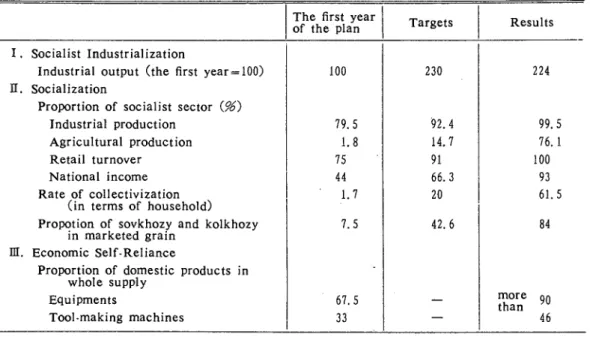
What were the results of the industrialization, which had been created at such a heavy cost ? To begin with, let us quote a number of statistics which were published by the USSR. Industrial outputs increased by 124 percent, and the target was attained 97.3 percent in four years and three months Above all, heavy industry increased by 173 percent, and the target was attained 108 percent during this period. 0n the other hand, growth in light industry was only 56 percent, and the target could not be attained. As a result of the industrializa-tion, the percentage of domestic products in the whole supply of equipments and tool-making machine increased. Agricultural production was to grow one and half times in five years according to the plan. But, because of disorder (resistances by peasantry and mass slaughter of livestocks) in the process of collectivization of agriculture other than poor harvest in 1931 and 1932, not only the targets for agriculture could not be attained but also the agricultural production decreased. The collectivization was carried out with more rapid pace than plan-ned. As a result, out of gross agricultural products. the proportion of agricultural products produced in socialist sector reached 76.1 percent. Since the proportion of sovkhozy and kolkhozy in the production of marketed grain amounted t0 84 percent, the volume of grain procurement increased to the 】evel that could somehow support industrialization.“Leasing of industrial enterprises as a form of state capitalism”15)CeaSedto exist virtually by 1930. “Private industry, which had played certain roll in census industry in the beginning of the
introduction of NEP, was virtually driven away completely already in the earliest years ,0f the firstfive-year plan as a result of successful development of socialist (state and cooperative) industry.”16)Small industry (kustarinichestvo, etc.), in which 57.1 percent of all labour
power of the Soviet industry had been engaged and which had produced 22.4 percent of the gross industrial output in 1926/27, was rapidly losing importance.''" The private sector.
68 Res. Rep. Kochi Univ. Vol. more than 224 99.5 76.1 100 93 61.5 84 9 0 4 6
which had occupied 17.6 percent of the gross industrial output in 1928, occupied only 0.5 percent in 1932.1" Out of gross national income, the proportion of national income which. was created in socialist sector rose t0 93percent in 1932.. The socialist sector completely dominated also in the sphere of circulation. (See Table 4.)
Table 4. The Results of the Performance of the First Five・Year Plan
I. Socialist Industrialization
Industrial output (the first year = 100) Ⅱ. Socialization
Proportion of socialist sector (%) Industrial production Agricultural production Retail turnover National income Rate of collectivization (interms of household)
Propotion of sovkhozy and kolkhozy in marketed grain
Ⅲ. Economic Self-Reliance
Proportion of domestic products in whole supply Equipments Tool・makingmachines 1 0 0 79.5 1.8 75 44 1.7 7.5 67.5 33 230 92.4 14.7 91 66.3 20 42.6 一 一
Source: V. I. Eidel'man (ed.). ShagiP:yatiletolこ,Moscow・, 1968, p. 73.
How shall we understand these statistics now ? As is generally known, western economists have discussed the methods of estimation of “correct” numerical value, for the reason that Soviet industrial statisticsinclude overestimates (by duplicated・ calculation of interim products, ・ neglect of rise in prices and so on). The author has no intention to go into this problem here. But the author wants to introduce only one distorted view. An ex-Mensheviki and Russian emigre N. Jasny maintained in his last book that the industrialization effort during these years was accompaniec! by the pursuit for qualitative targets at the expense of qualitative targets and many disorganization, and that not so many results could be obtained. He told us that the effort was in vain."' On the contrary。an English economist R. W. Davies properly criticized Jasny's view in his review article. According to Davies, Jasny was not free from bias,so that “the achievements resulting from the capital construction drive of 1928-32 are unrecorded, and it is made to seem an entirely pointless exercise”20) in his description. We also need to study Davies' attitude in which he tries to observe the realities with a cool mind。 Indeed, the industrialization during these years was accompanied by enormous wastes of
resources and labour powers from dispersed investment and disorganization. But an objective fact remains that approximately 1,500 big enterprises were built, including Dneproges, the Magnitogorsk and Kuznetsk metallurgical complexes. the Ural machine factory, the Rostov agricultural-machinery plant. tractor factories at CheliabinskレStalingrad, and Kharkov, auto-mobile factories in Moscow and Sormovo, the Ural chemical works, the Kramator factory of
heavy machinery, etc.. And new sectors of industry were established, which had not existed in tsarist Russia一automobile and tractor manufacturing, a chemical industry, etc.."' At
that time. capitalist countries suffered from world crisis which began in 1929 and extended to an unprecedented scale. In these countries productions declined sharply and a great number of unemployees surfaced. It stands out in striking contrast to the stagnation of capitalist countries that only the USSR, at the same time, wrestled with large scale con-struction of industry and made a great progress without “business cycles”, suffering from labour shortage rather than unemployment. It is without question that heavy industry which had been constructed during these years led to the reinforcement of defence power and further contributed the victory of the USSR in World War II。
Is it right that we should consider the construction of socialism in the USSR from this one point ? It seems that many-faceted considerations are required. How should we consider the following problems: the stagnation of light industry, the decline of agricultural produc-tions, the enforcement of collectivization of agriculture and so on ? Researchers, especially Marxists in Japan hitherto have positively evaluated the construction of socialism in the USSR during these years, considering these problems as inevitable consequences of the construction of heavy industry. The author also was not an eχception. However, it seems that the tradi-tional evaluation is too optimisticニ
ⅦExaminations of “the Inevitability of the Turn”
Here we encounter a problem that should be examined. This is the problem: “the inevi-tability of turn”at the end of 1929. , This also relates to the problem : how should we evaluate N. Bukharin. There are some arguments which justify “the great turn” by Stalin at the end of 1929 for the following reasons. The author can not afford to examine these reasons from every side. So, the author will confine himself to write brief comments on the reasons, promising to discuss them in detail afterwards.
a) The international situations
Soviet researchers explain that the enforcement of the overall collectivization of agriculture from above was done because of serious international situations at that time. But M. Lewin explains that the leadership of CPSU took into no account the factor of international situations when they enforced the overall collectivization of agriculture from above. To mention inter-national situations as a reason .is, according to Lewin, a justification by hindsight。"' Also it is well-known to us now that CPSU was not very cautious against the rising Nazis in
Germany until 1934. Thus, Lewin's argument seems to be well-ground. A further examina-tion will be required on this point.
b)The Growth of Kulaks
An argument is widespread that kulaks, who had grown up by this time, were reluctant to sell grain, and therefore changed into an obstacle for industrialization. But, on the contrary, we may be allowed to say that an error in price policy became one of the causes of the pro-curement crisis.・For example, the state procurement price of grain was fixed at a low level,
70 Res. Rep. Kochi Univ. Vol. 27、Sdc. Sci.
and a gap between
the procurement
price and the private market
price was
widening (75
percent in 1927/28, 134 percent in 1928/29)."'
And
that, rich peasants in the USSR
were
relativelysmall by the criteriaof Western Europe.
It seems doubtful to emphasize the menace
of the restoration of capitalism directly from the existences of kulaks.
c) The Problem of Replacement of Fixed Capital
Professor Kamijima (Osaka College of Economics, Japan), for example, states:“Grain pro-curement crisis was not mere shortage of procurement, nor mere crisis in countryside (the rise of kulaks), but it was, in fact, a consequence of synthetic synergy of contradictions inherent in NEP.”24)He attaches the importance to the replacement of fixed capital, as follows : “At this point of time, at last. state industry was entering a period of full-scale
construction, and this induced demands for new investment, firstof all, in wide sphere of heavy industry. Therefore, neither to follow former method of accumulation, nor to preserve moderate growth rate, in actualities, became almost possible physically. Neither the shortage of procurement and the corresponding raise of procurement price, nor the reduction in prices of manufactured goods - tolerable in the past ―- were n0longer possible
econo-mically and physically.”25J Professor Kamijima asserts that NEP was in an impasse at that time and that it became inevitable to turn to a new policy beyond the framework of NEP. So, he does not agree with Roy Medvedev's opinion that though still effective, NEP was abolished before the time Set.26)(However,hedoes not forget to add : This turn was done
by Stalin in the most clumsy way.)
It is sure that NEP got into a serious difficulty at that time. But in what degree was the “turn” inevitable ? Didn't he overestimate the problem ・of replacement of fixed capital ? On
this point, an American economist D. Granick, who had studied Soviet metal-fabricating industry in detail, argued that the fear of a replacement bulge, which a delay of the
re-placement of fixed capital might intensify, had been grossly exaggerated."'
d)The Construction of Heavy Industry the Reinforcement of the Defence Power It is often said that the industrialization with priority to heavy industry under the
leader-ship of Stalin somehow created heavy industry and reinforced the defence power, which in turn led the USSR to victory in World War II, whereas Bukharin's course might not have created heavy industry and, consequently, not led to victory. But such an argument is quite doubtful. Indeed some merits were involved in Stalin's course, but much more demerits were involved too. Bukharin opposed Stalin for the reason that Stalin's policy would invite an catastrophic result, and failed from power in 1929. When we reexamined the results of the performance of the first five-year plan with a cool mind, we could say that Bukharin's anxiety and forecast unfortunately proved true. It is sure that heavy industry took a leap forward owing to the performance of the plan, but light industry showed stagnation and agri-cultural production inversely declined. As to heavy industry, notwithstanding the great in-vestment with considerable sacrifices, the result corresponding to the sacrifices could not be obtained。
A. A. Barsov points out the bad influence which extraordinarily high investment rate exerts on industrial development, that iS: in spite of the yearly rise in the accumulation rate
during the first five-year plan, growth rate of national income was adversely decreasing year after year, and especially in 1933, when industrial output increased by only 5 percent. com-pared t0 1932 when the accumulation rate boomed t0 44.2 percent. According to Barsov, the shortage of the consumption goods, which intensified in 1931 and 1932, was negatively reflected in the material interest of the working people, and this could not help to exert in-fluence on the efficiency of production.^'' Moreover, Barsov explained without mentioning the name of Bukharin : “We can not help supposing that the accumulation rates in 1931 and 1932 were, in all probability, extremely too high and scarcely corresponded the optimum con-dition for the task of the most speedy industrialization of the country when we take into account, first of all, the decline of agricultural production level. It seems that the ap-proximately same effect in increasing industrial output and growth of heavy industry could have been obtained, even if somewhat small part of national income was assigned to accu-mulation, increasing consumption funds and creating better condition for material stimulation and rise in social labour productivity.29)
Similarly Roy Medvedev says: “The years 1932 and 1933 were a time of crisis for the national economy. Agricultural production had reached its lowest point, famine was begin-ning in many rural areas, and the industrial working class had also suffered a sharp deteriora-tion in its standard of living.”3o)
For this reason, the party and the government were obliged to adopt a sort of adjustment policy from 1933 t0 1934. That is why the second five-year plan, which was adopted by t‘he17th Party Congress in January 1934, predetermined that the average growth rate of light industry should be 18.5 percent while that of heavy industry should be 14.5 percent
(How-ever, these targets were neglected later. ). Consequently there are no grounds for the argument that heavy industry would not be constructed timely if Bukharin's course was adopted. Therefore, the author has a fundamental doubt about“the inevitability of turn”.
VⅢThe Consequences of “Great Turn”
In fact, Stalin's course could not realize a more rapid industrialization than Bukharin's course even against Stalin's will because of its inherent contradictions. Moreover, Stalin's course, that iS,“the great turn”,the investment excessively inclined to heavy industry and the enforcement of collectivization of agriculture from above, created a lack of solidarity and led to a social crisis. Thus the regime of suppression became firmly fixed in Soviet socialism. In the 192O's neither the single value system, nor the single doctrine dominated society, and diversified value systems coexisted. Cooperations between the Party and various groups of intelligentsias and specialists as well as lively debates among people including both party members and non-party members could be observed everywhere at that time.
But the process of the execution of Stalin's course after 1928 was simultaneously a process in which different opinions and resistences 一一which naturally occurred -一一 were not settled through debates and persuasions, but were excluded coercively. Non-Bolsheviki specialists were made victims of, to begin with, the Shakhty trial (May 1928), the trial of Industrial Party (November to December 1930), the Mensheviki trial (March 1931) and the trial of Vickers engineers (April 1933)."' With the Kirov affair (December 1934) as a start, the
72 「ゝ
、吟 Rep. Fvpchi UTf^v-・ YO;1, 27, Sqc. 肺. 一一
same process proceeded even within ,.●●1・I ,.〆ゝ・lj.「11「呼●.1ゝ・ ・yS.l・ ’゛・11・ ・ half of the 193O's
kj1S ●.¥・ ・1.●
the Cornrpunist Party of Soviet Un哨n
in the sefioqd
“ S m a l り e 9 鵬 ” w e r e s w a l l o w e d o r r 剛 a c e d f c i y S 呻 吟 e n t p r g r i 門 S \ y i t h i n り h g r ! 卯 心 d り 卯 t h e s t a t e s e c t o r b e c a m e i n f l a t e d m o r e a n 4 r f ) o r e . S i m u l t a n e o i ( s l y w i t い h e r e o r 卵 n i z a t i o n Q f t 恥 Y S N K h ( S u p r e m e C c ? u r │ c i l 9 f j S T a t i q n a l E q 叩 o m y ) i n t o i n d i v i d u が i n d u s t r i a l m i n i s t r i e s . a h i g h l y 9 9 叫 皿 雌 邸 内 n n i n 町 n l 印 叩 i n り y 聯 m w a s C O r 叩 l e t e d . J u s り § B u k h a r j n h 副 帥 r 昧 り w o l l e n , c o s t l y , a n d i n e f f i c i e n t a d m i n i s t r a t i v り p p a r a t u s ・ 叩 c e c r e a t e d ・ 叫 e s s a n t l y 9 9 卵 叫 叫 t p s w e l l w i t h i t s o w n , s e l f 一 糾 s t a i r ( i n ! 1 d y n a m 卜 m . 4 S t o § o c i a l i s t r e p r g a n i z a t i 叩 9 り g r i c u l t u r e , t h p p e r c e n t a g e o f c o l l 叩 t i y i z a t i f l n w a s r a i s e d t p 7 7 . 7 p e r c e n t ( i n t e r m s o り o w n a r e a ) i n 1 9 3 2 リ ㈲ t 9 9 9 . 1 p e r c e り り p ! 9 3 7 . I n t h i s c o n r ! e c t i q n . i O リ q r m 叫 y e x p l a i n e d t h g ! t s p c i a l i s m h a d 副 r ! 邸 り r i u m p h a n d c o n s e 叫 e n t l y t h e t r a n s i t i p n a l p e r i o d f r o m c a p i t a l i s m t o § 叫 叫 s m h a d t e r m i n a t e d ( “ s o c i a l i s m a リ h p n r § t p h a s e p f p o m m u n i s m h ^ j i b e e n b a s i c a l ! y r e a l i s e d つ i n t h e y S S R a t t h i s p p i n t o り l r 限 f 9 r r 哨 印 り h a t s o c i a l i s t o w n e r s h i p h a d b e e n c o m p l e t e d i n n e a r l y 1 0 0 p e r c e n t o f t h e n a t i q n a l e c o n o m y i n c l u d i n g a g r i c u l t u r e A n d t h e r e a r e m a n y r e s e a r c h e r s o n s o c i a l i s t e c o n o m y w h o b e l i e v e a n d r e p e a t ● ・ 4 ・ ¶ ● 1 , 1 ・ l l ● ゛ i S 1 1 . l i . ・ I ’ 1 ヤ ? i り ・ 1 ● I Z . ・ ’ ・ ・ ● j t ゝ i ゛ I / . t h i s f o r m a り x p l 印 面 9 n j n J a p a n . B u t i t m u s t b e S a 叫 卯 1 t t h i s e x p l a n a t i o n ヽ 卜 t 叩 附 m 乱 T h e c o l l e c t i v i z a t i o n o f a g r i c u l t u r e c o u l d n o t h a v e b e e n c a r r i e d o u t b a s e d o n t h e r e s u h t t p : / / w w w . . . . a d . j p . k 1 . ・ 4 . jt . ミ ・ . 4 t . i J S . ・ . . , ’ ● . ・ . r . 4 1 ・ . ・ 丁 J . 4 f ● . ● J - ● ・ / ・ ↓ ・ ゝ J . , ● 4 ・ ● j 1 s u f f i c i e n t i n d u s t r i a l i z a t i o n . O n t h e c o n t r a r y , t h e c o l l e c t i v i z a t i o r ! o f a g r i c u l t u r e w a s , i r ! p r a c r t i c e , c a r r i e d o u t i n a n e x t r e m e l y s h o r t t i m e , b e c a u s e t h e l e a d e r s h i p o f t h e P a r t y r e g a r d e d ● ’ . ノ I I ● ・ ● 1 Φ ` 丿 ・ - ● ● ・ ● ・ j 1 ・ ● ● ● ・ ● .● ● ● J ` ● ● I ・ ・ 1 ・ Φ ・ ● I ♂ ● ● ・ ・ ● ・ i t a s m o s t i m p o r t a n t t o s o l v e t h e p r o c u r e m e n t c r i s i s i n o r d e r t o p r o m o t e i n d u s t r i a l i z a t i o n 9 ● . ● ● t . . i ’ ・ ・ ● 4 ● ● ● ゝ ノ ● ● ● ’ ` - 1 ミ ー ・ 鞠 「 r l ● , 」 ● ● k , f ● ¶ 」 ・ s ● l ● ● , ≒ ・ . ● , ・ , . ● T h e r e f o r e , t h e k o l k h o z y w h i c h h a μ b p e r ! c r e a t p c ! i n s u c h a w a y l a c k e d t h e m a t 町 i a l f p u n d a t i 叩 S a d e g i ! a t e t Q " s o c i a l i z e d a g r i c u ! 叫 r 9 ” . 4 ! t h o u g h l a r g e - s i z e d a g r i c u l t u r a l m a c h i n り s u c h a s t r a c -t o r s , c o m b i n e s a n d t r u c k s w e r e S U R R l i p d t o a g r i c u l t u r e l a t e r , t h e d a m a g e f r o m m a s s s l a u g h t t p : / / w w w . ゝ . . 6 ・ . . ・ i 4 ● タ ● 4 X ● ・ , . . φ ・ ・ ・ f t ・ ・ W ● ・ j ● ・ ` , . ● k ● ・ j ・ ぐ ● ゝ 1 1 1 ゝ f ・ . μ 1 - s ・ ! I W ・ ` ・ ● ・ ● ` ・ , ” c ″ ‘ ゛ o f l i v e s t o c k s w a s s o s e v e r e t h a t t h e 1 9 2 9 p p a k o f t o t a l h p r s e p p w e r u t i l i z e d o n t h e f a r m s w a s ● . . ・ 同 ・ 6 ● ● S ・ l・ J j ・ ・ ・ ゝ k ・ s / . . 心 . ゛ . 「 │ . ’ . ・ ・ ・ ! ・ ゛ . ・ ・ . ● l i J . y . 」 . ・ ・ ● ・ ● ・ ・ 警 ・ ・ s ● ・ n o t r e g a i n e d b y 1 9 3 8 . " ' W e p r e v i o u s l y s a w t h a t a g r i c u l t u r e w a s u t i l i z e d a s a s o u r c e o f a c c u m u l a t i o n f o r i n d u s t r i a l i z a t i o n . N o w l o o k a g a i n T a b l e 4 w h i c h B a r s o v d r e w u p . I n 1 9 3 1 , f o r e x a m p l e , t h e e q u i v a l e n t c o e f f i G i e n t o f e x . c h a n g e b β t w e e n a g r i c u l t u r e a n d n o n - a g r i c u l t u r a l s p h e r e e q u a l s 2 . 3 1 . F r o m t h e i t e m s o f t h e s a m e t a b l e , w e c a n p e r c e i v e t h a t t h e e q u i v a l e n t c o e f f i c i e n t o f e x c h a n g e b e t w e e n s o c i a l i z e c ! e c o n o m y o f k o l k h p z y 即 皿 n o n - a g r i c u l t u r a l s p h e r e e q u a l s 7 . 7 5 ( t h i s m e a n s t h a t s o c i a l i z e d e c o n o m y o f k o l k h o z y d e l i v e r e d 7 . 7 5 u n i t s o f a g r i c u l t u r a l p r o d u c t s t o n o r ! - a g r i c u l t u r a l s p h e r e i n e x c h a n g e f o r e v e r y l u n i t o f p r o d u c t f r o m t h e ! a t t e r ) . 4 丁 l k ● ● M o r e o v e r , t h e b a l a n c e o f m a t e r i a l e x c h a n g e b e t w e e n a g r i c i ! l t u r e 即 d t h e s t a t e ( T a b l e 5 ) , w h i c l ! a l s o B a r s o v d r e w u p , s h o w s t h a t t h e e q u i v a l e n t c o e f f i c i e n t o f e x c h a n g e b e t w e e n s o c i a l i z e d . 4 . . ● 4 ● ・ ● ● J ミ , ‰ . ● , ・ - ● ● ● I ’ S ● ● ● ● 1 ・ e c o n o m y o f k o l k h o z y a n d t h e s t a t e w a s a t r e m e n d o u s l y h i g h f i g u r e o f 8 . 6 6 . S t a t e p r o c u r e m e n t ミ ー − ● ・ . . ・ - 同 ・ . ・ ・ − 4 ● . ● ・ 4 ● ● ・ ゝ ● ● ● ・ . j . ● 丿 j ● ● ● p r i c e s w e r e p e g g e d a t a n e x t r e m e l y l o w l e v e l d u r i n g t h e 1 9 3 O ' s , s o t h a t t h e p r i p e s o f m a n y ● 4 ミ ゛ ` . ` , ゜ ゛ ● ` ・ ゛ ゛ I I ・ 1 . 〆 ・ , / . ● ・ ・ ・ . ・ ゛ ゝ j s s ゛ . ・ i ● s o r t s o f a g r i c u l t u i ‘ 3 1 p r o d u c t s , s u c h a s g r a i n s a n d p o t a t o e s , ( ! 吊 り 9 t , り o m p e n s a t e f Q r p r o d u c t i o n μ 3 S t S . K o l k h o z p e a s a n t r y 9 9 リ 1 4 b 町 e ! y r e p r o d u c e d t 図 r o w n 肺 叫 r p o w e r り y v i r t u e o f s u b -s i d i a r y v v o r k o n h p u s e h p l d p l o t s . S u c h a r e l a t i 叩 ! b e t w e e r ! t h e S t 排 卵 4 p e a s a n t r y b a s i c a l l y r 9 聊 皿 d u n c h 叩 煕 d u n t i l t h e 卯 P り 「 即 c g o f K h r u s h c h e v ' s a g r i c u l t u r a ! P o ! i c y 球 e r W o r l d W a r I I . " ' T h i s W 4 S t h り u b s t a n c p g f 串 り p - p a l l ^ c ド 斗 j c i a l i z e d a g r i c u l t u r e ” w h i c h h a d b 9 叩 c r e a t e d c o e r c i v e l y f r o m a b o v e i n t h e 1 9 3 O ' s . T h e a u t h o r h e s i t a t e s t o a s s e r t t h a t t h i s w a s n o t a s o -1 ● ● -1 ● -1 -1 ゛ ・ ● d -1 ’ ● -1 ● ・ ● ● │ ・ 1 ● ’ ● j − ● . ; ● ● i ・ ・ ゝ . c i a l i z e d a g r i c u l t u r e . H o w e v e r , a q u e s t i o n r e m a i n s 。 t h a t i s : i n w h a t d e g r e e w a s t h i s a g r i c u l - ・ 1 - ● t , ● - - ・ - - . ・ 1 1 ● 1 ● ` ゛ ` l ・ ` ・ ・ ・ ・ j ’ ゝ ` ● d ` ゛ ・ ’ − ・ ● 1 , / ● l
Table 5. The Balance of Material Exchange
between Agriculture and
theState in Social Sectors in 1931
(in
million rubles at calculation prices)
All agriculture
Sovkhozy
Kolkhoz・cooperative
sector
Private*
sector
Kolkhozy
and MTS
soc. eco. of kolkhozy1.?Vlarketed output of agriculture delivered to the state
2. Industrial goods delivered from the state to agriculture
3. Balance (2-1) 4. Equivalent coefficient(1:2) 4,320.9 1,313.0 -3,007.9 3.29 253.9 424.5 十170.6 0.59 2,178.3 420.5 -1,766.8 5.15 2,178.3 249.9 -1,937.4 8.66 1,879.5 468.0 -1,411.5 3.96
* Private sector includes subsidiary work of kolkhoz peasantry in this table.
Source: A. A. Barsov, Balans Stoimostnykh Obvienovmezhdu Gorodom i Dereunei, Moscow : Nauka, 1969. pp. 148-149.
ture socialistic ?
The construction of socialism after “the great turn” not only transformed a backward ag-ricultural country into a industrial country,・ but also fundamentally remolded the Soviet society as well as the Communist Party of Soviet Union itself. The author can not characterize this metamorphosis appropriately; According to M. Lewin's formulation, the Stalin model that emerged in the 193O's on the ruins of NEP exhibited the following traits:34’
1)a high degree of centralization of economic decision making and planning 2) comprehensive character of planning `
3) preference for physical units as instruments in accounting
4) the use of “material balances” for obtaining internal consistency of the plans
5)a centralized administration for material supplies, which operated as a rationing system 6) the imperative and detailed character of plans
7)a hierarchically organized administration within factories
8) the relegation of market categories and mechanisms to a secondary role, mainly the sphere, albeit important, 0f personal consumption and t0labor
9) coercion by the state. as direct organizer of the economy with its ubiquitous controls and etatization not only of the economy but of the other spheres of life as well
In addition to that, we can say that the situation such as a fusion, an adhesion, an uni-fication of the Party and the State, in other words, “etatization of the Party” was completed in the political sphere."' The Soviet society which had been remolded in the 193O's is an unique socialism carved out of the above-mentioned traits.
Note
1. Roy Medvedev,Let HistoりJudge, Japanese version translated from Russian by Seirin Ishido, Tokyo : San'ichi Shobo, 1973, Part 1,p. 148. The cited sentence is omitted in the
74 Res. Rep. Kochi Univ. Vol. 27. Soc. Sci.
English version. The corresponding paragraph which must include the Sel!tence is on page 360 0f English version.
2. As to the grain procurement crisis and the extraordinary measures, see E. H. Carr and R.χN. DaviesFoundatios of a plannedEconomy 1926−jタ2タ, Vol. one・I, London : MaC・ millan, 1969, pp. 48-66.
3. Moshe Lew inPolitical Undercurrentsin Soviet Economic1:)ebates: From Buhharin to 怯e Modern Reformers,Princeton University Press, 1974, p. 69.
4. In description of paragraph II the author owed to ibid.。・pp. 41 ― 66.
5.“A Note of an Economist'", The CollectedWorks of Bukharin,Tom. 2, (Japanese version) p. 118.
6. Moshe Lewin, Russian Peasantsand SoxitetP・ntier; A Stud:yof Collect!。zationLondon: George Allen and Unwin Ltd., 1968, p. 346.
1,Loc.ctt.
8. Takeshi Kamりima. An Introducti。71of Soviet Econ。mtcHis£6りごIntra.Party L)ebatescon. cerningNEP,(in Japanese) Tokyo : Aoki Shoten, 1977, p. 162.
9. See, for eχample, F. Seton, KconomicE)e-uelopmentand Policjiof the So-uietUnion(in Japanese) Tokyo : Sobunsha, 1959, p. 123.
10. A. A. Barsov,“Sel'skoe Khozyaistvo i Istochniki Sotsialisticheskogo Nakoplenie v Gody Pervoi Pyatiletki (1928^32)”, IstoriyaSSSR,no. 3. 1968.
Batans SloimoJtnjpfeh 01。nertot)viezhdu Gorod。m i IDere-unei,Moscow Nauka, 1969.
,“NEP i Vyravnivanie Ekonomicheskikh
Otnoshenii mezhdu
Gorodom
i
Derevnei", M. P. Kim (ed.), Novaya EfeonotnichesfeayaPolittfea; Voprosy Teorti i Istorii,Moscow s Nauka, 1974.
Barsov criticizes in principle the western researcher's view that the industrialization during these years was carried out through “socialist primitive accumulation". However, a merit of Barsov's study consists in the point that he did not follow the stereotyped criticism and he made clear the extent of agriculture's contribution to the industrialization in quantity as a result of analysis by the balance of material exchange between rural and urban regions in terms of value.
11. Naum JasnySoviet Industrialization, 1928-52, Chicago, 1961, pp. 109-110.
12. Roy Medvedev, Let History Judge(English version), New York : vintage books. 1973, p. 107.
13. For example, a representative book on economic history which was published by Science Academy of the USSR says that the volume of consumption per capita gradually increased as follows:
year 1928 1929 1930 1931 100 101.5 106.2 112.0
I. A. Gladkov (ed.),Postroenie FundamenはSotsialisticheskoi EfeonoJiitfet l。 SSSR,1926−1932 es., Moscow. 1960, p. 102.
14. A. A. Barsov, Balans Stoimostnykh Obmenov inezhduGorodoin iIZ:)erct。7どらp. 95. 15. I. A. Gladkov, op. cit., p. 206. ,
16. ibid., p. 210. 17. ibid., p. 211. 18. ibid., p. 210.
19. Naum JasnySoviet Economistsof the Tt。en£ies。・Na刀les tobe Kerne。ibered.Cambridge University Press, 1972, p. 9.
20. Soviet Sは■dis. Vol. 25, no. 1, p. 130. 21. See Roy Medvedev, op. cit., p. 101. 22.?V[oshe Lewin, 0p. cit, p. 492.
Pelican Book, 1976. pp. 139- 142.
24. Takeshi Kamijima,“On the Methodology of Studying Economy of Transitional Period",
The Annals of Economic Theory Socieり(in Japanese), no. 11, Tokyo : Aoki Shoten, 1974,
p. 126.
25. Takeshi Kamijima, An Introduction of Sotijet Econorntc Htstorjip. 126.
26. Roy Medvedev, Let HistoりJudge,(Japanese version), p. 225.
27. David Granick, So'utet Metal-Fabricating and Economic Development ; Practice ■uersus
Policy,The University of Wisconsin Press, 1967, pp. 135-136.
28. Barsov, op. cit., p. 95.
29. ibid., p. 96.
30. Roy Medvedev, LetI Historv Judge,(English version), p. 106.
31. See Naum Jasny, op. cit., pp. 61 ― 71.
32. David Granick, 0p. cit, p. 131.
33. As to the relationship between socialized economy of kolkhozy and subsidiary work on
household plots, the following book gives us detailed informations : Hiromasa Nakayatna,
ContemporaりSoviet Agricultur・e ; Khrushche・u's Agricultural Polic:yand Hierarchic Strata
of Prcソession, (in Japanese) The University of Tokyo Press, 1976.
34. Moshe Lewin, Political Undercurrents,pp. 113-114.
35. See Yuzuru Taniuchi, A IReflectionon C・ntemporary Socialism(in Japanese) Tokyo:
Iwanami Shoten, 1978, p. 337.