Where is the Object of Words ?
Dharmakīrti, Dharmottara, and Jñāna
ś
rīmitra
NAKASUKA Miyuki
1. Introduction
The aim of this paper is to examine the fundamental disagreement between Dharmottara and Jñānaśrīmitra on the topic of the word s object in the apoha theory. The disagreement stems from two different views concerning objects related to words and conceptual cogni-tions: three-domain view and two-domain view. The former accepts three domains, inter-nal, exterinter-nal, and neither internal nor exterinter-nal, and the latter the first two domains. Both the views are seen in Dharmakīrti s PV and PVin. The difference between Dharmo-ttara s position and Jñānaśrīmitra s depends on which view they inherit from Dharmakīrti.
2. Dharmakīrti
In PV Dharmakīrti describes the following process by which one takes action toward an external entity through a conceptual cognition. Step 1: One perceives an external entity that has differences (bheda) from all other ones, and then the residual impression (vāsanā) of one of the differences (O1) is implanted into his/her mind. Step 2: When he/she
per-ceives another external entity that has the same difference (O1), the residual impression is
awakened. Step 3: There arises a conceptual cognition that judges (adhi-ava√so) its mental image (O2) to be the external entity (O4). Step 4: This conceptual cognition leads
him/her to a practical activity toward the entity (O4).
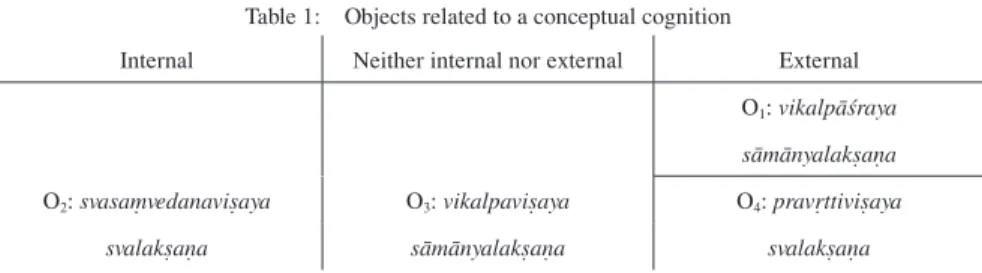
In this process, there are four kinds of objects related to a conceptual cognition: the object on the basis of which it arises (O1); the object of self-awareness (O2); the object
called the conceptual cognition s object (O3); and the object of an activity caused by it
(O4). O1 and O3 are called sāmānyalakṣaṇa. O2 and O4 are called svalakṣaṇa. They can be
Table 1: Objects related to a conceptual cognition
Internal Neither internal nor external External O1: vikalpāśraya
sāmānyalakṣaṇa
O2: svasaṃvedanaviṣaya O3: vikalpaviṣaya O4: pravṛttiviṣaya
svalakṣaṇa sāmānyalakṣaṇa svalakṣaṇa
Dharmakīrti s argument on linguistic activities in PV presupposes the following process.
Step 1: When the speaker perceives an external entity, then on the basis of its difference
(O1) from others (see the steps 1–2 in the case of a conceptual cognition), there arises in
him/her a conceptual cognition in which a mental image (O2) appears, being mixed with a
certain word. Step 2: The speaker wishes to make the entity known to the hearer in accor-dance with the mental image (O2) appearing in the conceptual cognition, and then makes
an expression about the entity by uttering the word. Step 3: There arises in the hearer a conceptual cognition that judges its mental image (O2) to be the entity (O4). Step 4: The
hearer takes action toward the entity (O4).
In this process, the three kinds of objects are all called the object of a word in differ-ent senses: O1 is the object on the basis of which the speaker s conceptual cognition arises;
O2 is the object directly connected with the word in the conceptual cognition the speaker or
the hearer has; and O4 is the object of the hearer s judgment and activity, which are the
pur-pose of the utterance of the word. They are called sāmānyalakṣaṇa, svalakṣaṇa, and svalakṣaṇa, respectively. In the case of words, Dharmakīrti does not take into account the mental image judged to be the external entity (O3), which belongs to the third domain, i.e.,
neither internal nor external. For, unlike conceptual cognitions, words do not have the function of judgement. It should be noted that Dharmakīrti calls only the mental image (O2) the object of the word in the following contexts.
(a) Expressions about sāmānya, sāmānādhikaraṇya, and dharmadharmibheda: These expressions are possible only with regard to mental images, not with regard to external entities because an external entity is different from all other ones and cannot be divided into parts.
(b) The object of affirmation/negation: In the statements p does not exist and q does not exist in
p, even if p is not existent in the external world, it does not follow that there is no object of
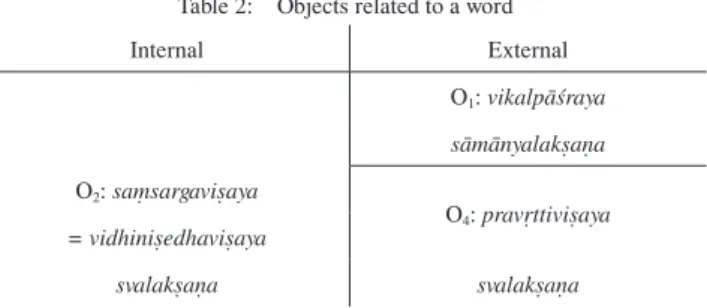
The objects O1, O2, and O4 can be assigned to the two domains as follows:
Table 2: Objects related to a word
Internal External O1: vikalpāśraya sāmānyalakṣaṇa O2: saṃsargaviṣaya O4: pravṛttiviṣaya = vidhiniṣedhaviṣaya svalakṣaṇa svalakṣaṇa
In PVin, Dharmakīrti takes the two-domain view not only regarding words but also re-garding conceptual cognitions, and the contrast between perceptions and conceptual cogni-tions in PV―the former have their objects in the two domains whereas the latter in the three domains―disappears. Perceptions and conceptual cognitions differ only in whether the presence and absence of their appearances correspond to those of the external entities. Moreover, interpreting the object of words as the object of conceptual cognitions arising from words, Dharmakīrti explains the two objects in the same manner. In addition, with re-gard to the object of affirmation/negation he reuses his own expression in PV, and there-fore there is no difference on this point in PV and PVin.
3. Dharmottara
Dharmottara declares that the object of words is equal to that of conceptual cognitions, in-terpreting the object of a word as the grasped objects (*grāhya) of both the speaker s and the hearer s conceptual cognitions which are the cause and the effect of uttering the word respectively (AP(Dh) 236.6–10). This allows him to explain the object of words in terms of the grasped object of conceptual cognitions instead of the object of words itself.
He inherits Dharmakīrti s position on the object of conceptual cognitions represented in PV. There Dharmakīrti considers that the object of conceptual cognitions is the mental image judged to be the external entity, and Dharmottara calls it superimposed form (āropitarūpa), distinguishing it from the mere mental image, which is the object of self-awareness.
Dharmottara introduces into the theory of valid knowledge (pramāṇa) the division of its object, i.e., the grasped (grāhya) and the judged (adhyavaseya). According to him, both
perceptions and conceptual cognitions have the same function of judging x to be y. In the case of conceptual cognitions, x means the grasped object, which is a sāmānyalakṣaṇa, and y the judged object, which is a continuum of svalakṣaṇa. This interpretation is different from Dharmakīrti s view in PV. For Dharmakīrti a sāmānyalakṣaṇa as the object of a con-ceptual cognition is what can be denoted by x+y. Dharmottara s unique view on the grasped is reflected in his interpretation of the famous passage from PVin, svapratibhāse narthe rthādhyavasāyena pravartanāt... (PVin 46.7). According to him, adhyavasāya means superimposition (samāropa), which occurs at the same time as self-awareness does, and therefore no one can distinguish the object of self-awareness, i.e., the mental image, and that of the conceptual cognition, i.e., the superimposed form. In this case, svapratibhāsa in the passage means āropa and because it is neither internal nor external, anartha means the unreal (avastu) (AP(Dh) 238.18–34).
Giving the four options for the object of affirmation/negation: 1) the external entity, 2) the conceptual cognition, 3) the grasped aspect (*grāhyākāra), and 4) the superimposed form, he denies all of them and proposes as the object the superimposed form that is judged to be the external entity (AP(Dh) 243.27–244.9). This expression is paraphrased by Jñānaśrīmitra as the externality of the superimposed [form] (āropitasya bāhyatā).
Table 3: Objects related to a conceptual cognition and a word
Internal Neither internal nor external External
svasaṃvedanaviṣaya vikalpaśabdaviṣaya vidhiniṣedhaviṣaya pravṛttiviṣaya
=grāhya =adhyavaseya
svalakṣaṇa sāmānayalakṣaṇa āropitasya bāhyatā svalakṣaṇa
4. Jñānaśrīmitra
Jñānaśrīmitra denies the third domain, neither internal nor external, which Dharmottara accepts, and the superimposed form that belongs to the domain. According to Jñānaśrīmitra, there are only two modes of cognition: appearance (pratibhāsa) and judg-ment (adhyavasāya). Therefore, the object of a conceptual cognition is only of two kinds: the mental image appearing in it and the external entity judged by it. The former belongs to the internal domain, the latter the external domain, so that there is no room for the third domain (AP(J) 230.4–7). Denying the third domain, he shifts sāmānyalakṣaṇas from the
third domain to the internal one. According to him, the mental image itself is the svalakṣaṇa which is the object of self-awareness, and, being made one with the external en-tity, called also sāmānyalakṣaṇa. Whether the mental image is called svalakṣaṇa or sāmānyalakṣaṇa depends on the cognitive operation of making one (ekīkaraṇa), which is none other than adhyavasāya (AP(J) 226.23–26).
Jñānaśrīmitra s interpretation of adhyavasāya indicates that he is conscious that adhyavasāya being involved with two factors, i.e., the mental image and the external entity, leads to acceptance of the third domain. We can find this from his interpretation of the above-mentioned passage from PVin, svapratibhāse narthe... too. He discards the struc-ture of adhyavasāya, judging x to be y, by interpreting the locative case suffix in the ex-pression svapratibhāse narthe not as viṣayasaptamī, but as satisaptamī. Moreover, in or-der to deny Dharmottara s interpretation of anartha as the unreal (avastu), he explicitly says that anartha means the mental image, which is real (vastu), but not existent (asat) in the external world (AP(J) 227.22–24).
According to Jñānaśrīmitra, at the ultimate level, there is no object of affirmation/ne-gation in the internal or external world; whereas, at the conventional level, the object is only the external entity, which is the judged (AP(J) 229.1–15). For ordinary people have the misconception that it is the external entity that is the object of both affirmation/nega-tion and words, and this misconcepaffirmation/nega-tion urges them to take/refrain from acaffirmation/nega-tion toward it (AP(J) 229.16–23). At the conventional level, he provides different views in order to deny each opponent s views. In denying Dharmottara s view that the object of words is the su-perimposed form, he provides ordinary people s view that the object is external entity es-tablished through judgment. In denying ordinary people s view, he provides the view that the object is the mental image established through appearance. At the ultimate level, how-ever, he tells the truth: there is no object of words (AP(J) 230.7–18).
Table 4: Objects related to a conceptual cognition and a word (at the conventional level)
Internal External
svasaṃvedanaviṣaya pravṛttiviṣaya
=grāhya =adhyavaseya
= vidhiniṣedhaviṣaya
5. Conclusion
In PV Dharmakīrti accepts the three-domain view and the two-domain view regarding con-ceptual cognitions and words, respectively, whereas in PVin he accepts only the two-do-main view regarding both of them. Inheriting the three-dotwo-do-main view, Dharmottara applies it not only to the case of conceptual cognitions but also to that of words. This becomes pos-sible by identifying the object of a word with that of the conceptual cognition that is either the cause or the effect of the utterance of the word. According to him, the object of words is the superimposed form, which belongs to the third domain, in other words, which exists in neither internal nor external world, and concequently, the object of words is unreal. Jñānaśrīmitra, inheriting the two-domain view, rejects the three-domain view advanced by Dharmottara. Analyzing the object of words from the perspective of the conventional and ultimate levels of truth, while he accepts the existence of the object of words at the con-ventional level, he denies it at the ultimate level. In conclusion, it can be said that the dis-agreement between Dharmottara and Jñānaśrīmitra derives from the different views they inherit from Dharmakīrti.
Abbreviations
AP(Dh) Tibetan translation of Dharmottara s Apohaprakaraṇa. Frauwallner, Erich. 1937. “Beiträge
zur Apohalehre: II. Dharmottara.” Wiener Zeitschrift für die Kunde des Morgenlands 44: 233–287.
AP(J) Jñānaśrīmitra s Apohaprakaraṇa. See JNĀ.
JNĀ Jñānaśrīmitranibandhāvaliḥ. Ed. Anantalal Thakur. Patna: Kashi Prasad Jayaswal Research
Institute, 1987.
PV Dharmakīrti s Pramāṇavārttika. Miyasaka Yūsho, ed. 1971–1972. Pramāṇavārttikakārikā (Sanskrit and Tibetan). Acta Indologica 2: 1–206.
PVin I, II Dharmakīrti s Pramāṇaviniścaya Chapters 1 and 2. Ed. Ernst Steinkellner. Beijing: China Tibetology Publishing House, 2007.
PVin III Dharmakīrti s Pramāṇaviniścaya Chapter 3. Eds. Pascale Hugon and Toru Tomabechi.
Bei-jing: China Tibetology Publishing House; Vienna: Austrian Academy of Sciences Press, 2011.
Key words Dharmakīrti, Dharmottara, Jñānaśrīmitra, pratibhāsa, adhyavasāya, śabdārtha