9-1
A Basic Research for Evaluating University Campus Development in Indonesia: A Case Study of
University of Indonesia, Udayana University, and Hasanuddin University
RAHMA HIROMI
1. Introduction1.1. Background of the Study
The Republic of Indonesia is an archipelago in Southeast Asia with total populations over 246 million. This condition is proportional to the educational needs in every region of the country. To accommodate these needs, some universities in Indonesia are developing their campuses to improve their capacity. As a planning problem, the condition of some older buildings was not capable of providing the needs, which is increasing every year. Most universities in Indonesia prefer to build new campuses to accommodate future enrollments. However, the construction of new campuses in dense urban areas was challenging. Taking existing limitations to consideration, how universities handle such challenges and how to evaluate the new campus development in Indonesia are the basics question that this research tries to study.
1.2. Purpose and Objectives
The purpose of this study was to investigate how the new campuses handles the urban challenges and to develop a new tool for evaluating new campus developments in Indonesia. Therefore, this study has two main objectives. The first is to find out the issues of new campus development in Indonesia. The second is developing new evaluation tool by analyzing the issue, relevant literature, and existing evaluation tools and test it to know whether is applicable in Indonesia or not.
2. Review of Relevant Literature And Studies 2.1. New Campus Development
Richard P. Dober (1996) explained that expansion of existing campus might be accomplished in several ways. The best way to begin the decision making process is by preparing a development plan. The strategy of starting with such a plan can be justified by the need for long-range projections of land requirements and site locations in order to determine the placement of the earliest construction. Physically, expansion requirements can be met in many ways including build a new campus.
The following constitutes the steps to be taken in preparing plans for a new campus:
a. Preliminary programming, preparation of a diagrammatic development plan
b. Site selection
c. Final development plans d. Phase one project plans
2.2. Evaluation
Evaluation is as important as the preparation in new campus planning. Evaluation provides the consolidated source of information showcasing project progress. As stated by Hongwei Tan, Shuqin Chen, Qian Shi & Lingling Wang in their research about green campus development in China (2013), that it is necessary to set up a long-term goal of sustainable development of the university. It is the important guarantee for campus development to establish an evaluation system and methodology of the campus. According to that statement, there are several prominent evaluation tools in the world to evaluate and rates the performance of a given neighborhood against a set of criteria and themes.
2.3. Selected Evaluation Tools
NSA (Neighborhood Sustainable Assessment) tool (or commonly referred: district sustainability assessment tool, neighborhood sustainability rating tool, sustainable community rating tool, rating system, evaluating tool, etc.) is a tool that evaluates and rates the performance of given neighborhood against a set of criteria and categories, to assess the neighborhoods’ position on the way towards sustainability and specify the extent of neighborhoods’ success in approaching sustainability goals (Sharifi 2013).
There are several prominent evaluation tools in the world to evaluate and rates the performance of a given neighborhood against a set of criteria and themes: LEED-ND (focus on neighborhood sustainability), CASBEE-UD (focus on environmental performance), and so on. Since LEED-ND is one of the evaluation tool that applicable for overseas and CASBEE-UD is one of the evaluation tool that applicable for Japan and Asian Countries. This research selected these two evaluating tools for further analysis.
Similarly, Indonesia also has an evaluation tool named GREENSHIP. This evaluation tools discussed more about new building, existing building, and interior. As this research only focus on new campus development, GREENSHIP evaluating tools was not used in this study. Besides, there is an evaluation tool relatively new, which was developed in Japan called CAS-Net Japan. This evaluation tool is the most closely related to this study among all, which evaluate the sustainability of campuses. However, CAS-Net is only focus on campus sustainability in Japanese universities and contributes to create more environmentally sustainable society in Japan.
9-2
Table 1 Samples Characteristic3. Methodology
The purpose of this study was to investigate how the new campus handles the urban challenges and to develop a new tool for evaluating new campus development in Indonesia.
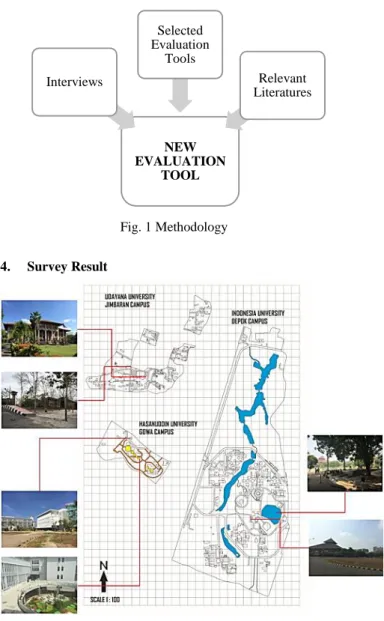
First objective is finding out the issues of new campus development in Indonesia. Site observation and interviews with the people who manage the campus developments in each campus was conducted to obtain accurate information and understanding of the general issues of new campus development in Indonesia. In order to develop a new evaluation tool for campus development in Indonesia, after understanding the issues from interview and the benchmarks of campus development from relevant literatures, study about the similar evaluating tools was needed. By using existing evaluation tools (LEED-ND and CASBEE-UD), new campus samples in Indonesia were evaluated to understand them.
After understanding the basis of developing campus and try to evaluate, the new evaluation tool for campus development in Indonesia was developed by analyzing the issue, relevant literature, and existing evaluation tools and synchronizing all. Finally, the new evaluation tool was tested for its applicability in Indonesia.
3.1. Sampling Method
Among 13 universities that are developing new campuses in Indonesia, there are 10 campuses with recently completed projects and on-going projects. Almost all of 10 these selected new campus projects had similar criteria. After looking the information more deeply, projects with different characteristic were selected as samples for this research. The selected samples were: University of Indonesia, Hasanuddin University and Udayana University (Table 1).
3.2. Interview
The topic of the interview is random, related to the designated campus development.
Fig. 1 Methodology
4. Survey Result
Fig. 2 Campus Samples Map
4.1. University of Indonesia
University of Indonesia, Depok campus is a transit-oriented development and surrounded by 2 train stations and bus stops. This campus has a plan to create an environment-based campus or known as the ‘green campus’. This campus provides 6 lakes (water absorption area for Depok city). From interview, Head of University Planning, Development, and Control, University of Indonesia, explained that this campus applied ‘energy independent’ in the campus hospital, applied energy audit, applied green roof, and so on. However, the issue is, a highway has being constructed in one part of this green campus.
Fig. 3a Bicycle Facility Fig. 3b Green Roof NEW EVALUATION TOOL Interviews Selected Evaluation Tools Relevant Literatures University Main Characteristic
University of Indonesia (Depok City, West Java)
Due to rapid development which caused by University of Indonesia, Depok district which was previously under Bogor Regency and became a city in April 22nd 1999
Udayana University (Jimbaran, South Kuta, Bali)
Developed new campus in the tourism area, connected by high-speed arterial roads
Hasanuddin University (Gowa, South Sulawesi)
Only developed one faculty and located in a brownfield area (former paper factory)
9-3
Fig. 4 LEED-ND Evaluation ResultFig. 5 CASBEE-UD Evaluation Result
4.2. Udayana University
Udayana University, Jimbaran campus is located in the center of tourism area in Bali. Passed by arterial road, this campus has good and easy access. However, this campus is separated into several parts. From interview, Head of Planning and Information Systems, Udayana University, explained that this campus has several problems with neighbors about land ownership and land clearance, finally that condition affect the development process of this campus.
Fig. 6 LEED-ND Evaluation Result
Fig. 7 CASBEE-UD Evaluation Result
4.3. Hasanuddin University
Hasanuddin University Faculty of Engineering, located in a former paper factory in Gowa district. Since this campus is relatively new (established in 2004), support facilities in surrounding area are not adequate. Some buildings are still under construction. From interview, Head of Project Implementing Unit (PIU), Hasanuddin University, Engineering Faculty (Gowa Campus) explained that development of this campus reuse existing buildings of previous user. The master plan was developed according to local regulations, and cultivates community partnership that benefits the university while positioning one of the community’s greatest public facilities such as library, auditorium and sports facilities.
Fig. 8 LEED-ND Evaluation Result
Fig. 10 CASBEE-UD Evaluation Result
5. Analysis
It can be concluded after understanding the issues of new campus development in Indonesia, that majority of the issues of new campus development are due to less the maturity of long term campus development plan and the lack of understanding about the benchmarks of campus development. These problems became the basis for determining the main category for new evaluation tool for new campus development in Indonesia.
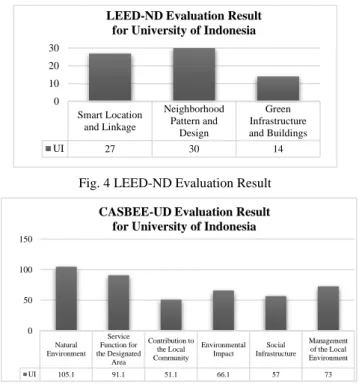
Smart Location and Linkage Neighborhood Pattern and Design Green Infrastructure and Buildings UI 27 30 14 0 10 20 30
LEED-ND Evaluation Result for University of Indonesia
Natural Environment Service Function for the Designated Area Contribution to the Local Community Environmental Impact Social Infrastructure Management of the Local Environment UI 105.1 91.1 51.1 66.1 57 73 0 50 100 150
CASBEE-UD Evaluation Result for University of Indonesia
Smart Location and Linkage Neighborhood Pattern and Design Green Infrastructure and Buildings UU 24 16 4 0 10 20 30
LEED-ND Evaluation Result for Udayana University
Natural Environment Service Function for the Designated Area Contribution to the Local Community Environmental Impact Social Infrastructure Management of the Local Environment UU 70.1 57.1 43.1 56.1 44 47 0 50 100
CASBEE-UD Evaluation Result for Udayana University
Smart Location and Linkage Neighborhood Pattern and Design Green Infrastructure and Buildings HU 25 16 17 0 10 20 30
LEED-ND Evaluation Result for Hasanuddin University
Natural Environment Service Function for the Designated Area Contribution to the Local Community Environmental Impact Social Infrastructure Management of the Local Environment HU 108.1 112.1 73.1 79.1 44 79 0 50 100 150
CASBEE-UD Evaluation Result for Hasanuddin University
9-4
LiteratureIssue
LEED-ND
CASBEE-UD
Fig. 11 Analysis Flow
Fig. 12 Determined Categories
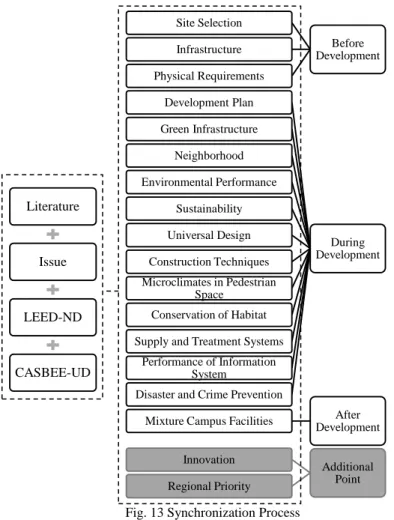
Figure 13 shows the synchronization process of literature, issue, and existing tools, then the result were grouped into the determined categories.
Fig. 13 Synchronization Process
After the new evaluating tool was develop, to know whether it is working properly or not, test was needed.
Table 3 Trial Result
CATEGORIES UI UU HU
Before Development (Preparation)
Site Selection 66 61 64 Infrastructure 4 4 4 Physical Requirements 17 16 17 During Development Development Plan 18 10 16 Green Infrastructure 22 7 13 Neighborhood 32 25 30 Environmental Performance 16 10 20 Sustainability 28 13 30 Universal Design 3 3 4 Construction Techniques 3 3 3 Microclimates in Pedestrian Space 6 5 7 Conservation of Habitat 10 2 10 Supply and Treatment Systems 7 7 7 Performance of Information System 8 8 9 Disaster and Crime Prevention 10 6 10
After Development
Mixture Campus Facilities 4 4 4
Additional Credits
Innovation 4 0 1
Regional Prioroty 1 0 0
TOTAL 259 184 249
6. Conclusion
- After understanding the issues of new campus development in Indonesia and an evaluation using selected evaluation tools, it can be concluded that majority of the issues came from less maturation of campus development plan for the long term and lack of understanding about the benchmark of campus development.
- Literature, issues, and selected evaluation tools were analyzed and applied to develop the new tool for evaluating campus development in Indonesia.
- This new tool currently only evaluates the basic aspects of campus development in Indonesia. However, it is easy to use and applicable in Indonesia.
References
1) Dober, RP, 1996, Campus Planning. Society for College and
University Planning, Michigan, USA.
2) Haapio A. Towards Sustainable Urban Communities. Elsevier: 2011.
3) IBEC, 2007. CASBEE for Urban Development: Technical
Manual 2007 Edition. Institute for Building Environment and Energy Conservation, Tokyo, Japan.
4) Kenney, DR, Dumont, R, Kenney, G 2005, Mission and Place:
Strengthening learning and community through campus design. American Council on Education and Praeger Publishers, Westport USA.
5) Raimi, M, Benfield, K, & Aaron, W 2009. A Citizen’s Guide to
LEED for Neighborhood Development: How to Tell if Development is Smart and Green. The U.S. Green Building Council, Inc., United State.
6) Sharifi, A. and Murayama A. A Critical Review of Seven Selected
Neighborhood Sustainability Assessment Tools. Elsevier: 2012.
7) Sharifi, A. and Murayama A. Neighborhood Sustainability Assessment in Action: Cross-evaluation of Three Assessment
Systems and Their Cases from the US, the UK and Japan.
Elsevier: 2013.
8) Tan, H, Chen, S, Shi, Q & Wang, L (eds) 2013, Development of Green Campus in China. Elsevier, Amsterdam. Available from: Elsevier Books. [26 January 2016].
9) USGBC, 2011. LEED 2009 for Neighborhood Development. The
U.S. Green Building Council, Washinton, DC.
Benchmark (Relevant Literature)
Issue
(Interview + Observation) Existing Evaluation Tools (LEED-ND and CASBEE-UD)
Appropriate Category
New Evaluation Tool for Campus Development in Indonesia
Before Development During Development After Development Additional Credit Before Development Site Selection Infrastructure Physical Requirements During Development Development Plan Green Infrastructure Neighborhood Environmental Performance Sustainability Universal Design Construction Techniques Microclimates in Pedestrian Space Conservation of Habitat Supply and Treatment Systems
Performance of Information System
Disaster and Crime Prevention
After Development Mixture Campus Facilities
Additional Point Innovation