JAXA Research and Development Memorandum Challenges of Space Anthropology 2014-2015
March 2015
Japan Aerospace Exploration Agency
JAXA-RM-14-012EJAXA Research and Development Memorandum
Director General of Institute of Space and Astronautical Science (ISAS), Vice President, Japan Aerospace Exploration Agency (JAXA),
Astrophysics
I was watching the European Space Agency (ESA)’s webcast on the evening of November 12, fascinated by the landing of the Philae deployed from Rosetta on the Comet 67P/Churyumov-Gerasimenko. The mother probe Rosetta was built and operated by ESA, while the Philae by the consortium of European nations. The mission is to search for organic molecules and leftovers that initially formed the solar system about 4.6 billion years ago, providing us with information on the formation of the solar system and clues on the origin of life. I felt as if space agency managers, engineers, scientists, and politicians appeared in the webcast are unanimously telling us that we Europeans did this. Apparently such an extraordinary feat in space affects people’s perspective on their geographic, cultural, and political identity, perhaps with growing significance, from a photo of the lonely Earth by Apollo 17 to the construction and continued operation of the International Space Station.
A remarkable discovery by astronomers in recent years is that 60% of stars in universe harbor planets. Furthermore, ~60 planets so far discovered are located in the habitable zone with distance range from the central stars adequate for life to emerge and to survive. Astronomers do anticipate that in a few tens of years from now, with the most advanced telescopes deployed in space, the signatures of bio-makers indicating the existence of water, ozone, carbon-dioxide, methane, and any other essential materials for life will be found on the surface of those planets. The discovery, once made, may deliver fundamental and permanent impact to humanity: Where Do We Come From?
What Are We? Where Are We Going? People on this globe may even consider the possibility of Carl Sagan’s CONTACT situation more seriously.
The National Museum of Ethnology in Osaka, which is one of my favorite tranquil places, beautifully exhibits ethnical diversity in life, culture, and language in space and time domain on this globe. For a layman such as myself, anthropology appears to be an
space to humanity on ground, humankind in space (effect of space environment to humankind), and extra-terrestrial life form. We encourage you to visit and see the fine articles in “Challenges of Space Anthropology”.
space to humanity on ground, humankind in space (effect of space environment to humankind), and extra-terrestrial life form. We encourage you to visit and see the fine
articles in “Challenges of Space Anthropology”. I. The Two Faces of Tomorrow: Human Bio-sociocultural Diversity Expanded through Space Development
Keiichi OMURA, Osaka University, Associate professor ... 1
II. Television and Japanese imagination of outer space
Fumiaki ITAKURA, Kobe University, Associate Professor ... 29
III. A socio-cultural study of the discourses of mono-zukuri in the manufacturing of launch vehicles in Japan
Hirofumi IWATANI, National Museum of Ethnology, Visiting Researcher ... 35
IV. Anthropology of “First Contact”
Daiji KIMURA, Kyoto University, Professor ... 45
V. The Humanistic Approach to Space Exploration: A Cultural Anthropological Look at Space Tourism
Hiroki OKADA, Professor, Kobe University... 51
VI. Life in extraterrestrial space: An anthropological consideration on astronauts’
everyday experiences
Tomohisa SATO, Kyoto Bunkyo University, Associate professor ... 63 VII. Do we disturb the universe?: Diversity in space as a grotesque hope for humankind
Hiroaki ISOBE, Kyoto University, Associate professor ... 71
Space Development
Keiichi OMURA
Osaka University, Associate professor, Cultural Anthropology
1 Introduction: Quo Vadis Anthropos?
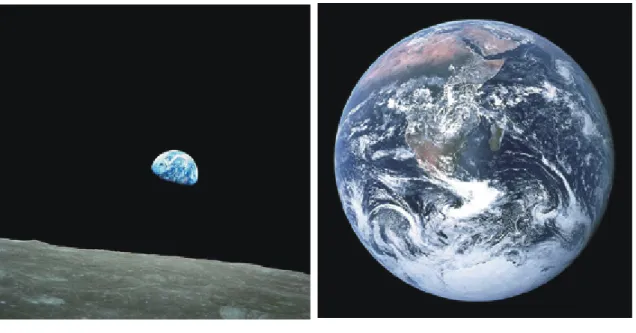
What reaction do you have to the following two photos (Figures 1 and 2), which are reputed to represent one of the most beneficial outcomes of the Apollo program as well as one of the most important events in human history? Do these photos not confront us with a fundamental question about the future of human society? Namely, whether humans will remain on Earth?
Starting Point: Two Photos of the Earth
The first photo was named “Earthrise,” and it depicts an image of the Earth rising from the lunar horizon, as seen by human beings for the first time in their 250,000 years of history. The photo was taken during a lunar orbit by a crew member of the Apollo 8 spacecraft on December 24, 1968. The second, named “The Blue Marble,” was taken by a crew member of the Apollo 17 spacecraft, which was on a mission to the moon on December 7, 1972, at a distance of approximately 45,000 kilometers from the Earth’s surface. This image was the first in human history to depict Earth as a full globe from a detached viewpoint.
To any life form inhabiting the Earth, including humans, the Earth is massive and indefinitely expansive to view in its entirety. Though it is impossible for humans to see the entire globe with the human eye, it has been possible throughout human history to
imagine the globe through inference or on the basis of data from observation devices. A full view of the Earth has, however, been largely unattainable to humans, who have inhabited the Earth’s surface for a long period of time. This is why the photos presented here are said to represent one of the most beneficial outcomes of the Apollo program and one of the most important events in human history. The photos commemorate the historic moment at which human beings escaped to great distances from the Earth, and for the first time in human history, attained a viewpoint that objectified the world.
These images have thus had a crucial influence on the human imagination.
A lone, blue marble is suspended in the profound darkness of deep space. National borders are not identifiable. The tiny and beautiful bubble is isolated but exuberant.
With one glance at the image, one realizes the Earth’s fragility and the fate of those who inhabit it regardless of nationality, race, and species.
The slogan “We must protect the precious Earth” likely had its birth in reaction to these photos, as they have been frequently used as icons by environmentalists. These images of the Earth as a full globe without national or ideological boundaries may have accelerated the development of “modernity” and the current historical phenomenon of
“globalization.” Regardless of the outcome, as is frequently highlighted in journalism Figure 1: Earthrise
(NASA: AS8-14-2383)
Figure 2: The Blue Marble (NASA: AS17-148-22727)
To any life form inhabiting the Earth, including humans, the Earth is massive and indefinitely expansive to view in its entirety. Though it is impossible for humans to see the entire globe with the human eye, it has been possible throughout human history to
imagine the globe through inference or on the basis of data from observation devices. A full view of the Earth has, however, been largely unattainable to humans, who have inhabited the Earth’s surface for a long period of time. This is why the photos presented here are said to represent one of the most beneficial outcomes of the Apollo program and one of the most important events in human history. The photos commemorate the historic moment at which human beings escaped to great distances from the Earth, and for the first time in human history, attained a viewpoint that objectified the world.
These images have thus had a crucial influence on the human imagination.
A lone, blue marble is suspended in the profound darkness of deep space. National borders are not identifiable. The tiny and beautiful bubble is isolated but exuberant.
With one glance at the image, one realizes the Earth’s fragility and the fate of those who inhabit it regardless of nationality, race, and species.
The slogan “We must protect the precious Earth” likely had its birth in reaction to these photos, as they have been frequently used as icons by environmentalists. These images of the Earth as a full globe without national or ideological boundaries may have accelerated the development of “modernity” and the current historical phenomenon of
“globalization.” Regardless of the outcome, as is frequently highlighted in journalism Figure 1: Earthrise
(NASA: AS8-14-2383)
Figure 2: The Blue Marble (NASA: AS17-148-22727)
and various other disciplines, it is safe to assume that these photos had a significant impact on human history.
Quo Vadis Anthropos? Questions of the Future of Human Society Inspired by the Two Photos
Half a century has passed since these photos were taken.
The phenomenon of globalization has advanced since the collapse of the Berlin Wall at the end of the Cold War era in 1989. Although a global system of industrial capitalism and an ideology of democracy have since dominated the world, national borders have not disappeared. Direct conflict between the East and West gave way to an outbreak of low-intensity conflicts. As mechanisms of capitalism endured unchanged, globalization has continued to spread while economic disparities grew between the Global North and South, wherein the rich populations grew richer as the poor became poorer. Human beings have gradually lost elements of cultural, linguistic, and biological diversity under the influence of globalization. In addition, they have been confronted with various other challenges related to population growth, food security, climate change, environmental destruction on a global scale, and so on.
On the other hand, efforts have not been made to revisit outer space, where the photos shown here were taken half a century ago. The moon still remains far afield from humanity, contrary to expectations. It is, of course, not the case that space development has not advanced since the photos were taken, as demonstrated by the construction and operation of the International Space Station (ISS), investigations of the solar system by unmanned space probes, the deployment of numerous satellites for various purposes, and so on. Space technologies, including aerospace engineering and computer and life-support technologies, have achieved levels of progress far beyond what humans could have imagined. It is now even considered to be technologically possible for humans to construct a moon base and conduct a manned Mars exploration. Aspects of daily life would indeed be impossible without space exploration given the spread of GPS and satellite communication.
Bearing these present conditions in mind, we refer to the photos again. Do these photos not confront us with questions surrounding the future of humans, namely, whether we will remain on Earth? Are we not faced with the important decision of whether to remain on Earth, a limited and fragile planet, or venture into the new frontier of deep space to realize our potential? Where is it that we want to or have to go?
What kind of society do we want to become? Do these photos not ask us, “Quo vadis
anthropos?” that is, “Where are you going, O Human?”
For anthropologists, these questions are crucial because anthropology as a discipline examines where human beings originate, their current realities, and where they are going. Indeed, no one can know or predict the future of human society.
Although a small group of specially trained astronauts currently reside semi-permanently on the ISS, it is still uncertain whether human beings will have the opportunity to enter outer space. As this option may yet remain, it is necessary to henceforth discuss it and draw conclusions concerning it. However, regardless of the decision that is ultimately made, it is still beneficial to investigate the possibility of human beings in outer space on the basis of the knowledge of human evolutionary history and our present conditions, which anthropologists have been documenting from the very beginning of the last century. This would be conducive to discussing and drawing decisions on the future of human society.
This is the purpose of this study. It examines the anticipated future of space development on the basis of patterns of human evolution, focusing on the human ability to freely multiply extensions of the human mind into the environment.
First, on the basis of the hypothesis on “cumulative cultural evolution” proposed by Tomasello and Bateson’s model on the evolution of learning, I describe how this capability enabled human beings to multiply across the surface of the Earth. Next, through a case study examination of Inuit societies in the Canadian Arctic and their relationships to the global network, I examine the present conditions of human society and describe the connections between diverse, regional subsistence societies and the global network in consideration of future space development. Then, on the basis of this consideration and “The Vienna Vision on Humans in Outer Space,” the projection for future space development by the European Science Foundation (ESF) and European Space Policy Institute (ESPI) in 2007, I consider the future of modern human beings in outer space and the task of anthropology in this future. Finally, I argue that future space development should follow two objectives: (1) it must continue to extend human society as far as possible beyond the terrestrial world into outer space, and (2) it must also protect human bio-sociocultural diversity so that it flourishes both on Earth and in the outer space, now and in the future.
anthropos?” that is, “Where are you going, O Human?”
For anthropologists, these questions are crucial because anthropology as a discipline examines where human beings originate, their current realities, and where they are going. Indeed, no one can know or predict the future of human society.
Although a small group of specially trained astronauts currently reside semi-permanently on the ISS, it is still uncertain whether human beings will have the opportunity to enter outer space. As this option may yet remain, it is necessary to henceforth discuss it and draw conclusions concerning it. However, regardless of the decision that is ultimately made, it is still beneficial to investigate the possibility of human beings in outer space on the basis of the knowledge of human evolutionary history and our present conditions, which anthropologists have been documenting from the very beginning of the last century. This would be conducive to discussing and drawing decisions on the future of human society.
This is the purpose of this study. It examines the anticipated future of space development on the basis of patterns of human evolution, focusing on the human ability to freely multiply extensions of the human mind into the environment.
First, on the basis of the hypothesis on “cumulative cultural evolution” proposed by Tomasello and Bateson’s model on the evolution of learning, I describe how this capability enabled human beings to multiply across the surface of the Earth. Next, through a case study examination of Inuit societies in the Canadian Arctic and their relationships to the global network, I examine the present conditions of human society and describe the connections between diverse, regional subsistence societies and the global network in consideration of future space development. Then, on the basis of this consideration and “The Vienna Vision on Humans in Outer Space,” the projection for future space development by the European Science Foundation (ESF) and European Space Policy Institute (ESPI) in 2007, I consider the future of modern human beings in outer space and the task of anthropology in this future. Finally, I argue that future space development should follow two objectives: (1) it must continue to extend human society as far as possible beyond the terrestrial world into outer space, and (2) it must also protect human bio-sociocultural diversity so that it flourishes both on Earth and in
the outer space, now and in the future. Figure 3: cumulative cultural evolution (Tomasello 1999: 38)
2 The Evolutionary Basis of Human Beings: The Ability to Freely Realize Extensions of the Mind
A mystery of human evolution that has puzzled anthropologists over many years is how cognitive skills unique to modern human beings have evolved over only 250,000 years, which is a very short time, evolutionarily speaking (Tomasello 1999). It has been highlighted that 250,000 years is not sufficient time for normal processes of biological evolution that involve genetic variation and natural selection to have developed the cognitive skills necessary to invent and maintain complex tool-use industries and technologies, complex forms of symbolic communication and representation, and complex social organizations and institutions.
Tomasello’s hypothesis of “cumulative cultural evolution”
To explain this phenomenon, Tomasello (1999) proposed the hypothesis of
“cumulative cultural evolution.” According to Tomasello, only modern humans have acquired species-unique modes of cultural transmission, that is, features of “cumulative cultural evolution.” This process “requires not only creative invention but also, and just as importantly, faithful social transmission that can work as a ratchet to prevent slippage backward—so that the
newly invented artifact or practice preserves its new and improved form at least somewhat faithfully until a further modification or improvement comes along” (Tomasello 1999: 5).
It is this mechanism of
“cumulative cultural evolution,”
which works on time scales several orders of magnitude faster than those of biological evolution, that has enabled
modern humans to develop in only 250,000 years cognitive skills and products that other animal species have never achieved.
This “cumulative cultural evolution” involves the following two stages, as shown in Figure 3:
(1) Child cultural learning: The ratchet of cultural evolution
This denotes the process in which children or novices learn existing cognitive skills through cultural learning. It is through this process that the pool of cognitive skills and products that have been created or invented in the past are faithfully transmitted over generations and preserved as resources for future innovation. This process functions as Tomasello’s “ratchet.”
(2) Individual or collaborative creation: The driving force of cultural evolution
In this process, individuals or groups of individuals modify existing cognitive skills and products or invent new ones on the basis of the accumulated pool of cognitive resources such as tools, technical processes, symbolic communication devices, and social institutions. This process accelerates the rate of cultural evolution, and thus may be understood as its driving force.
Two Mental Abilities of Modern Human Beings
As I have demonstrated elsewhere (Omura 2014), a close examination of Tomasello’s hypothesis according to Bateson’s model on the evolution of learning (Bateson 1972) shows that modern human beings possess two species-unique mental abilities in accordance with the two stages of “cumulative cultural evolution.” These abilities are as follows.
(1) The ability to engage in “theory of mind” (the ability essential to “cultural learning”)
According to Tomasello, cultural learning comprises three types of learning:
“imitative learning,” “instructed learning,” and “collaborative learning”; it is based on
“the ability of individual organisms to understand conspecifics as beings like themselves who have intentional and mental lives like their own” (Tomasello 1999: 5).
“Imitative learning” denotes forms of learning in which “youngsters actually reproduce the behavior or behavioral strategy of the demonstrator, for the same goal as the demonstrator” (Tomasello 1999: 26). “Instructive learning” denotes the learning process that “comes from the ‘top down,’ as knowledgeable or skilled individuals seek to impart knowledge or skills to others” (Tomasello 1999: 33). In “collaborative learning,”
novices learn through collaboration with knowledgeable and skilled individuals. These types of cultural learning would not be possible without the ability of learners to understand the intentions behind the behaviors of others.
Then, Tomasello indicates that the ability of cultural learning functioning as the ratchet of cultural evolution, which enables modern humans to accumulate
(1) Child cultural learning: The ratchet of cultural evolution
This denotes the process in which children or novices learn existing cognitive skills through cultural learning. It is through this process that the pool of cognitive skills and products that have been created or invented in the past are faithfully transmitted over generations and preserved as resources for future innovation. This process functions as Tomasello’s “ratchet.”
(2) Individual or collaborative creation: The driving force of cultural evolution
In this process, individuals or groups of individuals modify existing cognitive skills and products or invent new ones on the basis of the accumulated pool of cognitive resources such as tools, technical processes, symbolic communication devices, and social institutions. This process accelerates the rate of cultural evolution, and thus may be understood as its driving force.
Two Mental Abilities of Modern Human Beings
As I have demonstrated elsewhere (Omura 2014), a close examination of Tomasello’s hypothesis according to Bateson’s model on the evolution of learning (Bateson 1972) shows that modern human beings possess two species-unique mental abilities in accordance with the two stages of “cumulative cultural evolution.” These abilities are as follows.
(1) The ability to engage in “theory of mind” (the ability essential to “cultural learning”)
According to Tomasello, cultural learning comprises three types of learning:
“imitative learning,” “instructed learning,” and “collaborative learning”; it is based on
“the ability of individual organisms to understand conspecifics as beings like themselves who have intentional and mental lives like their own” (Tomasello 1999: 5).
“Imitative learning” denotes forms of learning in which “youngsters actually reproduce the behavior or behavioral strategy of the demonstrator, for the same goal as the demonstrator” (Tomasello 1999: 26). “Instructive learning” denotes the learning process that “comes from the ‘top down,’ as knowledgeable or skilled individuals seek to impart knowledge or skills to others” (Tomasello 1999: 33). In “collaborative learning,”
novices learn through collaboration with knowledgeable and skilled individuals. These types of cultural learning would not be possible without the ability of learners to understand the intentions behind the behaviors of others.
Then, Tomasello indicates that the ability of cultural learning functioning as the ratchet of cultural evolution, which enables modern humans to accumulate
modifications through historical time, is restricted to modern human beings. Therefore, he concludes that the differences in learning ability between modern humans and other animal species lie in the ability to engage in cultural learning. This ability is in turn based on the ability of learners to understand conspecifics as beings that follow intentional and mental lives similar to their own. This may also be understood as the ability to engage in “theory of mind.”
(2) The ability for objectification (the ability essential to “creation”)
According to Bateson’s model regarding the evolution of learning, it is important to objectify what has already been learned via cultural learning to creatively modify existing cognitive skills and products or to invent new ones by drawing from the accumulated pool of cognitive resources.
During infancy, human beings learn conventional technical processes, socially acceptable behaviors, conventional ways of understanding the world, and other forms of
“character” (Bateson 1972: 303), style, or culture via cultural learning. Thus, cultural learning enables subsequent generations to develop creative modifications and inventions by drawing from the accumulated pool of cognitive resources without having to invest the time and effort necessary to invent skills and products from scratch.
However, the attainment of knowledge via cultural learning is likely to persist throughout a learner’s life through reflectively unexamined learning processes and unconsciously automatized skills. This often develops cultural bias in the learner, which primes learners to adhere to what they had learned through this process and conservatively resist changes. Cultural learning thus often impedes the possibilities for creative modification and invention.
Therefore, it is necessary to “throw these unexamined premises open to question and change,” (Bateson 1972: 303) that is, to achieve “freedom from the bondage of habit”
(Bateson 1972: 30), to creatively modify existing cognitive skills and products, or invent new ones. In other words, it is essential to detach from and consciously objectify one’s own habits including reflectively unexamined premises, and unconsciously automatized skills. If conventional technical processes and ways of understanding the world are not consciously objectified, and instead remain as unconsciously automatized and unexamined premises, modifying or changing these perspectives will be impossible.
Therefore, it is necessary for modern humans to develop the ability to not only engage in
“theory of mind,” on which cultural learning is based, but also objectify conventional habits learned via cultural learning. This would allow modern humans to fully realize the possibilities of “cumulative cultural evolution” and thereby develop species-unique,
complex cognitive skills and products that are derived from them.
Thus, these two abilities, which allow modern human beings to acquire species-unique modes of cultural transmission, or “cumulative cultural evolution,”
bestowed humans with marvelous creative abilities that led to explosive improvements in their cognitive skills.
From the former ability to engage in “theory of mind,” humans were able to avoid investing time and effort on inventing problem-solving strategies anew for every problem encountered. However, this simultaneously resulted in rigidity and strict adherence to pre-existing, conventional problem-solving methods even under changing conditions. Hence, the latter ability for objectification enabled humans to objectify and disassemble skill sets learned via cultural learning, and thereafter rearrange or add new components to these sets to modify skills or invent new ones. This is the unique feature of human evolution that Tomasello revealed. Modern human beings are able to develop the necessary cognitive skills required to create complex products, such as technologies, communication devices, and social institutions, through the species-unique mechanism of cultural evolution, which is based on the two major abilities: 1) the ability to engage in “theory of mind,” and 2) the ability to objectify what has already been learned via cultural learning.
The Evolutionary Basis of Human Beings: The Ability to Freely Apply Extensions of the Mind
These two abilities relate to another important, species-unique characteristic of modern human beings: the ability to freely apply an extension of one’s own mind to the environment.
From the 1980s, cognitive scientists including anthropologists and psychologists have demonstrated that cognitive processes of the human mind are not limited to the brain and body but extend through the body into the environment. This characteristic of the human mind has been referred to as the “extended mind” (Clark 1991, 1998),
“situated cognition” (Lave 1988, 2011), and the “distributed mind” (Hutchins 1996).
For example, as Bateson (1972) highlighted, the mind of a logger does not operate strictly within his brain but extends to the relationship between him and the tree that he is cutting down. By adjusting his movements according to the changing condition of the tree with each blow of the ax and thus communicating with the tree through this action, the logger gradually changes the tree’s condition until it is finally felled.
Throughout this process, the logger’s brain and body coordinated by his nervous and
complex cognitive skills and products that are derived from them.
Thus, these two abilities, which allow modern human beings to acquire species-unique modes of cultural transmission, or “cumulative cultural evolution,”
bestowed humans with marvelous creative abilities that led to explosive improvements in their cognitive skills.
From the former ability to engage in “theory of mind,” humans were able to avoid investing time and effort on inventing problem-solving strategies anew for every problem encountered. However, this simultaneously resulted in rigidity and strict adherence to pre-existing, conventional problem-solving methods even under changing conditions. Hence, the latter ability for objectification enabled humans to objectify and disassemble skill sets learned via cultural learning, and thereafter rearrange or add new components to these sets to modify skills or invent new ones. This is the unique feature of human evolution that Tomasello revealed. Modern human beings are able to develop the necessary cognitive skills required to create complex products, such as technologies, communication devices, and social institutions, through the species-unique mechanism of cultural evolution, which is based on the two major abilities: 1) the ability to engage in “theory of mind,” and 2) the ability to objectify what has already been learned via cultural learning.
The Evolutionary Basis of Human Beings: The Ability to Freely Apply Extensions of the Mind
These two abilities relate to another important, species-unique characteristic of modern human beings: the ability to freely apply an extension of one’s own mind to the environment.
From the 1980s, cognitive scientists including anthropologists and psychologists have demonstrated that cognitive processes of the human mind are not limited to the brain and body but extend through the body into the environment. This characteristic of the human mind has been referred to as the “extended mind” (Clark 1991, 1998),
“situated cognition” (Lave 1988, 2011), and the “distributed mind” (Hutchins 1996).
For example, as Bateson (1972) highlighted, the mind of a logger does not operate strictly within his brain but extends to the relationship between him and the tree that he is cutting down. By adjusting his movements according to the changing condition of the tree with each blow of the ax and thus communicating with the tree through this action, the logger gradually changes the tree’s condition until it is finally felled.
Throughout this process, the logger’s brain and body coordinated by his nervous and
endocrine system, the tree, and the ax are integrated as a recursive circuit. This circuit functions as his mind. The same is true on a larger scale in the case of the mind of a pilot operating an aircraft. Hutchins et al. (Hutchins 1996; Hutchins & Klausen 1996;
Hutchins, Holder & Pérez 2002) demonstrated through field work that the mind of a pilot extends throughout the entire airplane through his colleagues, instruments, steering devices, and so on. Given that the aircraft is continuously being tracked and supported by ground controllers through radar and radio communications, it can be said that the pilot’s mind extends further to a control network that spans the entire globe.
However, the ability of the mind to extend into its environment is not a distinguishing trait limited to modern human beings. As was first highlighted by Merleau-Ponty (1995) and later demonstrated by ecological psychologists (Reed 1996), any organism can extend its mind to its environment through its behaviors, and can create and maintain each recursive circuit that involves itself and its surroundings.
However, only modern human beings can create tools or modify their living environments for the purpose of further creating and modifying them. Only modern humans can freely multiply extensions of their minds by endlessly grafting one recursive circuit onto another, and thereafter make tools for making tools for making tools ad infinitum, or modify living environments to endlessly develop them further.
The two abovementioned abilities broaden the ability of modern humans to freely multiply extensions of their minds. This is because it is essential to objectify one’s own conventional methods of problem-solving as recursive circuits of mind and understand the intentions behind these circuits to freely multiply extensions of one’s mind. In cases where recursive circuits of mind are not consciously objectified, it should be impossible to combine or graft one recursive circuit to another. Likewise, when the intention behind each recursive circuit is not understood, it would be impossible to combine or graft one recursive circuit to another and compose a coherent system. Only after recursive circuits of mind are consciously packaged on the basis of intentions does it become possible to freely multiply the extension of one’s mind.
It should now be clear that the process of “cumulative cultural evolution” discussed by Tomasello is an aspect of this free multiplication of the mind’s extensions, which surfaces in the case when one focuses on diachronic extensions of mind over generations.
This process also involves synchronic extensions of mind across space, which is demonstrated in the example of the aircraft pilot noted above. A mere glance at our daily lives is enough for us to realize how far-reaching and broad the synchronic extensions of mind are in the present era. This is indeed apparent given current processes of “globalization.” It is now possible to extend our minds to the entire globe by
connecting with various networks dispersed across the Earth such as the Internet and physical distribution networks. Modern human beings are thus able to freely and endlessly multiply extensions of mind in time and space as a result of possessing two cognitive abilities: 1) the ability to understand intentions behind circuit packages through engagement in “theory of mind,” and 2) the ability to objectify and modify packages learned via cultural learning.
3 Present Conditions of Modern Humans: The Diversity of Human Societies Flourishing on Earth
It should now be clear that the contemporary phenomenon of globalization results from this human ability to freely and endlessly multiply extensions of mind across time and space.
The multiple circuit chain of making tools for making tools for making tools ad infinitum resulted in the development of large industrial complexes that are based on physical distribution networks that span the Earth. The multiple extensions of communication via oral, literal, graphical, and electronic media, which are supported by terrestrial and extraterrestrial communication networks, not only span the entire globe and connect nearly seven billion people but also extend to outer space, broadening our cognitive horizons. Although globalization has caused many problems, as discussed in the beginning of this study, such as global environmental destruction and the increasing economic disparity between the Global North and South, the phenomenon has also improved lives and broadened human cognitive horizons in addition to interconnecting seven billion people, thereby promoting exchange between people at magnitudes greater than ever before. In this sense, globalization is undoubtedly one of the greatest accomplishments that modern human beings have achieved as a result of the two abilities that set us apart from other species, although many problems must still be resolved.
It is important, however, to understand that while the two abilities unique to modern human beings brought about important results, they are likely to be disguised behind the processes of globalization. These two abilities allow humans not to be strictly bound to only one mind extension circuit or, in other words, one way of life, and to instead live while moving between multiple extension circuits. This is because humans acquired the ability to consciously objectify and package extension circuits of mind depending on their intentions. In fact, in addition to the global networks that resulted from globalization, numerous extension circuits of mind currently exist, and humans
connecting with various networks dispersed across the Earth such as the Internet and physical distribution networks. Modern human beings are thus able to freely and endlessly multiply extensions of mind in time and space as a result of possessing two cognitive abilities: 1) the ability to understand intentions behind circuit packages through engagement in “theory of mind,” and 2) the ability to objectify and modify packages learned via cultural learning.
3 Present Conditions of Modern Humans: The Diversity of Human Societies Flourishing on Earth
It should now be clear that the contemporary phenomenon of globalization results from this human ability to freely and endlessly multiply extensions of mind across time and space.
The multiple circuit chain of making tools for making tools for making tools ad infinitum resulted in the development of large industrial complexes that are based on physical distribution networks that span the Earth. The multiple extensions of communication via oral, literal, graphical, and electronic media, which are supported by terrestrial and extraterrestrial communication networks, not only span the entire globe and connect nearly seven billion people but also extend to outer space, broadening our cognitive horizons. Although globalization has caused many problems, as discussed in the beginning of this study, such as global environmental destruction and the increasing economic disparity between the Global North and South, the phenomenon has also improved lives and broadened human cognitive horizons in addition to interconnecting seven billion people, thereby promoting exchange between people at magnitudes greater than ever before. In this sense, globalization is undoubtedly one of the greatest accomplishments that modern human beings have achieved as a result of the two abilities that set us apart from other species, although many problems must still be resolved.
It is important, however, to understand that while the two abilities unique to modern human beings brought about important results, they are likely to be disguised behind the processes of globalization. These two abilities allow humans not to be strictly bound to only one mind extension circuit or, in other words, one way of life, and to instead live while moving between multiple extension circuits. This is because humans acquired the ability to consciously objectify and package extension circuits of mind depending on their intentions. In fact, in addition to the global networks that resulted from globalization, numerous extension circuits of mind currently exist, and humans
move constantly between them.
It is indeed true and widely known that a number of minority languages have disappeared, and the lifestyles of modern human beings have rapidly and radically homogenized under the influence of globalization. It is not without reason that the loss of linguistic and sociocultural diversity is considered an important issue in present-day society. However, numerous anthropologists conducting exhaustive fieldwork in various global regions from the end of the 20th century have found that all the people are not entirely absorbed into only one extension circuit or global network despite the increasing influence of globalization. Rather, it has been found that various ways of life wherein humans move backward and forward across plural extension mind circuits (including global networks) are practiced in numerous places worldwide. The following case of the Inuit, an indigenous people living in the Canadian Arctic, provides an example of a community that follows a lifestyle that involves moving between global networks and a local mind circuit extension (Omura 2010, 2012a, 2012b, 2013). The local circuit in this case involves a subsistence system that has been handed down from their ancestors.
Present Conditions of the Inuit Society
The Canadian Inuit are involved with and absorbed into global network as they, like all human beings, live under the influence of globalization. More than a century has passed since they became part of the global capitalist system through their involvement in the fur trade from the beginning of the 20th century. Moreover, half a century has passed since this group was first subsumed into a modern nation-state through sedentalization into hamlets by the Canadian federal government under its assimilation policy in 1960s. Consequently, typical hunter-gatherer ways of life fell into the background, and contemporary Inuit society underwent dramatic sociocultural changes. Ways of life characterized by seasonal migrations following game are now a story of the past told by elders.
Undoubtedly, it is true that subsistence activities such as hunting, fishing, trapping, and gathering are still vigorously pursued, and it is even said that “Inuit who do not engage in subsistence activities are not Inuit” (Omura 2013; Stewart 1995, 1996). In addition, although the use of cash income to buy processed foods has become general practice, meat from wildlife hunted through subsistence activities is still venerated as indispensable “real food” (niqinmarik) that helps to maintain ethnic identity.
Furthermore, distribution of this meat continues to function as one of the cornerstones of the preservation of social relations. (Kishigami 1996, 1998, 2007; Stewart 1992;
Wenzel 1991).
However, the forms through which these activities manifest today have certainly changed; many hunters now engage in wage labor and participate in subsistence activities on a part-time basis. This has occurred as activities such as hunting have become highly mechanized through the use of equipment including, for example, high-powered rifles, four-wheel-drive buggies, and metal boats with outboard motors. It has also occurred out of the need for funds to meet the costs of procuring and maintaining equipment and also for buying gasoline and ammunition.
Moreover, the contemporary life of the Inuit is supplemented by the presence of home electronics and machines; houses are equipped with central heating systems, refrigerators, freezers, washing machines, dryers, computers, TVs, DVDs, iPads, iPods, and cable systems. Power plants in each community operate at all hours to maintain constant energy supplies in these communities. Icebreaking freight vessels and aircrafts regularly deliver processed foods such as hamburgers, chips, and soft drinks as well as other merchandise produced in Southern Canada and the US, which are supplied to local grocery stores. Children become fans of Japanese animation while older youth are obsessed with net-surfing and online shopping. Most hunters are also workers in government offices or construction sites who depend on public welfare, government subsidies, and public projects. News on Canadian politics and economics and global political and economic trends bring both joy and sorrow to them.
There is no doubt that the Inuit are participants in the global network of industrial capitalism and are positioned at the margins rather than at the center of the system.
They have no choice but to accept global political and economic trends as a result of this marginality. Despite achieving ethnic autonomy within Canada in 1999 through successful political negotiations with the Canadian government that gave birth to the Nunavut Territory, when the fiscal situation of the Canadian government becomes meager because of a slowdown in the global economy, individuals in this community risk losing their jobs in public administration or construction owing to cuts to public projects and government subsidies. Just as Inuit fur exports were seriously damaged by the overhunting of harp seals by Western business enterprises (which resulted in an embargo on seal fur to the European Union that led to a significant loss of an important source of income for the Inuit even though they were not responsible for the practices of these corporations) (Wenzel 1991), Inuit society is greatly affected by the world economy and political decisions of the nation-state. Inuit society is subordinated to global capitalism and the modern nation-state.
Nevertheless, massive external pressures and dramatic changes in lifestyle have
Wenzel 1991).
However, the forms through which these activities manifest today have certainly changed; many hunters now engage in wage labor and participate in subsistence activities on a part-time basis. This has occurred as activities such as hunting have become highly mechanized through the use of equipment including, for example, high-powered rifles, four-wheel-drive buggies, and metal boats with outboard motors. It has also occurred out of the need for funds to meet the costs of procuring and maintaining equipment and also for buying gasoline and ammunition.
Moreover, the contemporary life of the Inuit is supplemented by the presence of home electronics and machines; houses are equipped with central heating systems, refrigerators, freezers, washing machines, dryers, computers, TVs, DVDs, iPads, iPods, and cable systems. Power plants in each community operate at all hours to maintain constant energy supplies in these communities. Icebreaking freight vessels and aircrafts regularly deliver processed foods such as hamburgers, chips, and soft drinks as well as other merchandise produced in Southern Canada and the US, which are supplied to local grocery stores. Children become fans of Japanese animation while older youth are obsessed with net-surfing and online shopping. Most hunters are also workers in government offices or construction sites who depend on public welfare, government subsidies, and public projects. News on Canadian politics and economics and global political and economic trends bring both joy and sorrow to them.
There is no doubt that the Inuit are participants in the global network of industrial capitalism and are positioned at the margins rather than at the center of the system.
They have no choice but to accept global political and economic trends as a result of this marginality. Despite achieving ethnic autonomy within Canada in 1999 through successful political negotiations with the Canadian government that gave birth to the Nunavut Territory, when the fiscal situation of the Canadian government becomes meager because of a slowdown in the global economy, individuals in this community risk losing their jobs in public administration or construction owing to cuts to public projects and government subsidies. Just as Inuit fur exports were seriously damaged by the overhunting of harp seals by Western business enterprises (which resulted in an embargo on seal fur to the European Union that led to a significant loss of an important source of income for the Inuit even though they were not responsible for the practices of these corporations) (Wenzel 1991), Inuit society is greatly affected by the world economy and political decisions of the nation-state. Inuit society is subordinated to global capitalism and the modern nation-state.
Nevertheless, massive external pressures and dramatic changes in lifestyle have
not caused the Inuit to lose their identity. They are supported by solid confidence that will lead them into the future, as expressed in the following words of an Inuk person.
“Inuit Culture, which thrived in the harsh Arctic environment, will also thrive and advance in a global environment. What will remain, and what links the past, present, and future, is the sense of community, the willingness to help each other out, to be innovative and resourceful, in a word, to be Inuit, to be Human Beings’” (GN 1999: 1) (Statement of Jaypeetee Arnakak, Senior Communication Advisor, Nunavut Department of Sustainable Development).
How is it that the Inuit have acquired the confidence and drive that will lead them into the future?
The Multiple Worlds of the Inuit Society
The source of the Inuit’s confidence can be traced back to the resilience of their extension circuits of mind—the subsistence system (cf. Omura 2012a, 2012b). This system has been maintained to bolster the autonomous reproduction of Inuit society despite continuous interventions from the outside world. The subsistence system lies at the core of the political, economic, and cultural identity of Inuit society and involves acquisition, distribution, and consumption activities that are primarily structured through kinship. Through the following recursive process of its operation, both the relationships among the Inuit and that between the Inuit and wild animals are ceaselessly generated, regenerated, and integrated into the land (nuna)—their life world composed of Inuit and wild animals—into which minds of the Inuit are extended.
The Inuit first enter an ecological relationship with wild animals as
“providers/receivers of food” by obtaining individual animals through hunting, fishing, trapping, and gathering techniques of subsistence. The food (or other subsistence supplies) is then received and shared among the Inuit. This sharing process creates and defines the extended family—a foundation for sociopolitical relationships among the Inuit—which is based on cooperation and trust. This trusting and cooperative environment provides opportunities for the Inuit to share subsistence techniques. By elaborating on subsistence techniques, the Inuit can hunt a greater number of animals, and in doing so, they recreate its “self/other” relationship with animals into a
“receiver/provider” relationship. This infinite cycle of subsistence simultaneously separates and synthesizes the Inuit and wild animals into nuna, which denotes a hybrid, sociocultural-natural network of human and nonhuman attributes.
Relationships that are generated through this circular process with wild animals are not limited to a specific type of wild animal but are instead open to many species;
therefore, the extended family of the Inuit emerges at the intersection of multiple circular relationships between the Inuit and a diverse variety of wild animals. Moreover, the wild animals that are connected to the Inuit are ecologically interrelated. These animals are articulated as groups embedded in the network of their ecological relationships. This implies that the Inuit extended family comes into being blended as one articulation point in the vastly extended, interconnected ecological network of relationships through which several other groups of animals are also demarcated. This vast network that is ordered and woven through ecological and societal relationships forms the life world of the Inuit, which is called nuna. Thus, through the practice of subsistence activities, the minds of the Inuit extend into an extension circuit of mind called nuna that is woven through ecological and societal relationships between humans and wild animals.
The most important characteristic of this system lies in its resilience. This system has not collapsed but flexibly adapts to changing circumstances under any interventions from the outside world as long as the Inuit maintain their circular practice of subsistence. This is because the system is autonomously closed but simultaneously open to the outside, and forms what Maturana and Varela (1980) called an autopoietic machine.
In this subsistence system, social relationships among the Inuit and their ecologic relationships with various wild animal species are closed in their circulation. The acquisition of resources such as food and adjustments of social relationships in realms such as politics and economics (and thus their entire way of life) can be satisfied within the system. Therefore, the autonomy of subsistence as a way of life for the Inuit will remain unchanged if they continue to practice subsistence activities despite being subordinately connected to the globalized world network. Moreover, as long as social relationships among the Inuit and ecological relationships between humans and wild animals are cyclically generated, this system can maintain itself while accommodating external interventions. As previous studies indicate (Fienup-Riordan 1983; Kishigami 1996; Nuttall 1992; Stewart 1992, 1995; Wenzel 1991), Inuit society will be sustained through the continued practice of subsistence and will endure through the introduction of high-tech gadgets to subsistence techniques, and despite new tendencies toward eating processed foods such as hamburgers and pizza.
This is why the Inuit remain confident in being themselves and how they have retained a sense of drive that will lead them into the future. Despite being integrated
Relationships that are generated through this circular process with wild animals are not limited to a specific type of wild animal but are instead open to many species;
therefore, the extended family of the Inuit emerges at the intersection of multiple circular relationships between the Inuit and a diverse variety of wild animals. Moreover, the wild animals that are connected to the Inuit are ecologically interrelated. These animals are articulated as groups embedded in the network of their ecological relationships. This implies that the Inuit extended family comes into being blended as one articulation point in the vastly extended, interconnected ecological network of relationships through which several other groups of animals are also demarcated. This vast network that is ordered and woven through ecological and societal relationships forms the life world of the Inuit, which is called nuna. Thus, through the practice of subsistence activities, the minds of the Inuit extend into an extension circuit of mind called nuna that is woven through ecological and societal relationships between humans and wild animals.
The most important characteristic of this system lies in its resilience. This system has not collapsed but flexibly adapts to changing circumstances under any interventions from the outside world as long as the Inuit maintain their circular practice of subsistence. This is because the system is autonomously closed but simultaneously open to the outside, and forms what Maturana and Varela (1980) called an autopoietic machine.
In this subsistence system, social relationships among the Inuit and their ecologic relationships with various wild animal species are closed in their circulation. The acquisition of resources such as food and adjustments of social relationships in realms such as politics and economics (and thus their entire way of life) can be satisfied within the system. Therefore, the autonomy of subsistence as a way of life for the Inuit will remain unchanged if they continue to practice subsistence activities despite being subordinately connected to the globalized world network. Moreover, as long as social relationships among the Inuit and ecological relationships between humans and wild animals are cyclically generated, this system can maintain itself while accommodating external interventions. As previous studies indicate (Fienup-Riordan 1983; Kishigami 1996; Nuttall 1992; Stewart 1992, 1995; Wenzel 1991), Inuit society will be sustained through the continued practice of subsistence and will endure through the introduction of high-tech gadgets to subsistence techniques, and despite new tendencies toward eating processed foods such as hamburgers and pizza.
This is why the Inuit remain confident in being themselves and how they have retained a sense of drive that will lead them into the future. Despite being integrated
into global networks and marginalized and subordinated in systems of global capitalism and the modern nation-state, the Inuit may at any time escape from these networks and autonomously achieve the lifeway of their mind circuit through extension into nuna. This will continue as long as the subsistence system operates independent of global networks. In short, the Inuit have retained alternative ways of life, enabling them to survive when they escape from global networks. As a result, in situations where the Inuit engage in global networks, they do not passively engage with global capitalism and the modern nation-state, but remain autonomously independent as the Inuit entity incorporated in nuna.
It is this subsistence system that the Inuit has made longstanding efforts to protect through the Indigenous Peoples’ Movement from the 1970s (cf. Omura 2010). These efforts have enabled them to maintain alternative ways of life and thus remain confident in Inuit identity. It is important to note, however, that the ability to create, maintain, and move between multiple extension circuits of mind is necessary for them to practice such an endeavor. It would be impossible for them to maintain and flexibly move between two extension circuits of mind if they engaged in only one extension circuit or were unable to objectify circuits despite having access to more than one. The contemporary Inuit lifeway, which involves flexibly moving between nuna—their own life world—and a global network, is made possible through the species-unique ability to consciously objectify and freely multiply extension circuits of mind.
The Diversity of Human Sociocultures that Have Flourished on Earth
This form of lifestyle that involves moving between multiple extension circuits of mind is not restricted to contemporary Inuit ways of life. Anthropologists have shown that various communities worldwide follow this practice. Such systems span broad networks including the global network extended from the West, Islamic networks, overseas Chinese networks, and local networks such as the Inuit nuna. From the ability to freely multiply extension circuits of mind, modern human beings have not only extended their minds globally but have also been able to create and maintain multiple local extension circuits of mind, or various ways of life, while moving between them.
This ability has also enabled modern humans to occupy all surfaces of the Earth.
Modern human beings have effectively adapted to diverse ecological environments from the equatorial belt to the arctic tundra while maintaining their identity as a species.
This has occurred because humans can create or improve extension circuits of mind as extra-somatic, optional devices to adapt to various environmental conditions because of their ability to consciously objectify the circuits. If recursive circuits of mind were not
consciously objectified and packaged according to intentions, it would be impossible to even come up with the idea of creating or improving circuits according to environmental conditions. On encountering new environments during migration, humans improve existing circuits or create new ones as optional devices to adapt to these environments, and optionally use them without being limited to existing circuits created to adapt to past environment. Consequently, humans settled globally while retaining their identity as a species.
Anthropologists refer to this ability to extend circuits of mind as optional devices for adapting to environments as “socioculture.” With this ability to freely multiply extension circuits of mind, modern human beings have not only extended their minds globally but have also cultivated various sociocultures that are now ingrained in various environments worldwide. It can hence be concluded that the ability to freely multiply extension circuits of mind has resulted in two trends: 1) global networks extended across the Earth’s surface, and 2) local extension circuits of mind, which adapt to and are ingrained in each environment.
4 Bio-sociocultural Diversity Accelerated by Space Development: Outer Space as a Challenge to Modern Human’s Ability to Multiply Extension Circuits of Mind
If the ability to freely multiply extension circuits of mind represents a species-unique ability of modern humans, how will this shape the future of human society?
We can address this question on the basis of the opportunities and limits of human’s species-unique abilities by studying various types of extension circuits of mind that have been developed by modern humans from the beginning of human history to the present through a review of anthropological records. However, it is now possible to address this question through another method, given that half a century has passed since modern humans first entered outer space, creating possibilities for humans to commence activities in this new environment. I approach this problem by considering the opportunities and limits that affect our abilities in outer space, which is an extraordinarily different environment from that of the Earth in which humans have adapted. The analysis will examine the following questions. Will humans be able to adapt to environments of outer space with the aid of this ability? If so, how would humans adapt to the environment, to what extent would humans adapt, and what forms of extension circuits of mind would be required? In the following section, I will examine these questions in depth.