Combustion wave structure of ADN-based composite propellant
Koji Fujisato*, Hiroto Habu**, Keiichi Hori**, Hidefumi Shibamoto***, Xiuchao Yu***, Atsumi Miyake****
*Graduate School of the University of Tokyo, Bunkyo-ku, Japan
** Japan Aerospace Exploration Agency, Sagamihara, Japan
*** Hosoya Pyro-Engineering Co., Ltd., Akiruno, Japan
****Yokohama National University, Yokohama, Japan [email protected]
Abstract:
Combustion characteristics of pelletized ammonium dinitramide (ADN) and ADN-based propellants have been studied. Micron-meter-sized particles of Al, Fe2O3, TiO2, NiO, Cu(OH)NO3, Cu and CuO, and nano-meter-sized Al (Alex) and CuO (nanoCuO) were em- ployed as the additives for pelletized ADN. Only nanoCuO and Alex show the remarkable effects, so they are also added to ADN-based propellant. The binder of ADN-based propel- lant is thermoplastic elastomer (TP), and three kinds of mixtures (TP:ADN = 30:70, 20:80 and 10:90 mass%) were prepared .The burning rates of pelletized ADN and ADN-based propellants were measured under the pressure range from 0.6 to 6.2 MPa, and the surface temperature profiles were obtained about ADN-based propellants. Nano-sized CuO en- hanced the burning rate of pelletized ADN. Alex-incorporated ADN burned with flames even at 0.55 MPa under which pure ADN does not form the flame. Burning rate of non- additive ADN-based propellants has extremely high pressure dependency. In the case of TP/ADN (30:70), burning rate jump are found from the critical pressure approximately 3.2 MPa. The temperature profiles of TP/ADN (30:70) were measured, and the combustion structure was discussed. Both nanoCuO and Alex improved the burning rate characteris- tics, and the pressure exponents are 0.54 and 0.76 respectively.
Keywords: ADN; burning rate; surface temperature; burning rate modifier; nanoparticle
1 Introduction
The development of environmentally friendly propellants should be encouraged in addition to improvements of the prolusion performance. ADN is considered as the most expected sub- stitution of AP because it has the high oxygen balance and formation energy. The manufacture process of ADN has been improved over the last twenty years and the cost has become cheaper than before. In spite of these advantages, ADN has not been put into practical use for solid propellant due to low thermal stability and undesirable combustion characteristics. This re- search aims to comprehend combustion wave structure of ADN-based propellants.
There are several reports about ADN-based propellants. Parr et al. investigated about the flame structure of ADN/binder-sandwich-propellant with PLIF below 1.5 MPa [1]. It was re- ported that ADN showed weak diffusion flame that are too far from the surface to control the burning rate. Price et al. reported the burning behavior of various compositions [2, 3]. They used PBAN and HTPB as the binder and also investigated about the effects of ultra-fine Fe2O3, Al and Alex as the additive. They concluded that the pressure exponents are high at any com- position. Korobeinishev et al. studied about Polycaprolactone/ADN propellant and the effect of CuO as the burning rate catalyst [4]. The stoichiometric composition was formulated and 2
mass% of CuO was added in it. They reported that CuO can suppress the pressure exponent and CuO enhances the condensed phase reaction catalytically. Weiser et al. studied about Par- affin/ADN, and the mass ratio was 10 and 90 % respectively [5]. They measured real-time temperature profile and the gas species during decomposition with UV/VIS and IR spectra.
Menke et al. developed GAP/HMX/ADN propellant [6] and they suggested the new curing system. GAP/HMX/ADN propellant shows practicable pressure exponent (n=0.52). Wingborg et al. conducted the motor test with GAP/ADN (30:70 mass%) propellant [7]. This is the first report of firing test of ADN-based propellant and the specific impulse was 233 s. The same re- search group reported the ballistic properties of ADN/Al/HTPB propellant [8]. The burning rate is 12.8 mm/s at 6 MPa and the pressure exponent is 0.9. These values are almost the same as our experiment [9] of ADN/HTPB propellant which does not contain Al.
Additives are important factor for development of solid propellants. Strunin et al. reported about the effects of additives for ADN-pellet, and they added Al, Cu2O and K2Cr2O7. K2Cr2O7
is effective catalyst for AN, however it has no effects on the burning behavior of ADN. They reported that Al (20 mass%) and Cu2O (2 mass%) accelerated ADN burning rate.
There are many studies of combustion catalyst for AN, AP and double-base propellant.
Recently, nanoparticles of metal and metal-oxide are attracting attentions as burning rate modi- fiers. These materials were employed in this report. Many kinds of additives are added to ADN-pellet and ADN-based propellant, and the burning rates were measured. In addition, burning surface temperature profiles of ADN-based propellant were obtained to analyze the combustion wave structures.
2 Experimental
2.1 ADN pelletsADN was synthesized in house and the melting point was 360363 K, which means that the purity is high enough because that of highly purified ADN is 365 K. UV-spectroscopic analyses indicated approximately 96-99 % purity and the impurity was identified as ammoni- um nitrate by the TG-DTA thermal analysis. ADN were ground before mixing with additives.
Micron-meter-sized particles of Al, Fe2O3, TiO2, NiO, Cu(OH)NO3, Cu and CuO, and nano- meter-sized Al (Alex) and CuO (nanoCuO) were selected for the additives. The content frac- tion of additives is 2.0 parts of ADN. As for Alex and nanoCuO, 0.5 parts-incorporated sam- ples were also prepared. These additives and ADN were mixed in dichloromethane and dried in vacuum. The obtained powder was pressed under 110 MPa, and the density was 1.65-1.75 g/cm3. The diameter of the pellets was 6.0 mm and the length was 20 mm. Samples were burned in a strand burner purged with nitrogen. Burning rate was measured with the pictures recorded with high speed video camera.
2.2 ADN-based propellants
Thermoplastic elastomer (TP) which consists mainly of paraffin was employed as the binder. Rubber-like and low- melting TP shown in Fig. 1 was supplied for this study by Katazen Co., Ltd. It was specially prepared to show the lower melting point than ADN and the melting temperature was 343 K. TP/ADN samples have been prepared by the following procedures, ADN were well mixed with the melt- ed TP at 343 K and the mixture was casted and pressed in a mould. Additives are dispersed in melted TP before addition
of ADN. The strand sample was solidified after cool down Figure 1: Thermoplastic elastomer
to the room temperature. No changes were observed apparently while the propellant was stored at room condition for a month. Table 1 shows the composition of samples. Burning rate was measured with the same method as that of ADN pellet. Surface temperature profiles of TP/ADN (30:70) were also measured. Thermocouples which are PtPt/Rh (13 %)-25 m-dia are embedded into the sample.
3 Results
3.1 ADN pelletsBurning rates of pelletized ADN with and without additives are shown in Fig. 2-5. In Fig.
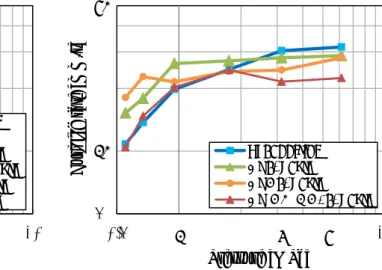
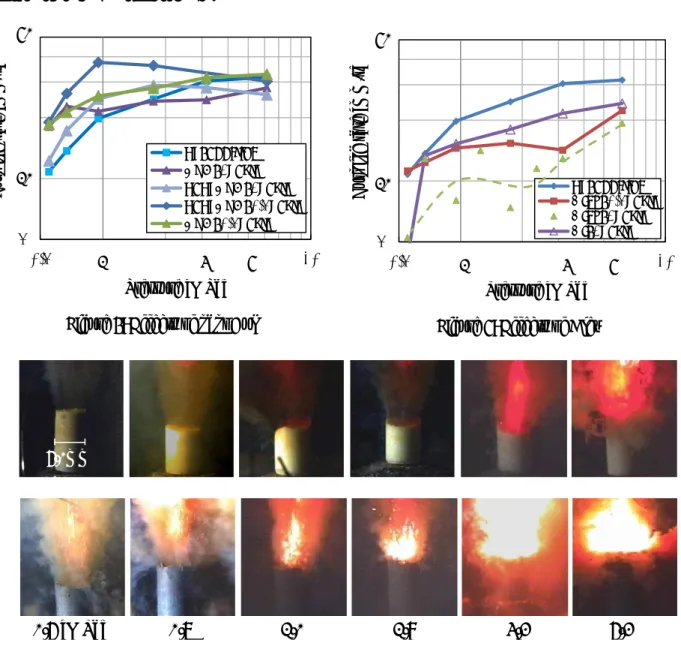
2, the additives are micron-sized Al, Fe2O3, TiO2, NiO and CuO. Fe2O3 has the most negative effect among them and the burning rate slows down under all experimented pressures com- pared to no-additive sample. Burning rates of copper compounds are compared at Fig. 3. These additives generate more smoke than no-additive sample during the combustion and darkzones can clearly be seen above 3 MPa. Cu has a little higher effect than CuO above 1 MPa. Cu is easily oxidized by ADN, and the color of the mixed powder turns smoky blue after drying of dichloromethane. The burning rate of Cu(OH)NO3 decreases above 2 MPa. These copper com- pounds generate residues during combustion, and the color was black which seems CuO at all compounds.
In Fig.4 normal CuO and nanoCuO were compared. The mass amounts of additives were 2.0 and 0.5 parts of ADN weight. Burning rates of CuO-0.5 parts sample is a little faster than CuO-2.0 parts. On the other hand, nanoCuO drastically enhance the burning rate particularly below 3.2 MPa. Therefore, nanoCuO is superior to normal CuO to enhance the burning rate.
Table 1: Sample Composition
Sample Binder Oxidizer Additive Mass ratio
TP/ADN (30:70) TP ADN - 30:70
TP/ADN (20:80) TP ADN - 20:80
TP/ADN (10:90) TP ADN - 10:90
TP/AP (20:80) TP AP - 20:80
TP/ADN/Alex TP ADN Alex 30:70:2
TP/ADN/nanoCuO TP ADN nanoCuO 30:70:2
5
0.5 10
no_additive Al_2parts CuO_2parts Fe2O3_2parts TiO2_2parts NiO_2parts
5
0.5 10
no_additive Cu_2parts CuO_2parts Cu(OH)NO3_2parts
Figure 2: Effects of copper compound Figure 3: Effects of normal additives
50
10
50
Burning rate [mm/s] 10
Burning rate [mm/s]
1 3 5 1 3 5
Pressure [MPa]
Pressure [MPa]
In Fig.5, burning rates of samples incorporated with Alex were shown. Alex was added 0.5 and 2.0 parts of ADN weight. Alex-0.5 parts was close to normal Al-2.0 parts. Figure 6 is re- corded photos of ADN (upper) and ADN incorporated with 0.5 parts-Alex (lower). ADN does not form the flame below 1.8 MPa, however Alex can be ignited in the gas phase even at 0.55 MPa and it helps to form the flame at higher pressure. The results of Alex-2.0 parts are scat- tered below 3.2 MPa because the burning rates vary depending on the presence or absence of flames. A little different of the experimental condition influences the formation of flame. In the case of Alex, combustion residues are not found though normal Al agglomerates and it remains inside the combustion chamber.
3.2 ADN-based propellants
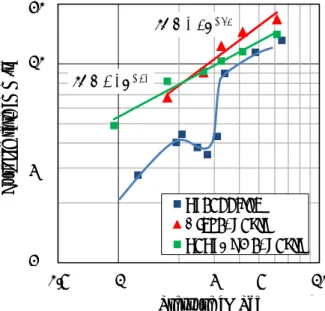
The linear burning rates were plotted in Fig.7. The results of TP/ADN (20:80) and (30:70) increases from approximately 3 MPa. TP/ADN (10:90) has not measured enough, but accord- ing to Weiser et al. Paraffin/ADN (10:90) [5], which is almost the same composition as TP/ADN (10:90) shows plateau between 2 and 3 MPa and the trend changes and increases from 3 MPa. The surface temperature profiles of TP/ADN (30:70) were obtained with 50m- dia-thermocouples and the results are shown in Fig.8. Temperature-constant-region was found at 1.3 and 2.1 MPa, and the temperature was between 700 and 800 K. However, there is no
5
0.5 10
no_additive Alex_0.5parts Alex_2parts Al_2parts
5 0.5 10
no_additive CuO_2parts nanoCuO_2parts nanoCuO_0.5parts CuO_0.5parts
Figure 4: Effects of nanoCuO Figure 5: Effects of Alex
Figure 6: Photos of ADN (upper) and Alex-incorporated ADN (lower) 0.6 [MPa] 0.7 1.0 1.8 3.2 6.2
50
10
50
Burning rate [mm/s] 10
Burning rate [mm/s]
Pressure [MPa]
Pressure [MPa]
1 3 5 1 3 5
6.0mm
such region at 4.8 MPa. Figure 9 is the result measured with 25m-dia-thermocouple at 3 and 4 MPa where the burning rate behavior changes.
Stepwise curve are found at the temperature range 750-1050 K on the result of 3 MPa The adiabatic temperature seems to be around 1800 K on both profiles.
Figure 10 shows the burning rate of TP/ADN (30:70) with Alex and nanoCuO. Both additives enhanced the rates and peculiar behav- ior between 2.1-3.4 MPa was improved. The pressure exponents were 0.76 and 0.54, respec- tively. TP/ADN/Alex extinguishes at 0.95 MPa.
nanoCuO has little effect above 3 MPa, however it enhances below 3 MPa and stable combustion is observed even at 0.95 MPa.
4 Discussion
ADN-based propellant show high pressure exponent in all of the compositions (Fig. 7). The burning rate behavior involves plateau and mesa type. Particularly, TP/ADN (30:70) shows the burning rate jump between 3 and 4 MPa.
nanoCuO and Alex enhanced the burning rate of both pelletized ADN and ADN-based propel- lants. It is important to comprehend the mecha- nism to improve their characteristics.
In Fig. 9, gasification temperatures can be found at 1050 K on the profile of 3 MPa, and 750 K at 4 MPa. The temperature difference is wide though the pressure increases only 1 MPa.
The combustion wave structure changes at this pressure. Below the gasification point, there is a noticeable difference between 3 MPa and 4 MPa,
50
20 10
2 1
㼞㼎㻌㻩㻌㻠㻚㻢㻼㻜㻚㻣㻢㻌
㼞㼎㻌㻩㻌㻡㻚㻠㻼㻜㻚㻡㻠㻌
㻜㻚㻡㻌 㻝㻜㻌
no_additve Alex_2parts nanoCuO_2parts
Burning rate [mm/s]
Distance [mm]
Temperature[K]
Distance [mm]
X
Figure 7: Burning rate of TP/ADN and TP/AP
Figure 8: Surface temperature of TP/ADN
(30:70) at 1.3, 2.1 and 4.8 MPa Figure 9: Surface temperature of TP/ADN (30:70) at 3 and 4 MPa
Temperature[K]
20
10
3
1
Burning rate [mm/s]
Pressure [MPa]
0.4 1 3 5 10 20 Pressure [MPa]
0.5 1 3 5 10
Figure 10: Effect of Alex and nanoCuO for burning rate of TP/ADN (30:70)
1050K 750K Gasification
point 3MPa
4MPa 2.1MPa
1.3MPa 4.8MPa
Gasification
point
which is indicated as zone X on Fig. 9. The temperature range is approximately from 750 to 1050 K and the width is 50m, which close to ‘Aerosol zone’ reported by Sinditskii et al [10].
According to the report, aerosol zone is between burning surface and first flame zone on pelletized ADN combustion. The initial temperature of aerosol zone is the range of 850 900 K at 3 MPa. This value is about 100– 150 K higher than the initial temperature of zone X. The first reaction depends only on the heat of condensed phase reaction, and it is not influenced by heat feedback from the gas phase, thus the achieving temperature can be calculated by specific heat of ADN (2.0 J/g・K) referred from [10] and that of binder (2.2 J/g・K). The calculated tem- perature of ADN/TP (70:30) is between 671 and 706 K. This is good agreement because the binder does not become the same temperature as ADN, and the calculated temperature should be lower than experiments. The final temperature of aerosol zone which equals the initial tem- perature of first flame zone is 1300 K in the case of pelletized ADN. This temperature depends on the composition, and in the case of ADN/TP (70:30) it seems to be 1050 K at 3 MPa be- cause each experiment at 3 MPa shows the same temperature though at 4MPa it changes varia- ble. Aerosol zone of pelletized ADN become narrow upper 4MPa and can be found as the break of the temperature profile. In Fig. 9, the small broken line can be recognized just below the gasification point, and the temperature is 750 K. It shold be more studied why aerosol zone disappears at 4MPa. However one reason can be raised from Fig.8. Comparing 1.3 and 2.1 MPa above the gasification point, the temperature gradient increases with the pressure increase.
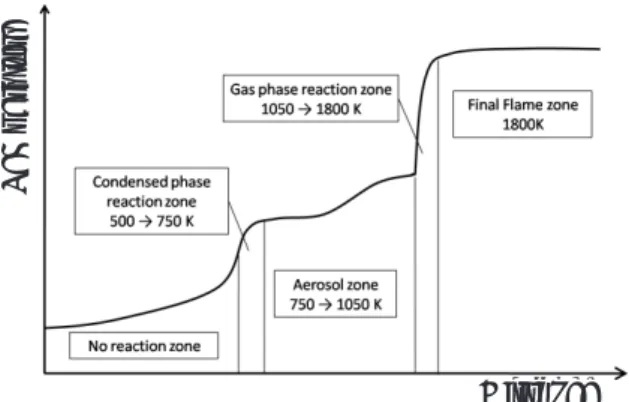
Accordingly, the increased heat feedback from gas phase reaction goes through the aerosol zone. Once the flame achieves the condensed phase reaction zone, it might be difficult that aerosol zone be formed again. From the above discussions, the combustion wave structures can be described like Fig. 11 and 12. Zone X is written as aerosol zone.
First reaction occurs quickly at condensed phase at 500 K or lower and the temperature is raised to 700 – 800 K. It is sometimes difficult to find this zone at higher than 4 MPa. Next step is slower than condensed phase reaction, and it is known as aerosol zone or fizz zone for double-base propellants. Decompositions proceeds relatively slowly, and the temperature grad- ually increases below 3 MPa. When the temperature reaches the ignition point which seems to be 1050 K, the gas reactions start. It is the important point that ADN is not directly heated by the gas phase reaction. It might be covered by the melting binder in the aerosol zone. On the other hand, aerosol zone is not be formed upper 4 MPa at which the heat feedback enhances the degradation of ADN directly, and the gasification becomes very high rate and the binder is blown off before enough mixing with ADN and degradation. It can be confirmed by Fig. 9 and 8. At Fig. 9, the gas reaction zone of 4 MPa is wider than that of 3 MPa, and the achieving temperature of gas phase reaction zone is 1600 and 1700 K, respectively. At 3 MPa, ADN and binder are well mixed each other in the aerosol zone, so it takes shorter time for reaction and
Distance Distance
Temperature
Temperature
Figure 11: Conbustion wave structure (P < 3 MPa) Figure 12: Conbustion wave structure (P > 4MPa)
the achieving temperature becomes higher than 4 MPa. At Fig. 8, the rate of temperature in- crease of 4.8 MPa is slower than that of 2.1 and 1.3 MPa. Gas phase reaction is different from pelletized ADN because the released gases are pre-mixed. This reaction is faster and the reac- tion heat is higher than pelletized ADN, thus the temperature gradient and heat feedback are high.
The contribution of additives for combustion wave structure of ADN-based propellant is future work.
5 Conclusion
nanoCuO and Alex has remarkable effets on the burning behavior of pelletized ADN and ADN-based propellant. nanoCuO is the most effective to enhance the burning rate of pelletized ADN particularly below 3 MPa, and more effective than normal CuO. Alex was ignited in the gas phase even at low pressures under which pure ADN does not form the flame.
Burning rates of ADN-based propellants were obtained and they have critical pressure be- tween 3 and 4MPa. The combustion wave structure of ADN-based propellants was presented based on the surface temperature measurements.
References
[1] T. P. Parr, D. M. Hanson-Parr, Solid Propellant Diffusion Flame Structure, Twenty-Sixth Symposium (International) on Combustion, p. 1981-1987,1996.
[2] E. W. Price, S. R. Chakravarthy, J. M. Freeman, Combustion of Propellants with Ammo- nium Dinitramide, A98-35220. 34th AIAA/ASME/SAE/ASEE Joint Propulsion Conference, Cleveland, July 13-15, 1998
[3] Satyanarayanan R. Chakravarthy, Jeffrey M. Freeman, Edward W. Price, Robert K.
Sigman, Combustion of Propellants with Ammonium Dinitramide, Propellants, Explosives, Pyrotechnics, 29, No. 4, 2004
[4] O. P. Korobeinichev, A. A. Paletsky, A. G. Tereschenko, E. N. Volkov, Combustion of Ammonium Dinitramide/PolyCaprolactone Propellants, Proceeding of the Combustion In- stitute, p. 2955-2961, Vol 29, 2002
[5] Volker Weiser, Norbert Eisenreich, Andrea Baier, Wilhelm Eckl, Burning Behaviour of ADN Formulations, Propellants, Explosives, Pyrotechnics, p. 163 –167, 24, 1999
[6] Klaus Menke, Thomas Heintz, Wenka Schweikert, Thomas Keicher, Horst Krause, For- mulation and Properties of ADN/GAP Propellants, Propellants, Explosives, Pyrotechnics, p. 218 –230, 34, 2004
[7] Niklas Wingborg, Sten Andreasson, John de Flon, Mats Johnsson, Mattias Liljedhl, Carl Oscarsson, Ake Pettersson, Marita Wanhatalo, Development of ADN-based Minimum Smoke Propellants, AIAA2010-6586, 46th AIAA/ASME/SAE/ASEE Joint Propulsion Con- ference, Nashville, July 25-28, 2010
[8] John de Flon, Sten Andreasson, Mattias liljedahl, Carl Oscarson, Marita Wanhatalo, Niklas Wingborg, Solid Propellants based on ADN and HTPB, AIAA2011-6136, 47th AIAA/ASME/SAE/ASEE Joint Propulsion Conference, San Diego, July 31 –Aug 03 , 2011 [9] Koji Fujisato, Hiroto Habu, Hidefumi Shibamoto,Xiuchao Yu, Atsumi Miyake, Keiichi
Hori, Combustion characteristics of ADN-based solid propellants, S1c-64, Europyro2011, Reims, France, May, 2011
[10]Valery P. Sinditskii, Viacheslav Y. Egorshev, Anton I. Levshnkov, and Valery V.
Serushkin, Combustion of Ammonium Dinitramide, Part2: Combustion Mechanism, Jour- nal of Propulsion and Power, Vol22, No. 4, July-August 2006