Islamization among the Orang Asli in Malaysia
year 2009‑01‑01
URL http://hdl.handle.net/10502/2061
The Taboo of Incest
Chapter 8
I begin this chapter with a myth passed down in Kampung Durian Tawar.
The mythological history of the village begins with “incest”.
In a village on the island of Percha lived Gentar Alam (to shake the heavens) and his younger sister Bumi (the earth).
They lived together in their house. Gentar, a warrior, was often away in battles. On one such occasion, Bumi discovered she was pregnant. Suspecting that Gentar was the father of the child Bumi was carrying, the villagers accused the brother and sister of incest. Gentar and Bumi could not bear the abuse. They fled the island with their kinfolk to the Malay Peninsula. Bumi gave birth to a child, named Batin Pah Galang, who became our ancestor.
Incest is a taboo found in most societies. However, the definition of incest varies from society to society, as do the sanctions applied to offenders.
Incest is also forbidden in Kampung Durian Tawar, and certain vindicatory sanctions under adat are taken against those who violate the taboo.
Nevertheless, I have come across cases of what I will call “unresolved
incest”. In these situations, incest occurred but no sanctions were
implemented. The enforcement of the Islamization policy on the Orang
Asli since the 1980s has had a significant effect on the cases of incest I
discuss in this chapter. As a result of the state-led Islamization policy,
the number of Islamic converts among the Orang Asli is increasing,
which is a threat to the social order of the village. For example, in one
case the parents of a girl who committed incest had converted to Islam,
and were now in conflict with the village adat leaders.
In this chapter and next chapter, I discuss Orang Asli adat
1and village politics in respect to marriage. Cases of incest, such as those discussed in this chapter, are classified broadly as “incorrect marriages”, which is a topic discussed in the next chapter. I examine Orang Asli adat, which is one variety of adat, in relation to Islam.
Village Adat
The adat of Kampung Durian Tawar is influenced by that of the matrilineal Minangkabau. Inheritance (in the past of paddy fields), succession of adat leadership titles and marriage customs are practiced under matrilineal principles. The Minangkabau influences, however, are of little significance to the Kampung Durian Tawar villagers.
In this book I argue that the Kampung Durian Tawar villagers may have “borrowed” their adat from the Malays in neighboring areas, but they nonetheless actively control what they adopt and how they put it into practice (cf. de Certeau 1987). From this standpoint, we can understand their rationale when they describe their adat as comprising their own practices ( cara kita) rather than something influenced by the Malays. They often insist that their adat is free from Islamic elements and therefore is
“the genuine adat” (adat benar). They also criticize the Malays in Negeri Sembilan for being caught in a dilemma between patrilineal Islam and matrilineal adat.
The Orang Asli’s ability to maintain their own adat arises from their special legal status. In the Orang Asli policy of 1961, the government granted the Orang Asli rights to maintain their customs, political system, laws and institutions, as long as these did not contradict the national legal system. The policy goes further, stating that these means of social order must be used as much as possible in dealing with crimes committed by Orang Asli (Nobuta 1996a: 113). The administration also leaves the judicial power with the adat leadership headed by the Batin, unless this conflicts with the national judicature (Nobuta 1998: 15). When it does conflict, the police or the national law deals with the case. For example, sanctions enforcing physical action, such as banishment, could clash with a national law. Hence, the sanctions taken by adat are in most cases restricted to financial punishment such as fines.
The villagers are especially afraid of the magical powers (or sorcery)
of the Batin in his role as judge. In a “trial” the credibility of a witness can
be tested by the use of the Batin’s sword (keris ). When a witness makes a
dubious statement, he/she may be asked if he/she is prepared to step over
the keris (as proof of telling the truth). If she/he is lying, the witness is said
to be too fearful of the Batin’s magical power to step over the sword and will eventually confess the truth.
This principle of judicial independence functions reasonably well, as long as all the parties concerned are Orang Asli. However, when a dispute involves an outsider, be the outsider Malay, Chinese or other, it is dealt with through the outsider’s law or by negotiation with the outsider.
In a criminal case, such as rape or murder, the police may well remain uninvolved, provided that both the offender and the victim are Orang Asli and that the case is settled. The court intervenes if the victim is Malay or any other non-Orang Asli.
There was a rape case in Kampung Durian Tawar a few years ago.
This was not reported to the police, and the offender was fined.
2One case involving an outsider had a different outcome. In 1996 a young villager raped a Malay woman. He was later arrested, tried and given a jail sentence, which he is still serving.
This principle also applies to marriages. When a villager marries an outsider, in most cases the marriage conforms with the latter’s marriage law, whether Malay or Chinese. Problems often arise when the marriage partner is a Malay Muslim (Mohd. Tap 1990: 136-57). The Orang Asli partner has no choice but to convert to Islam when he/she marries under Islamic law, which prohibits marriage with a pagan.
When an Orang Asli and an outsider wish to marry under Orang Asli adat, the marriage usually takes place according to the adat of the village to which the Orang Asli partner belongs. In relation to the state, the marriage custom of the Orang Asli is respected, but there is no state law that covers their union. Related to this, the Orang Asli do not have the custom of registering a marriage. The JHEOA, with its jurisdiction over marriages, conducts a household census but does not provide a so-called marriage registry. In the situation where Orang Asli “customary law” is not incorporated within the national legal system, the lack of a marriage registry places Orang Asli marriages out of the reach of state law. Such marriages require that both parties be Orang Asli and that, in compliance with the village adat, a dispute over the marriage be resolved without any involvement of outside authorities, such as the police.
In most cases when both the bride and groom are Orang Asli, the wedding ceremony is conducted in conformity with the village adat.
However, this practice is changing as more Orang Asli convert to Islam.
Now a marriage between a Muslim Orang Asli and a non-Muslim partner
can cause friction. The wedding party faces difficult decisions about the
law or model on which the marriage ceremony is to be administered, about
who officiates during the ceremony, about whether or not the non-Muslim must convert, about who prepares what for the feast, and so on.
The emergence of Islamic converts among the Orang Asli has given rise to socially and legally sensitive issues. Islamic converts are expected to follow Islamic law. With the Orang Asli, however, this is not so simple.
In Negeri Sembilan, on the one hand, the JHEOA issued a statement that Muslim Orang Asli did not have to conform to adat. The statement was sent from Undang Johol to the Batins via the JHEOA in Negeri Sembilan and Melaka. The notification laid down the principle that Muslim Orang Asli abide by Islamic law. The Aboriginal Peoples Act, on the other hand, allows an Islamic convert or any other religion to remain Orang Asli, suggesting that Muslim Orang Asli do not necessarily have to obey Islamic law. Hooker points out that the legal status of Islamic converts remains equivocal even today (1991: 53, 55-57, 61, 70-71).
In Kampung Durian Tawar, in response to the notification from the JHEOA, Islamic converts are in principle expected to follow Islamic law, without having to obey adat. However, in reality many of the converts who defy the village adat do not necessarily follow Islamic law either.
As mentioned in Part II, the lower people can be related to the upper people by kinship or by marriage but there are no members of both matrilineal descent groups holding the title of adat leadership. Such people have a marginal standing in the power structure of the village. Therefore, conversion to Islam by some of these people has not been a significant threat to the upper people. However, it can cause a dispute among the lower people, which often leads to friction among the upper people over the village leadership. This in turn makes it difficult to resolve the original dispute. In one of many aspects of the “unresolved incest” case discussed in this chapter, we see a leadership struggle among the upper people over a dispute among the lower people.
Adat Solution to Incest
As presented in their own myth, those who commit incest are usually cast
under suspicion by the rest of the village until they can no longer stand
the humiliation and flee. Even today, newcomers are often rumored to
be fugitives from their home villages where they have caused an incest-
related problem. In one neighboring Orang Asli village, a father and his
unmarried daughter were living together when the daughter was found to
be pregnant. Suspected of incest, the father killed himself out of shame
(malu). This story shows that incest, or even circumstances that draw
suspicion of it, is a violation to which social sanctions are due.
Sumbang is the Orang Asli (or Malay) term for incest. Its original meaning is “to violate adat”, but in its actual usage it expresses the concept of sexual or marital relations between opposite sexes that violate adat. In Kampung Durian Tawar sumbang derives a number of subordinate concepts.
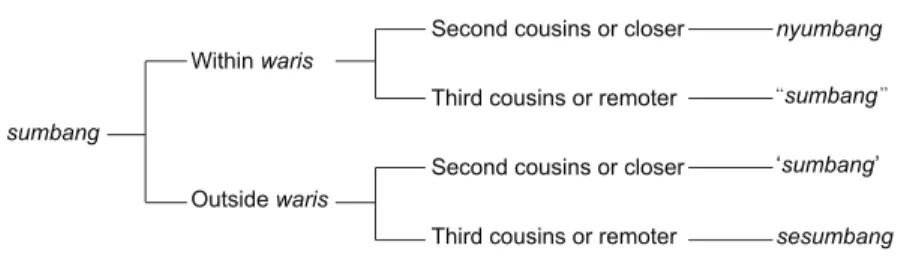
Figure 13 is a simplified chart that explains the concept of sumbang . All sexual behavior between relatives of opposite sexes that violate adat are called sumbang. In Kampung Durian Tawar, sumbang applies approximately to relatives that are second cousins or closer. As degrees of consanguinity are subject to the villagers’ memories of their genealogy, second cousins do not always form the threshold, but they do generally serve as the reference point, which I will express as ‘ sumbang’ in this chapter. When incest involves third cousins or more distant relatives in a matrilineal descent group (waris), the villagers also use the term sumbang . I will express the latter usage as “sumbang” in this book to distinguish from the standard, ‘ sumbang’.
Sesumbang is a word derived from sumbang. This concept covers a much wider scope. In the usage of this word, it does not matter whether or not the man and the woman concerned are related. Sesumbang includes acts by a man and a woman of being together on their own ( sesumbang pemandangang), talking on a topic of a sexual nature in the presence of a person senior to them ( sesumbang percakapan) and going out together (sesumbang ikut-turut).
The villagers of Kampung Durian Tawar strongly believe in strict segregation of the sexes. Unmarried men and women are prohibited from coming into physical contact with a member of the opposite sex. Premarital sexual relations are forbidden, and the sinners must face sanctions in some form, imposed by adat in this world or in the world after death (Baharon 1973: 73-74). Repeat offenders of sesumbang either receive sanctions
Figure 13
Concepts of sumbang in Kampung Durian Tawar
Second cousins or closer nyumbang Withinwaris
Third cousins or remoter "sumbang"
sumbang
Second cousins or closer ‘sumbang’ Outsidewaris
Third cousins or remoter sesumbang
Figure 13: Concepts of sumbang in Kampung Durian Tawar
“ ”
(hukum) or are forced to marry each other. Nevertheless, while these are general rules, in practice they are not strictly applied in all cases.
Tangkap basah is the term for a situation in which a man and a woman are arrested by the woman’s relatives and brought to the adat leaders to resolve their offence with “either sanctions or marriage”. This is another concept considered to have been borrowed from the Malays. To Malay Muslims, for a man and a woman who are not wed to each other to be alone in an enclosed space is considered behavior against Islamic precepts, and is called khalwat. If caught by the Islamic religious police, the offenders are arrested and fined. Tangkap basah is the Malay term to refer to such a situation (Mizushima 1993: 87). This Islamic idea of segregation of the sexes was adopted by Orang Asli society, where it has developed subtle differences in meaning and content. In the Orang Asli version of tangkap basah, it is the woman’s relatives who “arrest” them, not the religious police. According to the villagers’ accounts, the practice of tangkap basah was introduced after they encountered Malays.
Offenders of sexual incorrectness (salah, more generally, “wrong”) in most cases marry each other to avoid a situation of ‘sumbang’ or sesumbang.
In other words, in Kampung Durian Tawar, where extramarital sexual relations are forbidden, a potential situation of ‘sumbang’ or sesumbang is absolved by the means of marriage.
I now discuss this in the context of matches between cousins. If the couple are cross cousins who are second cousins or closer, their marriage in most cases is not disputed, even though their relationship comprises
‘sumbang’. Most often, however, theirs is not a normal marriage that follows an engagement. It takes place in the form of tangkap basah preceded by a pregnancy (bunting). When the match is between two second or closer patrilateral parallel cousins, their union is specifically called “hot” marriage (kepanasan), which comprises ‘ sumbang’ and is vigorously prohibited. However, this is also resolved by the means of marriage, mainly under tangkap basah.
A match involving two matrilateral parallel cousins, which I will
discuss further in this chapter, draws the greatest disapproval. In the past,
such cousins were never allowed to marry. Apparently, as punishment
for this offence the man and the woman were bound and immersed in
water seven times each (sangkar rendam tujuh kali). If they survived
this punishment, as further punishment they would be given some food
and then be banished (halau ) from the village at midnight. Regardless of
whether or not these punishments were actually carried out, this shows
that the taboo was regarded as especially abominable. Today, the villagers
say, these punishments cannot be carried out, as the perpetrators would be arrested by the police.
The taboo of a union between matrilateral parallel cousins relates to the matrilineal aspects of village adat, in which matrilineal lineages are central to kinship relations. Strictly speaking, the matrilineal lineages are called perut, meaning womb or abdomen. In Kampung Durian Tawar, where inheritance and titles (pusaka) are passed on according to matrilineal principles, the villagers more commonly use the term waris (the successor of pusaka) to refer to their matrilineal descent groups. The taboo of a union between matrilateral parallel cousins is connected to that of sexual relations and marriages within a waris. While all sexual relations and marriages between a parent and a child, a brother and a sister, and first and second cousins are taboos, those within a waris are more strictly forbidden and, more specifically, are called nyumbang or penyumbang (I use the former expression here).
Matrilateral parallel cousins can marry in instances where the kinship between them is distant. From my genealogical survey, I observed that the villagers’ genealogical memory seems to play a role, in that it is primarily concerned with the living, while memory of the deceased is generally short.
3Today, villagers are named in the Malay or Islamic style, with the individual’s name followed by that of his/her father. We can ascertain that Ayof bin Ekal’s father is Ekal, but nothing in his name tells us who his mother is. If Ayof’s mother died when he was very young, he most likely would not know her name.
Villagers do not remember the names or genealogical relations of most of the deceased. Accordingly, grandparents ( aki/wan), great-grandparents (moyang) and their contemporaries are generally beyond their memory.
However, Batin Janggut and other adat leaders possess extensive knowledge of the genealogy of the village population. This enables them to pass judgment on who may or may not marry whom. When they decide that the kinship relations of a particular man and woman are remote enough (with second cousins being the threshold), they may allow them to marry. Thus, incest between third cousins or more distant relatives within a waris can be resolved by marriage, as is the case with ‘sumbang’
mentioned earlier. This incest is expressed as “sumbang” in this chapter.
As discussed in Chapter 5, kinship in Kampung Durian Tawar can be seen as bilateral with a matrilineal ideology (matrilineal adat). If we examine the concept of sumbang with this in mind, it becomes clear that the Kampung Durian Tawar adat combines a number of different norms.
First, ‘ sumbang’ involves the taboo of sexual relations and marriage
between a man and a woman whose kinship is scrutinized according to both matrilineal and patrilineal lineages. Second, segregation of the sexes found in the concept of sesumbang reflects the Islamic values of Malay Muslim society. Third, nyumbang is a concept related to the ideology of the matrilineal principle.
I will seek to identify the miscellany of norms that comprise the adat of Kampung Durian Tawar. I will also focus on how the Orang Asli have adopted these apparently contradictory norms and put them into practice as their own. A concrete example of this is tangkap basah, which resolves
“incorrectness” by having the offenders arrested by their own relatives rather than the religious police. Another is the resolution of ‘sumbang’ by marriage after imposing sanctions according to the adat. Yet another is found when the rule for “sumbang” is applied to offenders of nyumbang to make them marry, as mentioned above.
Cases of Incest
Resolved Incest (Case One)
Here I discuss a couple who married as a consequence of “sumbang”.
The pair married under tangkap basah in February 1985, when the bride, Zaida, was pregnant with their first child. As of 1997, thirty-year-old Zaida and her thirty-four-year-old husband Konchon had an eleven-year-old son, an eight-year-old daughter and one-year-old twin girls.
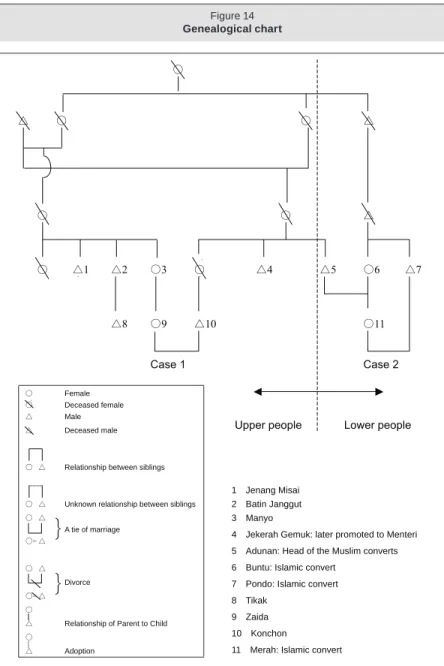
According to the genealogical chart (Figure 14), Zaida and Konchon can be regarded as either second or third cousins. If their kinship is tracked down from the sisters in the first generation, they would be considered third cousins. If it is tracked down from the half-sisters by different mothers, however, they would be second cousins. In terms of status in Kampung Durian Tawar, both are members of the group holding adat leadership titles, including that of the Batin. Among other things, this distinguishes Zaida and Konchon from the couple discussed in Case Two.
When Zaida was first pregnant, there was confusion as to how the
case should be dealt with under adat. It was later decided that they must
marry. Batin Janggut, the brother of Manyo (Zaida’s mother), made the
decision. According to the Batin’s interpretation, the two young members
of the same waris were third cousins (not second cousins) and, therefore,
were offenders of “sumbang” who must marry. A wedding ceremony is
normally officiated by the ibubapa (the head of the bride’s matrilineal
descent group) or an adat leader (lembaga adat). Batin Janggut took on
the role himself. He explained that no other adat leader could have borne
Figure 14 Genealogical chart
1 2 3 4 5 6 7
8 9 10 11
Case 1 Case 2
Upper people Lower people
Female
Deceased female
Male
Deceased male
Relationship between siblings
Unknown relationship between siblings
A tie of marriage
Divorce
Relationship of Parent to Child
Adoption
1Jenang Misai 2Batin Janggut 3Manyo
4Jekerah Gemuk: later promoted to Menteri 5Adunan: Head of the Muslim converts 6Buntu: Islamic convert
7Pondo: Islamic convert 8Tikak
9Zaida 10Konchon
11Merah: Islamic convert
the misfortune that the act of marrying the pair would invite, such was the significance of the decision. The families and relatives of both Zaida and Konchon were fined and the couple were divested of their rights (of inheritance, succession and usufruct) concerning pusaka of the waris of which they had been members.
4Marriage under ‘sumbang’ also carries monetary penalties for the relatives of the couple. Zaida and Konchon’s case differed from ‘sumbang’
in that they were stripped of their rights as members of their matrilineal descent group. This brings to the fore the issue of how to treat their four children. The solution is that, while Konchon and Zaida will never have their waris membership reinstated, their children can claim their rights.
According to the villagers, the children must wait until Batin Janggut, who married their parents, is replaced by a new Batin, and then they must perform a ritual of merujuk to seek a pardon from Manyo (the head of the waris ) (in this instance not on the husband’s side but on the wife’s).
The formalities demand that the children receive sanctions (minta hukum) from the Batin and ask the pardon ( ampun) of the waris.
A factor that helped to make Zaida and Konchon’s marriage possible was the amicable association between Zaida’s parents, Manyo and Ukal, and the adat leadership of Kampung Durian Tawar. This presents a contrast to Case Two, in which the father, Adunan, was in opposition to Batin Janggut and other adat leaders. Following Zaida’s marriage, nevertheless, her parents were said to have fallen ill and to have suffered madness (gila), and her sister, Zainon, suffered insomnia. Some villagers are of the opinion that they suffered in retribution for the marriage, while others dismiss such a view.
To the matrilineal descent groups that the adat leaders belong to, this marriage is tainted. To the groups in opposition, it serves as a focus for their criticism. Dissidents against Batin Janggut accuse him of having married a couple guilty of nyumbang.
Unresolved Incest (Case Two)
I heard of the second case of incest (Figure 14) when I was conducting an
interview survey of households in Kampung Durian Tawar. I was at the
residence of Jekerah Gemuk (later promoted to Menteri) with my field
assistant, Asat, when Jekerah Gemuk asked me if marrying the daughter of
one’s sister was allowed in Japan. I answered that in Japan such a scenario
was impossible. He explained that Merah, the daughter of his brother,
Adunan, lives in a de facto married with Pondo, her mother’s brother, with
whom she has children. “But isn’t it wrong (salah)?” I asked, to which he
replied, “It is. But we cannot do anything. They are Muslim”.
By that time I had learned of some unusual marriage practices among the Orang Asli, but this account of incest disturbed me greatly. The fact that they had produced children surprised me. I inquired if they had no concern about possible mental and physical disorders in such offspring.
Jekerah Gemuk, as well as Asat, replied that the couple had no choice but to raise the children. In fact, there is quite a high rate of consanguineous marriages in Kampung Durian Tawar, of which the villagers are aware.
They often say that the so-called mad men/women ( orang gila) and the physically disabled in the village are results of consanguineous marriages.
5Later in the survey, I obtained more information about the couple in Case Two. The woman’s parents had converted to Islam. Because of the village politics surrounding Islamization, I was unable to talk directly to them.
6The information that I did manage to collect can be summarized as follows. From the perspective of Pondo, he “married” his sister Buntu’s daughter, Merah. In 1997 Pondo was twenty years of age and Merah seventeen, and they had two children. Presumably, they “married” when Pondo was about eighteen and Merah fifteen. A majority of families in Kampung Durian Tawar are uxorilocal. As such, Merah and Pondo lived in the same house as Buntu (Merah’s mother and Pondo’s sister).
Pregnancy preceded their “marriage”. When Merah’s parents found out that their daughter was expecting a baby, they brought the matter to the adat leaders in charge of marriage.
The problem was too great for the village adat of Kampung Durian Tawar to manage. As it was impossible to marry the couple under adat, Merah’s father, Adunan, and the adat leaders disputed it. Adunan and his wife had converted to Islam by then, and had been showing strong signs of defying the adat.
My informants seemed to believe that the marriage would have been granted if the couple had been Muslim.
7Pondo had apparently attempted to convert to Islam. Subsequently, his identification card was confiscated, and he applied to the JHEOA for a new one. On his new card, he allegedly wrote his matrilateral grandfather’s name in place of his father’s (an identification card normally carries the cardholder’s father’s name following his own name and the conjunction bin/binti). Pondo went to another village and obtained its Batin’s signature to verify the new card.
My interpretation of the rumors about Pondo’s conversion and
identification card is as follows. An Islamic convert loses his/her old
name and registers a new one.
8The anticipation is that the names of
the incestuous couple would be deleted; thus, in this case their Orang
Asli descent would also have motivated Pondo to convert. The system automatically cancels the convert’s old identification card. However, this had probably not been Pondo and his family’s intention. They may have been after no more than a name change. This explains his reapplication for a new card. He could not seek Batin Janggut’s signature, with whom he was in strife. Having obtained the signature of a Batin in a neighboring village instead, he falsely reported to the JHEOA that he had lost his old card, in order to receive a new card carrying his grandfather’s name.
Pondo’s siblings, who are non-Muslim, have confirmed that he is an Islamic convert. With both of her parents being converts, Merah is most likely to be a convert as well. They are Muslim, at least formally, once they have registered themselves with the Department of Islamic Affairs. Convert or not, if, as alleged, his name was changed, any conflict with Islamic law is probably no longer an issue, because the new name does not carry his descent. It is difficult to believe that Pondo and his family willfully carried out the fabrication. However, one thing is clear:
conversion to Islam and the accompanying name change enables a villager to lose his/her descent and former name.
It is slightly plausible that the Department of Islamic Affairs pays no attention to the case on the grounds that the couple are Orang Asli.
Apparently, this incest has not been known among Malay residents in the neighborhood.
The non-Muslim siblings of Merah’s parents frowned as they talked to me about this “marriage”. Many of the Kampung Durian Tawar villagers show their outrage when they say that this “marriage” is incorrect (salah).
They also say that it is a “shame” (malu) that the situation is ongoing.
9It is worth noting, however, that the offenders and their parents countenance the incest. Batin Janggut’s son, Tikak, said that he was also critical of his estranged father for having failed to marry the couple according to the adat.
Pondo and Merah concluded that they also could not marry in the Islamic way. Before they continued their cohabitation, they stayed away in a forest for a week, which they decided served as their banishment by adat. Two children have been born to them. From the couple’s perspective, they could not expect the adat leadership to resolve the incest. They therefore took matters into their own hands and carried out what they thought should have been done under adat. They have no reason to doubt that “the incest has been resolved”.
The adat leaders are not happy about the solution, but they cannot
directly intervene. Merah’s parents are Islamic converts, who are defiant
against the Kampung Durian Tawar adat, especially when the adat leaders administer it. Although the “marriage” obviously violates Islamic law, the Department of Islamic Affairs pays no attention to the case on the grounds that the couple are Orang Asli. They are Islamic converts but their “marriage” is not registered in the department. This may be the reason why the authority cannot handle the case under the Islamic law.
Incest in the Periphery
In Malaysia, where Malay Muslims dominate, the non-Muslim Orang Asli constitute one of the marginal societies. Since Malaysia achieved its independence, Malay discrimination against the non-Muslim Orang Asli has been on the increase. Discriminatory views and attitudes of the Malays towards the Orang Asli have also spread to the Chinese and Indian populations (Mohd. Tap 1990: 444). In other words, the Chinese and Indians also disrespect the Orang Asli and display discriminatory behavior towards them. Hence, relatively few interracial marriages occur between an Orang Asli and someone outside the minority community.
Although often found before and during the British colonial period, interracial marriage with a Malay has become almost impossible.
Today most inter-ethnic marriages are between an Orang Asli woman and a Chinese trader ( tauke) or a marginal member of the Malay society.
Marriages between Orang Asli women and migrant workers from Indonesia are also on the rise. In short, it is most often a marginal man of the respective society who marries an Orang Asli woman.
With these limited opportunities of intermarriage, endogamy among the Orang Asli is rising. This is because the pool of prospective partners for Orang Asli is restricted. This tendency has become even stronger as the numbers of Islamic converts increase in the Orang Asli community.
Some Orang Asli give up a match because, to marry their Muslim Orang Asli partner, they would have to convert. The class structure that exists in Orang Asli society also restricts the choice of a spouse. In Kampung Durian Tawar a male member of the lower people is highly unlikely to marry a female of the upper people.
From Pondo’s perspective (Case Two), his choice of a wife was
extremely limited. He could not hope for a partner from the upper people
or from a non-Orang-Asli community. Even if he was willing to convert
to Islam, he could hardly have found a Malay woman who would marry an
Orang Asli who was generally perceived as poor. Exactly what made him
begin sexual relations with his own niece will remain a mystery, but it is
clear that he had to choose a wife from an extremely short list.
Significance of the Adat
Sanctions by adat carry more than economic significance. The incest in Case One was clearly a violation of adat. The adat leaders interpreted this as a matter that could lead to a more dangerous (bahaya) situation unless resolved by means compliant with adat. It resolved the violation in the form of marriage under the adat to abort the sexual relation between the unmarried man and woman. With this logic of the adat leaders, unresolved incest is a dangerous situation, which would cause illnesses, accidents and other misfortunes for the guilty party and their relatives.
Although sanctions were imposed by the adat in Case One, the offenders’
own responsibility (tangung sendiri) was still stressed. A child with disabilities, confusion of kinship, illness fallen on a family member or whatever, the consequences of incest must be resolved, after all, under the offenders’ own responsibility. The adat leaders can only impose sanctions to remove some of the possible causes of the misfortunes, to abort a dangerous situation and to recover order. Sanctions by adat possess magical significance, which seems to be the principle on which the adat of Kampung Durian Tawar works.
Execution of sanctions under adat also serves as a brake on the third party, and ends slanders and rumors. As adat is virtually a law within kinsfolk, the executor and the executee of the sanctions are kin to each other. A fine imposed by adat is little more than a formality. Besides, the fine is not large.
10As noted earlier, to resolve such disputes as in Cases One and Two by adat is legal because of the special status of the Orang Asli and because their custom lacks a marriage registry. Adat is restricted, however, when it contradicts state law. With the incest in Case Two, for example, the village adat calls for the death penalty by drowning and banishment, which is presumably against the state law.
Contradictions to the state law aside, it is believed that if the guilty
parties in Case Two receive some form of sanctions by adat, the village
will be saved, at least to some degree, from danger. Pondo and Merah
stayed away in a forest for a week, which they interpreted as banishment
and hoped would prevent misfortune. In their interpretation of adat,
their action resolved the incest. In the adat leaders’ interpretation, on the
contrary, sanctions must be executed according to the adat administered
by themselves, and makes many villagers in Kampung Durian Tawar
concerned about the possible disputes and misfortunes that may arise
from the incest.
Power Relations
Merah’s parents and Batin Janggut’s son Tikak see the incest in Case Two as acceptable only because Batin Janggut approved the marriage of the incest offenders in Case One. Adunan and Tikak interpret the incest in both Case One and Case Two to be nyumbang (incest between second cousins or closer relatives within a waris). Batin Janggut resolved Case One after his decision that it was ‘sumbang’ (incest between third cousins or more distant relatives within a waris). He decided that Case Two was nyumbang, which does not allow marriage as an option and requires vindicatory sanctions by adat. This discrepancy between the two interpretations of adat is a product of the politics in Kampung Durian Tawar.
When comparing the cases of incest, it is worth examining the kinship factors. With the exception of Merah’s father, Adunan, none of the families and relatives involved in Case Two belong to the groups holding a title of adat leadership. In fact, they all fall under the category of lower people.
Adunan and Tikak, who are in conflict with the adat leaders, including Batin Janggut, belong to the upper people. There is friction among the upper people over the village leadership and it is in light of this situation that the incest of Case Two is often discussed. It is also said that Adunan’s alienation from Batin Janggut prompted him to convert to Islam.
In this context we can understand why Case One has been resolved but Case Two has not. To the upper people, Case One presented a serious violation of the adat that they advocate and therefore required resolution by the adat. The incest in Case Two was a “tool” in the power struggle among the upper people, to whom, after all, the case was merely the business of the lower people. The latter have animosities towards the former and tend to defy the solutions advocated by the adat leaders. Because Merah’s parents are Islamic converts, and because the offenders themselves have converted, the adat leaders could risk being labeled as anti-Islamic if they intervened. The adat leaders have come to the conclusion that they will not become actively involved in the effort to resolve the case.
In effect, the adat leaders have neither tried to, nor can they, resolve
Case Two by adat. Endorsed by Islam, so to speak, the Islamic converts
among the lower people confront the adat leaders. Also, among the upper
people, an anti-Batin Janggut group led by Tikak has been challenging the
authority of the Batin, often with the backing of Islam and the state. This
confrontation in the realm of village politics has created a situation that
leaves the incest unresolved.
Adat, Islam and the State
Today in Kampung Durian Tawar norms by adat do exist, as do those of Islamic law and of institutions of the state such as the police and the courts. If someone unsatisfied with sanctions imposed by adat reports this to the police, the solution by adat can instantly lose its effect. If a sanction by adat contradicts the state law, in principle the state law overrules to resolve the dispute.
In Kampung Durian Tawar most consanguineous marriages of sumbang incur sanctions according to the village adat. Although outsiders find some of the sanctions unacceptable, they are accepted within the village. Malays and other outsiders generally disapprove of sumbang being resolved by marrying the incestuous couple after going through the formalities of sanctions by adat, but this is permitted in Kampung Durian Tawar.
11Discrepancies in the concept of incest between Islamic law and Orang Asli adat (of Kampung Durian Tawar) make the situation more complex.
Not all of the marriages found guilty of sumbang (including both ‘ sumbang’
and “sumbang”) under adat and subject to its sanctions contravene the Islamic law. The “sumbang” in Case One does not constitute a form of marriage forbidden by Islamic principles.
12Case Two inevitably involves Islamic law, as Merah’s parents are Islamic converts and the offenders of the incest (Merah and Pondo) probably are too. As noted earlier, the JHEOA in Negeri Sembilan issued a statement that Islamic converts among the Orang Asli do not necessarily have to follow their Orang Asli adat. In fact, the incest in Case Two, which should have been strictly forbidden, has not been resolved under adat as the adat leadership led by Batin Janggut had hoped. The rule that makes adat inapplicable to Islamic converts of the Orang Asli provides opportunities for Islamic law to invade the village. At the same time, it justifies the converts’ defiance of their adat.
13The laws observed by the Malays, the Muslim Orang Asli and the non-Muslim Orang Asli in relation to marriage are shown in Table 20.
The question that arises here is the legal status of the Muslim Orang Asli.
If conversion to Islam makes them Malay, they are supposed to follow the adat of the Malays and the Islamic law. Legally, however, they are never made Malay but remain Orang Asli, as noted in Part I. As they are Muslim, they are left to observe Islamic law.
In practice, however, a convert to Islam at a village level is unlikely
to follow Islamic law. Like a majority of the Orang Asli observing their
custom, Pondo and Merah did not register their marriage. They are in a
Table 20
Islamic laws and adat on marriage
Malay adat Islamic law Orang Asli adat
Malays
Muslim Orang Asli
non-Muslim Orang Asli
: Compliant, : Defiant, : Neither
de facto relationship, so to speak. It might be the case that they converted to Islam but have not had their marriage registered in the Muslim way. If Pondo and Merah actually are Muslims committing incest, this situation would make it extremely difficult to apply the Islamic law to them. In examining the legal status of Islamic converts of the Orang Asli and the actual situation involving the people at a village level, it becomes clear that there are no legal means to apply.
In this chapter, through discussions of the Orang Asli rules and practices concerning incest, I have described a situation of unresolved incest as a consequence of Islamization. Non-conformity to adat, Islamic law or state law leaves the Islamic converts in Case Two in a legal vacuum.
Thus, the emergence of converts and the issue of their legal status could erupt in various forms of conflict and produce disorder in Orang Asli society in terms of law and norms with adat, Islam and the state law. The confusion of norms is likely to have a grave effect on the identity of Orang Asli and their practices.
Malay adat Islamic law Orang Asli adat
Malays
Muslim Orang Asli
non-Muslim Orang Asli
: Compliant, : Defiant, : Neither