著者 Wu Belinda, Birkin Mark journal or
publication title
International Review for Spatial Planning and Sustainable Development
volume 1
number 1
page range 19‑30
year 2013‑01‑01
URL http://hdl.handle.net/2297/33110
19
http://hdl.handle.net/2297/32453?locale=en
Copyright@SPSD Press from 2010, SPSD Press, Kanazawa
Moses: Planning for the Next Generation
Belinda Wu
1* and Mark Birkin
11 School of Geography, University of Leeds, UK
* Corresponding Author, School of Geography, University of Leeds, UK, Email:
Key words: dynamic spatial MSM, ABM, population evolution, spatial planning, sustainable development
A
bstract:The study of population changes has always been at the centre of public policy and planning. People’s movements, interactions and behaviors will inevitably have an important impact on the society and environment that they are living in. At the same time, such changes will also lead to an evolution of the population itself over time. Advances in technologies and new tools often bring new visions to such studies. To facilitate strategic decision making and to plan developments for a more sustainable future, it is vital to study and understand the changes in our population.
This paper introduces Moses, an individual based model that simulates the UK population through discrete demographic processes at a fine spatial scale for 30 years from 2001 to 2031.
The modeling method is grounded in a dynamic spatial
MicroSimulation Model (MSM), but also introduced Agent
Based Model (ABM) insights to strengthen the modeling of
movements, interactions and behaviors of distinctively different
sub-populations. The MSM can not only produce projections of
baseline population with rich information on individuals to
facilitate various studies, it can be also useful in providing an
assessment of multiple scenarios for different planning
applications. In this paper, we will demonstrate three spatial
planning applications in the areas of residential land use planning,
public health planning and public transport planning. Whilst the
demonstrations are deliberately made simple, the contribution of
intelligent agents in the modeling of interaction, behavior and the
impact of personal histories on demographic changes is clearly
shown. Within this framework, it enables researchers to
effectively model the heterogeneous decision making units on a
large scale, as well as provide the flexibility to introduce different
modeling techniques to strengthen various aspects of the model.
1. INTRODUCTION
It is in the nature of human beings to plan for their future. People, cities, and societies (and their past, present, and future) therefore have never failed to capture the fascination of researchers and modellers. Due to its vital role in human society, the population evolution patterns have always been at the centre of public policy and planning. Modern planning and policy making now demand detailed information on individual decision making units during a longer period of time to facilitate strategic decision makings.
People’s movements, interactions and behaviors will inevitably have an important impact on the society and environment that they are living in. At the same time, such changes will also lead to an evolution of the population itself over time. Advances in technologies and new tools often bring new visions to such studies. Computer based models have now been extensively used in modeling complex social systems, not only because they can provide valuable groundwork when it is too expensive or impossible (for practical reasons) to experiment in reality, but also new research methods enabled by the capabilities of modern computers can radically transform human ability to reason systematically about complex social systems. This has become increasingly important as our world today confronts rapid and potentially profound transitions driven by social, economic, environmental, and technological changes.
Simulation games of urban areas have been phenomenally popular in recent years. The underlying aim of the research reported in this paper is to translate such games into real world policy environments. If planners were equipped with the means (through simulation) to understand social and demographic changes in response to shifts in policy, such a device would have valuable practical applications as both a “decision support system”, and as a pedagogic tool for understanding how cities work. Of course such interest is not unique: transportation and land use models such as URBANSIM project (Waddle, 2002), DELTA (Simmonds, 2001) and ILUMASS (Strauch et al., 2003); models of residential location and urban housing markets (Benenson et al., 2002) together with models of retail provision (Clarke et al., 2002), labor markets (Ballas et al., 2006), education (O’Donoghue, 1999) and health care systems (Smith et al., 2005). An increasing interest in models which represent the behavior of individual entities or ‘agents’ has generated policy-relevant applications to problems of disease control (Ferguson et al., 2005), transportation (Travelogue, 1996) and urban energy markets (Mozumder and Marathe, 2004).
Previous researches have pointed out that it is not possible to understand population changes properly without looking into the individual changes (van Imhoff and Post, 1998). At the same time, human activities have a strong spatial dimension, after all, “One cannot be at two places at the same time” (Hagerstrand, 1967). From a planning/policy point of view, “Means are to be employed somewhere” (De Man, 1988). Essentially, people have to live in a local area and they are affected by what goes on around them.
Although certain demographic patterns have been found to persist in some
geographical areas, it is difficult to identify the drivers as this is often the
outcome of complex interactions between multiple factors. To capture all the
factors within the modeling process can cause a series of theoretical and
practical issues. Location provides a useful substitute when such information
is hard to get and model, as the spatial variance can demonstrate to a degree
of the impact of the demographic, social economic, environmental, as well as
life style differences. Taking into consideration the spatial dimension, the
population can be simulated within a local context and picks up on geographical characteristics.
In this paper an individual based model, Moses (Modeling and simulation of e-Social Science), will be introduced. To better model individual movements, interactions and behaviors, Moses adopts a hybrid modeling approach that combines the strength of both MicroSimulation Model (MSM) and Agent Based Model (ABM). Using the results produced by the model, three spatial planning applications have been described to demonstrate the potential usage of the model: One is to assist the planning of university student accommodation as part of the residential land use planning; the second is to assist health care resource allocation from the projection of mortality and morbidity in small areas; the third is to assist the transport planning through a simulation of interactions between the population changes and infrastructure changes to generate indicators of sustainability in terms of emission/air pollution.
2. METHOD
One of our central aims, and which forms the heart of this paper, is therefore to produce a simulation model of the UK population, as it now is and as it can be expected to develop over a thirty year time horizon. As a fundamental basis for our approach, the technique of microsimulation has been adopted. Microsimulation has a fifty year history as a technique within economic analysis (Orcutt, 1957), while more recent applications of spatial microsimulation have embraced problems such as transportation, healthcare and housing (Wilson and Pownall, 1976; Magne et al., 2000, Brown and Harding, 2002). The benefits of MicroSimulation Model (MSM) (in contrast to macroscopic modeling approaches with similar objectives) within a demographic modeling context have been argued persuasively and eloquently by van Imhoff and Post (1998). In short, an MSM describes each individual with its particular characteristics. Therefore MSM has obvious advantages over a macrosimulation model that is based on stochastic differential equations and the population is described in aggregated terms by the number of individuals in different states (Brown and Harding, 2002). In particular, these authors demonstrate the richness of microsimulation as a device for the representation of both relationships between members of a population, and of the transitions between states within a population.
Despite its many strengths and advantages, we argue that a microsimulation model of a spatially distributed population depends on good data about the important transitions which are experienced by individuals.
Problems can therefore arise in at least two regards: firstly, when data is available, but only at aggregate scales; and secondly, when empirical data is difficult to access in any form. Agent Based Model (ABM) represents the individual decision making units as interacting agents with built-in intelligence. Such intelligence will then guide agents to make decisions and take actions during their interactions with other agents and the environment that they live in, according to their individual attributes and rules. The ease of introducing unique rules for different agents without affecting the remaining agents/components in the ABM helps us to improve the MSM when there is a knowledge gap or unavailability of data (Wu et al., 2008).
ABM approach also enables the modeling of heterogeneous agents to
represent individuals with distinctive characteristics and behaviors within the
system (Axtell, 2000). This accommodates the need of the study of
interactions within various sub-populations and the environment that they live in. This paper is therefore unique in its synthesis of the approaches of MSM and ABM.
Moses simulates the UK population through discrete demographic processes at a fine spatial scale for 30 years from 2001 to 2031. MSM projects population evolution patterns through the individual changes by applying transition probabilities according to individuals’ demographic and spatial characteristics to update relevant attributes, using a Monte-Carlo simulation through six important demographic processes: Ageing, Mortality, Fertility, Household Formation, Health Change and Migration. The simulated output then becomes the base-population for the next year’s simulation so that impact of previous year can be captured within the model.
Each component of change is constructed separately but individual components can also interact with each other during the simulation. For instance, Household Formation will lead to migration in many cases. Due to the statistical nature of the MSM, it is inflexible to accommodate distinctively different behaviours of individuals, especially where microdata are unavailable. ABM elements are implemented to provide the flexibility of behaviour modeling. Individuals are modeled as “agents” that can stop following the “external rules” from the MSM probability-based simulations and start to act and react according to their unique built-in “internal rules”
according to individual characteristics. For instance, individuals aged 19 to 30 in full-time education are modeled as “university student agents”. In the Migration process, they only stay in a city for a certain period of time according to their higher education programs, then leave upon graduation.
They prefer living close to their fellow students and the universities, subject to accommodation availability. More details of the agent elements of the hybrid model are described in section 3.
The population and its dynamics are described through the application of the model to the urban area of Leeds, a city of 730,000 people in the north of England. The Leeds area is used for illustrative purposes throughout this paper, but this model is completely generalizable between local areas across the country. As population is at the center of any public planning and policy, this model can be used to facilitate a range of policy making and public planning. Three applications in the areas of Land Use, Public Health and Public Transport have been described in the following sections to demonstrate some of the potential applications of the model.
3. RESIDENTIAL LAND USE APPLICATION:
STUDENT ACCOMMODATIONS
Migration is a complex demographic process where interactions and
behaviors play an important role and this is difficult to model. Due to its
central geographical location in UK and its reputation for university
education, Leeds has been attracting students to get their higher education
from all over the UK. Leeds also has an important place in the international
market for student recruitment. University student migration is an important
component of Leeds migration and student accommodation areas are an
important part of the residential land use planning. Therefore the model
needs to capture the interactions between the student migration and
accommodation demand in small areas. However, it is difficult to model the
distinctive behaviors of individual student migrants using MSM, due to its
statistical nature. As a result of students joining the general migration process, the MSM results in a considerable number of students reside in suburban areas and many students continue to stay in Leeds after their study and grow old in the central area. This projection is not an accurate reflection of the reality (Wu et al., 2008). Therefore a hybrid approach combining MSM and ABM techniques is adopted to strengthen the modeling of the subtlety of the local migration patterns in our model and the behavior modeling of the student migrants, as this is less well studied and lacks an appropriate theoretical basis in MSM. The main advantage of using ABM here is that it is relatively easy to introduce heterogeneous agents with distinctive behaviors that are not mathematically tractable, as ABM is most useful for problems where ‘‘writing down equations is not a useful activity”
(Billari et al., 2002).
Assumptions used in this application are similar to the behavior in housing choice that is described in Schelling’s famous model of housing segregation (Schelling, 1971), suggesting that people have the tendency to live where ‘‘similar” types of residents to themselves are. In the Migration process of the hybrid model, “university student agents” do not follow the
“non-student” migration probability-driven simulation steps, instead they follow their built-in rules to interact with other agents and the environment to achieve the goal to move to the areas where their fellow students stay. The typical interaction of a “student agent” with another would be “finding my fellow-students in the area they stay” and the typical interaction with the
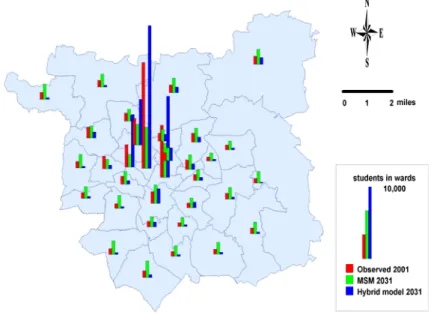
“environment” will be checking if the targeted area has a vacancy for the student to move in. Thus the “student agents” move around and interact with each other and their environment, as well as make decisions and take actions according to their individual rules that developed under simple assumptions described above. The heterogeneous migration behaviors of student migrants therefore can be captured within the projections and annual replenishment of young population has been achieved in small area population projections. In Figure 1, the hybrid model results in 2030 have been compared with the results generated using pure MSM and the observed in 2001.
Figure 1. Residential land use application: students in small areas 2001 and 2031 Source: Wu et al., 2010. Census data and area boundaries are Crown copyright 2003
As we can see, the map shows that there are both clear concentrations of
the student populations in the city centre areas that are close to the university
campuses in Leeds. In contrast, the MSM result suggests an even distribution of the student population throughout the whole city, even in the suburban areas.
The hybrid model therefore can provide a better groundwork for the residential land use planning by producing more accurate projections of the sub-population of university students. In terms of the strategic planning of the land use, the concentration of student population in the centre of the city gives a clue to the location choices when planning the residential land use for student accommodations. The projection of the student population in small areas in the future can also provide an indication in terms of the volume of land use demand and the number of housing units in the small areas in the future. This application has been developed with deliberate simplifications, but it demonstrates the potentials of the hybrid model. With minor modifications according to the specific residential land use purposes, this model can be used to explore various residential land use purposes, for either the whole population within the studied system or with a focus on certain sub-populations. As the model produces annual projections and previous impact is captured in the next year’s simulation, the model results can be used not only to facilitate short-term planning purpose, but also for longer-term decision making.
4. PUBLIC HEALTH APPLICATION: MORTALITY SCENARIOS
One of the advantages with simulating geographically identified populations is that the local context can influence the individual characteristics to a degree. Such information is important for public health planning. However, sometimes it is not only the current small area that influences behavior, but the places that individuals originally came from or used to live in often also play an important role. In some demographic processes such history can have a great impact. One simple example can be:
the mortality/morbidity risks of the miners should not suddenly change a great deal once they retired to a pleasant residential area. In order to model such impacts, we need to assess individuals’ behaviors using information from their personal histories. An ABM can meet such requirements with much more ease than a MSM, as agents can simply have a function to retrieve specified information from their own history that they carried along.
Based on the hypothesis that mortality/morbidity probabilities depend on not
only their current personal and environmental conditions, but also on their
personal histories, we explored 3 scenarios of mortality projections in the
Moses hybrid model that are based on current destination location, original
residence location in the system/birth places and personal migration histories
specifically. Take a simple example of an individual migrant that can be
called A here. If his origin is ward 1 and in the last 5 years his migration
destinations are: ward 2 in year 1, ward 2 in year 2, ward 2 in year 3, ward 3
in year 4, ward 4 in year 5. Then in the 1st scenario, migrant A will check
his current location and his mortality probability in year 6 will be determined
against the age-sex specific probability in ward 4 that corresponds to his age-
sex group; while in the 2nd scenario, his mortality probability will be based
on his age-sex specific probability in his origin: ward 1; in the 3rd scenario,
his mortality probability will be based on his age-sex specific probability in
the area that he stayed the longest, ward 2. Such changes in the individuals,
both different types of migrants and non-migrants, can be interesting for various researches and will result in significant changes in local population structure (Wu et al., 2010).
Projection results under different assumptions after 30 years have been compared spatially to assess the difference in the mortality distribution of the city in 2031. Although the distribution patterns of the mortality in three scenarios all look similar on the whole, the experiments reveal some interesting variations in small areas. We can see from the map (Figure 2) that there tend to be a higher mortality in the more established suburban wards in the north of the city in scenario 2 than in the current residence based projection. In comparison, scenario 3 indicates a reduction of mortality than in the current residence based projection in the northern suburban areas. It also indicates an increase of mortality in the southwestern belt around the city centre, as well as in a strip in the eastern area of the city. The mortality projection based on individual migration history in scenario 3 seems to differ from scenario 2 by indicating more deaths in traditionally immigrant/more deprived areas in the city. Such findings demonstrate that personal history could have an important impact on mortality (Figure 2).
Figure 2. Public health application: mortality in small areas 2031 Source: [23], Census data and area boundaries are Crown copyright 2003
Figure 2. Public health application: mortality scenarios in small areas 2031 Source: Wu et al., 2010. Census data and area boundaries are Crown copyright 2003
Empirical research on the relationship between limiting long-term illness and migration established that the illness status of migrants is mid-way between that of their origin and destination locations (Norman et al., 2004).
If this finding also applies to mortality, then a combination of all three
scenarios may be needed to represent the mortality chances of migrant
properly. We will continue to improve the mortality projection in the light of
such evidence. Although the mortality experiments discussed here are purely
based on hypothesis, it demonstrates that there are many more aspects of the
population MSM which can be strengthened through the use of ABM
techniques. Important elements of the model such as marriage behavior,
fertility patterns and change in health status might all benefit in a similar
way. Such explorations are not only just interesting experiments, but
potentially can play a vital role in facilitating the decision making where the
impact of personal history is required to be taken into account.
As it demonstrated in this application, the hybrid model enables us to monitor the changing patterns in individual demographic processes in the studied population in small areas, assess the impact of personal history under different scenarios of personal history circumstances and explore the relationship between the mortality rates and different environments. Such features can provide useful information to assist better grounded and targeted plans for the public health planning. In this application, the results indicated that the projection of mortality may need to take into account the impact from not only the destinations or origins of the modeled individuals, but also the impact from the personal migration histories. Such information can be useful for both strategic and tactical health planning. In terms of strategic planning, it helps planners to assess the impact on mortality in different scenarios and devise appropriate interventions; in terms of tactical planning, the variations in mortality in small areas can provide an indication to the public health service and support provision in the areas that are worse off than others. Again, with minor modifications, this model can applied to any other demographic process or sub-population to facilitate various planning purposes.
5. PUBLIC TRANSPORT APPLICATION: IMPACT OF NEW INFRASTRUCTURE
New public infrastructures are expensive and have great impact on our society. At the same time, population evolution patterns (e.g. ageing trend), must be taken into account during the development of new infrastructure.
Therefore careful consideration should be given to the evaluation and assessment of potential impact on small areas and more importantly, the people who live there. Public transport systems can affect many aspects of people’s life: while they play an important role in social inclusion by providing the deprived population with access to training, education and employment opportunities, as well as access to various public services, it can, on the other hand, cause problems such as traffic congestion, air pollution and noise. In fact, transport sector significantly contributes to CO
2emissions growth in many countries and accounts for 23% of global CO
2emissions according to the statistics of (IEA, 2007). The excess use of private travel means does not provide a sustainable environment for our society and has already had a serious impact on climate changes globally.
Therefore in order to reduce the effect of motorization on environment/climate changes, viable planning and policies need to be implemented to encourage a significant modal shift onto public transport (NETCEN, 2003), as well as provide an optimized structure of urban transport modes. Using the hybrid model, the interactions between the population changes and the environmental changes can be simulated. In this application, we developed a scenario where two new supertram lines are being built in Leeds to encourage the people in the city to adopt more sustainable urban transport modes. The tram lines are running from the city centre to the north-east and north-west. Based on the assumption that many people will switch from their current transport modes by private cars to the use of supertram, we then assess the impact of such changes on air pollution in small areas.
We assess the air pollution on the basis of CO
2emissions in our
simplified transport application model. CO
2emissions are calculated on the
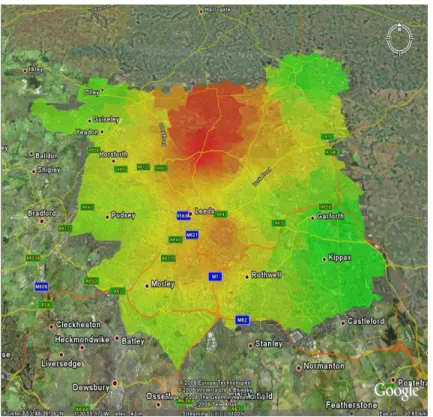
basis of the transport average speed that is determined by the urban transport condition. The speed-emission factor coefficients are calculated according to the vehicle speed emission factor database (Waterson et al., 2003) in grammes per kilometer to average speed, for different types and engine size of vehicles and in all the categories of European emission standards from pre-Euro I to Euro II (Liu et al., 2009). The impact made by the introduction of the new public transport infrastructure can then be assessed in the pollution map of Leeds (Figure 3). The shading shows the impact of the supertram on pollution by different colours: the colour of red means that the change has a high impact in the small area, while yellow means medium and green means low impact. As we can see in Figure 3, the introduction of the tram lines has made a high impact in the city centre and the north. There is a medium level of impact in the areas from city centre towards the north and the southwest areas. The impact is the smallest in southeast areas of the city.
In comparison, impact is greatest in the northern corridor where residents can access both tram routes. This may indicate that there will be more demand arising from passengers in the north suburban switch from the privately owned transport means to the public transport, as the new supertrams can provide them with a more efficient way of travel. Although city centre areas also have the access to both lines, the lower level of impact may indicate that many passengers in city centre are already using public transport as their preferred travel means due to the easy access to public transport services. On the other hand, in the south of the city, where there is no direct access to the tram lines, the pollution map indicates a higher impact in the southwest than in the southeast. This may indicate that there are easier accesses to links to tram services in southwest of the city than in the southeast. More work to improve the accessibility of the public transport network may encourage more travel modal shift in the southeast of the city.
Figure 3. Public transport application: impact of the supertram lines in small areas Source: Birkin, 20008. Census data are Crown copyright 2003
As demonstrated in the public transport application model, the hybrid model can assist the planners to assess the environmental changes before they implement practical plans in the city. Using the model, various locations can be selected for various transport infrastructure development and different scenarios can be constructed to explore different “what if”
situations. The modeling of other aspects of the transport system changes is also possible, for instance, with minor changes, the model can be used to assess traffic congestion and average journey times in the city etc. The results produced by the application model that demonstrate the environment changes can also be used in various studies that can further explore the interactions between the environmental changes and population changes to assist the transport planning through a range of transport simulations and generate indicators of sustainability.
6. CONCLUSION
In this paper, we introduced Moses, an individual based model that simulates the UK population through discrete demographic processes at a fine spatial scale for 30 years from 2001 to 2031. Population changes are simulated at the individual level : Ageing, Mortality, Fertility, Household Formation, Health Change and Migration. The modeling method is grounded in a dynamic spatial MicroSimulation Model (MSM). MSM can model the impact on individual decision units from the changes in strategic planning or government policies (Wu et al., 2008; van Imhoff and Post, 1998), but Moses also brings in the strengths of Agent Based Models (ABM) to enable the modeling of heterogeneous agents to represent individuals with distinctive characteristics within the system (Axtell, 2000). This accommodates the study of sub-populations with distinctive characteristics and behaviors. The ease of introducing unique rules for individual agents in ABM also helps us to provide a better representation of the studied population when there is a knowledge gap or unavailability of data (Wu et al., 2008; Billari et al., 2002).
Experiments carried out to date using this individual-based modeling approach have generated encouraging results. Not only can Moses produce better projections of baseline population for various demographic research purposes, it can be also useful in providing an assessment of multiple scenarios for different planning applications. For instance, using ABM to model the migration process of university students not only provides a better reflection of the unique student migration pattern in our population model and provides a better projection in small areas, it also provides a better groundwork to plan the residential land use for sub-populations with distinctive behaviors, such as university student migrants in small areas. This provides vital information for demographic planning/policy making (especially location based policies). Moses can also benefit other public policy making or public service planning. For instance, the ageing trends in certain suburban areas may promote changes in health service and public transport service provision in order to enable easy access to such services for the old and frail in the area. The rich attributes captured in the system are also very useful in various policy analyses or research purposes, especially in exploring various “what if” situations and testing different hypotheses.
This hybrid modeling approach demonstrates great potential in demographic
modeling to accommodate the distinctive behaviours of sub-populations and
the applications are by no means limited to the examples which have been
introduced in this paper. Similar illustrations with relevance to education, policing, land use planning or a wide range of commercial and business problems could equally well have been used. With further development and refinement of the model, we envisage that further model refinements will show its utility across a wide variety of social science domains and policy applications.
REFERENCES
Axtell, R., 2000, “Why Agents?-On the Varied Motivations for Agent Computing in the Social Sciences”, in Proceedings of the Workshop on Agent Simulation: Applications, Models and Tools, Argonne National Laboratory, IL.
Ballas, D., Clarke, G. and Wiemer, E., 2006, “Spatial microsimulation for rural policy analysis in Ireland: The implications of CAP reforms for the national spatial strategy”, Journal of Rural Studies, 22(3), p.367-378.
Benenson, I., Omer, I. and Hatna, E., 2002, “Entity-based modeling of urban residential dynamics: the case of Yaffo, Tel Aviv”, Environment and Planning B: Planning and Design 29, p. 491-512.
Billari, F., Ongaro, F. and Prskawetz, A., 2002, “Introduction: Agent-based computational demography”, in Billari and Prskawetz (eds.), Agent-based computational demography:
Using simulation to improve our understanding of demographic behavior, Springer/Physica, London/Heidelberg, p. 1–18.
Birkin, M., 2008, “Moses: Modelling, Simulation and e-Social Science”, in Proceedings of Sixth International Summer School on Grid Computing, Lake Balaton, Hungary, 6th-18th July 2008.
Brown, L. and Harding, A., 2002, “Social modelling and public policy: Application of microsimulation modelling in Australia”, Journal of Artificial Societies & Social Simulation, 5(4), http://jasss.soc.surrey.ac.uk/5/4/6.html. Accessed 18.02.2011
Clarke, G., Eyre, H. and Guy, C., 2002, “Deriving indicators of access to food retail provision in British cities: studies of Leeds, Bradford and Cardiff”, Urban Studies, 11, p.2041-2060.
De Man, W., 1988, “Establishing a geographic information system in relation to its use: A process of strategic choices”, International Journal of Geographical Information Systems, 2(3), p. 245- 261.
Ferguson, N., Cummings, A., Cauchemez, S., Fraser, C., Riley, S. and Meeyai, A., 2005,
“Strategies for containing an emerging influenza pandemic in Southeast Asia”, Nature, 437(7056), p. 209–214.
Hägerstrand, T., 1967, Innovation diffusion as a spatial process, The University of Chicago Press, Chicago.
IEA, 2007, CO2 Emissions from Fuel Combustion 1971-2005, International Energy Agency, Paris.
Liu, S., Chen, H., Birkin, M., Mao, B. and Guo, J., 2009, “Assessment of the transport policy effect on CO2 emissions using a system dynamic model”, in Proceedings of Air Quality 2009, Istanbul.
Magne, L., Rabut, S. and Gabard, J., 2000, “Towards a hybrid macro-micro traffic flow simulation model”, in Proceedings of INFORMS Salt Lake City spring 2000 conference.
Mozumder, P. and Marathe, A., 2004, “Implications of an integrated market for tradable renewable energy contracts”, Ecological Economics, 49(3), 259–272.
NETCEN, 2003, Vehicle Speed Emission Factor (Version 02/3), National Environmental Technology Centre, www.naei.org.uk/datachunk.php?f_datachunk_id=8. Accessed January, 2003.
Norman, P., Boyle, P. and Rees, P., 2004, “Selective migration, health and deprivation: a longitudinal analysis”, Social Science and Medicine, 60(12), p.2755-2771.
O’Donoghue, C., 1999, “Estimating the Rate of Return to Education using Microsimulation”, The Economic and Social Review, 30(3), p. 249-265.
Orcutt, G., 1957, “A new type of socio-economic system”, Review of Economics & Statistics, 58, p.773–797.
Schelling, T., 1971, “Dynamic models of segregation”, Journal of Mathematical Sociology, 1, p.143–186.
Simmonds, D., 2001, “The Objectives and Design of a New Land-use Modelling Package:
DELTA”, in: Clarke and Madden (eds.) Regional Science in Business, Springer, Berlin.
Smith, D., Clarke, G., Ransley, J. and Cade, J., 2005, “Food access and health: A
microsimulation framework for analysis”, Studies in Regional Science, 35, p.909-928.
Strauch,D., Moeckel, R., Wegener, M., Gräfe, J., Mühlhans, H., Rindsfüser, G. . and Beckmann, K., 2003. “Linking Transport and Land Use Planning: The Microscopic Dynamic Simulation Model ILUMASS”, in Proceedings of the 7th International Conference on GeoComputation, Southampton, UK, 8 - 10 September.
Travelogue, 1996, “Transims travelogue (LAUR-96-1430)”, available from http://transims.tsasa.lanl.gov/PDF_Files/Travel4.pdf. Accessed 18.02.2011.
Waddle, P., 2002, “UrbanSim: Modeling Urban Development for Land Use, Transportation, and Environmental Planning”, Journal of the American planning association 68(3), p. 297- 314.
Waterson, B., Rajbhandari, B. and Hounsell, B., 2003, “Simulating the Impacts of Strong Bus Priority Measures”, Journal of Transportation Engineering, 129, p. 642-647.
Wilson, A. and Pownall, C., 1976, “A new representation of the urban system for modelling and for the study of micro-level interdependence”, Area, 8, p.256–264.
Wu, B., Birkin, M. and Rees, P., 2008, “A spatial microsimulation model with student agents”, Computers, Environment and Urban Systems, 32, p.440–453.
Wu, B., Birkin, M. and Rees, P., 2010, “A dynamic microsimulation with agent elements for spatial demographic forecasting”, Social Science Computing Review special issue.
Van Imhoff, E. and Post, W., 1998, “Microsimulation Methods for Population Projection”, Population: An English Selection, 10, p.97-138.
![Figure 2. Public health application: mortality in small areas 2031 Source: [23], Census data and area boundaries are Crown copyright 2003](https://thumb-ap.123doks.com/thumbv2/123deta/5632474.2001712/8.892.111.577.462.781/figure-public-application-mortality-source-census-boundaries-copyright.webp)