IEICE TRANS. INF. & SYST., VOL.E93–D, NO.12 DECEMBER 2010
3269
LETTER
Special Section on Parallel and Distributed Computing and NetworkingRedundant TC Message Senders in OLSR
Kenji YAMADA†,Nonmember, Tsuyoshi ITOKAWA†, Teruaki KITASUKA†a), andMasayoshi ARITSUGI†,Members
SUMMARY In this letter, we reveal redundant control traffic in the op- timized link state routing protocol (OLSR) for MANET. Topology control (TC) messages, which occupy a part of control traffic in OLSR, are used to exchange topology information with other nodes. TC messages are gen- erated and forwarded by only nodes that have been selected as multipoint relays (MPRs) by at least one neighbor node. These nodes selected as MPRs are called TC message senders in this letter. One of solutions to re- duce the number of TC messages is to reduce the number of TC message senders. We describe a non-distributed algorithm to minimize the number of TC message senders. Through simulation of static-node scenarios, we show 18% to 37% of TC message senders in RFC-based OLSR are redun- dant. By eliminating redundant TC message senders, the number of TC packets, each of which contains one or more TC messages, is also reduced from 19% to 46%. We also show that high density scenarios have more re- dundancy than low density scenarios. This observation can help to consider a cooperative MPR selection in OLSR.
key words: OLSR, control traffic, multipoint relay (MPR) selection, topol- ogy control (TC) message
1. Introduction
The optimized link state routing protocol (OLSR) [1] is a routing protocol for mobile ad-hoc network (MANET).
OLSR is a proactive routing protocol on which each node exchanges regularly topology information with other nodes.
The key concept used in OLSR is the concept of mul- tipoint relays (MPRs). Each node selects a subset of its neighbors as its MPR set. The MPR set has the following two properties: (1) If a node ni sends a message, and that message is successfully forwarded by all MPRs of ni, then all (symmetric strict) 2-hop neighbors of niwill receive that message. (2) Keeping the MPR set small ensures that the overhead of the protocol is kept at a minimum[2].
Qayyum et al. [3] gives an analysis and an example of MPR set selection algorithm. They prove that the following MPR problem is NP-complete.
MPR Problem: Given a network (i.e. the set of one-hop neighbors for each node), a node niof the network and an integer k, is there a multipoint relay set for ni of size less than k?
The heuristic algorithm proposed by Qayyum et al. [3] pro- vides a near-optimal MPR set, and is employed in OLSR [1],
Manuscript received February 1, 2010.
Manuscript revised June 9, 2010.
†The authors are with the Graduate School of Science and Technology, Kumamoto University, Kumamoto-shi, 860–8555 Japan.
a) E-mail: [email protected] DOI: 10.1587/transinf.E93.D.3269
which allows to use other algorithms having improvements.
The nodes which have been selected as MPRs have two roles: generating TC messages, and forwarding them. In contrast, other nodes that no neighbor selects as MPRs never generate or forward TC messages. Each TC message gen- erated by nodeniadvertises the links between generatorni
and the nodes which selectnias an MPR.
In this letter, we consider minimizing the number of TC message senders, without any changes of the properties of the MPR set. The set of TC message senders is defined as a union of MPR sets of all nodes in the network. A pre- liminary consideration was shown in [4].
TC Message Senders Problem: Given a network (i.e. the set of one-hop neighbors for each node), and candidates of MPR set for each node of the network, which combination of MPR set selected from the candidates of each node mini- mizes the number of TC message senders?
For example, when there are several candidates of MPR set for a nodeni, the node should select the candidate that has larger number of common nodes with MPR set of neighbors ofnithan all the other candidates as its MPR set. The selec- tion will reduce the number of TC message generators.
The total number of TC messages which are generated or forwarded by MPRs is approximated by (the number of TC message senders)×(the average number of forwarders for each TC message). These two terms affect the total num- ber of TC messages. The MPR sets given through TC mes- sage senders problem decrease the first term. In this letter, we do not try to make the second term small, but we expect that the value of the second term is similar to that of OLSR.
To intuitively understand that TC message senders problem will reduce the total number of TC messages, we show an example network of eight nodes in Fig. 1. In this network, four nodesn11,n12,n31, andn32have the same two candidates of MPR set,{n21}and{n22}. The remaining four nodes have two candidates {n31} and {n32} for each node.
We consider{n21,n31}as a solution of TC message senders problem. Each arrow shown in Fig. 1 is drawn from an MPR
Fig. 1 An example solution of TC message senders problem.
Copyright c2010 The Institute of Electronics, Information and Communication Engineers
3270
IEICE TRANS. INF. & SYST., VOL.E93–D, NO.12 DECEMBER 2010
Fig. 2 An example network to compare MPR with MCDS.
selector to its MPR of this solution. In this solution,{n21}is the MPR sets ofn11,n12,n31, andn32.{n31}is the MPR set ofn21,n22,n41, andn42. Two MPRsn21 andn31 generate TC messages periodically, and forward the messages gener- ated by each other. Therefore, the number of generated or forwarded TC messages in each period is four. On the other hand, the heuristic of OLSR may selectn21 andn31 as TC message senders. However, the heuristic is not prohibited to choose MPR set{n21}for some nodes and{n22}for oth- ers. If three nodesn21,n22, andn31 are selected as MPRs by at least one node using the heuristic of OLSR, the num- ber of TC messages in each period is six. In the worst case where four MPRsn21,n22, n31, andn32 are selected using the heuristic, eight TC messages are generated or forwarded in each period. The TC message senders problem reduces the number of TC messages in this example.
A minimum connected dominating set (MCDS) is an- other candidate to reduce the number of forwarding nodes during the flooding process [5]. MCDS is out of the scope of this letter, since MCDS does not have the property(1)of MPR set described above. In other words, one of the dif- ferences between MPR and MCDS is that MPR guarantees the shortest path but MCDS does not, since MCDS only re- quires that every node has at least one neighbor in MCDS.
The path through nodes in MCDS may have the length of the shortest path plus one. For example, we consider a six nodes network shown in Fig. 2. Each nodeni(1≤i≤6) has up to four neighborsnj(i−2 ≤ j ≤i+2 and 1≤ j≤6). In this network, one of the MCDSs is{n3,n5}. If the only nodes in this MCDS are used to create a path fromn2ton6, the path is (n2,n3,n5,n6) and the length of this path is three. In contrast, the path through MPRs is (n2,n4,n6) which is the shortest path, since the MPR set ofn2is{n4}. As another difference, both time and message complexities of MCDS scheme are slightly higher than MPR scheme. Unfortunately, the con- cept of MCDS is not employed in any routing protocols of MANET currently.
The rest of this letter is organized as follows. In Sect. 2, the overview of OLSR is explained. The algorithm to find redundant TC message senders is explained in Sect. 3. Ex- perimental results of computer simulation are described in Sect. 4. Finally, we conclude the letter in Sect. 5.
2. OLSR
OLSR is a proactive routing protocol for MANET. OLSR maintains both neighborhood information and topology in- formation in each node. We denote the number of nodes in a MANET andi-th node asnandni, respectively.
Neighborhood information of each node is acquired from HELLO messages sent by other nodes. The informa-
tion is used to disseminate topology information efficiently.
As neighborhood information, each nodeni stores sets of one-hop neighbors, strict two-hop neighbors, MPRs, and MPR selectors of itself. These sets ofniare denoted asN(i), N2(i),M(i), andM−1(i), respectively. All links between pair of nodes inN(i) and nodes inN2(i) are also stored as the neighborhood information.
HELLO messages are broadcasted by all nodes period- ically but never be forwarded. The first purpose of HELLO messages is to discover neighbors with symmetric link. As the second purpose, information ofN(i) andM(i) included in a HELLO message of ni is used to update N2(j) and M−1(j) when node nj receives it. The MPR set M(i) is calculated using N(i), N2(i), and links between them. A node should select an MPR set such that each strict two-hop neighbor has at least one link to the node in MPR set.
Each MPR selectors set M−1(i) is a subset of neigh- borsN(i). Each node in M−1(i) selectsni as an MPR, i.e., nj ∈ M−1(i) implies ni ∈ M(j) except for the delay of HELLO message delivery. To disseminate topology infor- mation, a TC message is flooded into entire network period- ically. Each TC message informs the links between the TC message generatorniand its MPR selectorsM−1(i).
Topology information is acquired from TC messages.
The information is used to calculate routing table. Since all TC messages are generated by MPR selectors and each TC message does not contain all links between the MPR selec- tor and its neighbors, topology information of each node is partial information of actual topology. However, the first property of MPR set guarantees that the shortest path from itself to any other node is included in this partial topology information.
The heuristic algorithm [1] is used to calculate MPR setM(i), whenever the information ofN(i),N2(i), and links between them is changed by any received HELLO message.
MPR setM(i) is selected by the algorithm, independently of the MPR selection of other nodes. It is not the matter for the heuristic algorithm that MPR set of the node includes many common nodes with the MPR sets of its neighbors, or less.
Currently OLSR version 2 [2] is discussed at IETF from Aug. 2005, as an update to OLSR [1]. Redundancy of TC message senders of this letter is also applicable to OLSR version 2.
3. Redundant TC Message Senders
To reveal the existence of redundant TC message senders in OLSR, we use a non-distributed MPR selection algorithm.
The algorithm is not sufficient to be implemented in OLSR as an MPR selection scheme, due to its non-distributed na- ture. It is used to disclose a kind of boundary such as the minimal number of TC message senders. In this letter, we only show a central cooperative MPR selection algorithm solving TC message senders problem, instead of distributed cooperative MPR selection algorithms.
This algorithm consists of two parts: at first part each node finds all candidates of its MPR set by exhaustive
LETTER
3271
search, and all candidates contains the minimum number of one-hop neighbors which satisfy MPR property described in Sect. 1; at the second part, which is not a distributed man- ner, a central entity aggregates the list of candidates from all nodes and solves the TC message senders problem de- scribed in Sect. 1 exhaustively. The MPR set selected for each node by the algorithm is announced to its neighbors through HELLO message as same as original OLSR.
To explain strictly, the number of the candidates ofniis denoted asc(i), and the set of the candidates ofniis denoted asC(i) = {C(i,1),C(i,2), . . . ,C(i,c(i))}. C() for each node is calculated at the first part of the algorithm. At the second part,Πni=1c(i) combinations are searched to find a combina- tion (s(1),s(2), . . . ,s(n)) which provides the lowest number of TC message senders. The number of TC message senders for the combination is expressed as
n i=1
C(i,s(i)) ,
where 1 ≤ s(i) ≤ c(i) for all 1 ≤ i ≤ n. The candidate C(i,s(i)) is used as the MPR set M(i), instead of the MPR set calculated by the heuristics of OLSR.
In contrast, the heuristic algorithm of OLSR finds just one of the candidatesC() for each node (or other larger MPR set) as the MPR set of the node. Each MPR setM(i) selected by the heuristics algorithm may be equal to the best candi- dateC(i,s(i)). The redundancy of MPR selection is come from this multiple candidates of the MPR set.
4. Experimental Results
We compare the non-cooperative MPR selection scheme employed by OLSR [1] to the cooperative MPR selection scheme described in Sect. 3. We measure the number of TC message senders and the number of TC packets. Each TC packet encapsulates one or more TC messages.
We use ns-2 (ver. 2.29) with UM-OLSR v0.8.8 [6]
as a simulator. The simulation environment is that each node has an IEEE 802.11 interface, communication radius isr= 250 m, all nodes are static and distributed randomly in a region ofr×4rm2, the intervals of HELLO messages and TC messages are 2 and 5 seconds, respectively, and will- ingness is set atwill defaultto all nodes.
We assume that the nodes do not move during the simu- lation, then TC message senders of RFC-3626 OLSR are not changed after about 10 seconds from the beginning of the simulation. Therefore the number of TC message senders is counted at 20 seconds from the beginning. On the case of the cooperative MPR selection scheme, we solve the TC message senders problem only once per simulation. It is solved just before counting the number of TC message senders, and each node keeps the MPR set selected by the algorithm until the end of the simulation. The number of TC packets is counted from 20 to 60 seconds, including the packets sent originally by generator of TC message and the packets forwarded by MPRs.
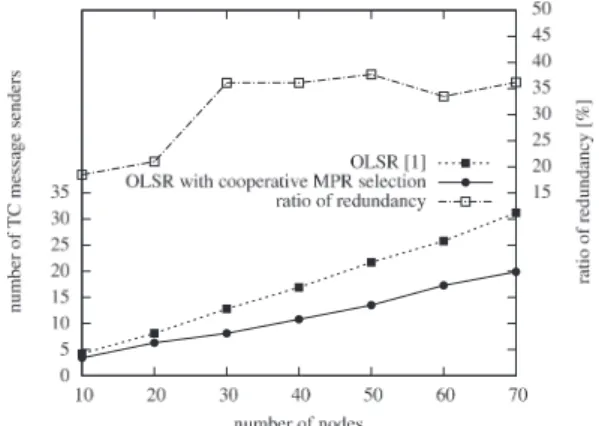
Fig. 3 Comparison of the numbers of TC message senders.
Fig. 4 Comparison of the numbers of TC packets.
The number of nodesnin a network is varied from 10 to 70. For each number of nodes, ten different node topolo- gies are simulated and the averages of ten results are shown in the figures.
Figure 3 and Fig. 4 show the number of TC message senders and the number of TC packets on average every second, respectively. The number of TC packets is the to- tal number of packets observed on the entire network. We counted TC packets, each of which may involve generated TC messages and/or forwarded TC messages. According to RFC 3626, each TC packet encapsulates one or more TC messages. Therefore, the number of TC packets is smaller than that of TC messages. This encapsulation helps to re- duce overhead of UDP and underlying headers and to lower the probability of collision with other nodes’ packets.
From the results, we divide the scenarios into two groups; the density of nodes is relatively low, i.e.,n ≤20, and relatively high, i.e.,n≥30. On the low density scenar- ios, there are not so many candidates of MPR set. On these scenarios, the numbers of TC message senders have 18% to 21% redundancy, and the numbers of TC packets have 19%
to 25% redundancy. In six topologies of them, we do not find redundancy.
On the other hand, high density scenarios mark high redundancy. The redundancy is between 33% and 37% in the number of TC message senders, and it is between 38%
3272
IEICE TRANS. INF. & SYST., VOL.E93–D, NO.12 DECEMBER 2010
and 46% in the number of TC packets. It implies that many nodes have enough number of candidates to select coopera- tive one on high density scenarios.
5. Conclusion
In this letter, we revealed redundant control traffic in OLSR.
To reduce the number of TC messages which are the control messages in OLSR, we tried to reduce the number of TC message senders. We defined the TC message senders prob- lem, to find redundant nodes which generate and forward TC messages. We explained a non-distributed cooperative MRP selection algorithm solving this problem. The algorithm is not sufficient to be implemented in OLSR, but is used to dis- close the minimal number of TC message senders. Through simulation, we showed the redundancy over 18% up to 37%, in terms of the average number of TC message senders. For the number of TC packets, there exists 19% to 46% redun- dancy.
Since the number of forwarders for each TC message also affects the total number of TC messages, minimizing the number of TC message senders will be insufficient to minimize overhead of control traffic. We need to investigate
the problem to reduce the number of forwarders in the fu- ture. We will consider distributed algorithms of cooperative MRP selection as a future work. The density of nodes is one of the key issues to consider them. We will evaluate the per- formance of distributed algorithms by comparing with the results of this letter as a kind of lower bound.
References
[1] T. Clausen and P. Jacquet, “Optimized link state routing protocol (OLSR),” RFC 3626, IETF, Oct. 2003.
[2] T. Clausen, C. Dearlove, and P. Jacquet, “The optimized link state routing protocol version 2,” draft-ietf-manet-olsrv2-10, IETF, Sept.
2009.
[3] A. Qayyum, L. Viennot, and A. Laouiti, “Multipoint relaying: An ef- ficient technique for flooding in mobile wireless networks,” Research Report, RR-3898, INRIA, March 2000.
[4] K. Yamada, T. Itokawa, T. Kitasuka, and M. Aritsugi, “A consider- ation on the number of TC message sender nodes in OLSR,” IEICE Technical Report, MoMuC2009-67, Jan. 2010.
[5] O. Liang, Y.A. S¸ekercio˘glu, and N. Mani, “A survey of multipoint relay based broadcast schemes in wireless ad hoc networks,” IEEE Commun. Surveys, vol.8, no.4, pp.30–46, 2006.
[6] F.J. Ros, UM-OLSR,
http://masimum.inf.um.es/?Software:UM-OLSR