有本 茂
1* Massoud Amini 2*
福田信幸3* Joseph E. LeBlanc 4*
村上達也5*
成木勇夫
6* Mark Spivakovsky 7*
竹内 茂8* Keith F. Taylor 9*
山中 聡10*
横谷正明
11* Peter Zizler 12*
Mathematics and Chemistry
Interdisciplinary Joint Research and the Fukui Project XVI
Shigeru ARIMOTO, Massoud AMINI, Nobuyuki FUKUDA, Joseph E. LEBLANC Tatsuya MURAKAMI, Isao NARUKI, Mark SPIVAKOVSKY, Shigeru TAKEUCHI Keith F. TAYLOR, Satoshi YAMANAKA, Masaaki YOKOTANI and Peter ZIZLER
This is the 16th part of the series of articles that records and further develops essentials of the Mathematics and Chemistry Interdisciplinary Symposium 2013 Tsuyama, whose main themes were symmetry, periodicity, and repetition.
The symposium was held on April 5th and 6th in Tsuyama city, Okayama, Japan, in conjunction with the Fukui Project and was devoted to the memory of the late Professor Kenichi Fukui (1981 Nobel Prize) who initiated the project. The present series also provides challenging cross-disciplinary problems which are directly related to the Fukui conjecture and to recent carbon nanotube research. Some of these problems are formulated using mathematical language not well known among chemists despite the importance of these notions in elucidating additivity and high-speed asymptotic phenomena in molecules having many repeating identical moieties. Some problems are formulated in terms of Fourier analysis connected to the theory of analytic curves, other problems are formulated in connection with the Science-Art Multi-angle Network (SAM Network) Project, which seeks to bridge Science and Art (visual, audial, and conceptual art) for a creative collaboration, and is an important part of the Fukui Project.
Key Words : the Fukui conjecture, Memoir of Prof. K. Fukui, Unique factorization domain (UFD), Carbon nanotube, Fourier analysis
I Introduction
8. Note on the Memoir of Prof. Kenichi Fukui and His Former Supervisor and Colleague
Prof. Haruo Shingu
Shigeru Arimoto
In recent article 1), entitled <Mathematics and Sciences>
Fukui Conjecture and New Frontier Project Interdisciplinary Research, I, the author of this section gave a memoir on fragments of Prof. Kenichi Fukui’s and his former colleague (and his former supervisor) Prof. Haruo Shingu’s philosophy.
I would like to present some notes and raise some questions related to them in this section.
原稿受付 平成
28
年9
月29
日1*, 10*, 11*
総合理工学科3*
総合理工学科非常勤講師2* Dept. of Math. Tarbiat Modares University, Iran
4* School of Integrated Studies, Pennsylvania College of Technology USA
5*
富山県立大学 工学部・生物工学科6*
立命館大学 理工学部・数学物理学系・数理科学科7* CNRS and Institute de Mathématiques de Toulouse, France 8*
岐阜大学 教育学部・数学科9* Dept. of Math. and Stat., Dalhousie University, Canada
12* Dept. of Math., Phys., and Eng., Mount Royal University, Canada
− 47 −
The article 1) in Japanese appeared in the Japanese journal called ‘Sugaku’ (Mathematics) published by the Mathematical Society of Japan. I had been requested by a former Editor-in-chief of the journal to write an article that contains an introductory review of the Fukui conjecture. The article 1) contains, among other topics,
(i) Review of the origin of the Fukui Conjecture, (ii) Review of the fundamental structure of the repeat
space, which is the motherboard of the conjecture.
(iii) Description of the philosophy of Prof. K. Fukui and Prof. Haruo Shingu.
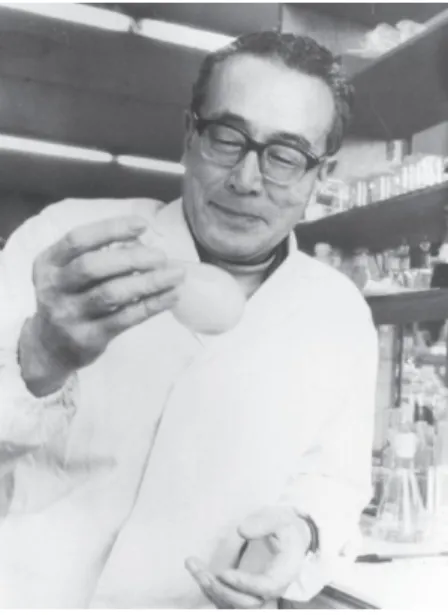
Fig. 1. Professor Haruo Shingu (1913-1988) courtesy of the late Mrs. Emiko Shingu
Here, I would like to focus on (iii), especially on Prof.
Fukui’s philosophical trends of dialectic and complementary approaches to science, which I witnessed many times as I was his student in Kyoto. As indicated in article 1), Prof.
Fukui’s and his former supervisor and research colleague Prof. Shingu’s philosophical trends may have been influenced by the Japanese philosopher Kitaro Nishida (1870-1945), who exerted strong philosophical influence not only on scholars but also on many other people from a variety of walks of life in Japan.
As mentioned in 1) and 2), the Fukui Project is currently called the New Frontier Project, after being recognized that the Fukui Conjecture was on the extension of Fukui’s pattern oriented methodology in Frontier Orbital Theory to additivity-oriented material science in chemistry. In the SAM Net Program of the New Frontier Project, we have extended
scientists, artists, musicians, philosophers, and those who are interested in crossing conventional boundaries in a variety of Sciences and Arts. To those who are associated with this extended form of network, I would like to pose the following Questions:
Questions N.
(N1) What is the origin of the notion of complementarity viewed from the point of cultural anthropology?
(N2) To which extent did the philosophy of complementarity [advocated by Niels Bohr, Werner Heisenberg, Wolfgang Pauli, and others] in the Copenhagen School give philosophical and methodological influence to quantum chemists (like Prof. Fukui) and experimental chemists (like Prof. Shingu), after the advent of Quantum Mechanics?
(N3) Is there a parallelism between (a) Bohr, Heisenberg, and Pauli’s dialectic and complementary approach to science, (b) Nishida’s dialectic philosophy, (c) Complementary aspects found in Taoism and other Practice and Thoughts in the East?
Note: As was mentioned in 1) and 2), Prof. Haruo Shingu (1913-1988) was an eminent experimental (organic) chemist, who played an important role in the formation of Fukui’s Frontier Electron Theory. Prof. Shingu was also the name-giver of ‘Frontier Electron’ (Note: In the earliest period, this is how Fukui’s theory was so called instead of
‘Frontier Orbital Theory’). Prof. Shingu also played a crucial role in the formation of the Fukui Conjecture. In fact, this conjecture was strongly based on Shingu’s and his ingenious research collaborator Takehiko Fujimoto’s empirical formula for the zero-point energies of hydrocarbons [cf. 1) and 3)-5)], and references therein]. As mentioned in 1) and 2), the zero-point energy is a manifestation of Heisenberg’s uncertainty principle and Shingu often mentioned this principle of quantum mechanics during his lectures on experimental chemistry, which accompanied a considerable amount of stimulating philosophical talks. While Prof. Fukui was an undergraduate student at Kyoto University, Prof.
Shingu, then Associate Professor, supervised young Fukui to open his eyes to the fascinating world of organic chemistry.
Prof. Shingu’s critical remarks on the then prevailing
classical electron theories later gave Prof. Fukui a strong
impact that ultimately lead Prof. Fukui to form his celebrated
Frontier Electron Theory, for which he was awarded Nobel
Prize in 1981. [Prof. Shingu was a coauthor of the first paper
6) of the Frontier Electron Theory.]
9. Fukui Project, Niagara Project, and the Science-Art Multi-angle Network (SAM Net) and
Challenging Problem DDS
Shigeru Arimoto, Joseph E. Leblanc, MasaakiYokotani The method of sonification (audiolization) of real number sequences associated with repeat sequences (i.e., matrix sequences in the repeat spaces) has played a heuristic and pedagogical role in the Fukui Project. The ‘Rosetta’ software system, which combines visual and audial heuristic tools was initially developed by the first author (S.A.) in 1990s in the University of Saskatchewan, Canada [cf. ref. 1)]. This unifying method has been revitalized through the Niagara Project which was initiated by S. Arimoto and J. LeBlanc in 2009. The idea of this project was born after the authors visited Corning Glass Museum, New York State, on the way to Niagara Falls, USA. The reader is referred to refs. 2),3) for the background and the development of the Niagara Project. This project was later incorporated into the Fukui Project and is now vigorously developing into what is called Science-Art Multi-angle Network (SAM Net). The reader is invited to visit the web site of SAM Net [cf. link 4) and references in the website]:
http://bit.ly/1Mrbd2R
Along with the new development of the SAM Net, we are planning to construct a web site called ‘Niagara SAM Net’, or ‘Niagara’ for short, which will provide both art-linked audio and visual data related to the Repeat Space Theory (RST). [Note: Here Niagara does not symbolize ‘Falls’ but it symbolizes an interesting ‘Boundary’ between two regions.]
Let f
ddenote the d-dimensional Magic Mountain
[0, ] defined in refs. 5) and 6). The function f
dis a real-valued continuous function defined on the d-dimensional cube:
I
d= {(x
1, x
2, …, x
d): 0 x
1, x
2, …, x
d 1}.
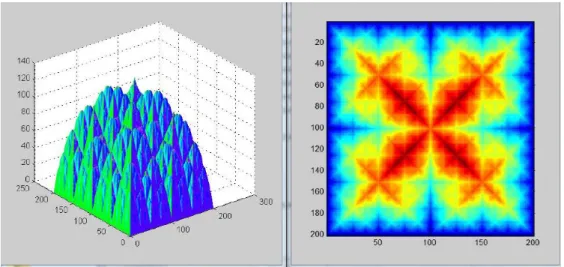
See figs. 1 for schematic representation of how one can make Magic Mountain 0. See figs. 2 and 3 for the graphics of the 2-dimensional Magic Mountain 0 and , i.e., f
02and f
2.
(We remark that the Magic Mountain , or MagicMt( ), was nicknamed Tsuyama-castle function, since it was discovered in the castle town of Tsuyama, Japan.)
Now we can state
Challenging Problem DDS. Let g
d: I
1 I
dbe a continuous function, and consider the composite function
f
dg
d: I
1 I
1.
Develop a computer program that produces ‘d-dimensional (fractal) sound of music’ by using the real number sequence
1
1 0
( ) :
N(x) dx
N k
h h k N h
N
where h = f
dg
d.
We remark that by the definition of f
d, T, and K, we have T(u) = f
0d u u , ,..., u ,
K(u) = f
d u u , ,..., u
for all 0 u 1. Thus, if g
dis given by
( ) , ,..., g
du u u u , then we have
T = f
0dg
d, K = f
dg
d.
Thus, the above challenging problem is a d-dimensional generalization of the Sonification of the Sequences
N(T),
N(K) discussed in section (3) by the authors of the present section.
References
1) S. Arimoto, <Mathematics and Sciences> Fukui Conjecture and New Frontier Project Interdisciplinary Research (in Japanese), Sugaku (Mathematics, The Mathematical Society of Japan), 68-3 (2016) 293-309.
2) S. Arimoto, M. Spivakovsky, E. Yoshida, K.F. Taylor, and P.G. Mezey, Proof of the Fukui conjecture via resolution of singularities and related methods. V, J. Math. Chem. 49 (2011) 1700-1712.
3) S. Arimoto, M. Amini, M. Spivakovsky, J. LeBlanc, K.F. Taylor, T.
Yamabe, Repeat space theory applied to carbon nanotubes and Matrix Art, Bulletin of Tsuyama National College of Technology, 54 (2012) 31-38.
4) S. Arimoto, Science-Art Multi-angle Network, LINK:
http://bit.ly/1Mrbd2R
5) S. Arimoto, Multidimensional Magic Mountains and Matrix Art for the Generalized Repeat Space Theory, J. Math. Chem. 50 (2012) 1210-1223.
6) S. Arimoto, Tsuyama-castle Function and Matrix Art, Bulletin of Tsuyama
National College of Technology, 53E (2011) 1-5.
How to make Magic Mountain
Magic Mountain = Pyramid(n)
In other words, Magic Mountain is the infinite sum of the pyramid functions called Pyramid(n) which are given as follows:
0 n