Instructions for use
Title Study on Photoregulated Biomolecular Motor-based Microrobot and its Application in Active Transport [an abstract of entire text]
Author(s) Mousumi, Akter
Citation 北海道大学. 博士(理学) 甲第14252号
Issue Date 2020-09-25
Doc URL http://hdl.handle.net/2115/79669
Type theses (doctoral - abstract of entire text)
Note この博士論文全文の閲覧方法については、以下のサイトをご参照ください。
Note(URL) https://www.lib.hokudai.ac.jp/dissertations/copy-guides/
File Information Mousumi̲Akter̲summary.pdf
Hokkaido University Collection of Scholarly and Academic Papers : HUSCAP
学 位 論 文 内 容 の 要 約
博士の専攻分野の名称 博士(理学) 氏名 モウシュミ アクター 学 位 論 文 題 名
Study on Photoregulated Biomolecular Motor-based Microrobot and its Application in Active Transport
(生体分子モーターを基礎とするマイクロロボットの 光制御と能動輸送への応用に関 する研究)
The recent progress in molecular machines has enabled the construction of microrobots, which can be defined as an integrated system equipping three elementary devices-actuator, processor and sensor in a molecular level.
Recently, our group reported on the construction of microrobot integrating biomolecular motor system (microtubule (MT)-kinesin) as an actuator, DNA as an information processor as well as a sensor. However, controlling their motion and mutual interaction in local regions and time are still lacking which have been the major challenges in microrobotics. Incorporating a photoswitchable sensor into the processor could be an appropriate approach to regulate them spatiotemporally by photoirradiation for further applications in an engineered system.
In chapter 1, the purpose of this dissertation and the background of this study are described. The development of microrobots in the field of robotics and its applications are also reviewed.
In chapter 2, the construction of photoregulated microrobot and the effect of light on their persistency of the motion are addressed. They were constructed using cellular proteins, MTs and kinesins as the actuators, DNAs as the information processors and azobenzenes as the photosensors. The persistency of the motion of microrobots, characterized as path persistence length (Lp), was reversibly regulated by light without interrupting the interaction between MT and kinesins.
Lp was found to increase and decrease upon UV and visible light irradiation alternatingly. Besides, photoresponsive DNA (pDNA) worked as a shield for MTs against damage by UV irradiation.
In chapter 3, the development of photoregulated swarming of
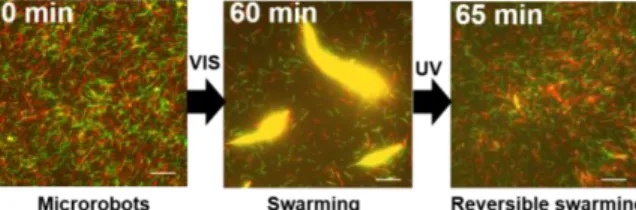
microrobots are described. DNA conjugated microrobots exhibited swarming in response to the visible light mimicking the natural swarming system i.e. bacteria colony, fish school, ant colony etc. The effects of related
Fig. 1 Controlling the trajectories of microrobots using DNA conjugation under photoirradiation.
physicochemical parameters e.g. the length, concentration of DNA, number of azobenzene molecules in the DNA sequences, the intensity of light etc. were
systematically investigated on the photoregulated swarming of the microrobots. The swarming was regulated in local regions using different sized and shaped photomasks through the UV light source. Additionally, their persistency of the motion was regulated under UV light.
In chapter 4, cargo transport by the photoregulated
molecular swarm robot is established. Molecular swarm robots were found to exhibit complex tasks efficiently by loading, transporting and unloading polystyrene bead as the cargo in response to the photoirradiation.
Moreover, the cargo transportation was controlled by the light in a spatiotemporal and systematic manner. The molecular swarm robots were able to load and transport larger sized cargoes whereas the single robots could not load. This result confirms the highly efficient cargo transportation by the molecular swarm robots. They tend to unload the cargo in a selected region by the photoirradiation resulting in the change of density of the cargoes unloaded.
In chapter 5, all the important results and future aspects of this research are summarized as the concluding remarks.
This dissertation describes the construction of a photoregulated microrobot integrating the biomolecular motor system, DNA and the photoswitch. Their persistency of motion as well as swarming have been regulated reversibly by photoillumination. After optimization of physicochemical properties for the swarming of the microrobots, the swarm robots were established as a highly efficient molecular cargo transport system.
The study would serve the knowledge in the viewpoint from biology, chemistry and engineering system not only to realize swarming but also to develop swarm robots with different functionalities like flexibility, parallelism, robustness that can perform a different complicated task through its group behavior. This work will contribute to the construction of phototactic microrobots that could autonomously self-align or navigate by responding to any light source and also in the establishment of photoregulated nanotrafficking system that could control the movement and transport of the microrobots in any direction. The high workability of the molecular swarm robot would be helpful to design and construct an efficient robot to work in more sophisticated nanotechnological
Figure 3: Cargo transport and unloading by molecular swarm robot through DNA hybridization under VIS-UV light.
Figure 2 Time lapse fluorescence microscopic images of swarming and reversible swarming of microrobots after ATP addition in response to VIS-UV light.
applications. Proper utilization of the DNA origami arrays in the biomolecular motor based molecular robot, could improve the robustness of the robot for a more complex task. Small chemicals, metal nanoparticles, and proteins can be transported as molecular cargo so that cargo sorting could be used for chemical synthesis or molecular manufacturing. For molecular manufacturing, swarm robots could be triggered to rearrange circuit components, such as nanoparticles, so that the function of the device can be adaptive to environmental signals much efficiently. With systematic approaches, microrobots could be easily programmed like macroscopic robots at the molecular level. Finally, the microrobots are expected to have great contributation in the emergence of a new dimension in chemical synthesis, molecular manufacturing and artificial intelligence based on the fusion of biotechnology, nanotechnology and informatics.