〔駒沢女子大学 研究紀要 第12号 p.43〜50 2005〕
The Effects of an Extensive Reading Program for Japanese Junior High School Students
Hiroshi OTA , Norio HAYASHI , Shigeyuki HIDAI , Yasuhito HAGIWARA
3.1 Subjects
The subjects for this study were 45
Japanese3 year junior high school students who participated in an extensive reading program as an elective course. They all attended the same national university affili- ated school and were taught by the present researchers.
3.2 An extensive reading program 3.2.1 An elective course
This program was offered for the1603 year students as an elective course. The purpose of the elective courses was to improve proficiency in each subject. The following nine elective courses were held:
Japanese calligraphy, social studies, math, science, music, physical education, fine arts, homemaking, and English extensive reading.
The1 half of the course consisted of daily90
‑minute classes held on three days in June.
The2 half of the course was held on an additional three days in September.Students chose one course for the 1 half and the2 half respectively.
3.2.2 Procedure of the extensive reading program
Each 90‑minute class was conducted as follows:(See. Appendix 1)
―Students came to the multi‑media room where the class was held, and chose a book from the class library, and read at their own pace. They were allowed to stop reading and change to another book as they liked.
―After reading one book, the students wrote a summary of the book and com-
To supplement the amount of input, extensive reading has been seen as a reason- able source of comprehensible input.
(Kanatani, Osada, Kimura and Minai(1990, 1991)Including in this research are, studies with Japanese junior high school students as subjects by Kanatani et al. (1994,1995)and classroom reports by Taniguchi (1989)and Osa(1996).
Kanatani et al.(1994) summarize the effect of an extensive reading program for junior high school students as follows :after the8 month of an extensive reading pro-
gram, there is a significant difference in the English test scores between students who participated in the program and those who did not. Up to the14 month, the difference continued, after that, the effect is likely to decrease.
However,there is little other research on the effect of extensive reading for Japanese junior high school students.
In this study,referring to Kanatani et al.
(1994), we will examine the effect of an extensive reading program for Japanese junior high school students.
2.Purpose
The purpose of this study is to identify the effects of an extensive reading program held in two three‑week sessions in June and in September for Japanese junior high school students by comparing the students who par- ticipated in the program with a control group who did not.
1.Introduction
In junior high schools in Japan, teachers do a wide variety of listening and speaking activities to foster studentsʼproficiency in English. To acquire a language, a massive amount of input is needed. Krashen (1985) believes that comprehensible input is essen- tial to acquire a language. However, in
Japanese junior high schools,students are not exposed to enough input. Teacher talk, text- books, and handouts a classroom teacher provides are the main sources of input.
Research has shown that the amount of input as a main source textbook is approximately no more than19pages of a paperback novel (Mizuno,2002).
ABSTRACT
The purpose of this study is to identify an effect of an extensive reading program held in two three‑week sessions in June and in September for Japanese junior high school students by comparing the students who participated in the program with those who did not.
In the program the students were encouraged to read as many graded readers as possible.
They chose a book from the class library,and read books at a suitable level and at their own pace.After reading one book,the students wrote a summary of the book and comments briefly in Japanese.Then they returned the book and submitted the sheet.At the end of each class,they were required to borrow at least one book and read it at home before the next class.
As a pre‑and a post‑test, a proficiency test called CASEC(Computerized Assessment System for English Communication)was conducted.The result of the tests shows that there is a significant difference in the scores between the students who participated in the program in June and September, and those who did not. However, the effect cannot be seen among the students who participated in the program in either June or September,therefore it is likely that a certain amount of reading is needed for improvement.
Komazawa Womenʼs University ,The Japan Institute for Educational Measurement,Inc. , Setagaya Junior High School Attached to Tokyo Gakugei University ,National Institute
〔駒沢女子大学 研究紀要 第12号 p.43〜50 2005〕
The Effects of an Extensive Reading Program for Japanese Junior High School Students
Hiroshi OTA , Norio HAYASHI , Shigeyuki HIDAI , Yasuhito HAGIWARA
3.1 Subjects
The subjects for this study were 45
Japanese3 year junior high school students who participated in an extensive reading program as an elective course. They all attended the same national university affili- ated school and were taught by the present researchers.
3.2 An extensive reading program 3.2.1 An elective course
This program was offered for the1603 year students as an elective course. The purpose of the elective courses was to improve proficiency in each subject. The following nine elective courses were held:
Japanese calligraphy, social studies, math, science, music, physical education, fine arts, homemaking, and English extensive reading.
The1 half of the course consisted of daily90
‑minute classes held on three days in June.
The2 half of the course was held on an additional three days in September.Students chose one course for the 1 half and the2 half respectively.
3.2.2 Procedure of the extensive reading program
Each 90‑minute class was conducted as follows:(See. Appendix 1)
―Students came to the multi‑media room where the class was held, and chose a book from the class library, and read at their own pace. They were allowed to stop reading and change to another book as they liked.
―After reading one book, the students wrote a summary of the book and com-
mented briefly in Japanese. Then they
To supplement the amount of input, extensive reading has been seen as a reason- able source of comprehensible input.
(Kanatani, Osada, Kimura and Minai(1990, 1991)Including in this research are, studies with Japanese junior high school students as subjects by Kanatani et al. (1994,1995)and classroom reports by Taniguchi (1989)and Osa(1996).
Kanatani et al.(1994) summarize the effect of an extensive reading program for junior high school students as follows :after the8 month of an extensive reading pro-
gram, there is a significant difference in the English test scores between students who participated in the program and those who did not. Up to the14 month, the difference continued, after that, the effect is likely to decrease.
However,there is little other research on the effect of extensive reading for Japanese junior high school students.
In this study,referring to Kanatani et al.
(1994), we will examine the effect of an extensive reading program for Japanese junior high school students.
2.Purpose
The purpose of this study is to identify the effects of an extensive reading program held in two three‑week sessions in June and in September for Japanese junior high school students by comparing the students who par- ticipated in the program with a control group who did not.
3.Method
1.Introduction
In junior high schools in Japan, teachers do a wide variety of listening and speaking activities to foster studentsʼproficiency in English. To acquire a language, a massive amount of input is needed. Krashen (1985) believes that comprehensible input is essen- tial to acquire a language. However, in
Japanese junior high schools,students are not exposed to enough input. Teacher talk, text- books, and handouts a classroom teacher provides are the main sources of input.
Research has shown that the amount of input as a main source textbook is approximately no more than19pages of a paperback novel (Mizuno,2002).
ABSTRACT
The purpose of this study is to identify an effect of an extensive reading program held in two three‑week sessions in June and in September for Japanese junior high school students by comparing the students who participated in the program with those who did not.
In the program the students were encouraged to read as many graded readers as possible.
They chose a book from the class library,and read books at a suitable level and at their own pace.After reading one book,the students wrote a summary of the book and comments briefly in Japanese.Then they returned the book and submitted the sheet.At the end of each class,they were required to borrow at least one book and read it at home before the next class.
As a pre‑and a post‑test, a proficiency test called CASEC(Computerized Assessment System for English Communication)was conducted.The result of the tests shows that there is a significant difference in the scores between the students who participated in the program in June and September, and those who did not. However, the effect cannot be seen among the students who participated in the program in either June or September,therefore it is likely that a certain amount of reading is needed for improvement.
Komazawa Womenʼs University ,The Japan Institute for Educational Measurement,Inc. , Setagaya Junior High School Attached to Tokyo Gakugei University ,National Institute for Educational Policy Research
Eventually the average scores and stan- dard deviation of the experiment group and those of the control group were almost the same.The results are shown in Table 3.1and 3.2.
Finally,in order to measure the effect of the extensive reading program, the total scores and scores of each section of the post
‑test between the experimental groups, and the control group were compared. To com- pare the total scores a paired t‑test was conducted. To compare the scores of each section, analysis of covariance (hereafter cited as ANCOVA)was conducted, as the scores of each section were not utilized for matching.
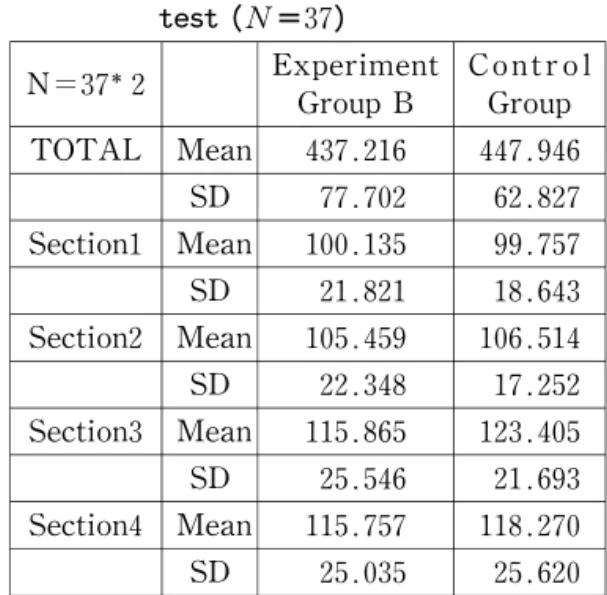
Table4.1and4.2show the descriptive statistics of the post‑test of the total scores and scores of each section of CASEC.
Paired t‑test or ANCOVA was conduct- ed to compare the scores of each section between the experimental group A and the control group,and between the experimental group B and the control group. Table 4.3 shows the results of paired t‑test and AN- COVA.
As shown in Table4.3, there is a signif- icant difference in the residual scores controlled for the post‑ test scores between the experimental group A and the control group(N=16,F (1,13)=7.497 ,p<0.05).It should be noted that the error variances between these groups can be statistically
in blanks(Dictation).
The pre‑test was conducted at the end of May, which was about a week before the start of the program in June and the post ‑test in early December, which was about three months after the program in September.
The students were divided into three groups as follows:
Experiment Group A(N=8),which con- sisted of students who participated in the program in June and September.
Experiment Group B (N=37), which consisted of students who participated in the program in either June or September.
Control group(N=45), which consisted of students who did not participate in the program.
In order to match the students of the experimental group A or B with those of the control group,the following procedures were adopted : first students who got the same total scores on the pre ‑test were paired,then those who got close total scores were paired.
Second,in terms of motivation toward learn- ing English,the present researchers carefully chose subjects for the control group who were as well‑motivated as those of the exper- imental groups. We were able to choose sub- jects as we taught the subjects English for three years and knew them very well. It should be noted that some students who did not choose to participate in the reading pro- gram were very motivated to study English.
They decided to take extra math classes instead as they needed to improve in that subject more than they needed improvement returned the book and submitted the
sheet.(See. Appendix 2)
―At the end of each class, students were required to borrow at least one ad- ditional book and read it at home by the next class.
3.2.3 Student orientation
In the first class, we instructed them on how to do reading in the class and we handed out a worksheet. The critical points were:
―Choose a book which is at a suitable level. That is, to facilitate reading gain without pain.(Day & Bamford, 1998).
Read a book that can be read with ease and comfort.
3.3 Reading Materials
Graded readers published by foreign pub- lishers were used.The following were readers that were mainly used.
―Bookworm Series (Starters, Stage 1, Stage2)by Oxford University Press
―Penguin Readers(Easystarts, Beginner, Elementary)by Longman
―Classic tales by Oxford University Press 3.4 Analysis procedure
As a pre ‑and a post‑test, the CASEC proficiency test was administrated to all the 3 year students at the end of May. CASEC was developed by The Society for Testing English Proficiency Inc.( Nippon Eigo Kentei Kyokai)to assess examineesʼproficiency in English.It is based on Item Response Theory.
It consists of the following four sections;
Section1:Fill in blanks in a sentence(Vocabu- lary),Section2:Fill in blanks in a discourse (Reading), Section 3: Listen & answer a
Table 3. 1 Descriptive statistics of pre‑
test (N=8)
N=8 2 Experiment
Group A Control Group TOTAL Mean 439.125 439.250
SD 51.817 52.941
Table 3. 2 Descriptive statistics of pre‑
test (N=37)
N=37 2 Experiment
Group B Control Group TOTAL Mean 402.892 402.514
SD 72.372 72.264 Table 4. 1 Descriptive statistics of post‑
test (N=8)
N=8 2 Experiment
Group A Control Group TOTAL Mean 473.250 463.000
SD 62.002 36.020 Section1 Mean 107.125 104.875 SD 13.685 9.804 Section2 Mean 119.375 110.875 SD 10.596 11.154 Section3 Mean 122.000 118.500 SD 33.594 9.957 Section4 Mean 124.750 128.750 SD 14.240 16.369
Table 4. 2 Descriptive statistics of post‑
test (N=37)
N=37 2 Experiment
Group B Contr o l Group TOTAL Mean 437.216 447.946
SD 77.702 62.827 Section1 Mean 100.135 99.757 SD 21.821 18.643 Section2 Mean 105.459 106.514 SD 22.348 17.252 Section3 Mean 115.865 123.405 SD 25.546 21.693 Section4 Mean 115.757 118.270 SD 25.035 25.620
Eventually the average scores and stan- dard deviation of the experiment group and those of the control group were almost the same.The results are shown in Table 3.1and 3.2.
Finally,in order to measure the effect of the extensive reading program, the total scores and scores of each section of the post
‑test between the experimental groups, and the control group were compared. To com- pare the total scores a paired t‑test was conducted. To compare the scores of each section, analysis of covariance (hereafter cited as ANCOVA)was conducted, as the scores of each section were not utilized for matching.
4.Results
Table4.1and4.2show the descriptive statistics of the post‑test of the total scores and scores of each section of CASEC.
Paired t‑test or ANCOVA was conduct- ed to compare the scores of each section between the experimental group A and the control group,and between the experimental group B and the control group. Table 4.3 shows the results of paired t‑test and AN- COVA.
As shown in Table4.3, there is a signif- icant difference in the residual scores controlled for the post‑ test scores between the experimental group A and the control group(N=16,F (1,13)=7.497 ,p<0.05).It should be noted that the error variances between these groups can be statistically considered to be the same and that there is
in blanks(Dictation).
The pre‑test was conducted at the end of May, which was about a week before the start of the program in June and the post ‑test in early December, which was about three months after the program in September.
The students were divided into three groups as follows:
Experiment Group A(N=8),which con- sisted of students who participated in the program in June and September.
Experiment Group B (N=37), which consisted of students who participated in the program in either June or September.
Control group(N=45), which consisted of students who did not participate in the program.
In order to match the students of the experimental group A or B with those of the control group,the following procedures were adopted : first students who got the same total scores on the pre ‑test were paired,then those who got close total scores were paired.
Second,in terms of motivation toward learn- ing English,the present researchers carefully chose subjects for the control group who were as well‑motivated as those of the exper- imental groups. We were able to choose sub- jects as we taught the subjects English for three years and knew them very well. It should be noted that some students who did not choose to participate in the reading pro- gram were very motivated to study English.
They decided to take extra math classes instead as they needed to improve in that subject more than they needed improvement in English.
returned the book and submitted the sheet.(See. Appendix 2)
―At the end of each class, students were required to borrow at least one ad- ditional book and read it at home by the next class.
3.2.3 Student orientation
In the first class, we instructed them on how to do reading in the class and we handed out a worksheet. The critical points were:
―Choose a book which is at a suitable level. That is, to facilitate reading gain without pain.(Day & Bamford, 1998).
Read a book that can be read with ease and comfort.
3.3 Reading Materials
Graded readers published by foreign pub- lishers were used.The following were readers that were mainly used.
―Bookworm Series (Starters, Stage 1, Stage2)by Oxford University Press
―Penguin Readers(Easystarts, Beginner, Elementary)by Longman
―Classic tales by Oxford University Press 3.4 Analysis procedure
As a pre ‑and a post‑test, the CASEC proficiency test was administrated to all the 3 year students at the end of May. CASEC was developed by The Society for Testing English Proficiency Inc.( Nippon Eigo Kentei Kyokai)to assess examineesʼproficiency in English.It is based on Item Response Theory.
It consists of the following four sections;
Section1:Fill in blanks in a sentence(Vocabu- lary),Section2:Fill in blanks in a discourse (Reading), Section 3: Listen & answer a question(Listening),Section 4:Listen & Fill
Table 3. 1 Descriptive statistics of pre‑
test (N=8)
N=8 2 Experiment
Group A Control Group TOTAL Mean 439.125 439.250
SD 51.817 52.941
Table 3. 2 Descriptive statistics of pre‑
test (N=37)
N=37 2 Experiment
Group B Control Group TOTAL Mean 402.892 402.514
SD 72.372 72.264 Table 4. 1 Descriptive statistics of post‑
test (N=8)
N=8 2 Experiment
Group A Control Group TOTAL Mean 473.250 463.000
SD 62.002 36.020 Section1 Mean 107.125 104.875 SD 13.685 9.804 Section2 Mean 119.375 110.875 SD 10.596 11.154 Section3 Mean 122.000 118.500 SD 33.594 9.957 Section4 Mean 124.750 128.750 SD 14.240 16.369
Table 4. 2 Descriptive statistics of post‑
test (N=37)
N=37 2 Experiment
Group B Contr o l Group TOTAL Mean 437.216 447.946
SD 77.702 62.827 Section1 Mean 100.135 99.757 SD 21.821 18.643 Section2 Mean 105.459 106.514 SD 22.348 17.252 Section3 Mean 115.865 123.405 SD 25.546 21.693 Section4 Mean 115.757 118.270 SD 25.035 25.620
not a significant interaction effect between pre‑test and grouping.
Section2of CASEC was made to mea- sure reading ability;too,therefore,the effect of the extensive program might be an improvement in reading ability.
5.Discussion
5.1. Summary of the results
As shown in Table 4.3, there is a signif- icant difference in scores between the exper- imental group A and the control group.That is, the effect of the extensive reading pro-
gram resulted in an improvement in reading ability. However, the effect cannot be seen among the experimental group B,therefore it is likely that a certain amount of reading is needed for improvement.
5.2. Interpretation of the results
Why can an improvement of reading ability be seen in this study?There might be some reasons for the development in reading.
Firstly, reading extensively itself has an effect on improving reading. However, there was no effect for the students who partici-
pated in the program for three weeks in either June or September, so a certain amount of extensive reading might be needed for development.
Secondly, the quality of reading might improve. It is likely that the students who participated in the program for six weeks both in June and September got used to read- ing extensively. That might lead students to read more effectively. The following are what they wrote in their report cards.
“I tried to read easier books fast and accurately.”(Student K)
“I learned to read books faster.”(Stu- dent O)
“In June I was able to read books at an easier level, but in September I could read books at the next level.Now that I am used to reading English books,I donʼ t feel Iʼm reading English books.” (Student C)
“I read fewer books this time than the last time, but I can read them more deeply.(Student H)
Thirdly, the time during the year when the program was run might be an optimal time for the students to read extensively.As Ota(2002), and Ota, Kanatani, Kosuge, and Hidai.(2003)mention,in June and September of their 3 year of junior high school the
level. It could mean that they comprehend sentences at a discourse level more easily.
Lastly,this time of the school year could also be an appropriate time for them to read extensively, as they become more conscious of entrance examinations for high school, in which they are required to read long pas- sages.
5.3. Suggestions for future research It should be noted that this study has examined only one extensive reading pro- gram as an elective course for the students, therefore the results of this study might not be taken as evidence for the efficacy of extensive reading programs for all Japanese junior high school students. Suggestions for future research would be as follows:
Firstly,the answers of the questionnaires by the students who participated in this study should be examined. In Kanatani et al (1994, 1995), the subjectsʼattitude toward reading improved.
Secondly, each student in experimental group A should be interviewed more thor-
oughly.How much did each read over the six weeks? What books at what levels did they read?How did they react to each book?How did their attitude toward reading change?
These results might shed light on the secret of success in an extensive reading program.
Acknowledgement
I would like to thank Professor Ken Kanatani at Tokyo Gakugei University for his valuable advice on this study. I am also
detailed comments on my earlier draft.
Notes
The results of this study were orally presented at the 27 annual meeting of KANTO‑KOSHINETSU ENGLISH LAN- GUAGE SOCIETY in August,2003.
References
Day, R. R.. & Bamford, J.(1998) .Exten- sive Reading in the Second Language Classroom, Cambridge:Cambridge Uni- versity Press.
Kanatani,Osada,Kimura,and Minai(金 谷憲、長田雅子、木村哲夫、薬袋 洋 子)
(1990). 高校における多読プログラムーそ の効果と可能性 関東甲信越英語教育学会 研究紀要 第5号、pp.19‑28.
Kanatani,Osada,Kimura,and Minai(金 谷憲、長田雅子、木村哲夫、薬袋 洋 子)
(1991) 英語多読プログラムーその読解力、
学習方法への影響― 関東甲信越英語教育 学会研究紀要 第6号、pp.1‑12.
Kanatani,Osada,Kimura,and Minai(金 谷憲、長田雅子、木村哲夫、薬袋 洋 子)
(1994). 中学生英語多読プログラムーその 動機づけと読解力への影響― 関東甲信越 英語教育学会研究紀要 第8号、pp.39‑47. Kanatani,Osada,Kimura,and Minai(金 谷憲、長田雅子、木村哲夫、薬袋 洋 子)
(1995). 英語多読の長期的効果―中学生と 高校生のプログラムの比較 関東甲信越英 語教育学会研究紀要 第9号、pp.21‑28. Krashen,S.(1985)The Input Hypothesis:
Issues and Implications. London:Long- man.
Table 4. 3 The results of paired t‑test and ANCOVA
Experiment
Group A Experiment Group B
N 8×2 37×2
TOTAL × ×
Section1 × ×
Section2 ○ ×
Section3 × ×
Section4 × ×
Note:○:There is a significant difference at the .05level.
×:There is no significant differ ence.
-
not a significant interaction effect between pre‑test and grouping.
Section2of CASEC was made to mea- sure reading ability;too,therefore,the effect of the extensive program might be an improvement in reading ability.
5.Discussion
5.1. Summary of the results
As shown in Table 4.3, there is a signif- icant difference in scores between the exper- imental group A and the control group.That is, the effect of the extensive reading pro-
gram resulted in an improvement in reading ability. However, the effect cannot be seen among the experimental group B,therefore it is likely that a certain amount of reading is needed for improvement.
5.2. Interpretation of the results
Why can an improvement of reading ability be seen in this study?There might be some reasons for the development in reading.
Firstly, reading extensively itself has an effect on improving reading. However, there was no effect for the students who partici-
pated in the program for three weeks in either June or September, so a certain amount of extensive reading might be needed for development.
Secondly, the quality of reading might improve. It is likely that the students who participated in the program for six weeks both in June and September got used to read- ing extensively. That might lead students to read more effectively. The following are what they wrote in their report cards.
“I tried to read easier books fast and accurately.”(Student K)
“I learned to read books faster.”(Stu- dent O)
“In June I was able to read books at an easier level, but in September I could read books at the next level.Now that I am used to reading English books,I donʼ t feel Iʼm reading English books.” (Student C)
“I read fewer books this time than the last time, but I can read them more deeply.(Student H)
Thirdly, the time during the year when the program was run might be an optimal time for the students to read extensively.As Ota(2002), and Ota, Kanatani, Kosuge, and Hidai.(2003)mention,in June and September of their 3 year of junior high school the students produced utterances at a discourse
level. It could mean that they comprehend sentences at a discourse level more easily.
Lastly,this time of the school year could also be an appropriate time for them to read extensively, as they become more conscious of entrance examinations for high school, in which they are required to read long pas- sages.
5.3. Suggestions for future research It should be noted that this study has examined only one extensive reading pro- gram as an elective course for the students, therefore the results of this study might not be taken as evidence for the efficacy of extensive reading programs for all Japanese junior high school students. Suggestions for future research would be as follows:
Firstly,the answers of the questionnaires by the students who participated in this study should be examined. In Kanatani et al (1994, 1995), the subjectsʼattitude toward reading improved.
Secondly, each student in experimental group A should be interviewed more thor-
oughly.How much did each read over the six weeks? What books at what levels did they read?How did they react to each book?How did their attitude toward reading change?
These results might shed light on the secret of success in an extensive reading program.
Acknowledgement
I would like to thank Professor Ken Kanatani at Tokyo Gakugei University for his valuable advice on this study. I am also grateful to Daniel Stewart for providing
detailed comments on my earlier draft.
Notes
The results of this study were orally presented at the 27 annual meeting of KANTO‑KOSHINETSU ENGLISH LAN- GUAGE SOCIETY in August,2003.
References
Day, R. R.. & Bamford, J.(1998) .Exten- sive Reading in the Second Language Classroom, Cambridge:Cambridge Uni- versity Press.
Kanatani,Osada,Kimura,and Minai(金 谷憲、長田雅子、木村哲夫、薬袋 洋 子)
(1990). 高校における多読プログラムーそ の効果と可能性 関東甲信越英語教育学会 研究紀要 第5号、pp.19‑28.
Kanatani,Osada,Kimura,and Minai(金 谷憲、長田雅子、木村哲夫、薬袋 洋 子)
(1991) 英語多読プログラムーその読解力、
学習方法への影響― 関東甲信越英語教育 学会研究紀要 第6号、pp.1‑12.
Kanatani,Osada,Kimura,and Minai(金 谷憲、長田雅子、木村哲夫、薬袋 洋 子)
(1994). 中学生英語多読プログラムーその 動機づけと読解力への影響― 関東甲信越 英語教育学会研究紀要 第8号、pp.39‑47. Kanatani,Osada,Kimura,and Minai(金 谷憲、長田雅子、木村哲夫、薬袋 洋 子)
(1995). 英語多読の長期的効果―中学生と 高校生のプログラムの比較 関東甲信越英 語教育学会研究紀要 第9号、pp.21‑28. Krashen,S.(1985)The Input Hypothesis:
Issues and Implications. London:Long- man.
Mizuno, K.(水野耕太郎) (2002). 読み Table 4. 3 The results of paired t‑test
and ANCOVA Experiment
Group A Experiment Group B
N 8×2 37×2
TOTAL × ×
Section1 × ×
Section2 ○ ×
Section3 × ×
Section4 × ×
Note:○:There is a significant difference at the .05level.
×:There is no significant differ ence.
-
手を育てる多読の授業 (http://www.sfc.
keio.ac.jp/〜kmizuno/paper1/)
Osa,K.(長 勝彦)(1996). 私のリーディ ング・マラソン 現代英語教育 8月号、
pp.19‑21、研究社.
Ota, H.(2002). Oral Language Develop- ment of Japanese EFL Learners:A Longi- tudinal Study of Spoken Performance by 101Junior High School Students.Unpub- lished Master Thesis, Tokyo Gakugei University:Tokyo.
Ota,Kanatani,Kosuge,and Hidai.(太田 洋、金谷憲、小菅敦子、日䑓滋之)(2003).
英語力はどのように伸びてゆくか―中学 生の英語習得過程を追う 大修館書店.
Taniguchi,H.(谷口弘美) (1989). 言語 活動の指導―時期による重点のかけ方を中 心に― 英語教育 12月号、pp.11‑13、大 修館書店.
Appendix1
オリエンテーション資料
英語選択授業 英語をたくさん読もう によ うこそ
この講座の目的:
英語の本をたくさん読むことにより、読むこと の楽しさと同時に英語の力をつける
授業のある日は 6月5日、12日、19日 授業の流れ
1.本を選ぶ
たくさん読むことが目的なので、楽しんで 読めるレベルから始め、次第にレベルを上 げるようにしよう。まずは簡単だと思うレ ベルの本から読もう。1ページに知らない 単語がたくさんあるような本は選ばないこ
2.本を読む
・ 辞書はできるだけ使用せず、知らない 単語は前後関係から判断しながらでき るだけ早く多く読むようにしよう。
・ 日本語へ訳しながら読むのではなく、、
英語のままで要旨や話の流れを理解す るように読もう。つまらないと思うと ころや難しいところはとばしても速く 一冊を読み切るようにしよう。
・ リラックスして読もう。
・ 面白くない、難しいと思った本は途中 で読むのをやめ、新しい本を読んでか まいません。
・ わからなくて気になるところ、ここを はずしたら話のポイントがわからなく なると思うところでは先生に質問に来 てかまいません。
3.簡単にあらすじを書く
授業の最後に今日読んだ本について簡単に あらすじを書きましょう。
4.家で読む本を借りる
今度の時間までに家で読む本を借りてくだ さい。最低1冊は読むようにしましょう。
次の時間までに読み終わった人は英語科研 究室に持ってきてください。そしてまた次 の本を借りましょう。
とにかくたくさん読みましょう。さてあな たの目標は、、、
Appendix2
Report Card
Class( )No( )Name( )
No. Date: Hour:
Title
<読んだ感想>(該当するものに○をつけよう)
おもしろかった つまらなかった
内容がよくわかった 全然わからなかった
辞書をよく使った 全然使わなかった
Summary(in English or Japanese) *簡単に書こう。10分以上かけないこと。 その時間があ ったら次の本を読もう。
手を育てる多読の授業 (http://www.sfc.
keio.ac.jp/〜kmizuno/paper1/)
Osa,K.(長 勝彦)(1996). 私のリーディ ング・マラソン 現代英語教育 8月号、
pp.19‑21、研究社.
Ota, H.(2002). Oral Language Develop- ment of Japanese EFL Learners:A Longi- tudinal Study of Spoken Performance by 101Junior High School Students.Unpub- lished Master Thesis, Tokyo Gakugei University:Tokyo.
Ota,Kanatani,Kosuge,and Hidai.(太田 洋、金谷憲、小菅敦子、日䑓滋之)(2003).
英語力はどのように伸びてゆくか―中学 生の英語習得過程を追う 大修館書店.
Taniguchi,H.(谷口弘美) (1989). 言語 活動の指導―時期による重点のかけ方を中 心に― 英語教育 12月号、pp.11‑13、大 修館書店.
Appendix1
オリエンテーション資料
英語選択授業 英語をたくさん読もう によ うこそ
この講座の目的:
英語の本をたくさん読むことにより、読むこと の楽しさと同時に英語の力をつける
授業のある日は 6月5日、12日、19日 授業の流れ
1.本を選ぶ
たくさん読むことが目的なので、楽しんで 読めるレベルから始め、次第にレベルを上 げるようにしよう。まずは簡単だと思うレ ベルの本から読もう。1ページに知らない 単語がたくさんあるような本は選ばないこ と。
2.本を読む
・ 辞書はできるだけ使用せず、知らない 単語は前後関係から判断しながらでき るだけ早く多く読むようにしよう。
・ 日本語へ訳しながら読むのではなく、、
英語のままで要旨や話の流れを理解す るように読もう。つまらないと思うと ころや難しいところはとばしても速く 一冊を読み切るようにしよう。
・ リラックスして読もう。
・ 面白くない、難しいと思った本は途中 で読むのをやめ、新しい本を読んでか まいません。
・ わからなくて気になるところ、ここを はずしたら話のポイントがわからなく なると思うところでは先生に質問に来 てかまいません。
3.簡単にあらすじを書く
授業の最後に今日読んだ本について簡単に あらすじを書きましょう。
4.家で読む本を借りる
今度の時間までに家で読む本を借りてくだ さい。最低1冊は読むようにしましょう。
次の時間までに読み終わった人は英語科研 究室に持ってきてください。そしてまた次 の本を借りましょう。
とにかくたくさん読みましょう。さてあな たの目標は、、、
Appendix2
Report Card
Class( )No( )Name( )
No. Date: Hour:
Title
<読んだ感想>(該当するものに○をつけよう)
おもしろかった つまらなかった
内容がよくわかった 全然わからなかった
辞書をよく使った 全然使わなかった
Summary(in English or Japanese) *簡単に書こう。10分以上かけないこと。 その時間があ ったら次の本を読もう。