get the full article by clicking titles. We recommend you read this PDF online, not by printing.
Readers may view, browse, and/or download
material for temporary copying purposes only,
provide d the se uses ar e f or noncom mer ci al
personal purposes, Except as provided by law, this
material may not be further reproduced, distributed,
transmitted, modified, adapted, performed, displayed,
published, or sold in whole or part, without prior
written permission from the publisher.
E x e c u t i v e S u m m a r y
1 Contribution of Geothermal Energy for Regional p. 10 Innovation and Earthquake Recovery
Geothermal heat is a renewable energy resource abundant in Japan, and it has a higher power generation potential than solar or wind power. The geothermal resources equivalent to geothermal power generation is estimated to be around 23GW (more than about 10% of the current electric power capacity of general electric power suppliers in Japan), which is the third highest in the world. However, the capacity of existing geothermal power plants is only 540MW, and there is substantial capability for increase. Compared to other renewable energy sources, geothermal energy characteristically provides not only electricity but also a substantial amount of heat. Approximately half of household electricity is used to generate heat for hot water and air heating, and geothermal heat has an advantage since it can be directly supplied as heat energy sources. In addition, since climate does not affect geothermal power like it does solar and wind power, geothermal power can provide a stable source of energy. Geothermal energy can also contribute to improving energy self-sufficiency rates and reducing CO 2 emissions. It is a sustainable energy source that can be locally produced and consumed and support the region.
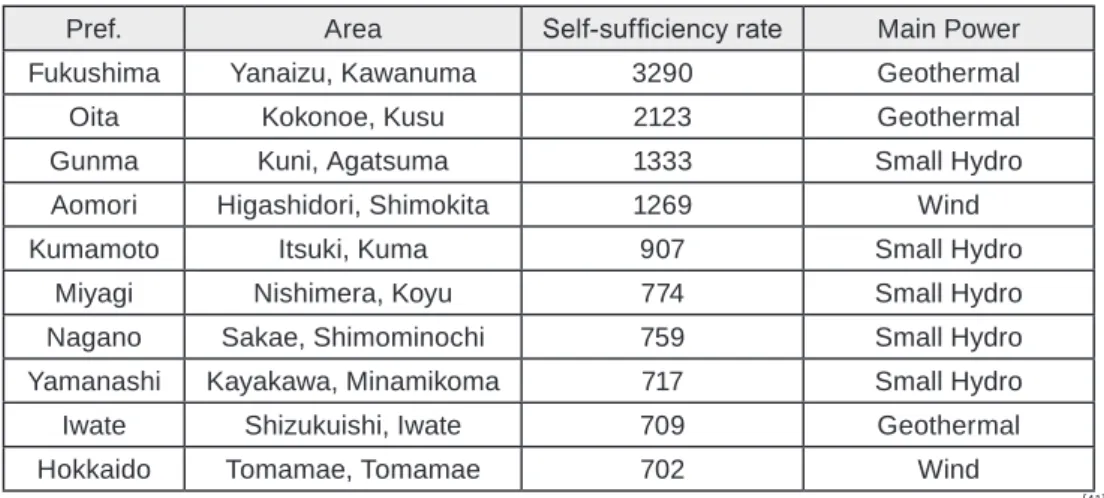
As such, geothermal heat is not only a new sustainable source of energy but also has the potential to improve energy efficiency, and to bring new industries to regions. The widespread use of geothermal energy has great potential to make regional contributions and is expected to, through direct and indirect factors, bring new employment opportunities to residents, increase the number of visitors, and contribute to the regional economy. In fact, there are some areas in Japan where their energy self-sufficiency rates are over 100% through the use of geothermal energy.
In particular, the Tohoku region, where is working towards recovering from the massive earthquake, has abundant geothermal energy resources. Since it has a relatively cold climate, the region will benefit more from a sustainable heat supply compared to regions with more moderate climates. Of course, it is important to create large-scale and centralized geothermal energy plants, but construction takes a long time. As such, it is desirable to start using geothermal energy that can be attained in a relatively short period through, for example, binary power generation and hot-spring power generation.
To smoothly develop geothermal energy, it would be most effective to create a system where each region makes its own comprehensive plan for the future, based on geothermal power generation and the national government supports the plan, rather than having individual parties developing power generation business plans.
It is desirable to look at cases in other countries as we revise laws and support technological development. Using geothermal energy as an essential heat supply source on a daily basis and building a community based on geothermal power generation with support from the government can create a low-carbon society and lead to regional vitalization. To this end, it is desirable for the government to revise laws, including the Natural Park Law and the Hot Spring Law, shorten the environmental assessment process, and support technological development.
(Original Japanese version: published in November, December 2011)
During the 20
thcentury, Japan experienced earthquakes resulting in ten or more people killed or missing at an average rate of one every 3.2 years. These earthquakes continue to occur at this pace as we enter the 21
stcentury.
The M9 Great East Japan Earthquake that occurred on March 11, 2011 inflicted the heaviest seismic and tsunami damage since the end of World War II and led to a nuclear accident, creating serious problems for the entire country. The Headquarters for Earthquake Research Promotion (HERP) issued a warning beforehand that the coast of Miyagi Prefecture had the highest likelihood of experiencing an M7- M8 earthquake. However, no one had thought that a massive M9 earthquake would strike. This incident was a major shock to those working in the field of seismology.
What sorts of effects will this earthquake have on seismology?
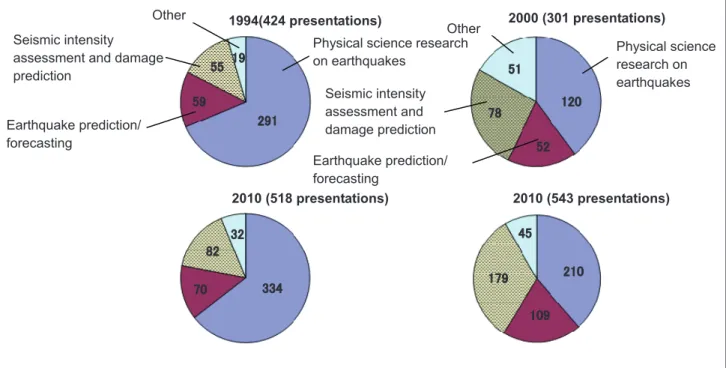
The 1995 Great Hanshin-Awaji Earthquake led to big changes in Japanese seismology. However, the results of a comparison between the Seismological Society of Japan’s (SSJ) research presentation titles at the regular meeting held in fall 1994 after the Great Hanshin-Awaji Earthquake and the fall 2010 meeting just prior to the Great East Japan Earthquake show little change. On the other hand, a comparison with the Seismological Society of America (SSA) allows us to infer that there is a systematic difference in presentation trends between the two countries.
The same impression is made by how sessions are put together. These differences are a contrast in the sense of mission observed in research trends. SSA presentations seem to have a strong mission orientation.
The 4
thScience and Technology Basic Plan questions whether science and technology as a whole are making concrete contributions to the various issues that concern the lives of the Japanese people. Accordingly, the author believes that research evaluation methods should determine the direction that research takes. If Japan is to demand a higher sense of mission from seismology, then it will not be enough to only revise project research evaluations. Rather, the author believes that we will need to reconsider how individual researchers are evaluated. This problem is related to the ability of the people managing research and the task at hand is to ask them to display true leadership.
(Original Japanese version: published in November, December 2011)
2 Trends and Problems of Seismological
Research in Japan in Light of Two Major p. 29
Figure : Seismological Society Presentation Themes Based on Presentation Titles (Left: USA, Right: Japan) Figures are number of presentations
Compiled by STFC
3 3
Seismological Society Presentation Themes Based on Presentation Titles (Left: USA, Right: Japan)
Figures are number of presentations Compiled by STFC
�� ��
��
���
��
��
�� ���
��
��
��
���
��
���
���
���
Physical science research on earthquakes
Earthquake prediction/
forecasting Seismic intensity assessment and damage prediction
Other 1994(424 presentations)
2010 (518 presentations)
Other
Physical science research on earthquakes Seismic intensity
assessment and damage prediction Earthquake prediction/
forecasting
2000 (301 presentations)
2010 (543 presentations)
3 Expansion of Market Mechanisms that Sustain p. 40 Ecosystem Services
- Certification Systems to Promote Ecosystem Conservation in Daily Consumption -
Humanity receives the benefits provided by ecosystems, called “ecosystem services,” that make our lives plentiful and comfortable. Biodiversity is what supports these ecosystems. Much of our everyday lives, from public services to business, are made up of ecosystem services. However, according to the Survey on Environmentally Friendly Corporate Behaviors released by the Ministry of the Environment in December 2010, only a small percentage of companies in Japan consider it important to preserve biodiversity. The reason is that the tools and indicators to overview the relationship between business and ecosystem services are not in general use.
Some companies have taken the lead by implementing efforts according to frameworks developed around supply chains and business life cycles in order to obtain an overview of these relationships. Additionally, frameworks have been formulated to analyze each industries’ impact and dependency on ecosystems, providing business insiders advance recognize of the macro-level relationship between business and ecosystem services. Certification systems meant to preserve biodiversity and conserve ecosystem services are a means to encourage ecosystem conservation in supply chains by utilizing market mechanisms, and products with certification labels based on these systems are being on sale. At present, common certification systems are mainly limited to primary industries such as forestry, fishery and agriculture. If the Life Cycle Assessment (LCA), an established environmental impact assessment method, can be applied to manufactured goods as well, then it would be possible to expand certification systems for them. Furthermore, packaged certification services to conserve ecosystems could be offered in the service industry.
Certification labels on globally distributed products to promote conservation provide traceability that makes society safer. Encouraging certification systems and the distribution of products with certification labels in order to preserve ecosystems in many value-added industries would mean taking the lead in next-generation market mechanisms. An effective way to create new certification systems would be for industry groups and academic societies to take a leadership role and to encourage analytical and investigative projects by experts. Market mechanisms would result in an effective way to foster awareness in the form of participation in conservation throughout society, in addition to the global spread of ecosystem conservation.
(Original Japanese version: published in January, February 2012)
Q U A R T E R L Y R E V I E W N o . 4 3 / J u l y 2 0 1 2
Conservation Methods
Ecosystem Services
Consumer Purchases
& Consumption Product Processing
Retail Sales Resource Procurement
Ecosystem Service Providers
Supply Chain
Certification Label
Resource Procurement
Certification Label Certification
Label Certification
Label
3rdParty Certification Organization
3rdParty Certification Organization
Conservation Activities Qualified
Certification
Marketing
Promote certification labels for products that are good for the environment and ecosystems
Marketing
Promote certification labels for products that are good for the environment and ecosystems
Figure : Market Mechanism-based Ecosystem Conservation Methods
Prepared by the STFC
The abovementioned symposium was held at the National Institute of Science and Technology Policy’s Science and Technology Foresight Center on September 15, 2011.
Following the introduction of circumstances surrounding engineering R&D in Japan and around the world, as well as data on the international mobility of researchers, all participants were invited to participate in discussions held on the two issues.
In order to clarify the circumstances surrounding engineering R&D in Japan and the world in consideration of the international competitiveness of Japan up until now and into the future, premier international society IEEE (the Institute of Electrical and Electronics Engineering, Inc.) was targeted for a variety of analyses, and discussions have been held based on the data received. This symposium was the second of its kind to be held.
According to analysis results on the number of literature, Japan is transitioning in a way all its own. With a leveling off in periodicals, Japan is showing a continuing divergence away from the direction of world research in each field. Despite increased participation in conferences, there has been a downward trend when it comes to the publication of English articles, leading to discussions into the concern that this trend may be due to a decline in the quality level of research. Additionally, although universities currently take on a leading role in the production of literature, the number of fields has remained fixed for a long time, and with the expansion of diversity trending at a snail’s pace, concerns have been raised that Japan’s engineering R&D might only continue to weaken. On the other hand, with regard to international mobility of researchers, the international movement of researchers in Japan is rare, no matter the field, with researchers tending to stay in Japan and stick to the same organization. Acceptance of foreign researchers in companies and other organizations is also rare, prompting discussion into the causes and concerns of this trend. Generally speaking, subject that were raised as those that are necessary for future study included “ensuring diversity,” “the importance of people,” “the need for change among Japanese scholarly societies,” “network formation,” “the provision of meta-information,” “the enhancement of information transmission to countries overseas,” “utilizing the wisdom of other fields,” and “reconsidering Japan’s geographical significance.”
(Original Japanese version: published in January, February 2012)
4 Globalization and the Intensification of Global Competition Seen in the IEEE: What Impact will International Mobility of Research Personnel have on R&D? Symposium Report
p. 52
The amount of periodical articles does not increase, so the quality of research level may have decreased
The reason why keeping until after a conference is perhaps because the mental pain of producing periodical articles is intolerable
A similar phenomenon is not limited to engineering and can also be seen in both business and economics
The fixation of research may also be caused by the closed nature of universities Presentation 1:
Japan's international competitiveness
●Situation of long‐
term leveling off of periodicals
●Increase only in conference participation
●Are corporate researchers who moved to university doing the same research as before?
●It is seen in a particular area, but specialization and diversification can not be seen
Problem causes
Further weakening
Progress is born in diversity Even in other developed countries there is a shift away from engineering fields, but ensuring diversity covers that reduced ability
Diversity is born and making devices is desirable
We should absorb overseas knowledge (send promising researchers overseas and
summon promising foreign researchers)
Concerns for
the future Suggestions for the future
Acceleration of mobility through key people is possible. Japan is weak in this area
When researchers around the world began to move freely, only Japan was maybe left behind from the movement
A step to a major change is not a step forward
An important element is the power of network formation
Knowledge also from the humanities and social sciences
Is reconsideration of boundaries in terms of research also required?
Presentation 2:
Mobility of researchers
●Mobility is active in foreign countries
●Active mobility is not visible in any region in Japan
●There is a tend to remain in domestic organizations in any region in Japan
Changes are needed in the nature of academic societies in Japan
Provision of meta‐information is important
Conversion of ideas in a geographical sense
Japan's problems
Problems /Causes/ Suggestions for the future towards strengthening International competitiveness and globalization
Ensuring diversity
Taking advantage of the knowledge of other fields
Emphasis on
"People"
Reconsideration of geographical meanings Strengthening of information dissemination to foreign countries
There is a tendency to submit Japanese publications after a conference and exit
Refer to IEEE's transformation into a virtual society
Providing opportunities to exchange opinions is one of academic society functions
Orientation is important through setting a high common goal With reference to IEEE which has different management stance and
business‐oriented perspective as well Strengthening International competitiveness and Globalization
Figure : Problems Causes, Concerns and Suggestions derived from opinions
1
Contribution of Geothermal Energy for Regional Innovation and Earthquake Recovery
Kuniko U rashima and Jun W ada Green Innovation Unit
Introduction
After the Great East Japan Earthquake in March 2011, Japan has been promoting various policies like the Strategies to Revitalize Japan
[1]. In particular, there has been discussion around realizing a new optimum energy mix, with the aim of strengthening and accelerating green innovation strategies. It is essential that the adoption of renewable energy be more accelerated than ever. The Energy and Environment Council
[2]worked with related government ministries and agencies and other organizations to deepen the national debate and drew up a basic energy plan consisting of a new optimum energy mix.
The Guideline on Policy Promotion (May 17, 2011, Cabinet Decision) discusses environmental and industrial strategies in line with this plan as well as the Innovative Strategy for Energy and the Environment consisting of green innovation strategies (which support the abovementioned plan and strategies). The guidelines state that the government will, in the short term, respond to restrictions on electricity, foster growth by, for example, creating disaster-resistant energy supply systems (including the construction of Eco-Towns, energy conservation and new energy businesses, the development of distributed energy systems), create a virtuous cycle for expanding capital demands, and implement these initiatives in the disaster-stricken region ahead of other regions. The guidelines also state that the government will, in the medium to long term, strengthen initiatives to create new energy and environmental structures that respond to requests for a safe, stable supply, efficiency, and for the environment
[3].
Renewable energy does not become depleted as long as it is used within the range of nature’s replenishing power and, in general, it does not cause global warming. The International Energy Agency (IEA) explains in its publication (Renewables Information),
1
“Renewable energy is derived from natural processes that are replenished constantly. In its various forms, it derives directly from the sun, or from heat generated deep within the earth. Included in the definition is electricity and heat generated from solar power, wind power, the ocean, hydropower, biomass, geothermal resources, and biofuels and hydrogen derived from renewable resources”. As to solar power generation, a system for purchasing surplus household electricity was launched, and the use of solar power panels for households has been promoted, but improving efficiency is an issue
[5]. In addition, the adoption of wind power generation, small-scale hydropower generation
[6], and biofuel co-combustion (at thermal power plants)
[7]have been promoted in industry in recent years.
This article reviews the current state of geothermal power generation both in Japan and the world and discusses the potential of geothermal heat as an energy source, the contributions the use of heat can make to regional communities, and related policies.
Current State and Issues of Geothermal Energy
2-1 Geothermal Resources
Geothermal resources can be defined as heat generated within the Earth that can be used as energy.
Geothermal energy can be used both to generate power and as a direct heat source, and it is expected to reduce fossil fuel consumption and greenhouse gases
[8].
Temperatures within the Earth increase with depth below the surface, and the rate of the temperature increase is called the geothermal gradient. The average geothermal gradient in Japan is about 30°C/km
[8](the global average is about 20°C/km). If depth is not an issue, underground heat resources exist everywhere.
However, for heat resource usage to be economical, it is desirable to find resources at as shallow a depth
2
Source: Reference[10]
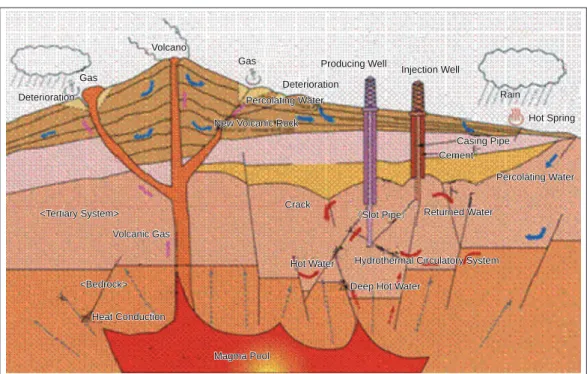
Figure 2 : Underground Model of a Geothermal Resource(Onuma-Sumikawa Geothermal System) Types of Geothermal Resources
Geothermal Resources
Convection Geothermal Energy (Prior Convection)
HDR Geothermal Energy (Heat Conduction)
Hydrothermal Geothermal Energy Vapor-Dominated Geothermal Energy
Source: Reference[9]
Figure 1 : Type of Geothermal Resources
Magma Pool Heat Conduction
<Bedrock>
<Tertiary System>
Deterioration
New Volcanic Rock Volcano
Gas
Gas Deterioration
Percolating Water Rain
Hot Spring
Percolating Water
Hydrothermal Circulatory System Deep Hot Water
Hot Water
Producing Well Injection Well
Casing Pipe Cement
Returned Water
(Slot Pipe) Crack
Volcanic Gas
Magma Pool Heat Conduction
<Bedrock>
<Tertiary System>
Deterioration
New Volcanic Rock Volcano
Gas
Gas Deterioration
Percolating Water Rain
Hot Spring
Percolating Water
Hydrothermal Circulatory System Deep Hot Water
Hot Water
Producing Well Injection Well
Casing Pipe Cement
Returned Water
(Slot Pipe) Crack
Volcanic Gas
変質 Change
噴気 Gas
火山 Volcano 浸透水 Percolating Water 新規火山岩類 New Volcanic Rock 第三系 Tertiary System 火山性ガス Volcanic Gas 基盤岩 Bedrock マグマ溜り Magma Pool 生産井 Producing Well 還元井 Injection Well 割れ目 Crack 熱水 Hot Water
熱水循環系 Hydrothermal Circulatory System 深部熱水 Deep Hot Water
孔明管 Slot Pipe 環元水 Returned Water セメント Cement
ケーシングパイプ Casing Pipe
雨 Rain
温泉 Hot Spring
出典: 参考文献10 Source: Reference #10 変質 Deterioration
噴気 Gas
火山 Volcano 浸透水 Percolating Water 新規火山岩類 New Volcanic Rock 第三系 Tertiary System 火山性ガス Volcanic Gas 基盤岩 Bedrock マグマ溜り Magma Pool 生産井 Producing Well 還元井 Injection Well 割れ目 Crack 熱水 Hot Water
熱水循環系 Hydrothermal Circulatory System 深部熱水 Deep Hot Water
孔明管 Slot Pipe 環元水 Returned Water セメント Cement
ケーシングパイプ Casing Pipe
雨 Rain
温泉 Hot Spring
出典: 参考文献10 Source: Reference #10
as possible. As long as one uses heat moderately, the Earth will continuously replenish it, and so it is a sustainable and renewable source of energy.
As Figure 1 shows types of geothermal resources.
The geothermal resources can be divided into two types depending on how the heat is replenished: 1) convection-dominated geothermal resources (heat from deep underground is transferred to groundwater and moves up through circulating water) and 2) hot dry-rock geothermal resources (there is no circulating water and the rock conducts heat). When people talk about geothermal resources, they usually mean the former. This form is easier to use, since heat is obtained as hot water or vapor, and like hot springs, hot water sometimes pours out naturally.
Figure 2 shows underground model of Geothermal Resouce. Hot water and vapor (used for power generation) are heated by geothermal heat in a groundwater reservoir (confined and pressurized
under a shielding layer), which often lies 1,000 to 2,000 meters underground. Heated groundwater is brought up through a production well as pressurized vapor or hot water. Recently, it has become clear that the source of the water (hot water for either power generation or hot spring) is rainwater from the surrounding area.
After it is used for geothermal generation, cooled water is usually returned underground through an injection well to maintain the underground water balance and prevent the surrounding environment from being affected by impurities from underground
[10].
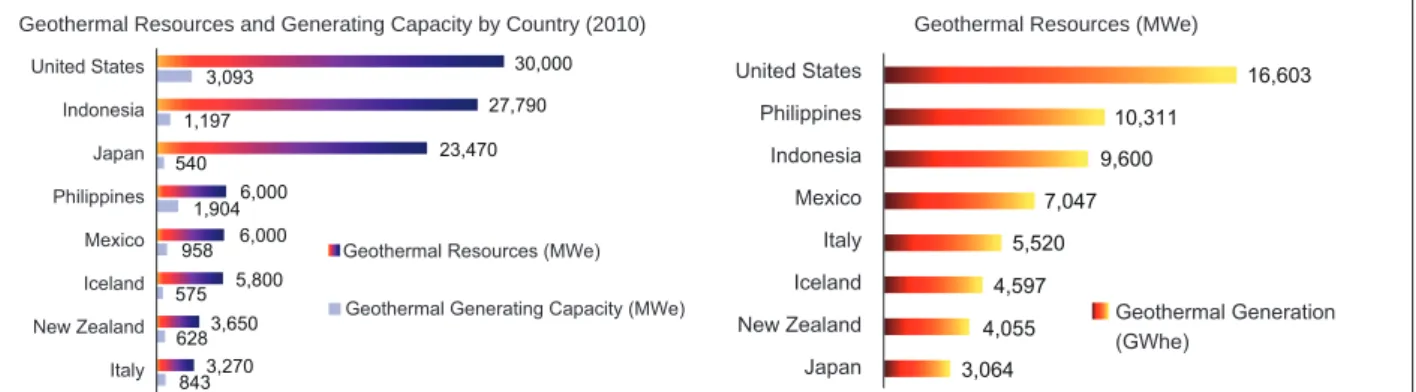
Japan is one of the countries that have abundant
geothermal resources. Figure 3 shows geothermal
power generation resources and installed power
generation capacity. Japan’s hot water resources (over
150°C) alone amount to 23,470 MW when converted
into power output (which could supply hot water at
150°C for thirty years)
[11]. Japan has the world’s third
largest geothermal resources (after the United States
and Indonesia), and it still has abundant untapped geothermal resources.
Geothermal resources can be used not only for geothermal power generation but also as a direct heat source. Figure 4 shows how geothermal energy is used. Hot water and vapor usually come out through a well using their own pressures, and, generally speaking, it is easy to provide energy even during external power outages and other emergencies, depending on the system structure.
The use of underground heat requires the technology to use soil or water underground (at 0-100 meters deep) as a heat source for a heat pump. The topic was previously covered in Science & Technology Trends (No. 90, September 2008). The underground temperature is roughly constant throughout the year. It is lower than the air temperature in summer and higher in winter. Therefore, if waste heat is put underground in summer, and heat is brought out as a thermal source for a heat pump in winter, one can run an air conditioner, heater, snow-melting system, or water heater using less power than if one were using the air as a thermal source
[12].
2-2 Geothermal Power Generation
2-2-1 Comparison of Other Renewable Energy Compa red w it h ot he r re newable e ne rg y, geothermal power generation has the following major characteristics.
- Compared with solar power and wind power generation, geothermal generation is reliable in terms of supply. A stable power supply is attainable with no need to set up a back-up power source and secondary battery. In addition, operating ratios are higher than solar power and wind power generation, and so as shown in Figure 5, geothermal generation can annually produce power energy several times higher than solar and wind power generation.
Facility utilization rates are also high, and the power generation unit price is about one fifth to one third of the unit price of solar power
[15].
- Heat is a byproduct and can be used for various purposes.
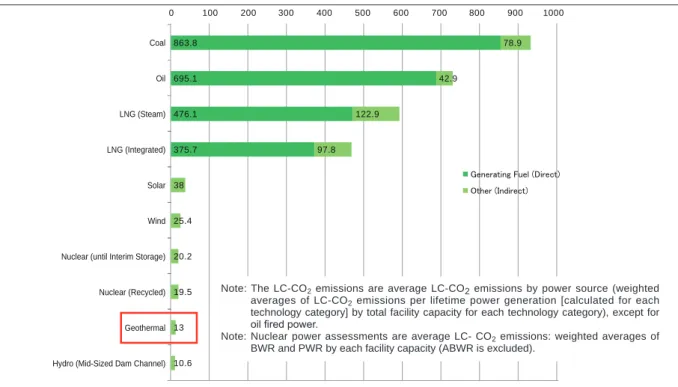
- The emissions rate of CO 2 over the lifecycle of the facility is about one quarter to one half of the CO 2
emissions generated from solar power and wind power generation as shown in Figure 6.
Source: Prepared by STFC based on Reference[13,14]
Figure 3 : Geothermal Resources, Installed Power Generation Capacity, and Geothermal Power Generation around the World
Geothermal Resources and Generating Capacity by Country (2010) Geothermal Resources (MWe)
Convection Geothermal Resource
Geothermal Resources
Extraction
HDR Geothermal Resource
Water Injection
& Extraction Steam & Hot Water
Dry Steam
Flash Power Generation Binary Power Generation Geothermal Power Generation
Direct Geothermal Usage Hot Water, Room Heating, Melting Snow, etc
Geothermal Heat Soil & Groundwater Heat Pump Heat Source Hot Water, Room Heating/
Cooling, etc.
Prepared by STFC.
Figure 4 : Usage of Geothermal Resources
375.7 476.1 695.1 863.8
10.6 13 19.5 20.2 25.4 38
97.8 122.9
42.9
78.9
0 100 200 300 400 500 600 700 800 900 1000
Generating Fuel (Direct) Other (Indirect) Coal
Oil
LNG (Steam)
LNG (Integrated)
Solar
Wind
Nuclear (until Interim Storage)
Nuclear (Recycled)
Geothermal
Hydro (Mid-Sized Dam Channel)
Figure 6 : CO
2Emission over the Lifecycle of a Facility by Type of Power Generation (Unit: g-CO
2/transmission end kWh)
Note: The LC-CO2 emissions are average LC-CO2 emissions by power source (weighted averages of LC-CO2 emissions per lifetime power generation [calculated for each technology category] by total facility capacity for each technology category), except for oil fired power.
Note: Nuclear power assessments are average LC- CO2 emissions: weighted averages of BWR and PWR by each facility capacity (ABWR is excluded).
Source: Reference[17]
2-2-2 Issues Surrounding Geothermal Resource Development in Japan
In Japan, the capacity of geothermal power stations increased by 314MW between 1990 and 1996, accounting for more than half of the current capacity, 540MW. This trend coincides with efforts to develop geothermal resource exploration technology and hot water/vapor handling technology based on oil development and mine technology as well as to cultivate human resources after the launch of the
“Sunshine Project” in 1974. However, since the launch
of the Hachijo-jima geothermal power plant in 1999, no plants have been established except for expanded small-scale binary power generation, discussed below
[18]. This is in contrast to trends in the United States, the Philippines, Indonesia, Italy, and elsewhere, where geothermal power generation is rapidly becoming popular.
Some of the reasons that Japan’s geothermal power generation is not increasing in contrast to other renewable energy or other countries are as follows:
2744
2254
3310
540
2144
1889
Geothermal Solar Wind
Annual Power Generation (GWh) Capacity (MW)
The graph was prepared by STFC. The power generation prices and facility utilization rates are based on Reference[15].
*Nuclear power generation prices are being reassessed by the Japan Atomic Energy Commission.
Figure 5 : Comparisons of Annual Power Generation, Facility Capacity, Power Generation Unit Price, and Facility Utilization Rate (Fiscal 2008)
Generating
Method Cost
(JPY/kWh) Utilization (%) 8.2~13.3 45 10.0~17.3 30~80
5.8~7.1 60~80 5.0~6.5 70~80 4.8~6.2 70~85
46 12
10~14 20
7.8~18.3 70 Hydro
Oil LNG Coal Nuclear Solar Wind Geothermal
Basis for Annual Power Generation
- Geothermal: FY2008 results data (Reference [15])
- Solar: Calculated according to assumed facility utilization of 12% based on 2,144 MW currently installed as of FY2008 (Reference [16]) Annual Power Generation = 2,144 MX x 24 hrs x 365 x 0.12 x 0.001 (GWh / MWh)
- Wind: Calculated according to assumed facility utilization of 20% based on 1,889 MW currently installed as of FY2008 (Reference [16]) Annual Power Generation = 1,889 MX x 24 hrs x 365 x 0.2 x 0.001 (GWh / MWh)
1) A resource survey takes a substantial amount of time and, depending on the result, there is risk of giving up on commercialization in the middle of the process.
2) Many places appropriate for geothermal power generation are located in natural parks, and it is difficult to develop facilities under the current Natural Parks Law.
3) Some point out that development will affect hot springs.
4) It takes at least three years to finish environmental impact assessment procedures.
5) A secondary factor for each of the abovementioned causes is that the lead time between the launch of a development process and the beginning of actual power generation operation is more than ten years.
As such, it takes a long time to recover investments, and business incentives are low.
6) Compared with other renewable energy, the government’s assistance for initial investments is scarce.
In particular, items 2) to 4) are causes for concern in Japan. The Natural Parks Law regulates power generation facilities in national parks in order to protect the natural environment and landscape.
National parks and hot spring areas have abundant hot water resources that can be used for geothermal power generation, but due to regulation, their development has not been promoted.
In addition, due to the budget screening in May 2010 under the Democratic Party of Japan administration, it was determined that the geothermal development promotion survey project and the geothermal power generation development project would be reviewed on the presumption that the projects may be abolished
[19]. Of the geothermal development costs, excavation accounts for a substantial fraction, which has to be resolved. The key to geothermal commercialization depends on whether a sufficient supply of hot water can be secured, and there is a high risk of excavating unsuitable sites before finding a hydrothermal vein that will support a stable business. If many excavations are required, the investment for a geothermal business becomes substantial. It costs between 300 million to 400 million yen to excavate a well down to about 2,000 meters, and the risks for a private company are huge. This is one of the major reasons why geothermal commercialization has not been promoted.
The government provides initial investment support to new energy, including geothermal energy. However, the support differs considerably depending on power generation sources. The new energy introduction acceleration support project in fiscal 2011
[20]sets upper limits: solar power generation may receive either up to one third of the total cost or 250,000 yen/
kW, whichever is lower; wind power may, after an individual consultation, receive up to 1.5 billion yen if there is adequate cause; natural gas cogeneration and microgrid systems may receive up to 500 million yen. In contrast, geothermal power may receive up to one half of the cost of a survey and excavation project and one fifth of the establishment cost of a geothermal power generation facility
[21]. This means, for example, that only up to 500 million yen may be subsidized for an excavation survey that costs about one billion yen. As discussed below, only 24 million yen may be subsidized for establishing the electric power system required for a binary power generation system 50kW (transmission end), grid connection, etc. that costs about 120 million yen
[22]. As discussed in item 6), geothermal power generation is at a disadvantage when it comes to receiving government assistance.
Due to these factors, not much attention has been given to geothermal energy compared to other renewable energy. Geothermal energy has its own unique issues, but most of the issues are expected to be resolved to some extent.
Current State of Geothermal Energy Use in Japan
3-1 Geothermal Energy Use for Power Generation The output (i.e., facility capacity) of individual commercial geothermal power generators currently installed in Japan is between few l MW and 112 MW.
For example, some hotels and other private facilities have a capacity of 100kW. Power for commercial uses generated by geothermal energy is transmitted to a distant point of demand, and so, like thermal power and hydropower plants, it requires a concentrated power source. Roughly speaking, geothermal power generation for commercial uses needs power output equal to a large-scale wind power generator or even larger, like a small and medium-scale water power generation facility. Current typical geothermal power generation depressurizes (or flashes) extracted vapor or hot water (part of which turns into vapor), sends
3
Prepared by STFC based on Reference[23]
Table 1 : Current State of Geothermal Power Generation (as of November 2010)
steam into a steam turbine, and the rotating turbine generates power. Therefore, even when the amount of hot water is the same, the higher the temperature of the hot water is, the higher the power output becomes, leading to higher economic efficiency. As such, it is desirable to establish a facility at a location with high temperature hot water.
Table 1 shows the current state of geothermal power generation in Japan. Currently, facilities are located in eight prefectures, and many of them are situated along the volcanic belts in Hokkaido, the Tohoku for, and the Kyushu region. The facilities provide not only electricity but also supply heat for contributing to regional businesses.
3-1-1 Dry Steam and Flash Steam Power Generation If spew from a production well is vapor containing very little hot water, only simple moisture removal is required before transferring steam into a steam turbine to generate power. This method is called dry steam power generation. The Matsukawa geothermal power plant, Japan’s first geothermal power plant, has been using this method to generate power since 1966. If a well produces mostly hot water and not so much vapor, a steam separator is used to separate (or flash) steam, which goes into a steam turbine for power generation.
This method is called flash steam power generation (Figure 7). After the steam is separated, if the pressure of the remaining hot water is high enough, a second separator can be installed to depressurize the hot
Pre f. Plan t �oc ation Ste am
Supply Utility Use �ated
Ou tpu t Start
Ye ar Dire c t Geoth ermal Use Hokkaido Mori Mori,
Kameda HEPCO HEPCO General 50MW 1982 69 greenhouses
Sumikawa Kazuno Mitsubishi Tohoku
General 50MW 1995 Sumikawa Kazuno
Materials Electric Power General 50MW 1995 Akita Onuma Kazuno Mitsubishi
Materials
Mitsubishi
Materials General 9.5MW 1974 Uenotai Yuzuwa
Akita Geothermal
Energy
Tohoku
Electric Power General 28.8MW 1994
Kurikoma Foods (food processing), Minase Heated Pool, Akinomiya Heated Pool
Tohoku
Hachimantai Geothermal Steam Dyeing Workshop room and water heating for Matsukawa Hachimantai
Tohoku Hydropower &
Geothermal
Tohoku
Electric Power General 23.5MW 1966
Workshop, room and water heating for nearly 700 hotels, inns, guesthouses, pensions, resort houses, shops and hot spring facilities, 95 greenhouses Iwate Kakkonda
No. 1
Shizukuishi, Iwate
Tohoku Hydropower &
Geothermal
Tohoku
Electric Power General 50MW 1978 Iwate Prefecture Indoor Heated Pool (alt. name: Hotswim)
K kk d Shi k i hi Tohoku
T h k Kakkonda
No. 2
Shizukuishi,
Iwate Hydropower &
Geothermal
Tohoku
Electric Power General 30MW 1996
Miyagi Onikobe Osaki J-Power J-Power General 15MW 1975 Oraga Tropical Garden Fukushima Yanadu-
Nishiyama
Yanaizuma, Kawanuma
Okuaizu Geothermal
Tohoku
Electric Power General 65MW 1995 Tokyo Hachijojim
a Hachijo TEPCO TEPCO General 3.3MW 1999 Greenhouses, mixed bathing facilities Suginoi
Hotel Beppu Suginoi Hotel Suginoi Hotel Private 1.9MW 1981 Hot springs, room heating, water heating, cooking
Otake Kokonoe,
Kusu Kyuden Kyuden General 12.5MW 1967
Hacchobaru No. 1
Kokonoe,
Kusu Kyuden Kyuden General 55MW 1977
Hacchobaru No 2
Kokonoe,
Kusu Kyuden Kyuden General 55MW 1990
Oita No. 2 Kusu
Hacchobaru Binary
Kokonoe,
Kusu Kyuden Kyuden General 2MW 2006
Takiue Kokonoe, Kusu
Idemitsu Oita
Geothermal Kyuden General 27.5MW 1996 Water heating for 40 private homes Kokonoe Kokonoe,
Kusu
Kuju Kanko Hotel
Kuju Kanko
Hotel Private 0.99MW 1998 Hot springs, room heating, water heating Nittetsu
Ogiri Kirishima Kagoshima Geothermal
Kyuden General 30MW 1996
Kagoshima Kirishima
Int'l Hotel Kirishima
Daiwabo Kanko Kirishima Int'l
Hotel
Daiwabo Kanko Kirishima Int'l
Hotel
Private 0.1MW 1984 Hot springs, room heating
Yamakawa Kirishima Kyuden Kyuden General 30MW 1995
8 Pref. 17 Places 13
Companies 9
Companies 540.09MW
Generator Water Vapor
Coolant
Pump Hot Water
Producing Well Injection Well Turbine
Cooling Tower Steam
Separator
Condenser
水蒸気 Water Vapor タービン Turbine 熱水 Hot Water 生産井 Producing Well 還元井 Injection Well 汽水分離器 Steam Separator 発電機 Generator 冷却水 Coolant 復水器 Condenser ポンプ Pump
Prepared by the STFC
Figure 7 : Dry Steam/Flash Steam Power Generation
water to create more steam, which is then put into the mid-section of the turbine in order to improve power output and use geothermal energy effectively. This is called a double flash cycle and used at the Mori and Hacchobaru geothermal power plants (Table 1).
The largest output from an individual dry steam and flash steam power generator is 140MW (New Zealand).
Dry steam and flash steam power generation is used as concentrated power sources and is the mainstream of geothermal power generation. These methods are mostly suitable for locations producing hot water at temperatures greater than 200°C. Three Japanese makers (Mitsubishi Heavy Industries, Toshiba, and Fuji Electric) account for 70% of the world’s share of geothermal turbines for large-scale power generation.
Geothermal turbines and generators are exposed to a more severe environment compared to thermal power generation because various underground materials are sent as-is to turbines. Thermal turbines used to require biennial maintenance, but Japanese makers created turbines that are more corrosion-resistant with coated rotors and stators. In addition, by installing equipment to capture moisture (water droplets) and drain it out of turbines and making other improvements, thermal turbines are now of a higher quality and can be used continuously and stably for six years without problems. These improvements are the reason for Japan’s expanded market share.
3-1-2 Binary Power Generation
The steam is usually used to rotate turbines, but with binary (cycle) power generation other substances with lower boiling points than water (e.g., hydrocarbon) are heated and vaporized, and the pressurized steam is used to operate a power generation system. This method can use heat sources at temperatures lower than 150–200°C (which cannot be used with a water/
steam-based system) as shown in Figure 8.
In recent years, this method has become increasingly popular. Ormat in Israel holds the world’s top share in this method. Kyushu Electric Power’s Hacchobaru geothermal power plant (110MW), they have been they using with a 2MW binary power generation system since 2006 that using an existing production well where the power output had declined. Normal pentane (boiling point: 36°C) is used to operate the turbine. In addition, the Kalina cycle (a kind of binary power generation) uses a solution of water and ammonia and can generate power using heat resources at even lower temperatures (less than 100°C).
Binary power generation was recognized as a
new energy source by the RPS law
[NOTE1]. It does
[NOTE 1] Renewables Portfolio Standard is a
system that requires electric power suppliers to use a
certain proportion of electricity generated from new
energy, depending on the amount of energy they
distribute each year, in order to promote new energy.
Power Generator
Coolant
Pump Pump
Hot Spring Usage
Hot Spring Source
Cooling Tower Hot Water
Water/Ammonia Compounds
Turbine
Power Generator
Coolant
Pump Hot Water
Producing Well Injection Well
Cooling Tower Low Boiling Point Hydrocarbons, etc.
Turbine
Pump
Prepared by STFC
Figure 8 : Binary Power Generation
Prepared by STFC
Figure 9 : Hot-Spring Power Generation
not require high temperature heat sources like flash steam power generation, and compared to the flash steam system, many locations are suitable for the establishment of a binary power plant. Therefore, the number of binary power plants is expected to increase in Japan as well as world.
3-1-3 Hot-Spring Power Generation
An estimate indicates that the Kalina cycle system could generate approximately 722MW of power using unused heat released from existing hot springs while
maintaining an appropriate temperature for bathing
[24]. The system is a kind of binary power generation discussed above and is commonly called “hot-spring power generation.” Characteristically, there is no need to excavate a new well, and so it can start generating power easily. Hot-spring power generation is expected additional power generation to existed Geothermal energy capacity as shown in Figure 9.
3-1-4 Enhanced Geothermal System
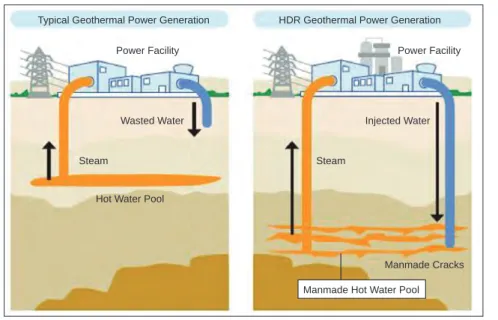
In Figure 10, the enhanced geothermal system (EGS)
generates power by injecting water into underground hot dry rocks, artificially creating steam and hot water, and retrieving them to turn a turbine. The EGS is a next-generation technology for places where natural vapor or hot water cannot be attained. The important technologies for this system concern the artificial creation of cracks so that water can pass through underground hot dry rocks and the injection of high- pressure water underground to collect hot water or vapor.
The Central Research Institute of Electric Power Industry (CRIEPI) and the NEDO conducted hot and dry-rock thermal resource recovery tests in Ogachi, Akita prefecture and Hijiori, Yamagata prefecture, respectively. In the latter case, a hot water recovery and circulation test was conducted for about two years, and a 50kW power generation test was conducted for about three months. The tests were completed in fiscal 2002, and no continuous tests have been conducted since
[25].
3-2 Usage as Heat
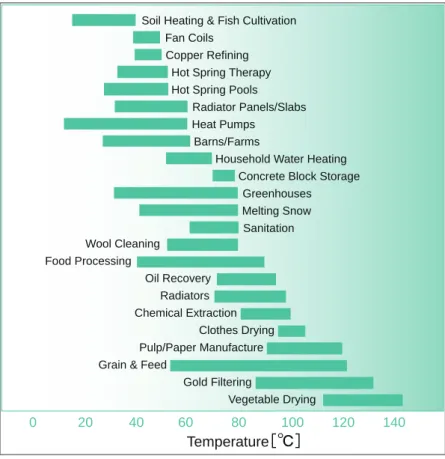
More than half the energy for households is used to generate heat for, for example, making hot water or heated air. In Figure 11, there is also a variety of heat energy uses in industry.
Unlike other renewable energy, not only can geothermal energy generate electricity but it can also provide a substantial amount of heat energy to communities. In other words, by using heat energy, we can expect to save energy resources and prevent global warming.
The higher the temperature of a geothermal
resource, the greater the variety of uses it has.
Thermal efficient cascading use of hot water is possible since after high temperature water is used, the water can be reused for other purposes even after the temperature goes down. In addition, hot water generated in the steam separation process for flash steam power generation can be used as a heat resource before the water goes into an injection well by having it exchange heat with clean tap water to create warm water. Thermodynamically, less than 10% of hot water at a temperature lower than 120°C can be converted to electricity, but if it is used directly as heat, all of the water’s heat energy can be utilized.
In recent years, the use of geothermal heat for air conditioning/heating systems has been rapidly becoming popular around the world, and it is already in practical use in many places in Japan. In this case, one does not need to excavate a well to collect hot water, and heat can be used by a simple construction method like putting a heat exchanger pile in the ground. For example, Tokyo Sky Tree and other large- scale commercial facilities have recently adopted geothermal heating systems. The coefficient of performance (COP) at Tokyo Sky Tree is expected to exceed 1.3, the highest district heating and cooling (DHC) level in Japan
[26].
Unlike hot water use, geothermal heat use is not completely CO 2 free, but the energy-saving effect is great. Advantages for the widespread use of geothermal heat are the mitigation of the urban heat island effect, the reduction of electricity consumption and CO 2 emissions by reducing fire- powered heating in cold regions, and smoothing of
Power Facility Power Facility
Typical Geothermal Power Generation HDR Geothermal Power Generation
Injected Water Wasted Water
Steam Steam
Hot Water Pool
Manmade Hot Water Pool Manmade Cracks
Figure 10 : Enhanced Geothermal System
Source: Reference[48]
Temperature [℃]
0 20 40 60 80 100 120 140
Soil Heating & Fish Cultivation Fan Coils
Copper Refining Hot Spring Therapy Hot Spring Pools
Radiator Panels/Slabs Heat Pumps
Barns/Farms
Household Water Heating Concrete Block Storage
Greenhouses Melting Snow Sanitation Wool Cleaning
Food Processing
Oil Recovery Radiators Chemical Extraction
Clothes Drying Pulp/Paper Manufacture Grain & Feed
Gold Filtering
Vegetable Drying
Figure 11 : Heat Energy Use by Temperature
Source: Reference[8]
electricity consumption by reducing peak electricity in midsummer and using nighttime power.
Thus, geothermal heat can be used to create an energy system as a power generating source, depending on regional circumstances, and also as heat, which is not affected by climate conditions.
Geothermal heat also hardly doesn’t depends on fossil fuels.
Geothermal Energy Use in the World
In contrast to Japan, geothermal power generation grew rapidly by about 30% in the decade between 1995 and 2005. In particular, the growth in the United States, Iceland, and Indonesia is notable. Especially, the federal and state governments support renewable energy in United States.
The use of geothermal heat pumps has become popular in the United States, Sweden, and, recently, China.
4-1 United States
One of the guiding principles for energy and environmental policy in the United States that called
“Investing in the clean energy jobs of the future.” The
government aims to create 17,000 jobs by providing 2.3 billion dollars in tax credits for the clean energy manufacturing sector
[27].
Currently, the Department of Energy (DOE) and other organizations are actively investing in geothermal energy. The American Recovery and Reinvestment (ARR) Act of 2009 provided 350 million dollars for verifying developing geothermal power generation and 50 million dollars for geothermal heat pumps
[28]. Specifically, a National Geothermal Data System (NGDS) is aimed at reducing the risk of failure for geothermal developers by providing comprehensive information, including geothermal resource data and assessment, tech nological information, successes and failures in geothermal research, and policies. In addition, the Office of Electricity Delivery & Energy Reliability of the DOE has been working with other organizations on the electric grid to allow geothermal energy resources to reach distant markets.
The Geothermal Technologies Program (GTP), an industry-government-academia program launched in 2008, aims to popularize geothermal power generation and reduce power generation costs by 2020 or 2030.
The GTP conducts activities organized around the five areas shown below
[29]. The National Renewable
4
[NOTE 2] Independent Power Producer (IPP) is also called a “wholesale power provider” in Japan. The 1995 revision of the Electricity Business Act allowed general businesses to supply wholesale power to electric power companies.
Energy Lab (NREL) estimates that enhanced geothermal power generation has a potential of 16,000 GW in the United States, and so the development of enhanced geothermal systems technology is particularly emphasized.
• Enhanced geothermal systems technology
• Hydrothermal power
• Low-temperature resources
• Strategic planning, systems analysis and geothermal data
• Technology validation
In 2008, for example, Google invested 10 million dollars in ventures including: AltaRock Energy, which works on Engineered Geothermal Systems (EGS) (6.25 million dollars); Potter Drilling (4 million dollars); and the Southern Methodist University Geothermal Laboratory, which works on the mapping of geothermal energy resources in North America (489,521 dollars). Such research and development has been ongoing
[30].
4-2 Indonesia
Indonesia has huge geothermal potential some as Japan. Unfortunately, the usage rate for geothermal power generation used to be about 4.5%, making up less than 3% of Indonesia’s total resources. However, in 2003, the Indonesian government adopted a Geothermal Law and drew up a geothermal power generation roadmap. According to the roadmap, the government is planning to expand by 2025 the capacity of geothermal power facilities to about 1 GW (5% of primary energy), which will be about eight times greater than the current level. To achieve the plan, it is essential to promote Independent Power Producers (IPPs)
[NOTE2], which raise private funding, and a total of 20 billion yen (including 10 billion yen of credit) will be funded for exploratory drilling for geothermal energy. JICA, JBIC, consulting companies, and trading firms from Japan are planning to provide financial and technological assistance to develop geothermal energy
[31]. Indonesia does not have a natural park law like Japan, and geothermal development is expected to proceed more easily. It is also interesting that Indonesia is trying to develop geothermal energy even though the country has abundant fossil resources such as oil, natural gas, and coal.
4-3 Iceland
The population of Iceland is about 320,000. In the 1930s, the capital Reykjavik was suffering from smog from coal power generation and began shifting to oil. However, the 1970s oil crisis forced Iceland to reexamine this policy, and the use of geothermal energy has become more popular. Geothermal energy was developed primarily for community air heating, and now, 90% of the population has been using on geothermal heat for air heating. Geothermal energy is used primarily as a heat source, with excess energy being used for power generation. Iceland has abundant renewable energy such as hydro and geothermal energy. In 2009, renewable energy accounted for 85%
of primary energy. In addition, 100% of electricity is supplied by renewable energy (about 30% by geothermal and 70% by hydro energy)
[32]. Notably, Iceland did not have many industries other than fishing, but, taking advantage of electricity generated from 100% renewable energy, Iceland attracted multi- national aluminum smelting plants, which consume 70% of the country’s electricity. Iceland’s clean electricity is then exported to the world as a form of aluminum. In addition, the Svartsengi geothermal power station uses geothermal seawater (taken up for power generation) to operate Blue Lagoon, the world’s largest open-air hot spring resort for the public.
4-4 Germany
Germany is enthusiastic about using renewable energy and has actively been promoting the use of geothermal energy. The government is expected to increase geothermal power generation capacity by 2020 to about 280 MW, 40 times higher than the current level. This equals to 1.8 TWh/year of power.
A total of 8.2 TWh of heat is also expected to be supplied by deep geothermal energy by 2020 (3.4 TWh from geothermal power stations and 4.8 TWh from heat from geothermal facilities that do not generate power and only provide heat). In addition, 850 MW of power generation capacity is expected to be added by 2030
[33].
Currently, there are three geothermal power
stations and 167 heat supply facilities (which use deep geothermal energy and do not generate power). For example, hot-water-based binary power generation is in operation in Landau and Unterhaching (south of Munich). They each recover hot water at around 120°C from a depth of 3.3 to 3.4 km deep. Germany does not have volcanic hydrothermal systems. But despite this disadvantage compared to geothermal power plants abroad, geothermal power generation is in operation, showing the country’s serious willingness to develop geothermal energy
[34]. In 1999, a comprehensive geothermal energy facility was established in Erding, north of Munich. This facility obtains 80t/h of warm water at 65°C from a depth of 2,300 meters, and the water is then heated up to about 100°C through a heat exchanger and heat pump. The hot water is used for community air heating and industries, and groundwater cooled via the heat exchanger and heat pump is used for an artificial hot spring and drinking.
As such, all the heat and water resources obtained from underground are effectively used
[35].
To promote geothermal power generation projects, Germany created policies that give preferential treatment to geothermal projects and reduce related risks. The Renewable Energy Law adopted in January 2009 raised compensation prices for purchasing geothermal power and also adopted a special bonus system. As such, the fixed-rate purchasing system and other systems have been effective. For example, a new geothermal power station (up to 10 MW) established in 2009 received a fixed purchasing rate of 16 euro cents/kWh compared to 14 euro cents before the revision, and until 2015, 4 euro cents will be added as a bonus. In addition, if the station provides heat, 3 euro cents are added. However, the fixed purchasing rate will be reduced every year by 1 euro cent per year. Therefore, a power provider who establishes a facility sooner receives more funding, and it is profitable to excavate a depth of more than 3 kilometers. In addition, the Renewable Energies Heat Law adopted in January 2009 requires new buildings to use renewable heat, which has been promoting the use of geothermal energy
[33].
The Federal Environment Ministry made 60 million euros available in financing for deep geothermal drilling projects, and this credit program reduces the risks associated with drilling in particular. The KfW Bank Group provides loans for deep underground drilling through commercial banks, and the upper
limit is 80% of all the costs necessary for drilling. If no hot water reservoir is found, the investor will not have to pay the remaining amounts once the project is considered a failure
[36]. The government also continues to provide grant funding for research and development and tries to reduce technological and geological risks.
In this way, Germany has been active in making national policy to develop geothermal energy.
4-5 Australia
Australia is also promoting renewable energy policy and is planning to invest at least 35 billion Australian dollars by 2020. Australia is expected to accelerate the use of renewable energy through the current tax credit system for electricity prices and the federal government’s Small-scale Renewable Energy Scheme (SRES).
In 2010, Geodynamics, Ltd. began constructing a large-scale EGS plant. More than 40 venture companies are developing geother mal power generation in the Cooper Basin. Australia does not have volcanoes, and so, to obtain vapor and hot water, the wells must go down to a depth of over 4,000 meters, twice as deep as ordinary wells. Many companies and individuals have already invested in geothermal power generation. One of the reasons why Australia has been increasingly investing in renewable energy even though it has abundant energy resources is that it aims to actively reduce greenhouse gases
[37].
Expanding the Use of Geothermal Energy in Japan
5-1 Geothermal Power Generation Potential in Japan
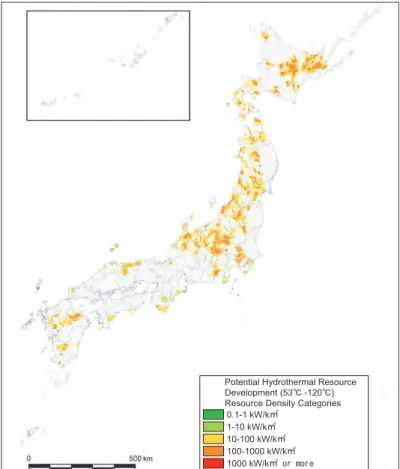
Japan’s geothermal power generation has not been growing, in contrast to other renewable energy in Japan or geothermal power generation in other countries. As discussed in Chapter 2, factors include the lengthy amount of time it takes to conduct a site survey and construct a large-scale geothermal power station, and the fact that power stations cannot be built in national parks. On the other hand, we have seen progress in small-scale geothermal technologies and excavation technologies such as for binary power generation, which can help solve Japan’s unique issues. NEDO created a geothermal resources map, and the risks that surround geothermal development have decreased.
5
Source: Reference[32]