An investigation into the application and reception of digital gaming in reading and writing courses
journal or
publication title
言語教育研究
number 28
page range 177‑214
year 2017‑11
URL http://id.nii.ac.jp/1092/00001512/
An investigation into the application and reception of digital gaming in reading and writing courses
Anna Twitchell Euan Bonner
Abstract
In university English reading and writing courses that include creative narratives as a genre topic, typical end-of-unit projects ask students to write an original story. However, creative writing in an L2 may be intimidating for students, especially those who have not had much experience with the genre in their L1, which may lead to writer’s block. In order to counteract this, the presenters designed several versions of a narrative-driven game for students to utilize as a framework that attempts to combine both genre analysis and language experience. Results indicate that students are highly receptive to this approach and by interacting with a digital collaborative multi-player narrative game as scaffolding for creative writing projects, L2 learners were able to generate ideas more quickly than without a framework. Furthermore, students who played a tablet-based version of the framework were able to produce more average output in terms of length and number of unique words per text when compared to students who played a paper-based version of the framework, suggesting that the former may be more beneficial for L2 writers in this context.
Introduction
“All writing problems are psychological problems. Blocks usually stem from the fear of being judged. If you imagine the world listening, you'll never write a line.” So asserts Erica Jong, in her essay of advice to would-be creative writers (Martin, 2008, p. 3). This might be doubly true for second language (L2) learners who may have not have engaged in narrative fiction writing in their first language (L1). Given the lack of experience that these students
have in creative writing, it should be noted that an absence of – or inadequate application of – a framework from which the students can build their own original text can lead to L2 learners becoming overwhelmed with a given creative writing task and limiting their ability to produce text quickly, which led to the researchers of this study to examine the currently available materials for the Narrative Unit of the Foundational Literacies course at Kanda University of International Studies (KUIS).
As of 2015, the final project for the aforementioned unit has presented students with the following statement via Google Document: “Create a fictional narrative, using your own imagination… it can be set anywhere, anytime, and there are no limits to what happens, and what we might learn.” When given to the students, the researchers noted through observation that many of the learners spent the majority of their class time producing little to no output.
When prompted as to why they were not engaged in pre-writing brainstorming activities, the majority of responses alluded to not having any ideas. In essence, these students were faced with “writer’s block,” which for the purposes of this paper is defined as an inability to produce new creative work for an extended period of time. While this behavior was not observed in all learners, there was a significantly high enough number of students that the current researchers could claim a majority of their students had difficulty with the project because of writer’s block.
As such, the researchers hypothesized learners may benefit from a framework of setting, characters, and basic plot from which to scaffold their own creative writing project. It was postulated that when learners were not burdened with being creatively responsible for every aspect of narrative design, they might be able to approach the creative writing project with more confidence and less time spent overcoming writer’s block. Furthermore, during this same period, there was anecdotal evidence from the university’s Self-Access Learning Centre (SALC) that there had been an increase in popularity of adventure game books among
students. These are the genre of books that let the reader determine what will happen throughout the story by making a choice from a provided selection and turning to the corresponding page number. As a result, the researchers decided the framework they were developing should incorporate the gameplay styles of these types of interactive books. It was hoped that motivation and interest would be maintained through the scaffolding process if learners felt engaged with the narrative through collaboratively interacting with the text.
Using collaborative gameplay as an activity for classroom-based L2 instruction is not uncommon, but much of the previous game-based learning studies led the current researchers to reject the idea of using commercially-available games as a narrative framework. Instead, for this study the researchers chose to custom-design a narrative-based cooperative multiplayer game that revolves around a murder mystery that students must solve. This game was piloted with four classes, and then redesigned multiple times after reviewing participant feedback. The most recent iteration of the game has been designed to incorporate the current course curriculum approach of text-type analysis by providing genre-features that can be easily identified through textual enhancement within the game itself, as well as serve as both model-text and concept reinforcement for students enrolled in KUIS’ Foundational Literacies course.
The purpose of this study is to investigate the learners’ receptiveness to using an interactive game to scaffold their end-of-unit writing activities. Specifically, the researchers aim to determine if using a game that has been custom-designed to their proficiency level and course curriculum was able to (1) hold learners’ interests, (2) motivate learners to work collaboratively, and (3) provide enough of a framework to lessen time spent on pre-writing activities and thus limit writer’s block. The goal of this study is to gain a better understanding of how role-playing-game-based learning approaches that focus on a collaborative multi- player storytelling experience are received in a Japanese university L2 reading and writing
context.
Literature Review
There have been extensive studies focused on whether or not utilizing video and computer games have the potential to supplement language learning. The collaborative nature of many of these games has been noted for being an opportunity for language learners to engage in the target language with native speakers. Certainly, the growing popularity of MMORPGs (massively multi-player online role-playing games) over the past decades has allowed subscribers to gain access to millions of players around the world, all conversing with each other in virtual environments using written and verbal communication. These cooperative games are popular not only because of their entertainment value but because they offer the chance for players to interact with rich virtual environments and other players, both real and computer-controlled. It has been asserted that the interaction in these games
“arguably comprise the most socially and cognitively complex forms of interactive media currently available” (Thorne, S. L., Black, R. W., & Sykes, J. M., 2009, p. 807-808). Indeed, Piirainen-Marsh and Tainio (2009) suggest that while engaged in playing these types of games “players…develop an ability to consciously attend to, reflect on, critique, and manipulate features of the game at a metalevel” (p. 167). These researchers – as well as language instructors who face a generation of learners accustomed to spending a significant amount of their time with these types of digital environments – are beginning to investigate whether the socially interactive nature of MMORPGs might contribute positively to second language (L2) acquisition for English language learners. Preliminary research indicates that L2 acquisition may indeed be aided by students using these digital domains when supplemented with their in-class education (Garcia-Carbonell et al., 2001; Piirainen-Marsh &
Tainio, 2009; Suh et al., 2010; Throne et al., 2009; Waters, 2007).
Peterson (2012) noted that L2 participants who engaged with native speakers of English through the MMORPG Wonderland over the course of four months reported that they found the experience “particularly useful as a learning experience” to improve their language skills (p. 376). Of particular note to the current study, Peterson suggests the “scaffolding provided by peers in the game appears to have contributed to learners’ production of coherent and appropriate [target language (TL)] over the sessions…learners conducted their interactions exclusively in the TL and…communication breakdowns were infrequent” (p. 377). This, combined with participants reporting their positive reception of using a game as a way to learn the TL, was largely because of an increase in comfort level when using English over time. This finding mirrors similar studies’ assertions that learners who play cooperative multiplayer games seemingly have less hesitation and are less prone to hide language mistakes while playing this type of game when compared to a traditional classroom setting (Kongmee, I., Strachan, R., Montgomery, C., & Pickard, A., 2011; Rama, P., Black, R., Van Es, E., & Warschauer, M., 2012; Rankin. Y., Gold, R., & Gooch, B., 2006).
Much of the previous research has focused on the effect on the increase in confidence in communicating in the TL through mostly verbal utterances. While this is certainly important, fewer studies have focused on whether games of this nature can contribute to the same increase in comfort in reading and writing in the TL. Kongmee et al. (2011) noted that there are certain limitations for participants to practice their writing skills in MMORPGs like Asda Story and Zentia because the only way to engage with written communication is by using the chat box function. The researchers of that study decided to set additional out-of-game writing assignments due to the lack of opportunity within the game. Indeed, most MMORPGs share a similar limitation when it comes to in-game written communication. This is not particularly surprising, given that the chat box function is perfunctory at best - often used for quick private exchanges in shorthand jargon between players while they are busy with the gameplay
- and not designed as the primary way for a group to interact.
Filling this gap in formative writing assessment in L2 writing necessitates shifting from MMORPGs as the focus-point for study and looking more closely at other gaming platforms.
Of particular interest to the current researchers is the application of augmented reality for specific educational purposes. Several researchers have found varying levels of success with custom-designed games designed for Personal Digital Assistants (PDAs). Harvard University, in conjunction with the University of Wisconsin and the Massachusetts Institute of Technology developed the Handheld Augmented Reality Project (HARP) to teach math and literacy skills to middle and high school students. In this study (O’Shea, P., Mitchell, R., Johnston, C., & Dede, C., 2009) a narrative-driven augmented reality (AR) simulation was created which fictionalized an alien invasion that sees participants collecting data through PDAs in order to discover why the aliens have landed. The end result of the project found that players cited increased motivation, involvement, and excitement while playing the game. A similar study (Wagner, 2006) was designed to help students learn art history using handheld PDAs. When compared with the same information being distributed through a paper-based version and a computer-based version of the game with identical textual and graphic information, participants reported that they “felt that the AR PDA system provided the most fun of the three conditions” (p. 94). However, like most of the studies focused around MMORPGs, reading and writing was not the focus of the either of these studies.
Grasset, Dunser, and Billinghurst (2005), however, investigated whether using a MagicBook (an AR book that has virtual elements registered on physical pages) affected the ability of readers of varying levels in recall and retell activities. The results suggested that AR elements could benefit medium- and low-proficiency readers. Likewise, a study (Smith, 2012) aimed at determining whether there were any noticeable differences in development of junior high school learners’ spatial situational models linked to maps compared whether
visuals in traditional books were more or less effective than interactive computer games (iMapBooks). The iMapBooks and MagicBooks in these studies operated in similar ways through the use of handheld AR devices. The results of both studies suggest that those who interacted with AR-enhanced books and interactive computer games were able to perform better in terms of reader comprehension and retention of detail on post-tests.
As for using digitally-mediated games specifically for developing writing skills, Dickey (2011) used a computer-mediated narratively-designed game-based learning environment called Murder on Grimm Isle to foster ideas for persuasive writing. This murder-mystery game saw players collecting evidence in the form of artifacts, documents, and voicemail messages from murder suspects. As the framework for forming arguments for persuasive writing, the game allowed learners to “transfer their experiences into prewriting activities”
and activated their existing schema of mystery stories. However, the game itself had “no single narrative [for players] to uncover” nor did it address learner’s perspectives of using game play for learning. Furthermore, Murder on Grimm Isle was perceived by participants of that study as a “game” rather than as a “game-based learning environment” – as had been designed – and found the lack of linear progression within the framework to be disconcerting.
It should be noted that none of the above studies using AR technology, nor the writing- specific study involving Murder on Grimm Isle were designed with L2 learners as the target end user. Furthermore, all of the participants in these studies were primary and secondary education students, whereas the current researchers are interested in the implementation of collaborative multi-player digital games at the university-level. Indeed, much of the previous research aimed at investigating the usefulness of digitally-mediated RPGs for university- level second language learners has been focused on the kinds of commercially available MMORPGs discussed earlier. As such, the researchers of the current study felt that there was a notable gap in exploring whether or not there was any benefit of using a custom-designed
RPG for university reading and writing L2 learners. Much of the research outlined previously, though not a one-to-one transfer of methodology, was able to inform the approach of the current study.
Firstly, even though all participants would have access to the internet via university- required tablets, the cost of providing all participants with accounts for an MMORPG like World of Warcraft would be financially prohibitive. It was also noted that in many of these games, there are challenges associated with not understanding the game objectives, not being able to find individuals with whom to play the game (Rama et al., 2012), difficulty in maintaining intersubjectivity (Peterson, 2012) as well as not providing enough opportunity to practice writing (Kongmee et al., 2012). Furthermore, “learners are presented with brutally authentic texts…so language that learners are exposed to cannot be controlled, and language forms cannot be fully anticipated” (Rama et al., 2012). Considering Krashen’s (1982) assertion that unmodified language can be considered to be only “noise” by L2 learners, it was deemed necessary that the game the current researchers were developing needed to offer a sheltered approach to vocabulary input for the researchers’ intermediate-level participants.
The anticipated result of controlling the language in the game would be that low-to-mid-level learners who are unused to encountering authentic English language texts - especially gaming jargon – would not be intimidated by lack of familiarity with gaming-specific vocabulary.
The studies focusing on the custom designed AR games discussed earlier also outlined several issues that the current researchers took into consideration. The aforementioned HARP project was ostensibly supposed to be entirely collaborative, but competitiveness developed between teams which led to some participants rushing through the data in order to keep even with the progress of other groups. Furthermore, even though the game was designed to allow students to draw conclusions based on their own reasoning skills, and was therefore left open to multi-narrative conclusions, the participants expressed the desire to have the “correct”
answer (O’Shea et al., 2009). This sentiment was echoed by the learners playing Murder on Grimm Isle. The participants in this study were confused because the game had several narrative threads to pursue and no way to uncover the “correct evidence to find the culprit.”
Even though the students were informed that the input was not a game per se, but rather a game-based learning environment, they were upset at the difference between their expectations and their experience.
Taking this into account, the researchers of the current study felt that a single narrative approach was necessary to minimize the disconnect between player experience and player expectation. A single-narrative line was developed, with a limited number of clues to be gathered that would lead to the “next level” of the game. Furthermore, unlike the other games developed, there would be a “correct” answer.
Rationale and Research Questions
At KUIS, there has been a call for instructors to include more opportunities for learners to engage with and manipulate course materials using their school-required tablets. While many instructors have sought to “go paperless” with currently available curriculum materials by distributing them via Google Docs or other digital methods, there have not been many materials made available to instructors that are tablet-exclusive outside teacher-created iBooks specific to a unit topic. The researchers felt that this dearth of specifically-designed materials presented an opportunity to create the game as a digital application that students could download onto their tablets. Utilizing the game-development platform Unity, the researchers wrote and programmed a murder-mystery game that requires the player to investigate a crime scene as well as interview witnesses and suspects in order to identify the culprit. This game includes digital game-spaces in the form of touch and gyroscopic motion controlled visuals, choose-your-dialogue options with branching responses, and augmented
reality features.
However, even with the shift to digitally-mediated materials, the researchers felt it was important to test whether there were any differences seen in learner receptiveness or outcomes that resulted from the method of implementation. This stems from the observation that the incorporation of new technological approaches into classrooms may be interesting for both learner and instructor, but may not be as effective a learning tool when compared to more familiar approaches. This concern led to the development of two versions of the game: a tablet-based version, and a paper-based version. As such, the researchers developed the following research questions:
1. How receptive are Japanese university students to using gameplay in reading/writing courses?
2. How easy is it for Japanese university students to use augmented reality and virtual game spaces to supplement traditional educational methods?
3. What is the difference, if any, in output between students who use the digital version of the game and the students who use a paper-based version of the game?
Design and Methodology
The research was conducted over the course of two years with two different iterations of the game. This section will discuss the first iteration of the tablet and paper versions of the game, followed by preliminary findings and the subsequent changes made to the second iteration as a result. All iterations and versions of the game were designed incorporating elements of gameplay that have been cited as the basis for creating an engaging game (Gee, 2005; Kim, 2015). The game revolved around a murder-mystery story with role-playing elements such as artifact discovery and dialogue interactions with non-player characters (NPCs) encountered over the course of the narrative. The goal of the game was to gather
enough evidence to be able to identify the culprit and arrest them. The first iteration of the game was designed to assess Foundational Literacies: Reading and Writing students’
receptivity to using a game in class to supplement traditional classroom activities (worksheets, grammar lessons), as well as to ascertain whether using a narrative-driven collaborative multiplayer game was easy or difficult. After obtaining the results via survey from the first iteration, a second iteration of the game was developed to assess to what extent that using a framework may have helped alleviate writer’s block. For the purposes of this paper, it should be noted that the researchers each taught two classes of Foundational Literacies both years of the study. In order to account for variables related to teaching-style and classroom rapport, each researcher presented one of their classes with the tablet version of the game and their other class with the paper version.
First Iteration Participants
Four classes of Foundational Literacies: Reading and Writing students were used as a convenience sample for the study. Each class consisted of an average of 20 intermediate proficiency level students. All participants were enrolled in the English Department of KUIS, and were then-current students of the researchers. Seventy-nine of these participants were first-year students and one participant was a second-year student who was repeating the second semester of the course. All participants were made aware that participation in the study was voluntary.
Design
The participants met for two 90-minute lessons of Foundational Literacies each week for eight weeks over the course of the Narrative Unit. Traditional lessons (daily grammar points,
implicit/explicit instruction, worksheets) alternated with gameplay sessions (Appendix A).
Participants were arranged into groups of 3-4 individuals, who then created and role-played a singular detective avatar. During each gameplay session, participants collated information discovered through interacting with the game into “Police Reports” (Appendix B). At the end of each gameplay session, students were given extension activities related to the game, such as creating timelines or reviewing evidence for cause of death (Appendix C).
Differences in Paper and Tablet Versions of the Game
While all of the input in terms of text was identical for both versions of the first iteration of the game, there were some notable differences in how that text was presented to the players based on the different mediums used:
“Interviews” with NPCs:
Paper version: Witness and suspect interviews were delivered via a series of small printed handbooks similar to the style of adventure game books. Each handbook contained a single interview exchange with one NPC, with a series of questions and dialogue options available for the player to ask. Depending on the options chosen, one group of players might receive information from that NPC that differed from a different group of players. Only one copy of each handbook was available to the groups of players at any given time in order to facilitate collaboration.
Tablet version: Using their tablet, players would see a first-person perspective image of a 3D animated character, who would “converse” with the player via a text- based interface. Players would ask NPCs questions and engage in dialogue by selecting from a range of on-screen text options and reading the responses.
“Evidence Collection”
Paper version: Players would “visit” scene locations by looking at printed color photos related to the investigation and reading text descriptions of their contents.
Once they had decided which evidence was important to their investigation, they received notes printed with further information.
Tablet version: Players interacted with objects via the tablet’s touch screen interface.
The tablet’s built-in gyroscope was used to allow players to rotate the in-game character’s perspective, allowing players to use physical rotation to simulate looking around virtual spaces. AR was also used to place characters and objects in the real world, viewable via the tablet camera and screen.
Data Collection
A pre-unit assessment in the form of a narrative writing assignment was given to the students at the beginning of the unit. The task for this assignment was nearly identical to the original end-of-unit project suggested by the Foundational Literacies curriculum, in that participants were asked to write a story. This activity was done in the same groups that would play the game together once the unit began, and was designed to observe how long it took for students to brainstorm ideas and begin writing an original fictional narrative.
The researchers collected feedback from the participants through surveys composed of close and open-ended questions: once at the halfway point of the unit, and once again at the end of the unit, after the final writing project had been submitted. The survey (Appendix D) administered halfway through the unit was delivered to individual students via Google Forms – to be completed outside class - and consisted of two Likert-scale questions related to the enjoyableness and difficulty of the game to that point, three close-ended questions asking if participants understood the game mechanics and which activity they liked most, and two
open-ended questions asking for participants to expand on two of the responses (most-liked activity, and how to make the game more enjoyable). At the conclusion of the unit, a final post-unit survey (Appendix E) was done as an in-class activity. Seven open-ended questions that mirrored the previous survey were written on separate sheets of paper. Participants answered these questions as a group, passing the sheets of paper around the classroom in a
“carousel” activity.
Results
Pre-Unit Writing Assessment
The observations made by the researchers during the pre-unit writing assessment activity corresponded with earlier observations made in previous classes. Participants appeared to struggle to create ideas for a fictional narrative within a short time. In fact, no group of participants was able to begin writing within the first 90 minutes (or first class) of the activity.
Instead, participants decided to continue brainstorming outside of class and come ready with ideas for the next class meeting. It was noted by the researchers that some groups still struggled to begin writing even during the second day of the activity.
Mid-Unit Survey
Sixty of the eighty participants responded to the survey. When asked about the enjoyability of the game, 48.7% of tablet participants responded that they somewhat enjoyed or really liked playing, with 24.1% responding that they somewhat enjoyed the game. When the paper participants were asked the same question, 63.3% responded to the first question that they somewhat enjoyed or really liked playing, with 30% somewhat enjoying the game.
Figure 1: First Iteration Mid-Unit Survey Results for the Paper and Tablet Participants
Post-Unit Survey Results
Participants indicated that the most enjoyable aspects of the game were activities that were not directly linked with either the mystery or language features. These included activities such as completing a jigsaw puzzle to gain access to another level of the game (tablet version) and the act of searching the university campus for clues to find a kidnap victim (both versions). The reasoning given for enjoying these types of activities was that they were “just interesting” or that they could “relax.” It was found that these types of activities were also identified as being “easy” for the participants, although the jigsaw puzzle for the paper version was considered to be more difficult than the tablet version. Both groups of participants also indicated that they did not particularly like the conversations that they encountered over the course of the game, claiming that the interviews were “boring,”
“confusing,” and “long.” Both groups were unanimous in their positive reception of having
the grammar lessons alternating with the gameplay sessions, citing that they found it to be useful to practice their writing skills.
Second Iteration Participants
Like the previous iteration, four classes of Foundational Literacies: Reading and Writing students were used as a convenience sample for this study. Each class consisted of an average of 16 intermediate proficiency level students. All participants were enrolled in the English Department of KUIS, and were then-current students of the researchers. Additionally, like the first iteration, one participant was a second-year student who was repeating the second semester of the course.
Design
The second iteration of the game reduced the scope of the Narrative Unit to six weeks of lessons and gameplay sessions, removing the pre-unit writing assessment, the review lessons, and reducing the number of genre/grammar features (Appendix A). The arrangement of participant grouping was also reduced from groups of 3-4 into pairs of 2-3 learners.
Additionally, rather than one detective avatar that the participants would share, each participant was tasked with creating their own detective avatar to role-play. The gameplay itself was split between the partners, with one partner responsible for one investigative line of inquiry, while their partner was responsible for a different part of the investigation during gameplay sessions. The reason for this was to eliminate the temptation for some students to leave all the work to one member of the group.
As indicated above, each player was given an independent task to fulfill during the gameplay sessions with time at the end to discuss their discoveries with each other. Players
with like roles were allowed to sit next to each other while playing the game to allow collaboration and discussion. Many of the extension activities were heavily modified after informal feedback from participants of the pilot version, and several of the in-game activities were either modified or eliminated as a direct result of the post-unit survey responses to the first iteration of the game. The researchers decided that just because an activity was deemed to be “enjoyable,” this was not enough of a reason to justify its existence.
The story of the game itself was also modified, removing the climax and conclusion to the story to allow participants to complete the story to their liking as their final narrative project assignment. Additionally, all suspects in the game were given a clearer motive in the attempt to lessen confusion among the players.
Gameplay Differences in the Second Iteration
In the second iteration of the paper version, each interview with the NPCs, as well as all game photographs and activity sheets were combined into one A4-sized printed book distributed to each player for the duration of each gameplay session. For the second iteration of the tablet game, the player’s role-playing perspective was changed from 1st to 3rd person, allowing students to design how their character looked in-game, and new multiplayer features were added to allow students to see each other’s characters in the game. As a result of researcher observation and participant feedback from the first iteration that it was cumbersome, the AR element was removed from the game and replaced with scenes featuring virtual spaces.
Data Collection
At the conclusion of the unit, the researchers gave each participant a survey that consisted of a mixture of close- and open-ended questions. This survey was administered during class and delivered via paper. Additionally, participants submitted a final written text
for assessment. This project tasked participants with writing the climax and conclusion to the game’s story. As part of the observation process, researchers took note of how long it took for participant dyads to brainstorm story ideas together and begin writing. This written text was graded by the researchers as part of the participants’ formal graded assessment of the unit.
For the purposes of the current study, the researchers parsed each submitted text for word count and lexical density.
Results
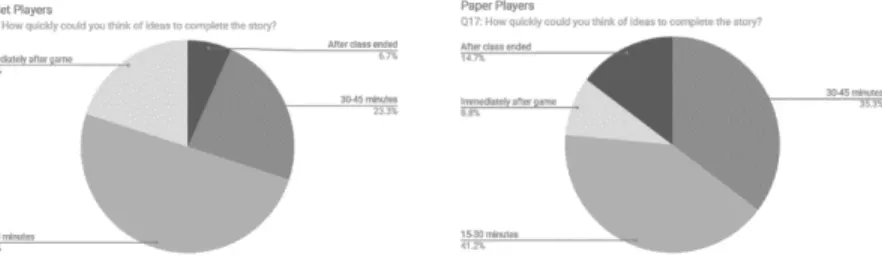
When participants were given their post-unit writing assignment, the researchers observed that they were able to brainstorm and begin writing more quickly than participants from the first iteration of the game when given a similar pre-unit writing activity. When asked to estimate how long it took for the brainstorming process, 70% of the players of tablet version reported that they were able to complete the brainstorming process and begin writing within 30 minutes of receiving the assignment. As for the paper version, 50% of players reported being able to begin writing within the same time frame.
Figure 2: Comparison between time taken to complete brainstorming process for final writing project.
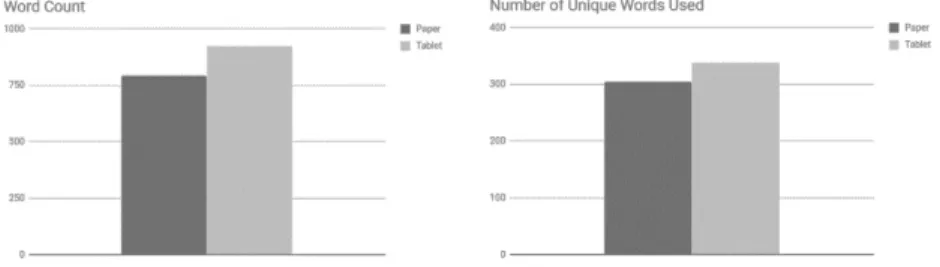
The researchers collected the final writings of all participants, put each of them into the online text analyzer site Textalyser (http://textalyser.net/) in order to determine how long each text was in terms of overall output (number of words) and how many unique words had been written by each participant. The participants who had played the tablet version averaged 925 words of output, while the paper version participants averaged 794 words, a difference of 15.25%. The lexical density of participants using the tablet version was 338 unique words, whereas the paper version participants averaged 308 unique words, a difference of 10.26%.
Figure 2: (left) Second Iteration comparison of total output of number of words per text for final narrative writing project; (right) Second Iteration comparison of total output of number of unique words per text for final narrative writing project.
A series of questions were posited to the participants for the post-unit survey, many related to participant receptiveness and levels of confusion regarding game mechanics (Appendix F). Most of these were Likert-scale questions, with subsequent opportunities for participants to expand on their answers with personal observations and anecdotes. All 65 participants responded to the survey.
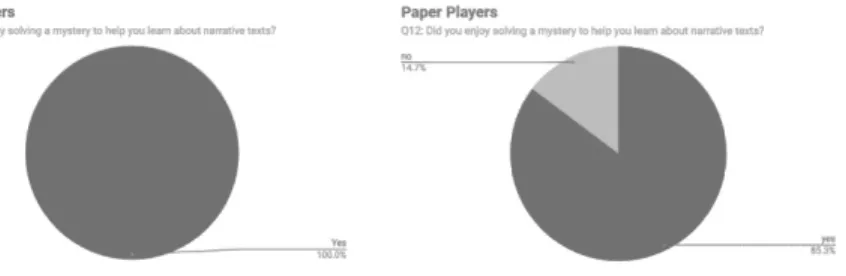
When asked whether they enjoyed solving a mystery to learn about narrative texts, tablet version participants unanimously responded positively, compared with 85.3% of the paper
version students. Some of the positive responses explained that they liked learning in this manner because, [sic] “If I was said ‘Just write’ without introduction I can't think of what story I should write.”
Figure 3: responses from (left) tablet version players and (right) paper version players about receptiveness of using a game to learn about narrative texts.
Similar results were reported by both groups of participants when they were asked if they liked playing a murder-mystery game to practice their reading and writing skills, with the tablet group reporting 100% positive reception, and the paper group also viewing it positively, but to a lesser extent at 82.4%. While the tablet group was overwhelmingly positive in their reasons for preferring to learn reading and writing skills through gameplay sessions, some of the paper version participants said that [sic] “Sometimes we misunderstood the story, so it causes confusing.”
When asked about confusion regarding the game mechanics (e.g., “Did you understand how to continue the dialogue?”) 92.4% of tablet participants responded that they had no or little confusion about how to play the game, while only 32.3% of paper participants reported having little to no confusion.
Limitations
The researchers admit that some of the limitations to using AR for their game designs rests on the researchers’ own decisions to use tablets, which are larger and heavier than smartphones. Even though tablet-based AR was found to be inconvenient for the purposes of this study, the researchers feel that the advancement in software available for AR programs compatible with smartphones will render future studies focused on similar activities a viable option.
Implications and Discussion
The results suggest that though there were negligible differences in participants’
receptivity to the first iteration of the game, the second iteration had significantly higher numbers of players reporting that they enjoyed using the game to practice reading and writing skills and learning about narrative genre features. Despite the increase overall, an even higher proportion of second iteration tablet players reported that they liked playing a game for the Narrative Unit. Indeed, in-class observations by the researchers found that students using the tablet version engaged in more collaboration with their partners than students using the paper version. As a result of the participants’ self-reported responses to enjoying the game, coupled with in-class observations from the researchers, it can be asserted that there are more noticeable differences in terms of motivation, collaboration, and positivity on the part of the participants who played the tablet version.
As for ease of use, eliminating the AR elements of the tablet version in favor of an entirely self-contained virtual game space in the second iteration also eliminated the problems noted in the first iteration associated with physical exertion and difficulty in gathering information for taking notes. The researchers had been concerned that the second iteration may cause some new issues to arise in terms of some students not knowing how to navigate
the virtual game space with their avatar, but the participants reported little to no difficulty with this. Thus, the most pressing issues of the tablet version had been addressed with the second iteration. However, this was not the case with second iteration of the paper version of the game. It was noted through the post-unit survey that many of the participants found the instructions in the paper version’s game book to be confusing as they did not fully understand at what points they were supposed to be working alone or with their game partner.
Furthermore, whereas the first iteration of the tablet version seemed to actually prevent collaboration, splitting the tasks between pairs of students and necessitating teamwork contributed to eliminating this unforeseen effect of using individual tablets for gameplay.
These findings stand exactly opposite to the different iterations of the paper game. When participants were forced to share a single handbook among 3-4 members of a group, collaboration was notably strong among the players. When each student was provided their own personal copy of the paper game in the second iteration, collaboration markedly decreased. Whether this was due to the lack of graphic visual stimulation or some other reason would be entirely stipulation at this point without further study.
Returning to the original problem cited by the researchers - writer’s block - the initial group writing activity for the first iteration supported earlier observations that the lack of any sort of framework led to a significant amount of time (in this case, a full class-period of 90 minutes plus homework) just for brainstorming. While the first iteration primarily focused on whether or not students were comfortable using a game as a tool to learn reading and writing, the post-unit writing activity of the second iteration was able to demonstrate that a framework did indeed help reduce time spent between receiving the assignment and beginning to write.
Additionally, the second iteration of tablet version was noted to have a significantly higher effect on the participant’s ability to begin constructing their creative writing project quickly when compared to the second iteration of the paper version. Furthermore, as for output in
terms of number of words produced, both iterations of the tablet version saw participants writing more volume than participants who played the paper version.
Conclusions
As a result of this study, the researchers assert that there does seem to be strong evidence that L2 learners enrolled in KUIS’ Foundational Literacies courses do indeed benefit from using a framework to assist their own creative writing projects. By decreasing the time it takes to brainstorm creative writing ideas through an interactive and collaborative game, students were typically able to begin writing within 30 minutes of receiving the assignment, which stands in direct contrast to the 90+ minutes it had taken students who were given the task without the framework.
Moreover, the evidence collected via surveys and final project assessment has shown that the tablet version was not only better received by students, but also easier to use than the paper version. Additionally, collaboration with partners was noticeably more prevalent with participants who played the tablet version. When the in-class observation of increased motivation and engagement with the game is paired with the results of tablet version player’s production of longer texts as well as more richly diverse vocabulary within those texts, it is the conclusion of the researchers that the tablet version serves L2 writers better than the paper version. As a result, it is the recommendation of the researchers that Kanda University of International Studies consider using student tablets to implement a digitally-mediated narrative framework for students who are tasked with writing a fictional narrative.
References:
Dickey, M. D. (2011), Murder on Grimm Isle: The impact of game narrative design in an educational game-based learning environment. British Journal of Educational Technology, 42: 456–469. doi:10.1111/j.1467-8535.2009.01032.x
García-Carbonell, A., Rising, B., Montero, B., & Watts, F. (2001). Simulation/Gaming and the Acquisition of Communicative Competence in Another Language. Simulation &
Gaming, 32(4), 481-491. doi:10.1177/104687810103200405
Gee, J.P.: Learning by design: Good video games as learning machines. E-Learning 2(1), 5 (2005). doi:10.2304/elea.2005.2.1.5
Grasset, R., Dunser, A., & Billinghurst, M. (2008). The design of a mixed-reality book: Is it still a real book? 2008 7th IEEE/ACM International Symposium on Mixed and Augmented Reality. doi:10.1109/ismar.2008.4637333
Kim, B. (2015). Designing Gamification in the Right Way. Library Technology Reports, 51(2), 29-35.
Krashen S., Principles and Practice in Second Language Acquisition, Oxford University Press, Oxford, 1982
Kongmee, I., Strachan, R., Montgomery, C. and Pickard, A. (2011) Using massively multiplayer online role playing games (MMORPGs) to support second language learning: Action research in the real and virtual world. In: 2nd Annual IVERG Conference: Immersive technologies for Learning: virtual implementation, real outcomes, 27-28 June 2011, Middlesborough, UK.
Martin, Phillip. (2007). The New Writer's Handbook 2007: A Practical Anthology of Best Advice for Your Craft and Career. Minneapolis, MN: Scarletta Press. (p. 3).
O’Shea, P., Mitchell, R., Johnston, C., & Dede, C. (2009). Lessons Learned about Designing Augmented Realities. Discoveries in Gaming and Computer-Mediated Simulations, 1(1), 1-15. doi:10.4018/978-1-60960-565-0.ch001
Peterson, M. (2012). Learner interaction in a massively multiplayer online role playing game (MMORPG): A sociocultural discourse analysis. ReCALL, 24(3), 361-380.
doi:10.1017/S0958344012000195
Piirainen-Marsh, A. and Tainio, L. (2009). Other-repetition as a resource for participation in the activity of playing a video game. The Modern Language Journal, 93(2), 153-169.
Rama, P., Black, R., Van Es, E., & Warschauer, M. (2012). Affordances for second language learning in World of Warcraft. ReCALL, 24(3), 322-338.
doi:10.1017/S0958344012000171
Rankin, Y., Gold, R. and Gooch, B. Evaluating interactive gaming as a language learning tool.
Paper presented at SIGGRAPH 2006. Boston, MA. July.
Smith, G. G. (2012), Computer game play as an imaginary stage for reading: implicit spatial effects of computer games embedded in hard copy books. Journal of Research in Reading, 35: 1–19. doi:10.1111/j.1467-9817.2010.01447.x
Suh, S., Kim, S. W., & Kim, N. J. (2010). Effectiveness of MMORPG‐based instruction in elementary English education in Korea. Journal of Computer Assisted Learning, 26(5), 370-378.
Thorne, S. L., Black, R. W., & Sykes, J. (2009). Second Language Use, Socialization, and Learning in Internet Interest Communities and Online Games. Modern Language Journal, 93: 802-821.
Wagner, D., Schmalstieg, D., & Billinghurst, M. (2006). Handheld AR for Collaborative Edutainment. Advances in Artificial Reality and Tele-Existence Lecture Notes in Computer Science, 85-96. doi:10.1007/11941354_10
Waters, J. K. (2007). On a quest for English. T. H. E. Journal, 34(10), 26-32.
Appendix A
Lesson and Gameplay Schedules
First Iteration
Week 1 Intro to RPG / Character Creation Characterization in Narrative Week 2 Gameplay Session Narrative Structure Week 3 Gameplay Session Plot/Setting/Pacing Week 4 Gameplay Session Perspective in Narrative Discourse
Week 5 Review Writing Workshop #1
Week 6 Gameplay Session Tense-Aspect-Modality in Narrative
Week 7 Gameplay Session Sub-verb agreement
Lexical cohesion/chains
Week 8 Gameplay Session Writing Workshop #2
Second Iteration
Week 1 Build Background/Narrative Arc Character Creation Week 2 Characterization in Narrative Fiction Gameplay Session Week 3 Descriptive Language Gameplay Session Week 4 Narrative Perspective Gameplay Session Week 5 Phrasal Verbs and Slang Gameplay Session Week 6 Tense-Aspect in Discourse Gameplay Session/
Writing Workshop
Appendix B Police Report
Appendix C
Example of Extension Activities
Appendix D Mid-Unit Survey
1. How much did you enjoy playing the game?
really liked it somewhat liked it neutral not really not at all
2. How difficult was the dialogue to understand?
not at all difficult somewhat difficult as expected somewhat easy very easy
3. Was your role in the group clear to you?
Yes No
4. Which activity did you enjoy the most?
Conversations Searching Adam’s apartment Looking at Adam’s desk / calendar
5. What did you like most about your favorite activity?
6. Did you understand how to complete the Police Report?
Yes No
7. How can we make Panda Mysteries more enjoyable for you?
Appendix E Post-Unit Survey
1. What did you think about the murder mystery story?
2. How would you make this game or unit more interesting?
3. What was your favorite part of the game? Why?
4. What was your least favorite part of the game? Why?
5. What did you think about having grammar lessons in between game days?
6. What was the easiest part of the unit for you?
7. What was the most difficult part of the unit for you?
Appendix F
Post-Unit Survey (2nd iteration)
Tablet Version GAMEPLAY
1. The first time you played the game, did you understand how to move your character?
I understood without instruction I needed to be told
2. The first time you played the game, did you understand how to continue the dialogue?
3. The first time you played the game, did you understand how to make choices when speaking to characters?
I understood without instruction I needed to be told
4. The first time you played the game, did you understand how to use the city map?
I understood without instruction I needed to be told
5. The first time you played the game, did you understand how to use “Look Around”
mode to search for clues and information?
I understood without instruction I needed to be told
6. On “Thursday,” did you understand how to put together the letter from Ronny?
I understood without instruction I needed to be told
7. Did seeing your partner’s detective character in the game help you work better as a team?
I understood without instruction I needed to be told
WORKSHEETS AND PINBOARD
8. Were the worksheets helpful or not helpful? Would you change anything about them?
Please make suggestions below:
a. Character Creation Sheet ____helpful ____not helpful b. Indirect Characterization ____helpful ____not helpful
c. Police Report ____helpful ____not helpful
d. Timeline Activity ____helpful ____not helpful
e. What does all the evidence point to? ____helpful ____not helpful f. Who Killed Adam Mortis? ____helpful ____not helpful g. Climax Brainstorming Worksheet ____helpful ____not helpful
Suggestions for improving worksheets:
___________________________________________________________________________
___________________________________________________________________________
___________________________________________________________________________
9. Did you think the pinboard was helpful?
Yes no
INTEREST LEVEL
10. Was the mystery interesting?
yes no
11. Why or why not?
___________________________________________________________________________
___________________________________________________________________________
12. Who were the most memorable characters? Circle all you remember well.
a. Chief d. Allison g. Yvette Jenkins j. Celeste
b. Stanley e. Maria h. Ronny Jenkins k. Cicero
c. Bryan f. Michael i. Adam l. Other
13. Did your level of interest in the story change over time? For example, were you more interested in solving the mystery the longer you played?
became more interested as I played interest stayed the same as I played became less interested as I played
14. How could we make the story or characters more interesting?
___________________________________________________________________________
___________________________________________________________________________
___________________________________________________________________________
IN-CLASS ACTIVITY
15. Do you think that you and your partner did the same amount of work for this game?
Yes no 16. If no, why not?
___________________________________________________________________________
___________________________________________________________________________
17. Did you enjoy solving a mystery to help you learn about narrative texts?
Yes no
18. Why or why not?
___________________________________________________________________________
___________________________________________________________________________
19. Do you think that playing the mystery game was an interesting way to practice your reading and writing skills?
Yes no
20. Do you think other classes would enjoy learning about narrative texts in a similar way (playing a game)?
Yes no
21. How difficult was the vocabulary in the reading?
Always difficult sometimes difficult rarely difficult never difficult
22. How quickly could you think of ideas to complete the story’s climax and resolution?
My partner and I could write ideas immediately after we finished playing.
My partner and I could write ideas after 15-30 minutes.
My partner and I could write ideas after 30-45 minutes.
My partner and I could write ideas only after class had ended.
Book Version GAMEPLAY
1. Were the instructions about how to read the book easy to understand? For example:
“Turn to upper page 35.”
very easy to understand somewhat easy to understand very difficult to understand
2. How often were the instructions in the book confusing?
always confusing sometimes confusing rarely confusing never confusing
3. Were you ever confused about when to work with your partner or when to work alone?
For example: Did you understand when to read separately for different interviews?
always confused sometimes confused rarely confused never confused
WORKSHEETS
4. Were the helpful or not helpful? Would you change anything about them? Please make suggestions below:
a. Character Creation Sheet ____helpful ____not helpful b. Indirect Characterization ____helpful ____not helpful
c. Police Report ____helpful ____not helpful
d. Timeline Activity ____helpful ____not helpful
e. What does all the evidence point to? ____helpful ____not helpful f. Who Killed Adam Mortis? ____helpful ____not helpful g. Climax Brainstorming Worksheet ____helpful ____not helpful
Suggestions for improving worksheets:
___________________________________________________________________________
___________________________________________________________________________
___________________________________________________________________________
INTEREST LEVEL
5. Was the mystery interesting?
Yes no 6. Why or why not?
___________________________________________________________________________
___________________________________________________________________________
7. Who were the most memorable characters? Circle all you remember well.
a. Chief d. Allison g. Yvette Jenkins j. Celeste b. Stanley e. Maria h. Ronny Jenkins k. Cicero
c. Bryan f. Michael i. Adam l. Other _______
8. Did your level of interest in the story change over time? For example, were you more interested in solving the mystery the longer you played?
became more interested as I played interest stayed the same as I played became less interested as I played
9. How could we make the story or characters more interesting?
___________________________________________________________________________
___________________________________________________________________________
IN-CLASS ACTIVITY
10. Do you think that you and your partner did the same amount of work for this game?
Yes no
11. If no, why not?
___________________________________________________________________________
___________________________________________________________________________
12. Did you enjoy solving a mystery to help you learn about narrative texts?
Yes no
13. Why or why not?
___________________________________________________________________________
___________________________________________________________________________
14. Do you think that playing the mystery game was an interesting way to practice your reading and writing skills?
Yes no
15. Do you think other classes would enjoy learning about narrative texts in a similar way (playing a game)?
Yes no
16. How difficult was the vocabulary in the reading?
Always difficult sometimes difficult rarely difficult never difficult
17. How quickly could you think of ideas to complete the story’s climax and resolution?
My partner and I could write ideas immediately after we finished playing.
My partner and I could write ideas after 15-30 minutes.
My partner and I could write ideas after 30-45 minutes.
My partner and I could write ideas only after class had ended.