Ainu Hunting of Small Animals in the Nineteenth‑Century Fur Trade System
著者(英) Koji Deriha
journal or
publication title
Senri Ethnological Studies
volume 72
page range 101‑115
year 2009‑01‑20
URL http://doi.org/10.15021/00002603
101
Edited by Shiro Sasaki
Chapter 5
How can we Approach the Issue of Ainu Traps? Ainu Hunting of Small Animals in the Nineteenth-Century Fur Trade System
Koji Deriha
Historical Museum of Hokkaido
1. Introduction
The purpose of this paper is to advance a new theoretical explanation of the development of hunting for small and middle-sized fur-bearing animals among the Ainu people. I shall describe their hunting activities in the nineteenth century, and discuss the significance of the hunting of small and middle-sized animals in Ainu society and culture.
Although many studies have described Ainu subsistence activities, mainly focusing on bear and deer hunting, salmon and trout fishing, and sea mammal hunting, little is known about their hunting of small and middle-sized animals such as sable, fox, marten, and otter.
The Ainu used several kinds of traps for such hunting, and their similarity to the traps used in other areas of Northeast Asia and Siberia has sometimes been pointed out. However, previous studies have not adequately explained the relationships between equipment, techniques, and ecological and socio-cultural conditions. Why did they use those implements? What is the meaning of these similarities among Northeast Asian peoples?
These questions remain to be answered.
I would like to start with an analysis of local archival resources in Hokkaido to describe Ainu hunting in the nineteenth century. Based on this analysis, I will show that the hunting of small and middle-sized animals, especially the trapping of fur bearing animals, was an important activity for the Ainu people during this time. In the process, I shall also discuss the significance of traps and trapping techniques as part of their hunting equipment and techniques, and also point out the strong political and economic influence of powerful countries on their activities.
In this analysis and description of the hunting activities of the Ainu people, one
important key word merits particular attention. This is “trade.” In recent studies of the
history of Northeast Asia, including Hokkaido, researchers cannot help facing the issues
concerning this factor. It seems that all the socio-cultural activities of the Ainu are now
explained in relation to trade. Although I shall not discuss whether or not this tendency is
appropriate, it is a fact that the hunting of small and middle-sized animals by the Ainu has
much to do with this factor. Surrounding countries also expanded their political power over
the Ainu by means of trade. I shall therefore also discuss the relation between hunting and
trading activities in Northeast Asia.
2. A Brief History of Studies of the Ainu Hunting
The viewpoint of this study is different from that of previous studies, which have primarily focused on Ainu “hunting techniques” or “food resources procurement.” Instead, as I said above, I will focus on trade.
Although we can list a large number of studies concerning Ainu hunting and fishing activities, there are few studies about the hunting of small and middle-sized animals, such as sable, fox, marten, and otter, for the fur trade. The reason that so many scientists have studied bear and deer hunting and salmon and trout fishing is, I think, that they assumed these activities occupied a core and essential position in Ainu culture. The bear was one of the most important and respected animals in the Ainu belief system. In addition, as it is the most ferocious and largest animal in Hokkaido, scholars have focused on how it has been hunted from the viewpoint of hunting techniques. According to Ainu ethnography, deer, salmon and trout were reported as part of their staple diet. In particular, making and preserving smoked salmon for winter was the most important task of all their annual activities. River fishing is one of the most interesting themes from the perspective of subsistence studies (Hayashi 1969).
Several anthropologists and archaeologists have reported their studies regarding the hunting implements and devices that characterize the hunting activities of the Ainu, focusing on some typical weapons. For example, Takemitsu Natori, Kazuyoshi Ohtsuka, and Hiroshi Utagawa have been often referred to kite, harpoons of the toggling type (Natori 1945; Ohtsuka 1977; Utagawa 1980), and classified them into several types in their comparative studies of archaeological and ethnological materials. Many scholars have focused on aconite poison and the amak or shikake-yumi, a spring bow or automatic bow that was used for bear hunting. Hitoshi Watanabe in particular has evaluated them as two noteworthy elements among Ainu hunting equipments and devices (Watanabe 1972).
I do not deny the significance of these former studies and their viewpoints. However, it is a mistake to think that the description of those activities covers the entire range of Ainu hunting behaviors. They did not even mention the activities, techniques, and equipment for hunting small and middle-sized animals. Taking into account of the economic and political situations surrounding the Ainu people since the seventeenth century, they should have paid more attention to the significance of the hunting of fur-bearing animals.
In the following sections, I shall illustrate the hunting activities of the Ainu, considering them in connection with their trade activities. I shall also describe complex features of Ainu life in the nineteenth century.
3. Historical Background to the Hunting of Small and Middle-sized Animals by the Ainu
Before turning to closer examination, I would like to run through the history of Ezo Island,
today called Hokkaido, from the seventeenth to the nineteenth centuries. I shall summarize
several articles about Hokkaido history from the perspective of trade between the Ainu and
Japanese, especially based on the work of Shin’ichiro Takakura and Susumu Emori
(Takakura 1960; Emori 1987).
Even before the establishment of the Kaitakushi (Colonial Department) in 1869, Hokkaido was not a “paradise” for hunters and gatherers. It was following the foundation of the Kaitakushi that development accelerated and a great mass of immigrants rushed to Hokkaido. However, the political and economic conflict between the Ainu and Japanese was seen as early on in Japanese history as the medieval period. Until the fourteenth- fifteenth centuries, the Ainu people still maintained their freedom to go anywhere they wanted, and to trade with anyone they liked. They were able to visit the northern part of Honshu (mainland Japan) to trade. At the same time, the Japanese built small colonies in the southern part of Hokkaido, in which area the Ainu and Japanese traded with and sometimes battled each other. Through this trade and fighting, one colony developed politically and militarily and became a strong feudal clan named Matsumae (or Kakizaki).
At the end of the sixteenth century Matsumae (Kakizaki) Yoshihiro, a lord of the Matsumae feudal clan, was granted exclusive trading rights with the Ainu by the supreme governors of Japan. This means that Matsumae Yoshihiro was authorized as the ruler of Ezo (Hokkaido) by the feudal governments, both the Toyotomi government and the Tokugawa Shogunate. The Matsumae feudal clan adopted an economic policy based on not rice cultivation but the profit of selling natural products in Ezo-chi (Hokkaido; chi means land).
The Ainu were gradually subject to restrictions on their freedom to move freely.
In the early-seventeenth century, the Matsumae (Kakizaki) clan divided Hokkaido into two areas, one for Japanese and the other for Ainu, and prohibited the two peoples from freely visiting each other, and the clan also divided Ezo-chi into several parts and set up one or more trading posts in each. The clan allotted the posts to its vassals and gave them the right to trade with the Ainu living in the area surrounding their post. However, this system restricted the Ainu people to exchanging materials with the Japanese only at the post to which each group belonged. In the first half of the eighteenth century, the clan modified its trading system from one in which the chigyo-nushi (the vassal-owner of the trading post) directly controlled his own post and adjacent areas, to the new one that allowed the chigyo- nushi to commission merchants to manage trade with the Ainu in return for a fee.
However, the clan soon changed this system to yet another, in which the clan granted permission to merchants to stay in their divided trading zones and force the Ainu to work as fishing workers under their strict control (basho-uke-oi-sei). It was more economical for the merchants to manage fisheries than trade with the Ainu. In other words, it was more convenient for them to control the Ainu as workers than to accept them as trade partners.
The Ainu had to work hard throughout the year without being able to leave their fishing camps and were under the strict control and supervision of the merchants. The products were mainly salmon and herring. They not only fished but also made all the preparations for fishing, maintained the fishing implements, and served in the merchants’ office and houses. It was only during a few weeks or days in autumn that they were able to prepare enough food to survive the coming winter. In some fishing camps, they worked hard all year round.
Viewed from the Ainu side, it is clear that their rights and freedom to trade with
Japanese people were gradually restricted. It is probable that during the fifteenth century
they had been able to go anywhere to trade. However, after the seventeenth century their situation changed for the worse.
4. Ainu Hunting Under Matsumae Supervision
4.1 Hunting Activities of the Ainu and the Trading Policy of the Matsumae
In addition to the fees paid by the merchants, the Matsumae clan demanded some products hunted and gathered from their surroundings by the Ainu. These were eagle feathers, bear skins and gall bladders, sea otter skins, and the pelts of small and middle-sized animals such as fox, sable, and otter. The Ainu sold the game to the merchants, and in turn the Matsumae clan purchased it at the same price from the merchants (Takakura 1972). In fact, it was not so much a business as a transaction required by the Matsumae from both the Ainu and the merchants in each allotted area.
The clan made a profit by trading those materials in mainland Japan and Sakhalin. It sold bear skins and gall bladders and sea otter pelts to the Japanese on the one hand, and traded valuable fox, sable and otter pelts to Sakhalin in exchange for Chinese products such as silk cloth, silk robes and glass beads on the other.
According to previous studies by Takakura (1939) and Hora (1956), there were trading networks during the pre-modern period among the indigenous peoples of Northeast Asia, including the inhabitants of Hokkaido, Sakhalin, and the Amur River region. At least by the early 19th century, the Matsumae clan was engaged in international trade to profit from the sale of special products, particularly small and middle-sized animal furs procured from the Ainu. Table 1 shows the 1853 trading inventory of the Shiranushi trading post, located at the southern edge of Sakhalin (Table 1). This inventory indicates that the Matsumae clan carried animal furs into Sakhalin, but I would like to stress that neither bear skins nor deer pelts are seen in this inventory. The furs that the clan traded with the northern peoples were those of sable, fox, otter, and marten, i.e., small and middle-sized fur-bearing animals. I also quote an old document recorded in 1822 as evidence that the Matsumae brought large amounts of fur into Sakhalin. The document is as follows.
山靼交易に相成候小皮類、東蝦夷地ノ分其場所ニテ取集メ、毎年三月頃迄ニソウヤヘ差立テ、同所 ニテ取揃へ、北蝦夷地ヘ相廻シ来ル(文政五午年四月 箱舘中送書并箱舘町役人其他外在々被下品
物書付控 沖之口規定書 全)
Concerning small animal fur used for the Santan Trade [the trade between Japanese and Amur people in Sakhalin in the eighteenth and nineteenth centuries], in Eastern Ezo-chi [the Pacific Ocean side of Hokkaido], the materials should be collected at each trading post, and sent to Soya [one of the trading posts located at the northern end of Hokkaido] until March every year. The materials sent from all the posts are gathered together and prepared for shipping at Soya, and sent to Kita-Ezo-chi [Sakhalin] (Memorandum of Transfer of Duty from Edo-bakufu to Matsumae 1822) (Hakodate-shi 1974)
The question may be raised of why the Matsumae brought furs to the north. This was
because there was strong, steady demand for furs from both the Qing dynasty and the
Russian Empire (Takakura 1939).
4.2 The Merchant’s Dilemma: Fishing Productivity and the Matsumae’s Demands What must be emphasized at this point is that not all Ainu hunters freely and voluntarily hunted those animals and traded the fur required by the Matsumae.
Almost all those merchants who managed fisheries were enthusiastically interested in increasing the productivity of fishing, and they tried to avoid turning their hands to such an insignificant matter as hunting for fur-bearing animals for the Matsumae clan (Takakura 1972). According to Shinzo Hasegawa’s study of the Takashima trading zone in northwest Hokkaido, the merchant of that trading zone borrowed several Ainu people from the Saru and Shiraoi trading zones as workers during the herring fishing season in 1866 (Hasegawa 1987). This is one of the best examples illustrating how enthusiastically the merchants persisted in fishing production. They were too busy to pay much attention to hunting for fur-bearing animals. At the same time, however, they had to meet the demands of the Matsumae clan. How did they resolve this dilemma?
For this purpose, merchants would allow only several designated Ainu hunters to hunt fur-bearing animals within their territorial area. It was reasonable for merchants to restrict the Ainu from engaging in hunting, because they wanted to keep as large a number of them as possible engaged in fishing, but they were compelled to obey the Matsumae’s policy and orders. Merchants allocated a proportion of the Ainu’s labor to hunting to meet the demand of the clan. The hunters generally could not hunt the animals they wanted or encountered in the forest, but only those designated animals which no doubt brought profits to the Matsumae clan.
Table 1 Trading materials brought into Shiranushi, Sakhalin by the Matsumae clan in 1853 (Kaiho 1991: 8).
Category Material Quantity
Fur Otter
FoxSable
From Hokkaido From Sakhalin
1,265 588582 (324) (258)
Metal Iron pot
Large size pot with four grips Middle size pot with four grips Pot of 12.6 l. with four grips Pot of 9 l.
Pot of 5.4 l.
Pot of 3.6 l.
Pot of 1.8 l.
FileAdz
(5)26 (2)(6) (1)(2) (5)(5) 585
4.3 Designated Hunters: An Analysis of the Ainu Hunting Activities
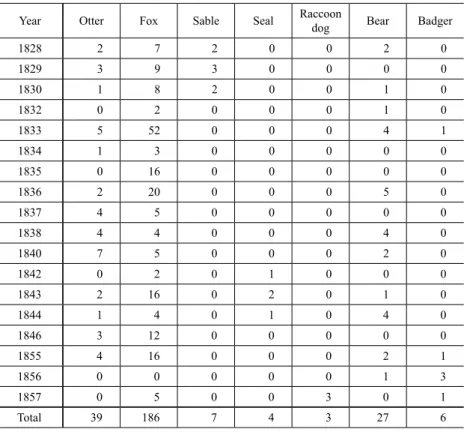
I investigated an inventory of annual trading materials kept by one of the old merchant families in the Yoichi trading zone in southwest Hokkaido. My analysis of the record clearly reveals that the Ainu hunters of that area hunted small and middle-sized fur-bearing animals like fox, otter, and sable for trade (Table 2).
The records also give us the names of the hunters and their actual activities. They clearly show that the hunters were definitely designated and that their numbers were few. In the first document, which was recorded in 1832 at the Yoichi trading zone, the merchant reported the names of the Ainu hunters to the Matsumae clan and requested its permission (Yoichi-cho shi henshu shitsu 1985).
イシカリ御勤番
上田促様 竹内儀兵衛様 上役之節改メ被仰出候 覚
一、 下ヨイチ乙名 Lower Yoichi trading port: Chief 一、 サケシユス Sakeshusu
一、 小使 Leader
一、 子トハケ Netohake
一、 上ヨイチ脇乙名 Upper Yoichi: Sub-Chief 一、 イタキサン Itakisan
一、 小使 Leader
一、 ア子ヤ Aneya
一、 ウトクレ子 Utokurene
一、 リコツ Rikotsu
一、 シハシノ Shihashino
一、 トンキタエ Tonkitae
一、 タサラ Tasara
一、 モンコホケ Monkohoke
一、 シフヤ Shifuya
一、 ヤエノニ Yayenoni
一、 キムンヤイ Kimunyai
一、 イクハシ Ikuhashi
〆 十四人 Total 14 persons In all
右者 上下ヨイチ御場所 書面之蝦夷人 例年御軽物に付 山入仕候間 此段奉申上候 以上 I would like to report that these persons, the Ainu from the Upper and Lower Yoichi trading zones, go to mountain areas to hunt karumono animals every year.
天保三辰年十月 1832, October
支配人 Manager
長 七 Choshichi Takeya 御詰合様 To the Governor
The next one was recorded in 1855, describing the hunting activity in the Otasutsu and Isoya trading zones near Yoichi in southwest Hokkaido.
熊並北蝦夷地廻り山靼交易小皮類取獲方之儀者,兼而支配人共江申付置ニ付,山猟巧者之蝦夷人相 撰,正月上旬頃より山入為致,捕獲次第運上家ニ而定値段を以買入遣,三月上旬頃迠ニ勤番所江差出 候ニ付,東蝦夷地より追々相廻リ候小皮類共取揃,北蝦夷地勤番之者通行之節,品訳番添相渡候仕来
ニ御座候。尤熊皮,胆,鷲之尾等者帰登之節持参仕候
As to the hunting for bears and small fur-bearing animals, which were used in the Santan trade in Sakhalin, in accordance with our [the Matsumae clan’s] order, merchants recruited several excellent Ainu hunters, send them to mountain areas to hunt the animals from early January [according to the lunar calendar], and bought the game at the designated price from the Ainu. They usually sold us the game at our posts by the beginning of March. So, in this season, we visited the posts to gather bundles of pelts, starting from Eastern Ezo [the southern part of Hokkaido], and gave them to our vassals who would take them to Northern Ezo [Sakhalin]. However, as to the bear skins and gallbladders and the tail feathers of eagles, our vassals brought them to Matsumae when they came back. (Historical Museum of
Table 2 Quantities of animals caught in Yoichi (Deriha 2002: 148).
Year Otter Fox Sable Seal Raccoon
dog Bear Badger
1828 2 7 2 0 0 2 0
1829 3 9 3 0 0 0 0
1830 1 8 2 0 0 1 0
1832 0 2 0 0 0 1 0
1833 5 52 0 0 0 4 1
1834 1 3 0 0 0 0 0
1835 0 16 0 0 0 0 0
1836 2 20 0 0 0 5 0
1837 4 5 0 0 0 0 0
1838 4 4 0 0 0 4 0
1840 7 5 0 0 0 2 0
1842 0 2 0 1 0 0 0
1843 2 16 0 2 0 1 0
1844 1 4 0 1 0 4 0
1846 3 12 0 0 0 0 0
1855 4 16 0 0 0 2 1
1856 0 0 0 0 0 1 3
1857 0 5 0 0 3 0 1
Total 39 186 7 4 3 27 6
Hokkaido Col. No. 1935-10)
The third one was recorded in 1809, describing hunting activity in Kunashiri Island, eastern Hokkaido.
軽物に出す鷲の尾捕る事は、ヲンネベツ、十一月末より正月下旬迄も、乙名とも初め重立候夷人共 の内、場所場所より毎年人数を定め差遣し、雪中の業也。熊猟の事も右同様人数を定、正月中旬よ
り山入致し是を取―以下省略―。
As to the tail feathers of eagles, which are used in the karumono trade, at Onnebetsu, from late November to late January (winter season), the Otona [chief], and main people in each trading post designate several hunters and send them hunting in the snow fields every year.
Bear hunting should be managed in the same way, i.e., the chiefs and main people appoint a decided number of hunters to send them hunting in mountain areas from the middle of January [according to the lunar calendar]. … (Hokkaido cho 1969)
We can presume that this pattern was seen throughout Ezo, particularly in the regions along the Sea of Japan, because these areas were under the control of the same ruler belonging to the Matsumae clan.
5. Analyses
5.1 Usage of Animal Fur Within Ainu Society
Undoubtedly a question may be raised here. Did the Ainu never hunt fur-bearing animals for daily use as well as for trade? Although it is very difficult to answer to this question, we can approach this problem by an analysis of historical documents and drawings as well as research on ethnological materials preserved in museums.
Since the 1990s I have investigated the Ainu collections in many museums of the world as well as old Ainu-e drawings, a genre of Ainu pictures drawn from the late eighteenth century to the late nineteenth century. Regretfully, however, I was unable to find any materials made of the fur of animals such as sable, fox, otter, or marten (Deriha 2000).
Bear pelts were used only in small pouches attached to hunting quivers and ceremonial headgear (Figure 1). Although one old document says they made a dress of bear fur, we discovered only few clothes belonging to the Sakhalin Ainu in the museum collections at St Petersburg in Russia (Kotani 1993; Spb Ainu Project Group 1998).
This is not because fur and skin products cannot be stored for long. The conservation conditions of museum materials are unrelated to this issue. The Ainu usually processed deer skin, bones, and horns into boots, arrows, diggers, and straps, and seal skin into boots and clothes. We can see these items in good condition in museum exhibits and storages (Ikeda 1993). Nor would it be correct to think that the furs of fox, sable, otter, and marten spoil easily.
I therefore conclude that the Ainu did not use the fur of small and middle-sized
animals for their own use, but mainly hunted them for trade during the seventeenth-
nineteenth centuries. Although a document written in the late seventeenth century indicates
that the Ainu in some locations wore fur clothes, there is no reason to believe that clothing made of the fur of small and middle-sized animals was in popular use within Ainu society at that time.
5.2 Ainu Fur-animal Hunting and Pre-modern Countries
The Ainu put as much or even greater weight on hunting small and middle-sized animals for fur as they did on hunting large game, especially in the nineteenth century. However, they did not catch the animals they encountered or that they wanted to hunt in their natural surroundings. Hunters were managed, and were obliged to catch the animals they were required to hunt. In other words, they hunted not voluntarily but compulsorily. Moreover, this compulsory hunting was systemized and was included in the ruling system of the Matsumae clan.
This fact and this perspective have never been investigated before, because previous researchers usually looked at the bear and deer hunting that they recognized as both the primary subsistence activity and the essence of Ainu culture. It would be reasonable to suppose that this system of hunting small and middle-sized animals for fur could have existed only under the rule of the Matsumae clan and Tokugawa Shogunate in Japan.
Figure 1 A pouch made of bear skin.
However, we should not categorize this kind of compulsory hunting as an occasional occurrence in the Ainu’s long hunting-gathering history. To understand and interpret it appropriately, we should enlarge the scope of our vision to the vast area of Northeast Asia (Deriha and Tezuka 1994).
From the seventeenth to the nineteenth centuries Northeast Asia was under the rule of three huge pre-modern feudalistic countries: the Qing dynasty in China, the Russian Empire, and the Tokugawa Shogunate in Japan. As Sasaki has made clear, the Qing dynasty organized the people of the Amur basins and northern and middle Sakhalin into payers of fur tribute in order to rule them, while Russia sent its military forces to Kamchatka, Chukotka, the Aleutian Islands, Alaska, and the Kuril Islands in search of better fur resources (Sasaki 1996). According to the fur tribute policy of the Qing dynasty, tribute payers obtained huge quantities of presents comprising cotton and silk materials and some kinds of food, though they were obliged to pay a sable pelt every year. During the eighteenth century, this policy stimulated trading activity by the inhabitants of the Lower Amur basins and Sakhalin, who enlarged their business (the so-called “Santan Trade”) to southern Sakhalin and the northern edge of Hokkaido. Here their activity encountered the rule of the Matsumae clan. The clan, and later the Tokugawa Shogunate, took on the role of supplying them with fur, because it was profitable for the Japanese side to buy Chinese products like silk costumes, silk materials, and glass beads, which could be sold at good prices in Japan, in exchange for the fur. For this purpose the clan ordered the merchants who were permitted to manage fisheries in Hokkaido to organize the Ainu hunters to capture fur-bearing animals for the Santan Trade. The compulsory hunting of the Ainu people was an inevitable occurrence under the political and economic conditions then prevailing in Northeast Asia.
5.3 Demand for Fur and Similarity of Hunting Traps Between Indigenous Peoples If Ainu hunting of fur-bearing animals should be regarded as a compulsory and unwilling activity that occurred under specific political and economic conditions, we now confront a difficult question. What position should it be given in Ainu culture?
From the traditional point of view of researchers of Ainu culture, hunting of fur- bearing animals in the pre-modern age was not an essential element, because it was not established at the will of the Ainu themselves. These researchers would say that they do not have to examine such elements to clarify the structure and essence of Ainu culture. Is this, however, an appropriate attitude to the study of a culture? Even if the hunting of fur-bearing animals was compulsory, it was a fact that Ainu hunters were engaged in it and that they utilized all their knowledge and techniques to capture small and middle-sized animals. If this hunting was politically conditioned by the ruling and surrounding countries, researchers should examine how it was influenced by these conditions.
Political and economic conditions had a strong influence on the hunting devices used
to catch fur-bearing animals, as well as on the quality and quantity of the product. In pre-
modern Northeast Asia, which was under the rule of feudalistic and dynastic countries, all
trade materials were required to be of high quality so they could be used by people of
higher class. Sable and silver fox fur, in particular, which were used only in the costumes of
Figure 2 Traps of the Ainu and other ethnic groups in Hokkaido and Russian Far East.
Kuari spring-bow trap used by the Ainu of Hokkaido (Deriha).
Spring-bow trap used by the Ainu of Sakhalin (Yamamoto 1970).
Spring-bow trap used by the Nivkh (Taksami 1967).
Spring-bow trap used by the
Oroch (Lar’kin 1964). Trap used by the Oroch (Lar’kin 1964).
Aku-pe trap used by the Ainu of Hokkaido (Batchelor 1901).
Trap used by the Ainu of Sakhalin (Deriha 1995).
Trap used by the Nivkh (Taksami 1967).
the imperial family in China, had to be of the highest quality. At the same time, however, they provided hunters with a good income. It was reasonable for the hunters to have made every effort to improve their hunting devices to attain this goal.
The inhabitants of Northeast Asia (especially the Amur basin, the Primorye region, and Sakhalin), including the Ainu, improved their hunting devices and accepted superior devices in order to catch fur animals efficiently without harming their fine fur (Sasaki 1996). According to Ainu ethnographies recorded in the nineteenth and early twentieth centuries, fox, marten, and otter were caught with “traps” (Natori 1972).
It is said that Ainu traps have several variants, of which a few are very similar to those used by Siberian indigenous peoples, at least the peoples of the Amur River basin and the Primorye region (Deriha 1995). Figure 2 shows some traps used by the Ainu and Siberian peoples. Although there are several different types of release system for each type of trap, their frames are very similar, and the same release system is also widely found among the different peoples. Is this similarity accidental, or the result of external influence?
In conclusion, I should note that the broad expansion of the demand for fur set the stage for the hunting of fur-bearing animals and the adoption of new hunting devices by indigenous peoples. When issues such as the similarities of devices between two cultures are discussed, some archaeologists and ethnologists like to use key words such as
“diffusion” or “influence.” Ainu studies have followed a similar pattern. I am not satisfied, however, to use those words to explain the distribution of similar traps or devices. What do the words “diffusion” and “influence” mean? We should pose the questions of why and how those traps and devices diffused throughout Northeast Asia and Siberia. It was the fur trading system devised by the Qing dynasty that led the inhabitants, including the Ainu, to introduce new hunting devices that were able to catch the animals without harming their fur.
6. Conclusions
In summary, hunting for small and middle-sized fur-bearing animals by Ainu hunters in the nineteenth century in Hokkaido was not a voluntary activity but a compulsory one required by the Matsumae clan and its merchants. From the perspective of the study of traditional Ainu culture, this sort of activity cannot be regarded as an “essential” and “pure” cultural element. Moreover, some may point out that the examples I gave in this paper do not represent the situation of all the Ainu in Hokkaido. However, it is a historical fact that some Ainu hunters met the demands of the clan and merchants by hunting small and middle-sized fur-bearing animals with specially devised equipment and techniques. Researchers should not turn their eyes away from this sort of fact because of its supposed lack of cultural purity, but must examine and analyze it enthusiastically.
It should also be noted that some devices and techniques are similar to those of the inhabitants of the Amur basin, Sakhalin, and Siberia, who were under the rule of the Chinese and Russian Empires. These had similar characteristics to those of the Matsumae clan and the Tokugawa Shogunate in that they were pre-modern, feudalistic, and dynastic.
This means that to study Ainu society and culture in Hokkaido researchers must have a
broad perspective, knowledge of the societies and cultures of the various peoples surrounding the Ainu, and an interest in the history of Northeast Asia.
References
Batchelor
1901 The Ainu and Their Fork-Lore. London: The Religious Tract Society.
Deriha, K.
1995 Shuryou-gu kara mita Hokkaido Ainu oyobi Hokuto Ajia shominzoku no kogata kegawa-ju shuryo katsudo no imi [Significance of hunting small fur animals by the Ainu in Hokkaido and peoples in northeastern Asia viewed from hunting implements:
Especially through comparative study of traps and spring bows]. In The Historical Museum of Hokkaido (ed.) Final reports on “Research project of the historical and cultural exchange of the North,” pp. 306-331. Sapporo: The Historical Museum of Hokkaido. (In Japanese with English summary)
2000 Ainu shakai ni okeru kegawa no riyo ni tsuite: Zaihokubei hakubutsukan shiryo to Ezo ga Shima Kikan no kento wo toshite [Ainu chose fur materials for trade not for making their tools and goods: An analysis of the materials stored in the US museums and one genre of Ainu picture “Ezo Shima Kikan”]. In The Historical Museum of Hokkaido (ed.) Final reports on “Research project of the culture exchange history of the North,” pp.
235-254. Sapporo: The Historical Museum of Hokkaido. (In Japanese with English summary)
2002 Kinsei makki ni okeru ainu no kegawaju shuryo ni tsuite: kegawakoeki no shiten kara [Ainu’s hunting for fur bearing animals in the end of the Edo period: from the view point of the fur trade]. In Sasaki, S. (ed.) Hirakareta Kei to shite no Shuryo Saishu Sahakai [Hunter-gatherer societies as open systems] (Senri Ethnological Reports 34), pp. 97-163.
Osaka: National Museum of Ethnology.
Deriha, K. and K. Tezuka
1994 Ainu no kegawa-ju shuryo to sono Hokuto Ajia ni okeru rekishi-teki ichi: Ainu minzoku no shuryo katsudo kenkyu no hoko no shisa ni mukete no shiron [Why did the Ainu hunt fur animals: On hunting activities of the Ainu in the northeastern Asian history]. In The Historical Museum of Hokkaido (ed.) Preliminary reports on “Research project of the historical and cultural exchange of the North” in 1993, pp. 73-81. Sapporo: The Historical Museum of Hokkaido. (In Japanese with English summary)
Emori, S.
1987 Ainu no rekishi: Hokkaido no hitobito2 [A history of the Ainu: People in Hokkaido 2].
Tokyo: Sanseido.
Hakodate-shi (ed.)
1974 Hakodate-shi-shi [A history of Hakodate City] Vol. 1. Hakodate: Hakodate City.
Hasegawa, S.
1987 Bakumatsu-ki Nishi-Ezo-chi Takashima-basho ni okeru genchi rodoryoku no sonzai keitai [On the State of Ainu Labourers in Western Ezo-chi, 1837-1868]. Shogakutokyu [The Economic Review] 37(1,2,3):57-80. Otaru: Otaru University of Commerce.
Hayashi, Y.
1969 Shiki no shigoto [Seasonal tasks]. In Ainu minzoku-shi [Ethnography of the Ainu] pp.
319-320. Tokyo: Daiichi hoki shuppan.
Hokkaido cho (ed.)
1969 Shin Hokkaido-shi [A New history of Hokkaido], Vol. 7. Materials 1. Sapporo:
Municipal Office of Hokkaido.
Hora, T.
1956 Karafuto-shi kenkyu: Karafuto to Santan [A study of the history of Sakhalin: Karafuto and Santan]. Tokyo: Shinjyu sha.
Ikeda, T.
1993 Hokubei no hakubutsukan shozo no Ainu Kankei dobutsu shiryou ni tsuite [Ainu materials of animal matters in North American museums]. In Kotani, Y. (ed.) Zaibei Ainu kankei shiryou no minzokugaku-teki kenkyu [Ethnological study of Ainu materials in North American museums], pp. 52-61. Nagoya: Faculty of Liberal Arts, Nagoya University.
Kaiho, M.
1991 Kita-ezochi-onhikiwatashi-mokuroku ni tsuite: Kaei 6 nen no santan koeki [On the
“Kita-ezochi-onhikiwatashi-mokuroku”: Santan trade in 1853]. In The Historical Museum of Hokkaido (ed.) Preliminary reports on “Resaerch project of the historical and cultural exchange of the North” in 1990, pp. 1-66. Sapporo: The Historical Museum of Hokkaido.
Kotani, Y. (ed.)
1993 Zaibei Ainu kankei shiryou no minzokugaku-teki kenkyu [Ethnological study of Ainu materials in North American museums]. Nagoya: Faculty of Liberal Arts, Nagoya University.
Lar’kin, V. G. (Ларькин, В. Г.)
1964 Орочи: историко-этнографический очерк с середины XIX в. до наших дней [Oroches: Historical-ethonographic outlines from the mid-19th century to the present day]. Москва: Издательство «Наука».
Natori, T.
1945 Funkawan Ainu no hogei [Whale hunting in the Gulf of Funka]. Tokyo: Hoppo Bunka Shuppansha (in Japanese).
1972 Hokudai-fuzoku-hakubutsukan shozo Ainu dozoku hin kaisetsu [Ainu materials in the museum in Hokkaido Univeristy]. In Ainu to kokogaku I: Natori Takemitsu chosakushu I [The Ainu and archaeology I: Anthology of Takemitsu Natori I], pp. 57-103. Sapporo:
Hokkaido shuppan kikaku senta.
Ohtsuka, K.
1977 Ainu no kite (kaiten shiki rito mori) no shokeiretsu keitai bunrui to hennen [The kite, toggle-headed harpoons of the Ainu: Typology and chronology]. Bulletin of the National Museum of Ethnology 1(4): 778-822. (In Japanese with English summary)
Sasaki, S.
1996 Hoppo kara kita koueki min: Kinu to kegawa to Santan-jin [Traders from the North;
Silk, fur and the Santan people]. Tokyo: Nihon hoso shuppan Kyokai.
SPb Ainu Project Group
1998 Ainu collections of Peter the Great Museum of Anthropology and Ethnology, Russian Academy of Sciences catalogue. Tokyo: Sofukan. (In Japanese, English, and Russian) Takakura, S.
1939 Kinsei ni okeru Karafuto wo cyushin to shita Nichiman koeki [Japanese-Manchurian trade in Sakhalin in the pre-modern age]. Hoppo Bunka Kenkyu Hokoku [Studies from the Research Institute for Northern Culture] 1: 163-194 (in Japanese).
1960 The Ainu of Northern Japan: A study in Conquest and Acculturation. (Translated by John A. Harrison.) Transactions of the American Philosophical Society, New series 50(4):
1-88.
1972 Shinpan Ainu seisaku-shi [A history of the Ainu policy, new edition]. Tokyo: San’ichi shobo.
Taksami, Ch. M. (Таксами, Ч. М.)
1967 Нивхи: современное хозяйство, культура и быт [Nivkh: Present life, culture, and customs]. Ленинград: Наука, ленинградское отделение.
Utagawa, H.
1980 Monookuri-ba to shite no Tateana-joso-iko ni tsuite [Problems on Iwakute, Middle of Ainu]. In Institute of Archaeology and Tokoro Field Laboratory, Faculty of Letters (eds) Raitokoro Kawaguchi Iseki [Raitokoro Kawaguchi Site], pp. 98-106, Tokyo: Institute of Archaeology and Tokoro Field Laboratory, Faculty of Letters, the University of Tokyo.
Watanabe, H.
1972 The establishment of Ainu culture: The conflux of ethnographic, historic and archaeological studies. Kokogaku Zasshi (Journal of the Archaeological Society of Nippon) 58(3): 47-64.
Yamamto, Y.
1970 Karafuto ainu: Jukyo to mingu [Sakhalin Ainu: Their houses and other materials].
Tokyo: Sagami shobo.
Yoichi-cho shi Henshushitu (ed.)
1985 Yoichi-cho shi [A History of Yoichi Town] Vol. 1. Materials. Yoichi: Editorial Board of the History of Yoichi Town.