Ceremonialism in the Early Formative of Ecuador
著者(英) J.Scott Raymond
journal or
publication title
Senri Ethnological Studies
volume 37
page range 25‑43
year 1993‑12‑15
URL http://doi.org/10.15021/00003032
Ceremonialism in the Early Formative of Ecuador
J. SCoTT RAYMOND
71he Univensity of CZiLgary
Among the vivid memories of my initiation to field research in the Andes is the constant struggle for sobriety. While living in a remote Andean village, attempting to combine archaeological and ethnographic research, it seemed that every social encounter was an occasion for imbibing alcohol and chewing coca leaves. Recruiting workmen, I soon learned, was not an economic negotiation but was a matter of establishing social relations; ritual drinking and chewing was an ongoing means Of renewing these social relations. Digging an archaeological site involved frequent pauses to make offerings of alcohol and coca to the spirit world and to blow tobacco smoke over the excavation units. Ceremonialism was not limited to festival days, but pervaded all aspects of social life. From an Andean,perspective the physical world is charged with religious, spiritual, and cosmological symbolism. Everyday life is fi11ed with small ritualistic acts, which are performed at a variety of locations, and which perpetuate a consciousness of social/cultural relationships with the world.
I was lucky and privileged to have this inside glimpse of life in an Andean com‑
munity early in my career, but it has taken me more than two decades to com‑
prehend some of the lessons and understand their implications for archaeological research. Like many other archaeologists I have tended to separate archaeological data into ceremonial and nonceremonial categories. Yet, among South American indigenous societies there was probably no sharp boundary, either conceptually or' behaviorally, between secular and ceremonial life. Some activities may have been purely secular/domestic and others highlY formalized ceremonies, but between these two extremes was a range of activities which mixed the two domains. Archae‑
ological data, then, may simultaneously convey messages about both secular and ceremonial life. Ceremonial activities are not confined to ceremonial precincts, such as plazas or temples, but may be carried out in domestic settings, in fields, at
"spiritual" places in the natural landscape, at crossroads. Furthermore, although some ceremonies may require specialized paraphernalia, many rituals may use ordinary implements which have utilitarian functions in other contexts. Archaeol‑
ogists, then, are at a clear disadvantage in studying ceremonialism. Many, perhaps even most ceremonial activities will leave no distinctive traces, and most of the traces which are left will be mixed with traces of other activities to the extent that they cannot be interpreted clearly. No wonder archaeologists interested in studying ceremonialism concentrate their efforts on "ceremonial 'centres" ‑i.e., 25
26 J. S. Raymond sites where the life is believed to have been predominantly ceremonial‑‑ rather than ordinary settlements. Yet, our understanding of the meaning and origin of such formalized centers is likely to remain very incomplete unless we also can learn about ceremonialism in the context of secular life.
With such a perspe.ctive in mind, I will review the manifestations of ceremoni‑
alism during the Early Formative period of southwestern Ecuador, concentrating particularly on the Valdivia culture. Ceremonialism is evident in Valdivia culture from its earliest manifestations, ca. 3500 B.c.,i) and elements of it can be traced back to the Las Vegas culture which preceded it. I will argue that a formal ceremonial symboljsm evolved from the domestic context of Early Valdivia settlements, and that by Late Valdivia, ceremonial precincts were set apart from residential
‑‑‑ Social and Economic Context
The identification of Valdivia as the earliest ceramic‑bearing culture of Ecuador came in the 1950's from investigations at several near=shore sites distributed along the southern coast of Guayas province and along the northern shore (Meggers et al. 1965) of the Gulf of Guayaquil (Fig. 1). Although there was some controversy over the exact dating of Valdivia, it was generally accepted that it dated to at least 2500 B.c. There was also disagree'ment over the nature of the sub‑
sistence economy. The most publicized view during the 1960's held that the sea and mangrove lagoons supplied most of the staple foods. Terrestrial game and plants were regarded as possible additional but minor sources of food (Meggers et al.
1965:107). Carlos Zevallos (1971) was the first to challenge the view that Valdivia was merely a fishing/gathering society. On the basis of his investigations at the San Pablo site he suggested that the Valdivians practiced agriculture, including the cultivation of corn.
Investigations by several teams of archaeologists during the 60's, 70's, and 80's have gone far toward settling some of the early controversies and uncertainties.
Controversy surrounding the dating of Valdivia has diminished, and most ar‑
chaeologists now agree that Valdivia dates to at least the 4th millennium B.c. in uncorrected radiocarbon' years (see Fig. 2). Archaeological surveys of the valley systems of southwestern Ecuador have given a picture of Valdivia settlement pat‑
terns which is very diffk)rent from the coastal pattern first recorded. From the first, Valdivia settlement is characteristically within the valleys and adjacent to fertile and watered bottom lands (Raymond 1988, 1989; Zeidler 1986). Context‑sensitive excavation strategies and advances in palaeofaunal and palaeobotanical techniques have yielded more detailed evidence of subsistence resources (Pearsall 1988). Re‑
mains of terrestrial game are more abundant than seafood in the assemblages which 1) Dates used in the text are uncalibrated. Figure 2 gives an approximate correlation bet‑
ween the uncalibrated and calibrated scales as they apply to the Early Formative and Preceramic chronology of southwestern Ecuador.
8 IQ
Valdivia
2o
Pueblo Nuevo San Pablo
r'Xoma Alta
gi‑tJ‑ic.Le.m.entma
;i.:a,:..ii{el.If.aIroras:,・x.,v
t‑・N 3Aguadita,'R fr.s..ILt"E
1・Z・・
.)
C'"‑ S
:.‑:‑ 'N
. ..‑p."‑. ‑
!
es
・k tc .Eeg
Q
e‑.Tk..‑
c!}ǸLas V'e' gis' ・‑・・・' l S
/‑‑
.. ...}
Real Alto
La Centinela
N.‑・'‑$
e
Guayaquil si
v
csllof
̀USpgy
e
ve"
km
1.
/
v
a A /x e' 'v.t S )biS‑N"
/ "‑"
A.‑
N i.
t el b.' !e"" AA
lllll]t・,.,ECI.1‑I.AD.C・.1.
V" jk .l S ..̀ Jv X‑N‑e"1' ,‑;
tsN.
x) 1;
7ttl
Fig. 1 Map of southwestern Ecpador, showing locations of principal Valdivia Com‑
plex sites and the Las Vegas site (OGSE‑80).
Calibrated Uncalibrated ValdiviaPhases
Time Scale Time Scale (Hm).
1750 B.C. 1500
24oo
3050
36so
20oo
2500
rm
Fig. 2
8 Terminal
7
6
Late
5
4 Middle
3
2
1
Early
Chronology of the'Valdivia Period (Hill 1975).
28 J. S. Raymond have been analyzed, 'and there is evidence of cultivated food plants, including maize, beans and some root crops. Analytical techniques from bone chemistry have been applied to discriminate the relative dietary importance of food resources (van der Merwe et al. n.d.). The results indicate that seafood was not the mainstay it was once believed to be, and that terrestrial game and even freshwater fish may have been as important. Maize was apparently of negligible dietary importance during Valdivia, though it became significantly more important during the Late Formative.
Root crops and beans may have been agricultural staples.
There are now very complete surveys of Valdivia settlement distributions for the Valdivia and Chanduy (Verde/Zapotal) valley systems in Guayas province and 'for the Jama valley in Manabi province. Less complete surveys exist for the Javita,
Simon Bolivar, and Ayampe valleys. The settlement patterns revealed from these surveys provide clues for inferring the social, political and economic context.
In both the Chanduy and Valdivia valleys, settlement goes back to the first phase of Valdivia (Raymond 1989; Zeidler 1986). At that time there were two prin‑
cipal settlements in each valley, one in the lower sector and one in the middle sector.
Each of the 4 settlements has immediate access to valley bottom land which could have been made productive with water‑table farming. These were apparently in‑
dependent agricultural communities. The down‑valley settlements would have had more direct access to sea resources and the up‑valley settlements to wood, stone and good hunting territories.
Both valleys experienced a gradual increase in population and a dispersion of small settlements along the bottom land during the Middle Valdivia years. The lower valley settlements grew in size and apparent importance, especially Real Alto in the Chanduy valley. During Late Valdivia there was a further increase in popu‑
lation.and dispersion of small settlements. In Chanduy, the resident population at Real Alto diminished, redistributed apparently in a series of nearby satellite settlements. The ceremonial precinct Continued to function and was rebuilt. In the Valdivia valley the large lower valley settlement diminished to a small hamlet and was not replaced anywhere in the valley by a comparable settlement. In both valleys there were small settlements for the first time away from the bottom land.
Lo'oking at these patterns over the more than 1,500‑year span, Valdivia seems to have begun as a series of politically and economically independent nucleated communities and to have changed gradually into regionally dispersed settlements, probably socially and politically integrated by participation in regional ceremonial centers. In the Jama valley, which was not settled until Terminal Valdivia, the latter pattern was established from the outset (Zeidler 1991). In the Valdivia valley, the succeeding Machalilla period saw a significant increase in population, the establish‑
ment of very large nucleated settlements in the middle sector of the valley and the apparent development of some economic specialization.
Valdivia is preceded in southwestern Ecuador by the Las Vegas culture, evidence of which is limited to the vicinity of the Santa Elena peninsula. Las Vegas has been documented by Karen Stothert (1985, 1988) at 36 sites, but most infor‑
matively at the site of OGSE‑80. 0GSE‑80 covers an area of about 2,200 square meters and records a history of occupation from about 10000 B.p. to 6600 B.p. The food remains attest a broad‑spectrum economy, utilizing both sea and terrestrial resources. During the latter half of the occupation at OGSE‑80, phytoliths indicate that maize was cultivated. The settlement pattern suggests that the society was organized into small temporary settlements from which the inhabitants foraged over a large part of the Santa Elena peninsula and neighboring hinterland. The funerary remains suggest that there were no formalized status and role divisions within the society, other than those defined by gender and age.
Ceremonial Plan at Real Alto
By the end of the Valdivia sequence, ceremonialism was manifest in planned architectural arrangements. Late Valdivia ceremonial mounds have recently been discovered at the San Isidro site, the focal Valdivia settlement in the・Jama valley (Zeidler 1991), and at La Emerencia, a Late Valdivia site from El Oro province in southern Ecuador (Staller n.d.). We do not yet know, however, how these mounds '
fit into the overall plan of their respective settlements. ' ' '
The clearest and most detailed expression of cereMonial architecture comes from Real Alto, which is the most thoroughly excavated of all of the Valdivia set‑
tlements. With occupation ranging・ over more than 1,OOO years, the settlement size and arrangement underwent some significant changes. During the final occupation, phases 6‑7 of the ceramic chronology, Real Alto seems to have served principally as a regional ceremonial center. The settlement as a whole, however, took on the look of a ceremonial center much earlier, during phase 3. At the core of the settlement was an elongated rectangular plaza, with the main axis running NNE/SSW.
Domestic structures were ranged in rows around the plaza. Successive building phases were constructed on the domestic midden, so that over time the houses rested on low ridges above the plaza. The southern end of the site has been destroyed, so it is not known whether the settlement was closed or open at that end, although the investigators believe it was probably closed (Marcos 1978, 1988;
Zeidler 1984; Marcos, Lathrap and Zeidler 1976).
Two opposing artificial mounds extended into the plaza from the eastern and western ridges, creating a narrow corridor between them'and thereby restricting access between a larger southern and a smaller northern arena. Structures were built atop each of the mounds from as early as Valdivia 2, but the construction of the western mound seems to have preceded the eastern mound by a significant period of time. The western mound had a ramp, and the eastern mound a rough stairway which provided access to the plaza. The structures and mounds underwent several rebuilding and renewal events. Compact clay lenses indicate that the mounds were resurfaced periodically with wet clay (Marcos 1978:14‑21, 1988:37‑46).
The materials buried in the floors of the structures suggest that they had specialized ceremonial functions. A large number of burials was excavated from the floor and doorway of the western mound structure, which caused the investigators
30
t J. S. Raymond
to call it the Charnel House or CZxsa de dsario. The structure on the eastern mound has been called the Fiesta House or Casa de Reunio'n; so named because of the large number of complete bowls, presumed to have been drinking bowls, which had been buried in the floor. Also, these structures were free of quantities of broken pottery and other debris associated with the domestic structures (Marcos 1978:13‑22).
During Middle Valdivia, then (phases 3, 4, 5), Real Alto was a large residential settlement with a planned ceremonial precinct in its center. The settlement covered an estimated area of 12.4 hectares. The precinct continued to be the focus of cere‑
monial activity through the Late Valdivia phases (6, 7), but the resident population successively moved away to much smaller hamlets, leaving a small elite or, perhaps, caretaking group, to maintain what had nearly become a "vacant ceremonial center" (Zeidler 1984, 1986).
In summary, by the 3rd millennium B.c., a formalized plan for a ceremonial center seems to have existed at Real Alto in southwestern Ecuador. The elements of the plan are: 1) an elongated plaza with the axis pointing roughly N‑S; 2) a resi‑
dential settlement surrounding the plaza, exhibiting roughly bilateral symmetry; 3) two ceremonial structures opposing each other across the long axis of the plaza. A further element may be that the settlement was situated on the highest rise of land in the vicinity. Was the Real Alto plan a prototype for later ceremonial centers in Ecuador and Peru, as some have suggested? Maybe so, but to answer that question we need to know more about the origins of ceremonialism, which leads inevitably to questions about the interrelationships between ceremonial and domestic life.
Valdivia Settlement Plans
The early ontogeny of the settlement plan at Real Alto is diMcult to determine with certainty, since the earliest occupation is buried by more than 1,OOO years of accumulated midden. The interpretation of the settlement plan for phase 2 is a circular or U‑shaped ring of houses which enclosed what later became the smaller northern plaza. The two ceremonial mounds were positioned toward the opening of the U (Marcos 1988; Zeidler 1984). The transformation ofthis plan into the rectan‑
gular plaza with rows of houses occurred during phase 3. The plan of the settlement before phase 2 is still less certain; however, Damp (1979:79, 1984:581) has specu‑
lated that it consisted of a ring of small houses around a small plaza.
Was Real Alto representative of large Valdivia settlements? Can the layout of its ceremonial precinct be traced to a village plan which was characteristic of Valdivia settlements? To pursue these questions, I turn to findings from investiga‑
tions at other Valdivia sites in southwestern Ecuador.
More than 150 Valdivia sites have been recorded from the valleys neighboring the Santa Elena peninsula in southwestern Ecuador. Most represent very small set・‑
tlements, and most of the larger settlements have been mostly buried or destroyed by either later settlements or by the forces of nature, or by both. It may be impossi‑
ble to recover information about the settlement plan from most of those sites. There
are, however, some of the larger sites which are promising, and investigations at 7 of these, those listed in Table 1, have produced evidence of settlement plans for Ear!y and Middle Yaldivia occupations. Of the 7 only one, Loma Alta, has been excavated with the objective of revealing the layout. For the others, the settlement plans have been deduced from surficial indications.
Loma Alta was discovered and first exc'avated by Presley Norton (1982) in the early 70's. Norton's excavations revealed a deep and extensive midden, dating prin‑
cipally to Valdivia phases 1 and 2, situated in an inner valley setting, and associated with ceremonial caches of pottery, grinding stones and human burials. In 1980 and 82 more extensive excavations were carried out at the site under the direction of Jpnathan Darnp and me and with the collaboration of Norton and Jorge Marcos.
Our excavations confirmed that the principal and most extensive occupation of the site had been during Early Valdivia, but that the site had been occupied on a smaller scale intermittently from then right up to the present day. The settlement was built on a low hill which sits above a large tract of fertile bottom land of the Valdivia valley. The founding occupation seems to have been limited to the north‑
ern part of the hill, but by the beginning of Valdivia 2, the settlement was extended to cover the whole of the hill top, comprising an area of 2.5 hectares (Fig. 3).
Dwelling structures were not as evident in the excavations at Loma Alta as they were at Real Alto; however, some postmold arrangements associated with the Early Valdivia occupations suggest the outlines of circular huts, 2 to 3 meters in diameter.
These are similar to the Valdivia 1 hut excavated by Damp (1979, 1984) at Real Alto. As at Real Alto, the dwellings are associated with the midden. If the midden, then, can be taken as an indication of the domestic space of Loma Alta, the Early Valdivia settlement consisted of an oval arrangement of small dwellings surround‑' ing a vacant central arena. It 'was open at the southern end, and the main axis was aligned north/south. This layout corresponds almost exactly with the plan of the ValdiVia 2 settlement at Real Alto, as described above. No indications of mounds or ceremonial structures corresponding to those at Real Alto were discovered at the open end; however, a small cache of smashed pots may have constituted a dedicatory offering.
The six other sites listed in Table 1 appear to have closely similar settlement plans. These sites were recorded and mapped during the Loma Alta project but are from the coastal valley systems south of Valdivia and north of Chanduy (Fig. 1).
All show extensive evidence of looting. Although it was distressing to see the destruction, we found that the looters pits, piles of back dirt, a' nd scatters of broken pottery provided a means of assessing the structure and age of each site which other‑
wise would not have been possible. We mapped the topography of each site and the distributions of the middens as well. Since the investigation of these sites was ancillary to the rest of the project, we removed only small surface collections and took notes on the distributions of other materials which we left in situ. The extent of subsurface exposure varied from site to site, so my estimates of the sizes and shapes of the settlements are of variable reliability and should be regarded as approximate
32 J.S. Raymond
も
。
◎
o
黛・・
濫 温
毒㌧ 掘
■
「轡 「
『思
』ζ
、撃1雄
9
.㌦アゴ
ヨ 峯
乏
垂
岨
噌
f
器
ヨ
げ
蓄
婁
口
{
も「
口 雲 崇
…
8
8
茎
孚
零
旨
8
蕊
望
里 囑 望
『
o o
§§く亀;曇 を まト ロ コ コ コ
謡嚢
き8呂¥
_量O口■
臣 二
2
≡さ
;
E霊 註 讐 ≡
雪
9
ぎ り
◎・
ε、 N
出
省 即
自
名 の ち ぎ
コ
ρ●躍
葛 ぞ
.霞の
≧
昌o
の
。』
サ豊
当 時
。 昌 昌く
の 已
。 も 冠
.2
調Ω
』bO
o口
o
oら
っ
e⑩
●口噌
Table. 1 Comparisons of settlement size, shape, axial orientation, and topographic position for eight Valdivia sites. The following key is used for phase of oc‑
cupation: ?, insuMcient information; x, full occupation; c, small occupa‑
tion.
AGUADITA LA LORA
CLEMENTINA LA CENTINELA
PUEBLO NUEVO SAN PABLO LOMA ALTA REALALTO
SIZE(inha). SHAPE AXIS POSITION PHASE
ll'
2‑3i3‑4l4‑5liIl
l・l>io Oval
tU
NW‑
SE
i'l
ilNs11/::' i
Hill
Top
lll
EarlyI/Middelli
l Late
;l
l,lll
x x i・ll・iii'li x Ii・
x x i"il'
i'l x ?
l Ixli・ ?
:l7̀
x xl/. x l
I ll・ x ll・ x x c
l l{xt x x
l・iili
x x c
llil l/x/ x
x
xlit x IIi/xl x c c
i !lilll
II x x ilill.Ii x x
l‑
E x at best. I am less certain of the size of the interior vacant space in each case and of the extent of occupation during parti.cular phases than I am of the general plans of settlement.
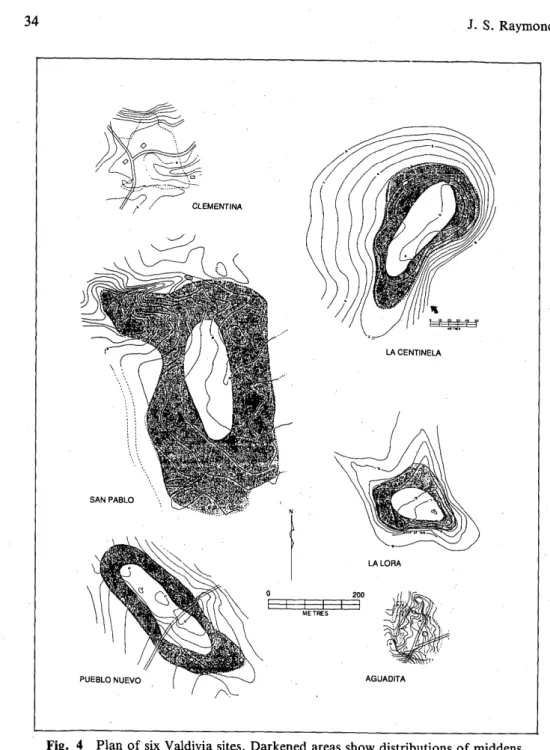
Although there is a wide range in size, from 1 to 12 hectares, there is a remarkable consistency in shape and axial direction (Fig. 4). Four of the six have oval settlement2) plans; one a rectangular plan; and the other ' an elongated plan, the exact shape of which could not be determined. Two have axial alignments which are almost, exactly north/south, and although the axial directions of the others range only from northwest/southeast to northeast/southwest, clearly a northerly/souther‑
ly direction was preferred. I was unable to discover any consistent correspondence between the alignment of settlement axes and topographic features such as nearby stream or river courses. Given that 6 sites, if we include Loma Alta and Real Alto, were built on low hilltops, the axes of the settlement were pre‑determined by the shape of the hilltop. However, for all but one there are other suitable hilltops with different alignments nearby which could have been selected for settlement.
All of the settlements enclose a vacant central space, but it wasn't possible to determine whether or not they were open at one end. The central spaces seem to be generally consistently proportional to the overall size of the settlement, except for the largest of the settlements, San Pablo,3) in which the vacant space seems propor‑
tionally smaller.
Early Valdivia settlements are smaller than those of Middle and Late Valdivia;
although, as mentioned earlier, beginning in Middle Valdivia there are both very 2) I am assuming again that the midden corresponds with the distribution of the dwellings.
34 J・ S. Raymond
2tht i 1‑‑‑K .' ovtyl
' ' )=:T :s<.: s.o
,. CLEMEN:rtNA
l
K
/
.
s
's
t'"
g"
. s
e
‑k "w
.
s
WIif!!il!;!i3 ‑ETfi[s LA CENTINELA
'K・‑,
4‑L "・"‑Xn ,
PUEBLO NUEVO iiillii}i
eg N
A.
O 200EEEEiEi9
METRES
‑
LA LORA N‑ ‑iNM
AGUADITA
Fig. 4 Plan of six Valdivia sites. Darkened areas show distributions of middens.
3) The area looted at San Pablo covered more thari 12 ha, but as far a' s I can tell, did not in‑
clude the southeastern edge ofthe site where Zevallos and Holm (1960) recovered evidence of Valdivia 2‑3 occupation. The whole of the 12 ha may not have been occupied simul‑
taneously, but I estimate that approximately 10 ha were occupied during Valdivia 4‑6.
large and very small settlements. Only the la"rge settlements, however, show evidence of planned layouts. San Pablo is comparable in size to Real Alto, although its size may be partly the result of an accretion of sequential settlements (see Marcos 1988:19‑21). It's main period of occupation, Middle Valdivia, is the same as that of Real Alto, and the rectangular distribution of the midden suggests the squared‑off layout of Real Alto.
There are no mound's comparable to those at Real Alto evident on the surface of any of the sites. A natural low hill which overlooks the'San Pablo site at its northwestern edge might have served as a natural ceremonial mound, but the asso‑
ciated cultural materials are almost all post‑Valdivia. Furthermore, since the main axis of the hill points east‑west, it may not have been suitable for an Early Valdivia settlement.
Antecedents
There are no known antecedents for the Valdivia settlement plan; however, ceremonial ritual is evident in the remains of the Vegas culture from at least the 7th millennium B.c. Funerary patterns of 192 buried human skeletons, excavated at OGSÈ80, constitute the main evidence of ritual behavior (Stothert 1988). Burial orientations were distinctly different for adult males, subadult males and females.
Occasional grave goods, including shell spoons, perforated shell adornments, a polished stone axe, red ochre, and a pile of round stones provide further evidence.
OGSE‑80 is exceptional among Yegas culture sites, which are mainly small, shallow, and probably associated with transient occupations. Stothert (1988:58) suggests that it was continuously occupied for a 3,OOO‑year span, which is a reason‑
able interpretation given the size and depth of the deposit. Periodicity of settlement during that span, however, has not been determined, so it is possible that it was occupied repeatedly at regular but short intervals, perhaps for ceremonial purposes.
From his investigations of an historic Chachi ceremonial center, DeBoer (1991:2) has shown that "the longevity of generally vacant ceremonial centers . . . can create the archaeological appearance of large sedentary settlements." OGSE‑80, then, may have been a focal center where otherwise dispersed foraging peoples gathered for funerary and other ceremonial occasions. Regardless of the degree of perma‑
nence of occupation, however, there is no discernable settlement plan which could be interpreted as an expression of a community or which anticipates the Valdivia pattern. .
Vegas shelters, however, do exhibit a continuity with Valdivia, both physically and conceptually. At OGSE‑80, Stothert (1988) excavated the foundation of a small hut, defined by a shadQw trench circumscribing an oval area about 1.5 meters across. A nearby hearth, associated fire‑cracked rock, some shells and a grinding stone are suggestive of household activities of food preparation, bUt which could also refiect ritual activities. An adult female skeleton buried in the floor of the hut indicates that its use was not limited to everyday domestic activities. Outlines of other huts were not as clearly delineated at OGSE‑80, but the patterned clusterings
,
36 J. S. Raymond of skeletons in mass graves indic'ates that such shelters were commonly associated with funerary ceremonialism.
The Early Valdivia huts from Loma AIta and Real Alto are similar in shape and apparent construction, although the Vegas example is at the small end of the range of variation. Burial of the dead beneath the floors of huts and houses con‑
stitutes a further continuity, and one which has symbolic implications.4)
These small structures were not merely domestic shelters; they served ritualis‑
tic and spiritualistic purposes as well. Initially these roles were probably bound together symbolically in the concept of house or dwelling. The house enclosed domestic life and was also a focused space for certain rituals. At Real Alto, by Late Valdivia 2 (Marcos 1988), separate ceremonial structures were built as well, modeled after the domestic shelters. The "Charnel House" Seems to have been a symbolic community expression of the funerary function of houses. Admission to the ritual houses was probably restricted according to social rules, e.g., age and gender, and burial in the "Charnel House" was probably socially restricted as well.
The Middle and Late Valdivia houses (Zeidler 1984) had elongated oval ground plans, with a doorway at one end. Marcos et al. (1976:4) have noted the similarity of the house plan, on a miniature scale, to the overall plan of the Valdivia settlements, implying that one was a metaphorical expression of the other. Such speculation becomes more interesting and plausible in light of evidence (DeBoer 1991) that Native Americans, in both South and North America, commonly thought of or referred to ceremonial centers as "big houses."
Just as the walls of houses enclosed domestic space and・ spatially focussed household rituals, the physical plan of the settlement simultaneously enclosed communal space and defined a stage for community rituals. The formalization of this space is first seen in the north/south orientation, and later in the construction of mounds and ceremonial houses within the central space.
It seems plausible, then, to propose that there was a conceptual interconnec‑
tion between house and community plan and that both were symbolically imbued with domestic and ceremonial connotations. As the settlement grew larger at Real Alto, so did the houses. It would seem that the basic residential unit shifted from
4) A dedicatory burial consisting of two individuals was interred beneath the fioor of a small hut at Loma Alta. A large pit had been dug into the sterile substratum of the site, the top of which was congruent with the base of the hut. The sides of the pit were lined with a thick organic matting. The adult human bones were placed on top of the matting along'one side of the pit, and the pit was fi11ed with sterile clay to the level of the hut floor.
Several factors suggest that this hut may have had more than common domestic significance in the settlement at Loma Alta. It contained the only double burial found.
The burial, which had a miniature pot (probably a lime container for coca chewing) and shells associated, was the only Valdivia burial from Loma Alta with grave goods. No other hut was found with such a large pit or one lined with organic matting, and finally the hut was positioned on a slight high spot. Furthermore, the position of this hut within the settlement plan corresponds with that of the "Charnel House" at Real Alto.
nuclear families to large extended family households. The central plaza grew as well, but many, perhaps the majority, of houses no longer directly bordered the plaza. Physical access to the plaza, then, Was somewhat restricted, and it.may have been that use of the plaza was socially regulated and ihcreasingly formalized. It is easy to see how this could have physically represented the concept of central
"sacred" space and outer "secular" space, and simultaneously, the north/south axis of the plaza may have divided the s,ettlement into eastern and western halves.
Analogues of this pattern are richly represented in the ethnographic record, from rigidly formalized imperial Cuzco to the simpler plans of Amazonian villages.
Ktual Paraphernalia
There is very little obvious evidence of cereinonialism or religious life in the objects which are preserved in Valdivia assemblages, and most of what does exist, such as cairns and ceremonial offerings, is not expressed in a readily interpretable pattern. However, two classes of artifacts, figurines and ceramic yessels, provide some insight.
Small anthropomOrphic figurines are abundant in Early and Middle Valdivia assemblages. Thousands have been excavated by archaeologists, and if we had a record of all that have been looted by huaqueros, the numbers would soar to the tens of thousands. .The earliest figurines, which are associated mainly with Valdivia
1 and 2 assemblages, were carved from soft stone. Fired clay figurines began to be made in Late'Valdivia 2, and thereafter, the manufacture of stone figurines declined dramatically. Human‑like features are only vaguely represented on many of the stone figurines, and even on those which are clearly anthropomorphic, the sex is not explicit. The clay figurines, however, are clearly human. The‑overwhelming majori‑
ty is female with the sex explicitly indicated in the breasts and buttocks.
Despite their obvious ritual connotations, neither the stone nor ceramic figurines have distributions which correlate with ceremonial features. Some clay figurines were unearthed in the excavations of the ceremonial mounds at Real Alto, associated with each of the rebuilding phases through Valdivia phase 6, and some have been found in association with burials. Many haye been excavated from the floors of Middle Valdivia houses, but the maj ority of figurines has been found in the middens, where they had been discarded along with household rubbish (Lundberg
1977; Meggers et al. 1965; Stahl 1986). Apparently there was no need to curate figurines. They were made, used, and discarded. '
Most of the figurines which have been recovered in controlled excavations are broken, leading some archaeologists to suggest that they may have been ritually broken. However, since they are fragile objects, that is a hard proposition to test. In her study of ceramic figurines from Real Alto, Lundberg (1977) expressed doubts that they had been broken deliberately, given that the whole specimens tended to be small and sturdy. On the other hand, Stahl (1986) has argued convincingly that the stone figurines from Loma Alta were deliberately broken and defaced. Eighty‑six percent of the stone figurines from Loma Alta were fragmented, and most of these
38 J. S. Raymond were severely damaged; yet the breakage does not correspond with structural weaknesses in the figurines.
The large number and ubiquitous distribution of figurines suggests that they ' were used in rituals which occurred frequently and which commonly were enacted in or around 'the home. If they were deliberately mutilated during the ritual, it is unlikely that・they were icons; rather, they seem to have been implements which were 'utilized during the ceremony and then thrown away. Drawing on ethnographic analogy, Stahl (1985,.1986) and'others (Lundberg 1977; Lathrap et al. 1975; Meg‑
gers et al. 1965; Zevallos and HolM 1960) have suggested that figurines were ritual paraphernalia for shqmanic rites, an explanation which I find plausible.
Pottery'is commonly interpreted in functional or utilitarian terms, unless it comes from explicitly ritualistic contexts or unless it js ornamental. I suggest, as have others (Damp 1982; Lathrap et al. 1975; Norton 1977; Stahl 1985), that from the beginning Valdivia pottery played a significant social/ceremonial role in ad‑
dition to whatever utilitarian purposes it may have fulfi11ed. Ethnoarchaeological research has shown that among some South American indigenous groups the time and energy spent in ceramic manufacture is justified more in social/ceremonial than utilitarian terms (DeBoer 1990; DeBoer and Lathrap 1979; Kensinger 1975:55‑67).
From the earliest manifestations, Valdivia pottery was・manufactured accord‑
ing to a standardized set of rules. The basic household set consisted of three vessel shapes, a tall‑necked jar, a short necked jar, and a bowl (Fig. 5). Firing was well controlled, and there were specific rules for surfaCe treatment and decorative appli‑
cation. There is a range of variation in quality among specimens, but the standard of quality was generally high. Analysis of residue may someday indicate how specific vessels were used; in the meantime, hoWever, we can only speculate about function based on shape, abrasiQn marks, and adhering charcoal. The jar forms were pro‑
bably used for detoxifying foods, temporary storage, cooking, and brewing; the bowls for serving and consuMing food and drink.
There is no "fine ware" ・which might have been reserVed for special occasions, but significantly greater attention, care, and energy were put into finishing and ' decorating the bowls than into the jars. Furthermore, although both jars and bowls were decorated, bowl designs are more complex and intricate, and they exhibit a distinctive set of motifs. An obvious implication is that bowls were more than mere domestic serving vessels, that they at least dccasionally participated in events which were more public or special than daily eating and drinking within the household. A salient possibility, which has been suggested by others as well, is ritualized drinking
tt
's '' .・'! 1
tt
tttt t '
' ‑‑‑‑‑‑‑‑‑‑‑‑‑‑‑‑‑‑‑‑‑‑‑‑‑‑‑‑‑‑:‑‑4‑‑‑‑‑t‑‑ .‑ ,
Fig. 5 Drawings of the standard set of Early Valdivia vessel forms.
(Damp 1982; Lathrap et al. 1975; Stahl 1985).
As I noted earlier, drinking intoxicating liquids is an important element of social and ceremonial life among Andean peoples. That seems to be true for most of the indigenous peoples of South America, whether they are highlanders or lowlanders (DeBoer and Lathrap 1979; DeBoer and Moore 1983; Harner 1973;
Isbell 1985; Allen 1988). Although any portable vessel which holds liquid will do, drinking vessels used publicly are often of standardized shape and elaborately decorated, as, for example, Inca qeros and Shipibo ke'mpo. By analogy, then, in a domestic context Valdivia bowls may have been used for social drinking among members of difiierent households, with the host serving chicha according to a social‑
ly prescribed procedure. In more explicitly ritual contexts such as shamanic rites, the bowls may have been treated as ceremonial paraphernalia. Stahl (1985, 1986) has fully developed this idea, arguing convincingly that hallucinogenic drugs were used by shamans to induce ecstatic experiences, and that the decorative motifs which appear on Early Valdivia bowls were inspired by hallucinogenic images.
Hallucinogens may have been mixed with the drink and served in a bowl to the participants in the rite.
In community wide social/ceremonial contexts, such as periodic festivals, decorated bowls could have had a significant functional and very public role among the paraphernalia, simultaneously fi11ing the practical need,for containers of food and drink and symbolically representing communal order.
There is no compelling evidence that such festivals were held in Valdivia com‑
munities. However, the presence but infrequent occurrence of seafood and especial‑
ly of cQrn, and the apparent low dietary importance of both (van der Merwe et al.
n.d.) makes sense if they were regarded as feast foods. Norton (1977) has postulated that the coastal site of Punta Concepcion, which is one of the few Valdivia sites with shell middens, was used only periodically, with shellfish constituting・the feast food.
Summary and Conclusion
To summarize, in Ecuador ceremonialism can be traced back to at least the 7th millennium B.c. in the funerary patterns of the Vegas culture. A thousand‑year hiatus in the archaeological record separates Vegas and Valdivia, and there are few indications in the material record of a direct cultural continuity between them. The most significant changes with the onset of Valdivia are the establishment of perma‑
nent nucleated・settlements and a dramatic decrease in the number of sma!1 transient settlements. There is a continuity at first in household size, as refiected in the small huts, and in the funerary custom Qf burial beneath the fioors of dwellings. But from the first, the Valdivia settlements are laid out according to a plan. Houses, arranged in an elongated arc or oval, defined a bounded central space, which was aligned along a north/south axis. There are obvious parallels between this pattern and the settlement plans of Amazonian villages, and in a generql sense with the organization of many Andean villages. In the ethnographically recorded settlements, the central
40 J. S. Raymond space is the focus of community‑wide ceremonial and ritual activities which symbolically define and renew social relations within the community, and establish the position of the community within the cosmos.
During Early Valdivia, ceremonialism seems to have involved household and community equally. The central plaza was an undifferentiated space. Households seem to have had equal access to the plaza. A simple set of ceramic vessels satisfied both domestic and ritual needs. Motifs on the vessels suggest that communications with the spiritual world were facilitated by hallucinogenic drugs. From ethnographic analogy, we can say that such spiritual ceremonies were probably led by members of the community who had been taught the rituals and trained in the manipulation of drugs. Judging by the ubiquitous distribution of figurines, ceremonies were held among small groupings of households as well as at the community level.
During Middle Valdivia, some settlements were abandoned or were severely reduced in size; others more than quadrupled their areas. Judging by Real Alto, growth in community siZe 1'ed to an increase in the size of the household units and, perhaps, the establishment of residential wards (Zeidler 1984). Households no longer had equal access to the central plaza. The central plaza was elaborated into a long rectangle. Ceremonial mounds, surmounted by house‑like structures, defined an inner secluded precinct.
These changes suggest that there was some differentiation of the community in social and eeremonial terms, perhaps refiecting a joining together of formerly smaller settlements. The elongated plaza, with residential areas lying mainly east and west of it, suggests that it not only symbolically united the community but may have divided it into moieties. There are no clear signs of economic or political specialization, but differential access to the plaza may reflect status difilerentiation.
The continued ubiquitous distribution of figurines indicates that households con‑
tinued to function as ritual arenas. But ceremonies held in the inner plaza and in the ceremonial structures must have excluded some members of community. Thus, ceremonial activities seem to have been conducted at three levels: 1) Within the residential houses among members of a household; 2) At the community level in the large plaza; and 3) In the ceremonial structures and inner plaza among groups selected, perhaps, according to age, gender, and/or social status.
The variety of ceramic vessel forms increased significantly during Middle Valdivia, mainly among the nonutilitarian vessels. This may have begun a differen‑
tiation of fine ritual from commoh household wares, but the contextual data are too ambiguous to tell.
During Late Valdivia, large communities, like Real Alto, splintered into smal‑
ler satellite settlements. The plaza and ceremonial moundS, however, continued to be used and renewed, and households around the plaza continued to be occupied.
Household rituals, no doubt, continued to be practiced in the satellite settlements, but representatives from these communities probably participated in scheduled events at the ceremonial centers to reaffirm community identity, redefine social rela‑
tio.ns, and recharge the cosmos.
There are formal similarities between the layout of Valdivia ceremonial centers and early ceremQnial centers of coastal and highland Peru and of highland Bolivia, and it is tempting to postulate, as have some archaeologists (Lathrap 1985; Marcos et al. 1976), that there were close historical relationships. However, before we can draw conclusions from inter‑regional comparisons of ceremonial centers, it is necessary to study cerem,onialism within ordinary settlements for each region and' determine the local development of ceremonial symbolism. Such data are only now becoming available in a few locations within the Central Andes. I am not suggesting that inter‑regional influences were unimportant but that such influences can only be understood ‑in the context of the local formalization of ceremonialism.
Bibliogr'aphy Allen, Catherine J.
1988 77ze HOId Lijle Has: Coca and Cultural ldentity in an Andean Community.
Washington, DC: Smithsonian Institution Press.
Dalnp, J.
1979 Better Homes and Gardens: The Life and Death of the Early Valdivia ComMuni‑
ty. Unpublished Ph.D. dissertation, Department of Archaeology, University of Calgary.
1982 Ceramic Art and Symbolism in the Early Valdivia Community. ulOurnal ofLatin American Lore 8(2):155‑178.
1984 Architecture of the Early Valdivia Village. American Antiquity 49:573‑585.
DeBoer, Warren R.
1990 Interaction, Imitation, and Communication as Expressied in Style: The Ucayali Experienee. In M. W. Conkey and C. A. Hastorf (eds.), T7ze USes of Style in Archaeology, pp. 82‑104. Cambridge: Cambridge University Press.
1991 Ceremonial Centers. from the Cayapas to Chillicothe. Paper presented at the 56th Annual Meeting of the Society for American Archaeology, New Orleans.
DeBoer, Warren R. and Donald W. Lathrap
1979 The Making and Breaking of Shipibo‑Conibo Ceramics. in C. Kramer (ed.), Ethnoqrchaeology.' implications ofEthnography for Archaeology, pp. 102‑138.
New York: Columbia University Press, DeBoer, Warren R. and J. A. Moore
1983 The Measurement and Meaning of Stylistic Diversity. IVaimpa Pacha 20:147‑162.
Harner, Michael
1973 71he Jtvaro, People of the Sacred va2itedells. Garden City: Anchor Press.
Hill, Betsy Dupuis
1975 A New Chronology of the Valdivia Ceramic Complex from the Coastal Zone of Guayas Province, Ecuador. Ig7ampa Pacha 10‑12:1‑32.
Isbell, Billie Jean
1985 7b Dq172nd Our:selves: Ecology andRitual in an Andean' Village. Prospect Hights:
Waveland Press.
Kensinger, Kenneth M.
1975 Studying the Cashinahua. In J. Powell Dwyer (ed.), T7ie Cashinahua ofEastern Pleru, pp. 9‑86. Bristol: Haffenreffk:r Museum of Anthropology.
Lathrap, Donald W.
i
42 J. S. Raymond
1985 Jaws: The Control of Power in the Early Nuclear American Ceremonial Center, in Christopher B. Donnan (ed.), Early Ceremonial Architecture in the Andes, pp. 241‑267. Washington, DC: Dumbarton Oaks Research Library and Collec‑
tion.
Lathrap, Donald W., Donald Collier, and Chandra Helen
1975 Ancient Ecuador: Culturc Clay and Creativity, 3000‑300 B.c. Chicago: Field Museum of Natural History.
Lundberg Emily
1977 Reappraisal of Valdivia Figurines Based on Controlled Feature Contexts: A Prelimipary Report. Paper presented at the 42nd Annual Meeting of the Society for American Archaeology, New Orleans.
Marcos, Jorge G.
1978 The Ceremonial Precinct at Real Alto: Organization of Time and Space in Valdivja Society. Unpublished Ph.D. dissertation, University of Illinois, Urbana‑
Champaign.
1988 Real Alto: la historia de un centro ceremonial Vbtdivia, 2 vols. Biblioteca Ecuatoriana de Arqueologia, No. 4‑5. Quito: Corporaci6n Editora Nacional.
Marcos, Jorge G., Donald W. Lathrap, and James Zeidler
1976 Ancient Ecuador Revisited. Eield Museum ofAlatural Histoi:y Bulletin 47(6):3‑8.
Meggers, Betty J., Cliford Evans, and Emilio Estrada '
1965 Early]FbrmativePeriodofCoastalEcuador: T7ze VicitdiviaandMachalillaPh(zses.
Smithsonian Institution, Contributions to Anthropology 1. Washington, DC:
Smithsonian Institution.
Norton, P.
1977 The Loma Alta Connection. Paper presented at the 42nd Annual Meeting of the Society for American Archaeology, New Orleans.
1982 Preliminary Observations on Loma Alta, an Early Valdivia'Midden in Guayas Province, Ecuador. in J. G. Marcos and P. Norton (eds.), Primer simposio de correlaciones antropolo'gicas andino‑mesoamericano, pp. 101‑119. Guayaquil:
Escuela Superior Politecnica del Litoral.
Pearsall, D. M.
1988 An Overview of Formative Period Subsistence in Ecuador: Paleoethnobotanical Data and Perspectives. Ih B. V. Kennedy and G. M. LeMoine (eds.), Diet and Subsistence: Current Archaeological Per:spectives, pp. 149‑158. Calgary: The Archaeqlogical Association of the University of Calgary.
Raymond, J. Scott
1988 Subsistence Patterns during the Early Formative in the Valdivia Valley Ecuador.
in B. V. Kennedy and G. M. LeMoine (eds.), Diet and Subsistence: CurrentAr‑
chaeological Per:spectives, pp. 159‑164. Calgary: The Archaeological Association of the University of Calgary.
1989 Early Formative Societies in the Tropical Lowlands of Western Ecuador: A View from the Valdivia Valley. Paper presented at the Circum‑Pacific Prehistory Conference, Seattle.
Stahl, Peter
1985 The Hallucinogenic Basis of Early Valdivia Phase Ceramic Bowl Iconography.
,lournal ofIlsychoactive Drugs 17(2):105‑12.3.
1986 Hallucinatory Imagery and the Origin of Early South American Figurine Art.
PVbrld Arehaeology 18(1):134‑15O.