• 検索結果がありません。

Development of multi-frequency mm-wave spectrometer for atmospheric observation

N/A
N/A
Protected

Academic year: 2021

シェア "Development of multi-frequency mm-wave spectrometer for atmospheric observation"

Copied!
1
0
0

読み込み中.... (全文を見る)

全文

(1)

Development of multi-frequency mm-wave spectrometer for atmospheric observation

Akira Mizuno

1

, Tomoo Nagahama

1

, Taku Nakajima

1

, Takahiko Kosegaki

1

, Syoki Iriyama

1

, Genma Mizoguchi

1

, Kohei Haratani

1

, Hiroyuki Iwata

1

, Daichi Tsutsumi

2

, Naoto Sekiya

3

, Takuma Hayashi

3

,Yoshihiro Tomikawa

4

, Mitsumu K. Ejiri

4

, and

Kaoru Sato

5

1

  Institute for Space-Earth Environmental Research (ISEE), Nagoya University, Japan

2

  Department of Physics, Nagoya University, Japan

3

  Department of Electrical and Electronic Engineering,   University of Yamanashi, Japan

4

  National Institute of Polar Research, Japan

5

  Graduate school of science, University of Tokyo, Japan

We will upgrade the millimeter-wave spectrometer for atmospheric minor constituents in the stratosphere to lower-thermosphere at Syowa station under the 61th Japanese Antarctic Research Expedition (JARE). In this paper, we report the performance of the new spectrometer measured in our laboratory.

[Background]

Most of the present ground-based microwave instruments for atmospheric spectroscopy are dedicated to observe a single molecular line. That is mainly because the frequency separations among different molecular lines are larger than instantaneous observable frequency bandwidth of the microwave instruments. This is crucial difference between the microwave and the other wavelength. Simultaneous observation of several molecular species chemically and/or dynamically connected with each other and subsequent comparative study of such species provide more fruitful information to understand the mechanism of temporal variation of atmospheric molecules. So, to overcome the present situation of the ground-based microwave instruments, we developed new key device for multi-frequency observation, i.e., a waveguide-type frequency multiplexer that enable us to distribute the signal coming through a single optical system to 4 superconducting receivers, and the 4 receivers are cooled down by a single cryogenic refrigerator. We already reported the performance of the frequency multiplexer in the last symposium, and afterward, we successfully built a practical observing system equipped with the device.

[Results]

We developed a cryogenic system to cool down the multi-frequency receiver system, optical system that guides the signal from the atmosphere into the receiver system, integrated IF (intermediate frequency) circuit to re-assign the signal-band frequencies of the multiple channels into a single FFT processor having an instantaneous bandwidth of 2 GHz. For the observation at Syowa, we use the upper two channels of the frequency multiplexer. The scientific target is to study the influence of energetic particle precipitations (EPPs) on the middle and upper atmosphere, and the observable frequency windows are adjusted to observe NO, O

3

, CO, NO

2

, HO

2

between ~230 GH and ~250 GHz. In the cryogenic system, by using a power-saving small refrigerator (Ulvac UR4K03) whose cooling power is 0.3 W, we confirmed that the two receivers can be cooled down to ~ 4.3 K by utilizing a multi-layer radiation shield, super-insulation, and thermal anchors made of oxygen-free copper. For the optical system, we used a quasi-optical approximation method

(Gonzalez, 2016) to design the shape of the parabolic and elliptical mirrors to configure a frequency independent optical system. In the integrated IF circuit, the three 1

st

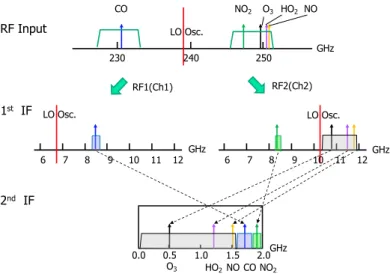
IF signal bands at ~ 230GHz and ~ 250GHz are down-converted between 8 GHz and 12 GHz, and finally those signals fall into within the bandwidth of the backend FFT processor, 2 GHz (Figure 1) by adjusting the frequency configuration of band-pass filters (BPFs) and 2

nd

mixers. In addition, we use a superconducting band-pass filter developed by Yamanashi University as the 1st-stage band-pass filter that provides very sharp skirt characteristics to reduce the crosstalk between the passbands.

References

Gonzalez A., Frequency Independent Design of Quasi-optical Systems, Journal of Infrared, Millimeter and Terahertz Waves, 37, 147-159, 2016.

230 240 250

6 7 8 9 10 11 12 6 7 8 9 10 11 12

0.0 0.5 1.0 1.5 2.0

RF Input

1

st

IF

2

nd

IF

RF1(Ch1) RF2(Ch2)

GHz

GHz GHz

GHz

CO NO

2

O

3

HO

2

NO

LO Osc.

LO Osc. LO Osc.

O

3

HO

2

NO CO NO

2

Figure 1. Frequency conversion chart of the new spectrometer system.

Figure 1.    Frequency conversion chart of the new spectrometer system.

参照

関連したドキュメント

There are many exciting results concerned with the exis- tence of positive solutions of boundary-value problems of second or higher order differential equations with or

, 6, then L(7) 6= 0; the origin is a fine focus of maximum order seven, at most seven small amplitude limit cycles can be bifurcated from the origin.. Sufficient

The time-frequency integrals and the two-dimensional stationary phase method are applied to study the electromagnetic waves radiated by moving modulated sources in dispersive media..

In addition, the controller includes a new high voltage circuitry that combines a start−up current source and a brown−out detector able to sense the input voltage either from

Figure 16 shows the operational waveforms of an IH cooker for the voltage for a switching frequency equal to the resonant frequency (upper graph blue waveform), the current (upper

Amount of Remuneration, etc. The Company does not pay to Directors who concurrently serve as Executive Officer the remuneration paid to Directors. Therefore, “Number of Persons”

In order to allow the NCP1244 to operate in CCM with a duty cycle above 50%, the fixed slope compensation is internally applied to the current−mode control. The slope appearing on

In order to allow the NCP1246 to operate in CCM with a duty cycle above 50%, the fixed slope compensation is internally applied to the current−mode control. The slope appearing on