A Study on the Mainstream of Real Estate Education with Core Term Analysis
-Focusing on Undergraduate Education-
DONG HYUN KIM
A dissertation
Submitted to The Graduate School of Real Estate Sciences, Meikai University, in Partial Fulfillment of The Requirements
for The Degree of Doctor of Philosophy Graduate School of Real Estate Sciences
Meikai University
March 2020
i CONTENTS
TABLE OF CONTENTS...i
ABSTRACT……….….….... iv
LIST OF TABLES AND FIGURES...viii
Chapter 1. INTRODUCTION 1.1 Background... 1
1.2 Research Objectives... 4
1.3 Previous Research... 7
1.4 Features and Contributions... 9
Chapter 2. HISTORY AND CHARACTERISTICS OF REAL ESTATE EDUCATION IN THEUK 2.1 History of Real Estate Education in the UK...……..………..11
2.2 Making a Hypothesis about the Chracterisitcis of Real Estate in the UK...14
2.3 Chronology of Real Estate Education in the UK...………...15
Chapter 3. HISTORY AND CHARACTERISTICS OF REAL ESTATE EDUCATION IN THE US 3.1 History of Real Estate Education in the US...18
3.2 Making a Hypothesis about the Chracterisitcis of Real Estate in the US...22
3.3 Chronology of Real Estate Education in the US...24
ii
Chapter 4. CLARIFYING THE CHARACTERISTICS OF REAL ESTATE EDUCATION OF IN THE UK AND US AND FINDING OUT THE MAINSTREAM OF REAL ESTATE EDUCATION BY CORE TERM ANALYSIS
4.1 Data used in this study...26
4.2 Core Term Analysis Method...28
4.3 Core terms and subjects of the UK and US...33
4.3.1 Selected core terms and subjects...33
4.3.2 Comparing term-based analysis with subject-based analysis...36
4.3.3 The limitation of term-based analysis proposed in this study...40
4.4 The Characteristics of the UK and US Real Estate education...40
4.4.1 From the viewpoint of subject distribution...40
4.4.2 From the viewpoint of linked 2nd terms...43
4.4.3 From the viewpoint of Core Terms...46
4.5 Verifying Hypotheses about the Characteristics of UK and US Real Estate Education...53
4.5.1 Verifying Hypotheses about the Characteristics of the UK Real Estate Education...53
4.5.2 Verifying Hypotheses about the Characteristics of the US Real Estate Education...53
4.6 Finding out the Mainstream and picking up the BOK of Real Estate Education based on Core Terms...54
4.7 Summary...58
iii
Chapter 5. IDENTIFYING JAPAN’S SPECIFITIES BY PROXIMITY ANALYSIS
5.1 Core Terms in Japan Real Estate Education...60 5.2 Proximity Analysis Method for Core Term Comparison among the UK, US, and
Japan...62 5.3 Summary...65
Chapter 6. CONCLUSIONS AND FUTURE WORKS
6.1 Conclusions...67 6.2 Future Works...69
REFERENCE...70
Appendix A The 250 Mandatory Subjects of the UK Real Estate Course Accredited by
the RICS...74 Appendix B The 189 Mandatory Subjects of the US Real Estate Course Accredited by
the AACSB...89 Appendix C The 13 Mandatory Subjects of the Real Estate Department of Meikai Univ.
in Japan...101 Appendix D The UK Subjects Linked with the UK Only the Core Terms…...….…….…….…....102 Appendix E The US Subjects Linked with the US Only the Core Terms…...…….…..……...…..107 Appendix F The UK and US Subjects Linked with Core Common Terms..…....………...110 THESIS ACKNOWLEDGEMENT...121
iv ABSTRACT
Today, globalization is proceeding in all fields with remarkable advances in information and communication technology. In recent years, the globalization trend has expanded not only in the fields of finance, investment, and real estate development in the business environment area, but also in the fields of education and culture in the knowledge industry area.
In order to evolve in accordance with a new era, it is more important than ever to educate real estate professionals via a well-designed curriculum that responds to the demands of a new age. Since 2000, university-level real estate education programs have been a topic of discussion in a global context.
These days, the globalization of real estate education is being led by The Royal Charter of the Royal Institution of Chartered Surveyors (RICS) in the UK and The Association to Advance Collegiate Schools of Business - International (AACSB-International) in the US. In this perspective, the study on real estate education should start with reviewing the historical developments and current streams of the real estate educations of the UK and US.
Due to reasons like these, the research objectives of this study are as follows.
⚫ The first, clarifying the characteristics of real estate education in the UK and US through the review of the literatures on historical developments.
⚫ The second, finding out the mainstream of current global age and picking up the Body of Knowledge (BOK) of real estate education through analyzing the current subject titles of real estate departments accredited by the RICS and AACSB-International. These outputs will give some clues for designing and improving the real estate education in Japan.
⚫ Last, identifying Japan’s specificities in real estate education through core term comparison based on proximity analysis among the UK, the US and Japan as one example of eclectic model countries.
To achieve these objectives, we proceeded with this study as follow.
v
⚫ First, via the review of the literatures on historical developments, we made hypotheses about the characteristics of real estate education in the UK and US.
⚫ Second, via the analysis of the terms used in the current subject titles of real estate departments accredited by the RICS and AACSB-International, we verified the hypotheses made in the before step.
For the analysis, the titles of 250 and 189 Mandatory Subjects for graduation were collected from the websites of 14 real estate departments in the UK and 22 real estate departments in the US universities.
And terms were extracted from the titles of mandatory subjects by using text mining techniques. After the Term Frequency (TF) and the Term Proportion (TP) of each term were calculated, the terms were grouped, counted and arranged by TF and TP order.
⚫ Third, by using the core common terms chosen from the terms arranged by TF and TP in the before step, we found out the mainstream of current global age and picked up the Body of Knowledge (BOK) of real estate education. The definition of core common terms are as high frequent terms extensively appeared in the subject titles of the UK and US.
⚫ Last, via core term comparison among the UK, the US and Japan by using proximity analysis, we identified Japan’s specificities of real estate education.
The study results are summarized as follows.
⚫ First, we clarified the characteristics of real estate education in the UK and US via the hypotheses made by the review of the literatures on historical developments and the hypotheses verification by the terms extracted from the current subject titles of real estate departments accredited by the RICS in the case of UK and AACSB-International in the case of US.
The characteristics clarified in this study are summarized like as belows.
『In case of the real estate education of the UK, the main-characteristics can be said to have been
practiced with center on the physical aspects having roots in surveyor's training for lords’ estate management. But, recent years, “Finance and Investment approach of the US” seems to be penetrating the education of the UK.』
vi
『“In case of the real estate education of the US, the main-characteristics can be said to have been
practiced with focus on finance and investment in the business environment based on the free transfer of land ownership dating to before independence. And, “Basic knowledge education related to real estate at the liberal art level is also placed a lot of value on, which have aimed developing generalists who have a foundation at real estate fields.』
⚫ Second, we found out the mainstream of current real estate education.
The mainstreams found out in this study are summarized like as below.
『Now is “the age of Management” after “the age of Development” has passed and “Finance” and
“Investment” are key terms of recent real estate education.』
⚫ Third, we also picked out the Body of Knowledge (BOK) of current real estate education.
The BOK picked out in this study is summarized like as below.
『The Body of Knowledge (BOK) of current real estate education is “Management”, “Finance,”
“Law,” “Development”, “Investment”, “Appraisal“, “Principles”, and “Business”.』
⚫ Fourth, we identified the specificities of the real estate education of Japan among the UK, the US and Japan. The specificity identified in this study is summarized like as below.
The Proximity of Japan to the US is highest among the UK, the US and Japan. This can be interpreted as the context of the US approach has been affecting the Japanese real estate education curriculum.
『The real estate education of Japan is more oriented toward the f the US than the UK.』
⚫ Finally, although there was no quantitative analysis in this research, the subjects related to the terms of
“History” and “Ethical” should be considered more important, especially considering the current era of global financial crises and complex financial services derived from real estate. In addition, subjects focusing on entrepreneurship and negotiation, as well as operational abilities for use in construction projects, should be emphasized in the future.
However, this study has some limitations.
As a first limitation of this study, the mainstream and the BOK of real estate education were extracted
vii
with the core terms of the curriculum required in the real estate departments, which are limited to the departments accredited by the RICS and AACSB. As future work, it is expected that the subjects and core terms collected over a wide range of educational institutions will be able to extract a widely acceptable mainstream and BOK of real estate field.
Another limitation of this study, we classified words under the assumption that same term, which is the basis of classification, always has the same meaning. However, this method has limitations that the meaning of each word may have different nuances or be interpreted in different meaning depending on the context of the connected terms or the country. In future work, we hope to improve these limitations by finding better methods.
One more limitation of this study, the term-based analysis proposed in this study has the superiority in the analysis of education contents but did not provide any ideas about “How is it taught in the class?”.
“How it is taught in the class” is also an important topic. In future work, we also hope to improve these limitations by expanding this study.
viii LIST OF FIGURE
Figure 1. The overview of research...6
Figure 2. The main analysis process of research...6
Figure 3. The developing history of the RICS...14
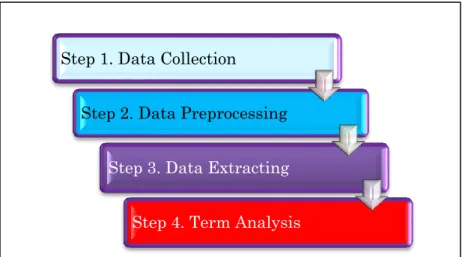
Figure 4. The process of ext mining is conducted by four step...28
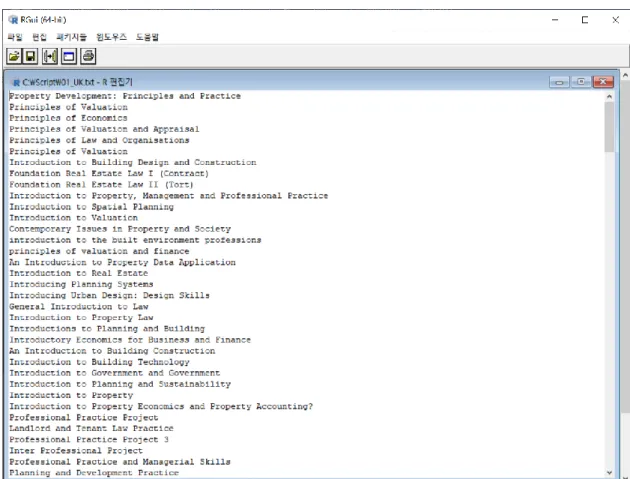
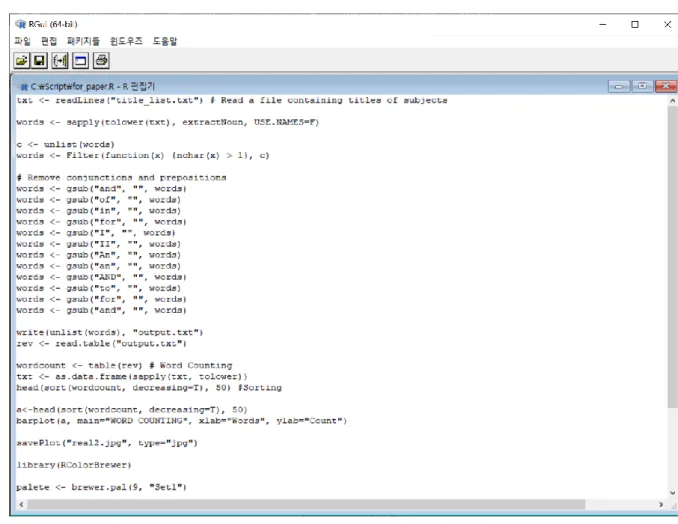
Figure 5. Example of R program for Listing subjects of the UK ...29
Figure 6. A part example of R programming code for Filtering and Removing...31
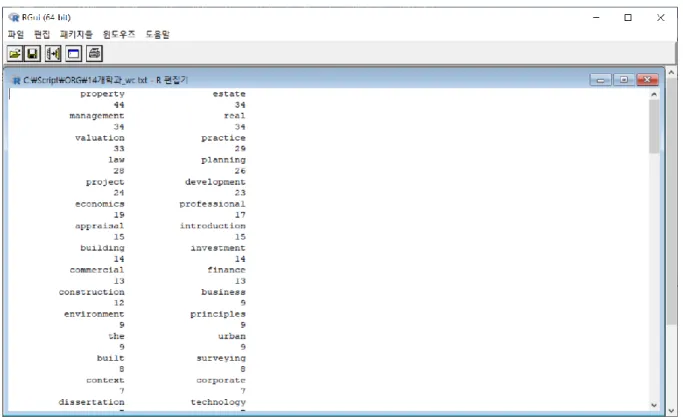
Figure 7. One example of grouping term list based on term frequency order...32
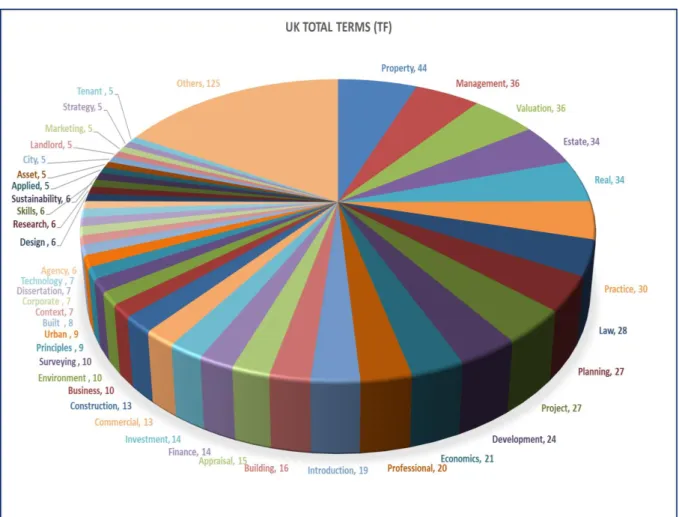
Figure 8. The total term distribution of the UK...36
Figure 9. The total term distribution of the US...37
Figure 10. The total subject distribution of the UK...37
Figure 11. The total subject distribution of the US...38
Figure 12. Comparing two methods in case of the UK...38
Figure 13 Comparing two methods in case of the US...39
Figure 14. Distribution of subjects in the UK...41
Figure 15. Distribution of subjects in the US...41
Figure 16. The word cloud for terms in the UK curriculum...46
Figure 17. Terms related with the UK curriculums...48
Figure 18. The word cloud for core terms in the US curriculum...50
Figure 19. Terms related with US curriculums...52
ix
Figure 20. Total term distribution of the UK and US...55
Figure 21. Relationship image among core common terms...56
Figure 22. The Specificities of core terms in JAPAN word cloud...62
ix LIST OF TABLES
Table 1. Real estate education programs in 28 countries classified by the scheme of Yu (2001) ...3
Table 2. The Chronology of Real Estate Education in the UK ...15
Table 3. The Chronology of Real Estate Education in the US ...24
Table 4. Real Estate departments in the UK university...27
Table 5. Real Estate departments in the US university...27
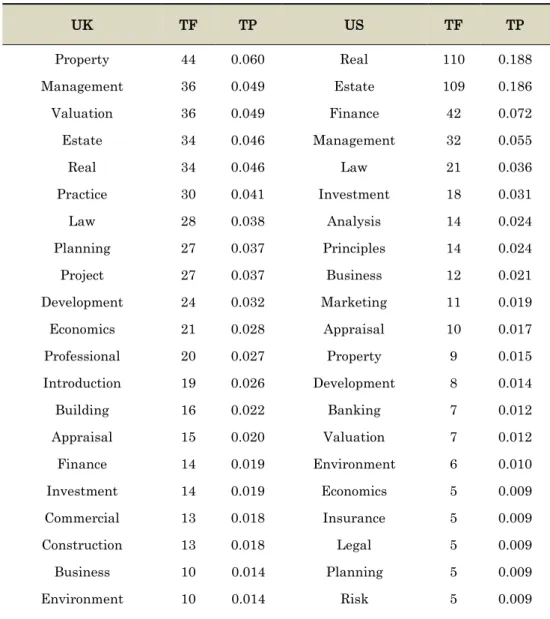
Table 6. Core terms from Mandatory Subjects (MS) of the UK and US...33
Table 7. Core Subjects form Mandatory Subjects (MS) of the UK and US...34
Table 8. Subjects containing “Law” in case of the UK...43
Table 9. Subjects containing “Law” in case of the US...44
Table 10. Summarizing Terms linked with “Law” in the UK and US: 2nd Core Term Analysis...45
Table 11. Only terms in the UK...47
Table 12. Terms to be inclined towards UK...47
Table 13. Core Common Terms for clarifying the Characteristics of the UK...48
Table 14. Only terms in the US...50
Table 15. Terms to be inclined towards US...51
Table 16. Core Common Term for clarifying the Characteristics of the US...51
Table 17. Core Common Terms...55
Table 18. Summary of Japan core terms...60
Table 19. Proximity analysis results among the UK, US and JP...65
1 Chapter 1. INTRODUCTION
1.1 Background
Providing new solutions and technologies to real estate problems, real estate science has evolved to solve complex real estate problems that arise between people and real estate. Today, globalization is proceeding in all fields with remarkable advances in information and communication technology. In recent years, the globalization trend has expanded not only in the fields of finance, investment, and real estate development in the business environment area, but also in the fields of education and culture in the knowledge industry area.
The Bologna Process1 and the Erasmus program2 as the representative examples in the field of higher education and globalization in the education sector, are now in progress. In order to evolve in accordance with a new era, it is more important than ever to educate real estate professionals via a well-designed curriculum that responds to the demands of a new age.
In real estate higher education fields, Since 2000, university-level real estate education programs have been topics of discussion in a global context. Schulte et al. [1,2] classified the real estate education programs of 39 countries into three categories: “surveying approach” in the United Kingdom (UK),
“investment and finance approach” in the United States (US), and “interdisciplinary approach” in European countries, except the UK.
Yu [3] at the National University of Singapore expanded the scope of the discussions to worldwide coverage and classified real estate educations into the UK model, the US model, and an eclectic model which includes Asian and African countries.
1 A set of ministerial agreements among 48 the European countries to enhance comparability in the standards and quality of higher-education qualifications. In 1999, the process begun with the Bologna declaration, which was signed by educational ministers from 29 European countries, aiming at building The European Higher Education Area(EHEA)
2 An European union (EU) exchange student programme that has been in existence since 1987.
2
Here, “interdisciplinary approach” mentioned in Schulte et al. [1,2] or “eclectic model” mentioned in Yu [3] refers to the model of real estate education in which the UK and US education models are modified appropriately according to the educational needs of the local real estate industry.
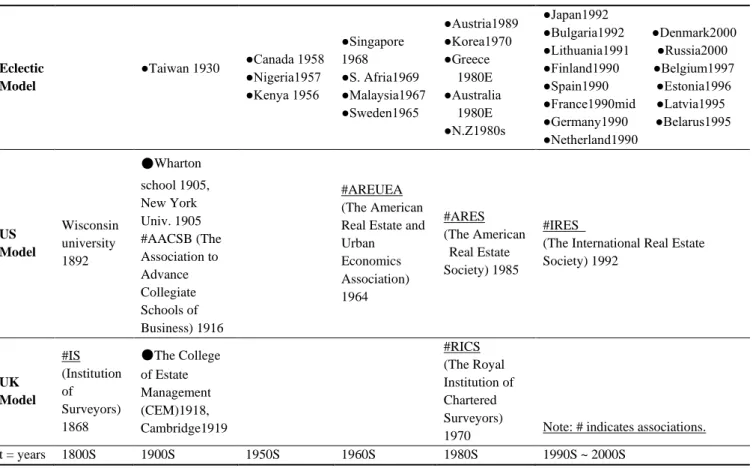
Table 1 categorizes 28 countries which have university level real estate programs among 39 countries in Schulte et al. [1] according to the classification scheme of Yu [3]. The 28 countries were categorized according to their current education content. The eclectic model includes not only a country with a similar nature to the UK and the US from its inception but also some countries that initially adopted the UK model but later modified it to the US model with the increasing number of professors earning degrees in the United States. Table 1 shows that most countries currently are classified as eclectic models, which means that most countries have been influenced by the real estate education of the UK and the US, which has historically led real estate education. In this regard, the UK and US still take influential positions.
Today, the globalization of real estate education is also being led by the Royal Charter of the Royal Institution of Chartered Surveyors (RICS) in the UK and the Association to Advance Collegiate Schools of Business - International (AACSB-International) in the US. In this perspective, research on real estate education should start with reviewing the historical developments and curriculums of the real estate educations in the UK and US.
In other words, the analysis on contents of real estate education accrediated by RICS and AACSB-International can provide an insight into the mainstream of globalization of real estate. In addition, through the analysis on the contents of the real estate education, we would like to get some clues about the entity of the Body of Knowledge (BOK), which has long been discussed in the real estate domain.
Although the definition of BOK can be defined in various ways depending on the field, generally BOK is a term used to represent the complete set of concepts, terms and activities that make up a professional domain, as defined by the relevant professional association. Previously many studies (The BOK session at
3
the annual ARES meeting in 1992 (Epley,1991 [4]) sought to find the BOK of the real estate field. In this study, we attempted to find out the BOK which is inherent in the curriculum by examining and analyzing the subjects currently accrediated by RICS and AACSB-International using the Revealed Preference method.
Table 1. Real estate education programs in 28 countries classified by the scheme of Yu (2001)
Eclectic Model
●Taiwan 1930 ●Canada 1958
●Nigeria1957
●Kenya 1956
●Singapore 1968
●S. Afria1969
●Malaysia1967
●Sweden1965
●Austria1989
●Korea1970
●Greece 1980E
●Australia 1980E
●N.Z1980s
●Japan1992
●Bulgaria1992 ●Denmark2000
●Lithuania1991 ●Russia2000
●Finland1990 ●Belgium1997
●Spain1990 ●Estonia1996
●France1990mid ●Latvia1995
●Germany1990 ●Belarus1995
●Netherland1990
US Model
Wisconsin university 1892
●Wharton school 1905, New York Univ. 1905
#AACSB (The Association to Advance Collegiate Schools of Business) 1916
#AREUEA (The American Real Estate and Urban Economics Association) 1964
#ARES (The American Real Estate Society) 1985
#IRES
(The International Real Estate Society) 1992
UK Model
#IS (Institution of Surveyors) 1868
●The College of Estate Management (CEM)1918, Cambridge1919
#RICS (The Royal Institution of Chartered Surveyors)
1970 Note: # indicates associations.
t = years 1800S 1900S 1950S 1960S 1980S 1990S ~ 2000S
Despite the fact that most countries are classified as eclectic models as shown in Table 1, the contents and characteristics of eclectic models have not been sufficiently studied. In this context, this paper attempts to find out the characteristics of Japanese real estate education as an eclectic model through comparison with the UK and US models. In other words, through the term analysis of the subject titles of the real estate department established in Japan, the UK and the US, some features of real estate education in Japan can be expected to be identified.
4 1.2 Research Objectives
Today, educational contents at higher education institutions have been expanded to meet the complexity and advancement of the real estate industry market, and the related academic scope has been expanded and the analytical aspects are also being developed to satisfy the academic level required in the university education.
However, many research papers (K-W.Shulte et al.(2002,2005)[1,2] and Yu, Shi-Ming(2001)[3]) have pointed the problems in current real estate education. These issues include ambiguity in educational goals and scope, a lack of systematic education systems, applicant reductions, and student quality declines.
In association with solving these issues, it is necessary to discuss whether education responds appropriately to the social needs of real estate professionals, and to examine the university curriculum considering the rapid changes in socioeconomic global environment surrounding real estate. In order to evolve in accordance with a new age, it is more important than ever to educate real estate professionals via a well-designed curriculum. In this regard, this study aims to suggest the direction of improving the real estate education in Japan by reviewing and analyzing the education of the real estate departments of the UK and US universities.
The following three objectives can be considered to tackle the issues mentioned above.
⚫ The first, clarifying the characteristics of real estate education in the UK and US through the review of the literatures on historical developments.
⚫ The second, finding out the mainstream of current global age and picking up the Body of Knowledge (BOK) of real estate education through analyzing the current subject titles of real estate departments accredited by the RICS and AACSB-International.
5
⚫ Last, identifying Japan’s specificities in real estate education through core term comparison based on proximity analysis among Japan, the UK and the US as one example of eclectic model countries.
To achieve these objectives, we proceeded with this study as follow.
⚫ First, via the review of the literatures on historical developments, we made a hypotheses about the characteristics of real estate education in the UK and US.
⚫ Second, via the analysis of the terms used in the current subject titles of real estate departments accredited by the RICS and AACSB-International, we verified the hypotheses made in the before step.
For the analysis, the titles of 250 and 189 Mandatory Subjects for graduation were collected from the websites of 14 real estate departments in the UK and 22 real estate departments in the US universities.
And the terms were extracted from the titles of mandatory subjects by using text mining techniques.
After the Term Frequency (TF) and the Term Proportion (TP) of each term were calculated, the terms were grouped, counted and arranged by TF and TP order.
⚫ Third, by using the core common terms chosen from the terms extracted in the before step, we found out the mainstream of current global age and picked up the Body of Knowledge (BOK) of real estate education. The definition of core common terms are as high frequency terms extensively appeared in the UK and US in the subject titles.
⚫ Last, via core term comparison among the UK, the US and Japan by using proximity analysis, we identified Japan’s specificities of real estate education.
Figure 1 shows the overview of research and Figure 2 shows the main analysis process of research.
6
Figure 1. The overview of research
Figure 2. The main analysis process of research
7 1.3 Previous Research
Real estate education in higher education institutions began about a hundred years ago to train practitioners in the UK and US, and this education is now spreading worldwide with the globalization of the knowledge market.
With the expansion of free trade, globalization is proceeding in all areas of the world, including business culture, finance, investment and development as well as education and culture in the knowledge industry.
From this point of view, research on real estate education suitable for the global age begins with reviewing the educational histories and current status of the UK and US which are the leading countries in real estate education. Notable studies of real estate education in the UK and US conducted in Japan are as follows.
Aoyama and Hayashi [5] reviewed the current status of education programs in the UK in 1985, including the system and curriculum used by the University of Reading. Kurosawa et al. [6] introduced the past and current states of real estate education in the UK and US, and Tamada [7] presented a comparison of the educational curriculums of the UK, US, Republic of Korea and Japan. Kawakuchi et al. [8] discussed real estate education in university of Meikai and other universities in Japan, and introduced the curriculum of
the Land Economy at the University of Cambridge in the UK. Recently, Hayashi and Kim [9]
commented some perspectives on Japanese case by assessing past and present systems of the UK and US.
As described above, previous studies in Japan have focused primarily on introducing education systems and their histories. They have not investigated details of education curriculums, even though real estate education curriculums are urgent and important research topics, especially in today’s global age.
In case of abroad researches on main direction of real estate education and finding directions to deal with the globalization of the business market, K-W.Shulte et al.[1,2] and Yu, Shi-Ming[3] surveyed, analyzed and compared the UK, US, and other regions.
8
Schulte et al.[1] categorizes 28 countries which have university level real estate programs among 39 countries in according to the classification scheme of Yu [3]. The 28 countries were categorized according to their current education content. According to the classification method of previous studies, the world real estate education was divided into the UK, US, and Eclectic model and the research was conducted on universities in all higher education.
Another tries in the US as a part of the curriculum research, there was a discussion to identify the knowledge paradigm that real estate science should deal. Donald R. Epley[10] concluded that the BOK (Body Of Knowledge) paradigm of real estate education was so diverse that it was too broad for an individual or group to handle efficiently.
In the analysis of the required subject system focusing on the universities that have established the major or concentration of real estate educations in the universities, the study of Roy T. Black and Joseph S.
Rabianski [11] also concluded that while there are many areas of agreement as to the most important topics in real estate, there is also substantial disagreement.
In 1998, a questionnaire survey by Butler, J. Q. et al. [12] was conducted to find out what key skills were in real estate science. As a result, communication, problem solving, decision making, and negotiation skills were found to be important in real estate. In 2003, a questionnaire survey was conducted by Black, R.T. et al. [13] on 376 real estate experts from around the world about the range of knowledge that real estate science should address. The results of the survey show that real estate science is divided into 36 core knowledge fields, and the recognition of what the knowledge field is important depends on which group of real estate fields is engaged.
Black, R.T. et al. [13] argued that the curriculum should be designed to provide decision makers and managers of real estate with the concepts and skills needed to solve current and future real estate problems, regardless of the system of real estate department curriculum.
However, the main conclusion of these studies are “There is no doubt that it is important to educate real estate professionals via a well-designed curriculum. It is a very difficult object because the knowledge
9 scope of real estate is so diverse and too broad.”
In this regard, this study aims to provide the basic information for the well-designed curriculum and find the clues for designing the real estate education in Japan by reviewing and analyzing the subjects of the real estate departments in the UK and US universities.
1.4 Features and Contributions
As mentioned in chapter 1, the RICS and AACSB-International currently take the initiative on globalization of real estate education. Shelton et al.[14] investigated what curriculum requirements constitute real estate programs, but focused only on the curriculums accredited by AACSB-International.
To overcome this limitation, this paper analyses the curriculums accredited by the RICS as well as AACSB-International for more objective analysis. This is one of the major features and contributions of this study.
Second, the core terms that constitute the titles of subjects are extracted via text mining. This is another point of distinction to Shelton [14] that used the subject title itself for analysis. We think that the analysis based on subject title itself is some barriers. For example, subject titles can offer an infinite number of combinations and some titles are unreasonably made because of the needs of the university such as hour restrictions and the requests of lecturers, etc. These make systematic analyses like categorizing the characteristics of subjects difficult. In general, the terms constituting the titles of subjects, not including articles and conjunctions, can be said to represent the core contents of the subject since they are chosen to express the contents of the subject. Even if the subject title is parsed into basic terms, the meanings of basic terms do not fade out. In this perspective, this study has proceeded on the basis of basic terms that constitute the titles of subjects rather than the entire subject title itself as in Shelton et al [14].
Third, with common core terms extracted from the curriculums accredited by the RICS and the
10
AACSB-International, we attempt to find out the main stream and pick up the key word of the BOK of real estate education. This work is the notable contributions of this study.
Fourth, the characteristics of real estate education of the UK and US are clarified by two step:
hypotheses and verification. Via the review of the literatures on historical developments, we made a hypotheses about the characteristics of real estate education in the UK and US. And via the analysis of the terms extracted from the current subject titles of real estate departments, we verified the hypotheses. By going through this two-step process, we are sure tha it become possible to more accurately clarify the characteristics of real estate education of the UK and US.
Last, through a proximity analysis between the UK, US and Japan, we try to identify Japan’s current status of real estate education in a global context. This is the first try in Japan.
11
Chapter 2. HISTORY AND CHARACTERISTICS OF REAL ESTATE EDUCATION IN THE UK
In this chapter, we reviewed the historical developments of the real estate education for identifying the characteristics of the UK. And on the basis of reviewing up the historical developments, we made the hypotheses about the characteristics of real estate education in the UK. We also arranged the chronology table of real estate education in the UK.
2.1 The History of Real Estate Education in the UK
The education of professional surveyors began in the middle ages in the UK. In 12~13 century, the job of surveyor appeared for the maintenance of the loard’s estate and its facilities like such as castles. According to the book of Great Britain(Nick, F.; Scarlett, P. (2002)), surveyors were the managers of large rural estates in rural communities and in Early 14 centry and apprenticeship system also appeared as surveyor's home career succession training under the medieval guild system[15].
In the 16th century, urbanization was accelerated by the 1st and 2nd Enclosure and in the 18th century, the Industrial Revolution demanded that the roles and skills of surveyors became more specialized and diversified3. This created new opportunities for surveyors[16].
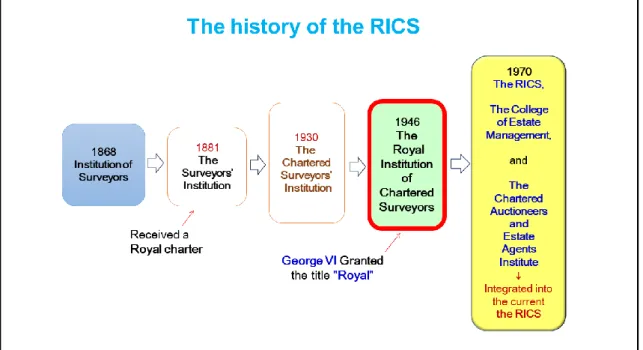
In 1868, William Sturge established the “Institution of Surveyors(IS), the predecessor of the RICS, ” for peeling off a traditional way and establishing a modern way, which eventually became the “Royal Institution of Chartered Surveyors” in 1947 [17]; this organization maintained the standards of membership and guaranteed that licensed surveyors would have outstanding qualifications and skills [15]. The IS established a compulsory professional qualifying examination for its Professional Associates and Fellows; the first
3 The businesses related to professional surveyor work are categorized by the RICS into 17 professional groups, as follows:
Art and Antiques; Commercial Property; Dispute Resolution; Facilities Management; Machinery and Business Assets;
Management Consultancy Professional Group; Residential Property; Valuation; Environment; Geomatics; Minerals and Waste; Planning and Development; Rural Building Control; Building Surveying; Project Management; Quantity Surveying;
and Construction.
12
examinations were held in 1881 [18]. The IS’s establishment and qualifying examination brought systematic management and improved quality to the profession, something that would be continued in the future through courses in higher education.
The 19th century was a turning point for modern education. And real estate shifted the focus from rural land surveys to the demand of urban area such as urban architecture. By the middle of the 19th century, the need for universal education was widely recognized; with the enactment of the Education Law in 1870 and amendments to that law in 1902 and 1918, the modern education system in the UK was established. Public college education began in accordance with the the modern education system. This law also affected popularizing higher education including surveyors. On the basis of such an eraly background, the Estate Management degree on behalf of traditional guild education system for the practical work of Surveyor, a precursor of the current real estate field, was established at this time.
In1918, real estate related education at institutions of higher education was started in the UK. William Wells borrowed facilities from London University to establish the College of Estate Management(CEM) with absorbing the Chartered Auctioneers’ and Estate Agents’ Institute[19]. The CEM was formed to serve for the property-related estate management and construction industry sectors by providing evening courses and a post-based distance learning class [20]. In 1967, a part of the College of Estate Management(CEM) was integrated into the University of Reading. The main purpose of the CEM was for passing the RICS job certification exam to be specialists of the property-related estate management and construction industry sectors.
In 1919, the Department of Estate Management was founded by William Dampier at the Faculty of Agriculture in Cambridge University. The purpose of the Department of Estate Management was rather for providing an academic foundation not than for passing the certification examination. It was the first full-time internal degree to provide an academic foundation.
13
In 1922, the IS expanded and supported training by using distance learning system for surveyors at University and Institution College. After 1930, the Chartered Surveyor, the successor of IS commissioned universities to train professional practitioners but supervised universities’ programs.
In 1946, the department of Estate Management was independent from the Faculty of Agriculture in Cambridge University and the fields of education were widened to include urban studies.
In the 1960s, new departments derived from the Department of Estate Management began to emerge and the programs for surveyor education were expanded to Technical college& Polytechnics.
In 1962, the University of Cambridge established a BSc in Land Economy with William Dampier, who had already created a BSc in Estate Management at the Faculty of Agriculture in Cambridge University.
Like this, the origins of Land Economy study in the University of Cambridge date back to Estate Management classes taught at the Faculty of Agriculture.
In 1968, the University of Reading established a BSc in the deparment of Real Estate and Planning by absorbing a part of the College of Estate Management(CEM).
In 1970, three institutions – RICS, the College of Estate Management, and the Chartered Auctioneers and Estate Agents Institute – integrated into the RICS which has continued until now. Around this time, the surveying courses of the university, which were operated under the supervision of the RICS, has been transformed into an autonomous system of university education.
Figure3 shows the developing history of the RICS.
14
Figure 3. The developing history of the RICS
From this integration, the current the RICS was established. However, in response to a decline in the number of applicants (A nearly 50% decline in the number of student surveyors in the UK occurred between 1994 and 2001 [21]) and the progress of university autonomy, the RICS had almost entirely abandoned its role in examinations [14].
After 1999, the RICS shifted into a new role overseas. The RICS transformed itself into a global organization that facilitates quality control of Chartered Surveyors outside the UK through systems such as their accredited courses and partnerships with universities, along with the Bologna Process, a program promoting globalization in higher education in the EU [16].
2.2 Making a Hypothesis about the Characteristics of Real Estate in the UK
To summarize the history of real estate related education in the UK, the education on real estate has roots in Surveyor's Training for lords’ estate management. The College of Estate Management(CEM) and the Department of Estate Management established for higher education to educate specialists mainly related to
15
the physical aspects of estate management after Amendments to the Education Law in1918 .
The first appearance of named Real Estate Department was the University of Reading, which established a BSc in Real Estate and Planning established in 1968 by absorbing a part of the College of Estate
Management(CEM).
From these series of historical developments, we make a hypothesis about main-characteristics of UK as below.
『The main-characteristics of real estate education in the UK can be said to have been practiced with center on the physical aspects having roots in surveyor's training for lords’ estate management.』
2.3 The Chronology of Real Estate Education in the UK
In this chapter, the main chronology of real estate education in the UK is summarized in the table format as follows.
Table 2. The Chronology of Real Estate Education in the UK
years The Chronology of Real Estate Education in the UK
A.D. 8 ~ 9 C
A.D.12~13 C
EarlyA.D.14 C16C
Mid 18C ~ Early 19C
In Europe, the institutional maintenance of Manorialism was established and became the economic basis of feudalism
The appearance of surveyors in the manorial system.
Apprenticeship: Surveyor's Home Career Succession Training, Auctioneer's Training Simultaneously
Start of 2nd Enclosure: privatization of landlords, wage labor of small farmers, creation of enclosure map by Enclosure surveyor, differentiation and evolution of real estate business such as commissioner, surveyor, agent, auctioneer, and appraiser, development of modern land management
service
16 1880
1868
1881
1835~7
1844~7
1870 1900’s~
Late 1900’s
1902
1911
1918
1919
1922
1930
1938
1946
1947
There was a conflict between the land caretaker (Charles C Boycott) and the tenants land use management. This case is an example of Land Questions reflected in social problems and became the economic term “boycott” of today. Bailiff, church (parish), university (University: assets of local
college) Large land ownership: Bailiff, church, parish, college
Establishment of IS (Institution of Surveyors), the predecessor of the RICS (non special education )
Member of the Institution of Surveyors founded by William Sturge.
The Surveyors’ Institution: Received a Royal Charter as Surveyors’ Institution
1st Railway speculation boom
2nd Railway speculation boom
The enactment of the Education Law
Non-agricultural serving exam preparation course at Heriot Watt College (Edinburgh), Stowe College (Grasgow)
Amendments to that law in 1902 and 1918, the modern education system in the UK was established.
At Birmingham Univ., town planning courses are conducted by surveyors who are practitioners.
William Wells borrows facilities from London University to establish the College of Estate Management, which award B.Sc degrees (Focusing on passing the RICS job certification exam,
a part of the Department in 1967 integrated into the Univ. of Reading)
Department of Estate Management was founded by William Dampier in the Faculty of Agriculture Cambridge University (Not for passing the certification exam, the first full-time internal degree to provide an academic foundation for the education of the surveyor, Incorporated into the department
of estate Management in 1964)
Institution of Surveyors(IS), the predecessor of the RICS, received a Royal Charter, expanded and supported training for Surveyors at Full-time University and Institution College, established a distance learning system (The RICS and College of Estate Management also received a Royal
Charter)
The Surveyors’ Institution became “The Chartered Surveyors’ Institution”.
Independent CEM was absorbed in the University of London, which then began offering a BSc in Estate Management.
Department of Estate Management was independent of the Faculty of Agriculture in Cambridge University and teaching field was widened to include urban studies.
George VI Granted the title “Royal” the professional body became The Royal Institution of Charter as Surveyors’
17 1960
1962
1968
1970
1991
1994
1999
Expansion surveying courses to Technical college& Polytechnics: (1960~1970)
The University of Cambridge established a BSc in Land Economy with William Dampier, who had already created a BSc in Estate Management at the same university.
The University of Reading established a BSc in Real Estate and Planning
From this integration, the current The RICS was established.
Three institutions – The RICS, The College of Estate Management, and The Chartered Auctioneers and Estate Agents Institute – all merged.
And Assessment of Professional Competence ( APC ) started by the RICS
Commencement of sustainable retraining of compulsory CPD (Counting Professional Development) for the RICS members
Abolition of supervision role of the RICS and recognition of autonomy for universities in the UK (The RICS has abandoned the role of surveillance over land surveillance, mineral surveying,
quantity surveying, planning and development, valuation, including building surveying)
The process begun with the Bologna declaration.
The RICS shifted into a new role overseas; The RICS transformed itself into a global organization that facilitates quality control of Chartered Surveyors outside the UK through systems such as their accredited courses and partnerships with universities, along with the Bologna Process, a program
promoting globalization in higher education in the EU.
18
Chapter 3. HISTORY AND CHARACTERISTICS OF REAL ESTATE EDUCATION IN THE US
In this chapter, we reviewed up the historical developments of the real estate education for identifying the characteristics of the US. And on the basis of reviewing up the historical development, we made the hypotheses bout the characteristics of real estate education in the US. We also arranged the chronology table of real estate education in the US.
3.1 The History of Real Estate Education in the US
Since the early days of the US, there had been a market environment in which the transfer of land is free.
The US has embarked on policies of moving away from Europe. Among them, a representative policy was the free trade of land. The British settlers who immigrated to the US pursued the freeholds in the New England region [23]. This custom was established in the New England region dating to before independence in 1776, which provided for a freehold of land by a certificate of registration of the transfer of the land rights[24].
In 1794, Real Estate Management Company appeared in Cruikshank Company, New York[24]. The word of “Real Estate” appeared on literatures for the first time in the history.
The year of 1862 was the age that is important in related with real estate. In this year, the Homestead Act4 was enacted for the purpose of increasing the number of independent farmers and for promoting the expansion of eastern industrial capital into the West together with western rail development. But after a few years, it caused unfavorable problems and land speculation. The unfavorable use of the Homestead Act and the conflicts between immigrants due to monopoly land ownership caused the land question that became major social issues in the US.
4 If a pioneer who resides for five years grants 160 acres of land free of charge or who has lived longer than six months, he is entitled to purchase land at $ 1.25 per acre.
19
Enactment of the Morrill Act5 was also enacted in this year. The Morrill Act with the support of the government was implemented for promoting higher education. This law had the effect of popularizing higher education and became a driving force of modern American industry. But it also caused problems of land ownership between some individuals and universities.
These social situations and land markets caused various problems like monopoly and land speculation.
Henry George in 1879 issued the social problem called the Land Question6 and Claimed Single Tax7 [25,26].
Many economists and practitioners became interested in social phenomena represented by Land Question.
The solutions to to solve the negative repercussions resulting from the Land Question were reflected in the contents of university education. In 1886, a course called Land Tenure was opened at the University of Kansas by James H. Canfield as means of investigating the Land Question; in 1892, Fred M. Taylor opened a lecture entitled the History and Theory of Land Tenure and the Agrarian Movement at the University of Michigan. Like these, courses related to Land Question were opened in some universities; however, university officials saw to it that such courses were short lived because of the lack of university stakeholders’
understanding. These courses were abolished after two years [27]
But, a course called “Property and Rent of Land” that began as a seminar in 1892, taught by R. T. Ely at the German Historical School at Wisconsin University, had been carried on and became a regular university course titled “Land Tenure” in 1916[27]. “Land Tenure” was renamed to“Land Economics” in 1919.
In1905, the first establishment of a Real Estate course that offered a full degree in higher education at two University. Real Estate courses were opened in Wharton School of Finance and Commerce and Evening
5 Free Grant of Land for Victims of Independence War and Universities.
6 Land question: Henry George(social proplem) pointed out the misappropriation of illegal land compensation, conflict with natives due to the big company's monopoly land ownership, and the land agents moral hazard.[26]
7 Single tax: At the time, Henry George argued that the biggest cause of social inequality was the inequality of land ownership, and insisted that the unpaid income (all economic rent derived from land lease) from land ownership be single-taxed and all other taxes removed.[25] Most economists had little support for Henry George, but his demands for equal opportunity and systematic economic analysis were the incentives for reform. Economists and land practitioners also became interested in social problems caused by land problems.
20
School at Philadelphia and in School of Commerce at New York University. Real Estate course was also opened at Wharton School of Finance and Commerce, Evening School in Philadelphia University and at School of Commerce, Evening School in New York University.
Like these course, real estate education at institutions of higher education were started in the US from 1905.
It is 13 years earlier than UK. In case of the UK, the College of Estate Management(CEM) established by William Wells in London University was the first time of of higher education in1918. In 1908, the School of Economics in Pittsburgh University also opened Real Estate course [28]. The general purpose and ideals put forth in these classes are illustrated in the following: “Thus, collegiate courses in real estate were designed to improve the productivity and ethical standards of real estate dealers, to improve dealers’
understanding of their economics and social function, and to provide an education about real estate customs, economics and valuation for consumer and business property owners and renters” [28].
In 1916, the first establishment of a land tenure course that gives a formal degree in higher education institutions. The courses of Land Tenure were opened by R. Ely and Taylor in Wisconsin University and in Ohio State University. As mentioned above, “Land Tenure” was renamed to“Land Economics” in 1919.
In 1916, the Association of Collegiate Schools of Business (ACSB) was established; this organization later evolved into The Association to Advance Collegiate Schools of Business (AACSB) in 1919. In 1923, the Joint Commissions (Participation in AACSB, Land Institution, and NAREB to discuss real estate education[28].) were opened under the auspices of NAREB which was established in 1908 by the US government for the “expansion of existing knowledge through education and research” with the aim of leading brokers [28]; the first three curriculums for standard real estate education were developed in 1924 (Fisher Real Estate Practice (Principles of Real Estate Practice, 1924) on real estate practice, Ely and Morehouse (Elements of Land Economics, 1924) on Land Economics, and Babcocs (Appraisal of Real Estate, 1924) on appraisal [28]). These efforts contributed greatly to the development of academic education for real estate dealers and other practitioners. In 1931, a standardized real estate curriculum began to be taught at MBA(Master of Business Administration)-level business schools [28]. Real estate
21
education from the early 1920s to the mid-1950s was a quantitative system focused on the acquisition of real estate qualifications; main object of real estate education at that time was for licensing and professional development education by land economics approach[29].
One area of remarkable growth in terms of the number of real estate programs in the 1950s was MBA programs. After 2nd World War, an increasing number of retired soldiers seeking to get qualified as real estate brokers had promoted the development of real estate vocational education in MBA. The number of MBA programs began to increased rapidly at this time, and many MBA included one or two real estate courses. Some MBA’s even offered concentration courses[30].
However, such rapid growth of real estate courses came up against an unexpected wall by the Gordon-Howwell (Ford) and Pierson (Carnegie) report 1959 [31]; the authors expressed a negative opinion of the content and quality of real estate education that focused on the acquisition of real estate certification.
The Gordon-Howwell (Ford) and Pierson (Carnegie) report said that undergraduate programs were insufficiently analytical, too institutional, and vocationally-oriented. They recommended that business schools offer only a course or two in the core fields of marketing, finance and management. They also suggested that the number of courses in “inner” fields such as real estate and insurance be reduced, the remaining courses be made much more analytical, and real estate not be a part of the “core curriculum.”
They argued that academic real estate education at the university should separate education from any certification exam [30]. This led to an overall shrinkage in the spread of real estate education, and many real estate programs and courses moved to finance departments [30]. This is the historical background of many real estate programs now in finance departments and many subjects of real estate programs having finance related topics in the US.
The early 1960s postwar economic expansion and return to peaceful life meant an increase in demand for real estate qualifications, and university real estate departments began to recover [29,30]. During this period, real estate education turned from land economics approach to a problem-solving approach for answering to developing demand by introducing various analytical techniques (also called analysis for
22
decision-making or real estate administration); at the same time, investment analysis began to be recognized as an important topic of study, providing an integration framework and an analytical basis for real estate decision-making [29]. At the end of 1964, The American Real Estate and Urban Economics Association (AREUEA) was established and researches in real estate science became more analytical and academic[30]. In the 1970s and 1980s, the problem-solving approach developed two branches:
multidisciplinary and financial management. With the proliferation of MBA programs in the 1980s, investment and finance became the most popular topic. This trend that has continued to this day [30].
In the 1990s, with the expansion of globalization, The American Real Estate Society (ARES; founded in 1985) became a catalyst for the formation of The International Real Estate Society (IRES; formed in 1992) and other real estate societies around the world [30]. The IRES has contributed to the support and development of international real estate education by holding a conference every year.
As a result of the globalization trend, the AACSB decided to accredit its first school outside of North America (ESSEC8) in 1997 and changed the organization’s name to the AACSB International Association for Management Education. In 2001 it renamed itself again, changing to the AACSB International Association to Advance Collegiate Schools of Business; the goal was to globalize and expand its certification program internationally [32].
3.2 Making a Hypothesis about the Characteristics of Real Estate in the US
To summarize the history of real estate related education in the US, the education on real estate has evolved in the business environment based on the free transfer of land ownership and the education on real estate has roots in Seminar on Land tenure.
8 ESSEC Business School (École Supérieure des Sciences Économiques et Commerciales)is an international higher education institution located in France (Cergy-Pontoise and La Défense in the Paris area), Singapore and Morocco. Founded in 1907, ESSEC Business School is one of the most selective French "Grandes écoles" and referred in France as one of the
"trois Parisiennes" (three Parisians), together with ESCP and HEC Paris. ESSEC Business School is one of the 76 schools in the world to have obtained the triple accreditation of AACSB, EQUISand AMBA. ESSEC is the first European business school to obtain AACSB accreditation. http://www.essec.edu/en/