における非対称性の関係
著者 山本 敬三
雑誌名 北翔大学北方圏生涯スポーツ研究センター年報
巻 6
ページ 1‑6
発行年 2015
URL http://id.nii.ac.jp/1136/00002106/
北翔大学北方圏生涯スポーツ研究センター年報 第6号 2015
Bulletin of the Northern Regions Lifelong Sports Research Center Hokusho University Vol.6
スキージャンプにおける助走姿勢とテイクオフ動作における非対称性の関係
Relationship of Asymmetry between In-run Posture and Takeoff Motion in Ski Jumping 山 本 敬 三
Keizo YAMAMOTO
─ ─1
スキージャンプにおける助走姿勢とテイクオフ動作における非対称性の関係
Relationship of Asymmetry between In-run Posture and Takeoff Motion in Ski Jumping
山 本 敬 三 Keizo YAMAMOTO
Abstract
In a series of movement of the ski jumping except for landing, bilateral symmetric movement is required to a ski jumper for aerodynamic efficiency and stability. The purpose of this study was to evaluate the relations of biomechanical bilateral asymmetry between the in-run posture and the takeoff motion in ski jumping. Nine male and six female subjects consented to participate in the study. They performed three simulated takeoff motions with their training shoes on a flat floor. We measured the in-shoe forces at the soles of both feet during the in-run posture and the takeoff motion, using the insole-shape sensors for plantar pressure distribution. By calculating the imbalanced load at the in-run posture and the force-time integral during the takeoff motion, we ascertained the symmetry index (SI) in both phases. The mean values of three trials of each subject were determined as measurements. Correlation between two SIs in in-run and takeoff was determined by analysis of correlation, which yielded a positive correlation (r = .63, P <
.05). Results showed that the imbalanced load during the in-run phase somewhat influenced the bilateral imbalance of takeoff forces during the takeoff motion.
Keywords:in-run posture, in-shoe force, force-time integral, imbalanced load
北翔大学生涯スポーツ学部スポーツ教育学科
Ⅰ.Introduction
A ski jumping comprises six successive actions of in-run, takeoff, early stage of flight, stable flight, preparation for landing, and landing in order. The dynamic features of actions from in-run to stable flight in these movements is important for competitive performance.1) 2) 3) 4) Bilateral symmetric postures in the in-run and the flight phases may be advantageous aerodynamically, if the wind acted on a ski jumper is the head wind of constant direction and speed such as
a wind tunnel laboratory. In addition, good symmetry in the flight phase is advisable to obtain better flying form points.
The takeoff motion connecting the in-run posture and flight posture is desired a bilaterally balanced performance. In earlier studies of the takeoff motion however, the motion was assumed bilaterally symmetry and the bilateral imbalance has been discussed only scarcely. For example, Virmavirta et al. (2009; 2011) assumed that the both sides of the body during takeoff were symmetrical. 5) 6) Janura et al. (2010) conducted a kinematic analysis of the in-run
スキージャンプにおける助走姿勢とテイクオフ動作における非対称性の関係
posture using two-dimensional video image data but no reference to bilateral imbalance. 7) Similarly, in earlier studies of flight posture, its bilateral symmetry was merely assumed. 8) 9) 10)
Observing the ski jumper’s posture reveals some bilateral imbalance in the in-run posture and the takeoff motion (Fig. 1). Komi and Virmavirta (1997)
described that well-balanced in-run posture is a prerequisite for a good takeoff in ski jumping.11) They emphasized the importance of a continuous transition from the in-run posture to the takeoff motion.
Therefore, the purpose of this study was to evaluate the relations of biomechanical bilateral asymmetry between the in-run posture and the takeoff motion in ski jumping.
Ⅱ.Method
Nine male subjects (age 17.3 (2.1) yr; height 1.71 (0.06) m; mass 58.3 (4.0) kg; mean (SD)) and six female subjects (age 20.8 (2.2) yr; height 1.59
(0.04) m; mass 53.4 (1.7) kg; mean (SD)) consented to participate in this study. All the participants were ski jumpers that had trained to improve their performance. They participated in our research after being given a verbal account of the study procedures and after submitting written informed consent.
They performed three simulated takeoff motions with training shoes on a flat floor. Capacitance-based insoles (Pedar-X; Novel GmbH, Munich, Germany)
were used to measure the in-shoe forces at a sampling frequency of 100 Hz (99 sensors per foot, total weight of the device was 0.95 kg). We measured the plantar pressure distribution during performance inserting the insole-shaped pressure distribution sensor fitting to their foot size into their training shoes. They wore leg tights to accommodate the cord connecting the sensor and logger. To avoid disturbing their performance, the cord was put in the tights. We forced them to take a fixed foot position at in-run posture to eliminate any bilateral asymmetry in fore-and-aft positioning. The plantar pressure distribution sensor was calibrated properly by adherence to the provided manual. The in-shoe forces of both feet were obtained using taking the resultant of forces measured by plantar pressure distribution sensor. The force acted on each sensor was calculated of product of the outputted pressure and the area of each single sensor. And then, the in- shoe force of each foot was obtained from the sum of all 99 points. The raw force curves were smoothed using a fourth-order (zero lag) low-pass Butterworth filter with a cut-off frequency of 30 Hz. Software
(DIAdem 2010; National Instruments Corp., Austin, TX) was used for data processing.
In calculation of the bilateral force imbalance during the in-run posture, we first measured the 0.5 s time- average of the in-shoe force of both feet at static in-run posture in each trial and then calculated the mean of these three trials to determine the measured value of in-shoe force. SI for each subject was calculated using the equation presented below.
Fig. 1 Bilateral asymmetry during in-run phase (a) and take off phase (b), photographs taken from behind ski jumper.
(a) Uneven load toward right in in-run posture and bilateral asymmetry in upper limb.
(b) Shoulder joint of left limb is extended compared to that of right limb in takeoff motion (arrow).
─ ─3
SI= R−L ×100(%)
0.5×(R+L)
In that equation, R and L respectively represent the measured values of in-shoe force on the right and left feet. SI is positive for R > L.
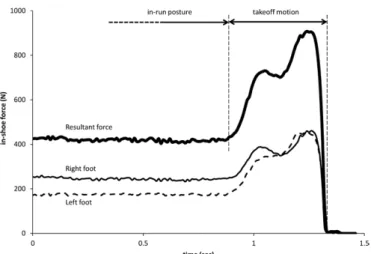
For calculation of the bilateral force imbalance in the takeoff motion, we first obtained the force-time integral (FTI) from the beginning of takeoff to toe- off for each foot in each trial, and then calculated the mean FTI of these three trials. SI of the takeoff motion was calculated to define the bilateral imbalance in the same manner as described above. We determined the time interval of the takeoff motion from the curve of the resultant in-shoe force for two feet. To do so, we calculated the mean and SD of the resultant in-shoe force in the in-run posture. Defining the beginning of the takeoff motion as the instance in which the resultant in-shoe force exceeded mean + 2SD and the end of it as the instance of toe-off (Fig. 2).
Statistical procedures
For data of 15 subjects, we conducted a paired t-test, examined the statistical bilateral imbalance of in-shoe force at the in-run posture and of FTI in the takeoff motion. Furthermore, the relation of these two SIs was tested after performing Pearson analysis of correlation between SIs in the in-run posture and the takeoff motion. For all statistical analyses, SPSS 14.0 (SPSS Inc., Chicago, IL) was used with level of significance P
< .05.
Ⅲ.Results
Mean (SD) of in-shoe force in the in-run posture were 258.56 (53.9) N for the right foot and 230.87
(51.0) N for the left foot, the former was significantly greater than the latter (P < .05). Mean (SD) of FTI in the takeoff motion was 197.56 (36.6) Ns for the right foot and 192.03 (35.18) Ns for the left foot, with no significant difference between them (P = .099). An example of in-shoe force curve from the in-run posture to takeoff was portrayed in Fig. 2. Bilateral imbalance of load was recognized during the in-run posture and the takeoff motion. In the subject presented in Fig. 2, the takeoff force curves had two peaks, with the first peak of 386.4 N (right foot) and 356.7 N (left foot) and in-shoe force of right foot was greater than that of the left foot. At the second peak, they were 454.3 N (right foot) and 438.9 N (left foot), with a smaller imbalance than that at the first peak.
In statistical analysis, a moderate significant correlation (r= .63) was observed between SI in the in-run posture and SI in the takeoff motion (Fig. 3).
Figure 3 depicts the correlation between two SIs in the in-run posture and in the takeoff motion. Values in x-axis stand for SI in the in-run posture and those in y-axis for SI in the takeoff motion. They are averaged values for each subject. A positive SI denotes uneven loading on the right foot and a negative one on the left foot. Fourteen subjects had recorded uneven loading on right foot in the in-run posture. The largest SI in
Fig. 2 In-shoe force curves and their resultant force from in-run posture to takeoff measured at both feet.
Fig. 3 Relation between symmetry indexes (SI) between in-run posture and takeoff motion.
Plus value in both abscissa and ordinate means that the load or takeoff force in lower right limb is greater than that in the lower left limb.
スキージャンプにおける助走姿勢とテイクオフ動作における非対称性の関係
the in-run posture was 33.2% and that in the takeoff motion was 12.1%.
Ⅳ.Discussion
The positive correlation was found between two SIs in the in-run posture and in the takeoff motion (r= .63, P< .05). This result suggests that the influence of uneven loading in the in-run posture on bilateral imbalance in the takeoff force. This result suggests that in-run and takeoff are not mutually independent and that they maintain continuity. Schwamedar (2008)
described that ”The relative success of each phase is dependent upon the previous one.” 12) The results support that assertion quantitatively. Therefore, reducing the bilateral imbalance in the in-run posture might be able to improve the lateral imbalance in the takeoff motion.
Regarding the effect of bilateral asymmetry on jump performance, Yoshioka et al. (2010, 2011) assessed the effects of bilateral asymmetry in muscle strength on the jumping height of the squat jump. 13) 14) They compared the jumping height of the symmetry model with that of 10% bilateral asymmetry of muscle strength model using a computer simulation technique. The difference in jumping height was 0.5%. They negated the influence of asymmetry on the height. Similarly in our research, subjects with uneven loading in the in-run posture less than 10%
of SI generally showed small SI in the takeoff motion.
These results suggest a negligible effect of asymmetry on jumping performance for small SI in preparatory posture. However in ski jumping, jumping height alone does not provide a high evaluation of performance.
Achieving postural stability of flight in an early stage after takeoff is one target of all ski jumpers and a key issue related to improved performance. 12) Asymmetry of muscle strength in lower limbs causes displacement of the center of gravity and leaning of the body trunk in a horizontal direction in vertical jumping. 13) 14)
Concerning the effect of bilateral imbalance on ski jumping, an excessive imbalance of bilateral takeoff force might cause the rolling of body. That brings about challenge of postural control in rolling direction in early flight phase and exercises a bad influence on jumping performance.
We found a positive correlation between SI in
the in-run posture and that in the takeoff motion and recognized a definite connection between them.
However no significant difference between both feet was recognized in the takeoff motion. These results suggest that subjects in this study took tactical movement to correct bilateral imbalance in static in- run posture during the dynamic takeoff motion later.
Although this movement was probably done to secure the safety in the flight phase after takeoff, this tactical movement was not able to identify it from the present study. In actual performance at a jumping hill, some jumpers exhibit bilateral imbalance in movement of upper limb and others take an in-run posture with feet displaced back and forth. These might be tactics to mitigate bilateral asymmetry in movement and posture. They are open to future study. The results of this study are expected to be helpful to ascertain methods of training and tactics of performance to eliminate bilateral imbalance. Moreover, they might provide basic data to select the best tools and gear.
Limitations
The subjects of this study were mainly junior athletes, so it is not clear that world-class athletes also have similar laterality shown in the study.
Furthermore, although these subjects wore training shoes and performed simulated takeoff motions, it remains unclear whether the bilateral asymmetry found in this study is enhanced or reduced in actual performance with ski-boots, skis, and suits. To address this issue, additional experiments will be undertaken making use of an advanced ramp equipped with a force measuring system that can measure floor reactions to the right and left feet separately, as Schwameder (2008) described. 12)
Acknowledgement
This work was supported by JSPS KAKENHI Grant Number 22700620.
References
1)Arndt, A., Brüggemann, G.P., Virmavirta, M. et al.:
Techniques used by Olympic ski jumpers in the transition from takeoff to early flight. Journal of Applied Biomechanics, 11:224−237, 1995.
2)Schwameder, H., Müller, E.: Biomechanische
─ ─5 Beschreibung und Analyse der V-Technik im Skispringen (Biomechanical description and analysis of the V-technique in ski-jumping).
Spectrum der Sportwissenschaften, 7: 5-36, 1995.
3)Schwameder, H., Müller, E., Lindenhofer, E. et al.:
Kinematic characteristics of the early flight phase in ski-jumping. In: Müller, E., Bacharach, D., Klika, R., Lindinger, S. Schwameder, H. (Eds.),Science and skiing III, 381-391, Oxford: Meyer & Meyer Sport, 2005.
4)Virmavirta, M., Isolehto, J., Komi, P. et al.:
Characteristics of the early flight phase in the Olympic ski jumping competition. Journal of Biomechanics. 38(11):2157−2163, 2005.
5)Virmavirta, M., Isolehto, J., Komi, P et al.: Take-off analysis of the Olympic ski jumping competition
(HS-106m). Journal of Biomechanics. 42(8):
1095−1101, 2009.
6)Virmavirta, M., Kivekäs, J., Komi, P.: Ski jumping takeoff in a wind tunnel with skis. Journal of Applied Biomechanics. 27(4):375−379, 2011.
7)Janura, M., Cabell, L., Elfmark, M. et al.: Kinematic characteristics of the ski jump inrun: a 10-year longitudinal study. Journal of applied biomechanics.
26(2):196−204, 2010.
8)Lee, K.D., Park, M.J., Kim, K.Y.: Optimization of ski jumper's posture considering lift-to-drag ratio and stability. Journal of Biomechanics. 45(12),2125−
2132, 2012.
9)Schmölzer, B., Müller, W.: The importance of being light: aerodynamic forces and weight in ski jumping. Journal of Biomechanics. 35(8):1059−
1069, 2002.
10)Schmözer, B., Müller, W.: Individual flight styles in ski jumping: results obtained during Olympic Games competitions. Journal of Biomechanics. 38
(5):1055−1065, 2005.
11)Komi, P.V., Virmavirta, M.: Ski-jumping take- off performance: Determining factors and methodological advantages. In Müller, E., Schwameder, H., Kornexl, E., Raschner, C. (Eds.),
Science and skiing, 3-26, Cambridge, UK: Chapman
& Hall, 1997.
12)Schwameder, H.: Biomechanics research in ski jumping, 1991-2006. Sports Biomechanics. , 7(1):
114−136, 2008.
13)Yoshioka, S., Nagano, A., Hay, D. C. et al.: The
effect of bilateral asymmetry of muscle strength on jumping height of the countermovement jump:
a computer simulation study. Journal of Sports Sciences. 28(2):209−218, 2010.
14)Yoshioka, S., Nagano, A., Hay, D. C. et al.: The effect of bilateral asymmetry of muscle strength on the height of a squat jump: a computer simulation study. Journal of Sports Sciences. 29
(8):86−877, 2011.
スキージャンプにおける助走姿勢とテイクオフ動作における非対称性の関係
抄 録
本研究の目的は,スキージャンプにおける助走姿勢と踏切動作におけるバイオメカニクス的左右差 の関係を調査することとした。被験者は9名(男6名,女3名)とした。被験者には,平地上で助走 姿勢からテイクオフ動作を3試技課した。インソール型の圧力分布センサを用いて,助走姿勢からテイ クオフ動作完了までの左右足それぞれの床反力を計測した。助走姿勢時の荷重配分とテイクオフ動作 中の踏切力積を算出し,両局面における対称性指数(symmetry index,以下SI)を求めた。個人の3 試技の平均値を測定値とした。相関分析より,助走姿勢時とテイクオフ動作時のSIの関係性を求めた。
両者には正の相関関係が認められた(r = .63, P < .05)。本研究により,テイクオフ動作時の踏切力の 力学的左右差は,助走姿勢時の荷重配分の影響を受けることが分かった。
キーワード:助走姿勢,床反力,踏切力積,荷重配分