Abstract
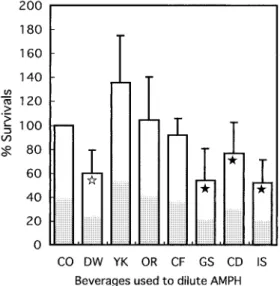
Amphotericin B(AMPH)has been generally used for prophylaxis or treatment of specific fungal dis- eases in immunocompromised patients. However, because it is difficult for children to ingest, mainly be- cause of its bitter taste, it is often diluted with soft drinks. We therefore investigated the effect of dilution of AMPH with various beverages on its antifungal activityin vitro.Candida albicanscells were exposed for 30 min to AMPH diluted twofold with each of six commercially available beverages or distilled water, and percent survival was determined. The results showed 60% survival in the dilution with distilled water and higher survival when diluted with Yakult(136%;p<0.01), orange juice(104%;p<0.01), and coffee-milk(92%;p<0.01). By contrast, lower survival was obtained when diluted with gum-syrup(54
%), sweet cider(76%), and shaved-ice syrup(52%)with no significant differences from distilled water
(60%),suggesting that these three beverages may be useful for diluting AMPH. The results of this study are a warning to medical workers that some methods of making AMPH more palatable considerably de- crease its antifungal activity and may have a negative effect on host defenses against infectious diseases.
〔J.J.A. Inf. D. 77:29〜33, 2003〕
Introduction
Protecting patients who are immunocompromised by chemotherapy for malignant tumors from con- tracting infectious diseases is a significant problem, and diseases caused by fungal infection, such as candi- dosis, progress rapidly and often lead to death1)〜3). Therefore, antifungal agents are usually administered to immunocompromised patients, as prophylaxis, to treat specific infections, or as empirical or preemptive therapy4). Continuous oral administration of antifungal agent, such as amphotericin B(AMPH)5)6), is re- quired to treat such patients, in addition to general countermeasures such as hand-washing by the medi- cal personnel and gargling by the patients.
However, it is sometimes difficult for children to ingest AMPH because of its appearance, bitter taste, and unpleasant smell, and oral administration seems to exacerbate the suffering of these patients, who
Effect of Amphotericin B Dilution with Various Beverages on the Survival of Candida albicans Cells
Tomoe OHSHIMA1), Yozo MIYAKAWA2), Tamiko WATANABE1)& Kenji OHYAMA1)
Department of1)Clinical Nursing,2)Life Sciences, Yamanashi Medical University
(Received:July 8, 2002)
(Accepted:November 20, 2002)
Correspondence to:Yozo MIYAKAWA
Department of Life Sciences, Yamanashi Medical University, Tamaho, Yamanashi 409―3898, Japan antifungal activity, amphotericin B,Candida albicans, beverage Key words:
have already experienced exhaustion and vomiting during the course of chemotherapy. Therefore, at- tempts are generally made to reduce the discomfort by chilling or diluting AMPH with beverages, such as orange juice. However, the antifungal activity of AMPH may be greatly affected by conditions within the oral cavity or by the method used to make it palatable(such as dilution with beverages).We there- fore investigated the effects of dilution of AMPH with various commercially available beverages on its an- tifungal activityin vitro, usingCandida albicansas a representative causative species of opportunistic fun- gal infections.
Materials and Methods
Strain and culture conditions.C. albicansM1012 serotype A that had been maintained in our labora- tory7)and identified by serological methods with Candida Check8)was used as a representative causative strain of opportunistic infections. It possesses marked ability to adhere to human buccal epithelial cells or to various tissue cells9).The cells were grown in Sabouraud glucose liquid medium7)or on Sabouraud glu- cose agar plates containing streptomycin(50 mg!l).
Antifungal agent and preparation of test samples. Amphotericin B(AMPH), whose proprietary name is FUNGIZONE SYRUP(Bristol-Myers Squibb, Munich, Germany), was used as the antifungal agent in this study. Yakult(aLactobacillus product;Yakult Honsha Co. Ltd., Tokyo),100% orange juice
(Orange juice;GOLD PACK Co. Ltd., Tokyo), coffee-milk(Snow Brand Milk Products Co. Ltd., Tokyo), gum-syrup(KEY COFFEE INC., Tokyo), sweet cider(Asahi Soft Drinks Co. Ltd., Tokyo), and shaved-ice syrup(MEIDI-YA Co. Ltd., Tokyo)were used in this study. AMPH, 100 mg(potency)!ml, was diluted twofold with each of these beverages or with distilled water and used as the test solutions.
Determination of antifungal activity. A 0.2 ml portion of aC. albicanscell suspension(1.1×10⁷!ml)was added to 2 ml of each of the test solutions described above, and they were incubated for 30 min at room temperature. After 500-fold dilution, a 0.1 ml sample was immediately plated onto Sabouraud glucose agar and incubated at 30℃ for 48 hr. The number of yeast cells after the 30-min incubation was determined by counting the colonies on agar plates. The sample in which the test solution was replaced by distilled water(containing no AMPH or beverage)was used as a control. The ratio of the number of colonies with the test solution to the number of colonies in the control(averaged 200 colonies!plate)times 100 was used as the percent survival. Experiments with each sample were replicated at least three times. In this proto- col, the washing step to remove traces of AMPH transferred onto each agar plate by 0.1 ml plating(10 µg!20 ml of plate)was omitted based on the results of the following experiment. To test the effect of traces of AMPH on percentage survival, immediately after the 30-min drug exposure cells were washed 1―3 times with 5 ml of distilled water(DW)by centrifugation, then suspended in 2 ml DW, and diluted 500- fold with DW( washed sample ),or the cells exposed to the drug for 30-min were directly diluted 500- fold without washing( unwashed control sample ).Thereafter, both of the 0.1-ml washed and un- washed samples were subjected to colony counting as described. The percentage survival, 62.0% for 1 wash, 66.7% for 2 washes, and 56.7% for 3 washes(averages of 3 experiments), did not significantly differ from the 60.3% in the unwashed control by the Student sttest, showing that traces of AMPH had no ef- fect on percentage survival, and thus that the washing step could be omitted.
Statistical analysis. The statistical significance of the data was determined by Student sttest. AP value of less than 0.05 was considered significant.
感染症学雑誌 第77巻 第 1 号
Results
We investigated the effects of dilution of AMPH with various beverages on its antifungal activityin vitro(Fig. 1).The results showed that percentage survival after dilution with distilled water was 60%, and that it was significantly higher in Yakult(136%;p<0.01), orange juice(104%;p<0.01), and coffee- milk(92%;p<0.01). By contrast, a markedly lower level of percentage survival was obtained with gum- syrup(54%), sweet cider(76%), shaved-ice syrup(52%), none of which was significantly different from the percentage survival with distilled water(60%)(indicated by stars in Fig. 1),suggesting that these three drinks may be useful for diluting AMPH.
We also examined the direct effect(without AMPH)of the six beverages used in the above experi- ments on the survival ofC. albicans cells. The cells were exposed for 30 min to each of the beverages in
Fig. 1 Effect of AMPH dilution with various bever- ages on percentage survival of Candida albicans cells.
To AMPH, which was diluted twofold with distilled water(DW), Yakult(YK), orange juice(OR), coffee- milk(CF), gum-syrup(GS), sweet cider(CD), and shaved-ice syrup(IS),C. albicanscells were added, and the cells were incubated for 30 min. Yeast cell survival was then determined as a percentage of the control(CO)(incubated 30 min solely with dis- tilled water without AMPH ) and expressed as means ± standard errors ( 100% survival corre- sponds to an average of 200 colonies!plate). The bar with the solid star indicates that the percentage survival with these beverages was not significantly different from that for AMPH diluted with distilled water(open star;ca. 60% survival)by Student s ttest.
Fig. 2 Direct effect of various beverages on the sur- vival ofC. albicanscells.
C. albicanscells were treated for 30 min with each of the six beverages(the same beverages and abbre- viations as those used in the experiments shown in Fig. 1).After treatment, the percentage survival of yeast cells compared to the control(exposed for 30 min to distilled water alone)(CO)was determined.
The bar with a solid circle indicates that the per- centage survival with these beverages was found to be significantly higher than with for the control
(open circles)by Student sttest.
the absence of AMPH, and survival as ratios of the control cells(100% survival)exposed to distilled water alone were compared( Fig. 2 ). The results showed significantly increased percentage survival with Yakult(144%;p<0.01), orange juice(148%;p<0.01), and coffee-milk(122%;p<0.05)(indicated by the solid circles in Fig. 2), indicating cell division-promoting activity of these drinks.(Although Yakult contains livingLactobacilluscells, none of these cells were observed in the agar plates with streptomycin
[see Materials and Methods]). By contrast, the survival ratio was not greatly affected by the other three beverages(gum-syrup, sweet cider, and shaved-ice syrup).
Discussion
For many years AMPH has been used as a systemic antifungal agent. It is a polyene macrolide that binds to sterol components of the fungal cell membrane, altering membrane permeability and permitting cytoplasmic constituents to leak out of the cell2)10). In clinical investigations, AMPH has been reported to bind to serum lipoproteins6). The results of ourin vitroexperiment shown in Fig. 1 are interpreted as in- dicative of retention of the antifungal effect of AMPH when diluted with certain beverages, such as gum- syrup, whose main ingredient is sugar. By contrast, dilution of AMPH with beverages containing lipids, such as Yakult or coffee-milk, markedly reduced its antifungal effect againstC. albicans, suggesting an in- teraction between AMPH with some of these compounds.
While most nurses have emphasized the comfortable use of antifungal agents clinically, especially when administering them to children, they have not always sufficiently checked their effect on antifungal activity. The results of this study indicate that dilution of AMPH with certain beverages markedly re- duces its antifungal activity. Our study therefore may warrant a warning to medical workers that some attempts to make AMPH more palatable cause a marked decrease in antifungal activity, and thus have a negative effect on host defense against serious infectious diseases.
In addition, the results of our experiment on the direct effects of the six beverages used in the above experiments on the survival ofC. albicanscells revealed a significant increase in percentage survival with some of them, such as Yakult(Fig. 2). This indicates that some beverages may possess cell division- promoting activity and suggests that gargling immediately after their ingestion should be performed to prevent fungal infections in immunocompromised patients.
The results of this study suggest that some beverages, such as Yakult, have the ability to markedly reduce the antifungal activity of AMPH(Fig. 1)and may also possess cell division-promoting activity(Fig.
2),however, it remains unclear whether such effects also occurin vivo.Further investigations, such as in experimental animals or etiological studies in immunocompromised patients, are required to apply the re- sults from the basic study to clinical fields.
References
1)Abe S, Yamaguchi H:Host Defense Mechanisms against Fungal infections. Jpn J Med Mycol 2000;41:77―81.
2)Bodey GP, 2nd edn. Candidiasis:Pathogenesis, Diagnosis, and Treatment. Raven Press, New York, 1993.
3)Odds FC, 2nd edn. Candida and Candidosis:A Review and Bibliography. Balliere Tindall, London, 1988.
4)Castagnola E, Bucci B, Montinaro E, Viscoli C:Fungal infections in patients undergoing bone marrow transplantation:
an approach to a rational management protocol. Bone Marrow Transplant 1996;18 Suppl 2:97―106.
5)Dutcher JD:The discovery and development of amphotericin B. Dis Chest 1968;54:Suppl 1:296―8.
6)Lyman CA, Walsh TJ:Systemically administered antifungal agents. A review of their clinical pharmacology and thera-
感染症学雑誌 第77巻 第 1 号
peutic applications. Drugs 1992;44:9―35.
7)Kagaya K, Miyakawa Y, Fujihara H, Suzuki M, Soe G, Fukazawa Y:Immunologic significance of diverse specificity of monoclonal antibodies against mannans ofCandida albicans. J Immunol 1989;143:3353―8.
8)Miyakawa Y:Identification of aCandida albicanshomologue of thePHO85gene, a negative regulator of the PHO system inSaccharomyces cerevisiae.Yeast 2000;16:1045―51.
9)Miyakawa Y, Kuribayashi T, Kagaya K, Suzuki M, Nakase T, Fukazawa Y:Role of specific determinants in mannan of Candida albicansserotype A in adherence to human buccal epithelial cells. Infect Immun 1992;60:2493―9.
10)Lampen JO:Amphotericin B and other polyenic antifungal antibiotics. Am J Clin Pathol 1969;52:138―46.
Candida albicansに対する amphotericin B の抗菌活性に及ぼす薬剤希釈法の影響
山梨医科大学・1)臨床看護学,2)生命科学
大島 智恵1) 宮川 洋三2) 渡邉タミ子1) 大山 建司1)
小児の真菌感染予防及び治療に使用される am- photericin B シロップ(以下,AMPH)は,内服が 困難であるため,ジュースで稀釈する等の工夫が されている.そこで,AMPH を稀釈する際の稀釈 液の違いが抗菌活性に与える影響を試験管内(in vitro)で検討した.ヤクルト等 6 種の希釈液,ま たは蒸留水により AMPH を各々 2 倍希釈したも
のに,Candida albicans菌液を添加,30 分間放置後
の残存生菌率を測定した.その結果,蒸留水(60
%)と比べ,ヤクルト 136%(P<0.01),オレンジ
ジュース 104%(P<0.01),コーヒー牛乳 92%(P
<0.01)と有意に高値であった.一方,ガムシロッ
プ,炭酸ジュース,かき氷シロップの 3 種では,
各々 54%,76%,52% と蒸留水と有意差を認め ず,抗菌活性が保持されたことから,これら 3 種 が稀釈液として有効であることが示唆された.今 回の結果から,臨床の現場で患児に AMPH を安 楽に内服させようとする行為が,方法によっては 抗真菌効果を低下させ,感染予防という本来の目 的に逆行してしまう可能性が強く示唆された.