Acta med nagasaki. 6 : 36 - 42
Thyroid Tumors Among Those
Exposed to Radiation From the Atomic Bomb
Chikao HARANO, Hiroshi TEZUKA and Raisuke SHIRABE*
First Department of Surgery Nagasaki University Medical School
Received for publication August 30, 1961
45 out of 205 cases of thyroid diseases seen in 14 years, 1947 through 1960 had some history of exposure to the atomic bomd radiation. These were investigated for the relationship between various types of thyroid di- seases and the atomic bomb radiation. The results of the study are as follows :
1) Of the thyroid disease of those who were exposed within 2 km from the hypocenter, the incidence of thyroid cancer was evidentally higher than that of the non-exposed incidence. 2) No particular changes specific to ra- diation were recognized in the histological findings of thyroid cancer of the exposed. 3) Exposure during early years of life had a greater effect in in- creasing incidence of thyroid cancer than in the exposure during later years.
4) Toxic goiter was less common among the exposed than among the non- exposed. These two groups were compared for incidence of specific thyroid diseases.
It has already been reported by TH. WINSHIP (1955)°' and KUWAHARA 4' that radiation has an important role in the increasing incid- ence of thyroid cancer, but there has been no report on the relation between thyroid cancer and exposure to the atomic bomb.
However, OBO6,7>, MORI5' and IsHIDA3' have reported a high incidence of cance of all kinds among those exposed to the atomic bomb.
By the kindness of various hospitals in Nagasaki City and ABCC we had an opportunity to study 205 cases of thyroid tumors resected during January 1947 through December 1960. We found 45 cases of thyroid tumors among the exposed and compared these cases with 160 cases of thyroid tumors among the non-exposed. This is a report of the study.
DATA AND CLASSIFICATION OF THYROID TUMORS
The sources of the patient material of the study are as shown in Table 1. Thyroid glands were resected and examined histologically.
The location of all patients at the time of exposure was investigated
*原 野 愛 生 ・手 塚 博 ・調 来 助
1962 THYROID TUMORS 37 and those who were exposed within 5km were regarded as the exposed and those beyond 5km as the non-exposed.
The classification of the diseases mostly followed that of the American Goiter Association with the following exceptions for conve- nience of collecting the materials : so-called papillary adenocarcinoma and metastatic malignant adenoma were regarded as adenocarcinoma; di- ffuse toxic goiter and nodular toxic goiter were considered together simply as toxic goiter; diffuse nontoxic goiter which was rare, and the goiter caused by the rudement of thyro glossal duct were put under the heading "others"
RESULTS
1) The frequeucy by sex and age at the time of operation was studied on both exposed and non-exposed groups, and the result was as shown in Table 2. Female cases were much more frequent than male cases in both groups with the proportion of 6.5: 1 in the exposed group and 5.6: 1 in the non-exposed group. There was no significant difference between the two groups. Among the non-exposed group, the frequency was high from age 20 through 50, wheras it was highest in 30's among exposed group, of which median age was higher than the non-exposed. In other words, there was a tendency of low in the twenties and of high contraction in the sixties or more in the exposed cases compared to the non-exposed cases.
Table 1 Sources of the Cases
SchoolDept.
Unive. Med.Dept.
"Non -Exposed" ,
1stof Surgery 15
hool 2ndof Surgery 4
8
Exposed Non-Exposed Total
86 101
ScNagasaki13 17Nagasaki Univ, Med,
Nagasaki A-Bomb Hospital 0 8
Nagasaki Tomonaga Hospital 12 58 70
Nagasaki Mitsubishi Hospi3 7
Other Hospitals in Nagasa0 2
Tot160 205
Remarks: (1) Those who were directly exposed within 5km from the hypocenter are classified here as
(2) The cases are limited here only to those who underwent operation in Nagesaki
tal 4
ki 2
al 45
C. HARANO et al
Table 2
Frequency of the Thyroid Disease By Sex and Age
94.4
00
0
Exposed Non-Exposed
Age
M F Total / M F Total ~o
- 9 0 0 0 0 0 1 1 0 .6
10 - 19 0 2 2 4.4 3 12 15 9.4
20 - 21 1 25 33 38 23.7
30 - 39 1 15 16 35.6 8 33 41 25.6
40 - 49 1 8 9 2
.4 33 37 23.1
50 - 59 1 6 7 15.5 2 12 14 8.8
60 - 2 7 9 20,0 3 11 14 8.8
Total 6 39 45 100.0 25 35 160 100.0
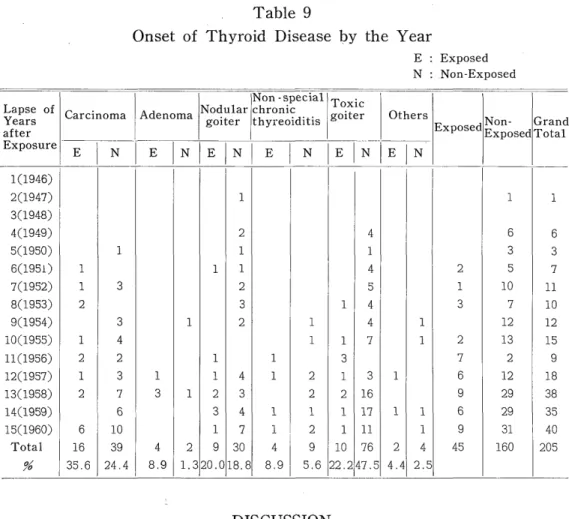
2) In regard to the frequency by disease in the exposed cases, as indicated by Table 3, thyroid cancer was predominant with 16 cases or 35.6%, which was followed by 10 cases (22.2%) of toxic goiter. In the non-exposed cases, toxic goiter was most prevalent with 76 cases (47.5%), which was followed by 39 cases (24.4%) of thyroid cancer and 30 cases (18.3%) of nontoxic nodular goiter.
Table 3
Frequency of the Thyroid Disease by Type and Sex
10.6±2.4 13.8±2.7 8.9±4.2
18.8±3.1 5.6±1.8 22.2±47.5±4.0
2.5±1.2 100.0
M F Total
Exposed Non-Exposed
io M F Total °o
Adenocarcinoma* 0 7 7 15.6±5.4 1 16 17
Papillary carcinoma* 2 7 9 20,0±5.9 4 18 22
1 1 2 1.3±0.9Adenoma 0 4 4
Nodular goiter 0 9 9 20.0±5.9 1 29 30
Non-special chronic
thyreoiditis 0 9 9
Toxic goiter 3 7 106 2 17 59 76
Others 0 2 2 4.4±3.1 1 3 4
25 135 160 100.0Total 6 39 45
* Malignant tumor
1 3 4 8. 9±4.2
3) The frequency by disease and age are shown in Table 4 and
Table 5. It is difficult to find a significant difference between the
exposed cases and non-exposed cases. The age at the time of exposure
and the incidence of cancer among the exposed cases are shown in
Table 6. The incidence of malignancy was highest among thyroid lesion
in the youngest age group of exposed population.
C, _ HARANo et al
Table 4
Frequency of the Thyroid Disease by Type and Age (Exposed)
Adenomachronicma goitergoiter
99
20.04.8 9
Non - specialAdeno
- PapillaryNodular Toxic O
thers Total °ocarcinoma carcino ,ditis
- 9 0 0 0 0 0 0 0 0 0
10-19 0 1 1 0 0 0 0 2 4.4±3.1
20-29 0 1 0 0 0 1 0 2 4,4±3.1
30-39 3 3 0 4 1 4 1 16 35.6±7,1
40-49 1 1 2 2 0 3 0 g 20.0±6.0
50-59 1 1 1 1 0 2 1 7 15.6±5.4
60- 2 2 0 2 3 0 0 9 20.0±6,0
Total 74 10 2 45 100.04
6 0~0 15.6±5.4 20.0±6.0 8.9±1,3 1±1.3 2±6.23,1 100.0
Table 5
Frequency of the Thyroid Disease by Type and Age (Non-Exposed)
NodularToxic
20-29
8.8±2.2
18.8 5
.6±1.8
'y Ad
enomachronic Non-special i
Adeno- Papillar°
carcinoma carcinoma goiter th
yreoiditis goiter Others Total /°
- 9 0 0 0 0 0 1 0 1 0 .6±0,6
10-19 1 0 0 0 0 13 1 15 9.4±2.3
2 4 0 7 1 25 0 39 24.4 ± 3.4
30-39 4 3 0 11 2 19 2 41 25,6±3.5
40-49 4 7 1 5 3 15 1 36 22.5±3.3
50-59 3 1 1 5 2 2 0 14
60- 3 7 0 2 1 1 0 14 8.8±2.2
Total 17 22 2 30 9 76 4 160 100.0
475 2,5 100 .0°0 10.6±2.4 13.8±2.±1
.0 ±3.951 ±1.23
7 1.3±0.9
'
Table 6
Frequency by Age ATB* of Thyroid Disease and Cancer
Female Total
ancerancer MaleProportion
Total C Total I C Total C ancer °ocase case case
0- 9 1 1 2 1 3 2 67.7
10 - 19 1 0 7 3 8 3 37.5
20 - 29 0 0 12 4 12 4 33.3
30 - 39 0 0 6 2 6 2 33.3
40 - 49 2 0 5 1 7 1 14.3
50 - 59 2 1 5 2 7 3 42.8
60 - 0 0 2 1 2 1 50.0
At the Time of the Atomic Bomb
THYROID TUMORS
Distribution of the Diseases by the Distance of Exposure
Table 7 is the distribution of the diseases by the distance of exposure. The number of cases was not sufficient to allow comparison of varions dista- nce categories. However, when adenocarcinoma and papillary carcinoma are both considered as thyroid cancer, cancer was found in 7 cases, 50.0
% among 14 cases of the exposed within 2 km, as shown in Tabe 8.
This figure is statistically significant as compared with the non-exposed cases. In the range of 2-3 km, cancer found in 3 cases out of 10 (30%), and in 6 cases out of 21 (28.6%) in the range of 3-5 km, and as dista- nce became greater from the hypocenter incidence of cancer gradually decreased as low as that of the non-exposed group (24%).
Table 7
Frequency of Thyroid Disease by the Distance of Exposure from the Hypocenter
chroniccarcinoma Adenoma goiter
0 - 1 -
3 -
Adeno Papillary Nodular Non-special Toxic o
(km) carcinoma I carcin thyreoiditis goiter Others Total /
1 0 0 1 0 1 1 0 3 6.7
2 3 4 0 1 0 3 0 11 24.4
2- 3 2 1 1 2 2 2 0 10 22.2
5 2 4 2 6 1 4 2 21 46.7
Total 7 9 4 9 4 10 2 45 100.0
76 4 I 160 24 °o
Exposed 17 2 2 2 30 9
Table 8
Frequency of Thyroid Carcinoma by the Distance of Exposure from the Hypocenter
-