Status and Future Perspectives of Utilizing Big Data in Neurosurgical and Stroke Research
Ataru N
ishimurA,
1Kunihiro N
ishimurA,
2Akiko K
AdA,
3Koji i
ihArA,
1and J-AsPECT study G
rouP1Department of Neurosurgery, Graduate School of Medical Sciences, Kyushu University, Fukuoka, Japan;
2Center for Cerebral and Cardiovascular Disease Information, National Cerebral and Cardiovascular Center, Osaka, Japan;
3Department of Clinical Trials and Research, Clinical Research Center, National Hospital Organization Nagoya Medical Center, Nagoya, Japan
Abstract
The management, analysis, and integration of Big Data have received increasing attention in healthcare research as well as in medical bioinformatics. The J-ASPECT study is the first nationwide survey in Japan on the real-world setting of stroke care using data obtained from the diagnosis procedure combination- based payment system. The J-ASPECT study demonstrated a significant association between compre- hensive stroke care (CSC) capacity and the hospital volume of stroke interventions in Japan; further, it showed that CSC capabilities were associated with reduced in-hospital mortality rates. Our study aims to create new evidence and insight from ‘real world’ neurosurgical practice and stroke care in Japan using Big Data. The final aim of this study is to develop effective methods to bridge the evidence-practice gap in acute stroke healthcare. In this study, the authors describe the status and future perspectives of the devel- opment of a new method of stroke registry as a powerful tool for acute stroke care research.
Key words: Big data, neurosurgical research, stroke research, diagnosis Procedure Combination
Introduction
The last decade has seen significant advances in the amount of data routinely generated and collected, as well as in our ability to use technology to analyze and understand this data. The intersection of these trends is called ‘Big data’ and it is helping busi- nesses in every industry achieve higher efficiency and productivity. repeated observations over time and space generate most Big data; examples include worldwide users’ internet search engine queries (e.g., Google), e-commerce browsing and transac- tions (e.g., Amazon), and genomic sequencing in biomedical research.1,2)
in the united states, the advanced bioinformatics technologies have led to the use of Big data in many fields of healthcare. in stroke care, the use of Big data has received considerable attention as an important source for creating new evidence.3–9) Although the use of Big data for healthcare is considered important in Japan, it is yet to be utilized effectively, including for stroke care research.
The nationwide survey of acute stroke care capacity for proper designation of comprehensive stroke centers in Japan (J-AsPECT study) is the first nationwide survey in Japan on the real-world setting of stroke using Big data obtained from the diagnosis procedure combination (dPC) based payment system.10,11) This review discusses the creation and analysis of Big data using analytics and the current uses that are relevant to stroke and the J-AsPECT study that are challenges to using Big data in stroke care research.
Big Data Analytics in Healthcare
A simple definition of Big data is based on the concept of datasets whose sizes are beyond the management capabilities of typical relational data- base software. A more articulated definition of Big data is based on the three V paradigm: volume, variety, and velocity.12,13) The volume of the data requires novel storage scalability techniques and distributed approaches for information query and retrieval. The variety of the data source prevents the straightforward use of neat relational structures.
Finally, the velocity, which is the increasing rate at received June 14, 2016; Accepted July 21, 2016
online september 27, 2016
Neurol Med Chir (Tokyo) 56, 655–663, 2016
655
- 16 -
Neurol Med Chir (Tokyo) 56, November, 2016 which data is generated, follows a similar pattern as
the volume.14) in the domain of healthcare, Big data sources and techniques include structured electronic health record (Ehr) data, unstructured clinical notes, medical imaging data,15) genetic data,16) and the other data (epidemiology and behavioral data).17)
despite the inherent complexities of healthcare data, there is potential and benefit in developing and implementing Big data solutions within this realm.
A report by mcKinsey Global institute suggests that if the united states healthcare were to use Big data creatively and effectively, the sector could create more than $300 billion in value every year.18) Two-thirds of the value would be in the form of reducing the united states healthcare expenditure.18) Advances in computer and networking technology, patient monitoring systems, and Ehr systems have allowed hospitals to collect and store a rapidly increasing volume and variety of patient data.19,20) increasing the recognition of the potential utility of Big data in health outcomes research has created an impetus to collect and pool Ehr data in national datasets. These large datasets provide access to information regarding rare conditions and outcomes that are otherwise difficult to study without robust sample sizes. The goal of Big data analytics in healthcare is to build evidences and insights based on the ‘real world,’ and furthermore, to use these evidences to lower costs and improve outcomes through smarter decisions.
Bid Data Analyses about Stroke in the United States
An example of health-care-related Big data efforts in the united states is the nationwide inpatient sample (Nis), which is structured inpatient Ehr data. The Nis is one of the major databases compiled and maintained by the healthcare cost and utilization project (hCuP), which is funded by the agency for healthcare research and quality (AhrQ). Federal and state governments along with medical industry fund AhrQ.21)
The Nis is the largest all-payer database of inpatient discharge data, and hence, it is a useful dataset for outcomes research. Among hospitals participating in the survey, every discharge for the calendar year is included. The database contains discharge-level data instead of patient-level data, and there is no unique patient identifier to identify re-admissions. several severity measures are also included in the Nis.
researchers can use these measures for risk-adjustment, or to develop their own risk-adjustment models using the diagnosis and procedure codes included in the data. The Nis does not currently identify conditions present on admission. The age, gender, socioeconomic factor and comorbidities index such as Charlson
comorbidities index is a typical adjustment factor for risk-adjustment. Propensity score matched analyses or mixed model analyses adjusted for hospital level variability of disease severity are typical statistical methods conducted in claims-based analysis.
Nis contains data on a stratified sample of over 1000 us hospitals with approximately 8 million hospital stays per year; weights are available to convert Nis data into national estimates.21) Further, specialty hospitals (e.g., orthopedics or obstetrics-gynecology hospitals) are included, as are long-term acute care hospitals (since 2005). The data have been collected on an annual basis since 1988, and resources are available to facilitate the evaluation of time trends.
For the effective use of Big data in stroke care, analyses using Nis have been reported in the united states since 1999; further, the number of articles increased rapidly after 2006. Chronological change in stroke care in the united states can be analyzed using Nis database as it provides not only overall nationwide data, but also continuous data per annum.
The Nis provides important information such as nationwide epidemiological and health economical information. in 1999, Williams et al. reported the esti- mation of the occurrence, incidence, and characteristics of total (first-ever and recurrent) stroke using the Nis database that is representative of all 1995 us inpatient discharges.3) There were 682,000 occurrences of stroke with hospitalization and an estimated 68,000 occur- rences of stroke without hospitalization. The overall incidence rate for the occurrence of total stroke (first- ever and recurrent) was 259 per 100,000 population (age- and sex-adjusted to 1995 us population). This new figure emphasized the importance of preventive measures for a disease that has identifiable and modifi- able risk factors and of the development of new and improved treatment strategies and infrastructures that can reduce the consequences of stroke. The impact of new treatments for stroke was evaluated by examining the changes between 1990 to 1991 and 2000 to 2001 in in-hospital mortality rates and hospital charges in adult patients with stroke.4) There had been an increase in the inflation-adjusted hospital charges for all patients with stroke and a reduction in mortality rates for all stroke subtypes, which was probably related to an increase in the proportion of patients with stroke admitted to urban teaching hospitals.
Nis data can provide clinical data such as clinical background or outcome; therefore, a researcher can analyze these data similar to a normal registry. outcomes in acute stroke patients treated with thrombolysis were examined using the Nis database available in the united states for the years 1999–2002.5) The thrombolysis cohort had a higher in-hospital mortality rate compared with nonthrombolysis patients (11.4%
- 17 -
Neurol Med Chir (Tokyo) 56, November, 2016
vs. 6.8%). The rate of intracerebral hemorrhage was 4.4% for the thrombolysis cohort and 0.4% for nonthrombolysis patients. multivariate logistic regres- sion showed advanced age, Asian/Pacific islander race, congestive heart failure, and atrial fibrillation/flutter to be independent predictors of in-hospital mortality after thrombolysis. Trends in therapy for cerebral aneurysms in the us were identified along with outcomes, using Nis data for the period 1993–2003.6) Endovascular techniques for aneurysm occlusion have been increasingly used, while the use of surgical clipping procedures has remained stable. Toward the end of the study period, better overall outcomes were observed in the treatment of cerebral aneurysms, both ruptured and unruptured. Large academic centers were associated with better results, particularly for surgical clip placement. it was hypothesized that patients with iCh had a higher mortality risk if they were admitted to the hospital on the weekends than if they were admitted during the week.7)
one advantage of nationwide claim data such as Nis is that they can provide data about rare diseases or special treatments that are difficult to obtain from a single facility. The incidence, mortality, and risk factors for pregnancy-related stroke in the united states from 2000–2001 were estimated.8) A total of 2,850 pregnancy-related discharges included a diagnosis of stroke for a rate of 34.2 per 100,000 deliveries. There were 117 deaths or 1.4 per 100,000 deliveries. African-American women are at an increased risk, as are women aged 35 years and older. risk factors, not previously reported, include lupus, blood transfusion, and migraine headaches. The acute stroke hospitalization rates for children and young adults (aged 15–44 years) and the prevalence of stroke risk factors among children and young adults hospitalized for acute stroke9) has been examined. The prevalence of hospitalizations of acute ischemic stroke increased among all age and gender groups except females aged 5–14 years.
hypertension, diabetes, obesity, lipid disorders, and tobacco use were among the most common coexisting conditions, and their prevalence increased during the period of study among adolescents and young adults hospitalized with acute ischemic stroke.
About 250 articles are published using the Nis database related to stroke. They become an impor- tant evidence for epidemiology or health economy about stroke.
Attempt using Big Data about Stroke in Japan—J-ASPECT study
The dPC is a mixed-case patient classification system that was launched in 2002 by the ministry
of health, Labor, and Welfare of Japan (mhLW) and was linked with a lump-sum payment system.22) This system collects important data during hospitaliza- tion in addition to the characteristics of the unique reimbursement system. Each patient’s background information or discharge summary, which includes principal diagnosis, complications, comorbidities, and outcomes are recorded in the administrative database associated with the dPC system. These patient data are coded using the international Clas- sification of diseases and injuries 10th revision (iCd-10) code. The dPC project collects three types of information: Form 1 is a clinical summary that contains information on diagnosis and severity. The E file has information about the bundled charge of the procedure and the F-file indicates the detail of the bundled procedures. Form 1, E-file, and F-file are matched according to the id number that is unique for each discharged case. using these data, we can describe the process of each in-patient treatment. From the point of view of Big data, the dPC is regarded as a large sample of the structured inpatient Ehr data in Japan.
The J-AsPECT study was performed to examine the associations between PsC and CsC capabilities and the impact of CsC capabilities on the hospital volume of stroke interventions. This cross-sectional survey used the dPC discharge database from partici- pating institutions in the J-AsPECT study.
Impact of Comprehensive Stroke Care Capacity on the Hospital Volume of Stroke Interventions10)
in 2000, the brain attack coalition discussed the concept of stroke centers and proposed two types of centers: comprehensive stroke centers (CsCs) and primary stroke centers (PsCs).23,24) most patients with stroke can be treated appropriately at a PsC, and the joint commission has established programs for certifying PsCs and evaluating their performance.25) The concept and recommended key components of CsCs enable intensive care and specialized tech- niques that are not available at most PsCs. A set of metrics and associated data elements that cover the major types of care distinguishing CsCs from PsCs have been published previously.23,24)
in the J-AsPECT study, a 49-question survey was developed on hospital characteristics (i.e., number of beds, academic status, geographic location, and participation in the dPC payment system), PsC and CsC capacity, and hospital volume of stroke interventions. The questionnaire was mailed on February 2011 to 1369 certified training institu- tions of the Japan Neurosurgical society, Japanese society of Neurology, and Japan stroke society.
This survey included 25 items related to the five
- 18 -
Neurol Med Chir (Tokyo) 56, November, 2016 Cochran-Armitage trend test and multivariable linear regressions for the hospital volume.
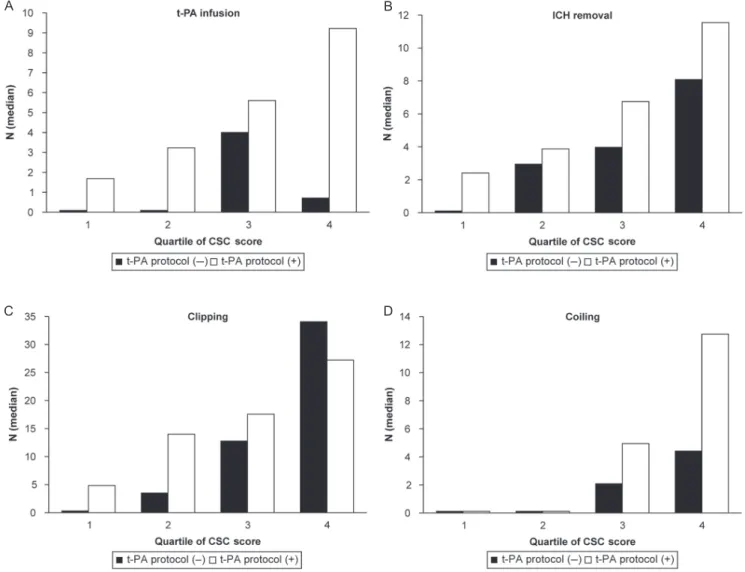
Approximately 749 hospitals responded to the survey. on performing multivariate analysis adjusted for hospital characteristics, the total CsC score, but not the availability of a t-PA protocol, was associated with the volume of all types of interventions with a clear increasing trend (P for trend < 0.001) (Fig. 1).
This study demonstrated a significant impact of comprehensive stroke care capacity represented by the total CsC score on the hospital volume of stroke interventions and unique aspects of comprehensive stroke care capacity in Japan.
Impact of CSC capabilities on in-hospital mortality in patients with stroke11)
Among the institutions that responded to the questionnaire on CsC capacity, data on patients hospitalized for stroke between April 1 2010 and march 31 2011 were obtained from the Japanese dPC database. in-hospital mortality was analyzed with hierarchical logistic regression analysis adjusted for age, sex, level of consciousness on admission, comorbidities, and the number of fulfilled CsC items in each component and in total. hierarchical logistic regression models were used to estimate odds ratios (ors) for in-hospital mortality adjusting for institu- tional level difference. Each model had two levels of hierarchy (hospital and patient) while considering the random effects of hospital variation, as well as fixed effects of CsC score and patient effects of age, sex, and level of consciousness. The total score and each subcategory score were analyzed separately. CsC scores were divided into quintiles and analyzed the trend with the Cochran-Armitage trend test.
data from 265 institutions and 53,170 emergency- hospitalized patients were analyzed (Table 2).
mortality adjusted for age, sex, and level of conscious- ness was significantly correlated with personnel, infrastructural, educational, and total CsC scores in patients with ischemic stroke. mortality was significantly correlated with diagnostic, educational, and total CsC scores in patients with iCh and with specific expertise, infrastructural, educational, and total CsC scores in patients with sAh.
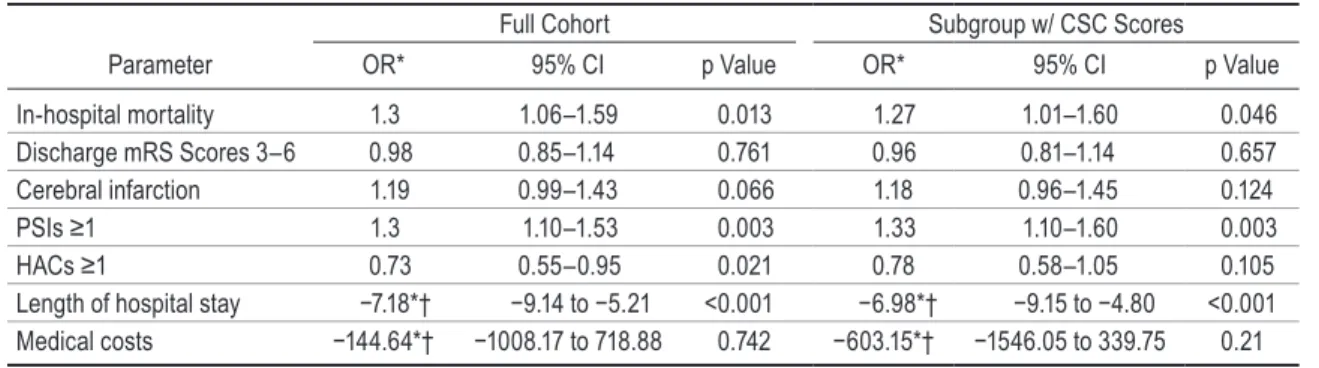
CsC capabilities were associated with reduced in-hospital mortality rates, and the relevant aspects of care were found to be dependent on stroke type (Fig. 2).
Problems and future perspectives of utilizing Big Data
There are some problems for the dPC-based clinical study. The most frequent problem is the accuracy of information.26) As dPC data is closely related to Table 1 Number (percentage) of responding hospitals
(n = 749) with the recommended items of comprehensive stroke care capacity
Components items n %
Personnel Neurologists 358 47.8
Neurosurgeons 694 92.7 Endovascular
physicians 272 36.3
Critical care medicine 162 21.6 Physical medicine and
rehabilitation 113 15.1 rehabilitation therapy 742 99.1 stroke rehabilitation
nurses* 102 13.8
diagnostic (24/7) CT* 742 99.2
mri with diffusion 647 86.4 digital cerebral
angiography* 602 80.8
CT angiography* 627 84 Carotid duplex
ultrasound* 257 34.5
TCd* 121 16.2
specific expertise Carotid
endarterectomy* 603 80.6 Clipping of iA 685 91.5 hematoma removal/
draining 689 91.9
Coiling of iA 360 48.1 intra-arterial reperfusion
therapy 498 66.5
infrastructure stroke unit* 132 17.6 intensive care unit 445 59.4 operating room staffed
24/7* 451 60.4
interventional services
coverage 24/7 279 37.3 stroke registry* 235 31.7 Education Community education* 369 49.4 Professional education* 436 58.6 CT: computed tomography, iA: intracranial aneurysm, mri:
magnetic resonance imaging, TCd: transcranial doppler.
data missing: stroke rehabilitation nurse, 9; CT, 1;digital cerebral angiography, 4; CT angiography, 3; carotid enda- rterectomy, 1; carotid duplex, 3; TCd, 3; stroke unit, 1; operating room staffed, 2; stroke registry, 7; community education, 2; professional education, 5. reproduced from iihara et al.10) with permission from the publisher. Copyright
© 2014 National stroke Association.
major components of CsCs (personnel, diagnostic programs, specific expertise, infrastructure, and educational components) and five items related to PsC certification (Table 1). CsC scores were divided with/without the availability of a t-PA protocol into quintiles and analyzed the trend with the
- 19 -
Neurol Med Chir (Tokyo) 56, November, 2016
the payment, there is a possibility that the medical staff may allocate inappropriate diagnosis in order to obtain more reimbursements. The second problem is the possibility of sampling bias. The current dPC database covers only acute in-patient cases.
Furthermore, dPC data do not provide detailed medical information in comparison with general large-scale cohort studies. Because dPC data are limited to hospitalized data, it can provide infor- mation about outcomes such as complications or hospitalized death; however, it cannot provide data such as foreign progress or long-term convalescence.
While dPC data have these limitations, the advan- tage compared with the other databases is that it can cover all types of diseases treated in acute care
facilities. Furthermore, we can obtain data about rare diseases or special treatments, which are difficult to obtain from a single facility.
There have been few academic papers on a large- scale clinical study originating in Japan. one of the reasons is that most Japanese clinical studies are small-scale studies based on close hospital groups, i.e., one university hospital and its associate facili- ties, and the case registry database is limited to some diseases and domains. Therefore, nationwide statistics about various diseases and treatments are insufficient in Japan. Because nationwide claim data such as dPC data can be obtained from multiple centers with the same format, it is expected as a valid solution to these problems.
Fig. 1 Associations between primary and comprehensive stroke care capabilities and case volume of stroke treatment in 2009 in Japan. The inclusion of total comprehensive stroke care (CSC) score, availability of a tissue- type plasminogen activator (t-PA) protocol, and other hospital characteristics in the model revealed that the total CSC score, but not the availability of a t-PA protocol, was significantly associated with the hospital volume of stroke interventions. Q, quintile. Reproduced from Iihara et al.10) with permission from the publisher. Copyright
© 2014 National Stroke Association.
A
C
B
D
- 20 -
Neurol Med Chir (Tokyo) 56, November, 2016 Table 2 Demographics of the patient study cohort at the time of diagnosis and hospital characteristics according to stroke type
Total
(n = 53,170) ischemic stroke (n = 32,671)
intracerebral hemorrhage (n = 15,699)
subarachnoid he morrhage
(n = 4,934)
male, n (%) 29,353 (55.2) 18,816 (57.6) 9,030 (57.5) 1,584 (32.1)
Age, mean years ± sd 72.5 ± 13.1 74.4 ± 12.2 70.7 ± 13.5 64.7 ± 14.8
hypertension, n (%) 39,918 (75.1) 22,531 (69.0) 13,281 (84.6) 4,229 (85.7) diabetes mellitus, n (%) 13,725 (25.8) 9,318 (28.5) 3,278 (20.9) 1,174 (23.8) hyperlipidemia, n (%) 15,015 (28.2) 11,104 (34.0) 2,529 (16.1) 1,412 (28.6) medications during hospitalization
Anti-renin-angiotensin system agent 34,136 (64.2) 17,694 (54.2) 12,537 (79.9) 4,019 (81.5) Ca channel antagonist 25,984 (48.9) 10,469 (32.0) 11,719 (74.6) 3,903 (79.1) sympathetic antagonist 6,334 (11.9) 3,821 (11.7) 2,172 (13.8) 364 (7.4) *β-blocker, α,β-blocker 4,357 (8.2) 3,048 (9.3) 1,133 (7.2) 188 (3.8)
α-blocker 2,374 (4.5) 953 (2.9) 1,232 (7.8) 200 (4.1)
diuretic agent 9,950 (18.7) 5,860 (17.9) 3,074 (19.6) 1,049 (21.3) Loop diuretic 7,434 (14.0) 4,609 (14.1) 1,912 (12.2) 940 (19.1)
other diuretic 4,425 (8.3) 2,527 (7.7) 1,653 (10.5) 255 (5.2)
Antidiabetic agent 10,295 (19.4) 6,784 (20.8) 2,473 (15.8) 1,075 (21.8)
insulin 7,654 (14.4) 4,597 (14.1) 2,044 (13.0) 1,046 (21.2)
oral antidiabetic agent 5,749 (10.8) 4,459 (13.6) 1,110 (7.1) 197 (4.0) Antihyperlipidemic agent 12,387 (23.3) 9,264 (28.4) 1,839 (11.7) 1,310 (26.6)
statin 10,099 (19.0) 7,840 (24.0) 1,366 (8.7) 912 (18.5)
Antiplatelet agent 23,635 (44.5) 21,746 (66.6) 625 (4.0) 1,298 (26.3)
Aspirin 11,929 (22.4) 11,119 (34.0) 378 (2.4) 447 (9.1)
Japan Coma scale
0, n (%) 19,635 (36.9) 15,027 (46.0) 3,620 (23.1) 1,024 (20.8)
1-digit code, n (%) 19,371 (36.4) 12,375 (37.9) 5,934 (37.8) 1,117 (22.6) 2-digit code, n (%) 6,937 (13.0) 3,396 (10.4) 2,705 (17.2) 852 (17.3) 3-digit code, n (%) 7,227 (13.6) 1,873 (5.7) 3,440 (21.9) 1,941 (39.3) Emergency admission by
ambulance, n (%) 31,995 (60.2) 17,336 (53.1) 10,909 (69.5) 3,830 (77.6) Average days in hospital (range) 21 (11–40) 20 (12–38) 22 (10–43) 30 (12–54) hospital characteristics (CsC scores)
Total score (25 items) 16.7 ± 3.8 16.8 ± 3.4 17.1 ± 3.4
Personnel (7 items) 3.7 ± 1.2 3.7 ± 1.2 3.8 ± 1.2
diagnostic techniques (6 items) 4.4 ± 1.1 4.5 ± 1.0 4.5 ± 1.0
specific expertise (5 items) 4.4 ± 1.0 4.4 ± 0.9 4.5 ± 0.8
infrastructure (5 items) 2.8 ± 1.3 2.9 ± 1.3 2.9 ± 1.3
Education (2 items) 1.4 ± 0.8 1.4 ± 0.8 1.4 ± 0.8
CsC: comprehensive stroke center. *A composite variable with a pure beta antagonist and a mixed alpha/beta adrenergic antagonist (e.g., labetalol). reproduced from iihara et al.11) with permission.
- 21 -
Neurol Med Chir (Tokyo) 56, November, 2016
Fig. 2 Associations between total comprehensive stroke care scores separated into quintiles (Q) and in-hospital mortality of patients after all types of stroke. Odds ratios (ORs) and 95% confidence intervals (CIs) of in-hospital mortality for each quintile are depicted compared with that of Q1 as the control (Q1, 4–12 points; Q2, 13–14 points; Q3, 15–17 points; Q4, 18 points; Q5, 19–23 points). Reproduced from Iihara et al.11) with permission.
As for J-AsPECT study, it is advantage that the overall database about stroke can be established and important information can be provided effectively without bothering stroke physicians. Furthermore, the facilities that participated can feedback their medical treatment process and the outcome of stroke compared to other Japanese hospitals; this benchmark promotes improvements in the quality of the stroke care in each facility.
To make up for the shortcomings of the dPC data and realize a higher quality clinical epide- miologic study, it will be important to link the dPC database with other databases. in the united states, the surveillance, epidemiology, and end results (sEEr)-medicare database is constructed for cancer research. The sEEr-medicare data reflect the linkage of two large population-based sources
of data that provide detailed information about medicare beneficiaries with cancer. The data come from the sEEr program of cancer registries that collect clinical, demographic, and the cause of death information for persons with cancer and the medicare claims for covered health care services from the time of a person’s medicare eligibility until death.27)
in the field of stroke care, claim data and registry is expected to be linked. in Japan, the construction of the nationwide stroke registry has been planned in order to foresee the development of the basic law for stroke measures. in the future, the linkage of this stroke registry and dPC database can result in a unique population-based source of information that can be used for an array of epidemiological and health services research. Furthermore, it can help
- 22 -
Neurol Med Chir (Tokyo) 56, November, 2016 discard the manual work required to enter the data
in each facility and reduce the burden on prostrate stroke physicians.
Conclusion
The use of Big data is expected as an effective modality that establishes new evidence about stroke care. The J-AsPECT study demonstrated the importance of the impact of CsC capacity and CsC capabilities on in-hospital mortality in stroke using the dPC database, one of the Big data databases in Japan. The advantages of applying Big data such as dPC to stroke care are that the overall database about stroke can be established without bothering stroke physicians and it can become a large-scale clinical study originating in Japan. The develop- ment of a new method of stroke registry using Big data is expected as it would greatly improve future stroke care.
Disclosures
The J-AsPECT study was supported by the grants- in-aid from the ministry of health, Labour, and Welfare of Japan (principal investigator, Ki). AN, KN and AK have no conflicts of interests to declare. Ki received grants from Nihon medi-Physics, otsuka Pharmaceutical Co., Ltd., AstraZeneca K.K.
Acknowledgement
We thank Prof. Nobuo hashimoto (National Cerebral and Cardiovascular Center) and Prof. Takamasa Kayama (Yamagata university) for collaboration with the Japan Neurosurgical society and Profs. Akira ogawa (iwate medical College) and Norihiro suzuki (Keio university) for collaboration with the Japan stroke society. We also thank dr. manabu hasegawa (shimonoseki City health Care Center) and dr. Yasuhiro Nishijima and dr. Kei Takayama (ministry of health, Labour and Welfare) for the helpful discussion, and Arisa ishitoko for secretarial assistance.
References
1) Laney d: 3d data management: controlling data volume, velocity, and variety. https://blogs.gartner.
com/doug-laney/files/2012/01/ad949-3d-data- management-Controlling-data-Volume-Velocity- and-Variety.pdf
2) mayer-schonberger V, Cukier K: Chapter 1: Now. in:
mayer-schonberger V, Cukier K, eds. Big data: A revolution that will transform how we live, work, and think. Boston: Boston Houghlin Mifflin Harcourt 1–18, 2013
3) Williams Gr, Jiang JG, matchar dB, samsa GP:
incidence and occurrence of total (first-ever and recurrent) stroke. Stroke 30: 2523–2528, 1999 4) Qureshi Ai, suri mF, Nasar A, Kirmani JF, Ezzeddine
mA, divani AA, Giles Wh: Changes in cost and outcome among us patients with stroke hospitalized in 1990 to 1991 and those hospitalized in 2000 to 2001. Stroke 38: 2180–2184, 2007
5) Bateman BT, schumacher hC, Boden-Albala B, Berman mF, mohr JP, sacco rL, Pile-spellman J: Factors associated with in-hospital mortality after admin- istration of thrombolysis in acute ischemic stroke patients: an analysis of the nationwide inpatient sample 1999 to 2002. Stroke 37: 440–446, 2006 6) Andaluz N, Zuccarello m: recent trends in the treat-
ment of cerebral aneurysms: analysis of a nationwide inpatient database. J Neurosurg 108: 1163–1169, 2008 7) Crowley rW, Yeoh hK, stukenborg GJ, medel r,
Kassell NF, dumont As: influence of weekend hospital admission on short-term mortality after intracerebral hemorrhage. Stroke 40: 2387–2392, 2009
8) James Ah, Bushnell Cd, Jamison mG, myers Er:
incidence and risk factors for stroke in pregnancy and the puerperium. Obstet Gynecol 106: 509–516, 2005
9) George mG, Tong X, Kuklina EV, Labarthe dr: Trends in stroke hospitalizations and associated risk factors among children and young adults, 1995–2008. Ann Neurol 70: 713–721, 2011
10) iihara K, Nishimura K, Kada A, Nakagawara J, Toyoda K, ogasawara K, ono J, shiokawa Y, Aruga T, miyachi s, Nagata i, matsuda s, ishikawa KB, suzuki A, mori h, Nakamura F: J-AsPECT study Collaborators: The impact of comprehensive stroke care capacity on the hospital volume of stroke inter- ventions: a nationwide study in Japan: J-AsPECT study. J Stroke Cerebrovasc Dis 23: 1001–1018, 2014 11) iihara K, Nishimura K, Kada A, Nakagawara J,
ogasawara K, ono J, shiokawa Y, Aruga T, miyachi s, Nagata i, Toyoda K, matsuda s, miyamoto Y, suzuki A, ishikawa KB, Kataoka h, Nakamura F, Kamitani s: Effects of comprehensive stroke care capabilities on in-hospital mortality of patients with ischemic and hemorrhagic stroke: J-AsPECT study.
PLoS One 9: e96819, 2014
12) mcAfee A, Brynjolfsson E: Big data: the management revolution. Harv Bus Rev 90: 60–66, 68, 128, 2012 13) Lynch C: Big data: how do your data grow? Nature
455: 28–29, 2008
14) merelli i, Perez-sanchez h, Gesing s, d’Agostino d: managing, analysing, and integrating Big data in medical bioinformatics: open problems and future perspectives. Biomed Res Int 2014: 1–13, 2014 15) Tempany Cm, Jayender J, Kapur T, Bueno r,
Golby A, Agar N, Jolesz FA: multimodal imaging for improved diagnosis and treatment of cancers.
Cancer 121: 817–827, 2015
16) Cain AA, Kosara r, Gibas CJ: Genosets: visual analytic methods for comparative genomics. PLoS One 7: e46401, 2012
- 23 -
Neurol Med Chir (Tokyo) 56, November, 2016
17) Chui KK, Wenger JB, Cohen sA, Naumova EN:
Visual analytics for epidemiologists: understanding the interactions between age, time, and disease with multi-panel graphs. PLoS One 6: e14683, 2011 18) manyika J, Chui m, Brown B, Bughin J, dobbs r,
roxburgh C, Byers Ah: Big data: The next fron- tier for innovation, competition, and productivity.
McKinsey Global Institute, 2011
19) Wolfe PJ: making sense of Big data. Proc Natl Acad Sci U S A 110: 18031–18032, 2013
20) Costa FF: Big data in biomedicine. Drug Discov Today 19: 433–440, 2014
21) databases. healthcare Cost and utilization Project (hCuP). November 2015. Agency for healthcare research and Quality, rockville, md. http://www.
hcup-us.ahrq.gov/nisoverview.jsp.
22) Yasunaga h, ide h, imamura T, ohe K: impact of the Japanese diagnosis procedure combination-based payment system on cardiovascular medicine-related costs. Int Heart J 46: 855–866, 2005
23) Alberts mJ, Latchaw rE, selman Wr, shephard T, hadley mN, Brass Lm, Koroshetz W, marler Jr, Booss J, Zorowitz rd, Croft JB, magnis E, mulligan d, Jagoda A, o’Connor r, Cawley Cm, Connors JJ, rose-derenzy JA, Emr m, Warren m, Walker md: Brain Attack Coalition: recommenda- tions for comprehensive stroke centers: a consensus
statement from the brain attack coalition. Stroke 36: 1597–1616, 2005
24) Alberts mJ, hademenos G, Latchaw rE, Jagoda A, marler Jr, mayberg mr, starke rd, Todd hW, Viste Km, Girgus m, shephard T, Emr m, shwayder P, Walker md: recommendations for the establishment of primary stroke centers. Brain Attack Coalition.
JAMA 283: 3102–3109, 2000
25) reeves mJ, Parker C, Fonarow GC, smith EE, schwamm Lh: development of stroke performance measures: definitions, methods, and current meas- ures. Stroke 41: 1573–1578, 2010
26) matsuda s, Fujimori K, Kuwabara K, ishikawa KB, Fushimi K: diagnosis procedure combination as an infrastructure for the clinical study. Asian Pac J Dis Manag 5: 81–87, 2011
27) National Cancer institute. sEEr-medicare Linked database. http://healthcaredelivery.cancer.gov/seer- medicare/
Address reprint requests to: Koji iihara, md, Phd, department of Neurosurgery, Graduate school of medical sciences, Kyushu university, 3-1-1 maidashi, higashi-ku, Fukuoka 812-8582, Japan.
e-mail: [email protected]
- 24 -
Current Trends and Healthcare Resource Usage in the Hospital Treatment of Primary Malignant Brain Tumor in Japan: A National Survey Using the Diagnostic Procedure Combination
Database (J-ASPECT Study-Brain Tumor)
Koji Y
oshimoto,
1Akiko K
AdA,
2daisuke K
ugA,
1Ryusuke h
AtAe,
1hideki m
uRAtA,
1Yojiro A
KAgi,
1Kunihiro N
ishimuRA,
3Ryota K
uRogi,
1Ataru N
ishimuRA,
1Nobuhiro h
AtA,
1,4masahiro m
izoguchi,
1,5tetsuro s
AYAmA,
1and Koji i
ihARA11Department of Neurosurgery, Graduate School of Medical Sciences, Kyushu University, Fukuoka, Japan;
2Clinical Research Center, National Hospital Organization, Nagoya Medical Center, Nagoya, Japan;
3Department of Preventive Medicine and Epidemiologic Informatics, National Cerebral and Cardiovascular Center, Suita, Japan;
4Department of Neurosurgery, National Kyushu Medical Center, Fukuoka, Japan;
5Department of Neurosurgery, Kitakyushu Municipal Medical Center, Kitakyushu, Japan
Abstract
We conducted this study to clarify the current trends and healthcare resource usage in the treatment of inpatients with primary malignant brain tumors. The Diagnostic Procedure Combination (DPC) data of all inpatients treated between 2013 and 2014 in the 370 core and branch hospitals enrolled in the Japanese Neurosurgical Society training program were collected. DPC is a discharge abstract and administra- tive claims database of inpatients. We assessed 6,142 primary, malignant brain tumor patients. Patient information, diagnostic information, treatment procedure, and healthcare resource usage were analyzed.
Chemotherapy was the most frequent treatment (27% of cases), followed by surgery (13%) and surgery + chemo-radiotherapy (11%). Temozolomide (TMZ), the most frequently used chemotherapeutic drug, was administered to 1,236 patients. Concomitant TMZ and radiotherapy was administered to 816 patients, and was performed according to the Stupp regimen in many cases. The mean length of hospital stay (LOS) was 16 days, and the mean medical cost was 1,077,690 yen. The average medical cost of TMZ-only treatment was 1,138,620 yen whilst it was 4,424,300 yen in concomitant TMZ patients. The LOS was significantly shorter in high-volume than in low-volume hospitals, and the medical cost was higher in hospitals treating 21–50 patients compared to those treating 1–10 patients. However, the direct medical cost of TMZ treatment was the same across different volume hospitals. This is the first report of current trends and healthcare resource usage in the treatment of primary malignant brain tumor inpatients in the TMZ era in Japan.
Key words: malignant brain tumor, dPc, temozolomide, medical cost
Introduction
malignant brain tumors are amongst the most lethal types of cancer. its incidence is increasing, and hence, a growing number of patients are being treated in the clinic.1–4) the current incidence of primary brain tumors is 10–20 cases per 100,000
of the general population. Primary malignant brain tumors can be classified into a number of histo- logical subtypes, but are mostly gliomas with a World health organization (Who) grade between i and iV. treatment consists of surgery, radiotherapy (Rt), and chemotherapy (ctX), either alone or in combination, depending on the tumor histology and the patient’s condition. temozolomide (tmz) is an oral alkylating agent, and has been widely Received June 8, 2016; Accepted August 1, 2016
online september 27, 2016
Neurol Med Chir (Tokyo) 56, 664–673, 2016
664
- 25 -
Neurol Med Chir (Tokyo) 56, November, 2016
used to treat primary malignant glioma patients in Japan since 2006 when it was first covered by health insurance. After the publication of stupp et al’s influential study, the standard initial treatment strategy for malignant glioma became concomitant Rt and tmz-based ctX.5) however, as tmz is an expensive drug compared to carmustine and procarbazine, the economic burden of tmz usage for the treatment of malignant glioma has been a matter of debate. For example, Wasserfallen et al reported that tmz usage in concomitant and adjuvant treatment increased medical costs eight fold in a single institution cohort in switzerland.6) Nevertheless, several studies demonstrated the cost- effectiveness of tmz treatment in malignant brain tumor treatment.7–9) in this context, there is no data as to how many primary brain tumor patients are treated in Japanese hospitals, and how often tmz is administered overall and in single hospitals. given that concomitant tmz treatment after surgery is considered the standard treatment internationally for malignant glioma, the medical economics of tmz usage should be evaluated in individual countries because the health insurance system is different in each country.
in 2002, the Japanese government introduced a per diem prospective payment system with a diag- nosis-Related groups (dRg)-like grouping, which is called diagnostic Procedure combination (dPc).10) data for practices can be obtained from dPc, and an attending physician is responsible for clinical data entry for each patient. using this database, we have previously reported the discharge outcomes of cerebrovascular disease patients in a nationwide retrospective analysis (the J-AsPect study).11–13) in this study, we collected and analyzed all the dPc data for patients treated in 370 core and branch hospitals from a total of 847 hospitals participating in the Japan Neurosurgical society training program. Brain tumor patients are treated in neurosurgical hospitals in Japan, and this treatment includes ctX and Rt.
therefore, this dataset may include the majority of data for patients treated in Japan during the designated period.
the first aim of this study was to reveal what kind of therapeutic modality is administered, and the difference of modality based on patient age, focusing particularly on tmz usage in the Japanese clinical setting. the second aim was to evaluate healthcare resource usage based on measures such as length of hospital stay (Los) and direct medical cost using an exhaustive patient administrative claim database. our findings clarify the current trends in the treatment of primary malignant brain tumor patients, and its associated medical economics in Japan.
Materials and Methods
Data acquisition
of the 847 hospitals participating in the Japan Neurosurgical society training program, 392 agreed to participate in this study. We obtained data between April 2013 and mach 2014 from 392 hospitals, but 22 hospitals were excluded from the analysis because insufficient data are available. in total, the data from 370 hospitals were analyzed, including the dPc data of 501,609 patients admitted to neurosurgical hospitals. this dataset included background patient information such as age, sex, charlson score, and Japan coma scale (Jcs) score: 1, 2, 3-digit, and we could acquire information about the treatment procedure and modality, and the administered drug. in addition, we could obtain healthcare resource usage informa- tion such as the Los and direct medical cost. direct medical costs include hospitalization, medications, imaging examinations, surgery, ctX, and Rt. Analysis of indirect medical costs is not included in this study.
As mentioned above, the dPc reimbursement system pays for the surgery, Rt, and ctX as fee-for-service (FFs), while other costs for hospitalization, medica- tions, blood examination, imaging examination, and physician time are inclusive. As the cost of chemo- therapeutic drugs is inclusive, the dose and duration of ctX are not reflected in dPc reimbursement. the medical cost was converted into us dollars based on an exchange rate at 103 Japanese Yen per us dollar.
Patient extraction
in this study, we focused on patients with primary malignant brain tumors of neuroepithelial origin. the dPc database does not include diagnostic histological information. the icd-10 codes denote different intracranial primary malignant tumors as follows:
c71, malignant brain tumor; c70, malignant intrac- ranial tumor originating in the meninges; and c72, malignant intracranial tumor originating in the cranial nerves. in order to extract information on primary malignant brain tumors of neuroepithelial origin, we used c71 as the dPc icd-10 code. using this code, we assumed that we could extract data on astrocytic, oligodendroglial, ependymal, pineal, embryonal, germ cell, and other neuroepithelial tumors. Primary central nervous system lymphomas were not included as they are specified by a different code. We also assumed that no malignant meningeal, mesenchymal, or peripheral nerve sheath tumors were included in the analysis.
Patients with malignant tumors in the sellar region and pituitary tumors were also excluded. in total, data for 6,142 patients with a primary malignant brain tumor were retrieved using code c71. data analysis was performed for these patients.
- 26 -
Neurol Med Chir (Tokyo) 56, November, 2016 interferon, bevacizumab, methotrexate, carmustine, ifosfamide, cisplatin, carboplatin, vincristine, cyclo- phosphamide, and procarbazine. We considered that ctX had been administered when there was a code for ctX and one of these drugs were listed.
RT
in Japan, payments for Rt are classified and coded according to the treatment modality. external beam therapy (eBt) is coded as m001, and stereotactic radiosurgery (sRs) and stereotactic Rt (sRt) are coded as m001-2 and m001-3, respectively. in this study, we identified patients treated with Rt and sub-categorized them by modality using these codes.
Statistical analysis
Los and medical cost were treated by log trans- formed value. geometric means and their 95%
confidence intervals were calculated. A general linear mixed model analysis was performed to determine statistically significant differences in mode of therapy on Los or medical cost adjusted for age, sex, and the charlson and Jcs scores as a fixed effect and the hospital as a random effect. the differences in the number of patients per hospital were also determined.
Reference population was set on male, average age (46.28), Jcs = 0, and average charlson score = 4.28, and then estimates and their 95% confidence interval for Los and medical cost were presented. A value of p < 0.05 was considered statistically significant.
the reference category for the number of patients per hospital was 1–10, and the Jcs score had a value of 0, 1, 2, or 3. the analyses were performed using sAs version 9.4 (sAs institute inc., cary, Nc, usA).
Ethical statement
the research plan was designed by the authors and approved by the institutional Review Board of Kyushu university. the requirement for individual informed consent was waived.
Results
Patient demographics
of 6,142 primary malignant brain tumor patients, 57% were male and 43% were female. With regard to age, 18% of the patients were children aged 15 years or younger, 65% were adult patients aged between 16 and 70 years, and 17% were elderly patients aged over 71 years. the tumor type was unknown in 3%
of the patients; 58% of patients had a primary tumor and 39% of patients had recurrent disease (table 2).
the number of patients treated in a single institu- tion varied between 1 and 277, with a median of 7 (Fig. 1), indicating that many hospitals treated less Evaluation of treatment modalities
the dPc database includes sub-codes that specify the surgical procedures and adjuvant therapy used, allowing demographic data to be stratified according to the treatment modalities described below.
Surgery
the type of surgical treatment is specified by a K-code. in this study, we aimed to extract data on surgical procedures related directly to tumor treatment. We used codes K169 (tumor removal by craniotomy), K171 (transsphenoidal tumor removal), and K151-2 (tumor removal by extended skull base craniotomy) to extract data for patients who had a tumor removed by craniotomy. in addition, to extract data on biopsies, we used codes K148 (only craniotomy), K1541 (functional stereotactic surgery [hemilateral]), and K164-4 (stereotactic hematoma evacuation) because stereotactic tumor biopsy was not K-coded as of the end of this study period. We also included codes K1492 (decompressive craniectomy), K145 (extra-ventricle drainage), and K174 (operation for hydrocephalus). collectively, to extract data for malignant brain tumor patients who underwent surgery, we used codes K-169, K148, K1541, K164-4, K171, K151-2, K1492, K145, and K174 (table 1).
CTX
in order to evaluate the use of chemotherapeutic drugs, we selected the following agents that are used in the neurosurgical clinic: tmz, nimustine (AcNu),
Table 1 Number of extracted patients according to K-code
K-code description Number of
patients (%) K1691 tumor removal by craniotomy
(pineal region) 18 (0.9)
K1692 tumor removal by craniotomy 1688 (79.8)
K148 craniotomy only 34 (1.6)
K1541 Functional stereotactic surgery
(hemilateral) 83 (3.9)
K164-4 stereotactic hematoma evacuation 45 (2.1) K145 extraventricular drainage 66 (3.1) K174 operation for hydrocephalus 129 (6.1) K1492 decompressive craniectomy 22 (1.0) K151-2 tumor removal by extended skull base craniotomy 13 (0.6) K171 transsphenoidal tumor removal 6 (0.3) K171-2 endoscopic transsphenoidal tumor removal 11 (0.5)
- 27 -
Neurol Med Chir (Tokyo) 56, November, 2016
than 20 primary malignant brain tumor patients (small-volume hospitals), and a few hospitals treated more than 100 patients (high-volume hospital).
Surgery
of 6,142 primary malignant brain tumor patients, 2,236 were assigned a surgical K-code, and of these, 1,963 patients had a K-code related to surgery to treat the tumor (Fig. 2A, table 1). the remaining 273 patients underwent procedures not directly related to the tumor, such as brain abscess evacuation, tracheostomy, or central venous catheter insertion.
According to data from the Japan Neurosurgical society, there were 25,160 brain tumor surgeries in neurosurgical hospitals in 2013. therefore, the number of surgical cases analyzed in this study is equivalent to 7.8% of all brain tumor surgeries in Japan for a period of one year.
Radiation
A total of 1,510 primary brain tumor patients under- went Rt (Fig. 2A), of whom, 1,203 were treated using eBt, 90 using sRs, and 217 using sRt. eBt was the most popular radiation modality followed by sRt and sRs in all age groups (Fig. 2B), and the frequency of these modalities were very similar.
Table 2 Demographics and clinical characteristics of patients included in this study
total, n 6,142
male, n (%) 3,489 (56.8)
Age
≤15, n (%) 1,091 (17.8)
16–70, n (%) 3,984 (64.9)
≥71, n (%) 1,067 (17.4)
Primary, n (%) 3,549 (57.8)
Japan coma scale
0, n (%) 4,211 (68.6)
1-digit code, n (%) 1,592 (25.9) 2-digit code, n (%) 240 (3.9) 3-digit code, n (%) 99 (1.6) charlson score
2, n (%) 1,948 (31.7)
3, n (%) 733 (11.9)
4, n (%) 757 (12.3)
5, n (%) 962 (15.7)
6–10, n (%) 1643 (26.8)
11–15, n (%) 99 (1.6)
Fig. 1 The distribution of the number of primary malignant brain tumor patients treated at each hospital
CTX
ctX was administered to 3,079 of the 6,142 patients with a primary brain tumor (Fig. 2A), using a total of 4,728 different regimens. As shown in Fig. 3A, the most frequently used drugs were tmz (41%), followed by etoposide (11%), interferon-b (9%), and carboplatin (9%). Bevacizumab and carmustine were rarely used because they were not covered by health insurance at the start of this study period. With respect to age group, pediatric patients were less frequently administered tmz compared to adults, but were more frequently treated using etoposide, carboplatin, metho- trexate, vincristine, cisplatin, or cyclophosphamide (Fig. 3B). We also investigated the frequency with which combinations of drugs were administered to different age groups (table 3). in total, combination therapy was used in 871 cases, and combined carbo- platin and etoposide (cARe), or combined tmz and interferon-b, were both commonly used in the adult group. in contrast, combined cisplatin and vincris- tine was most frequently used for pediatric patients, followed by combinations of carboplatin and etopo- side, or ifosfamide, cisplatin, and etoposide (ice) at a similar frequency. combined cyclophosphamide, cisplatin, and vincristine therapy (Packer regimen) was also commonly used in the pediatric group.
We focused our analysis on tmz, as it is the most commonly used chemotherapeutic drug for the treatment of malignant glioma. the most common duration of tmz administration for initial cases (816 cases) was between 40 and 45 days, which is consistent with the standard concomitant tmz treatment protocol of 42 days for initial malignant gliomas (Fig. 3c). in addition, in the concomitant tmz treatment protocol, tmz therapy and Rt were initiated on the same day for most patients (Fig. 3d).
− 28 −
Neurol Med Chir (Tokyo) 56, November, 2016 Fig. 2 (A) Frequency of each treatment modality (B) The ratio of different radiotherapy modalities in age groups (C) The distribution of types of therapy for all patients, and (D) by age group
Mode of therapy
the 6,142 primary malignant brain tumor patients were classified into eight groups depending on whether they underwent surgery alone, surgery + Rt, surgery + ctX, surgery + chemo-radiotherapy (cRt), Rt, ctX, cRt, or none of these (Fig. 2A, c).
Patients with primary tumors were most frequently treated using ctX, followed by surgery, and surgery + cRt. Pediatric patients less frequently underwent surgical treatment and were more often treated using ctX compared to adults. hence, the type of therapy varied between adult and pediatric patients (Fig. 2d).
LOS
We analyzed the Los with respect to the mode of therapy. the mean Los of all the patients was 16 days. When we stratified the data according to the mode of therapy, primary tumor patients who underwent surgery had longer hospital stays compared to non-surgically treated patients (table 4). in the subgroup of primary tumor patients who under- went surgery, the mean Los was long amongst
Table 3 Combination of chemotherapeutic drug accord- ing to the patient age group
chemotherapeutic
drug (n = 871) ≤15 yr
(%) 16–70 yr
(%) ≥71 yr (%) carboplatin +
etoposide 69 (25.7) 253 (43.7) 5 (20.8) temozolomide +
interferon-b 22 (8.2) 229 (39.6) 16 (66.7) cisplatin + Vincristine 90 (33.6) 19 (3.3) 0 ifosfamide + cisplatin
+ etoposide 60 (22.4) 46 (7.9) 0 cyclophosphamide +
cisplatin + Vincristine 27 (10.1) 7 (1.2) 0 Procarbazine
+ Nimustine +
Vincristine 0 25 (4.3) 3 (12.5)
those who underwent surgery + cRt (73.8 days), followed by surgery + Rt (65.5 days), surgery + ctX (38 days), and surgery alone (23.2 days). cRt was the most common treatment administered to patients who did not undergo surgery. When we
− 29 −
Neurol Med Chir (Tokyo) 56, November, 2016
Fig. 3 Frequency with which each type of chemotherapeutic drug was administered for primary malignant brain tumor patients (for a total of 4,728 regimens) in (A) all patients and (B) patients in different age groups (C) The distribution of the duration of temozolomide (TMZ) administration for primary malignant brain tumor patients undergoing initial treatment (D) Relationship between the time between surgery and the start of TMZ or radio- therapy for primary malignant brain tumor patients undergoing initial treatment
stratified the patients according to the number of primary malignant brain tumor patients treated by their hospital, the Los was significantly shorter in high-volume hospitals than in low-volume hospitals (table 5).
Direct medical cost
the dPc dataset also lists inpatient direct medical costs including surgery, ctX, Rt, hospital stay, and other diagnostic and treatment modalities.
the average direct medical cost for treating the patients was 1,077,690 yen. consistent with the Los, surgical treatment was much more expensive than non-surgical therapy (table 4). surgery + cRt was the most expensive treatment, at 5,926,220 yen, followed by surgery + Rt (4,757,000 yen) and
surgery + ctX (3,937,540 yen). the mean cost of surgery was 2,752,300 yen. We found that medical cost was higher in hospitals treating 21–50 patients compared to those treating 1–10 patients (table 6).
however, although the medical cost was lower in high-volume hospitals than in small-volume hospi- tals, this difference was not statistically significant.
in the dPc system, days and dose of tmz adminis- tration for the primary patients are not translated in the medical expenditure, which means that medical cost depends on whether tmz is administered. We analyzed medical expenditure for tmz only patients (420 cases) and concomitant tmz patients (816 cases) according to the number of the patients per hospital. in tmz only patients, the average medical cost was 1,138,620 yen, whilst for concomitant tmz
− 30 −
Neurol Med Chir (Tokyo) 56, November, 2016 patients it was 4,424,300 yen, indicating that the
direct medical cost increases more than two fold when it includes Rt in Japan. in both groups, the medical cost was not statistically different among hospitals with different patient volumes (table 6).
Discussion
in this study, we analyzed the current status of malignant brain tumor treatment using the dPc database in Japan. the advantage of using dPc data is that patient and hospital information, diag- nosis, procedures, and administrative claim data are completely enumerated for all of the patients in the participating hospitals. Another benefit is that all of these data can be collected from the administrative claims database of inpatients without additional effort by medical staff. this study covered 370 hospitals (44%) out of all 847 Japanese Neurosurgical society training program core and branch hospitals. thus, we think that our study is a good representation of the current trends in malignant brain tumor treatment in Japan. Approximately 24,000 patients
are newly diagnosed with primary malignant brain cancer annually in the united states.3,4) in this study, 3,562 (58%) of the 6,142 malignant tumor patients had primary disease, which is equivalent to 15%
of all the patients in the united states.
our analysis revealed that many of the hospitals treated less than 20 patients with primary malig- nant brain tumors in a single year. there are very few high-volume centers treating more than 100 malignant brain tumor patients per year in Japan, in contrast with the usA, europe, Korea, and china, where malignant brain tumor patients are treated in high-volume core center hospitals. Regarding the use of cytotoxic chemotherapeutic drugs, we found that tmz was administered to approximately 40%
of patients, and that the next most frequently used drug was administered to less than 10% of patients, indicating that tmz is the most widely prescribed drug for treating primary malignant brain tumors.
however, amongst pediatric patients, tmz was less frequently administered than platinum-based drugs, etoposide, vincristine, and ifosfamide. this may be because tmz offers no significant benefit in pediatric Table 4 Length of hospital stay and medical cost depending on therapeutic modalities
Length of stay (days) medical cost (10 thousand yen)
modalities n geometric
mean 95% ci n geometric
mean 95% ci
None 1893 8.0 0.6–101.3 1774 39.1 4.1–369.1
ctX 1672 11.0 1.3–93.7 1640 64.5 11.3–370.1
Rt 321 11.9 1.4–98.4 302 97.1 32.8–287.8
cRt 414 37.9 7.8–183.6 408 230.5 69.8–761.4
surgery 779 23.2 7.4–73.2 763 275.2 132.5–571.5
surgery + ctX 313 38.0 9.7–148.2 309 393.8 181.3–855.3
surgery + Rt 70 65.5 26.5–162.4 68 475.7 264.3–856.1
surgery + cRt 680 73.8 35.0–155.7 672 592.6 341.3–1029.0
Table 5 Length of hospital stay according to the patient volume of the hospital
Length of stay (days) Analysis of mixed model
estimates for reference population Patient volume n geometric
mean 95% ci p value estimates 95% ci
1–10 998 24.6 2.7–227.5 – 18.1 16.4–20.0
11–20 863 20.8 2.2–194.4 0.256 16.6 14.5–18.9
21–50 1109 18.4 1.5–221.1 0.854 18.4 15.8–21.5
51–100 1480 16.0 1.4–182.9 0.181 15.8 13.2–18.9
>
=101 1692 10.0 0.8–124.5 0.001 11.5 8.9–14.9
− 31 −
Neurol Med Chir (Tokyo) 56, November, 2016
Table 6 Direct medical cost according to the patient volume of the hospital
medical cost (10 thousand yen) Analysis of mixed model
estimates for reference population Patient volume n geometric mean 95% ci of
geometric mean p value estimates 95% ci
1–10 977 133.5 13.5–1318.3 – 110.1 99.2–122.1
11–20 795 135.6 13.4–1373.9 0.334 119.3 103.7–137.3
21–50 1063 134.0 11.6–1549.2 0.011 139.7 119.0–163.9
51–100 1472 110.2 8.2–1475.4 0.655 115.2 96.1–138.1
>
=101 1629 72.0 5.5–941.0 0.224 92.9 71.7–120.3
TMZ only
medical cost (10 thousand yen) Patient volume n geometric
mean 95% ci
1–10 82 162.2 27.4–958.9
11–20 55 107.6 11.8–984.2
21–50 82 137.1 17.4–1080.5
51–100 105 101.7 11.3–918.6
>
=101 93 83.1 12.5–554.3
TMZ + RT (concomitant)
medical cost (10 thousand yen) Patient volume n geometric
mean 95% ci
1–10 149 463.7 160.3–1341.1
11–20 125 460.3 159.3–1329.6
21–50 169 460.2 161.5–1311.3
51–100 226 410.6 116.4–1449.0
>
=101 140 437.0 146.9–1300.2
Reference population means male, average age(46.28), Jcs = 0, and average charlson score = 4.28
patients,14) or, in part, because germ cell and embryonal tumors occur frequently in pediatric patients. indeed, combination ctX, which is usually administered for germ cell and embryonal tumors, was most frequently used to treat pediatric tumors.
According to the standard protocol, Rt consists of fractionated focal irradiation at a dose of 2 gy per fraction for a total dose of 60 gy, which is admin- istered once daily 5 days per week over a period of 6 weeks. concomitant ctX consisted of tmz at a dose of 75 mg per square meter per day, administered 7 days per week from the first day of Rt until the
last day of Rt. We found that tmz administration most frequently lasted 40–45 days for many of the initial primary malignant brain tumor patients. in addition, Rt and tmz administration often started at the same time postoperatively, suggesting that concomitant ctX and Rt is the current trend for initial primary malignant brain tumors in Japan.
taken together, our findings demonstrate that tmz treatment for initial primary malignant brain tumor patients was undertaken according to the international standard protocol in Japanese neurosurgical hospitals.
We also evaluated the frequency with which different therapies were used to treat the patients.
the most frequent treatment was ctX (27%), followed by surgery (13%), and surgery + cRt (11%). No single treatment type was used for more than 30% of patients. this differs from findings using the Brain tumor Registry dataset,15) where surgery + cRt was most frequently used (51%), followed by surgery (18%) and surgery + Rt (18%). observation alone and other treatments accounted for only 2% of patients. there are a number of possible reasons for this discrepancy between the datasets. First, because tumor histology is not included in the dPc dataset, it is possible that this varies significantly between the datasets, which would be reflected in the different thera- pies used. second, the tmz administration for malignant glioma was covered by Japanese health insurance in 2006, which means that Brain tumor Registry data were collected before the tmz era between 2001 and 2004. this might explain why ctX (possibly involving tmz) was used more frequently for patients included in our dataset.
third, actively treated patients in the university and national center (core) hospitals might have been selectively included in the Brain tumor Registry.
given that our data are collected from all of the patients in registered hospitals including branch hospitals, our results reflect the current situation
− 32 −
Neurol Med Chir (Tokyo) 56, November, 2016 regarding malignant brain tumor treatment after
admission to Japanese neurosurgical hospitals.
sub-analysis of therapy type for primary tumor patients demonstrated that pediatric patients less frequently underwent surgical treatment, including surgery alone or combined with cRt, compared with adult and elderly patients. however, pediatric patients more frequently underwent ctX. this suggests that pediatric patients are more often treated using ctX than Rt, and indeed the prevalence of Rt regardless of surgery and ctX was 7.5%, 18%, and 25% in pediatric, adult, and elderly patients, respectively. Regarding the type of Rt used, sRs/
sRt accounted for a quarter of all Rt used to treat primary brain tumors.
our analysis also revealed novel findings regarding health care data in Japan. Japan sustains full and equal health insurance coverage with a single reimbursement fee system for all physicians and patients.16) under this system, the mean Los for primary malignant brain tumor patients was 16 days.
hospital stays generally get longer with increasingly complex modes of therapy. According to the 2011 data of the ministry of health, Labour and Welfare in Japan, the mean Los or all cancer patients was 19.5 days.17) the mean Los in our dataset was closer to this value (16 days). Accordingly, the mean Los in the surgically treated groups was 46 days. the ministry of health, Labour and Welfare data also reveal that patients who undergo craniotomy have the longest stay in hospital (mean 48.5 days) among all patients undergoing surgery. As data for patients with benign tumors are also included in the ministry of health, Labour and Welfare dataset, this study is the first to demonstrate that the Los of malig- nant brain tumor patients depends on the mode of therapy. given that ctX or Rt is more likely to be administered as an inpatient treatment in Japan, we need to be careful in comparing healthcare resource usage between countries.
in this study, we first evaluated the direct medical cost for the treatment of inpatient primary malignant brain tumor patients in Japan. the mean medical cost of all 6,142 patients was 1,077,690 yen, which is equivalent to 10,463 us dollars at the exchange rate of 103 Japanese yen per us dollar. A recent publi- cation showed that the total direct cost for surgery and Rt ranged from 50,600 to 92,700 us dollars in the united states.9) We found that the medical cost of patients undergoing both surgery and Rt was 4,757,000 yen (46,184 dollars) in this study. Although the direct medical cost cannot be compared between countries with different health insurance systems, it seems clear that the direct medical expenditure for combined surgery and Rt is within the same range
in both countries. As expected, the medical costs are greater for patients undergoing surgery, Rt, and ctX, at 5,926,220 yen (57,536 dollars). concerning tmz treatment, the cost of treating patients under- going concomitant tmz therapy after surgery was 4,424,300 yen (42,541 dollars). A previous study found that the medical cost of inpatients with concomitant tmz therapy was 59,121 us dollars in the united states,18) which indicates that medical costs including tmz treatment is lower than that in the united states. Furthermore, our results showed that the direct medical cost of patients undergoing surgery with only tmz and concomitant tmz is similar among the hospitals regardless of patient volume. this indicates that the same level of treat- ment is administered for primary malignant brain tumor patients across all hospitals in Japan, which may partly be because tmz use is included in the dPc system, and thus, the dose and duration of tmz administration is not reflected in the direct medical cost.
A limitation of this study is that detailed informa- tion concerning the tumor site, histology, and extent of resection was not available in the dPc data set.
Furthermore, because the dPc dataset only includes mortality data for the corresponding admission period, information on patient outcomes after discharge is not included. thus, the survival rate cannot be calcu- lated. moreover, outpatient data are not included.
Nevertheless, this study provides a clear picture of the current trend of treatment for malignant brain tumors in Japan. if we can link this population-based dataset to the standard registration database, we could obtain very useful information regarding the treatment of malignant brain tumor patients.
in summary, we have assessed the current treat- ment and healthcare resource usage of malignant brain tumor patients in Japan using exhaustive claim data from 6,142 patients. this study could act as a road map towards the establishment of a better health care policy.
Acknowledgement
this study was conducted as the Joint Project of the 34th annual meeting of the Japanese congress of Neuro- surgeons (President K.i.) and the Japan Neurosurgical society. We also thank Profs. takamasa Kayama and Nobuo hashimoto for their supervision of this collabo- rative project with the Japan Neurosurgical society.
Conflict of Interest
the authors declare that there are no potential conflicts of interest in relation to this study.
− 33 −