Roles of Soil Organic Ma1er
Func4on of humic substance
• Largest pool of carbon on the surface of earth
• Repress global warming
• Nutri4on supply to plant and microbes
• Hold nutrients and water
• Improve soil physical proper4es
• Promote plant growth
Humic substance is not almighty, however.
• Humic substance can not support the growth of crops by itself.
• Op4mum pH
• Favorable moisture condi4on
• Sufficient mineral nutrients
• No growth inhibi4ng substance
should be the background for the effect of humic substances
Role of soil organic matter
Plant
Soil microbes Soil organic
matter Mineral nutrients
Soil
Role of Soil Organic Matter
Improvement in
a.Soil Physical properties
b.Chemical & Biological prpperties c.Plant Growth Promotion Effects
Change in concept of plant nutri4on
• J.Tull (early 18th century) Importance of plowing
• A. von Thaer (early 18th century ) Theory of humus nutri4on
• Theodore de Saussure (early 19th century ) Importance of mineral nutri4on.
Discovery of photosynthesis
• J.B. Boussingault (1834) Discovery of nitrogen fixa4on
• J. von Liebig (1840) Mineral nutri4on theory
Hyphae of fungi Polysaccharide Humic substance
Aggregate structure Aeration and Drainage Mitigation of soil erosion Soil water retention
Increase in specific heat
Increase in soil temperature a.Improvement of Soil Physical properties by soil
organic matter
Hierarchical structure of soil aggregates
Forming process of soil aggregates
Myceria of Fungi Ca4ons
Clay minerals Bacteria cells
Humic substances
粘土 陽イオン 腐植物質
細菌 菌糸
/細根
Humic
substances Hyphae, fine
roots
Clay Ca4ons Bacteria
Mechanism of soil aggregate formation
Role of Mycorrhizal fungi
• Promo4on of nutrient absorp4on ( P absorp4on )
• Promo4on of aggregate forma4on
Large sized aggregate
b.Improvements in chemical and biologicalproperties
Retention of cations and anions
Transport and translocation of mineral nutrients
Binding and inactivation of harmful artificial organics Mitigation of the effect of pollutants
Donor of Proton(H+)
Physiologically active substances Nutrient supply in good balance Source of nutrients for
heterogeneous microbial communities Competition with pathogenic germs
c.Plant growth promotion effects
Promotion of germination and root initiation Promotion of the growth of root and stem Complex formation with nutrient elements Promotion of nutrient absorption by plants Hormone-like activity
Promotion of permeability of cell membrane Promotion of photosynthesis, respiration, and enzyme activity
Suppress protein and increase sugar contents in plants
Alleviation of plant growth inhibition under
cold weather and irregular meteorological conditions
Plant growth promotion effects
Plant hormone activity
+SOM
No SOM
Optimum Excess
Deficiency
Stable production under deficiency and excess of nutrients
Cold tolerance
Yield
Characteriza4on of soil organic
ma1er
Division of soil organic ma1er(Takai, 1977)
Soil Organic Ma1er
Biota Non-‐biota
Dead body of biota Dark amorphous high polymer
Animal and microbial residue Plant residue
Non-humic substances Humic substances Humus
Soil
Extracted solution Residue Acid
Supernatant Precipitate
Humin Humic acid
Fulvic acid
Alkaline extractant
HFdecompo sition
Chelating agent
Fractionation of humic substances
Proposed molecular structure of humic acid
Chemical composition of soil organic matter
Molecular weight Complexity
Dark color
Organo-mineral complex
Coarse OM
Water soluble OM
Humic
Humin Humic acid Fulvic acid
Soil organic matter
Heterocyclic N, Nucleophilic N Protein, peptide Nucleic acid Amino acid
Cellulose Hemicellulose Monosaccharides
Resin Suberin, cutin Triglyceride Higher fatty acid
Sterol Lower fatty acid adsorbed
Non-adorbed
Peptideglycan
Phospholipid
Non-humic
Interaction with inorganic components
Humic and non-humic concept
According to solubility
Co-existing non-humic substances
Lignin
Phytic acid Non-humic
Large small
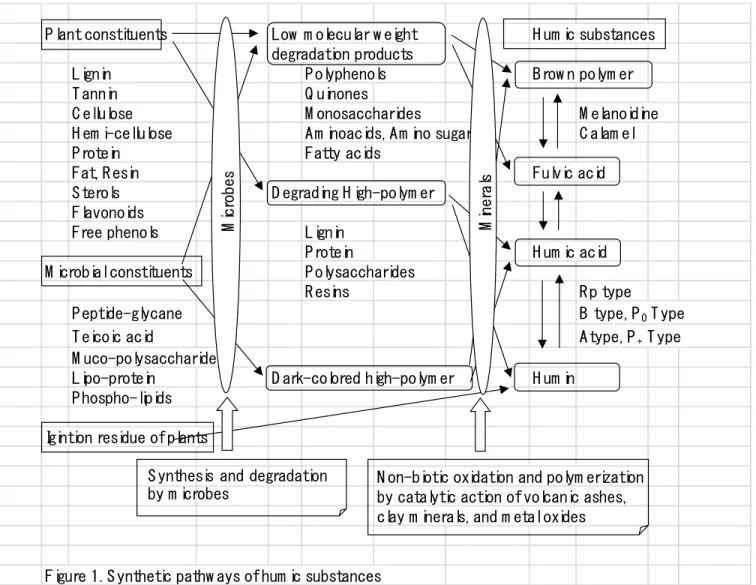
P lant constituents Low m olecular w eight H um ic substances degradation products
Lignin P olyphenols B row n polym er
T annin Q uinones
C ellulose M onosaccharides M elanoidine
H em i-cellulose A m inoacids, A m ino sugars C alam el
P rotein Fatty acids
Fat, R esin Fulvic acid
S terols D egrading H igh-polym er
Flavonoids
Free phenols Lignin
P rotein H um ic acid
M icrobial constituents P olysaccharides
R esins R p type
P eptide-glycane B type, P0 T ype
T eicoic acid A type, P+ T ype
M uco-polysaccharides
Lipo-protein D ark-colored high-polym er H um in
P hospho-lipids Igintion residue of plants
N on-biotic oxidation and polym erization by catalytic action of volcanic ashes, clay m inerals, and m etal oxides
Figure 1. S ynthetic pathw ays of hum ic substances
Minerals
S ynthesis and degradation by m icrobes
Microbes
Humic acid Humin Fulvic acid
Water soluble OM
Organo-mineral complexes
Free form OM
Humic substance Non-humic
Concept on soil organic ma1er
Soluble in acid and alkaline
Not soluble in alkali or acid
Precipitate with acid Bound with minerals
Dark colored, amorphous high polymer OM with known structure Not bound with
minerals
Soluble in water
COO-
COO-
COO- COO-
COO- COO-
COO- COO-
OH
OH
OH OH OH
OH OH
OH
COO-
COO- COO-
COO-
-OOC
O O
O
O O
O O
O
O O
Hydrophilic part
Hydrophobic part
Carbohydrate chain
Condensed ring
Turbostratic structure
Structural concept of humic substances NH3+
Protein CO
CO
CO
CO
CO CO
CO OC OC
Synthe4c expression of elementary composi4on of humic substances
• As indices for expressing elementary
composi4on synthe4cally, following ra4os are calculated. Elementary number is used in the calcula4on.
Combus4on Quo4ent
• Combus4on quo4ent (CQ) is a theore4cal
value for respira4on quo4ent as proposed by Tamiya 5)
• CQ= 4C / (4C + H-3N-2O) -‐-‐-‐-‐-‐-‐ (1)
Degree of Unsatura4on
• Degree of unsatura4on ( DU) shows the
number of unsaturated bonds and ring bonds per 100 carbon atoms.
• DUH = (2C + N-H) / 2C ×100 -‐-‐-‐-‐-‐-‐ (2)
Degree of Oxida4on (ω)
ω=(2O-H)/ C -‐-‐-‐-‐-‐-‐ (3)
shows the excess or deficit of oxygen and hydrogen in comparison with Cn(H2O)n
• This value is distributed between -0.8 and +0.9 for humic substances.
Elementary composi4on of humic substances
H/C and O/C
0.00 0.20 0.40 0.60 0.80 1.00 1.20 1.40 1.60 1.80
0.00 0.20 0.40 0.60 0.80 1.00 1.20
H/C
O/C
Soil
Buried soil Environmental Sedient
Sed-Humin Coal
Orl-HA Orl-FA
0.0 0.2 0.4 0.6 0.8 1.0 1.2 1.4 1.6 1.8
-1.0 -0.5 0.0 0.5 1.0
H/C
Degree of oxidation ω
Degree of oxidation(ω) and H/C
● soil humic acids from literature 3 ■ humic acids from buried volcanic ash sois、○ humic asids from literature 7, △ humic acids from sea and lake sediments, ▲ humin from sediments, □ coal, ◆ humic acids from Russian soils in literature 6 ◇fulvic acids from Russian soils.
0 40 80 120 160
0.3 0.5
0.7 0.9
1.1
RF
ΔlogK
A型
B型
Rp型
P型
0 40 80 120 160
0.3 0.5
0.7 0.9
1.1
RF
ΔlogK
Classifica4on of humic substances by RF and ΔlogK
● Type A, ○ Type B, ■ Type P with obvious Pg absorp4on, □ Type P without Pg absorp4on
▲ Type Rp from mineral soil, △ Type Rp from O layer
Type A
Type B Type
Rp Type P
UV-‐vis. Absorp4on spectra of humic acis in different types
Type A Inogashira (volcanic ash soil), Type B Higashiyama (brown forest soil), Type P Tsubame (Pg of buried soil), Type Rp Anjo (paddy soil)
Concentra4ons are adjusted to 1mgC mL-‐1
0.1 1 10 100
200 250 300 350 400 450 500 550 600 650 700
absorbance
nm
A型 B型 P型 Rp型
pH12-‐pH7 difference absorp4on spectra of different types of humic acids.
(Same humic acids as in the previous figure)
-2 -1 0 1 2 3 4 5
200 250 300 350 400 450 500 550 600 650 700
pH12-pH7 difference absorption
nm
A型 B型 P型 Rp型