Bull. Kyushu Inst. Tech.
(M. & N. S.) No. 30, 1983, pp. 37-54
A SCHEMATIC-MODEL ANALYSIS OF BAND CROSSING DIFFICULTY IN THE CRANKING MODEL
By
Ryoji OKAMOTO
(Received Nov. 29, 1982)
Abstract
The stability condition for a self-consistent cranking model solution is explicitly derived and shown to agree with the condition for the non-existence of an imaginary RPA frequency. The spin values become redundant in the backbending region when the pairing field is unstable. An example ofthe missing spin value is displayed for the fu11y degenerate case. The fluctuations in three components of the angular momentum of valence particles are presented for the first time. Their significance in the conservation of the total angular momentum is discussed in relation to the stability of the pairing fieid.
gl. Introduction
The Hartree-Fock-Bogolyubov cranking (HFBC) theory has been widely adopted to investigate the high spin phenomena known as the backbending (BB), which is associated with the band crossing. It was pointed out in particular by Hamamotoi), partly by Sano et al.3) and Banerjee et al.2) that the HFBC theory may lead to the difficulty in the BB region. (Band Crossing Difficulty.) There are various viewpoints both on the relia- bility of the HFBC theory in the BB region and on the physical meaning of the band crossing diMculty. It is of interest to get deeper understanding these two aspects from the following reasons: First, the band crossing effect is characteristic of such an intermediate situation in which the angular momentum of the nucleus can increase either by collective rotation or by particle alignment9), and is expected to take place in rather wide region of spin valuesiO). Next, it seems necessary to consider the stability of the yrast state in order to describe microscopically the collective excitation near over the yrast state. The band crossing difficulty are summarized as follows: At first, on the one hand, may not exist the spin values in the BB region. On the other hand, the spin values may become re- dundant in this region. These two situations are connected with each other5). Secondly, it has been mentioned that there exists large angular momentum fluctuation in the cranking model wave function. In the (non-) self-consistent treatment of the particle-rotor (PR) model, the fluctuation in j., the x-component of the angular momentum of valence particles, varies rapidly with the rotational frequency in the BB region. This rapid fluctuation is
38 Ryoji OKAMoTo
taken as a direct evidence of the breakdown of the validity of the cranking model in Ref. 1).
While in the HFBC theory, that in J., the x-component of the total angular momentum, is considerably large over the wide region of spin values and varies rather gradually with the angular momentum. The latter fact is not necessarily considered to limit the validity of the cranking approximation in Ref. 11). Then, what is the significance of the angular momentumfluctuation? Thelastdifficultyisthestabilityconsideration. IntheBBregion, several values of spin I generally correspond to a given Lagrangian multiplier tu due to the non-linearity of the gap equation. Consequently, holding co fixed in a HFBC calculation leads to oscillation between states with different values of ÅqJ.År, so that convergence to a self-consistent solution is hardly obtained. (Numerical instability.) Then, alternative methods are recently proposed in order to overcome the numerical instability; The
iterative diagonalization with a fixed ÅqJ.År not with a fixed tu`) and the gradient method'3).
However it is mentioned that there is always found a 'region in which the solution is un- stable8).
Hamamoto analyzed the band crossing difficulty in the context of an idealized model of ii312-particles coupled to a rotor and interacting via the pairing force, in which for the
sake of simplicity the self-consistency was neglected. Marshalek and Goodman5) studied the difficulty with the use of an exactly soluble PR model, the R(8) model'), which can simulate the main results in Ref. 1). They examined in particular the missing (redundant) spin values problem for the fully degenerate case which corresponds to the Iimit of sharp BB. However, it seems that their analysis has the ambiguityjust in the limiting procedure for sharp BB. The subject of the stability vvas discussed by Sano et al.3), ten years ago, by Chu et al.6), several years ago and by Horibata and Onishi8), very recently. However, the perturbative treatment utilized in Ref. 3) is not appropriate for the sensitive problem such as an stability. While Chu et al. pointed out firstly to adopt variation of the total energy for fixed spin value rather than variation of the cranking energy for fixed rotational frequency in order to properly consider the stability. However it seems that the clear basis of the argument for the mechanism of an instability is not shown in Ref. 6). In the work of Horibata and Onishj, the constraint condition is neglected in the second variation, though the so-called Lagrangian multiplier method can not be applied to the second vari- ation under the constraintsi4).
In the present paper we investigate the band crossing difficulty in terms of the R(8) model, since the comparison of the cranking model solution with the exact one can be made and simple analytic expressions can be written down. We shall derjve the expressions in question as explicitly as possible in order to unambiguously discuss. Although the band crossing difficulty were particularly pointed out in the PR model, many realistic cal- culations have been performed with the use of the HFBC theory. Therefore, a special attention is paid to the connection between the SCC picture, in which the yrast states are considered to be quasiparticle (q.p.) vacuum, and the band crossing (BC) picture, in which the crossing of the zero q.p. state band with the two q.p. aligned band produces the yrast
A Schematic-Model Analysis of Band Crossing DiMculty in the Cranking Model 39
line. We confine our discussion mainly to the yraft state for simplicity. In g2, the self- consistent treatment of the PR model is briefly recapitulated. The explicit expression of the stability condition is derived and the physical significance of the fluctuation in the angular momentum of valence particles is investigated in g3. In g4, the analysis of the fully degenerate case is carried out. We discuss the results of numerical calculations in g5. In the last section, concluding remarks will be given.
g2. Self-consistent treatment of the particle-rotor model
2.1 The Hamiltonian of the R(8) modet
Let us briefiy sketch an exactly soluble PR model, the R(8) model. See Ref. 7) for details, In this model the identical particles are distributed among the 9 single particle states withj --- 312 which split into the two groups by energy separation 26 due to the prolate deformation of the core and interact via the pairing force. For simplicity, the number of particles is taken to be half the available number of levels, 29. The Hamiltonian is
H= g- (I-J')2+Hsp+Hp, (2•1)
where a-i is the moment of inertia of the core, I the total angular momentum of the system, and J' the particle angular momentum, respectively. H,p denotes the single particle Hamiltonian, and H, the pairing interaction of strength G, respectively. It should be kept in mind that the particle Hamiltonian, H,,+H,, does not commute with J' except for
Åí==o.
2.2 Self-consistent treatment of the particte-rotor modet
We suppose as in Ref. 6) in the first approximation that the total angular momentum I is aligned in the x-direction and has the classical c-number I :
I.fsl, I, yO, I. yO. (2.1)
Subsequently, the HB factorization of H yields the SCC Hamiltoinan ;
su -v -v
H,.. =E,.,+ :H,, ---A 2 (aNt, aN;+blb;-)-h.c.-a(I-ÅqJ'.År)j.:. (2.2) v= 1
The terms embraced by the symbol : : are to be regarded as normal ordered with respect to q.p. vacuum state, the energy being given by
Escc= gt (I-ÅqJ•xÅr)2+ÅqHspÅr- AG2 (2.3)
where Åq År denotes the expectation value with respect to the q.p. vacuum state. Here, the operator a;(b;) creates a fermion in the upper (lower) level, while at.-(bt-) is the corre-
40 Ryoji OKAMOTo
sponding time-reversal conjugate operator. We acquire new fermion operators (aNt, aN, St, 5) by performing the so-called Goodman transformation. The gap parameter A and the rotational frequency co are determined by the self-consistent conditions,
tu :a(I-Åqj.År) (2.4)
and
A=G S} (Åqa",-aN,År+Åq5,5.År). (2.5)
v= 1
There are also the requirements
ÅqJ'yÅr =ÅqjzÅr=Os (2•6)
which are fulfi11ed automatically. H,.. can be diagonalized as
4n
Hscc =Escc+ Z'Ei Z ct tv (i)ctv(i) (2•7) i=1 v=1
where ctg and ct. are q.p. operators introduced by the Bogolyubov transformation;
ct;(i) = Uiia'V t, + U2iSt + V3ib'V ,- + V4i a'V ,- , i= 1, 2,
(2.8)
ct.(J')== Vijat, + V2j5;+ U3j5,+ u4ja"',, 1' --- 3, 4.
The coefficients U's and V's are independent of the index v, and correspond to the com- ponents of the eigenvectors of a (4 Å~ 4) matrix with eigenvalues, Ei(i --- 1, 2) and Ej(j --- 3, 4).
The q.p. energies are
Ei :-t2--+E., E,=--tui--+E., E,=-:l+E-, E.={;+E., (2.g)
where
EÅ} = (e2+A2+co2Å}co7)'/2, 7=:(e2+4A2)'/2. ` (2.10)
One obtains the gap equation from eq. (2.5)
A,,,,A-t/lli9IL.(f.+f--), f..,.7Å}E2,co, (2.11)
and the relation between I and ca from Eq. (2.4);
i==2+Åqi•.År -2+g(f. --f-), (2.i2)
respectively.
A Schematic-Model Analysis of Band Crossing DiMculty in the Crankjng Mode} 41
g3. Stability condition for a solution ofthe self-consistent cranking model
3.1 Derivation of the stability condition
To properly consider the stability one should adopt variation of the total energy with respect to A for fixed I, which is a constant of motion, as pointed in Ref. 6). The total energy Eo is expressed by
Eo=g(I -- Åq1'.År)2+ÅqH.,År+ÅqH,År. (3.1)
Here, co is taken as a function of I, and determined by Eq. (2.4). Then, the first partial=
derivative of Eo with respect to A for fixed I follows
OoEAo ,.,-{li-EAo ,,.+-S:i! ,. OoE,,o ,,, (3.2)
=A[1 -•- 2-iG97-i(f. +f-)] •s297-i [7-i(f. +f.)+ •••] .
The first factor in r.h.s., as expected, leads to the gap equation with the use of the stationary condition. It should be noted that the second term in r.h.s. of Eq. (3.2) newly arises from the constraint condition, Eq. (2.4). In the similar manner, we can get the second derivative as a stability criterion, for a non-trivial solution with A vEO
-Oo2AE,O , = [1 + (3/ 8) s2 st (E;3 + E:3) • (2a - G) -- (918)aG6` st 2(E. • E-)-3] (3. 3)
Å~ [8 (G S2)-i + (6aGe2 + 12A2) • (E -.3 + E:3) + 36aA2e2 S2 • (E. • E-)"3]
Å~ A2e2 S2 •7-`• [1 + (314)ae22(E -.3 + E:3)] -2 and for a trivial solution with A =O
Oe2AE,O- , == [1 - G 91(2e) •(f O. +f 9)] •(f O. +f9) •( S21e), fO. =f. (A -= O). (3.4)
It is of interest to point out the mechanism of an instability for a non-trivial solution.
The sign of 02EolOA21i is determined mainly by the factor (2a-G) in r.h.s. of Eq. (3.3), since e is usually small and Em decreases considerably in the BB region. Therefore we can say the instability is the result of competition between the particle alignment effect, which is proportional to aS2, and the pairing correlation effect, which is proportional to GS2. We stress that this feature is different from -the result in Ref. 6). As will be discussed in the next subsection, this stability condition is in accord with the condition for the non-existence of an imaginary RPA frequency.
We believe that the following consideration may provide a deeper understanding of the instability. It has been mentioned often that the solution of a self-consistent cranking
t
42 Ryoji OKAMoTo
model, in the BB region, corresponds to a saddle point in the energy surface. We can display clearly that the solution of the SCC model with a rotor leads to a saddle point in the energy surface with constant co. In this case, spin I is considered not to be constant but to be determined as a function of co by Eq. (2.4). Let us define E6 by
E6(co, A)" ÅqHspÅr+ÅqHpÅr+"!ltl2' • (3•5)
It seems natural to think that the condition
OE6 -O
e']-' .--orrA' [ÅqH.sqÅr+ÅqHpÅr]l.=O (3.6)
is not equivalent to the requirement;
H2o= O,
where H2o is the dangerous term of Eq. (2.2). Taking into account of the form of H2o, the energy function which is differentiated is naturally considered to be
E.(tu, A) :ÅqH.,År+ÅqH,År+-IY6- "m,coÅqj.År (3•7)
which corresponds to the cranking energy. In fact we find
OE
'-e-zC- ,. = A [1 ' (6912y )( f+ +f- )] • e2 K2 • 7-2 [(f. +f- )y- ' + 3A 2(E -. 3 + E: 3)] . (3. s)
We should stress that the first factor of Eq. (3.8) leads to the same gap equation as for fixed I. Performing similar calculation, however, we obtain
02E
- oA ,C . = (4A 2e2 97-`) • [2G-i S:2-' + 3A2(E;3 + E:3)] • [1 - (318)G62g(E-.3 + E: 3)]
(3.9)
which is different from Eq, (3.3). By differentiating the gap equation for a non-trivial solution with respect to co, follows
[1 - (3/8)Gs29(E-.3 + E:3)] =(3/ 16)67e2Si}A-' • (E\3 -- E:3)1(dAldco) . (3.10) T,he 1.h.s. of Eq. (3.10) determines the sign of Eq. (3.9), In the BB region, dA/dcoÅrO, then 02E.laA2l.ÅqO.
3.2 The con,nection between the stability condition for the solution of the HB equation equation and thatfor collective oscillation in the RPA
The close connection between the stability of a HF solution and that of RPA has been known. Here we can show that the correct stability condition mentioned above is identical to the RPA condition used in Ref.. 6). Namely, the correct stability leads to the
A Schematic-Model Analysis of Band Crossing DiMculty in the Cranking Model 43
non-existence of an imaginary RPA frequency. The body-fixed components of the tota}
angular momentum I are expanded in the boson representation as usua16) about the point, I.ftsl, I,fuO, I.AsO. See Ref. 6) for details. We are concerned with one of the RPA Ham- iltonian, H4, which describes pair vibrations and rotations and the fluctuations in J'
.
about Åq1'.År. There are three non-zero frequency modes with frequencies tu4.(a =1, 2, 3) and one zero-frequency mode which is the pairing rotation. The tu4.'s are roots of a cubic secular equation,
f(x) == x3-(Kii+K22+K33)•x2+•••, (x-tuZ.) . (3.11)
The conditionf(x=O)ÅqO implys the condition that the three roots, xi, x2, x3 are positive values. After elementary calculation, we can acquire
f(x=O) == 64A2•E2•El(E.+E-)2•7-2 (3.12)
Å~ [1 +(318)629(E;3 + E:3) (2a - G) - (918)aG6`S22 • E\3 • E:3] .
The second factor of this expression is in accord with the one that determines the sign of o2Eo/OA21i•
3.3 The significance of the .fiuctuation in the angular momentum of valence particles As stated in g2.1, in the PR model, the total angular momentum, L is conserved
artificially by the coupling of the particles to a rotor and the angular momentum of valence particles J' i's not conserved in general even for the exact Hamiltonian.
Let us briefly consider the significance of the fluctuation in the angular momentum of valence particles. The total angular momentum Iis the sum ofthe angular momentum of the core R and that of valence particles j;
I=R+i (3.13)
It follows
I2 "- R2+2R •j +j2. (3.14)
At the first step, we assume that the core rotates about the x-axis with frequency tu;
R. rv - [Il-, R, t'v R,NO. (3. 15)
At the second step, when spin value I is given, co is determined by the relation
w= a(I -- Åqi.År). (3.16)
Then we can get the approximate relation,
ÅqI2År N [!i:- +ÅqJ'xÅr]2+Åq1' x2 +J' 2y +J' 2zÅr -' ÅqJ'xÅr2=: I2 + Aj2• (3•17).
,
44 . Ryoji OKAMoTo
where Al'2 is defined by
zdj2 == A]'x2+td .i y2+Aj2z• (3•18)
Therefore, if AJ'2NI in the BB region,
ÅqI2År A" I(I+ 1) .
Namely, non-zero AJ'2 itselfdoes not imply the difliculty, but can be considered to be a quantum fluctuation to conserve the total angular momentum I, when the rotational axis ofthe core is artificially fixed in the x-axis. The rapid change in Aj.2 with I means certainly that the total angular momentum is not well separated into the collective rotation of the core and the single particle alignment, at least in the BB region. In fact, as will be shown jn g5, the results of numerical calculation will exemplify the fact that when the cranking model solution is stable, AJ'2tv I, on the contrary, when unstable, AJ'2ÅqÅqI.
g4. Analysis of the fully degenerate case
The limiting case of s=O is especially simple and can be utilized for deriving the qual- itative features in the general case. In Ref. 5), the case ofs infinitesmal is extensively investigated, since this case is considered as the limiting of sharp BB or weak band- interaction. The following drawbacks seems to be included in their treatment. At first, there is an ambiguity that the relationship between A and co is artificially determined before the self-consistent equation is solved. Subsequently, the beforehand determined solution for e infinitesmal is simply interpolated into the missing region of spin values of e=O case.
Therefore, we examine intensively s=O case, since there is no ambiguity in this case. We disregard meanwhile the relation between the parameters, 6 and a, which are primarily connected with each other.
When 6=O, there is no interaction between the bands and the single particle states are
fu11y degenerate. Since the angular momentum fluctuation about the x-axis, Al' .2, is zero, the solutions are eigenstates of .i..
H.,==O and Al'
.2==O. (4,1)
The gap equation and the alignment of angular momentum are respectively,
Am G2S;2 [..[AA Iil:l.+Tl:!C,,Dl]-=o (4.2)
and
ÅqjxÅr-Si2[ l2 III :I - lll!,`,O,l ]. (4. 3) Then
A Schematic-Model Analysis of Band Crossing DiMculty in the Cranking Model 45
A =GSI2 (O)
Åq1' .År =- O (29)
i==f (2+29)
, ifcoÅqA (coÅrA) (4.4)
and a singularity takes place at co=A. The yrast state energy Eo(I, A) are
Eo(I, A=GS2)= -g2- I2-GS22 (Of{;Isg G.S2) (paired), (4.5)
Eo(I, A=O) = -g- (I-2S2)2 (2S2ÅqIÅq oo) (aligned).
In response to the discontinuity at co ==A, when GÅq2a, the spin values are missing in the range (G9/a)ÅqIÅq29. While in the exact solution, as shown in Fig. .13 of Ref. 5), there exist the spin values.
For such a singular situation, Marshalek and Goodman simply interpolated the solu- tion in the e.O limit to the portion of missing spin values in the case of 6 =O, which are different primarily frorri each other. Since the gap equation becomes indefinite at tu :A, the HB equation itself should be solved. The energy eigenvalue specialized to e=O and to co =A are
E,=--IT, E,==-g2A-, E,=-ll-, E,=--t7..A-. (4.6)
The U, V coefficients can be determined independently of co and of A. For instance, the HB equation corresponding to the eigenvalue Ei is given by
112 -- 312 O -1 -312 -112 --1 O
O -1 -112 -312 -1 O -3/2 1/2
.
Ul1 U21 V31 V41
-O. (4.7)
This equation can be solved easily. It follows A == G2(2 +V3)14,
jx == 22(2 - V])14•
I -= (GS21a) • (2 + Vg)14 + 2S2 • (2 -- Vl3')14, Eo(I, A) = (G2S2212a) [(2 +V3T)/4]2 • (1 -- 2alG) .
(4.8)
These results are shown in Fi' g. 1. The expectation value of the square of angular mo- mentum of valence particles is given by
46 Ryoji OKAMoTo
o
o
I
1 (a) 1 (b)
Fig, 1. The total energy as a function ofIin the case ofe=O.
(a) GÅq2a, (b) GÅr2a. . The arrow means the direction of increasing (o. The singular point for (v ==a is written by a black circle. Two spin values, Ii and I2, are G91a and 2S2, respectively.
Åqj2År = ÅqJ' x2 +ii +1' 2zÅr
[(2 -V2)14]2 •9• {[(2 -Y2)14]2• S2 +1} (co == A), (4. 9)
29(29+1) (coÅrA).
Since the magnjtude of J' at tu ==A is not an integer, the solution is forbidden quantum=
mechanically. As a result the difficulty in question is not removed.
Let us briefly consider the physical meaning of Åí=O case in order to clarify why the difficulty occurs. The parameter a is dependent of s, although this fact js not discussed in Ref. 5). Since the moment of inertia of the core is usually proportional to the square of the degree of deformation which is proportional to the single particle separation 2Åí in the present model,
aoc E-2. (4. 10)
Therefore, in the limit s-O
a '-e' oO , H(R(8)).H., E...,t =: - GL(L + l) ,
A-•GSi} (L: the total quasispin). (4.11)
The system leads to the spherical nuclei in which the particles interacts only via the pairing force and there exists only one intrinsic excitation. The allowed values for I are determined from Pauli principle as follows for the two particle system,
A Schematic-Model Analysis of Band Crossing DiMculty in the Cranking Model 47
(j----g-)i; i..,,,.
For degenerate 22 particle system, (J• --- g)i9 ; I.. o, 2g.
These two states with I=O (29) has the quantum number, the total quasispin L=9 (O).
For each values of L,j.. can take the values
,i..=O, Å}2,,.., Å}2(sl2 --- L), (4.12)
The state with L=9 (O) and J'.==O (29) means the completely paired (aligned) state.
The excited states have degeneracy on .i.. The excitation energy in the exact solution AE....t, and that in the cranking model solution AE,.., are
AEexact = GL(L + 1.)= GS:2(9 + 1)
and
AEscc = G92 N AEexact'
We can say the mechanism of missing spin values as follows: When the system rotates, • the alignment Åqj.År increases discontinuously due to the degeneracy of the states on J'..
As a result, a mis-matching between I and tu happens. This leads to the missing of the total spin I. Therefore a similar situation may happen, even for non-zero, small values of s, when the alignment increases rapidly with the increase of the rotational frequency, such as in rare earth region, since I is restricted to be an integer value.
5. Numericalcalculation
5.1 Results ofcalculations
Since the main aim in this section is to elucidate numberically the features discussed in g3, we shall not examine in detail the dependence of the calculated results on the para- meters a, G, e and 9. Instead, we adopt two typical parameter sets listed in Ref. 6):
Parameter set A; a ==O.0241, G=O.0375, e==O.075 and 2=8, Parameter set B; a=O.O197, G :O.0750, e =O.050 and 9 =4.
The results of numerical calculation are summarized in some representative figures.
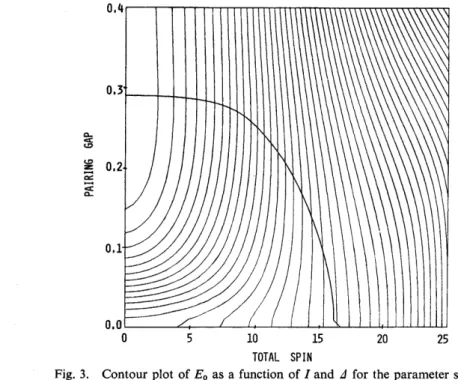
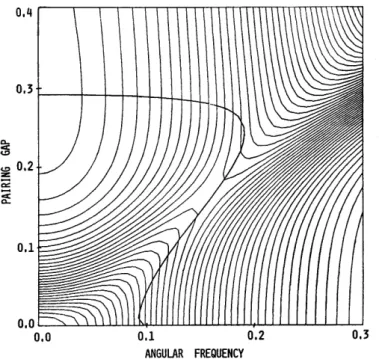
Firstly, we consider a stable solution. The yrast trajectory is composed of two parts, one with A 7EO and the other with A ==O as shown in Fig. 2. For the parameter set A, the cranking model solution is stable as shown in Fig. 3, from which it can easily understood that 02EolOA21i takes always positive value. As discussed in g3, 02E.10A21. takes always negative value in the BB region, even when 02Eo/OA2ii takes positive value. See Fig. 4.
48 Ryoji OKAMoTo
25
20
15
E9i;
Eil
6" 10
O,O O,1 O,2 O,3
ANGULAR FREQUENCY
Fig. 2. The total spin Ias a function of to. The solid line designates the result for the parameter set A, the broken line, the result for the parameter set B.
O,4
O,3
"s 2 O,2
EE
O,1
o,o
O 5 10 15 20 25
TOTAL SPIN
Fig. 3. Contour plot of Eo as a function ofIand A for the parameter set A.
The self-consistent solution A(I) is written by a thick line.
A Schematic-Model Analysis of Band Crossing DiMculty in the Cranking Model 49
O,4
o,s
ft
oe O,2
=sc
E
O,1
O,O O,1 O.2 O,3
o,o ANGULAR FREQUENCYFig, 4, Contour plot of E. as a function of w and d for the parameter set A.
The self-consistent solution a(o) is written by a thick line.
as
x9 :e 15
:.
I
\ 10
:
:5
/..-..--..
O S- 10 S no as
roTAL SPIN
Fig. 5. The angular momentum fiuctuation of valence particlgs as a function of Ifor the parameter set A. The solid line means dJ'.2, the dotted line.
Aj,2, the broken line, dj2. and the thick line dy'2, respectiVely.
50 Ryoji OKAMoTo
In Fig. 5, we show the angular momentum fiuctuations of valence particles. In the ground state at I==O, A,i.2=Aj,2==Al',2=O. These facts indicate that J'. is a good quantum number and the nucleus is axially symmetric in the ground state. As the rotation is switched on,
axial and time-reversal symmetries are broken, Then AJ' .27EAJ'2, and AJ'2.SO. It should be noted that the dependence of AJ' .?, AJ'2, and AJ'2. on I are different from those of AJ.2,
AJ; and AJ; in Ref. 12), For the parameter set A, Aj2 is about the same magnitude with I in the BB region, due to the coherent contributions from Aj.2, Aji and Aj2.. As a result, the conservation law of the total angular momentum I is approximately satisfied for the stable solution. Nextly, we consider an unstable solution. Let's compare the characteristic ratio of parameters, a and G.
2a --I 1•28 (parameter set A),
--Gny-( o.s6 (parameter set B)•
In fact we can get an unstable solution for the parameter set B. In Fig. 2, co-I plot for the parameter set B is shown. There occurs the "downbending" part in A7EO part in contrast with the "upbending" part for a stable solution, It is ofinterest to point out the
relation between the dependence of I on co and the stability condition. By considering the spin value I as a functional of tu, we can easily derive the following expression,
o,
o,
g
2 O,
a? a
o,
e-,
O 5 10 15 20 25
TOTAL SPIN
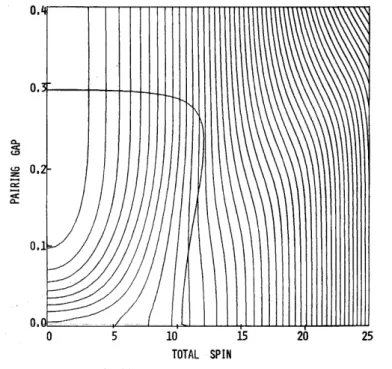
Fig. 6. Contour plot of Ee qs a function ofIand ti for the parameter set B.
The notation is the same as in Fig. 3. ,
A Schematic-Model Analysis of Band Crossing DiMculty in the Cranking Model 51
dd,I
, = [1 + (3!8)e2 S12(E;3 + E: 3) • (2a -- G) -- (918)Ge`92 • E\3E:3]
1{a[1 --- (318)Gg2S2(E;3 + E:3)]} .
The denominator of this expression is the factor vv'hich determines the sign of 02E.10A21,.
and has always a negative value in the BB region. The numerator is the one that deter- mines the sign of 02EolOA21i. Therefore, dl!dco becomes negative value for a stable solu- tion and positive value for an unstable solution in the BB region. Let us inquire into the contour map of Eo(I, A) in order to see what happens in "downbending" part. From Fig.6 we can see that there is a "backward going" part corresponding to the
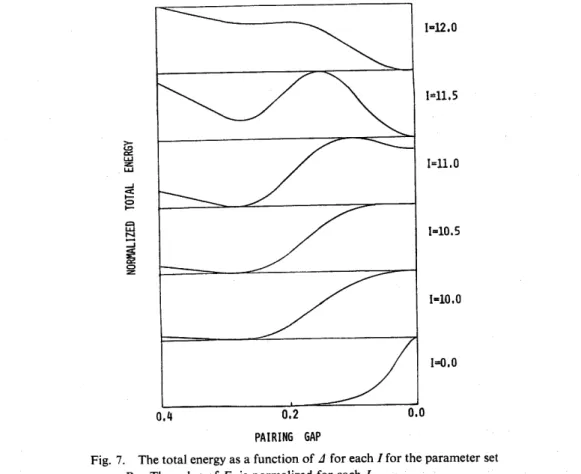
"downbending" part in Fig. 2. However, in this contour map, it is hard to examine the stability. Let's take longitudinal figures, namely the dependence of Eo on A for each I.
As seen from Fig. 7 it can be understood that 02EolOA21i for the solution with smaller A becomes negative value in the "backward going" region of Fig. 6. Furthermore, we can see that Eo of a normal phase solution becomes smaller than Eo of a stable solution with
ts cts - t6 - ml { 2
!nn,O
Itll,5
I=11,O
1=10.5
l=10,O
I=O,O
PAIRING GAP
Fig. 7. The total energy as a function of a for each Ifor the parameter set B, The value of Eo is normalized for each L
52 Ryoji OKAMoTo
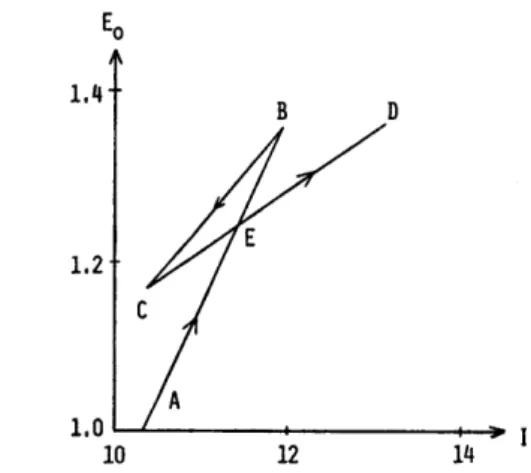
superfluid phase at IN11. The yrast energy as a function ofI is shown in Fig. 8. There occur an instability and the redundancy of spin values only in the part from points B to C in Fig. 8. For an unstable solution, Aj2 is considerably smaller than I. As a result, the conservation law of the total angular momentum is broken.
Eo
1,4
1,2
10 12 14
Fig. 8. The total energy as a function ofI for the parameter set B.
The arrow means the direction of increasing to.
5.2 On the connection between the SCC- and BC-pictures
For the stable solution the q.p. vacuum state is the yrast state. For the unstable solution, the energy of q.p. vacuum state is the lowest minimum from the points A to E in Fig.8. Just at the point E, Eo(I,A) coinsides with Eo(I,A=O). Then, from the points E to B, Eo(I, A) is a local minimum, but not the lowest one, the fact of which may suggest an existence of a tunnel effect. From the points B to C, Eo(I, A) is a local maxi- mum and the solution should be discarded. Let us compare the energy difference AEo : Eo(I, A)--Eo(I, A=:O) with the lowest two q.p. energies, (Ei+E3), in order to examine the connection between the SCC- and BC-pictures. For instance, at Itv 10.9,
AE, tNv - O.0548 and (E, + E,) tv O. 1710.
The SCC picture doesn't necessarily correspond to the BC picture with respect to the en- ergy. This may be due to the behaviour of the self-consistently determined q.p. energy which is not like the level crossing as illustrated in Fig. 10 of Ref. 6).
g6. Concludingremarks
To properly study one should adopt variation of the total energy with respect to A for fixed I. The stability condition derived in this way coincides with the condition for
the non-existence of an imaginary RPA frequency. This fact suggests us that the RPA
A Schematic-Model Analysis of Band Crossing DiMculty in the Cranking Model 53
exciation should be considered for fixed I, not for fixed co. The instability is the result of the competition between the two effects, the particle alignment and the pairing correlation. When the pairing field is unstable, the spin values are redundant. The total angular momentum is conserved approximately for a stable solution and not for an unstable solution.
If we utilize variation of the cranking energy for fixed tu, the different stability con-
dition from the above-mentioned one is obtained. By this condition, the BB phenomena leads always to the instability. Thus, the instability which is inherent to the BB phenomena is superficial.
When 6 is zero, the spin values are missing in the BB region for the case of 2aÅrG, due to the mis-matching between I and tu. Although the missing spin value problem is discussed' in the fully degenerate case for the R(8) model, we believe that the features may hold good for a realistic HFBC calculation, since I is restricted to be an integer.
The stability condition shows us that as the parameter a incresses, namely s decreases, the pairing field becomes stable. While it is well-known that as the parameter e, which is proportional to the degree of the core deformation, decreases, the quadrupole field be- comes unstable. We believe that the present analysis, in which the degree of the defor- mation is fixed, is valid in realistic cases, since the variation with respect to the shape deformation parameters may not so important for the yrast states with IÅq20 under consideration.
Acknowledgements
The author would like to express his sincere thanks to Dr. A. Kuriyama for the initiation of the present problem and for many suggestions which were essential to the present work. Hc also wish to thank Mr. M. Yahiro for helpfu1 advice on drawing graphs by using computer. The part of present work was done as a part of the 1980 annual research projects on "Theoretical Study of the High-Spin States of the Nucleus" organized by the Reseach Institute for Fundamental Physics, Kyoto University. The numerical calculations were carried out with FACOM M-200 at the Computer Center, Kyushu University.
References
1) I. Hamamoto, Nucl. Phys. A271 (19. 76), 15.
2) B. Banerjee, H. J. Mang and P. Ring, Nucl. Phys. A215 (1973), 366.
3) M. Sano, T. Takemasa and M. Wakai, Nucl. Phys. A190 (1972), 472.
4) A. L. Goodman, Nucl. Phys. A265 (1976), 113.
5) E. R. Marshalek and A. L. Goodman, Nucl. Phys. A294 (1978), 92.
6) S. Y. Chu, E. R. Marshalek, P. Ring, J. Krumlinde and J. O. Rasmussen, Phys. Rev. C12 (1975), 1017.
7) J. Krumlinde and Z. Szymanski, Ann. Phys. 79 (1973), 201.
t
54 Ryoji OKAMoTo
8) T. Horibata and N. Onishi, Prog. Theor. Phys. 67 (1982), 190.
9) A. Bohr and B. R. Mottelson, Physics Today, June (1979), 25.
10) A. Bohr and B. R. Mottelson, Nucl. Phys. A354 (1981), 303c.
11) H.J. Mang, Proc. Symp. High-Spin Phenomena in Nuclei, Argonne National Laboratory, 1979, p165.
12) A. L. Goodman, Nucl. Phys. A347 (1980), 123.
13) H. J. Mang, B. Samadi and P. Ring, Z. Phys. A279 (1976), 325.
14) W.Sibagaki, Kaisekigakutsuron (Advanced Analysis, Vol. 1) (Maruzen, Tokyo, 1963) p514 [in Japanese].
C. Carath6odory, Variationsrechnttng und Partielle Dtffe.rentialgleichungen erster Ordnung (Teubner, Leipzig und Berlin, 1935) pl85.
Department of Physics, KJ,ushu Institute of' Technology,
Kitakvushu 804 v