Methods of Self-Construal Using Classification
Tree Analysis
著者
Sachiko Kiyama, Youngmi Choung, Masato Takiura
journal or
publication title
Journal of Cross-Cultural Psychology
volume
50
number
10
page range
1127-1139
year
2019-11-27
URL
http://hdl.handle.net/10097/00128327
doi: 10.1177/0022022118815765 (C) The Author(s) 2018Multiple factors act differently in decision-making in the East-Asian region: Assessing methods of self-construal using classification tree analysis
Sachiko Kiyama Tohoku University
Youngmi Choung Korean Tourism College
Masato Takiura
The Open University of Japan
Author Note
Sachiko Kiyama, Department of Linguistics, Graduate School of Arts and Letters, Tohoku University; Youngmi Choung, Department of Tourism Japanese, Korean Tourism College; Masato Takiura, Graduate School of Arts and Sciences, The Open University of Japan.
The authors are grateful to Katsuo Tamaoka for invaluable suggestions on this study, as well as for his help in data collection. This research was supported in part by grants from the Ministry of Education of the Republic of Korea and the National Research Foundation of Korea (NRF-2015S1A5B5A01016367 awarded to YC), the Japan Society for the Promotion of Science Grants-in-Aid for Young Scientists (A) (16H05940 awarded to SK) and for Challenging Exploratory Research (18K18496 awarded to SK), and the start-up research costs program of Tohoku University Center for Gender Equality Promotion (awarded to SK).
Correspondence should be addressed to Sachiko Kiyama, Department of Linguistics, Graduate School of Arts and Letters, Tohoku University, Japan.
Abstract
Cultural resemblance between Japan and Korea has been assumed, because both East Asian cultures are generally characterized by collectivism. However, subsequent investigations suggest a contrast between the two cultures in the decision-making process, concurrent with a growing call for a more elaborate model of self-construal. This study compares the diverse ways of self-construal underlying decisions regarding invitations between Japan and Korea. We conducted a scenario-based questionnaire in which 377 Japanese and Korean college students made decisions regarding whether to invite someone to an activity, to do the activity alone, or to not do the activity. Utilizing classification tree modeling to analyze multivariate categorical data, we examined the participants’ selected actions according to two factors: interpersonal relations (i.e., whether the other was a friend or an unfamiliar but favored classmate), and the locus of interest in a given situation (i.e., whether the event was of interest to the speaker, hearer, or both parties). The results revealed cultural variations in invitations. Japanese students seem to be interdependent, in that they hesitate to invite others unless they have an assured interpersonal relationship, and tend to wait until they are sure of the other’s interest, even when interested themselves. In contrast, Korean students appear more independent in considering the other’s interest and pursuing their own interest. This study highlights the complex ways of self-construal within the alleged collectivist East Asian region, and also demonstrates the applicability of classification tree analysis in differentiating rank orders of multiple factors influencing people’s decision-making across cultures.
Keywords: Decision tree analysis, independent and interdependent self-construal, Japan,
Multiple factors act differently in decision-making in the East-Asian region: Assessing methods of self-construal using classification tree analysis
How people consider themselves is exemplified in how they make decisions about their actions and reactions in social intercourse all the time. The decision-making process depends largely on each individual’s view regarding how to maintain interpersonal relationships. Ever since the two constructs of individualism and collectivism (e.g., Hall, 1976; Hofstede, 1980), which relate to independent and interdependent self-construal, respectively, were proposed to characterize cross-culturally differentiated values, behaviors, beliefs, attitudes, etc., numerous theoretical and empirical efforts have been conducted to replicate this classic dichotomy (see Triandis, 1995 for a review; Holt & DeVore, 2005 for a meta-analysis). A recent exhaustive investigation by Vignoles, Owe, Becker, Smith, Easterbrook, and Brown et al. (2016) noted global variation in selfhood, which should not be confused with the oversimplified model of independent and interdependent self-construal. Particularly, they elaborated a comprehensive model to account for ways of being independent and interdependent across seven domains of personal and social functioning: defining the self, experiencing the self, making decisions, looking after oneself, moving between contexts, communicating with others, and dealing with conflicting interests. Among these seven domains, the alleged collectivist cultures in South and East Asia did not necessarily exhibit interdependent ways, especially in experiencing the self (self-containment vs. connection to others) and making decisions (self-direction vs. receptiveness to influence by others), although they were consistently found to be interdependent in other dimensions. So far, the multifaceted dimensions beyond the independent-interdependent dichotomy have been demonstrated to account for much cultural variation, not just between but also within regions. However, it still remains unclear how we could examine those multifaceted dimensions’ interactive
influence on the specific differences in people’s behavior within and between regions and across cultures.
One typical example that reflects individual self-construal is situations of deciding whether to invite the other to join an activity. Inviting is an illocutionary act where the speaker makes a commitment to provide a course of action that benefits the hearer (Searle, 1979). As there is no guarantee that invitees will accept, inviters inevitably risk rejection and losing face, which is defined as “the positive social value a person effectively claims for himself by the line others assume he has taken during a particular contact” (Goffman, 1967, p. 5). Therefore, extending an invitation can result in substantial disparity, depending on the dimensionality of independent and interdependent self-construal.
It has been thought that people in collectivist cultures (e.g., Japan and Korea) have a deep fear of rejection, while those living in individualist cultures (e.g., the U.S.) are relatively fearless in approaching others (e.g., Ambady, Koo, Lee, & Rosenthal, 1996; Gudykunst & Nishita, 1993; Markus & Kitayama, 1991; Obuchi, Fukushima, & Tedeschi, 1999; Yamaguchi, 1994). This assumption seems to be supported by some linguistic pragmaticists’ comparisons of daily invitation activities between speakers of Western and non-Western languages (Eslami, 2005; Ghorbani, Bing, Watson, Davison, & LeBreton, 2003), where speakers from so-called collectivist cultures (Persian/Iranian) tend to decline invitations compared to native English speakers from individualist cultures. Nevertheless, several cross-cultural investigations in the (non-Western) East Asian region have shown differences in the patterns of invitation. Although both Japan and Korea are considered to be collectivist cultures (Kim-Jo, Benet-Martinez, & Ozer, 2010; Schwartz, 1994), Choung’s (2011) qualitative analysis of role-playing conversations, wherein a young college student tries to extend invitations to his/her friend, indicates differences in linguistic behavior. Young Koreans tend to use more direct linguistic strategies when inviting their friends to a recreational activity, whereas their Japanese counterparts are
often more equivocal. The difference between Japan and Korea is also evident in various social interactions, such as responses to a compliment (Kim, 2012) or an unwarranted accusation (Kiyama, Takatori, Lim, & Tamaoka, 2016), suggesting that Koreans tend to self-disclose more and feel more comfortable approaching others than do the Japanese.
Although Vignoles et al. (2016) did not include Korea in their cross-cultural investigation of the seven-dimensional model mentioned earlier, Hofstede (1991) used Korean data in his framework of the cross-cultural diversity of self-construal, which divided more than 40 countries into four quadrants according to the two continuums of individualism/collectivism and uncertainty avoidance. While both Japan and Korea are included in the same quadrant of the collectivist and strong uncertainty avoidance distribution plot, Japan has much stronger tendencies toward uncertainty avoidance and is closer to individualism than Korea (Hofstede, 1991). The finding that the Japanese prefer to avoid uncertainty more than the Koreans do is consistent with the aforementioned cross-cultural comparisons by the linguistic pragmaticists that concluded that the Japanese, unlike Koreans, tend to hesitate when approaching others. Several subsequent studies have replicated the finding that Japanese people highly value security in their long-term interpersonal relationships and refuse to trust others (e.g., Leung, 1988; Merkin, 2006; Yamagishi, Cook, & Watabe, 1998). Even though these studies did not compare the so-called collectivist societies of Japan and Korea, presumably the Japanese have a stronger fear of being rejected by others than do Koreans, based on the findings by Choung (2011), Kim (2012), and Kiyama et al. (2016).
However, Hofstede’s (1991) plot of the individualism/collectivism continuum shows that the Japanese, not the Koreans, are more individualist, even though both cultures are considered collectivist. Accepting the assumption of Yamagishi et al. (1998), namely that cultures requiring strong security are characterized as more collectivist, compared to Koreans, the Japanese should be more collectivist than individualist. This contradiction
may derive from both theorists’ different views of individualism/collectivism, as well as the samples on which they are based. Hofstede’s (1991) straightforward observation is that the reticence of Japanese people with others is an individualist state. On the other hand, Yamagishi et al. (1998) offer a novel interpretation of Japanese aloofness as collectivist instead of individualist, because they have a deep fear of losing the security of their assured, long-term interpersonal relationships, and are not independent enough to pursue their own interests. Here is the confusion that prompts the call for more appropriate integration of the complex ways of self-construal beyond individualist vs. collectivist and/or Western vs. non-Western comparisons.
To elaborate the consequences of Korean and Japanese self-construals, Cha (1994) and Yamaguchi (1994) used the same Collectivism Scale to examine correlations with other personality scales. According to them, Koreans’ self-construal is characterized by a mutual-aid norm and friendship, and they are more independent and willing to help even strangers, whereas Japanese self-construal seems to be interdependent enough to value committing to the demands of their group, expecting benefits later. In other words, the disparity in self-construals in East Asia might be determined by their individual value in how to experience the self, how to make decisions, and how to deal with conflicting interests between the self and the other, for all of which Vignoles et al. (2016) found no significant differences between independent and interdependent ways in the region. In conclusion, to characterize East Asian people’s processes of self-construal, we need to interpret their decision-making in terms of whether they are motivated by preferring to pursue their own interests or their group’s interest.
In this paper, we attempt to examine a possible solution to better understand how the complex dimensions of self-construal are reflected in actual social intercourse across cultures in a non-Western region. In order to do this, a parsimonious scenario-based questionnaire was designed to assess the interaction effects among multiple factors
influencing decision-making regarding whether to invite others to join an activity, and if not, whether to do it alone. One factor to be assessed is the locus of interest, given the abovementioned empirical analyses. We predict that Korean people are more future-oriented in fearlessly approaching those they judge trustworthy, because they wish to pursue their own interests, while Japanese people rarely approach others owing to their greater concern with the interests of the group. More individualistic people, who are motivated to trust others even in uncertain situations, will invite others, even virtual strangers, to activities in which they themselves are interested. Conversely, collectivistic people, who are only motivated to approach long-term intimates in secure situations, will invite those with whom they are familiar, and only when they are sure that the other is interested in the activity. Individualists will do the activity alone if it is of interest, whereas collectivists will not, even if they are interested in the activity.
People are more trusting of others who are closer in a social network, given the potential reputation costs of bad behavior (Weaverdyck & Parkinson, 2018). Thus, whether one judges the other as trustworthy enough to extend an invitation depends on the interpersonal relationship between the inviter and the invitee, in addition to the locus of interest. We will consider another factor of interpersonal relations in our scenario study. The decision-making of a speech act is predictable using the traditional linguistic, anthropological framework of face management by Brown and Levinson (1987). They postulated that every speech act can be a face-threatening act (FTA) to the addressee, since no one can deny the possibility that the addressee does not want to be addressed at that time. Accordingly, the addresser has to decide whether or not to do the FTA, and if so, how to mitigate the FTA by taking any appropriate politeness strategies according to the degree of its weightiness. The weightiness of an FTA is estimated by the following three factors: the social distance (D) between the speaker (S) and the hearer (H), the
that culture (the rank of imposition: R). The previous cross-cultural comparisons of Japanese and Korean people’s behaviors (e.g., Choung, 2011; Kim, 2012; Kiyama et al., 2016; Tamaoka et al., 2010) consistently suggest a trade-off between the factors of P and D. Koreans are known to be more concerned with P (i.e., being obedient to superiors) and relatively unconcerned by the degree of D (i.e., being blunt with peers and inferiors regardless of social distance), whereas the Japanese tend to emphasize D (i.e., being diffident with unfamiliar people) but are less influenced by P (i.e., being less reserved with superiors in comparison with Koreans). The factor of interpersonal relations seems to matter, especially when comparing the two similar, neighboring cultures.
A possible method to compare the priorities of these multiple factors in different cultures is a decision tree analysis. This technique aims to select a useful subset of predictors from a set of candidate factors in descending order, with respect to a dependent measure. If the dependent measure is categorical data related to participants’ decision-making, as in this study, a classification tree analysis can be employed to seek significant qualitative differences (if the dependent measure is a scale, then a regression tree analysis is utilized). This classification tool is based on the chi-squared automatic interaction detector (CHAID) algorithm originally proposed by Kass (1980). CHAID automatically selects the candidate factor with the strongest interaction first, and then continues down to the one with the least interaction. In this tree-growing process, each parent node represents a factor, which only splits into child nodes when a significant difference is found between any of the other factors. Some recent studies in the field of linguistic pragmatics employed this technique to analyze linguistic data obtained from questionnaires (Kiyama et al., 2016; Tamaoka, Lim, Miyaoka, & Kiyama, 2010). However, decision tree analysis is still rarely used to examine cross-cultural differences in decision-making processes. We consider this method applicable to compare the effect of different priorities on any human behavior in social interactions.
Therefore, the purpose of this study is twofold. One is to elaborate the diverse methods of Japanese and Korean self-construal underlying the decision-making process involved in extending an invitation in this East Asian region. The second purpose is to demonstrate the applicability of decision tree analysis (classification tree analysis in this case) in finding rank orders among multiple predictors that determine people’s decision-making. For the first aim, we conducted a scenario-based questionnaire survey asking whether participants would invite others to join activities in terms of the two factors: locus of interest and interpersonal relations. Based on the above previous findings, we hypothesized that interpersonal relations would have a stronger effect on Japanese people’s decision to invite others, because they rely heavily on long-term interpersonal relations. On the other hand, we postulated that locus of interest would have a greater influence on Korean people’s decision-making, because they tend to trust others regardless of their current relations. To achieve the second aim, we compared the differences between findings obtained from the classification tree analysis and those from the alternative method of chi-squared tests.
Method
Participants
In total, 377 college students (192 male and 185 female) participated in this study, of which 188 were from Japan (110 male and 78 female) and 189 from South Korea (82 male and 107 female). Their native languages were Japanese and Korean, respectively. The participants from Japan were enrolled at several national and private universities in urban areas (i.e., Tokyo, Nagoya, and Sendai). The Korean participants were from several private universities in the metropolitan area of Seoul and the city of Cheongju. They were either paid or received course credit for their participation. The ages of the Japanese participants ranged from 18 to 24 years (M = 20.4 years, SD = 1.3 years), and those of the
Koreans from 18 to 25 years (M = 20.2 years, SD = 1.7 years).
Material
We created a questionnaire presenting three situations in which the locus of interest factor was manipulated. The first situation described a movie preview in which both the speaker and hypothetical hearer were interested, but the hearer appeared to be busy. The second situation concerned a sports game that only the speaker was eager to watch, while the hearer was busy at the time and was not interested anyway. In the third situation, the hearer wanted to play badminton, but the speaker was not interested. In all three situations, participants were asked to imagine themselves as the speaker and to make a decision regarding whether to invite the hearer to join them, do it alone, or not do it at all. For each situation, they selected one of three responses for two types of hypothetical same-sex hearers: familiar friend and unfamiliar but favored classmate. As there were three situations and two types of hearers, participants selected responses to six different cases in total. The pencil-and-paper scenario-based questionnaire survey took approximately ten minutes. The three situations were first written in Korean and then translated into Japanese by highly advanced bilingual people with many years of research experience. The translations were then translated back into Korean, and no significant problems were found. The English translation of the questionnaire is provided in the Appendix.
Analysis
To reveal rank orders in the multiple dimensions of self-construal people supposedly adopt simultaneously when making decisions, we needed to conduct a multivariate analysis to examine the interaction effects of multiple predictor factors on people’s selections as categorical data. This study compared two types of analyses: the traditional method of a series of chi-squared tests, and classification tree modeling to detect the interaction effects of multiple factors predicting a categorical dependent measure. The alpha level was set at .05 for all subsequent statistical analyses.
First, we cross-tabulated the three types of participants’ selections (i.e., invite, do it alone, and not do it) depending on the two cultures (i.e., Japan and Korea). As cross-tabulations only consider two-way tables at most, 3 × 2 tables were created separately for each condition of the two factors, namely interpersonal relations and locus of interest, as shown in Table 1. A series of chi-squared tests was conducted to check whether the results of the frequency distribution in each cross-tabulation were significant. Standardized residuals (M = 0, SD = 1) were also calculated to compare residuals from different cells in each table.
Second, we conducted classification tree modeling, including the two predictor variables arranged in a 2 (i.e., familiar and unfamiliar other) × 3 (i.e., of interest to both parties: speaker and hearer) design. The model was examined for each culture in terms of a dependent variable: the frequencies of the three types of participants’ selections (i.e., invite, do it alone, or not do it). The two independent variables were within-participant variables (i.e., repeated measures). Bonferroni adjusted p values were applied before splitting the nodes to avoid a Type I error (i.e., a false positive). The classification tree models were constructed using the software packages rpart (Therneau, Atkinson, & Ripley, 2017) and partykit (Hothorn & Zeileis, 2015), implemented in R ver. 3.3.0.
Results
The results from the series of chi-squared tests and standardized residuals in each cross-tabulation (Table 1) revealed whether each selection significantly differed between the Japanese and Korean participants for each condition of the two predictor variables (i.e., interpersonal relations and locus of interest). Overall, significant differences between the two cultures were found in selections where the hearer, when interested in the event, was familiar (Situation 3; χ2
2 = 6.667, p = .036, V = .598): “invite” was more
Japanese (33.8%). Regarding selections where the hearer was unfamiliar, significant differences were also found when the speaker was interested in the event (Situation 2; χ2
2
= 7.632, p = .022, V = .151). Korean participants responded “do it alone” (39.4%) more often than their Japanese counterparts (25.3%). The same was true when the hearer was interested in the event (Situation 3; χ2
2 = 17.688, p = .000, V = .226): “invite” was a more
frequent response among Koreans (46.9%), as was “not do it” among the Japanese (65.6%). As the chi-squared tests had to be conducted separately for each condition of the two predictor variables (interpersonal relations and locus of interest), it could not be determined how these two factors interact to influence participants’ selection of action.
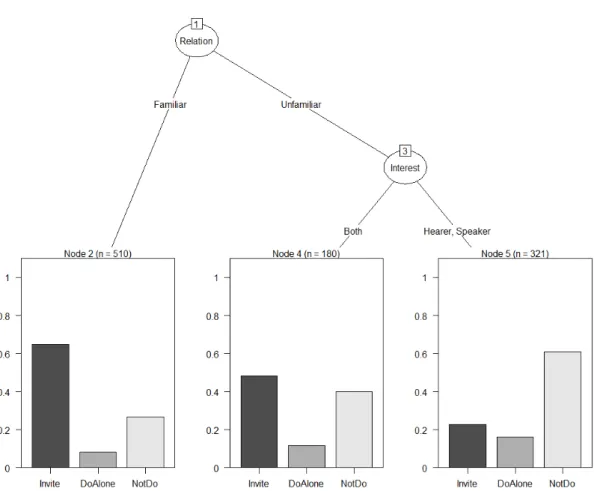
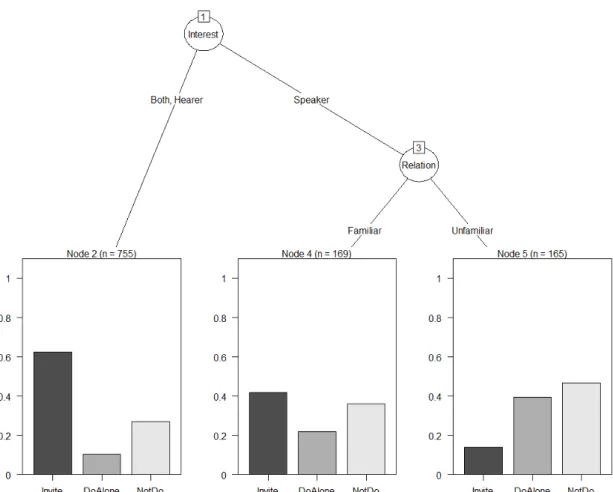
Classification tree modeling for Japan (Figure 1) and Korea (Figure 2) revealed that the rank order of the two predictor variables differed between the two cultures. The Japanese classification tree showed that interpersonal relations were a stronger predictor variable influencing selection than locus of interest, whereas the Korean one indicated the opposite. Locus of interest was the stronger predictor for Koreans’ selection of action, not interpersonal relations. Regarding selections by Japanese college students, “invite” had the highest ratio (64.9%) when the hearer was familiar, regardless of the locus of interest (Figure 1, Node 2); however, when the hearer was unfamiliar, their selection differed significantly depending on the locus of interest. They selected “invite” most often (48.3%) when both parties were interested in the event (Node 4), whereas the option “not do it” was selected more often (61.1%) when only either the speaker or hearer was interested (Node 5). Conversely, the Korean college students’ classification tree showed that they selected “invite” most often when either both parties or only the hearer (62.5%) was interested in the event, regardless of whether the hearer was familiar or unfamiliar to them (Figure 2, Node 2). When only the speaker was interested, they tended to invite the hearer if they were familiar (42.0%, Node 4), but selected to do it alone (39.4%) or not do it (46.7%) if the hearer was unfamiliar (Node 5).
Discussion
This study aimed first to compare the diverse ways of self-construal underlying decisions regarding invitations between the alleged collectivist cultures of non-Western Japan and Korea. We also tried to validate a multivariate analysis method to differentiate rank orders among multiple factors predicting people’s decision-making. The act of extending an invitation inevitably carries a certain risk of rejection by the invitee and the inviter losing face, but it also provides an opportunity for both parties to develop a firm tie if the invitee accepts. Whether people decide to take this risk should depend on individually and/or culturally relevant self-construals. The findings obtained through the combined use of a series of chi-squared tests and classification tree modeling regarding whether people extend an invitation revealed differences between the two alleged collectivist East Asian cultures according to two factors: interpersonal relations and locus of interest. Our hypothesis concerning how interpersonal relations and locus of interest influence the decision of whether to “invite,” “do it alone,” or “not do it” was generally supported. A series of chi-squared test revealed a significant difference, namely that Korean college students invited their friends to an activity in which the hearer was interested more frequently than did their Japanese counterparts. Consistent with Cha (1994) and Yamagishi’s (1994) conceptualization of ways East Asian people are collectivistic, Korean students, unlike the Japanese counterpart, seem more sensitive in that they try to satisfy the other’s needs.
The classification tree modeling indicated a more detailed process of decision-making regarding extending an invitation. For Japanese college students, interpersonal relations were a stronger predictor than locus of interest. Our Japanese participants tended to hesitate in inviting those with whom they were not familiar, suggesting that they avoid approaching others unless they have an assured, long-term interpersonal relationship. On the other hand, the stronger predictor for Korean students was locus of interest. Once they
knew the hearer was interested in the activity, they tended to extend an invitation, regardless of whether the other was familiar or unfamiliar to them (Figure 2, Node 2). Young Korean students seemed more fearless in facing rejection, and they were eager to invite a person they liked if they were interested in the event, regardless of whether they were already familiar with that person. This result is consistent with a previous conversational analysis (Choung, 2011) in which young Korean people preferred direct expressions in extending invitations to their friends, whereas their Japanese counterparts were often equivocal, conveying pessimism about whether the other would accept the invitation.
The interaction effect of interpersonal relations and locus of interest successfully differentiated the confusing ways of being independent or interdependent, especially in the dimension of decision-making in Asia, which was revealed in the results of Vignoles et al.’s (2016) exhaustive cross-cultural comparison across six world regions. They interpreted the unexpected results such that Japanese culture should be treated as individualistic among Asia. In light of our results from the classification tree modeling, however, Japanese young people might not be individualistic, at least in comparison with their Korean counterparts. It seems that young Japanese students cannot act without some assurance, given our finding that they tended to hesitate to invite someone with whom they were unfamiliar who was interested in the event, even though they liked that person. Young Japanese students tend not to invite an unfamiliar but liked person unless they are sure that both parties are interested in the event. Also note that they may not be able to act, without knowing that both parties are interested. This tendency supports the view that the Japanese are a highly interdependent people who rely heavily on long-term interpersonal relationships, which has been repeatedly demonstrated in previous studies (e.g., Ohbuchi et al., 1999; Yamagishi, 2011; Yamaguchi, 1994). The young Japanese students’ strong commitment to others is also evident in the recent issue called
benjo-meshi (toilet meal), which has drawn the attention of the Japanese media. These students
eat alone at the toilet, because they have strong fear of giving the impression to others that they do not have friends to have lunch with on campus (Takeda, 2016). Obviously they cannot act alone.
On the other hand, our Korean participants tended to invite those they liked when they knew that person was interested in the event, regardless of whether they were familiar with them. In other words, young Korean students, unlike their Japanese counterparts, do not hesitate to invite those with whom they are unfamiliar but like, suggesting that they are influenced more by the locus of interest than their current interpersonal relationship. In addition, our Korean participants seemed to do an activity alone more often than their Japanese counterparts and to pursue their own rather than the other’s interest. Thus, young Korean college students seem to have a more independent self-construal than young Japanese students.
Yamagishi (1988a, 1988b) characterized the Japanese collectivist value system in more detail. It is sustained by a system of mutual monitoring and sanctioning among group members, and therefore unjustified free riding (i.e., a group member experiencing problems accessing public recourse) is punished socially. The finding from the present analysis is consistent with this view, suggesting that young Japanese students do not act in their own interests but wait to discern others’ interests and seek assurance in their actual interpersonal relationships before making decisions regarding their social encounters. Conversely, young Korean students seem to devote their efforts to others’ interests when they judge it to be of benefit to themselves (i.e., the hypothetical other in our questionnaire was always favored by the participant).
This study also demonstrated the applicability of decision tree analysis, particularly classification tree modeling, to elicit how multiple candidate factors interact to predict a categorical dependent measure. While various methodologies have been developed for
multivariate analyses of continuous dependent measures, a technique for analyzing categorical data is scarce. However, this technique is required to better understand people’s decision-making processes. Classification tree modeling enabled us to discuss the difference within so-called collectivist cultures. Young Japanese students’ decision-making is strongly affected by interpersonal relationships rather than locus of interest, and vice versa for young Korean students. We could not differentiate this through a series of chi-squared tests alone. Although what we applied to this technique was discrete choice data concerning decision-making, the technique of decision tree analysis is also applicable to other types of data, such as coded categories based on free descriptions or observed behaviors, which will better manifest the detailed process of the complex ways of independent and interdependent self-construals across and within regions of the world.
Although the present parsimonious analysis provides some implications to demonstrate the decision-making processes of young college students in so-called collectivist cultures within the East Asian region in terms of whether to extend an invitation, there are some limitations to our approach. First, our way of manipulating the contextual factor might be somewhat confounded, in that the activity (e.g., a sports game, a movie) changed according to the locus of interest in the scenario. Although we did so in order to refresh the participants with a new situation in order to smoothly imagine their decision-making in actual social intercourse, future studies should replicate the effect of the factor by conducting more comprehensive experiments. Second, we did not manipulate age differences (i.e., the hypothetical other was always the same age as the participant in the questionnaire), because it was difficult to produce a situation suited to both same-age and older others. Since the factor of age difference is important, especially when discussing models of self-construal in collectivist cultures where people’s actions rely on a hierarchical system (e.g., Triandis, 1995), the interactions of age difference with other factors in decision-making in these cultures should be examined as a next step.
In addition to extending invitations, cross-cultural variation in interactional principles and cultural models of self-construal may be reflected in other situations. Such situations may include conflict management (Lebra, 1976; Ohbuchi et al., 1999), in which behavior differs significantly between private and public situations, as well as responses to unjustified accusations (Tanaka, Spencer-Oatey, & Cray, 2000). Thus, it could indicate that the more Japanese people value social harmony, the more they will require the other to adopt a cooperative attitude. Classification tree modeling would be efficient for cross-cultural comparisons of such complicated situations in which people are required to balance priorities in making decisions. Furthermore, it would satisfy the growing demand for empirical evidence of the various interactional principles or moral orders behind peoples’ behavior and language use (Spencer-Oatey & Jiang, 2003).
To conclude, the alleged collectivist ways of self-construal manifested in people’s decision-making regarding whether to extend an invitation seem to differ between Japanese and Korean college students in the East Asian region. Young Japanese students can be interpreted as strongly interdependent, in that they have a fear of inviting others unless they have an assured, long-term interpersonal relationship with them, and wait to see whether the other is interested before making a decision. In contrast, young Korean students may demonstrate more independent self-construal, in that they consider the other’s interest but have a simultaneous individualist motivation to pursue their own interest in their decision-making. This cultural variation within a so-called collectivist region (i.e., East Asia) supports the recent call for a more elaborate cultural model of self-construal beyond the Western vs. non-Western dichotomy. The technique of decision tree analysis would meet this call.
References
Ambady, N., Koo, J., Lee, F., & Rosenthal, R. (1996). More than words: Linguistic and nonlinguistic politeness in two cultures. Journal of Personality and Social Psychology,
70, 996-1011.
Brown, P., & Levinson, S. C. (1987). Politeness: Some universals in language usage. Cambridge University Press.
Cha, J. (1994). Aspects of individualism and collectivism in Korea. In U. Kim, H. C. Triandis, C. Kagitcibasi, S. Choi, & G. Yon (Eds.), Individualism and collectivism:
Theory, method, and application (pp. 157-174). Thousand Oaks, CA: Sage.
Choung, Y. (2011). Yuujin no kaiwa ni okeru “sasoi-koodoo” no nikkan taishoo kenkyuu:
Discourse politeness riron no kanten kara [A comparison between Japan and Korea on “invitation behavior” in conversations with friends: From the discourse politeness perspective]. Doctoral dissertation, Tokyo University of Foreign Studies (written in
Japanese).
Eslami, Z. R. (2005). Invitations in Persian and English: Ostensible or genuine?
Intercultural Pragmatics, 2, 453-480.
Goffman, E. (1967). Interaction ritual: Essays in face-to-face behavior. Chicago: Aldine. Ghorbani, N., Bing, M. N., Watson, P. J., Davison, H. K., & LeBreton, D. L. (2003). Individualist and collectivist values: Evidence of compatibility in Iran and the United States. Personality and Individual Differences, 35, 431-447.
Gudykunst, W. B., & Nishita, T. (1993). Interpersonal and intergroup communication in Japan and the United States. In W. B. Gudykunst. (Ed.), Communication in Japan and
the United States (pp. 149-214). State University of New York Press.
Hall, E. T. (1976). Beyond culture. NY: Anchor.
Hofstede, G. (1980). Culture's consequences: International differences in work-related
Hofstede, G. (1991). Culture and organizations: Software of the mind. London: McGraw-Hill.
Holt, J. H., & DeVore, C. J. (2005). Culture, gender, organizational role, and styles of conflict resolution: A meta-analysis. International Journal of Intercultural Relations,
29, 165-196.
Hothorn, T., & Zeileis, A. (2015). partykit: A Modular Toolkit for Recursive Partytioning in R. Journal of Machine Learning Research, 16, 3905-3909.
Kass, G. V. (1980). An exploratory technique for investigating large quantities of categorical data. Applied Statistics, 29, 119-127.
Kim, K. (2012). Nihongo to Kankokugo no home ni kansuru taishoo-kenkyuu [A
comparison between Japan and Korea on responses to compliment]. Tokyo: Hituji
Shobo (written in Japanese).
Kim-Jo, T., Benet-Martinez, V., & Ozer, D. J. (2010). Culture and interpersonal conflict resolution styles: Role of acculturation. Journal of Cross-Cultural Psychology, 41, 264-269.
Kiyama, S., Takatori, Y., Lim, H., & Tamaoka, K. (2016). From universal perceptions to diverging behaviors: An exploratory comparison of responses to unreasonable accusations among people from the United States, Japan, and South Korea.
International Journal of Linguistics and Communication, 4, 19-33.
Lebra, T. S. (1976). Japanese patterns of behavior. University of Hawaii Press.
Leung, K. (1988). Some determinants of conflict avoidance. Journal of Cross-cultural
Psychology, 19, 125-136.
Markus, H. R., & Kitayama, S. (1991). Culture and the self: Implications for cognition, emotion, and motivation. Psychological Review, 98, 224-253.
Merkin, R. S. (2006). Uncertainty avoidance and facework: A test of the Hofstede model.
Ohbuchi, K., Fukushima, O., & Tedeschi, J. T. (1999). Cultural values in conflict management: Goal orientation, goal attainment, and tactical decision. Journal of
Cross-Cultural Psychology, 30, 51-71.
Schwartz, S. H. (1994). Beyond individualism and collectivism: New cultural dimensions of values. In U. Kim, H. C. Triandis, C. Kagitcibasi, S. Choi, & G. Yon (Eds.),
Individualism and collectivism: Theory, method, and application (pp. 85-122).
Newbury Park, CA: Sage.
Searle, J. (1979). Expression and meaning: Studies in the theory of speech acts. Cambridge University Press.
Spencer-Oatey, H., & Jiang, W. (2003). Explaining cross-cultural pragmatic findings: Moving from politeness maxims to sociopragmatic interactional principles (SIPs).
Journal of Pragmatics, 35, 1633-1650.
Takeda, W. (2016). Reconsidering individualization of eating: A cross-cultural analysis
on determinants of commensality and solo-eating (Doctoral dissertation, Australian
National University). Retrieved from
https://openresearch-repository.anu.edu.au/bitstream/1885/101431/1/Takeda%20Thesis%202016.pdf Tanaka, N., Spencer-Oatey, H., & Cray, E. (2000). “It’s not my fault”: Japanese and
English responses to unfounded accusations. In H. Spencer-Oatey. (Ed.), Culturally
speaking: Managing rapport through talk across cultures (pp. 75-97). London:
Continuum.
Tamaoka, K., Lim, H., Miyaoka, Y., & Kiyama, S. (2010). Effects of gender-identity and gender-congruence on levels of politeness among young Japanese and Koreans.
Journal of Asian Pacific Communication, 20, 23-45.
Therneau, T., Atkinson, B., & Ripley, B. (2017). rpart: Recursive Partitioning and Regression Trees. R package version 4.1-11, Retrieved from
https://CRAN.R-project.org/package=rpart.
Triandis, H. C. (1995). Individualism and collectivism. Boulder, CO: Westview.
Vignoles, V. L., Owe, E., Becker, M., Smith, P. B., Easterbrook, M. J., Brown, R., et al. (2016). Beyond the ‘East-West’ dichotomy: Global variation in cultural models of selfhood. Journal of Experimental Psychology: General, 145, 966-1000.
Weaverdyck, M., & Parkinson, C. (2018). The neural representation of social networks.
Current Opinion in Psychology, 24, 58-66.
Yamagishi, T. (1988a). Exit from group as an individualistic solution to the free rider problem in the United States and Japan. Journal of Experimental Social Psychology,
24, 530-542.
Yamagishi, T. (1988b). The provision of a sanctioning system in the United States and Japan. Social Psychology Quarterly, 51, 265-271.
Yamagishi, T. (2011). Trust: The evolutionary game of mind and society. Berlin: Springer. Yamagishi, T., Cook, K. S., & Watabe, M. (1998). Uncertainty, trust, and commitment formation in the United States and Japan. American Journal of Sociology, 1, 165-194. Yamaguchi, S. (1994). Empirical evidence on collectivism among the Japanese: A
perspectivs from the self. In U. Kim, H. C. Triandis, C. Kagitcibasi, S. Choi, & G. Yon (Eds.), Individualism and collectivism: Theory, method, and application (pp. 175-188). Thousand Oaks, CA: Sage.
Appendix
Description of situations presented in the questionnaire. (Original versions were presented in Japanese and Korean.)
Participants read the following situations and selected one of three alternatives (i.e., invite, do it alone, or not do it) for two hypothetical others (i.e., familiar friend and unfamiliar but favored classmate) per situation. The notes in parentheses were not provided to participants in the actual questionnaire.
Situation 1 (of interest to both the speaker and hearer)
You now have free time after giving your presentation in class last week. By the way, you have won two tickets to a movie preview. You wanted to watch the movie, and your favorite actor will participate in the event. The following persons are also eager to watch the movie and are fans of the actor, but seem busy working on their presentation for class next week. What would you do in the situation?
Situation 2 (of interest to speaker only)
A game of your favorite sport will be held this Saturday evening. As an acquaintance gave you two free tickets to the game, you wonder whether to watch it with the following persons. However, you know they are not very interested in the game, and that they work part-time during the mornings on Saturdays and Sundays. What would you do in the situation?
Situation 3 (of interest to the hearer only)
You heard that the following persons were looking for a badminton partner, as they have bought a new badminton racket. You are not good at badminton and not interested in it,
Table
Table 1. Cross-tabulations of selection of whether to invite to event, do it alone, or not do it by Japanese and Korean participants according to interpersonal relationship and locus of interest
Invite Do it alone Not do it
n % Standard residual n % Standard residual n % Standard residual χ2 (2) p Cramer’s V
With familiar hearer
Of interest to both parties (Situation 1) 1.852 .396 .070
Japan 167 88.8% 1.335 9 4.8% -1.063 12 6.4% -.771 Korea 159 84.1% -1.335 14 7.4% 1.063 16 8.5% .771
Of interest to speaker (Situation 2) 3.896 .143 .107
Japan 74 43.3% .235 24 14.0% -.188 73 42.7% 1.244 Korea 71 42.0% -.235 37 21.9% .188 61 36.1% -1.244
Of interest to hearer (Situation 3) 6.667 .036 .598
Japan 90 59.6% -2.456 10 6.6% .165 51 33.8% 2.518 Korea 140 72.2% 2.456 12 6.2% -.165 42 21.6% -2.518
With unfamiliar hearer
Of interest to both parties (Situation 1) 3.404 .182 .098
Japan 87 48.3% .429 21 11.7% -1.817 72 40.0% .899 Korea 82 46.1% -.429 33 18.5% 1.817 63 35.4% -.899
Of interest to speaker (Situation 2) 7.632 .022 .150 Japan 30 17.6% .930 43 25.3% -2.760 97 57.1% 1.903
Korea 23 13.9% -.930 65 39.4% 2.760 77 46.7% -1.903
Of interest to hearer (Situation 3) 17.688 .000 .226
Japan 43 28.5% -3.484 9 6.0% -1.444 99 65.6% 4.204 Korea 91 46.9% 3.484 20 10.3% 1.444 83 42.8% -4.204
Note: A standardized residual larger than 1.96 indicates that the frequency in the cell is
Figure 1. Classification tree model for Japanese college students’ selection according to
Figure 2. Classification tree model for Korean college students’ selection according to