Vol. 19, No. 1 (1967)
ENZYMATIC HYDROLYSIS OF SOYBEAN POEYSACCHARIDES
111. C o m p o n e n t Polysaccharides of' t h e Taka-Diastase Hydrolysis Residue of t h e Soybean Cotyledon
Hemicellulose
B1
T e i i t i NARASAKX, T a k a z i KAWAGUTI," A k i r a
KONDO,
a n d Sin'itirB KAWAMURAThe first paper of this series'') reported that the most parts of arabinose and galactose were removed from the hemicellulose B1 by Taka-diastase and that rhamnose, fucose, and glucose were concentrated in the enzymatically unhydrolyzzble polysacchar ide residue. Fucose and rhamnose were found in soybean hemicelluloses by KAWAMURA and NARASAKI'~) for the first time in 1961.
The present investigation was made in anticipation of obtaining some informations for the structures of rnethylpentoses-containing polysaccharides in the soybean cotyledon hemicel- lulose B1.
Materials and Methods
Tne hemicellulose B1 and the Taka-diastase solution were prepared according to the pro- cedures reported in the first paper of this series'').
Enzymatic hydrolysis was performed under the standard conditions given in the above report and the enzymatically unhydrolyzable polysaccharide residue obtained after 48 hr hydrolysis was purified through copper-complex formation. An acid hydrolyzate of the pol ysaccharide contained rhamnose ($ ), fucose (
+
-I- ), xylose (4-
+
), arabinose (& ), glucose ( $ ), galactose ( & ), and galacturonic acid(+ +
).An open strip horizontal paper electrophoretic apparatus Toyo Kagaku-sangyo Co. Model CS-I1 was employed. for the electrophoretic separation of component polysaccharides in the enzymatically unhydrolyzable polysaccharide residue.
Electrophoretic conditions and colorimetric deter mination of separated polysaccharides were virtually the same as those reported by NARASAKI and F I J ~ ~ M O T O ' ~ ) .
Component sugars of electrophoretic fractions were identified by paper chromatography after acid hydrolysis as described in the above reportc3).
Results and Discussion
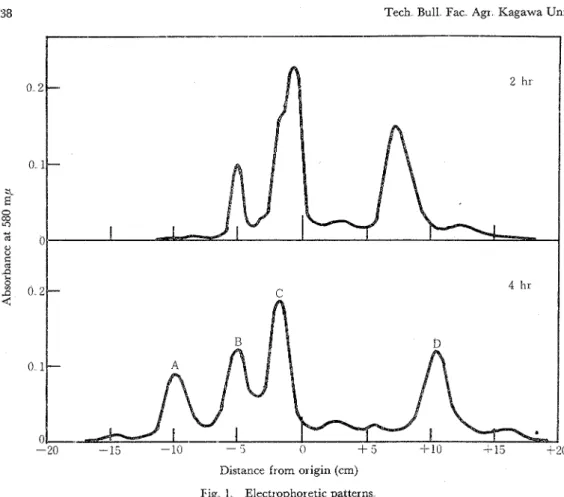
Electrophoretic patterns of the enzymatically unhydrolyzable polysaccharide residue are given in Fig. 1. The polysaccharide was clearly separated into four fractions; two moved to the cathode, one remained near the origin, and one moved to the anode.
Table 1 shows component sugars of the electrophoretic fractions obtained by 4 hr run.
*
Present address: Tokusima-,Ken Food Processing Experiment Station, Tokusima..38 Tech Bull Fac Agr Kagawa Univ
Distance from origin (cm) Fig 1 Electrophoretic patterns
The polysaccharide, 1 % ; borate buffer, p H 9 3, /*=0 06; 14 5 V ~ c m ; 0 35-0 57m4 cm
Table 1 Component sugars of electrophoretic fractions
. -- .. --
Electrophoretic Rhamnose Fucose Xylose Ar abinose Glucose Galactose Galacturonic
fractions acid
A - -
ttt
-
- - rtB - - itt - - - S f
C
+
I S t t i i-t t
D - it+ ti- -t - - -
The fractions A and B may be xylans. T h e presence of a xylan containing galacturonic acid was estimated in the second paper of this series(4). Detection of galacturonic acid-containing xylans both in the enzymatically hydrolyzable and the unhydrolyzable fractions opens new problems to be examined. In any case there may be two kinds of xylans in the hemicellulose
B1,
one containing galacturonic acid and the other being homoxylan.T h e fraction C contained rhamnose, xylose, glucose, and galacturonic acid and remained near the origin after. 4 hr run. Therefore, this fraction may be divided into some sub-fractions under suitable conditions.
Fucose was detected in the fraction D in the combination with xylose. Thus, fucose seemed to be present in a form of xylofucan. T h e result seems to be very interesting for a new
OLIVE 香川大学学術情報リポジトリ
Vol 19, No 1 (1967) 39
approach can be opened to clarify the form of fucose in the hemicellulose
B1
of soybean cotyledons.The present investigation suggests the usefulness of the combination of electrophoresis and the use of enzyme action for the study of polysaccharides in mixtures.
Acknowledgment
The authors wish to thank Prof. Akira KAJI, Laboratory of Fermentation Chemistry, this
University, for his useful1 suggestions.
A part of the expenditure was defrayed by the research fund donated by the Ministry of Education to T. NARASAKI (Enzymatic hydrolysis of soybean hemicelluloses, 1962) and to A. KAJI (Improvement of the utilization of agricult;ral and horticultural products by the use
of enzymes, 1962-1963).
References
(1) NARASAKI, T : Kagawa Dazgaku Nogakubu (3) NARASAKI, T
,
FUJIMOTO, K : Kagawa Dazgaku Gakuyutu Hokoku, 18, 16 (1966) Nogakubu Gakuzyutu I-Iokoku, 16, 73 (1964) (2) KAWAMURA, S , NARASAKI, T : Agr Bzol (4) NARASAKI, T : Ibid, 18, 23 (1966)Chem
,
25, 527 (1961) +?(" / ~ T ~ . % ~ . + I L P . - % B1 D70%{2flfJ 9 ' 7 % f l - . ~ T ~ n 7 ~ ~ @ s h ' ? % & I I L ' 7 7 E / ,-X, $3 3 1. -%, j j s 3 s ~ ~ ~ @ Q , & , l j f i T 5 , , * ~ @ D S @ ~ B ~ ? ~ L \ / . - . X , 7 3 - X , 4 V n - x , Y I L . ~ - x , $ 7 3 7 o y @ g . . $ , ( h ' T ~ > 6 .Z D B I ~ ~ ~ ~ $ E Z % ~ ~ C % ~ ~ I L ~ : ~ T ~ V ~ ~ - X
DZ+i3>6?dgLX53, + V D - . % k j j ? 9 Y P ~ @ ~ b ( ; T _ r ~ g , 7 4 ) - x , + V D -iT, 7 1 ~ 3 - % , 3 7 9 Y D ~ @ Q . L , ( Q B ,9,
~ b : ~ 7 3 - ~ t : 4 ~ ~ . - % h ~ I ; ? L 6 ~ , B . . C Z f i M S h ~ : . Li+:?hT, 7 3 ~ - ~ 1 2 4 9 ~ 7 j 5 7 Q l % ' T g E f - 6 Z k h i ; h h > 6 , , 7.h/-%%,b-.(bg%-)-t286IZ53;).BflT3.f j l Z , @ , b h 5 D T , 3 . h I - X D G @ B%C2f#sT3fLb>. + ~ o , - % . . C d : ~ { k kt-.'>DJE, $7 3 ';ID [email protected].( & + V ? y & Q & ? & b { g?JL > + . 9 7 7 , T$3~,3-i3ZkfiS@$%!T37':,,
f j Z f I { L Z D @ f % D % ~ D - ~ ~ + G 2 ? ( :