Field Study on the Habitat of Nautilus in the
Environs of Cebu and Negros Islands, the
Philippines
著者
HAYASAKA Shozo, SAISHO Toshio, KAKINUMA
Yoshiko, SHINOMIYA Akihiko, OKI Kimihiko,
HAMADA Takashi, TANABE Kazushige, KANIE
Yasumitsu, HATTORI Mutsuo, VUSSE Frederick
Vande, ALCALA Lawton, CORDERO Paciente A. Jr.,
CABRERA Jaime J., GARCIA Renato G.
journal or
publication title
南海研紀要
volume
3
number
1
page range
67-137
URL
http://hdl.handle.net/10232/15609
Mem. Kagoshima Univ. Res. Center S. Pac, Vol. 3, No. 1, 1982 67
Field Study on the Habitat of Nautilus
in the Environs of Cebu and Negros
Islands, the Philippines
Shozo Hayasaka," Toshio Saisho,21 Yoshiko Kakinuma,"
Akihiko Shinomiya,21 Kimihiko OKI,1' Takashi Hamada,3'
Kazushige Tanabe,4' Yasumitsu Kanie,5' Mutsuo Hattori,6'
Frederick Vande Vusse,71 Lawton Alcala,7' Paciente A.Cordero, Jr.,8) Jaime J. Cabrera81 and Renato G. Garcia.8'
Abstract
On the basis of, and as a development of the preliminary survey in 1980, the main work of the present research project entitled the "Marine Ecological Studies on the Habitats of Nautilus in the Environs of Cebu and Negros Islands, the Philippines" was carried out in 1981 for about a month from 26 th August to 26 th September, as a joint venture of Japanese and Philippine research workers. In this article the
processes and the results of the field study in 1981 are reported with some remarks
on the trapped specimens of Nautilus pompilius from the area studied.
Introduction and Acknowledgement
After three years studies on Nautilus macroxnphalus Sowerby in captivity by the members of JECOLN* (1979, 1980a, 1980b), it was felt necessary to make marine ecological studies on the habitat of Nautilus in the field to get a better understanding of this "living fossil" organism. About that time, a live specimen of Nautilus poxnpilius LlNNE floating probably from the Philippines was captured by fisherman in Kagoshima Prefecture (Hamada et al, 1978; Tanabe et al, 1978; Hamada et al, 1980). Among the distribution areas of the chambered Nautilus in the South Pacific, the Philippine Islands are the northernmost and closest to Japan. Therefore, our interest in the field
study on Nautilxis has been centered on the Philippine Islands. Fortunately, our
re-1) Shozo Hayasaka (-?-#lffZ), Yoshiko Kakinuma (ttffiftHP), Kimihiko OKI (iz'fc'IiM) • Faculty of
Science, Kagoshima University, Kagoshima, Japan.
2) Toshio Saisho (S£f>)ffS0|5), Akihiko Shinomiya {Wl%Ml%) '• Faculty of Fisheries, Kagoshima University,
Kagoshima, Japan.
3) Takashi Hamada (SEHPidr) : College of General Education, University of Tokyo, Tokyo, Japan,
4) Kazushige Tanabe (ffJiJIS—A): Faculty of Science, Ehlme University, Matsuyama, Japan. 5) Yasumitsu Kanie (SiXS'Tt) : Yokosuka City Museum, Yokosuka, Japan.
6) Mutsuo Hattori OJIinCffiS) : Japan Marine Science and Technology Center, Yokosuka, Japan.
7) Frederick Vande Vusse, Lawton AlCALA: Marine Laboratory, Silliman University, Dumaguete, the Philippines.
8) Paciente A. CoRDERO, Jr., Jaime J. Cabrera, Renato G. Garcia : Philippine National Museum, Manila, the Philippines.
68 S. Hayasaka el ah : Habitat of Nautilus in the Philippines
search project on the ecology of the chambered Nautilus in the Philippines was fi nanced with a Grant-in-Aid for Scientific Research from the Ministry of Education of the Japanese Government for two consecutive years: 1980 (preliminary survey) and
1981 (main part of the project).
The preliminary survey was carried out from 25 th August to 14 th September 1980 by three of our research group-S. Hayasaka, T. Saisho and Y. Kanie (Hayasaka,
1981a, 1981b; Kanie et al, 1981). Various information on the habit of Nautilus
pompilius and on the methods of fishing have been collected through hearing from shell dealers and fishermen in many places, such as Manila, Dumaguete and Bindoy (Negros Isl.), Cebu, Panglao (Bohol Isl.) and Iloilo City and the Antique District (Panai Isl). 15 living and 20 dead (shell) specimens were obtained at Bindoy, Panglao and many villages along the Antique coast. The environmental factors, such as tem perature and salinity of seawater were preliminarily surveyed at the six stations in the southern part of Tanon Strait (off Bindoy). Among the 10 living specimens collect ed in Tanon Strait three were safely brought to Kagoshima and three others to Tokyo for further laboratory studies. The field works mentioned above brought about the following results: 1) The distribution of Nautilus pompilius in the Philippines has rough ly been understood ; 2) the common features of submarine topography in and around their habitats have been recorded. Nautilus pompilius usually live near the muddy bottom ranging approximately from 150 to 100 m in depth on the slope rapidly deep ening to more than several hundreds meters; 3) the temperature condition of Nautilus population at about 150-200 m depth was ascertained to be about 20°C through the preliminary survey ; 4) although most fishermen are used to fishing Nautilus at a depth of about 200 m, this is merely for convenience of fishing and the actual depth-range of its habitat goes below 200m, being more than 500m in Tanon Strait; 5) information was collected about the organisms associated with Nautilus (several kinds of crustaceans), the favourite food for bait (chops of chicken, frog, eel and some other animal meats) and the behavior of Nautilus in the field ; 6) for fishing Nautilus, traps of two dif
ferent types are used ; 7) Nautilus fishing is usually done during the night. This may
be due to the nocturnal habit of Nautilus.
On the basis of, and as a favorable development of the foregoing preliminary survey, the main work of the present research project was carried out in 1981 for about a month from 26 th August to 26 th September. In this article are reported the processes and the results of the field study carried out by all the members of the research group including several researchers of the Philippines.
Before going further, we wish to express our gratitude to Dr. Alfredo E. EVANGELISTA of the Philippine National Museum, Manila for his kind arrangement for the official acceptance of our research group and the participation of three biologists in our project.
Our deepest thanks are also due to Prof. Angel C. Alcala, the Vice President of
the Silliman University for his attentive and scrupulous arrangements both for field
and laboratory works of our project, without which the presesent research project could
not have been realized.
The present field study was initiated by the pertinent suggestion of Dr. Sadahiko IMAI, Professor Emeritus of Kagoshima University, to whom we wish to express our
deep appreciation.
Mem. Kagoshima Univ. Res. Center S. Pac, Vol. 3, No. 1, 1982 69
the Southeast Asia Fisheries Development Center in Iloilo City, particularly to Mr.
Kunio Katsutani, the Deputy Chief, Dr. Chhorn Lim, the Head of the Station and
Mr. Shigeru KuMAGAi, Project Leader for their kind arrangements and guidance for our surveying trip to the Antique District in Panay Island.
Particular thanks are due to Messrs. Noboru Kawaji, Michihiro TABATA and Kaoru Sako of the Kamoike Marine Park in Kagoshima and Mr. Tsuyoshi Nagayama, a fisheries student of Kagoshima University, for their earnest support and help in
rearing Nautilus in the aquarium.
We are also indebted to the following persons ; Mr. and Mrs. Wilson VAILOCES in Bindoy for their invaluable help in field operation and accomodation; Mrs. Pacita B. Raterta, Secretary to the Vice President for Academic Affairs, Silliman University for her help ; Messrs. Yasuo Nozaka and Kiyoshi TAKEUCHI of the Embassy of Japan, Manila for their kind advice ; Messrs. Takeshi Sako and Katsumi Nose of the Kyushu Enterprise Co. Ltd. in Kagoshima and Mrs. Pacita de Guzman of the P. de Guzman Enterprises in Manila for their kind advice at the beginning of our preliminary survey in 1980; the officers at the branch offices of Japan Air Lines in Kagoshima, Fukuoka and Manila, and at the office of the Marketing and Sales of the Philippine Airlines, Manila for offering their facilities for transporting the considerable amount of equip ment needed in our field studies.
The present project was supported by the Grant-in-Aid for Scientific Research from the Ministry of Education of the Japanese Government for two years (1980 and 1981)
(No. 504207).
Members
Nine Japanese and five Philippine researchers participated in the project. Their names and special fields are listed below.
Dr. Shozo Hayasaka, Geology and Paleontology (Cenozoic molluscs), Faculty of Science, Kagoshima
University, Kagoshima, Japan.
Dr. Toshio Saisho, Marine Biology (plankton), Faculty of Fisheries, Kagoshima University, Kagoshima,
Japan.
Dr. Yoshiko Kakinuma, Marine Biology (coelenterates). Faculty of Science, Kagoshima University, Kagoshima, Japan,
Mr. Akihiko Shinomiya, Marine Biology (Pisces), Faculty of fisheries, Kagoshima University, Kagoshima,
Japan.
Mr. Kimihiko Oki, Geology and Paleontology (Cenozoic foraminifcrs), Faculty of Science, Kagoshima University, Kagoshima, Japan.
Dr. Takashi Hamada, Geology and Paleontology (Paleozoic arthropods, corals and cephalopoda),
College of General Education, University of Tokyo, Tokyo, Japan.
Dr. Kazushige Tanabe, Geology and Paleontology (Mesozoic cephalopods and bivalves), Faculty of Science, Ehime University, Matsuyama, Japan.
Dr. Yasumitsu Kanie, Geology and Paleontology (Mesozoic bivalves and cephalopods), Yokosuka City Museum, Yokosuka, Japan.
Dr. Mutsuo Hattori, Marine Geology, Japan Marine Science and Technology Center, Yokosuka,
Japan.
Mr. Frederick Vande Vusse, Marine Biology (coral reefs), Marine Laboratory, Silliman University,
Dumaguete, the Philippines.
70 S. HAYASAKA et ah : Habitat of Nautilus in the Philippines
the Philippines.
Dr. Paciente A. Cordero, Jr., Marine Biology, (marine algae) Philippine National Museum, Manila, the Philippines.
Mr. Jaime J.Cabrera, Marine Biology (molluscs), Philippine National Museum, Manila, the Philippines. Mr. Renato G.Garcia, Marine Biology (crustaceans), Philippine National Museum, Manila, the Phil
ippines. Aug. 26, Aug. 26, I Aug. 28, Aug. 28, Aug. 28, 1 Aug. 30 Aug. 31, 1981 '81 '81 '81 HI '81 Lv. Fukuoka Ar. Manila
Manila 1 f Making necessary arrangements in the Philippine National Museum, the
I i \ Embassy of Japan, Manila and the Philippine Airlines.
Manila ) { Lv. Fukuoka Ar. Manila
Manila 1 [
| } I Procurement of articles necessary for field works.
Manila J {
Lv. Manila Ar. Dumaguete
Itinerary
(Hayasaka and Saisho)
(Seven other members)
Aug. 31, '81 Dumaguete Making previous arrangements with Prof. A. C. Alcala, Vice President of Silliman University and other staffs participating in
the project, for the survey planned to undertake in Tanon Strait. Preparation, adjustment and test working of equipments.
Giving lectures in Silliman University on the history, present status
and the purpose of studying Nautilus (on Sept. 3).
Spet. 5, Sept. 6, Sept. 19, Sept. 20, Sept. 22, Sept. 23, Sept. 23, Sept. 25, Sept. 25, '81 '81 81 j 81 81 81 81 81 81 Sept. 26, '81 Dumaguete
Geological, oceanographical and biological field works for the marine ecological
study on the habitats of Nautilus in the southern part of Tanon Strait making
use of the two "base camps" in Dumaguete City and at Bindoy village.
(For the details see the following chapters.)
Dumaguete
Dumaguete Lv. Dumaguete
Ar. Manila
Having a consultation with the staffs of Silliman University about the plan for the future of our cooperative study on 'Nautilus. Giving lectures in Silliman University on the results of our field works for the previous two weeks (on Sept. 20).
(Hayasaka, Saisho, Kakinuma, Oki, Hattori, Cordero, Cabrera & Garcia)
Manila ] f Having a consultation with the staffs of the Philippine National [ \ { Museum about the plan for the future of our cooperative study Manila J [ on Nautilus.
Lv. Dumaguete
Ar. Manila
[ Thirteen live specimens of Nautilus to be carried to Japan were \ inspected and approved for export by the Philippine National
[ Museum.
Lv. Manila
Ar. Fukuoka (Hayasaka, Saisho, Kakinuma, Shinomiya, Oki & Tanabe) Ar. Narita (Hamada, Kanie & Hattori)
Mem. Kagoshima Univ. Res. Center S. Pac, Vol. 3, No. 1, 1982 7i
The Area Studied
Based on the information obtained through the preliminary survey in 1980, the southern part of Tanon Strait between Cebu and Negros Islands was fixed upon as
the area to be studied (Fig;. 1).
Fig. 1. Index map showing the studied area and the outline of the deepest
basin (about 500m in depth) in Tanon Strait.
Tanon Strait is rather narrow (27-15 km) and long (220 km from north to south)
in outline.
According to the chart published by the Hydrographic Office of Japan
in 1962, the deepest point (555 m) is situated in the central part, depths greater than 500 m extend widely from north to south (Fig. 1), and both sides of the strait have rather steep slopes climbing up to the coasts of the islands except where the submarine
terraces are developed. The depth of the strait gradually shallows northwards and at
the northern part of the strait there are many small islands such as Bayantan, Don and Guintan. Thus the Tanon Strait is separated from the Visayan Sea by this shallow
sea with many isles.
On the other hand, the depth of the strait gradually gets shallower from the center southward to the outlet of the strait. The shallowest part is thought to be 125 m off
72 S. Hayasaka et ah: Habitat of Nautilus in the Philippines
Liloan point of Cebu Island. Further south, outside the strait, the sea bed deepens
again towards Bohol Strait.
As a whole, the outline of Tanon Strait represents a long deep basin separated
from the sea outside by shallow areas. Therefore, it can be presumed that the strait
is characterized by a more or less closed environmental condition from the oceano-»raphic point of view.
Results of the Field Studies on the Habitat of Nautilus
Fig. 2. Map of the southern part of Tanon
Strait, showing the submarine topo
graphy, stations for oceanographic survey and lines of echo-sounding.
As the main part of our project, field studies on the environmental back ground of the habitat of Nautilus were undertaken along the following lines :
(1) Submarine topography
(2) Bottom sediments (3) Sea water characteristics (4) Biological observation
(5) Underwater camera works Two plans were made. The first plan was to get a better understanding of the general features of the southern part of Tanon Strait based on the field
work at the 9 stations arranged along transverse (Stations OB-5, Fl, F-2 and
F-3) and longitudinal (Stations A-l,
F-2, K-l, L-l, M-l and N-l) lines (Fig.
2). Secondly, much more datailed work was planned in the fishing ground off Bindoy village where the trapping Nau tilus was also intended (Fig. 3).
The following is a brief description of the processes and results of the field studies carried out during the period
from 7 th to 18 th November, 1981.
1) Submarine Topography
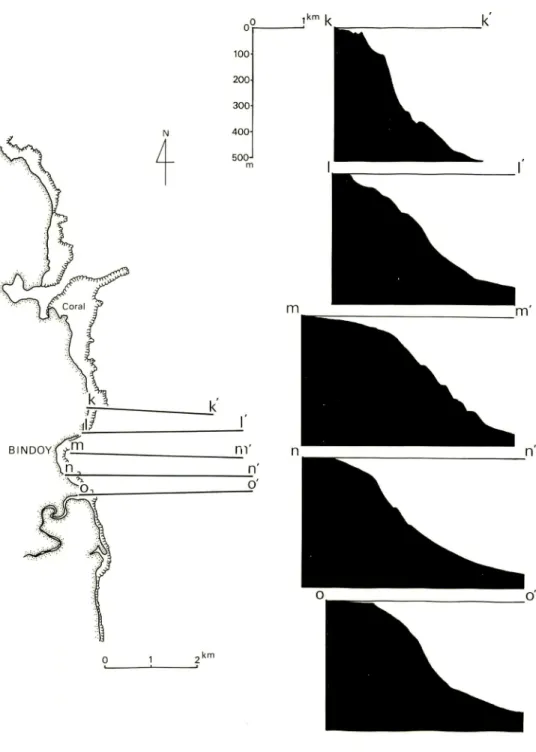
The sea bottom configuration seems to be one of the most fundamental features controlling the distribution of chambered Nautilus at least in the Philippine Islands. During the first part of the period of our field work, we engaged in topographic surveys as well as the oceanographic work throughout the area studied. Sounding was carried our by means of a portable echo-sounder (HONDA-HE 315) as shown in Figs. 2 and 5, and positioning was by a triangular survey making use of a hand compass (Ushikata Co.). The lines of surveying were determined to make a few transverse and
Mem. Kagoshima Univ. Res. Center S. Pac, Vol. 3, No. 1, 1982
<<^
&
fL009 L005 • L018»L003 • T19 • T10 nR ,'zu #1007 ,L010 OB-2 # u ,r OB-3 L013 500 1000 'Fig. 3. Map showing the locations for trapping Nautilus (•), fishing (OB-7 seine
net, OB-5 long line), oceanographic survey (+ ), observation of intertidal fauna (OB-6) and scuba diving (OB-8).
73
longitudinal profiles of the southern part of Tanon Strait (Fig. 2).
In the area studied, the deepest part (about 500m in depth) occupies the northern
half with steep slopes on both sides of it. The bottom topography of the deep basin is almost flat (Fig. 4, F-l —F-2) and on both sides steep slopes climb up to the coast
of islands or the outer margin of submarine terraces (Figs. 4 and 5). On the profiles
74 S. Hayasaka et al: Habitat of Nautilus in the Philippines
0 1 2<"" A-1
F-2
K-1 L-1 L-l M-l
N-1
Fig. 4. Bathymetric cross sections along the lines of echo-sounding (Fig. 2) in Tanon Strait.
observed. This strongly suggests the occurrences of faulting between the island and basin and the tectonic origin of this strait such as a "Graben". It is particularly inter esting that all the Nautilus specimens obtained are from such a steep slope of tectonic
origin.
To the south, the depth gets gradually shallower to the outlet of the strait (see the cross section from St. K-1 to St. M-l in the Fig. 4). Off the southern tip of Cebu Island there is a topographic rise of about 150 m in depth which bounds the southern end of the strait. Crossing over the rise the depth rapidly increases southwards be tween Negros and Bohol Islands where the seabed is more than 600 m deep. Therefore, the southern outlet of the strait represents an asymmetric saddle-like topography in the north-south profile of this area.
(2) Bottom Sediments
Eleven bottom samples used for this study were collected with a small dredge. All samples were preserved in buffered formalin (5%) and a part of each sample was stained with Rose Bengal for foraminiferal study. In the laboratory, the Emery set tling-tube method (Emery, 1938) and pipette techniques (Krumbein and Pettijohn, 1938) were utilized in determining the relative proportions of gravel, sand, silt and clay (Table 1) and the textural relations among sediments are indicated on SheparD's triangle (Fig. 6). Median diameter (Md), sorting coefficient (So) and skewness (Sk) were obtained graphically from the cumulative curve (Trask, 1932).
Mechanical analysis of the bottom sediments mentioned above brought about the following results:!) Silt and clay fractions constitute more than 80% of the samples
Mem. Kagoshima Univ. Res. Center S. Pac, Vol. 3, No. 1, 1982
Fig. 5. Map showing the lines of echo - sounding and the bathymetric cross sections showing rapid and step-like deepening of bottom topography off Bindoy.
76 S. Hayasaka et al.: Habitat of Nautilus in the Philippines
Table 1. Grain size measurements of bottom sediments from the southern part of Tanon Strait.
Station Depth Gravel Sand Silt Clay Mud
Silt^-Md So Sk
No. (m) (%) (%) (%) (%) Content (%) ""Clay
OB-1 25 0.03 20.14 76.26 3.57 79.83 21.36 0.031 1.562 1.138 OB 2 50 0.14 23.74 71.71 4.41 76.12 16.26 0.030 1.588 1.587 OB 3 98 1.96 49.75 44.79 3.50 48.30 12.80 0.068 3.612 1.501 OB 4 215 1.03 21.63 51.71 25.63 77.34 2.02 0.023 3.770 0.405 A-l 498 0.01 6.57 85.60 7.82 93.41 10.95 0.013 1.258 1.349 F -2 495 2.96 13.62 56.59 26.83 83.42 2.11 0.011 3.162 1.071 F -3 430 0.02 7.21 80.46 12.30 9177 6.54 0.006 1.365 1.110 K-1 463 1.72 16.91 39.82 41.54 81.36 0.96 0.012 - -L-l 307 0.35 43.08 25.94 30.62 56.56 0.85 0.019 >8.45 < 0.87 M 1 120 99.99 0.01 - - 0 - -- -N-l 450 1.05 12.15 16.19 70.61 86.80 0.23 --
-Fig. 6. Textural relations between the samples of sediments indicated
on the SheparD's triangle.
Table 2. Carbonates contents dissolved with a solution of hyhrochloric acid from the five samples of bottom sedimants.
Station Depth Carbonates No. (m) Cmtent (v/t%) OB-1 25 18.22 OB-2 50 23.03 OB -3 98 34.45 A-l 498 29.51 F-3 430 46.69
Mem. Kagoshima Univ. Res. Center S. Pac, Vol. 3, No. 1, 1982 77
obtained from depths over 400m (Stations A-l, F-2, F-3, K-1 and N-l) ; 2) Silt / Clay ratios of the samples from the deepest part and the marginal slopes of the strait de crease southwards (Table 1); 3) The sample collected from a depth of 307 m on the slope (St. L-1) is characterized by poor sorting (So : > 8.45); 4) Coral reef fragments of cobble and pebble sizes were collected from Station Ml situated at the outlet of the strait; 5) The proportion of clay in 3 samples is 3.5% to 4.4% (Stations OB-1, OB-2 and OB-3 off Bindoy) and the sand content regularly increases from 20.1% to 49.8% as the depth increases.
Carbonates dissolved from the five samples with a solution of hydrochloric acid are shown in Table 2. Dissolved carbonate values in the samples collected from the deep est part (Stations A-l and F-3) are 30 and 47%. These high values seem to reflect the abundance of planktonic foraminiferal tests and shell fragments in the bottom sediments in addition to the constant supply of carbonate-rich sediment chiefly from the small but numerous rivers in Negros and Cebu islands where the limestone forma tions of various ages are widely distributed.
(3) Sea Water Characteristics
The oceanographic observation was carried out from 7 th to 19 th of September,
1981 at the nine stations in the southern part of Tanon Strait as shown in Fig. 2. At each station, water samples were collected by a bucket from the surface and by three
Nansen bottles from depths of 10, 20, 30, 50, 75, 100, 150, 200, 300 and 400 meters. Sea water temperature, specific gravity, pH and dissolved oxygen (DO) were measured
on each water sample on the boat. Salinity, chemical oxygen demand (COD) and
oxygen isotope of sea water samples were measured in the laboratory (partly shown in
Table 3). Samplings of bottom sediments by dredge and of plankton by the closing
type plankton net from the three layers (200-100 m, 100-50 m and 50-0 m) were also carried out at each station.
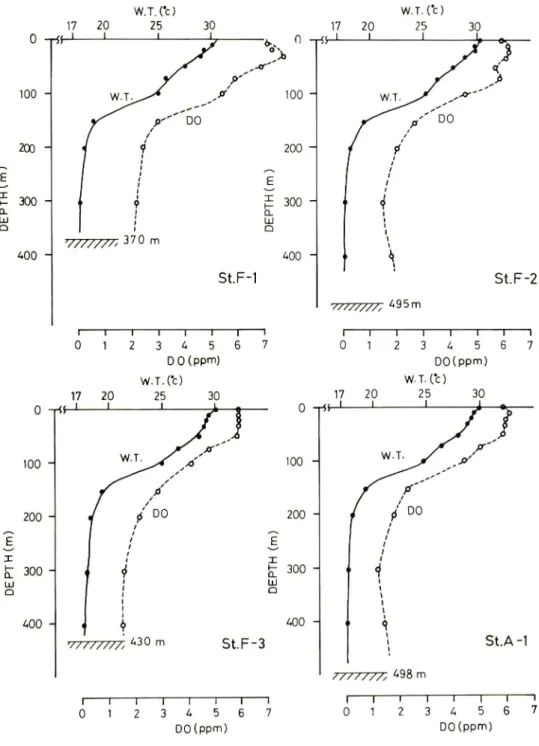
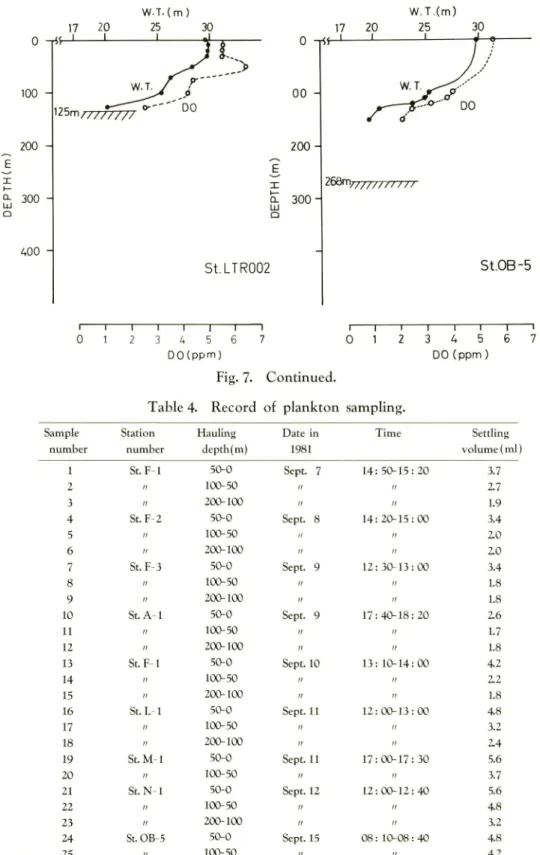
From the graphs showing changes of water temperature and DO with depth (Fig.
7), rapid change in water temperature (thermocline) is clearly shown to occur constantly
at the depth between 100 and 150 m of each station. Sea water temperature gradually lowers from the surface (about 30°C) to 100 m depth (about 25°C), and immediately below the thermocline it is about 20°C. The temperature of waters deeper than 200 m seems to be rather constant and bottom water is thought to be about 17°C.
Dissolved oxygen also decreases with depth and its maximum value was usually observed at the depths between the surface and 30 m, which may indicate the existence of a maximum layer of phytoplankton producing plenty of oxygen around this layer. It is generally said that the compensation depth of oxygen will appear at a depth approximately two times the depth of water transparency. For example, the trans parency at the St. F-2 was 33 m and the compensation depth can be estimated to be around 70 m. According to our observation DO value at 75 m depth is still high (5.85 ppm) and below this depth DO decreases rapidly.
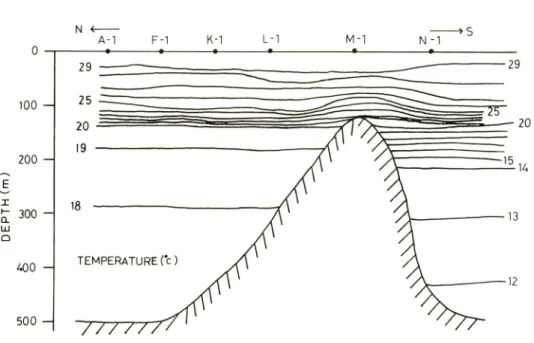
Based on the data at four stations OB-5, F-l, F-2 and F-3 (Fig. 7), an east-west
(transverse) profile of water temperature was compiled (Fig. 8a). In the same manner,
78 S. Hayasaka et «/.: Habitat of Nautilus in the Philippines
Table 3. Oceanographic data in Tanon Strait with a supplementary datum in Bohol Strait. (The weather is described by the BEAUFORT'S weather scale ; b, blue sky ; be, blue sky with detached clouds ; c, cloudy ; p, passing shower ; r, rain.)
St. No. F-l
Date Sept. 7, 1981 Lat. 9°45'09" N
Time 17:30-17: 50 Long. 123'1008' E
Weathar be Depth 370 m
Ship R. V. Orcinus Transparency 25 m
Depth (m) Temp. CC) Salinity (%) pH DO(ppm) 0 10 31.10 — 8.18 7.15 20 29.30 34.440 ao2 7.40 30 29.17 34.529 &07 7.65 50 27.60 34.568 7.99 6.90 75 25.90 34.608 7.92 5.85 100 25.02 34.686 7.95 5.30 150 19.09 34.784 7.64 2.95 200 ia22 34.823 7.66 2.35 300 17.96 34.696 7.64 2.25 St. No. F-2
Date Sept. 8, 1981 Lat. 9°46'05" N
Time 11:40-14: 10 Long. 123°03'06" E
Weather b Depth 495 m
Ship R.V. Orcinus Transparency 33 m
Depth (m) Temp.(°C) Salinity{%) pH DO(ppm)
0 30.20 34.412 &05 5.85 10 29.93 34.512 8.09 6.10 20 30.39 34.588 &09 6.15 30 28.99 34.608 aio 5.95 50 27.75 34.637 a io 5.70 75 26.21 34.666 ao3 5.85 100 25.20 34.750 aoo 4.45 150 19.60 34.804 7.77 2.65 200 18.21 34.814 7.69 2.10 300 17.92 34.823 7.72 1.50 400 17.81 34.833 7.72 1.90 St. No. F-3 Date Time Weather Ship Sept. 9, 1981 9:58-12:00 b R. V. Orcinus Lat. Long. Depth Transparensy 9°46'01" N 123T9W E 430 m 30.5 m
Depth (m) Tcmp.fC) Salinity {%) PH DO(ppm)
0 30.00 34.364 8.05 5.75 10 29.40 34.388 aos 5.75 20 29.23 34.416 a i 2 5.90 30 29.00 34.549 a n 5.85 50 2a50 34.608 a n 5.80 75 26.64 34.647 ao3 4.65 100 24.96 34.701 7.98 4.10 150 19.43 34.750 7.78 2.90 200 18.30 34.774 7.71 2.05 300 17.95 34.888 7.71 1.60 400 17.84 34.706 7.69 1.60
Mem. Kagoshima Univ. Res. Center S. Pac, Vol. 3, No. 1, 1982 St. No. A-l Date Sept. 9, 1981 Time 14:45-17:40 Weather be, p Ship R. V. Orcinus Lat. 9°52,03" N Long. 123*15*00" E Depth 498 m Transparency 31m
Depth (m) Temp. CO Salinity(%) pH D O(ppm)
0 30.00 - a 12 5.80 10 29.50 - a 14 5.95 20 29.29 - a 14 5.90 30 28.90 - 8.14 5.90 50 27.85 - 8.13 5.80 75 26.42 - ao4 5.00 100 24.90 - 7.99 4.30 150 19.44 - 7.78 2.20 200 18.20 - 7.70 1.80 300 17.93 - 7.69 1.20 400 17.83 - 7.71 1.40 St. No. K-1
Date Sept. 10, 1981 Lat. 9"40'07" N
Time 11: 22-13:00 Long. 123'13'04" E
Weather c, r Depth 463 m
Ship R. V. Orcinus Transparency 25.5 m
D O(ppm)
Depth (m) Temp.CO Salinity(%0) pH
0 30.00 34.466 ao7 10 29.22 34.520 7.96 20 29.55 34.578 7.97 30 29.27 34.608 7.97 50 27.90 34.627 7.93 75 2650 34.671 7.87 100 25.21 34.730 7.83 150 19.80 34.755 7.66 200 ia22 34.789 7.56 300 17.95 34.819 7.66 400 17.86 34.848 7.55 St. No. L-1 Date Sept. 11, 1981 Time 11: 50 Weather c, r Ship R. V. Orcinus Lat. 9°34'03" N Long. 123'13'04" E Depth 294 m Transparency 26 m 5.90 5.90 5.90 5.90 5.50 4.55 4.15 2.90 1.80 1.80 1.60
Depth (m) Temp.CO Salinity (%,) pH DO(ppm)
0 34.086 8.21 5.85 10 29.85 34.221 a25 5.85 20 29.76 34.451 a24 5.75 30 29.36 34.510 a25 5.85 50 2a04 34.412 a20 5.40 75 26.50 34.485 a 14 4.55 100 25.34 34.661 a i 2 4.10 150 19.19 34.671 7.84 2.10 200 18.20 34.735 7.80 1.30 79
80 S. Hayasaka et aL: Habitat of Nautilus in the Philippines St. No. M-l Date Sept. 11, 1981 Time 15:20 16:47 Weather be Ship R. V. Orcinus Lat. 9°24'04" N Long. 123T7'01" E Depth 120 m Transparecy 22 m
Depth (m) Tcmp.CQ Salinity (%,) pH DO(ppm)
0 30.20 34.510 8.12 5.85 10 29.92 34.520 8.13 5.80 20 29.49 34.657 8.13 5.85 30 29.40 34.706 813 5.75 50 27.95 34.725 ao6 5.40 75 26.20 34.779 aoi 4.40 100 23.16 34.848 7.91 3.40 St. No. N-l
Date Sept. 12, 1981 Lat. 9-19»09» N
Time 10:2711:58 Long, 123'22'02" E
Weather be Depth 450 m
Ship R. V. Orcinus Transparency —
Depth(m) Temp. (°C) Salinity {%) pH DO(ppm)
0 30.00 — 8.17 5.70 10 29.08 34.402 a2o 5.70 20 29.00 34.500 822 5.75 30 28.96 34.655 8.21 5.70 50 2a25 34.723 a 19 5.70 75 27.61 34.755 a n 5.15 100 26.30 34.794 8.13 4.65 ISO 18.11 34.902 7.84 2.70 200 14.16 34.964 7.73 2.40 300 13.02 34.991 7.69 2.30 400 12.60 35.095 7.68 1.90 St. No. LTR 002
Date Sept. 15, 1981 Lat 9'46'04" N Time 07: 15-08:00 Long. 123'09>06" E
Weather be Depth 125 m
Ship R. V. Orcinus Transparency —
Depth (m) Temp. (°0 Salinity (%>) pH DO(ppm)
0 29.60 — 10 29.99 — 841 5.50 20 29.90 — 844 5.55 30 29.73 — 843 5.50 50 2a30 — 853 635 75 26.10 — a28 4.25 100 25.39 — a32 4.05 125 20.06 — a i s 260
Mem. Kagoshima Univ. Res. Center S. Pac, Vol. 3, No. 1, 1982 81
St. No. OB-5
Date Sept. 17, 1981 Lat. 9"46'04" N Time 14:25 15:42 Long. 123° 1002" E
Weather c, r Depth 268 m
Ship R. V. Orcinus Transparency 22 m
Depth (m) Temp.CO Salinity(%) pH D O(ppm)
0 29.8 34.305 a59 5.65 100 25.30 34.451 &42 4.00 110 24.93 34.568 a4i 3.80 120 23.73 34.625 8.40 3.20 130 20.59 34.784 a29 2.50 150 19.61 34.873 a22 2.15
following six stations; A-1, F-2, K-1, L-1, M-l and N-1. It is noticeable that the
vertical and horizontal distribution of water temperature represents a beautiful stratifi cation throughout the area. This implies a remarkable stability of water at least in
this season.
Separation of water mass into two parts by a thermocline is also clearly
recognized ; the upper (shallower) light water and the lower (deeper) heavy water. The
upper water crosses over the topographic rise at the outlet of the strait, but outsidethe strait (St. N-1) the water mass deeper than thermocline represents a temperature
distribution quite different from that of the inside of the strait. At the St. N-1, a
rapid lowering of temperature below the thermocline is observed ; 14.16°C at a depth
of 200m, 13.02°C at 300 m and 12.60°C at 400 m. As already mentioned, the water
temperature at 200 m in Tanon Strait is about 18°C and the bottom water temperature
is thought to be about 17°C.
From the foregoing data, it can be reasonably concluded that there is striking
contrast between Tanon and Bohol Straits as to the temperature of water below the
thermocline (about 150m).
This indicates the stagnant feature of the water deeper
than the thermocline inside of Tanon Strait.
Judging from information hitherto collected, the lower limit of the optimum tem
perature-range for Nautilus is around 15°C. Therefore, the water mass below the ther
mocline in Tanon Strait seems to be suitable for Nautilxts to inhabit as far as the
water temperatures are concerned, while in Bohol Strait their habitat must be restricted
to the rather narrow depth range right below the thermocline.
The mixing in this season of the water outside and inside the strait is thought to
occur only for the water shallower than the topographic barrier at the outlet of the strait mainly by the tidal current. According to the captain of R. V. Orcinus, the
current velocity of the surface water off Bindoy has been known to be about three
knots southwards at the time of ebb tide and at the outlet of the strait near the Liloan point it attains 7 to 8 knots.
(4) Biological Observation A. Plankton
82 S. Hayasaka et at: Habitat of Nautilus in the Philippines 100 -200 -E i i— Q_ LU D 300 -400 17 1 20 i W.T. (t) 25 i 30 I V/////A 37 0 m St.F-1 I 1 1 1 1 1 1 1 0 1 2 3 4 5 6 7 DO(pprn) W.T.('c) 17 20 25 30 o --Sf I I 1 i .
/
9
100 - w.t, «y Ay 1 >* 200 -J
$ DO
? ' X £ 300 -1 i LLl a 400 -J T
'////////, AJU m bt.F-3 I 1 1 1 1 1 1 1 0 1 2 3 4 5 6 7 DO(ppm) W.T.('c) 17 „ i 20 1 25 30 1 '• a. b 100-y
>
-"""%'''do
200 -f
I 1 300 - 1 1 14
i 400 -i \ i k St.F-2 'W////// •+*jim I l l I l i I l 0 1 2 3 4 5 6 7 DO(ppm) W.T. (c) 17 20 25 30 v ' 1 ' i a/
?
100-y
i
wT-^y ^j/
200 -/
/ DO
1 1 I 300 - l 1 1 / i l 400 - l l l <} St.A -1 •V/ / / / / , 498 in I 1 1 1 1 1 1 1 0 1 2 3 4 5 6 7 DO(ppm)Fig. 7. Vertical distribution of water temperature and dissolved oxygen in Tanon and Bohol Straits.
•n O o 3 5" o "D 3 • o ^_^ i TD 3 6 O CD DEPTH(m) o o DEPTH (m) o _1_ 1 1 1 i X V N N c_n O 3 S •—a___ "\ \ ~^ to r-«-o o -z. \ —* tx--o—o» LJ1 ' O O ^ DEPTH(m) 3 C
84 S. HAYASAKA et al.: Habitat of Nautilus in the Philippines 17 20 0 -riM L W.T.(m) 125m//////// W.T.(m) 17 20 25 30 0 -rM-" L 00 200 -1 X i— p 300 -O 200-E x a. 300 UJ Q 400 SLLTR002 ~i i 1— 3 4 5 DO(ppm) 268m,77777777777 Fig. 7. Continued.
Table 4. Record of plankton sampling.
St.OB-5
DO (ppm)
Sample Station Hauling Date in Time Settling
number number depth (m) 1981 volume (ml)
1 St.F-1 50-0 Sept. 7 14: 50-15: 20 3.7 2 H 100-50 // // 2.7 3 ;; 200-100 // // 1.9 4 St. F-2 50-0 Sept. 8 14:20-15:00 3.4 5 ii 100-50 u ii 2.0 6 n 200-100 n ii 2.0 7 St. F-3 50-0 Sept. 9 12: 30-13:00 3.4 8 // 100-50 ;/ /; 1.8 9 // 200-100 /; // 1.8 10 St. A-1 50-0 Sept. 9 17:40-18:20 26 11 n 100-50 U // 1.7 12 n 200-100 ii // 1.8 13 St.F-1 50-0 Sept. 10 13: 10-14:00 4.2 14 // 100-50 // ;/ 2.2 15 /; 200-100 /; ;/ 1.8 16 St.L-1 50-0 Sept. 11 12:00-13:00 48 17 // 100-50 // n 3.2 18 n 200-100 // ii 14 19 St. M l 50-0 Sept. 11 17:00-17: 30 5.6 20 ii 100-50 // // 3.7 21 St.N-1 50-0 Sept. 12 12:00-12:40 5.6 22 // 100-50 // // 4.8 23 // 200-100 /; // 3.2 24 St. OB-5 50-0 Sept. 15 08: 10-08 : 40 4.8 25 n 100-50 // ;; 4.2
100 200 3 0 0 -o_ LlI Q 400 - 500100 200 -_E I t -Q. UJ Q 300 400 500
-Mem. Kagoshima Univ. Res. Center S. Pac, Vol. 3, No. 1, 1982
W <- -> E
OB-5 F-1 F-2 F-3
Fig. 8-a. Distribution of water temperature in the transverse section of Tanon Strait.
A-1 F-1 K-1 L-1 M-1 N-1 -*s
T7T77
Fig. 8-b. Distribution of water temperature in the longitudinal section of Tanon Strait and Bohol Strait.
86 S. Hayasaka et al: Habitat of Nautilus in the Philippines
at one additional station outside the strait off Dumaguete City from 7 th to 15 th September, 1981 (Table 4). The plankton net used was MARUKAWA's closing type net (30 cm in diameter with XX 13 Bolting silk muller gauze ; 0.097 mm mesh). Sampling was made from the three layers, that is, 50m-0m, 100m-50m and 200 m-100 m in
depth. Settling plankton is abundant at the stations in the southern part of Tanon
Strait (Stations LI and M-l) and in Bohol Strait (Station N-l), and is rather scarce
in the central part of Tanon Strait (Stations FT, F-2, F-3 and A-l). Phytoplanktons
are represented by Chaetoceros, Climacodium, Rhizosolenia, Lauderia, Thalassionema and Biddulphia.
Dominant zooplankton species are as follows; Copepoda, Pyrocystis, Ceratium, Chaetognatha, Oikopleura, Foraminifera, Radiolaria, Crustacean eggs and larvae, Salpa and Medusa.
B. Intertidal invertebrates
Toward the end of September 1981, we made a field observation of marine life within 200 m along the Bindoy beach at low tide. The shore in that area are variable in feature ; there are muddy sand, pebbles and rocks, and in some places rivulets were observed flowing. In the upper tidal zone, main part of our observation, there was muddy sand and a few mangroves grew and many molluscs lived. In the middle tidal zone, splinters of dead coral reefs were found on the rough surface of raised coral reef and shallow tide-pools were found in many places. In those tide-pools, green, red, brown algae and sea grass grew and echinoderms and arthropods lived.
In the low tidal zone, 90% of the shore was covered with coelenterates, such as soft
and stony corals. The following dominant species were observed. COELENTERATA
Solandaria secunda (Inaba) Macrorhynchia phoenicea (Busk) Eudendrium sp.
Dynamena sp.
Plumularia setacea (Ellis) Cassiopea ornata Haeckel Mastigias papua L. Agassiz
Alcysnium gracillimum KuKENTHAL Cladiella digitulata (Klunzlnger) Sinularia polydactyla Ehrenberg Sarcophyton elegans Morser Anthomastus spp.
ANNELIDA
Sabellastarte indica (Savigny) Serpula sp.
MOLLUSCA
Patelloida saccharina (Linne) Notoacmaea concinna (Lischke)
Nephthea spp. Millepora spp. Seriatopora spp. Acropora spp. Montipora spp. Astreopora sp. Leptoseris sp. Pavona sp. Fungia sp. Pontes sp. Goniopora sp. Fai'ia sp. Protufa sp.
Cantharus (Pollica) fumosus (DlLLWYN)
Mem. Kagoshima Univ. Res. Center S. Pac, Vol. 3, No. 1, 1982 87
Astraea calcar (Linne)
Nerita albicilla Linne
N. squarxxulata Le Guillou N. undata LlNNE
N. chaxnaeleon Linne Cerithidea sp.
Cerithiuxxx sp.
Littorina scabra (LlNNE)
Niso goniostorxxa A. Adams
Lyncina vitellxis (Linne) Natica gualteriana Reeve
Bursa rosa Perry
B. granulans (Roding) Chicorexis onixmeus (Link) Morula fiscella (Gmelin)
M. margariticola (BRODERIP) M nodicostata (Pease) M triangulata (Pease)
M sp.
Erronea ex-rones (LlNNE) E. listen (Gray) Erosaria boivinii (Kiener) ARTHROPODA
Dardanxis spp.
Caxxxposia retusa LATREILLE
Nassarius pullus (Linne)
N. oifarixis (Baird)
N. Ixiridus (Gould)
N. vitiensis (Hombron and Jaquinot) N. subspixwsxis (Hinds)
N. qaudiosus (Hinds) Mitra cremifarxixxx RODING
M sp.
Strigateila scutulata (Gmelin) S. paupercula LlNNE Conus coronatus Gmelin Caxxcilla bacillxixxx (Lamarck)
C. ixxterlirata (Reeve) Rhinoclavis sixxexxsis Gmelin Clypeoxxxorus zoxxalis (Sowerby)
C. rxxoniliferus (Kiener)
C. traillii (Sowerby) C. sp.
Stroxxxbxts urceus incisus WOOD Exxgixxa xxxexxdicaria (Linne) Cassidxda sp.
Trachycardium variegatuxxx (Sowerby)
Atergatis floridxis (Linne) Uca sp.
ECHINODERMATA
Ophioplocus imbricata (Muller et Troshe) Echixxostrephus aciculatus A. Agassiz Nardoa tuberculata Gray Synapta sp.
Protoreaster nodosus Linne Holothria argus Jaeger Echinothrix calaxxxalis Pallas H. pervicax Selenka Echirxoxxietra xxxathaei (Blainville) H. scabra Jaeger
TUNICATA
Pyura sp.
Botryloides sp. C. Fishes
To clarify the ichthyo-fauna around the studied area off Bindoy (Fig. 3), various
collections and observations were carried out as shown in Table 5.
Two types of traps as shown in Figs. 15 and 16 were used to collect Nautilus and the associated fauna.
Long line fishing was attempted at the St. OB-3 to catch the fishes around the studied area. The main and branch ropes were 400 m and 30 cm in length and made of nylon No. 5 and No. 10 respectively. Three kinds of hooks were used, 35, 45 and
S. Hayasaka et al.: Habitat of Nautilus in the Philippines
Table 5. Methods of collecting fishes or ecological observation at the studied area off Bindoy,
Station Bottom Depth of Methods of collection
number material water or observation
OB-3 Muddy sand 100 m-350 m Traps (2 types)
OB-5 -mud 150 m-250 m Long line
OB-7 Muddy sand 0 m- 10 m Beach seine net
OB-8 Coral reef 2 m- 30 m Observation by
SCUBA diving
F-2 Muddy sand 0 m-0.3 m Collection around
-mud floating algae by
small dip net
60mm in length. The baits of the long line were whole bodies of small fishes be longing to the Families Engraulidac, Gerridae, Leiognathidae and so on cellected by the beach seine net. The lines were set up at around 4 a. m. and hauled in at 7 a. m. on 18 th and 24 th, August.
Beach seine net is the main near shore fishing method to catch the small edible
fishes in this district. The length and height of the wing net were about 30 m and
2 m respectively. The mesh size of the bag net is 2 mm. The seine net fishing was usually operated around the St. OB-7 in the morning (around 10 a.m.) and in the evening (6 p. m.).
The list of fishes collected with the traps and long line were shown in tables 6 and 7. These fishes are living mainly at the depth of continental shelf and some of
them are widespread species from the tropical to the temperate Indo-Pacific region, i.e. Halaelurus buergeri, Brotula multibarbarta, Saurida undsquamis and Rexea solandri. The list of fishes collected with the beach seine net (74 species in 41 Families) is
shown in Table 8. The fauna of this place (St. OB-7) are different from that of the coral reef area around St. OB-8. The species commonly inhabiting the coral reef
area, such as Pomacentridae, Labridae, Scaridae and Chaetodontidae were rather
scarce in this place. On the other hand, some groups closely related to the sandy bottom in their habits, such as Mullidae, Sillagonidae, Gerridae, Leiognathidae,
Urano-scopidae and Pleuronectidae were frequently collected. Among them Leiognathus equidus and L. leuciscus are known to be the best as bait for trapping Nautilus*.
(5) Underwater Camera Works
A. Underwater TV and still camera
Underwater TV and still camera used for the present work were designed and
constructed by one of the writers (M. Hattori). Specifications of the equipment are described below.
Mem. Kagoshima Univ. Res. Center S. Pac, Vol. 3, No. 1, 1982
Table 6. List of fishes collected by traps (LTR, TR)
89
Scientific name
Scyliorhinidae
1. Halaelurus buergeri (Muller et Henle)
Moridae 2. Physieulus sp. 1 3. P. sp. 2 Congiopodidae Number of specimens Total length (mm) 482.5 199.1-246.6 197.8 4. Snyderina sp. 1 1361
Table 7. List of fishes collected by long line fishing.
„ . ... Number of Soentihc name specimens Total length (mm) Scyliohinidae
1. Halaeiurus buergeri (Mueler et Henle)
Muraenidae
2. Gymnothorax sp.
Synodontidae
3. Saurida undsquamis (Richardson)
Broturidae
4. Brotula tnultibarbarta Temminck et Schlegel Priachanthidae
5. Priachanthus sp. Gempylidae
6 Re.\ea solandri (Cuvier) Tetraodontidae 4ia7 965.3 332.1 380.5 232.8 7. Lagocephalus sp. 2 175.8-1925
Table 8. List of fishes collected by beach seine net.
o . ... Number of Scientific name specimens Total length (mm) Clupeidae
1. Harengula ovalis (Bennett)
Engraulidae
2. Stolephoriis indicus (Van Hasselt)
Plotosidae
3. Plotosus anguillaris (Lacepede)
Ophichthidae
4. Pisoodunophis cancrivorous (Richardson) Muraenidae
5. Gymnothorax sp. Synodontidae
6. Tracliinocephalus myops (Schneider) 7. Saurida gracilis (Quoy et Gaimard)
Belonidae
8. Tylosurus crocodilus crocodilus (Le Sueur) Hemiramphidae
9. Hyporhamphus sp.
10. Zenarchopterus sp.
Fistulariidae
11. Fistularia t'illosa Klunzinger
8 32.2-168.0 5 31.6-135.1 5 29.1- 75.6 I 476.1 2 311.6-318.6 1 110.0 5 90.2-120.6 388,4 3 150.3-2365 4 104.6-134.8 4 317.8-399.0
90 S. HAYASAKA et al: Habitat of Nautilus in the Philippines
Scientific name
Syngnathidae
12 Syngnathuides biaculeatus (Bloch)
Atherinidae
13. Atfierina sp.
Mugilidae
14. Mugif affinis GuNTHER
Mullidae
15. Upeneus vittalus (Forsskal)
16 U. tragula Richardson
17. U. moluccensis (Bleeker)
la U. sulphureus CuviER et Valenciennes
19. Parupencus pleurospilos (Bleeker) 20. P. barberinus (Lacepede) Apogonidae 21. Apogon sp. Priacanthidae 22. Priacanthus sp. Sillaginidae
23. Sillago maculata Quoy et Gaimard
Amhassidae
24. Ambassis urotaenia Bleeker Gerridae
25. Gerres filamentosus Guvier 26 Pentaprion longimanus (Cantor) Nemipteridae
27. Nemipterus sp. 1
28 N. sp. 2
29. N. sp. 3 30. Scolopsis dubiosus Weber
31. S. cancellatus (Cuvier et Valenciennes)
32. S. sp. Lethrinidae
33. Letfirinus miniatus (Schneider) 34. L. nematacanthus Bleeker
35. L. harak (Forsskal)
Lutjanidae
36 Lutjanus argentimaculatus (Forsskal)
37. L. russelli (Bleeker) 38. L. lineolatus (Ruppell)
39. L. sp. Theraponidae
40. Therapon jarbua (Forsskal)
Carangidae
41. Caranx ciliaris (Ruppell)
42 Seiaroides leptolepis (Cuvier et Valenciennes) 43. Alectis ciliaris (Bloch)
44. Atule sp.
Leiognathidae
45. Leiognathus equulus (Forsskal)
46. L. leuciscus (Gunther) Number of specimens Total length (mm) 1 140.3 7 6a0-90.2 2 135.9-139.1 3 6 19 2 3 8 1129-142.8 4a8-141.8 73.6-113.0 13a9-149.9 105.2-179.1 47.3-111.5 2 39.9- 55.4 2 81.4- 97.7 2 920-153.2 3 61.1- 65.1 3 1 91.9-170.0 100.2 5 6 1 1 2 3 107.3-1522 668-106.3 45.1 154.5 51.2- 61.0 110.0-147.1 2 2 4 84.8- 85.2 132.2-135.7 689-114.6 1 2 3 1 662 45.4-49.6 54.9- 681 52.7 4 54.0-175.0 2 1 3 1 1181-145.4 129.6 54.a 123.2 190.8 7 2 97.4-112.9 105.8-106.5
Mem. Kagoshima Univ. Res. Center S. Pac, Vol. 3, No. 1, 1982 91
Scientific name Number of Total
specimens length (mm)
Uranoscopidae
47. Uraxioscopus bicinctus Temminck et Schlegel
Callionymidae
48. Dactyiopus sp.
Blenniidae
49. Xiphasia setifer Swainson
Gobiidae
50. Acentrogobius sp. 51. Amblygobius sp.
Pomacentridae
52. Chrysiptera tricincta (ALLEN et Randall)
Labridae
53. Cheibo inermis (Forsskal) 54. Stetho/ulis sp.
55. Halichoeres sp.
56 Gymolutes (ecluse (Quoy et Gaimard)
57. Cheilinus bhnaeulatus Cuvier et Valenciennes Scaridae
58. Scarus sp. 1 59. S. sp. 2 60. S. sp. 3 Siganidae
61. Siganus spinus (LlNNAEUS)
62. S. rostratus (Cuvier et Valenciennes)
63. S. guttatus (Bloch)
Balistidae
64. Abalistcs steliatus (Anonymous)
Monacanthidae
65. Paraincmacanthus obiongus (TEMMINCK et SCHLEGEL)
Tetraodontidae
66. Pleuranacanthus sceleratus (Gmelin) 67. Tetraodon steliatus Block et Schneider Scorpaenidae
68. Dendrocbirus bellus (JORDAN et Hubbs) Platycephalidae
69. Rogudius asper (Cuvier et Valenciennes)
Bothidae
70. Bothus pantherinus (Ruppell)
Paralichthyidae
71. Pseudorhombus pentophtliabnus GUNTHER
Soleidae
7Z Heterornycteris japonicus (TEMMINCK et Schlegel) 73. Pseudaesopia japonica (Bleeker)
Cynogiossidae
74. Qynoglossus rnacrolepidotus (Bleeker) 1 86.0
1 209.9 3 77.3-148.3 5 323.9-429.8 3 3 64.3- 66.2 64.8- 75.9 8 34.8- 77.2 I 2 2 1 4 16Z8 61.1- 763 103.2-109.5 85.1 43.7- 97.5 1 1 2 153.0 145.1 70.8- 86.2 1 3 2 88.9 8Z0-145.2 104.4-13Z0 1 62.1 1 81.0 2 1 48.0- 19Z5 64.0 1 101.8 2 9Z9-111.8 3 139.0-165.1 1 97.8 2 1 99.9-133.1 8Z0
92 S. Hayasaka et al.: Habitat of Nautilus in the Philippines
Specifications of the underwater TV 280(L) X 0100 mm
3.5 kg
1000 m
National newvicon with 8.5 mm
lens, electronics were
reconstructed to smaller size. 0.5 lux 12V DC, UM-1 X 8 100 W, 12 V DC, 1.5 kg with 12 V DC power source. Coaxial cable 200 m (3c-2v) Size Weight Operational depth TV Sensitivity Power source Light
Specifications of the underwater camera
Size 240(L) X 0140 mm
Weight 4.5 kg
View port Pyrex glass dome port (t =
8 mm)
Operational depth 500 m
Camera Olympus OM-1 with winder
24 mm
Viewing angle 84 diagonal
Timer Preset 30 min., drive 1.5 min.
Electronic flash Olympus quick auto 310 in a
device (strobo) pressure case
B. Operations
Arrangement of the underwater TV is shown in Fig. 9. A frame for TV and still camera were constructed by a machine shop at Dumaguete City. Then, TV and light, camera and flash, power source for TV and light were fixed to the frame using stainless
VTR MONITOR TV
afJ
TV CAMERA LIGHT
Fig. 9. Underwater TV system.
steel horse band. Subsurface buoy, main rope and coaxial cable were used as shown
Mem. Kagoshima Univ. Res. Center S. Pac, Vol. 3, No. 1, 1982 93
MAIN ROPE
SUB SURFACE BUOY
STILL CAMERA
POWER SOURCE FOR TV CAMERA AND LIGHT
Fig. 10. Underwater TV and
still camera fixed to the frame.
C. TV picture and photographs
First, tests of the TV and still camera were tried
at depths between 10 to 40 meters off Dumaguete City and off Bindoy village. Fig. 11 shows a photo graph taken for the test at a depth of 40 m off Bindoy. In this case, a small trap was attached to the frame.
Fig. 12 shows the inside of a bamboo trap set at St. LTR 001 at the depth of 150 m.
Figs. 13 a-c are the photographs of TV picture showing sea urchins. The dimensions of those pic
tures are 1.6 m X 1.4 m (2.2 m2). Therefore, it is
estimated that the numbers of sea urchins are about 160 per square meter. By the TV observations, it is thought that sea urchins are commonly distri buted at depths between 80 to 150 meters. Some times, a great many sea urchins were collected by the small traps. According to Dr. Mutsuo Shigei of the University of Tokyo, those sea urchins are Malepia cordata Mordensen.
At depths between 80 to 100 meters, Dendro-phyllia 1 6p. was observed and it is shown in Figs.
14 a-c.
D. Record of TV and camera works
1 Sept. Design of TV and still camera frame made
of iron angles and giving an order to a machine shop in Dumaguete City.
Fig. 11. Photograph of small trap
taken by the underwater
still camera, at the depth
of 40 m off Bindoy.
Fig. 12. Photograph of inside bamboo
trap taken by the still camera, at the depth of 150m, St.
94 S. Hayasaka et aL: Habitat of Nautilus in the Philippines
Fig. 13. Photographs of sea urchins adopted from TV pictures. White tape attached to the frame indicates 10cm in length.
'% ^m * ,
:>#»<
Fig. 14. Photographs of Dendrophyllia 1
sp. adopted from TV
pictures.
2 Sept. Tests of TV at the Alumni Hall of Silliman University.
3 Sept. TV and still camera tests at a depth of about 10 m off Dumaguete City. 7 Sept. TV and still camera tests at depths between 34 to 40 m off Bindoy.
11 Sept. Attatching the camera and flash to a new bamboo trap. Setting the bamboo trap with camera at about 150 m at St. LTR 001. Hauling the bamboo trap at 9 p.m. to retrieve camera and flash from the pressure cases. Setting the
bamboo trap only with the pressure cases.
12 Sept. Try at retrieving the bamboo trap. A nylon rope between surface buoy and the trap came untied and the trap with pressure cases for camera and
Mem. Kagoshima Univ. Res. Center S. Pac, Vol. 3, No. 1, 1982 95
flash was lost.
15 Sept. Observation by TV started at 4:30 p.m. at 48 m deep muddy bottom, and continued through 100 to 130 m deep muddy bottom with a great many sea urchines. At the depths between 80 to 100 m, the TV frame became entangled with bush of coral (Dendrophyllia 1 sp.).
16 Sept. 5 to 6:30 p.m. Observation by TV at about 120 m deep bottom.
17 Sept. 4: 50 to 5: 50 p.m. Observation by TV at about 152 m deep bottom. 18 Sept. Observation by TV (Boat was moored to a surface bamboo buoy).
19 Sept. Observation by TV (Boat was moored to a surface bamboo buoy). Depth about 120 to 150 m.
Trapping of Nautilus and its Associated Fauna
As a result of our trapping experiments during September 724, 1981, some live
Nautilus pompilius were sampled from a population in Tanon Strait.
1 a t e r a l
Fig. 15. Five views of the traditional bamboo-made large trap (LTR) for fishing Nautilus at Bindoy. A. Sampling locations
Our trapping tests were made at several points on the southern side of Tinaogan
Reef, about 2-3 km ENE off Bindoy (Fig. 3). The submarine topography of the Tanon Strait near Bindoy changes from a long intertidal flat (about 1km wide) to a gently sloping floor (ca. 400-500m depth) through an abruptly dropping scarp at depths between 50 and 400 m. Similar submarine topography with a rapidly deepening scarp
is also present in other Nautilus habitats such as Fiji (Ward et al., 1977) and Palau
(Saunders and Spinosa, 1978). Bottom substrates around the trapping locations are
96 S. Hayasaka et al.: Habitat of Nautilus in the Philippines
Table 9. Record of the trapping of Nautilus pompilius
Landmarks Water
depth (m)
Combination
of traps Vessel Site no. Bindoy
market Red
house S. cape
Remarks
TRIO 250 285 180 170 7 + 4+1 Oikos III
TR11 - - - 160 4+9+2 Oikos 111 TR12 - - - 245 7 + 8+10 Oikos 111 TR13 - - - 215 6+5+1 Oikos III TR14 - - - 170 4+1 Oikos III TR15 - - - (170+) 10+8 Orcinus TR16 - - - 200 1 + 6 Oikos III TR17 - - - 200- 9 Oikos 111 TR18 - - - 80 1 + 5 Oikos III TR19 245 313 175 60 1 + 3 Oikos III
TR20 265 320 174 •SO 1+10 Oikos III
TR21 - - - 150 1 + 7 Oikos III
TR22 - - - 1 + 7 Oikos III
TR23 - -
-LTR 001 a - - - (170+) Oikos III U-W camera test
LTROOlb - - - (170+) Orcinus ditto, trap lost
LTR 002 255 300 179 120 Liberty LTR 003 251 282 LSI 148 Liberty LTR 004 259 308 - 147 Libery LTR 005 248 284 - 150 Liberty LTR 006 246 273 1S2 150 Liberty-LTR 007 263 313 - 145 Liberty 1
LTR 008 258 302 ITS 150 Liberty- \ cum TR 18
LTR 009 247 283 180 150 Liberty J LTR 010 264 310 178 135 Liberty-LTR 011 255 295 184 140 Liberty LTR 012 245 277 176 140 Liberty LTR 013 265 310 175 130 Liberty LTR 014 259 314 181 130 Liberty-LTR 015 251 297 181 130 Liberty LTR 016 261 303 180 150 Liberty 1 LTR 017 261 299 180 150 Liberty i cum TR21 LTR 018 250 285 182 150 Liberty- J LTR 019 - - - 120 Liberty LTR 020 - - - 130 Liberty-LTR 021 - - - 135 Liberty LTR 022 - - - 140 Liberty- 1 LTR 023 - - - 130 Liberty f cum TR 22 LTR 024 - - - 312 Liberty J LTR 025 - - - Liberty LTR 026 - - - Liberty-LTR 027 - - - Liberty
B. Material and Method
52 Nautilus pompilius were captured in two types of traps :(1) a large trap ("bobo") made of bamboo and fishing net (ca. 2 X 1.5 X lm in size), which is used by native fishermen (Fig. 15), and (2) a small double entry "crab pot" (ca. 70 X 50 X 30cm in size), devised by Japanese fishermen (Fig. 20.)
Mem. Kagoshima Univ. Res. Center S. Pac, Vol. 3, No. 1, 1982 97
The traditional large bamboo trap (LTR) has been designed especially for Nautilus catch and applied over the past several decades in the Bindoy area. Mr. VAILOCES may be an only successor of the technique to construct such a trapping device. He provided four traps of almost the same size for us though one of them was lost by
an accident during the underwater still camera experiment.
The frame structure and approximate size of LTR is diagrammatically shown with five views in Fig. 15. A fishing net with 3 cm mesh was applied to cover the structure. One opening is situated at the middle center of the inner side of the frontal portion with a narrow slit equipped by 17-20 sliding bamboo sticks on both sides. Stone or concrete blocks were set on the basal frame as the weight.
The LTR were set in the evening and drawn up in the next early morning. The
depth of the trapping experiment varied from 120 to 312 m off Bindoy. The LTR
were carried by a small canoe ("Liberty") with a bamboo float at both sides, and they
were handled only by human power.
They were separately set in different places,
not in a series. The trapping points were determined by a triangular net on naviga tional markers, and their bathymetries were estimated from the profiles of echo-sound
ings.
The bait adopted by our experiment for LTR was composed of various meat
such as frozen and fresh chicken, frozen shrimp, pork and fresh fish and tortoise. They
were set on wire hooks in several series and hung from the upper frame of the trap.
LTR was quite effective for Nautilus catch and 50 nautili were caught by 27 trap ping experiments. Only two traps failed to catch any nautili. The associated fauna in the LTR were usually rather large depending on the net mesh. More than 130
specimens were obtained including crabs, shrimps, fish, octocoral branches, gastropods
and sea urchins.
Much smaller organisms were also obtained from the muddy sedi
ments sticking to the frame and the coral branches, etc. The small traps (double entry
"crab pot") with fresh chicken, fish and shrimp as bait were arraryed in twos or threes
on bottoms at several points, and attached to surface floats with flags mainly for test
trapping the associated fauna. The baited small traps were always set in the afternoon,
and were pulled up again early in the next morning to collect trapped animals includ
ing Nautilus.A detailed taxonomic study on the associated fauna will be published on a sepa
rate occasion.It is noteworthy that there are several epifauna both of dead and living forms on
the Nautilus shell such as barnacles, bryozoans, foraminifcrs, serpulids and tubes.
Notes on the trapped Nautilus from Tanon Strait
Following the record of trapping tests, some biological observations on the trapped
Nautilus are described here, with special reference to the sexual dimorphism.
Following the capture, each Nautilus was labeled, weighed, sexed and measured.
Maximum shell diameter and apertural whorl breadth were measured using a slide
caliper of 0.05 mm accuracy. Identification of sexes was based on the presence of
reproductive organs such as spadix (male only), nidamental gland (female only) etc. Volumes of cameral liquid in the last chamber were also estimated for selected speci mens: the liquid was extracted with the aid of a hypodermic syringe (0.05 ml accuracy)
Table 10. Results of the test trapping for Nautilus pompilius off Bindoy. Spec. no. Date of coll. (1981) Trap site no. Water depth (m) Bait Association Sex Shell diam. (m) Shell width (mm) Wet weight (gr) Remarks B/D Cameral liquid (ml) B-l 9/7-9/8 TRIO 170 A 1 crab, 1 fish, 2 shrimps 1583 76.5 655 9/8 fx 0.483 25 B-2 // // ii C 3 crabs, 6 shrimps 151.9 74.4 550 9/8 fx 0.490 1.0 B-3 9/14-9/15 LTR 002 120 B + D octocoral frag. etc. 160.55 786 700 9/15fx 0.490 5.5 B-4 // // // // // m 159.1 8215 690 9/15fx 0.516 3.0 B-5 ii LTR 003 146 B + D 2 crabs, 2 fishes m 180.35 88.25 880 9/15 fx 0.489 11.5 B-6 ii ii ii // n 160.6 79.35 690 9/15 fx 0.494 5.5 B-7 ii n a // ii 161.3 780 690 9/15fx 0.484 0.5 B-8 a n a n ii 161.85 77.0 665 9/15fx 0.476 0.0
I
B-9 9/15-9/16 LTR 004 147 A + B + D 3 sea urchins 158.4 7645 715 9/16 fa 0.483 0.0 B-10 ;/ n n ii /; m 169.5 84.45 860 9/16fx 0.498 10.5 B-ll n n ii n n 157.2 768 635 9/16fx 0.489 2,5 ? B-12 ii n ii n II 166.2 827 810 9/16fx 0.498 3.0 — I' 8, B-13 ii LTR 005 150 A + B + D 1 fish, 15 sea urchins 165.2 81.8 745 9/16fx 0.495 0.0 B-14 it LTR 006 150 A + B + D 1 crab, 5 sea urchins 1628 80.03 745 9/16fx 0.492 3.7 Z B-15 9/16-9/17 LTR 007 145 B + E+F 1 crab, 7 sea urchins 161.85 781 740 9/17fx 0.483 0.0 B-16 // // /; II // 173.2 83.45 835 9/17fx 0.482 9.0f
B-17 // LTR 008 150 B + E+F 10 sea urchins 159.2 79.7 775 9/17fx 0.500 0.0 2" B-18 // LTR 009 150 B + E+F 3 sea urchins 159.9 81.2 715 9/17fx 0.508 4.0 B-19 // ii ii ii n 158.8 7685 690 9/17fx 0.484 0.0 B-20 9/17-9/18 LTR 010 140 B (none) 157.2 81.4 690 L 0.518 -•3s B-21 // ft // ii (none) m 181.2 89.0 1090 Iz, Kn 0.491 -r. B-22 // LTR on 140 B 8 sea urchins 159.1 81.1 690 Iz 0.510 -B-23 ;/ n // n /; m 174.0 87.8 835 Iz 0.505 -B-24 // /; // ii n 157.7 783 675 Iz 0.497 -B-25 // ;; // ii ii m 179.4 85.7 900 Iz 0.478-B-26 B-27 B-28 B-29 B-30 B-31 B-32 B-33 B-34 B-35 B-36 B-37 B-38 B-39 B-40 B-41 B-42 B-43 B-44 B-45 B-46 B-47 B-4S B-49 B-50 B-51 B-52 9/18-9/19 9/19-9/20 9/21-9/22 9/22-9/23 9/23-9/24 // // // /; f 170.02 82.0 790 Iz 0.482 // // /; // m 178.3 90.03 1035 h 0.505 LTR 012 140 B 1 sea urchin, 1 Oct. c. m 1767 88.15 955 Iz 0.499 " // II // 164.8 85.0 760 Iz 0.516 LTR 014 130 B + D 1 crab, 10 s. u., 1 oct. c. 161.1 79.7 725 Iz 0.495 ii n // // 159.5 77.4 705 Iz 0.485 n n // ;; 161.2 82.4 790 Iz 0.511 n ii // ;/ 167.65 80.75 820 Iz 0.482 LTR 015 130 B + D 1 crab m 170.2 84.2 885 Iz, Kn 0.495 LTR 016 150 B + C + D 1 crab 159.9 79.35 740 Iz, Kn 0.496 LTR 018 150 B + C + D 1 fish, 1 oct. c. frag. 168.7 83.4 775 Kn 0.494 // " ;/ // 163.35 80.05 790 Iz, Kn 0.490 LTR 019 120 B + D 13 sea urchins m 1568 79.7 680 KU 0.508 // n ;; // m 171.45 86.2 945 Y 0.503 LTR 020 135 B + D 2 crabs, 7 sea urchins m 171.8 81.1 900 T 9/27 fx 0.472 /; // n » m 163.4 81.1 845 E 0.496 LTR 021 135 B + D 2 crabs, 1 fish f 161.5 78.4 690 Y 0.485 LTR 024 312 B + D 2 crabs, 2 fishes, etc. m 178.3 87.3 995 Y 0.490 // " // // in 158.6 80.03 730 T 10/20 Ms 0.550 " II i> /; f 164.3 82.0 745 KU 0.499 LTR 023 130 B + D 1 crab, 6 sea urchins f 162.5 79.25 700 9/23 fx 0.488 // 1/ n // m 172.4 87.05 920 T9/26fx 0.505 LTR 022 140 B+D (none) m 16665 81.6 810 9/23fx 0.490 LTR 025 135 B + D (none) f 146.55 73.2 555 KU 0.499 /; // // (none) f 169.3 82.0 830 E 0.484 LTR 026 160 B + D 2 crabs m 150.5 73.25 610 KU 0.487 LTR 027 312 B + D 2 crabs, 1 gastrop., etc. m i6a i 81.45 755 E 0.485 frozen :hicken, B:fresh chicken, C : frozen sht imp, D : fish, E : frozen pork F : tortoise Remarks : Iz : for isozyme test, Kn : for vital staining, fx : fixed with formalin, KU : for Kagoshima, Y : for Yokosuka, T : for Tokyo. E : for Ehime, Ms : for Matsushima 3 ft) O t
I
o100 S. Hayasaka et a!.: Habitat of Nautilus in the Philippines
through a small hole drilled into the chamber.
Table 10 summarizes the capture record and basic data (weight, shell size, cameral liquid volume etc.) of the trapped animals.
A. Vertical distribution
Although our trapping experiments were carried out at various depths between 50 and 312 m, no Nautilus were caught from the water shallower than 100 m. As shown in Table 10, most Nautilus trapped were collected at depths between 120 and ,170 m. This is related to the number of trapping tests rather than the abundance in the depths: 4 animals were captured in two traps at a depth of 312 m, the deepest record in our experiments. Thus the average number of Nautilus per haul remains almost constant within the depths surveyed. According to the private communication
from Mr. W. Vailoces, live nautilus are occasionally found in traps settled on the
deeper bottoms in the central Tanon Strait. It is therefore postulated that living Nau tilus inhabits even the deepest water (ca. 500 m depth) of the strait.
Haven (1972) documented the catch record of Nautilus pompilius in the same area from August 8 through September 15, 1971. In that paper she described the fact that living animals are abundant at various depths below 71 m. Subsequently
Haven (1977) reported a similar vertical distribution pattern of this species in the
Tanon area on the basis of the wholeyear trapping data from August 1971 through August 1972. The results of our trapping tests are essentially similar to those of Haven (1972, 1977), and both suggest that no Nautilus migrated to water shallower than 60 m.
B. Soft anatomy of sexes and sex ratio
Some previous authors (e.g. Willey 1902; Haven 1977; Saunders and Spinosa 1978; JECOLN 1980 b) have already- realized the sexual difference of soft anatomy in modern Nautilus.
The sexes of the trapped nautilus were determined in accordance with the tech niques described in the previous papers; namely, (1) mature males are characterized by
possessing a spadix on either left or right side of a buccal mass (see PI. 6, figs, la, b)
and a marginally displaced buccal mass, (2) the buccal mass in females is centrally
located, with accessory organs (labial lobe and Owen's organ; see Saunders and Spinosa
1978, fig. 3), and (3) Females also possess a brown-colored, bipartite nidamental gland within the mantle cavity. The presence of a nidamental gland can be easily distin guished by holding a living animal upside down until the mantle cavity is widely opened. The above-mentioned sexual differences of soft anatomy are observed without removing the soft tissues from the shell. In addition to the externally exposed organs,
the male has a penis, a spermatophore sac and testis within the mantle cavity (PI. 6,
figs. la. b), while female has a large ovary and oviduct (PL 6, figs. 2 a, b)
As listed in Table 10, of the 52 specimens captured 17 (32.7%) were males and 35 (67.3%) were females. No sexless young animals were trapped during our experi
ments. Except for several immature males (B-4, B-38) and females (B-49, B-51), most
specimens are regarded as almost mature, judging from the presence of a blacked and thickened aperture and the disappearance of color bandings on the ventral part of body chamber (see Pis. 7 and 8). Closing together of the final two or three septa and the thickening of the last septum are also common features in the shells of mature
Mem. Kagoshima Univ. Res. Center S. Pac, Vol. 3, No. 1, 1982 101
animals (see PI. 9).
HAVEN (1977) summarized the seasonal fluctuation of sex ratios of Nautilus pom-pilius population in the Tanon area, relying on about 3000 animals trapped during August 1971 to August 1972. The results show that females were always fewer than males throughout a year (varying from 2.9 to 13.1% females in catch), and that fe males are more abundant in the spring (January through May ; ca. 11-15%) than in the fall (June through December ; 4-9%).
Although our trapping experiments were made during a limited period in Septem ber, the proportion of females in the total catch was much greater than those in Haven's (1977) trapping record. However, a fairly large proportion of females (33%) was also reported in a sample from the same area on the first "Alpha Helix" expedition during October-November, 1975 (Haven, 1977). From this evidence, it is reasonable to conclude that the sex ratio of the Nautilius poxxxpilixis population in the Tanon area is changeable not only monthly but also annually. The reproductive season of this species in this area, therefore, remains uncertain. Smaller proportions of females than males have also been recognized in the collections of the same species from Balanche
Bay (New Britain) (Willey, 1902), Fiji (Ward et al, 1977 ; Ward and Martin, 1980),
Nautilus cf. poxnpilixis or N. belauensis from Palau (Saunders and Spinosa, 1978; Saunders, 1981a), and N. xxxacroxxxphalxis from New Caledonia (Ward and Martin,
1980).
C. Sexual dimorphism of body weight and shell size
As listed in Table 11, mature specimens trapped show a distinct sexual dimorphic difference for the total live weight and shell dimensions. Namely, mature males are generally heavier (880.6 g in mean total weight) than females (719.3 g in the mean). Also, males usually have larger shells (171.4 mm in mean maximum diameter) than females (161.28 mm in the mean) (see PI. 7). As the observed ranges of the above characteristics in males and females partly overlap (Figs. 18 and 19), sexes cannot be determined by the difference in shell size only. The results of t-tests, however, indi cate statistically significant differences in the means of the sexes for the total live weight and shell dimensions with 95% accuracy (Table 11). Conversely, no significant differ
ence is present between the mean values of the ratio of whorl breadth to shell dia
meter.
Similar dimorphic patterns for total live weight and shell size have been recognized in the same species from Fiji (Ward et al. 1977 ; Ward and Martin, 1980) and in "Nautilus cf. poxxxpilixis" from Palau (Saunders and Spinosa, 1978).
D. Cameral liquid volumes
Stereometry of cameral liquid within the last-formed chamber was made for the early trapped 19 specimens (B- 1 and B- 19) (Table 10). The volumes in the specimens vary from 0 to 11.5 ml, and no significant relationship was observed between shell size and liquid volume. 3 males, however, generally possessed greater volumes of liquid
(8.3 ml in mean volume) than 16 females (2.3 ml in the mean).
As demonstrated by Denton and Gilpin-Brown (1966, 1973) and Ward et al (1980), in modern Nautilus the newest chamber is initially filled with liquid (= cameral
llOOg 900 800 700 600 500 + Male N=17 • Female N=35 • +v 95mm 80 75 65 + Male N=17 • Female N=55 + + + 140 150 160 170 Shell diameter 180 190mm 140 150 160 170 Shell diameter Fig. 16. Scatter diagrams of maximum shell diameter versus total live weight or whorl breadth of the specimens of Nautilus pompilius from the Tanon area. + + + 180 190mm B S a a-n