• 検索結果がありません。

Boundary Layer Loss Reduction of Cascade Flow by Wide Chord

N/A
N/A
Protected

Academic year: 2021

シェア "Boundary Layer Loss Reduction of Cascade Flow by Wide Chord"

Copied!
8
0
0

読み込み中.... (全文を見る)

全文

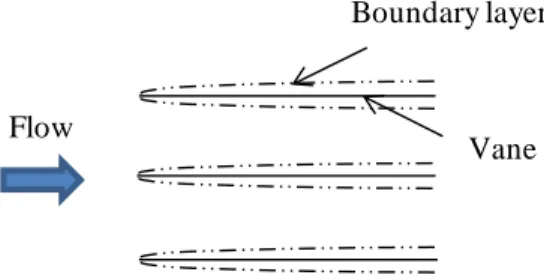
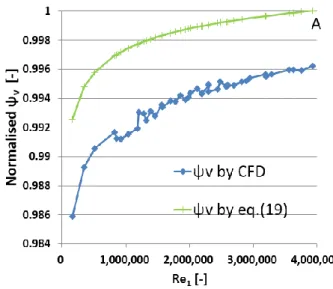
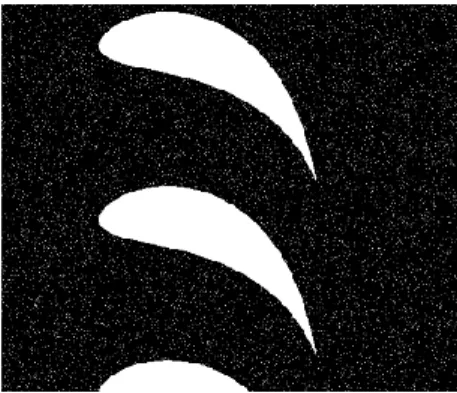
168. International Journal of Fluid Machinery and Systems DOI: http://dx.doi.org/10.5293/IJFMS.2021.14.2.168. Vol. 14, No. 2, April-June 2021 ISSN (Online): 1882-9554. Original Paper. Boundary Layer Loss Reduction of Cascade Flow by Wide Chord. Satoshi Otsuki 1. 1Mechanical System Research Department. Technical Institute, Corporate Technology Division. Kawasaki Heavy Industries, Ltd.. 1-1, Kawasaki-cho, Akashi City, 673-8666 JAPAN. [email protected]. Abstract. In actual turbomachinery, the wider chord cascade sometimes shows a higher aerodynamic efficiency than the shorter. chord one. This study tries to ascertain the underlying physical mechanism of the wide chord advantage mentioned above. in terms of the boundary layer loss reduction. It is verified the boundary layer loss has the characteristics of the chord to. the power of -1/n ( n > 1), therefore, the wide chord can reduce it. Next, by CFD, it is verified the boundary layer loss is. surely reduced by the wide chord. Consequently it is verified the wide chord is effective to reduce the viscous loss in. actual turbomachinery.. Keywords: Actual turbomachinery, Loss reduction, Boundary layer, CFD.. 1. Introduction. Recently all kinds of engines are required to reduce the fuel consumption in terms of both low running costs and . environment protection. For example, it is recognized only 1% aerodynamic efficiency rise for a 100MW steam turbine means that. a 1MW electric generator can be obtained for free. Therefore, efforts to obtain higher turbine efficiency by even less than 1% are. continued all over the world even recently, and even the well-formed turbine cascade flows without any flow separation at the design condition is still studied to obtain the higher efficiency. Therefore, various losses in the turbomachinery are studied through several. parameters, for example the tip clearance to staggered spacing ratio, the axial gap to spacing ratio, the blade span, and the end-wall. clearance etc. However, in this paper, we focus on the boundary layer loss in the main flow without secondary flows again, noticing. a little bit strange following facts. In the cascade flow the boundary layer loss is thought to be the main loss, therefore; it is effective. to reduce the boundary loss to obtain the higher efficiency. The boundary layer loss is quite related to the vane surface loss in the. cascade flow, and it can be assumed that a shorter chord cascade is advantageous because the distance along the vane over which. fluid flows or the boundary layer length on the vane surface becomes shorter, therefore; the total shear stress loss on the surface of. the vane is assumed to be small. However, it is sometimes observed that the wider chord cascade shows higher aerodynamic. efficiency in actual turbo machinery, and in practice there are some commercial compressors that adopt wide chords. As for the wide. chord, there have not been many studies on the physical mechanism that leads to the advantages of the wide chord cascade, especially. on turbine cascade flow. Therefore, in this paper, there are attempts to verify the advantages of the wide chord cascade theoretically through basic case studies for the boundary layer on vanes. The studies contained Blasius theory for the laminar boundary layer on. the flat plate and the turbulent boundary layer theory on the cambered vane. Next, they are verified by CFD. CFD calculations with. both the normal non-slip condition and the free slip condition on the vane are conducted to distinguish the boundary loss by. subtraction of the free slip condition loss from the non-slip condition total loss. In this paper, a single vane performance in the. cascade flow is not intended to evaluate, but the full wheel row performance is intended to evaluate as actual turbomachinery. evaluation. All studies are conducted for the identical solidity cascade and for the 2-dimensional main flow except the secondary. flow to verify the mid-flow characteristic in the cascade flow and the wide chord advantageous possibility in cascade designs for. actual turbomachinery.. Received January 22 2021; revised February 18 2021; accepted for publication April 2 2021: Review conducted by Tong Seop Kim, Ph.D. (Paper number O21005K) Corresponding author: Satoshi Otsuki, [email protected] . 169. 2. Evaluation Methods of Loss in Adiabatic Cascade Flow. When evaluating the loss, the entropy generation from the inlet to the outlet ΔS is mainly used as an indicator. ΔS has a. significant effect on the loss. For example, the relationship between ΔS and the total pressure loss coefficient ω for the adiabatic. turbine cascade flow is shown as Eq. (1). . ω = 𝑃01−𝑃02. 𝑃02−𝑃2 =. 𝛥𝑃0. 𝑃02−𝑃2 =. 𝑃02. 𝑃02−𝑃2 (𝑒𝛥𝑆/𝑅 − 1) (1). P01:total pressure at inlet, P02:total pressure at outlet, P2:static pressure at outlet, R : gas constant.. Moreover, the drag force F and the velocity coefficient ψv are also used as an indicator. F is used for the flat plate cascade evaluation, and ψv is used for the turbulent boundary layer evaluation on the circulate vane cascade. ψv is the ratio of the actual. outlet flow velocity to the ideal outlet flow velocity by the isentropic heat drop. With regards to F, Denton determined that the. relationship with the infinitely small variation of the entropy (ds) is as Eq. (2)[1] . T 𝑑𝑠. 𝑑𝑥 = −𝐹𝑥 (2). Fx : x-direction drag, T : temperature、x:distance along the flow . Whereas Fujimoto[2,3] showed that the two-dimensional cascade ψv could be given as follows.. ψv = v / v0 = 1 – 𝜹𝒖. ∗ +𝜹𝒍 ∗. 𝒃𝒐𝒖𝒕 (3) . 𝛿𝑢 ∗ , 𝛿𝑙. ∗ : boundary layer displacement thicknesses at the trailing edge on the upper side and lower side of the vane of . the cascade respectively.. bout : outlet flow width at the trailing edge of the vane of the cascade. (Fig. 2). The velocity coefficient ψv is closely related to the loss in the boundary layer as seen in Eq. (3). Additionally, as indicated by. Denton TΔS=ζ・1/2V2 (ζ: loss coefficient, V:velocity)[2], Eq. (4) shows that the velocity coefficient ψv is related to the entropy generation ΔS approximately . This supposes that the aerodynamic loss can be evaluated by the ratio of the velocity energy loss. . TΔS = 𝐶0・(1 − 𝜓𝑣 2)・. 1. 2 𝑉2 C0 : constant (4). 3. Wide Chord Advantage Study on the Boundary Layer on the Vane. To start from fundamental and general evaluation, the flat plane vanes cascade with 0 degree incidence as Fig. 1 is evaluated.. As well known by the momentum equation for the boundary layer, the drag on the one side of the flat plate (vane) by the boundary. layer of Fig. 1 is given as below. . Fig. 1 Boundary layers on the flat plane vanes cascade. Dc = ρbU 2θ (5) . Dc : drag on the single vane on the one side . ρ: density of the fluid. b : width of the vane in the vertical direction of the paper. U : velocity outside the boundary layer or of the upstream unit flow. θ : boundary layer momentum thickness. Therefore, a single vane drag generated on both upper and lower sides is as below.. Dc = 2ρbU 2θ (6). Boundary layer. Vane Flow. 170. If the vane number of a full wheel row is m, the total drag of the full wheel row Dt is given as below.. . Dt = 2ρbU 2θm (7). The relationship of the pitch (or vane) number m and the total circumference length L and pitch t is . m = L / t (8) . Also, the relationship of the solidity σ and the chord c is. σ = c / t (9). Combining eqs. (7)-(9) we can get. Dt = 2ρbU 2θ. Lσ. c (10). According to the Blasius theory for the laminar boundary layer in Fig. 1, θ was as below.. 𝜃. 𝑥 =. 0.664. (𝑅𝑒𝑥) 1. 2⁄ (11). x : distance from the tip to the point of interest. Rex : Reynolds number using x. Applying eq. (11) to a vane whose chord is c, we can get. θ = 0.664 𝑐. (𝑅𝑒𝑐) 1. 2⁄ =0.664(. 𝜇 𝜌𝑈⁄ ). 1 2⁄. (𝑐) 1. 2⁄ (12). Substituting eq. (10) into eq. (8) leads to. Dt = 2ρbU 2. Lσ. c × 0.664 (. 𝜇 𝜌𝑈⁄ ). 1 2⁄. (𝑐) 1. 2⁄ . = 1.228bLσ(U). 3 2⁄ (ρμ). 1 2⁄. (𝑐) 1. 2⁄. . Equation (13) shows that the wider the chord c is, the smaller the total drag of the full wheel row Dt is, with the same solidity. σ, suppose the fluid property and the inlet condition are the same. It shows the advantage of the wide chord in terms of the. laminar boundary layer in actual turbomachinery. . The same evaluation is conducted for the turbulent boundary layer as follows: The turbulent boundary layer momentum. thicknesses θ on the flat plate is also known as Eq. (14) by the 1/7-th-power law for the velocity distribution of the turbulent flow in the pipe, and the Blasius formula of the Reynolds number 1/4-th-power law for the coefficient of the flow resistance inside the. circular pipe, as in e.g. [4]. . θ = 0.0360 ( ν. U ). 1 5⁄. X 4. 5⁄ (14). θ : turbulent boundary layer momentum thicknesses, X : distance from the tip of the. vane along the vane surface. ν : kinetic viscosity of the fluid. Therefore, the corresponding formula to Eq. (13) for the total drag of a full wheel row Dt for the turbulent boundary layer is. given as below.. Dt = 0.0720bLρ(U). 9 5⁄ (ν). 1 5⁄ σ. (𝑐) 1. 5⁄ (15). Equation (15) also shows that the wider the chord c is, the smaller the total drag of the full wheel row Dt is, with the same. solidity σ, suppose the fluid property and the inlet condition are the same. This is also the advantage of the wide chord cascade. in terms of the turbulent boundary layer in actual turbomachinery. The mathematical function of 𝑐 1. 5⁄ dose not grow so rapidly as. one of 𝑐 1. 2⁄ , as c becomes bigger. However, it is said that in normal steam turbines, the low pressure stage vanes have longer. laminar boundary layers for their low Reynolds numbers; therefore, low pressure stage vanes which generate a rather big portion of. (13). 171. the total turbine power output may be more covered by the laminar boundary layer whose drag function is 𝑐 −1. 2⁄ for Dt. So the. wide chord may bring bigger benefits especially for low pressure stages of steam turbines. . As for the cambered vane cascade, Fujimoto made the calculation of the turbulent boundary layer displacement thickness δ* on. the circular plate vane cascade in Fig. 2, and gave it as Eq. (16), as in [2].. Fig. 2 Circular plate vane cascade. δ∗ = { 0.0259. (U) 17. 4⁄ (ν). 1 4⁄ ∫ U4dx. s. 0 }. 4 5⁄. (16) . U : velocity outside the boundary layer, ν: kinetic viscosity of the fluid. X : distance from the tip of the vane along the vane surface . And using the above result, Fujimoto also gave the velocity coefficient ψv for the configuration with γ=0 in Fig. 2 for the turbulent. boundary layer as below, as in [2,5].. . ψv = 1 - ⊿∗σ. {cos( α. 2 )}. 6 5⁄. (Re1) 1. 5⁄ (. Re1: Reynolds number using the inlet velocity w1. Re1 = cw1 /ν α : cascade turning angle. ⊿* : constant. According to Ref [2], ⊿* was chosen to be 0.09. Substituting of the definitions of Re1= cw1 /ν into Eq. (17) leads to Eq. (18).. ψv = 1 - ⊿∗σ. {cos( α. 2 )}. 6 5⁄. ( w1. ν⁄ ) 1. 5⁄ (𝑐) 1. 5⁄ (18) . As a reference, Eq. (18) is applied to the actual past designed reaction turbine vanes, and Eq. (19) is obtained by substituting. each corresponding parameter values into Eq. (17). . ψv =1- 𝐶0. (𝑅𝑒1) 1. 5⁄ C0 : constant. ψvs calculated by Eq. (19) are compared with ones obtained by CFD after normalized by ψv value of the point A in Fig. 3. It shows. that Eq. (18) can represent the ψv of the actual designed reaction turbine vanes, such that the difference of these two characteristics. are even maximum about 0.7% , and many other points are smaller than 0.5%. CFD method utilized for Fig. 3 was almost the same. two-dimensional method for the past designed profiles, and the software was quite the same as explained in the next chapter. . As regards the turbulent boundary layer loss of the cambered vane, Eq. (18) means that the wider c is, the larger ψv is, with the. same solidity σ. It can also clarify the advantage of the wide chord in terms of the velocity coefficient. Actually Fig. 4 shows the. same data used in Fig. 3, rearranged with the parameter of the outlet flow Mach numbers. It clearly shows that the wider chords. have higher velocity coefficients. Moreover, the aerodynamic loss ratio by the boundary layer could be evaluated by the deficit ratio. of the kinetic energy as Denton mentioned that TΔs=ζe・1/2V2 (ζ: loss coefficient, V: velocity)[1] the loss ratio above can be represented approximately as below[4]. . ζe = 1 − 𝜓𝑣 2 (20). ζe : kinetic energy loss ratio in the flow from the boundary layer on the vane surfaces. Substituting Eq. (18) into Eq. (20) leads to . (19). (17). . 172. ζ e ≒ {1 − (1 − ξ c −1. 5⁄ ) 2. } ≒ 2ξ c −1. 5⁄ ∽ 𝑐 −1. 5⁄ (21) . Here. ξ = ⊿∗σ. {cos( α. 2 )}. 6 5⁄. ( w1. ν⁄ ) 1. 5⁄ . In the procedure of Eq. (21), the small term is neglected. Eq. (21) shows that the energy loss ratio by the turbulent boundary. layer is to be approximately evaluated by the mathematical function of c-1/5 theoretically, using the Fujimoto formula, with the same. α, w1, and solidity σ. It also means that the wider chord can have the smaller energy loss. Therefore, the wide chord cascade advantage is verified in terms of the turbulent boundary layer on the circular vane cascade. . . Fig. 3 Comparison of the normalized velocity coefficient ψv by Eq. (9) and the past data. Fig. 4 Velocity coefficient characteristics for previously designed vanes. 4. Systematic Verifications of above Studies by CFD. A. 173. In this chapter, the above theoretical studies are verified by CFD. The software used is Ansys CFX V17.0 with the turbulent. model of k-ω SST. The calculated cascade vane profile are constructed by the Karman-Trefftz transformation as below. The software accuracy was validated by the turbine test facility approximately within 1% for three-dimensional multi-turbine-stages. . ζ−na. ζ+na = (. z−a. z+a ). n a = 10 , n = 2 (22). The center of the circle before the Karman-Trefftz transformation is (-1.5 , 3.4) .These profiles have sharp trailing edges; therefore,. the effect of the thickness (or the radius) of the trailing edge can be eliminated. They are rotated or re-staggered approximately 35° from the initial profiles. Consequently their geometrical inlet flow angles and outlet flow angles are approximately 90° and 20°,. respectively. Their CFD models are perfectly two-dimensional. Both normal non-slip calculations and free slip calculations on the. vane are conducted with the same boundary conditions. The subtraction of free slip calculations from the non-slip calculations are. evaluated as the loss (mainly caused) by boundary layer with eliminating of the flow curvature effects. Chords are chosen to be. 10, 30, 100 and 300mm considering the actual application range. Every chord case is calculated with the three outlet Mach number. parameters of 0.4, 0.5, and 0.6. All outlet Mach numbers conditions are arranged not to exceed 1% for the targeted ones by little. configurations of each inlet velocities for normal non-slip calculations. The 1 pitch mesh numbers are 30502,138277,138277, and. 522320 for 10, 30, 100, and 300mm chords, respectively. Figure 2 shows the 10 and 300mm vanes mesh diagrams as, mesh examples. . . (a) 300mm vane mesh (b) 10mm vane mesh. Fig. 5 10 and 300mm vane mesh diagrams. The losses studied are essentially not big values, while CFD or numerical calculations inevitably contain numerical errors.. Therefore, the low Reynolds number calculation conditions in which the viscous effects are comparably significant, are selected to. get a large S/N (signal-noise ratio) for accurate results of CFD within the actual ranges. Consequently, the conditions shown in Table. 1 are adopted, which correspond to the low-pressure last stage in an actual steam turbine. The Reynolds number range is. approximately from 3,300 to 143,000, and the fluid is an ideal H2O gas to eliminate the wet effect.. Table 1 Calculation conditions. Inlet Conditions Outlet Conditions. Inlet Velocity [m/s] Approximate 70 Static . pressure [Mpa} 0.007 Inflow angle [degree] 90. Total Temperature [degreeC] 60. 5. Results and Discussion. 5.1 Mach Number Distributions . Mach number distributions are shown in Fig. 6, comparing the widest 300mm chord ones with the shortest 10mm chord ones of. the outlet Mach number 0.5, for example. As regards 𝛿𝑢 ∗ , 𝛿𝑙. ∗, and bout (Ref. Eq. (3) and Fig. 2), though it is just the visual evaluation. at first, Fig. 6 shows that 𝛿𝑢 ∗ , 𝛿𝑙. ∗ relatively decrease compared with bout for the wider chord, therefore, the velocity coefficients are. expected to be higher for the wider chord by Eq. (2). Actually the velocity coefficient ψv in (a) is approximately 4.1% bigger than. one in (b). Also not only locally but almost on whole surfaces of both the suction and the pressure sides, the relative boundary layer. thickness in (b) is thicker than that in (a). This may make the vane profile shape duller for the shorter vane, which may result in the. decrease of the profile performance in spite of the geometrical similarity to the wider vane. Actually the out flow angle β2, indicated. in Fig. 2, is smaller in (a) than that in (b) by approximate 1.1degree.. 5.2 Boundary Layer Loss Verifications . 174. It is not easy to analyze the boundary layer loss data by CFD theoreticallyand directly, because of both laminar and turbulent. boundary layers may exist simultaneously in CFD results. Additionally, the CFD transition precise model of the boundary layer. between laminar and turbulent is still being studied in the world. However, the wide chord cascade is theoretically expected to have. an advantage in terms of the boundary layer losses as above, because they both are evaluated approximately by functions of c-1/n. (1<n, c:chord) by considering the boundary layer displacement thickness characteristics from the above studies. Figure 7 shows the. characteristics of the loss (caused mainly) in the boundary layer, which are obtained by subtraction of the free slip condition loss. from the non-slip condition total loss. At the outlet Mach number of 0.4, the 300mm chord cascade loss slightly bigger than the. 100mm chord cascade one. It may be because the Reynolds number reduces, therefore; the shear stress effect on the vanes by the. long flow distance along the vane gradually increases. However, in totally, Fig. 7 show that the boudary losses evaluated by the. CFD methods mentioned above surely have characteristic of functions of c-1/n approximately, and the wide chord cascade is expected to have an advantage in these Reynolds number ranges in terms of the boundary layer losses.. . (a) 300mm chord with the non-slip condition (b) 10mm chord under the non-slip condition. Fig. 6 CFD Mach number distributions of the nonslip condition. (a) Outlet Mach number 0.4 (b) Outlet Mach number 0.5 (c) Outlet Mach number 0.6 . Fig. 7 Characteristics of the loss mainly in the boundary layer. 5.3 Total Viscous Loss Reduction by the wide chord . Figure 8 shows the characteristic of the velocity coefficient. It is clear that the velocity coefficients increase for the wider chords.. The velocity coefficients obtained by CFD contain the effects of the total losses including both the boundary layer loss and the loss. in the rest mid-flow outside the boundary layer. Seeing Fig. 8, the velocity coefficients surely increase as the chord increases as. stdied above. Hence, it is verified that the wide chord cascade is advantageous in terms of the total viscous loss for geometrically. similar cascades with the same solidity and the same uniform inlet flows in actual turbomachinery.. 175. (a) Outlet Mach number 0.4 (b) Outlet Mach number 0.5 (c) Outlet Mach number 0.6. Fig. 8 Characteristic of the velocity coefficient for the chord. 6. Conclusion . In this study, the characteristic of the boundary layer in the cascade fundamental flow without secondary flow and the advantageous possibility of the wide chord with the identical solidity in the above flow for the full wheel row in actual. turbomachinery are studied again. They are conducted by both theoretically and CFD in the Reynolds number range of. approximately from 3,400 to 143,000 which corresponds to the low-pressure last stage in an actual steam turbine. Conclusions are. as follows. . 1. With the aid of the Blasius theory for the laminar boundary layer on the plane and the Fujimoto[2,3] theory for the turbulent boundary layer thickness of the circular plane vane cascade, the boundary losses are verified to have the characteristic of the. chord to the power of -1/n ( n > 1), therefore; the wide chord can reduce them, and the wide chord advantage is verified in. terms of boundary layer loss theoretically.. 2. The boundary layer loss and total loss for the cascade flow are also verified by CFD, and it is verified that the boudary losses. evaluated by CFD surely have characteristic of functions of c-1/n approximately, and the wide chord is advantageous for the. cascade flow in actual turbomachinery in terms of both the boundary layer loss and the velocity coefficient as expected. theoretically above.. Acknowledgments. The author would like to express his appreciation to Kawasaki Heavy Industries Ltd. for the useful instructions and availing of. the calculation machines and software for CFD.. Nomenclature. bout. c. Dc . Dt L. m . n. R Re1 s. T. t. U. w1 w2 X :. Outlet width of cascade flow [m] . Chord [m]. Drag per one vane of the cascade [N]. Total drag of the full wheel row [N] . Total circumference length [m] . Vane number of a full wheel row [-]. Exponent [-]. Gas constant Reynolds number by the inlet velocity w1 [-]. Entropy [J/kg K]. Temperature [K]. Pitch [m]. Uuniform inlet flow [m/s]. Inlet velocity [m/s]. Outlet velocity [m/s]. Distance from the tip of the vane along the vane. surface [m]. α. β2. δ*. ⊿* θ. v. μ ζe ρ. σ. ψv. Cascade turning angle, radian . Out flow angle, radian. Boundary layer displacement thicknesses at the. trailing edge on the upper side and lower side of . Vane of the cascade respectively [m]. Turbulent boundary layer displacement thickness,. [m]. Constant [-]; according to Ref[2] ⊿* = 0.09 Turbulent boundary layer momentum thickness. [m] Kinetic viscosity of the fluid [m2/s]. Dynamic viscosity of the fluid [Pa s]. Kinetic energy loss coefficient [-]. Density [kg/m3]. Solidity [-]. Velocity coefficient [-]. References. [1] Denton,J.D., “Loss Mechanisms in Turbomachines”, Journal of Turbomachinery, Vol. 115, 1993, 621. [2] Fujimoto, B.F., 1947 “Ta-bin Yoku no Nagare ni Tsuite (The second report)” Transactions of JSME, Vol 14, 47.. [3] Fujimot, B.F.,,1948 “Jouki Ta-bin Yoku no Kurikiteki Kenkyu ” Transactions of JSME Vol 14, 49. [4] E.g.,Bruce R, others, The Sixth Edition “Fundamentals of Fluid Mechanicals”, John Willey & Sons. Inc., P486. [5] Ishigai, S.I., Akagawa, K.A.,1971,”Jouki kogaku” , Korona-sha, Tokyo, P290-291, P225.

Fig. 1 Boundary layers on the flat plane vanes cascade
Fig. 2 Circular plate vane cascade
Fig. 3 Comparison of the normalized velocity coefficient ψ v  by Eq. (9) and the past data
Table 1 Calculation conditions
+2

参照

関連したドキュメント