Predictors of discharge outcomes following percutaneous
mechanical thrombectomy in patients with acute ischemic stroke:
Comparisons between the home discharge group and hospital
transfer group
Keiichiro Aoki*1, 2, Hisayoshi Suzuki1, Takeaki Miyata2,
Takahiro Ogino2 and Akihiro Iguchi2, 3
Received: 7 September 2020 / Accepted: 25 November 2020
Abstract
To clarify predictors of outcomes that can indicate the appropriateness of discharging patients to their own homes following acute ischemic stroke and percutaneous mechanical thrombectomy
(PMT). This study included 99 patients with acute ischemic stroke who were hospitalized in the
Department of Neurology at Hospital A and underwent PMT between April 2014 and December 2018. Of these, 32 and 67 patients were discharged to their own homes or to other hospitals, respectively. The following items were retrospectively collected from medical records within 3 days of PMT: age ; sex ; familial cohabitation and employment status ; serum albumin level ; consciousness disorders ; National Institutes of Health Stroke Scale (NIHSS), at the most severe
time and at 24 hours postoperatively ; Brunnstrom recovery stage (BRS) in upper limbs, fingers,
and lower limbs ; oral intake ; independence in activities of daily living such as eating, grooming, toileting, and walking ; and higher brain dysfunction. We identified significant differences between the groups in terms of consciousness disorders, both NIHSS scores, BRS, oral intake, independence in eating and grooming, and higher brain dysfunction (p<0.05). Multiple logistic
regression analysis revealed the following significant predictors of outcomes : NIHSS score at 24 hours postoperatively (odds ratio [OR]: 1.35 ; 95% confidence interval [CI]:
0.152-0.448) and oral intake (OR : 10.46, 95% CI : −2.252 to −0.095). NIHSS score at 24 hours
postoperatively and oral intake are useful predictors of patient outcomes following PMT for acute ischemic stroke. These can be assessed even when bed rest levels are low.
Key words : acute ischemic stroke, NIHSS score, outcomes, thrombectomy
Introduction
Recent advancements in the treatment of stroke, including the expansion of systems to rapidly transport patients to medical facilities following the onset of stroke symptoms and community medical
collaboration through specific pathways for patients in the acute, recovery, and maintenance phases, have considerably shortened the duration of acute care hospital stays1. According to the Japan Stroke Data
Bank2, ischemic strokes comprise 75.6% of all strokes.
Because Japan s population is aging, the number of patients with ischemic stroke is also on the rise.
Among the various types of ischemic stroke, cardiogenic ischemic stroke carries the worst prognosis3.
However, patients who are quickly diagnosed can undergo intravenous thrombolysis (IVT) as an acute treatment to restore blood flow4. Unfortunately, IVT
has been shown to be limited in effectiveness by poor recanalization rates, short indication time, and indication in only certain patients5. In addition, IVT
is ineffective in restoring blood flow if a major artery
Original Paper
* Corresponding author
Keiichiro Aoki
1 Department of Occupational Therapy, Showa University
School of Nursing and Rehabilitation Sciences, 1865 Tohkaichiba-machi, Midori-ku, Yokohama 226-8555, Japan.
2 Department of Rehabilitation Division, Showa University
Koto Toyosu Hospital.
3 Department of Physical Therapy, Showa University School
is obstructed by a thrombus6.
Therefore, percutaneous mechanical thrombectomy (PMT) is often indicated in patients whose symptoms do not improve with IVT or in those who are ineligible for the procedure. Reports have shown that PMT can improve outcomes in patients with acute ischemic stroke7, 8.
Previous studies have reported the following predictors of outcomes following PMT in patients with acute ischemic stroke : age9, infarct volume10,
reperfusion rate11, drop in blood pressure before
recanalization12, duration between stroke onset and
recanalization13, and National Institute of Health
Stroke Scale (NIHSS) score14. It would be ideal to
use only pre- and postoperative findings to determine whether patients can be discharged to their own homes ; however, making this decision on the basis of such findings alone is difficult in practice.
Currently, recommendations of rehabilitation staff are considered when deciding whether a patient can be discharged to his or her own home or a to recovery-phase hospital or another type of hospital15.
Although predictors based on rehabilitation parameters are also important in making that decision, no reports have investigated the same in patients with acute ischemic stroke who underwent PMT.
Therefore, the objective of this study is to determine these predictors, including medical and non-medical parameters, that can be assessed within a 3-day postoperative window and that can aid in deciding whether patients with acute ischemic stroke who have undergone PMT can be discharged to their own homes. By identifying these factors, patients and their families may receive consistent treatment from the onset of stroke to home discharge. Furthermore, we believe that discharging patients early to their own homes can lead to an improved quality of life.
Methods
1.Subjects
We screened 111 patients with acute ischemic stroke who were hospitalized and had PMT in the Department of Neurology at Hospital A between April 2014 and December 2018. In addition, we excluded those who had not undergone rehabilitation intervention within 3 days of PMT and those with obvious data deficiencies in their medical records, such as multiple missing values, which we found during data collection.
As a result, 99 patients were included in this study. Of them, 32 patients were discharged to their own homes (i.e., home discharge group), while the
remaining 67 were discharged to a recovery-phase hospital or to another type of hospital (i.e., hospital transfer group).
2.Data Collection
The data analyzed in this study were assessed within 3 days of PMT and were retrospectively collected from patient medical records. Patient personal attributes included age, sex, and familial cohabitation and employment status. Blood data was surveyed using serum albumin (Alb) level. Stroke severity was surveyed based on consciousness disorders and NIHSS, at the most severe time and at 24 hours postoperatively. The severity of paralysis was surveyed using Brunnstrom recovery stage (BRS) of patient upper limbs, fingers, and lower limbs. Activities of daily living (ADLs) were surveyed in terms of oral intake and independence in eating, grooming, toileting, and walking. In addition, higher brain function was surveyed for any dysfunction. We categorized data for certain variables according to the following standardized scales before collection. For consciousness disorders, the Glasgow Coma Scale (GCS) was used ; if even one deduction was assigned, a consciousness disorder was deemed present, and if no deductions were assigned, consciousness disorders were deemed absent. In terms of BRS of the upper limbs, fingers, and lower limbs, Stage ≥ V was deemed mild paralysis, whereas Stage ≤ IV was deemed severe paralysis. Furthermore, we set GCS and BRS scores as binary variables because both scores were not ratio scale nor interval scale. For oral intake, if the patient could orally ingest all types of foods, oral intake was deemed present ; if this was absent, even if nasogastric tube feeding was performed, oral intake was deemed absent. From nursing records, the FIMTM16 criteria was used to classify as independence
those cases for which no caregiver was needed. In addition, the cases for which a caregiver was needed was classified as dependence (monitoring, preparation, and assistance).
3.Data Analysis
The two groups were compared using Wilcoxon s signed-rank test and Fisher s exact test. In addition, to identify outcome predictors, the correlation between independent variables was examined, and stepwise multiple logistic regression analysis was performed. In this analysis, home discharge and hospital transfer were set as dependent variables, whereas all other variables were set as independent variables. We examined the degree of influence of the independent
on the dependent variables. JMP Pro v15.1 for Macintosh was used to perform the statistical analyses. The significance level was 0.05.
4.Ethical Considerations
This study was approved by the Research Ethics Committee of the Showa University Koto Toyosu Hospital Clinical Research Support Office (approval no. 19T7024). Information gathered for the purposes of this study was shared only between the study s authors. Notices were posted on bulletin boards
throughout the hospital and on our website explaining how to opt out of consent for use of patient medical information. Patients who opted out were explained the research objectives and surveyed items and were provided an opportunity to revoke permission to use their medical information.
Results
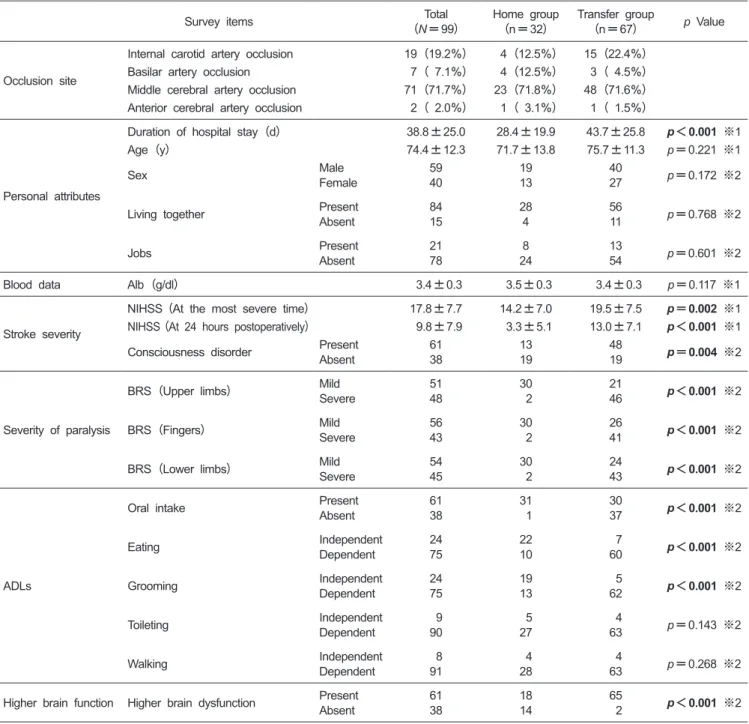
Occlusions in a majority of the patients (71.7%) were in the middle cerebral artery ; other sites included the internal carotid artery (19.2%), basilar Table 1. Comparisons between the home discharge and hospital transfer groups of patients
Survey items (N=99)Total Home group (n=32) Transfer group(n=67) p Value
Occlusion site
Internal carotid artery occlusion 19(19.2%) 4(12.5%) 15(22.4%)
Basilar artery occlusion 7( 7.1%) 4(12.5%) 3( 4.5%)
Middle cerebral artery occlusion 71(71.7%) 23(71.8%) 48(71.6%)
Anterior cerebral artery occlusion 2( 2.0%) 1( 3.1%) 1( 1.5%)
Personal attributes
Duration of hospital stay(d) 38.8±25.0 28.4±19.9 43.7±25.8 p<0.001 ※1
Age(y) 74.4±12.3 71.7±13.8 75.7±11.3 p=0.221 ※1
Sex MaleFemale 5940 1913 4027 p=0.172 ※2
Living together PresentAbsent 8415 284 5611 p=0.768 ※2
Jobs PresentAbsent 2178 248 1354 p=0.601 ※2
Blood data Alb (g/dl) 3.4±0.3 3.5±0.3 3.4±0.3 p=0.117 ※1
Stroke severity
NIHSS(At the most severe time) 17.8±7.7 14.2±7.0 19.5±7.5 p=0.002 ※1
NIHSS(At 24 hours postoperatively) 9.8±7.9 3.3±5.1 13.0±7.1 p<0.001 ※1
Consciousness disorder PresentAbsent 6138 1319 4819 p=0.004 ※2
Severity of paralysis
BRS(Upper limbs) MildSevere 5148 30 2 2146 p<0.001 ※2
BRS(Fingers) MildSevere 5643 30 2 2641 p<0.001 ※2
BRS(Lower limbs) MildSevere 5445 30 2 2443 p<0.001 ※2
ADLs
Oral intake PresentAbsent 6138 31 1 3037 p<0.001 ※2
Eating IndependentDependent 2475 2210 760 p<0.001 ※2
Grooming IndependentDependent 2475 1913 562 p<0.001 ※2
Toileting IndependentDependent 990 527 463 p=0.143 ※2
Walking IndependentDependent 891 428 463 p=0.268 ※2
Higher brain function Higher brain dysfunction PresentAbsent 6138 1814 65 2 p<0.001 ※2 ※1 Wilcoxon signed-rank test
※2 Fisher s exact test
artery (7.1%), and anterior cerebral artery (2.0%). In this study, at least 1 patient with each type of occlusion site was discharged to his or her own home. Wilcoxson s signed-rank test was used to compare the age, Alb levels, and NIHSS scores. NIHSS, at the most severe time (p=0.002) and at 24 hours postoperatively (p<0.001) were significantly different between the groups. Fisher s exact test was used to compare sex, familial cohabitation and employment status, consciousness disorders, BRS, oral intake, independence in ADLs, and higher brain dysfunction. We observed significant differences in consciousness disorders (p= 0.004), BRS (p <0.001), oral intake (p <0.001), independence in eating and grooming (p<0.001), and higher brain dysfunction (p<0.001) between the groups (Table 1).
Multiple logistic regression analysis revealed significant correlations between discharge destination and the following factors : NIHSS score at 24 hours postoperatively (odds ratio, OR : 1.35, 95%CI : 0.152-0.448) and oral intake (OR : 10.46, 95%CI : 2.252 to 0.095) (Table 2).
Discussion
1.Subjects
Mean duration of hospitalization was 28.4 19.9 days in the home discharge group and 43.7 25.8 days in the hospital transfer group. Da Ros et
al.17 reported that PMT in patients with mild stroke
was safe, has led to rapid improvement in NIHSS score, and accounted for differences in length of stay between the home discharge and the transfer groups. On the other hand, Tate et al.18 reported that
patients who underwent PMT had a shorter period of hospitalization and reduced medical expenses. Therefore, compared to the transfer group, the average NIHSS score at the time of onset of severe illness and 24 hours postoperatively was lower in the home discharge group than in the transfer group, which could be why many patients in the home discharge group improved early. In addition, if rapid improvement was observed, the length of stay in the ICU was short19, and this led to independence in
ADLs from the early postoperative period. This is
also believed to have led to a reduction in the length of hospital stay.
Arboix et al.20 reported that patients with
cardiogenic ischemic stroke were most likely to develop sudden onset of stroke and present with cortical symptoms, including conjugate deviation of the eyes, aphasia, and unilateral spatial neglect. Furthermore, they highlighted that because occlusions of main arteries result in large areas of infarct, the defining characteristic of such a stroke is a poor outcome. In the participants in our study, the cases of cardiogenic ischemic strokes were present in 26 of 32 patients (81.2%) in the home discharge group and in 59 of 67 patients (88.1%) in the transfer group. This finding indicates that PMT also gave good results in some patients with cardiogenic ischemic stroke.
2.Outcome Predictors
Significant predictors of patient outcomes were NIHSS score at 24 hours postoperatively and oral intake. According to Wirtz et al.21, NIHSS score at
24 hours postoperatively correlates with functional outcome at 90 days postoperatively. Some have reported that outcomes were good when NIHSS score at 24 hours after surgery was 5 points or less22-24.
We set NIHSS score at 24 hours after surgery for 5 points as a cutoff in this study. A total of 27 of 32 patients (84.3%) were discharged to their own homes, and 7 of 67 (10.4%) were transferred to a recovery-phase hospital or to another type of hospital. Therefore, similar to the reports of previous studies, NIHSS score was lower in the home discharge group. Furthermore, Schonenberger et al.25 reported that
NIHSS score at 24 hours postoperatively is a useful index of early neurological improvement. Leslie-Mazwi
et al.26 reported that NIHSS scores of 6-9 at 24 hours
are quite likely to be beneficial to patients. Mildly affected patients with comparatively low NIHSS scores at 24 hours tend to stabilize and improve faster ; therefore, it is important to initiate rehabilitation efforts soon after the surgery in order to improve ADLs. In terms of oral intake, Okabayashi et al.27 reported
that periods of no food intake are significantly shorter and NIHSS scores at hospitalization are significantly Table 2. Results of multiple logistic regression
Coefficient (SD) p-Value Odds Ratio 95% Confidence Interval Lower Upper NIHSS score (At 24 hours postoperatively) 0.300 (0.075) p < 0.001 1.35 0.152 0.448
Oral intake −1.173 (0.550) p = 0.033 10.46 −2.252 −0.095 p< 0.05
lower in patients in the home discharge group compared with those in the hospital transfer group. We observed similar results in our study : Patients capable of oral intake were more common in the home discharge group, and their NIHSS scores at 24 hours were lower compared with those in the hospital transfer group. According to previous reports, recovery of oral intake has been reported to be correlated with ADLs28, and eating behaviors can predict discharge
in the early period after stroke onset29. Similarly,
in our study, independence in eating and grooming was more common in patients in the home discharge group, thus, highlighting that recovery of oral intake is important to the improvement of ADLs soon after stroke onset. Therefore, care in the acute phase should be aimed to help patients achieve safe oral intake via evaluation of their swallowing ability.
We believe that collaboration between multiple departments to provide comprehensive interventions in accordance with appropriate evaluations can result in more frequent and earlier home discharges. The two predictors identified in this study―the NIHSS score at 24 hours postoperatively and oral intake― can be measured even when bed rest levels are low ; therefore, both are useful evaluative indices in predicting outcomes.
3.Limitations
One limitation of this study is its retrospective nature ; due to missing data for certain patients, not all patients treated within the study period were analyzed, which may have introduced bias into our results. In this study, oral intake was associated with impaired consciousness. Therefore, the existence of multicollinearity was considered in the analysis. However, details of the sub-items of NIHSS were not examined, and it will be necessary to examine these in future studies.
Additional prospective studies that collect data on the variables outlined in this study are warranted. Particularly, NIHSS scores at 24 hours collected prospectively could be used to calculate the cutoff values in predicting outcomes and advancing efforts toward recommendations for discharge.
Therefore, to improve NIHSS scores 24 hours after surgery, it is important to evaluate and implement rehabilitation as soon as possible after surgery and to perform early intervention for ADL training. Furthermore, to enable oral intake, it is important to consider an intensive approach by an inter-professional team working toward the acquisition of swallowing function.
Acknowledgments
We thank the patients who participated in this study, as well as the chief of the Showa University Koto Toyosu Hospital for cooperation and for providing hospital records. Conflict of interest disclosure
The authors have no conflicts of interest to declare. References
1. Hashimoto Y, Terasaki S, Watanabe S, et al. Over-view: referral system and treatment network for stroke.
J Clin Rehabil. 2011;20:612-619. (in Japanese). 2. Toyoda K, Sonoda K, Sato S, et al. The Japan
Stroke Databank. Current stroke care in Japan and ideal stroke registries. Neurol Ther. 2018;35:188-192. (in Japanese).
3. Tomii Y, Kamojima N, Iwata K, et al. Verification of clinical pathway for patients with acute ischemic stroke. Jpn J Stroke. 2012;34:317-323. (in Japanese). 4. Adams HP, Adams RJ, Brott T, et al. Guidelines
for the early management of patients with ischemic stroke: a scientific statement from the Stroke Council of the American Stroke Association. Stroke. 2003;34:1056-1083.
5. Emberson J, Lees KR, Lyden P, et al. Effect of treat-ment delay, age, and stroke severity on the effects of intravenous thrombolysis with alteplase for acute ischaemic stroke: a meta-analysis of individual patient data from randomised trials. Lancet. 2014; 384:1929-1935.
6. Bhatia R, Hill MD, Shobha N, et al. Low rates of acute recanalization with intravenous recombinant tissue plasminogen activator in ischemic stroke: real-world experience and a call for action. Stroke. 2010;41:2254-2258.
7. Lambrinos A, Schaink AK, Dhalla I, et al. Mechanical thrombectomy in acute ischemic stroke: a systematic review. Can J Neurol Sci. 2016;43:455-460.
8. Balami JS, Sutherland BA, Edmunds LD, et al. A systematic review and meta-analysis of randomized controlled trials of endovascular thrombectomy com-pared with best medical treatment for acute ischemic stroke. Int J Stroke. 2015;10:1168-1178.
9. Kim DH, Kim SU, Sung JH, et al. Significances and outcomes of mechanical thrombectomy for acute infarction in very elderly patients: a single center experience. J Korean Neurosurg Soc. 2017; 60:654-660.
10. Tonetti DA, Gross BA, Desai SM, et al. Final infarct volume of <10 cm3 is a strong predictor of return
to home in nonagenarians undergoing mechanical thrombectomy. World Neurosurg. 2018;119:e941-e946. 11. Albers GW, Goyal M, Jahan R, et al. Relationships
between imaging assessments and outcomes in solitaire with the intention for thrombectomy as primary
endovascular treatment for acute ischemic stroke.
Stroke. 2015;46:2786-2794.
12. Petersen NH, Ortega-Gutierrez S, Wang A, et al. Decreases in blood pressure during thrombectomy are associated with larger infarct volumes and worse functional outcome. Stroke. 2019;50:1797-1804.
13. Pan Y, Cai X, Huo X, et al. Cost-effectiveness of mechanical thrombectomy within 6 hours of acute ischaemic stroke in China. BMJ Open. 2018;8:e018951. (accessed 2018 Feb 1) Avail-able from: https://www.ncbi.nlm.nih.gov/pmc/articles/ PMC5855394/pdf/bmjopen-2017-018951.pdf
14. Almekhlafi MA, Davalos A, Bonafe A, et al. Impact of age and baseline NIHSS scores on clinical outcomes in the mechanical thrombectomy using Solitaire FR in acute ischemic stroke study. AJNR Am J Neuroradiol. 2014;35:1337-1340.
15. Aoki K, Suzuki H, Saito J, et al. Factors affecting the discharge destination outcomes of patients with acute stroke. Examination during the early stage of stroke onset. J Kanagawa Occup Ther Res. 2020;10:13-18. (in Japanese).
16. Data management service of the Uniform Data System for Medical Rehabilitation and the Center for Functional Assessment Research: Guide for use of the Uniform Data Set for Medical Rehabilitation. version 3.1, State University of New York at Buffalo, Buffalo, 1990.
17. Da Ros V, Cortese J, Chassin O, et al. Thrombec-tomy or intravenous thrombolysis in patients with NIHSS of 5 or less? J Neuroradiol. 2019;46:225-230. 18. Tate WJ, Polding LC, Kemp S, et al. Thrombectomy
results in reduced hospital stay, more home-time, and more favorable living situations in DEFUSE 3. Stroke. 2019;50:2578-2581.
19. Vina Soria L, Martin Iglesias L, Lopez Amor L, et al. Results and functional outcomes of acute ischemic stroke patients who underwent mechanical thrombec-tomy admitted to intensive care unit. Med Intensiva.
2018;42:274-282.
20. Arboix A, Alio J. Cardioembolic stroke: clinical fea-tures, specific cardiac disorders and prognosis. Curr
Cardiol Rev. 2010;6:150-161.
21. Wirtz MM, Hendrix P, Goren O, et al. Predictor of 90-day functional outcome after mechanical thrombec-tomy for large vessel occlusion stroke: NIHSS score of 10 or less at 24 hours. J Neurosurg. 2019;20:1-7. 22. Asdaghi N, Yavagal DR, Wang K, et al. Patterns
and outcomes of endovascular therapy in mild stroke.
Stroke. 2019;50:2101-2107.
23. Wu Z, Zeng M, Li C, et al. Time-dependence of NIHSS in predicting functional outcome of patients with acute ischemic stroke treated with intravenous thrombolysis. Postgrad Med J. 2019;95:181-186. 24. Reznik ME, Yaghi S, Jayaraman MV, et al. Baseline
NIH Stroke Scale is an inferior predictor of functional outcome in the era of acute stroke intervention. Int J
Stroke. 2018;13:806-810.
25. Schonenberger S, Uhlmann L, Hacke W, et al. Effect of conscious sedation vs general anesthesia on early neurological improvement among patients with isch-emic stroke undergoing endovascular thrombectomy: a randomized clinical trial. JAMA. 2016;316:1986-1996. 26. Leslie-Mazwi TM, Hamilton S, Mlynash M, et al.
DEFUSE 3 non-DAWN patients. Stroke. 2019; 50:618-625.
27. Okabayashi R, Hikari D, Hoshino M, et al. A study on the relationship between the number of days oral ingestion restarted and discharge destination in acute stroke patients. Gunma J Phys Ther. 2018;29:1-4. (in Japanese).
28. Sato S, Sato M, Mizuma M. Prognoses of stroke with dysphagia. J Showa Med Assoc. 2006;66:392-397. (in Japanese).
29. Aoki K, Iguchi A, Watabe T. Evaluation of Functional Independence Measure item scores for predicting home discharge after acute stroke rehabilitation. Jpn J