重力波から探る
重力崩壊型超新星のダイナミクス (arXiv: 1304.4372)
• Takami Kuroda
Kei Kotake(Fukuoka Univ.) Tomoya Takiwaki(NAOJ)
NaConal Astronomical Observatory of Japan(NAOJ)
© AstroArts
1 . 重力崩壊型超新星爆発 (CCSN) とは?
SN1054 SN1987A
©NASA
Core Collapse Supernovae (CCSNe) are
one of the most energeCc events in the universe
1 . 重力崩壊型超新星爆発 (CCSN) とは?
They are so bright comparable to a galaxy.
They affect on galacCc evoluCon in both dynamically and chemically
e.g. Kobayashi+’11
1 . 重力崩壊型超新星爆発 (CCSN) とは?
Tanaka+,’08
Typical explosion energy
Ekin~1051ergs
1 . 重力崩壊型超新星爆発 (CCSN) とは?
~Msunx (104km/s)2
R0
〜
103km€
~ −GMFe2 1
R0 − 1 RNS
⎛
⎝ ⎜ ⎞
⎠ ⎟
~ 1053ergs RNS
〜
NS 10km1 . 重力崩壊型超新星爆発 (CCSN) とは?
Liberated gravitaConal energy ~1053ergs is stored in the proto-‐neutron star (PNS)
Eint~1053ergs Erot~1051-‐52ergs
1 . 重力崩壊型超新星爆発 (CCSN) とは?
GravitaConal well
中心の莫大なエネルギーを 何とかして外層へと渡したい
空間
エネルギー 典型的な爆発運動エネルギー ~O(1051) ergs
~O(1052-‐53)ergs
1 . 重力崩壊型超新星爆発 (CCSN) とは?
GravitaConal well
空間 エネルギー
1 . 重力崩壊型超新星爆発 (CCSN) とは?
GravitaConal well
空間 エネルギー
1 . 重力崩壊型超新星爆発 (CCSN) とは?
GravitaConal well
ν内部エネルギー
磁場 角運動量
空間 エネルギー
媒体物 媒体対象
1 . 重力崩壊型超新星爆発 (CCSN) とは?
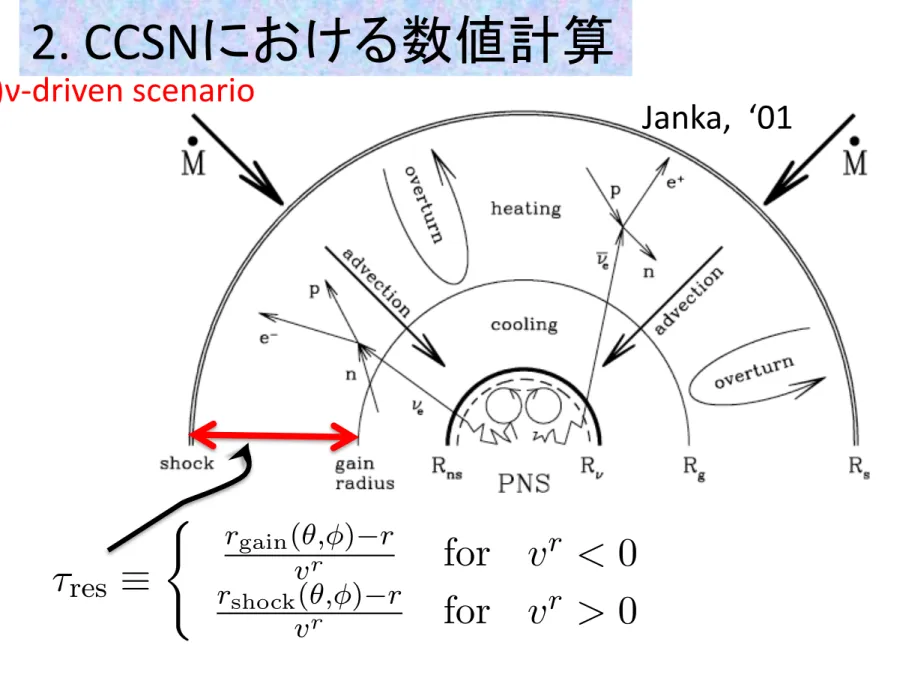
1)ν-‐driven scenario
Janka, ‘01
Rstalled_shock~100km €
2. CCSN における数値計算
1)ν-‐driven scenario (no-‐explosion under spherical symmetry)
€
13Msun Liebendorfer+,’01
2. CCSN における数値計算
Rshock(km)
Buras+,’06
2D
1D
Buras+,’06
Marek&Janka,’09
15Msun
11.2Msun
Takiwaki+,’11
13Msun
Suwa+,’10
1)ν-‐driven scenario (successful explosions in mulC-‐D)
2. CCSN における数値計算
1)ν-‐driven scenario
€
Janka, ‘01
€
τheat ≡ −ebind
Q ˙ Time scale of binding energy to be 0 (unbound)
– 22 –
Fig. 12.— Mean shock radii as a function of post-bounce time.
explosion (Janka 2001; Murphy & Burrows 2008). Here τres is the residency time scale defined by τres ≡
! r
gain(θ,φ)−r
vr for vr < 0
rshock(θ,φ)−r
vr for vr > 0 (43)
and represents how long a comoving fluid element in the gain region is expected to be exposed to the neutrino heating. Here we note both denominator and numerator are measured in the Eulerian frame. τheat is the heating time scale defined by
τheat ≡ −εbind
Q˙ (44)
where εbind and ˙Q ≡ e6φαQµnµ (see, Eq. 14) are the binding energy and the net heating rate of a fluid element, respectively. τheat represents how long it takes to get unbounded from the gravitational field for a fluid element. As for the definition of binding energy εbind, we adopted a Newtonian treatment expressed by
εbind ≡ ρ
"
utε + 1
2vivi + φN T
#
(45) where φN T < 0 is evaluated by solving Eq.(27). Then the heating efficiency is derived by averaging each time scale τres and τheat and take their ratio. Here the averaging is performed for all numerical cells with εbind < 0 and ˙Q > 0. If τres is longer than τheat, a fluid element is From Fig. 13, we see both of 3D models are efficiently heated compared to 1D models. This is because the radial flows can be converted to the lateral flows in 3D which lengthen τres. Furthermore, on one hand,
2. CCSN における数値計算
1)ν-‐driven scenario (successful explosions in mulC-‐D)
KT,Kotake,Takiwaki,’12
MulC-‐D effects are key to successful explosion
2. CCSN における数値計算
2)magneto-‐rotaConal explosion (MRE)
Takiwaki+,’08 (2D-‐axisymmetry) Scheidegger+,’10 (3D)
Possible amplificaCon mechanisms are 1) winding effect
2) magneto rotaConal instability(MRI)
2. CCSN における数値計算
Microphysics
• EOS of baryonic maiers above nuclear density (ρ>~2x10¹⁴g/cc)
• Neutrino transfer (Burrows+ ’06, Marek&Janka,’09, Suwa+,’10,Takiwaki+,’11)
一般相対論
(e.g., Obergaulinger+’06,Shibata+’06)
3次元の効果
(e.g., Mikami+’08,Scheidegger+’09,Iwakami+’09)
磁場の影響
(e.g., Yamada&Sawai,04,Kotake+’05, Burrows+’07 ,Takiwaki+’09,Kuroda&Umeda’10)2. CCSN における数値計算
BSSN formalism (metric)
RelaCvisCc (M)HD
3D-‐Nested grid
(or AMR)
Neutrino radiaCon (gray energy) 1) cooling (leakage)
2) heaCng (truncated (M1) method)
Features of our code (see, KT, Kotake & Takiwaki, ApJ, ’12)
Numerical scheme (code)
KT & Umeda,’10
Roswog&Liebendorfer’03, Sekiguchi,’10
Thorne’81, Shibata+’11
€
G
αβ= 8 π T
αβ≡ 8 π ( T
fluidαβ+ T
radiationαβ)
Hydrodynamic equaCons (10+3 variables)
Neutrino RadiaCon equaCons (12xNene variables) BSSN equaCons (17 variables) + Gauge condiCons
Numerical scheme (code)
Matsumoto,’07
Matsumoto,’07
To obtain conCnuous “
∇
Φ”(1) 2D interpolaCon
(2) 1D interpolaCon
2)MRE
GW emission from rotaCng star
1)ν-‐driven explosion
“Spherical” explosion “Oriented” explosion
But there are several problems…
Usually CCSNe occur very far from us!
θ~(10
8cm/10
22cm)=10
-‐14 Explosion occurs deep down the star!
opCcally thick
1000km
GW emission from rotaCng star
Kotake,’11, "GravitaConal Waves (from detectors to astrophysics)"
Then, how can we decipher which mechanism affects mostly on the explosion?
GW emission from rotaCng star
As candidates of strong GW emiiers mergers of compact stars
(NSNS,NSBH,BHBH)
Core Collapse Supernovae (CCSNe)
occurrence
frequency
~1/y/(200Mpc)^3 ~1/y/(20Mpc)^3
Phinney+,’91 Mannucci+,’07
GW Amp@src
~km ~m(Shibata+,’03)
h=A/D
~10^-‐22 ~10^-‐24
(D~200Mpc) (D~20Mpc)
GW emission from rotaCng star
h=AGW/D ~10^-‐24 (with D=10Mpc) (h/sqrt(100Hz)~10^-‐25)
Can we detect such extraordinary small signals?
h/sqrt(f)
GW emission from rotaCng star
What we have to do is to predict
gravitaConal waveforms and neutrino luminosiCes as precisely as possible in advance.
• Full general relaCvisCc
• MulC-‐energy & mulC flavor neutrino radiaCon
• 3-‐D
• (Magneto-‐hydrodynamical)
simulaCons are indispensable.
GW emission from rotaCng star
Aim
By using full 3DGR-‐Rad. hyd. code,
we invesCgate rotaConal effects on GW emission
In Oi+,’12, the computaConal domain is only one quadrant.
In Oi+,’07, they neglect ν-‐cooling
€
ϖ
0= 1000 km
Progenitor: 15Msun (WW95)
EOS: Shen eos (Shen+,’98)+e-‐e++photon(+neutrino) IniCal rotaConal profile
We calculated 4 models with varying Ω0
€
Ω0 = 0, π
6 , π
2 ,π(rad / s) According to Hegar, ’05, Ω0~1 (rad/s) at maximum.
Numerical scheme (iniCal condiCon)
1283cells * 9 Level nested structure (dxmin~450m)
Random perturbaCon
(
1%)
in density was added at iniCal Cray XT4 (512core) @ NAOJ, ~1.3ms/1day
400km
0<Tpb<50ms
If CCSN occurs within our galaxy (D<10kpc)
and progenitor rotates sufficiently fast
(
Ω>pi/2)
, (S/N)>10 can be achieved. ObservaCon along polar axis also gives us possibility of detecCon.
Results (GW spectra)
Results (GW spectra)
Comparison with Oi+,’12
Spectral peak appears at similar value ~670Hz(ours) ~700Hz(Oi+’12)
RotaConal signatures in GW spectra
rotaConal
axis equator
RotaCon
immediately a2er the
bounce late phase equator polar axis
~700Hz ~200Hz
l=2 mode
Where do these signals come from ?
RotaConal signatures in GW spectra
SpaCal distribuCon of GW source toward polar axis
Ω=pi
where
GW extracCon by quadrupole formulae
€
log ˙ ˙ I xx2 −I ˙ ˙ yy2+( )2 ˙ ˙ I xy 2
GW emission from one-‐armed spiral wave
One-‐armed Spiral wave is the GW (@~200 Hz) emiier
Equatorial plane
What determines emission @~200Hz?
~
200Hz is determined from Doppler shi‚ (rot. + sound velocity)Tpb=
GW emission from one-‐armed spiral wave
50km 100km 150km (x2+y2)1/2 km
€
Ωaco + Ωrot
€
Ωrot
“Fpeak-‐100Hz” reflects rotaConal Cme scale above the PNS(?)
~200Hz is determined from Doppler shi‚ (rot. + sound velocity)
Since Ωaco (~100Hz) is hardly changed by progenitor rotaCon
Conclusions
① CombinaCon of low-‐T/W instability and spiral SASI can leave its message in GW emission.
② Its emission frequency can be determined from Doppler shi‚.
NAOJ
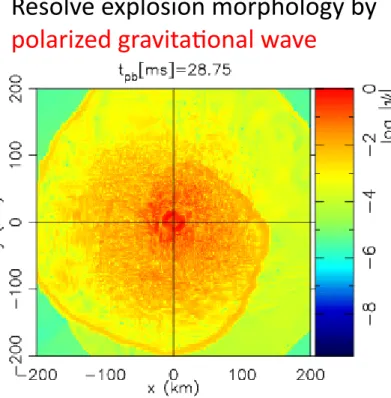
Usually CCSNe occur far from us and it is very difficult to resolve angular dependence of asymmetry.
c.f., Tanaka+,’12 Resolve explosion morphology by
polarized EM wave
9 per 2 ms, i.e., rotational period is Trot ∼ 8 ms. This rota-
tional time scale corresponds to 2/Trot = 250 Hz, where numerator 2 in left hand side comes from 2 emissions of a polarized wave during one rotation. This value 250 Hz is consistent with the aforementioned gravitational wave frequency, F ∼ 200 Hz. Therefore, we claimed the strong narrow band emission, appeared after the neutronization phase in our most rapidly rotating model R0pi, obviously originated from the one-armed spiral wave.
FIG. 6. Localized gravitational wave source term ψ along the equatorial plane for model R0pi. As seen, one-armed spi- ral wave emit strong gravitational wave and the spiral wave rotates approximately 90◦ per 2 ms.
To assess the origin of narrow band emission at F ∼ 200 Hz which is shifted ∼ 100 Hz higher compared to other models, we analyzed rotational-acoustic wave fre- quency. To do this, we defined following two rotational velocities Ωaco and Ωrot and plotted them in Fig. 7.
Ωaco ≡ 2 Cs 2π!
x2 + y2 (47) Ωrot ≡ 2 Vφ
2π!
x2 + y2 (48) In Fig. 7, spatial profiles of Ωaco + Ωrot (solid) and Ωrot (dashed) along the x axis at different time slices are plot- ted.
FIG. 7. Spatial profiles of Ωaco+Ωrot (solid) and Ωrot (dashed) along the x axis at different time slices. Color represents post bounce time labeled by numbers appeared in the panel.
As seen in the figure, rotational-acoustic wave fre- quency (solid lines) shows Ωaco +Ωrot ∼ 250 Hz at 60 km
! R ! 120 km. This frequency is consistent with both narrow band emission above the protoneutron star seen in Fig. 5 and our former estimation using Fig. 6. Re- markably, Ωrot is comparable to Ωaco and Ωrot amounts
∼ 100 Hz which is approximately the same value with peak shift seen in model R0pi during the prompt convec- tive phase. Therefore, we hope we can extract some infor- mation about rotation above the protoneutron star by es- timating gravitational wave’s peak shift. Here, however, we assume Ωaco does not change significantly from model to model in highly convective region, i.e., the sound veloc- ity Cs does not depend so much on the initial condition at precollapse phase. We consider this assumption is quite reasonable because many previous studies with different initial conditions, such as magnetic field or progenitor mass, reported gravitational wave emission with peaking
∼ 100 Hz during prompt convective phase [1, 16, 20].
Finally, we plot characteristic wave strain hchar with sensitivity threshold of gravitational wave detectors for Initial LIGO [8], Advanced LIGO [26] and KAGRA [11], in Fig. 8. To draw this figure, hchar is evaluated by Eq. (45) but without Hann window, therefore our re- sults show spectra of total emitted gravitational energy.
Observation along the equatorial plane produces broad band energy spectra with exceeding noise threshold over frequency range 100 ! F ! 1000 Hz. Faster rotation raises the chance to detect gravitational waves and this is consistent with results of [54]. Their results and ours are quantitatively similar with spectral frequency peak- ing at F ∼ 700 Hz and maximum amplitude of wave strain hchar(hchar/√
F ) is ∼ 6 × 10⁻²¹(2 × 10⁻²²).
Observation from polar region produces narrow band spectra with 2 peaks. First peak seen at F ∼ 1000 Hz is emitted during the neutronization phase (tpb ! 8) and is considered to be originated from the low-T /|W| insta- bility. In non- or slowly rotating models, thus, it cannot be seen this first strong peak. Second peak appears at F ∼ 100 Hz in non- to moderately rotating models and is mainly radiated during the prompt-convective phase in our short calculation time. This peak comes from time scale of acoustic wave mode. On the other hand, the sec- ond peak is shifted upward to F ∼ 200 Hz in rapidly ro- tating model. As already explained, this peak shift is due to the low-T /|W| instability and is determined by combi- nation of acoustic and rotational time scale. In terms of gravitational wave detection from polar region, the sec- ond peak achieves S/N " 10 irrespective of rotational profile and the first peak marginally reaches S/N ∼ 10 only in our most rapidly rotating model.
IV. SUMMARY AND DISCUSSIONS
In this paper, we derived the gravitational wave emis- sion from rotational collapse and bounce of a 15 M" star in full general relativity. Since observation by the gravi-
Resolve explosion morphology by polarized gravitaConal wave
lumpy structure oriented structure