Influences of Climate Change on Freshwater Environment
Tetsuya Sumi11Water Resources Research Center, Disaster Prevention Research Institute, Kyoto University, Gokasho, Uji, Kyoto 611-0011, Japan
1 INTRODUCTION
In order to evaluate the influences of climatic change on freshwater environment, various aspects such as water temperature, water movement in lakes, rivers and ground water, chemical properties of rivers and lakes, communities of plankton and fishes, and material cycles in watershed ecosystems should be considered. Most of these studies have been focused on each aspect separately but, in reality, the effects of global warming on freshwater environment should be predicted with the complex interactions. In addition, local environmental disturbance factors might be considered.
The paper is reviewing state of arts of these aspects based on the studies of several Japanese researchers and showing some possible adaptation techniques to mitigate these influences by dam reservoir operations.
2 INFLUENCES ON TEMPERATURE OF INLAND WATERS 2.1 Water Temperature in Inland Waters
The effects of global warming on inland waters are reviewed and discussed by Arai (2000). Latitudinal distributions of the water temperature and the lake circulation type are explained based on the annual mean and range of the equilibrium temperature. Fig. 1 shows these results. The maximum annual range of the equilibrium temperature is located around 30〜40°of latitude (Fig.1A) which is almost equal to observed annual range of lake surface temperature (Fig.1B). By the global warming, many lakes will change from dimictic to monomictic ones. If the air temperature will rise by 2°, water temperature in the rivers and mixing type in the lakes will be moved to the North by 3°of latitude or to the higher elevation by 300 m.
Fig. 2. River water temperature in Japan in August, 1949 (Arai and Nishizawa, 1974).
Fig.1. Latitudinal distributions of the annual range of equilibrium temperature for water and lake surface temperature
(modified from Arai, 1972).
A: Annual range of the equilibrium temperature averaged for each 10°of latitude
B: Annual range of lake surface temperature.
1: East Asia, 2: Japan, 3: Europe, 4:
North and South America, 5: West Asia and North Africa, 6: Pacific islands and Australia
2.2 Water Temperature Change in Lakes
Long-term observations on lakes have clarified the warming trend in recent years. Schindler (1997), Schindler et al.(1996) reported temperature changes of Experimental Lake Area near Lake Ontario from 1970. Endo et al.(1999) have reported the long-term field observation in Lake Biwa, Japan. After 1985, remarkable increase of water temperature have been observed at the 75m layer in North Basin of the Lake and overall lake temperature have been increased by about 1℃. In Lake Biwa, snow melting discharge into the deep layer is very much important for the trigger to circulate the lake but these forces have been weakened by the lack of enough snow falls in the watershed.
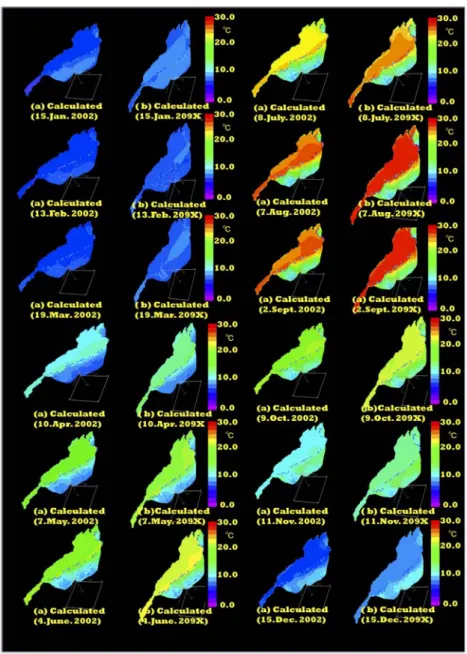
Although several simulations have already been made to predict the temperature field in the 21st century such as McCormick(1990) for Lake Michigan, DeStasio et al.(1996) for Mendota, Trout, Sparkling, Crystal, Mortish and Quinn(1996) for the Great Lakes, these results are widely divergent because of the differences in General Circulation Models (GCM). Yamashiki (2009) have studied the impact assessment of global-scale climate change for Lake Biwa by applying Meteorological Research Institute (MRI) GCM output into Biwa-3D which is 3-dimensional lake dynamic model. The high-spatial precision GCM output allows spatial averaging before applying into Lake Biwa basin. Based on the results, severe surface temperature increase for whole basin during summer season, which may induce several water quality degradation especially for North Basin of Lake Biwa.
Fig. 3. Comparison of monthly predicted water temperature (2002/209X) (Yamashiki, 1974).
2.3 Water Temperature Change in Rivers
Global water temperatures in rivers have been studied by Webb (1992, 1996). Webb have proposed three study approaches by 1) to compare past experiences of water temperature between warm or cold years, 2)to analyze relationship between air and water temperatures and 3)to study equilibrium temperature. Stefan and Preud’homme (1993) proposed the following equation by the analysis of water temperature (Tw) to air temperature (Ta) in rivers in Minnesota.
Tw = 2.91 + 0.864Ta
Stefan and Sinokrot (1993) studied flow regime such as discharge, velocity, river channel cross section and equilibrium temperature modified by light conditions. They showed water temperature increase 2.4〜
4.7℃ in 6 rivers in Minnesota where air temperature increase 3〜8℃ obtained by several GCM outputs.
Sinokrot et al. (1995) compared river water temperatures from various water sources such as surface or bottom layers in a reservoir and ground water springs. It showed +10〜-5℃ changes in the river course of 48km from the water source and big impacts on coolwater fishes were estimated.
3 INFLUENCES ON LAKE PLANKTON COMMUNITIES
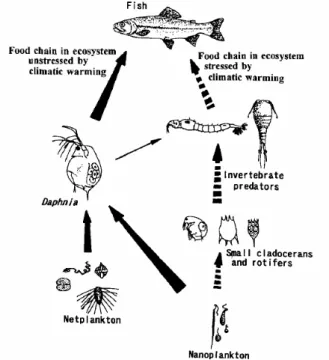
Hanazato (2000) reviewed the effects of climatic warming on lake plankton communities, and the effects on lake ecosystem structure and functioning. Such warming reduces dissolved oxygen concentration in the hypolimnion and enhances the dominance of cyanobacteria in the phytoplankton community. Thus, its effects resemble those of eutrophication. Increased water temperature due to climatic warming reduces high-temperature-sensitive species such as mysids an Daphnia. Warmwater fishes increase their habitats while coolwater fishes decrease them in the process of climatic warming, thus changing the community structure and distribution of zooplankton.
Furthermore, climatic warming may change a plankton community by controlling various biological interactions such as competition and predator-prey relationships, and reduce species diversity in the community. It is expected that the climatic warming enhances the contamination from toxic chemicals and increases UV penetration in lakes. Therefore, climatic warming promotes the deleterious effects of existing environmental stresses on lake ecosystems. It is hypothesized that the following two phenomena characterize the structural and functional responses of lake ecosystems to climatic warming: (1) reduction in the average size of organisms, and (2) a reduction in energy transfer efficiency from primary producers to top predators.
Fig. 4. Changes in habitats of warmwater fishes and coolwater fishes in lakes according to the process of climatic warming. Thermoclines are shown by solid arrows (Hanazato 2000).
Fig. 5 . Main pathways of carbon/energy flow from algae through zooplankton to fish in lake ecosystems
stressed and unstressed by climatic warming (Hanazato 2000).
4 INFLUENCES ON FRESHWATER FISH COMMUNITIES
Fresh water fishes can be classified to coldwater fishes (11-15℃), coolwater fishes (21-25℃) and warmwater fishes (27-31℃) by average temperature at their habitats in summer season (Magnuson et al., 1979). Generally, growth rate of fishes very much depend on water temperature in their habitats especially in summer season. McCormick et al.(1977) showed relationship between average daily growth rate of brook trout, white sucker and cisco and water temperature as shown in Fig.6. LT50 is temperature corresponding to 50% of mortality and it shows important values which define possible thermal habitats for each fishes.
Global warming will increase surface water temperature of lakes and rivers and decrease suitable habitats for coldwater and coolwater fishes. Their habitats will be limited in upstream of river basin and deep bottom layer of lakes and, on the other hand, ones for warmwater fishes will be increased.
These impacts will be drastically demonstrated by coolwater fishes such as Salmonidae such as salmon, trout, chars, freshwater whitefishes and graylings. Various researchers showed acceptable maximum temperature in summer season for their fishes such as Salvelinus malma (16℃), Salvelinus fontinalis(24℃), Salmo trutta (Broun trout) , Oncorhynchus mykiss(Rainbow trout) (22℃). Nakano et al. (1996) showed potential fragmentation and loss of thermal habitats for chars in the Japanese archipelago due to climatic warming. They predicted influences of global warming on Salvelinus malma and Salvelinus leucomaenis as shown in Fig. 7. Under 4 ℃ of temperature increase, 90% and 35% of their suitable habitats will be diminished respectively.
Fig. 6. Comparison of water temperature and average growth rate (McCormick et al. 1977).
Fig. 7. Potential fragmentation and loss of thermal habitats for chars in the Japanese archipelago due to climatic warming (Nakano et al.1996).
5 ADAPTATION FOR CLIMATE CHANGE BY FLEXIBLE DAM RESERVOIR OPERATION 5.1 Possible Adaptation by Dam Reservoir Operation
Japan has about 3,000 dams whose height is more than 15 m. These dams serve mainly for flood control, power generation, irrigation and/or water supply. There are 109 Class I Rivers, which are managed by the Ministry of Land, Infrastructure, Transport and Tourism (MLIT), but fewer than 10 of these are without a dam. That is to say that most rivers in Japan have been regulated by these dams. Modifications of flow regime, changing water quality and trapping sediment in these dam reservoirs have some adverse
Water tempareture (℃)
Average growth rate (%/day)
Present
influences on the downstream ecosystems. On the other hand, these reservoirs may have some potential to adapt for climate change impacts on river systems by using stored water volumes and thermal fluxes. These are integrated water temperature and flow regime managements to mitigate possible climate change impacts. In order to cope with these demands, various outlet structures and intakes which can be operated in a flexible manner should be designed and installed to important dams which have large effects in each river basin.
5.2 Management of Water Temperature in Reservoirs
Sakurai et al.(2006) studied the control of discharge water temperature considering inflow water temperature. The temperature of outflow discharge from dam reservoirs tends to change from that of inflow river water due to the effects of storage. Regarding the temperature of the outflow, cold-water discharge is a long-standing problem in Japan, and surface-water intake facilities and selective withdrawal facilities have had to address this problem. Recently, however, growing awareness of river environmental issues requires that in addition to mitigating cold-water discharge, the temperature of outflow water must be closer to that of the inflow water. In this study, they examined the feasibility of discharge approximating the inflow water temperature and the associated methods of operating selective withdrawal facilities in reservoirs in Japan by numerical simulations and physical experiments.
Fig. 8 shows a result of numerical simulations. In the case of the surface intake operation adopted frequently at present, the outflow water temperature tends to be warmer than that of the inflow, except for in early spring when cold-water discharge occurs in Japan, except for Okinawa (a sub-tropical region).
Meanwhile, the water temperature of the outflow can be approximated to that of the inflow to a considerable extent by making the intake operation follow the inflow water temperature, but this requires the existence of thermal stratification and the controllable period is limited.
Under the climate conditions, inflow water temperature and reservoir surface heat flux will be shifted.
We should start to study optimal reservoir operation to effectively utilize storage water volume and thermal fluxes in order to positively mitigate downstream influences on river environment.
Fig.8 Calculation results of the difference in temperature between inflow and outflow water (surface intake operation) (Sakurai et al., 2006)
5.3 Management of Flow Discharge from Reservoirs
Multipurpose dams have flood control, water storage and sedimentation capacities. Since 1997, a
“Flexible Dam Operation (FDO)” has been underway at dams under the jurisdiction of MLIT with the purpose of improving the river environment downstream of dams. FDO is a dam management method to enhance conservation and restoration of the river environment located in the downstream of a dam by
utilizing some part of flood control capacity as the "usable capacity" without interrupting primal flood control operation. The "usable capacity" is a vacant portion of dam's capacity, which is reserved for actual flood event during the rainy/typhoon seasons. The FDO requires storing water temporarily up to its design level and stored water can be used for increasing instream flow or flushing flow discharges.
River regulation by water storages reduces natural flood events which sometimes adversely impacts on water quality and morphological dynamics in river channels by stabilizing bed material movement. These variations in discharge are mainly depending on seasonal local climate which is important for flora and fauna on flood plains in the life history dynamics of these species. Flushing flow or flood pulse flow is an artificial attempt to recover these flood pulses from dam reservoirs by opening valves or gates by increasing water depth and velocity in some duration. These provide chances to refresh the riverbed.
5.4 Case Study at Managawa Dam
Managawa dam, arch dam of 127.5m high, was constructed in 1979 by the Ministry of Land, Infrastructure, Transport and Tourism in the Kuzuryu river system of catchment area 2,930km2(Fig.9).
Major purposes of this dam are flood control and hydro-power. Because of the dam operation, outflow regimes had been changed as shown in Fig.10. There are significant changes during snow melt season from March to June such as decrease of flood peaks and averaged discharges around 15m3/s which is almost equal to the maximum allowable intake discharge for power generation. In August and September, flood peaks were reduced by flood control operation. From November to January, small flood peaks were totally disappeared by reservoir storage operation.
0 5 10 20km
Managawa ManagawaDamDam
Completion 1979 H=127.5m V= 115 MCM Flood control Hydropower, etc.
Managawa Dam
Fig.9 Upper Kuzuryu river basin and Managawa dam
流入量
0 10 20 30 40 50 60 70
96/1/1 96/2/1 96/3/1 96/4/1 96/5/1 96/6/1 96/7/1 96/8/1 96/9/1 96/10/1 96/11/1 96/12/1
m3/s
Inflow
放流量0 10 20 30 40 50 60 70
96/1/1 96/2/1 96/3/1 96/4/1 96/5/1 96/6/1 96/7/1 96/8/1 96/9/1 96/10/1 96/11/1 96/12/1
m3/s 放流量
0 10 20 30 40 50 60 70
96/1/1 96/2/1 96/3/1 96/4/1 96/5/1 96/6/1 96/7/1 96/8/1 96/9/1 96/10/1 96/11/1 96/12/1
m3/s
Outflow
Fig.10 Inflow and outflow regimes at Managawa dam in 1996
In Managawa dam, there are only a few opportunities when river bed move and habitat can be refreshed due to flow regime changes by the dam operation. From 2000, FDO has been started both by increasing instream flow discharges and introducing periodical flushing flows in order to improve downstream environmental conditions. The main objective of the flushing flow is to move bed gravels and initiate detaching attached algae on them which are very important to provide fresh food sources to ‘Ayu’ fish species. Ayu is one of the most important fishes in summer season in Japan. In case of Managawa dam, artificial sediment supply is also planned to enhance river refreshment.
During peak discharges of 50m3/s, various field monitoring were conducted water level, flow velocity, temperature, turbidity, suspended sediment concentration, movement of river bed materials and so on. Rate of detached algae on river bed gravels were also measured both upstream and downstream of sediment placed point. Water level and velocity at 5.5km below dam increased 1.5m and 2.0m/s. At the point, sediment excavated from Managawa reservoir was placed, and almost fully eroded and supplied to the downstream river channel by the increased discharge. From the field examinations, it is founded that around 50m3/s peak discharge is needed to create enough tractive forces all through the downstream river courses of ca.10km from the dam. Rates of detached algae on river bed gravels were 31.4% at upstream and 53.3% at downstream respectively. It showed that eroded and transported sediment on river bed gravels increased the surface refreshment.
In Managawa dam, almost one third of flood pulses have been created by snow melts as shown in Fig.11.
Climate change will have big influences on quantity of snow fall and timing of snow melt season. We should study how to store these inflow water and utilize them not only for original reservoir objectives and but also environmental improvement objective including mitigation for climate change impacts.
0 50 100 150 200 250 300 350 400 450 500
0 10 20 30 40 50 60 70 80
流量(m3/s) 6/1-9/30
10/1-12/31 1/1-5/31
1994-2003
100m3/s 60m3/s 50m3/s
0 50 100 150 200 250 300 350 400 450 500
0 10 20 30 40 50 60 70 80
流量(m3/s) 6/1-9/30
10/1-12/31 1/1-5/31
1994-2003
100m3/s 60m3/s 50m3/s
Discharge (m3/s)
1994-2003
100m100m33/s/s 60m60m33/s/s 50m50m33/s/s
Fig.11 Past natural flood pulses in snow melt, baiu-front and typhoon seasons
6 Conclusions
In order to evaluate the influences of climatic change on freshwater environment, various aspects such as water temperature, water movement in lakes, rivers and ground water, chemical properties of rivers and lakes, communities of plankton and fishes, and material cycles in watershed ecosystems should be considered. The paper is reviewing state of arts of these aspects based on the studies of several Japanese researchers and showing some possible adaptation techniques to mitigate these influences by dam reservoir operations.
Taniguchi and Nakano (2000) reviewed researches on potential effects of global warming on freshwater fishes in 1990s. Most of these studies have focused on predicting changes in distribution of fishes based on their thermal-physiological data and on predicting population dynamics using species-specific bioenergetic models. However, in reality, the effects of global warming on freshwater fishes should not be predicted without considering the complex interactions with local environmental disturbance factors.
In addition, they pointed out the importance to look at changes in genetic structure of populations, life history plasticity, and biological interactions such as predator-prey and interspecific competition in their predictions. Also, they mentioned that extinction and changes in distribution of the fishes should influence food web and biogeochemical cycling but few such studies have been attempted yet. Future researches should include attempts to accumulate field observational data and to elucidate potential mechanisms of the effects of global warming on the freshwater fishes in the context of multidisciplinary cooperative studies.
Finally, we should also conduct intensive study for optimal reservoir operation to effectively utilize storage water volume and thermal fluxes in order to positively mitigate downstream influences on river environment including adaptation for climate change impacts. In order to realize these operations, effective cooperation among multidisciplinary fields including hydrology, hydraulics, fresh water biologist and other experts will be highly requested.
REFERENCES
Arai, T. (2000): Global warming and the temperature of inland waters, Japanese Journal of Limnology, 61, pp.
24-34.
DeStasio, B. T. Jr., D. K. Hill, J. M. Kleinhaus, N. P.Nibbelink and J. J. Magnuson (1996) : Potential effects of global climate change on small northtemperate lakes: Physics, fish and plankton, Limnology and Oceanography, 41, pp.1136-1149.
Endo S., Yamashita S., Kawakami M. and Okumura Y., : Recent Warming of Lake Biwa Water, Japanese Journal of Limnology, 60, pp. 223-228.
Hanazato T. (2000) : Climatic warming and lake plankton communities, Japanese Journal of Limnology, 61, pp.
65-77.
Ikebuchi, S., Sumi, T., Kobayashi A. and Omoto I.(2007): Dams and Environmental Flows: Concept and Implementation in Japan, 10th International River Symposium, Brisbane, CD-ROM.
Magnuson, J. J., L. G. Crowder and P. A. Medvick (1979) : Temperature as an ecological resource, American Zoology, 19, pp.331-343.
McCormick, M. J. (1990) : Potential changes in thermal structure and cycle of Lake Michigan due to global warming, Transactions of the American Fisheries Society, 119, pp.183-194.
Mori, S. (2000) : The influence of global warming on fish, A threat to life—The impacts of climate change, A.
Domoto, K. Iwatsuki, T. Kawamichi and J. Mc-Neely, eds. Tsukiji Shokan, Tokyo, and IUCN, Gland.
pp.110–119.
Mortish, L. D. and F. H. Quinn (1996) : Climate change scenarios for Great Lakes Basin ecosystem studies, Limnology and Oceanography, 41, pp.903-911.
Nakano, S., F. Kitano and K. Maekawa (1996) : Potential fragmentation and loss of thermal habitats for chars in the Japanese archipelago due to climatic warming, Freshwater Biology, 36, pp.711-722.
Sakurai T., Kashiwai J. and Kamada M. (2006): Study on the control of discharge water temperature considering inflow water temperature, ICOLD 22th Congress in Barcelona, Q.85-R.15.
Schindler, D. W., S. E. Bayley, B. R. Parker, K. G. Beaty, D. R. Cruikshark, E. J. Fee, E. U. Schindler and M. P.
Stainton (1996) : The effect of climaticwarming on the properties of boreal lakes and streams at the experimental lake area, Northwestern Ontario, Limnology and Oceanography, 41, pp.1004-1017.
Schindler, D. W. (1997) : Widespread effects of climatic warming on freshwater ecosystems in North America.
Hydrological Processes, 11, pp.1043-1068.
Stefan, H. G. and E. B. Preud'homme (1993) : Stream temperature estimation from air tempetrature, Water Resources Bulletin, 29, pp. 27-45.
Stefan, H. G. and B. A. Sinokrot (1993) : Projected global climate change impact on water temperature in five north central U. S. streams, Climate Change, 24, pp.353-381.
Taniguchi, Y. and Nakano S. (2000): Complex effects of global warming and local environmental disturbance on freshwater fish communities: the mechanisms, predictions, and repercussion effects, Japanese Journal of Limnology, 61, pp. 79-94.
Webb, B. W. (1992) : Trends in stream and river temperature, Hydrological Processes, 10: pp.205-226.
Webb, B. W. (1996) : Climate Change and Thermal Regime of Rivers, Report for Department of Environment, University of Exeter, Exeter.
Yamashiki, Y. (2009): Impact Assessment for Lakes and Reservoir – application into Lake Biwa, Proceedings of the Symposium on Extreme Weather and Impact Assessments - for better future projection -, pp.29.