• 検索結果がありません。

. The joint had a diffusion layer containing BeNi and Be

N/A
N/A
Protected

Academic year: 2021

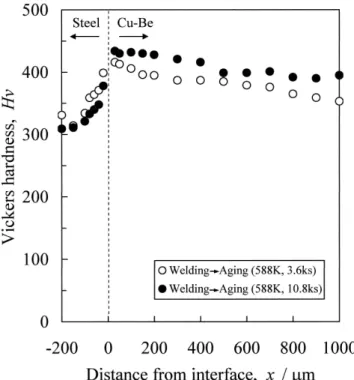
シェア ". The joint had a diffusion layer containing BeNi and Be"

Copied!
6
0
0

読み込み中.... (全文を見る)

全文

(1)

1. Introduction

Beryllium copper (Cu­Be alloy), which is a typical pre- cipitation hardening alloy, shows the highest tensile strength among Cu alloys and, furthermore, has excellent spring property, corrosion resistance, wear resistance and electrical conductivity. The major disadvantages of this material are high production cost and difficulty in bonding with other materials. Bonding techniques are one of effec- tive cost reduction measures. However, it is difficult to ap- ply fusion welding and diffusion bonding to the Cu-Be al- loy. In such bonding processes, the excellent property of the Cu-Be alloy due to age-hardening is lost by heating at elevated temperatures. Thus, solution and aging treat- ments are required to re-strengthen the Cu-Be alloy after bonding. In addition, the generation of noxious beryllium

gas on fusion welding and the formation of brittle com- pounds by interfacial reactions are viewed as a practical matter. Masumoto et al. have reported on the interfacial microstructures and the bonding characteristics of the diffusion-bonded Cu-Be alloy/austenitic stainless steel joint

1)

. The joint had a diffusion layer containing BeNi and Be

Cr at the interface, and did not show high joint effi- ciency. As a result, the application of insert material and heat treatment after bonding was tried to improve the bonding strength.

In the present study, the joining of Cu-Be alloy to aus- tenitic stainless steel and carbon steel was carried out by explosive welding. One of positive aspects of this method is the narrowness of heat-affected zone around the inter- face. This is expected to be beneficial to the performance

Effect of aging treatment on explosive welding process of beryllium copper to steel

Yasuhiro Morizono

*†

, Yusuke Hirokawa

**

, and Minoru Nishida

***

Kumamoto University, 2­39­1 Kurokami, Kumamoto 860­8555, JAPAN TEL +81­96­342­3707 FAX +81­96­342­3710

Corresponding address : [email protected]­u.ac.jp

**

Graduate Student, Kumamoto University. Present affiliation : Tokai Rika Co., Ltd.

***
Kyushu University, 6­1 Kasuga­kouen, Kasuga, Fukuoka 816­8580, JAPAN Received on : April24, 2008 Accepted on : November11, 2008

Abstract

Beryllium copper (Cu-Be alloy) was bonded to austenitic stainless steel by explosive welding. The effect of aging treat- ment for the Cu-Be alloy on the interfacial microstructures and the mechanical properties of the joints was investigated.

Before bonding, the Cu-Be alloy was solution-treated at 1073 K for 1.8 ks (1800 s) and then aged at 588 K for 3.6 and 10.8 ks. A wavy interface was formed in the joints with the non-aged and aged Cu-Be alloys. These joints differed markedly in the wavelength and the amplitude of the interface due to precipitation hardening of the Cu-Be alloy. However, fine grains of about 50 nm in diameter were observed along the collision interface in these joints. The formation of the fine grains is considered to be the trace of melting and subsequently rapid solidification at the contact surface of the Cu-Be alloy. The high hardness of the aged Cu-Be alloy was retained even after explosive welding, and the joint with the Cu-Be alloy aged at 588 K for 10.8 ks showed a bonding strength of about 700 MPa. On the other hand, the joint with the non-aged Cu-Be al- loy was aged at 588 K for 10.8 ks after welding, and its bonding strength reached about 700 MPa. This indicates that ex- plosive welding, which is characterized by extremely narrow heat-affected zone, is suited to the bonding method for the precipitation hardening Cu-Be alloy. The explosively welded Cu-Be alloy/carbon steel joint was also prepared, and the same tendency was recognized.

Keywords : Beryllium copper, Steel, Explosive welding, Aging treatment, Precipitation hardening

Research

paper

(2)

of precipitation hardening alloys after bonding. The effect of aging treatment before and after explosive welding was discussed on the basis of the interfacial microstructures and the mechanical properties.

2. Experimental procedure

Cu-Be alloy containing 1.84 mass%Be, austenitic stain- less steel (SUS304, 18.28 mass%Cr, 8.13 mass%Ni) and car- bon steel (S45C, 0.47 mass%C) were used in the present study. The Cu-Be alloy with dimensions of 90 mm x 10 mm x 2 mm was solution-treated at 1073 K for 1.8 ks in a vac- uum. The steels were machined into plates with dimen- sions of 90 mm x 40 mm x 5 mm and then annealed at 973 K for 3.6 ks in a vacuum. The bonding surfaces of the Cu- Be alloy and the steels were ground with emery papers.

These were degreased in acetone using an ultrasonic cleaner and dried with hot air.

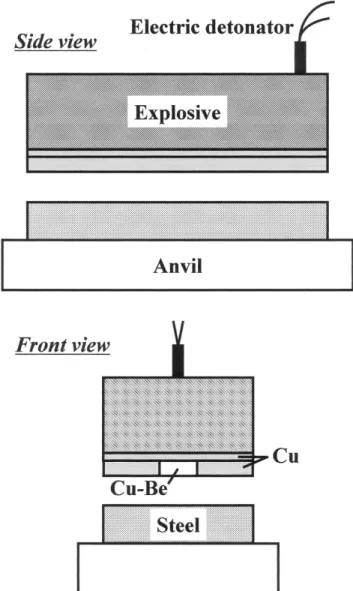
Explosive welding was carried out using experimental apparatus shown in Fig. 1. The Cu-Be alloy was combined with pure Cu plates to play a role as a flyer plate and fixed parallel to the steel. The distance between the Cu-Be alloy and the steel was 5 mm. The powdery explosive consisting mainly of ammonium nitrate was set on the flyer plate. Its detonation velocity is about 2400 m・s

-1

,and the explosive

with a weight of 64.8g was used. The collision pressure on explosive welding was estimated to be about 5 GPa

2), 3)

. The obtained clad plate was cut into several pieces.

Before and after explosive welding, aging treatment for the Cu-Be alloy was performed at a temperature of 588 K for various periods in evacuated silica tube.

The specimens were cut parallel to the detonation direc- tion to reveal the microstructures. The cross sections were ground with emery papers and then finished with alumina powder. After etching, they were examined by using an optical microscope and a scanning electron micro- scope (SEM) equipped with an energy dispersive X-ray spectroscope (EDX). The specimens for transmission elec- tron microscopic (TEM) observations were prepared from slices of about 0.1 mm in thickness, which were obtained by cutting and grinding of the joints. Disks of 3 mm in di- ameter containing the interface were made from the slices by using an ultrasonic cutting tool and finished with an ar- gon ion beam milling machine. Accelerating voltage on TEM observations was 200 kV. A Vickers hardness test was carried out to examine hardness distribution around the interface in the specimens. A load of 0.98 N was ap- plied at room temperature for 15 s. In addition, the bond- ing strength was evaluated at room temperature by a shear test, which was performed at a crosshead speed of 1.67 10

-6

m・s

-1

by using an Instron-type tensile machine equipped with a special gripping device. After the shear test, SEM-EDX analysis and X-ray diffraction (XRD) were conducted on the fracture surface.

3. Results and discussion

3.1 Microstructures of Cu-Be alloy/austenitic stainless steel interface

Figure 2 shows the relationship between the aging time and the Vickers hardness of the Cu-Be alloy aged at 588 K after solution treatment at 1073 K for 1.8 ks. “0 ks” in the horizontal axis means non-aged (= solution treated) state.

The hardness increased with aging time, and the alloy reached the maximum hardness at an aging time of more than 10.8 ks. In the present study, the non-aged alloy and the alloys aged at 588 K for 3.6 and 10.8 ks were selected, and their effect on explosive welding process was investi- gated.

Figure 3 shows optical micrographs of the interface in the explosively welded Cu-Be alloy/stainless steel joints.

The upper and lower sides in the micrographs are the Cu- Be alloy and the steel, respectively. The joint with the non- aged Cu-Be alloy is shown in Fig. 3(a). This joint had a wavy interface, and plastic flow induced by high energy collision was seen in the vicinity of the interface. Figures 3 (b) and 3(c) show the microstructures of the joints with the Cu-Be alloy aged at 588 K for 3.6 and 10.8 ks before weld- ing, respectively. The formation of the wavy interface was also recognized in these joints. However, their wavelength and amplitude were smaller than those in Fig. 3(a). It has been known that the wavy shape of the explosively welded interface is affected by collision angle

4)

. In general, the wavelength and the amplitude increase with the colli- sion angle. Therefore, it is considered that the change of Fig.1 Schematic illustration of experimental assembly for ex-

plosive welding.

(3)

the mechanical property of the Cu-Be alloy by the aging treatment has an influence on the collision angle. On the other hand, a clad plate after welding was cut in half paral- lel to the detonation direction, and the length of the bond area was measured within the distance from the position of an electric detonator to the edge of the plate (= 80 mm).

In the joint with the non-aged Cu-Be alloy, the rate of the bond area for 80 mm was 75 %. This was superior to that of the joint with the aged Cu-Be alloy, which was about 60

%. This indicates that the use of the non-aged Cu-Be alloy allows for more efficient bonding.

TEM observations were carried out to investigate the explosively welded Cu-Be alloy/stainless steel interface in further detail. Figure 4(a) shows a bright field image of the interface in the joint with non-aged Cu-Be alloy, and an electron diffraction pattern taken from region B in Fig. 4(a) is shown in Fig. 4(b). Fine grains of about 50 nm in diame- ter were formed between the Cu-Be alloy and the steel.

According to Cu-Fe binary phase diagram

5)

, pure Cu has the lowest melting point in this system. Therefore, the for- mation of fine grains may be attributed to melting and subsequently rapid solidification at the contact surface in the Cu-Be side. The joint with the Cu-Be alloy aged at 588 K for 10.8 ks also has a similar microstructure, as shown in Fig.2 Relationship between aging time and hardness of Cu- Be alloy aged at 588 K. Solution treatment was carried out at 1073 K for 1.8 ks before aging.

Fig.4 (a) and (c) Bright field images of the collision interface in explosively welded Cu-Be alloy/stainless steel joints.

(a) Cu-Be alloy was solution-treated at 1073 K for 1.8 ks before welding. (b) Electron diffraction pattern taken from region B in (a). (c) Cu-Be alloy was solution-treated at 1073 K for 1.8 ks and then aged at 588 K for 10.8 ks before welding.

Fig.3 Optical micrographs of the interface in explosively welded Cu-Be alloy/stainless steel joints. Solution and aging treatments

for Cu-Be alloy were carried out before welding. (a) Non-aged Cu-Be alloy. (b) and (c) Cu-Be alloys were aged at 588 K for 3.6

and 10.8 ks, respectively.

(4)

Fig.4 (c). Consequently, explosive welding of the Cu-Be al- loy to the stainless steel seems to be achieved by melting and rapid solidification at the collision interface, regardless of heat treatment condition of the Cu-Be alloy. Such a mi- crostructure is thought to be helpful for substantial bond at the interface, as reported on the explosively welded Ti/

steel joints

6), 7)

. In addition, although the joint with the non- aged Cu-Be alloy was aged at 588 K for 10.8 ks, the fine grain structure was retained even after the aging treat- ment.

3.2 Mechanical properties of Cu-Be alloy/aus- tenitic stainless steel joint

To clarify the effect of aging treatment before and after explosive welding, mechanical properties of the Cu-Be al- loy/stainless steel joint were evaluated by hardness and shear tests.

Figure 5 shows hardness distributions in the vicinity of the interface in the joints with the Cu-Be alloys aged at 588 K for 3.6 and 10.8 ks. The joint with the non-aged Cu-Be al- loy is also denoted. The bonding interface is expressed as

“0 µm” in the horizontal axis. All specimens became hard- ened around the interface by the collision of metal plates.

As compared to Fig. 2, the hardness of the Cu-Be alloy of the non-aged and briefly aged states increased immensely.

In addition, the area with a hardness of more than Hv = 400 existed in the aged Cu-Be alloy. Accordingly, explosive welding can prevent the hardness of the Cu-Be alloy from reducing on the bonding process. On the other hand, the hardness distributions in the vicinity of the interface in the joints aged at 588 K for 3.6 and 10.8 ks after welding are presented in Fig. 6. These results are analogous to Fig. 5, and the hardness distribution around the interface did not depend on the sequence of aging and welding for the Cu-

Be alloy. This fact is of great interest, and we require fur- ther investigations.

Figure 7 shows the bonding strength of various Cu-Be/

stainless steel joints. For comparison, the joint consisting of two Cu-Be alloys was prepared and then aged at 588 K for 3.6 and 10.8 ks. Aging time of “0 ks” in the horizontal axis represents the joint with the non-aged Cu-Be alloy and the bonding strength of this state was about 400 MPa.

However, the aging treatment before and after welding enhanced the bonding strength up to 700 MPa. It is note- worthy that the bonding strength of the explosively welded joint, as well as the hardness distribution shown in

Fig.6 Vickers hardness in the vicinity of the interface in ex- plosively welded Cu-Be alloy/stainless steel joints. Ag- ing treatment for Cu-Be alloy was carried out after welding.

Fig.7 Effect of aging time on shear strength of explosively welded Cu-Be alloy/Cu-Be alloy and Cu-Be alloy/stain- less steel joints. Cu-Be alloy was aged at 588 K before and after welding. “0 ks” in the horizontal axis repre- sents the joint with non-aged Cu-Be alloy.

Fig.5 Vickers hardness in the vicinity of the interface in ex-

plosively welded Cu-Be alloy/stainless steel joints. Solu-

tion and aging treatments for Cu-Be alloy were carried

out before welding.

(5)

Figs. 5 and 6, is not dependent on the sequence of aging and welding for the Cu-Be alloy. Furthermore, the change of the bonding strength with aging time was similar to that of the joint consisting of two Cu-Be alloys. It was con- firmed by using SEM-EDX and XRD that these fracture positions after the shear test were within the Cu-Be alloy.

Therefore, the bonding strength appears to be reflected appropriately in the results of fracture surface observa- tions.

It is thought that explosive welding is suited to the bonding method for the precipitation hardening Cu-Be al- loy. In particular, the use of the non-aged Cu-Be alloy con- tributes to attainment of the larger bond area on the ex- plosive welding process as mentioned above. Although such a joint has to be aged after welding, it has the me- chanical property equivalent to the joint with the aged Cu- Be alloy.

3.3 Cu-Be alloy/carbon steel joint

Explosive welding of Cu-Be alloy to carbon steel was carried out to verify the results of the Cu-Be alloy/stain- less steel joint. Figure 8 shows optical micrographs of the interface in the explosively welded Cu-Be alloy/carbon steel joints. The non-aged Cu-Be alloy was used in the joint in Fig. 8(a), while the alloy in Fig. 8(b) was aged at 588 K for 3.6 ks before welding. Although these joints showed the collision interface with a wavy shape, the wavelength and the amplitude differed with heat treatment process for the Cu-Be alloy. In addition, the length of the bond area in the clad plate after welding was measured within the distance from the position of an electric detonator to the edge of the plate (= 80 mm). The rate of the bond area in the joint with the non-aged Cu-Be alloy was 87.5 % and higher than that

in any other joint.

The bonding strength of the joint with the non-aged Cu- Be alloy was 426 MPa and was enhanced by the aging treatment before and after welding, as well as the Cu-Be alloy/stainless steel joint shown in Fig. 7. The joint aged at 588 K for 10.8 ks after welding showed a bonding strength of more than 600 MPa.

The use of the non-aged Cu-Be alloy leads to more effi- cient bonding even in the case of the carbon steel. Consid- ering the results in the previous sections, the process se- quence like “solution treatment → explosive welding → aging” is recommended for the bonding of the precipita- tion hardening Cu-Be alloy to the steels.

4. Conclusions

Cu-Be alloy, which is a typical precipitation hardening alloy, was bonded to austenitic stainless steel and carbon steel by explosive welding. The effect of aging treatment on the bonding process was investigated on the basis of the interfacial microstructures and the mechanical proper- ties. The main conclusions are summarized as follows.

(1) The joints with the non-aged and aged Cu-Be alloys had the collision interface with a wavy shape. These joints dif- fered markedly in the wavelength and the amplitude of the wavy interface due to precipitation hardening of the Cu-Be alloy.

(2) Fine grains of about 50 nm in diameter were observed along the collision interface in the Cu-Be alloy/stainless steel joint, regardless of heat treatment condition of the Cu -Be alloy. This is considered to be the trace of melting and subsequently rapid solidification at the contact surface of the Cu-Be alloy.

(3) In the case of the stainless steel, the joint with the Cu- Be alloy aged at 588 K for 10.8 ks showed a bonding strength of about 700 MPa. On the other hand, the joint with the non-aged Cu-Be alloy was aged at 588 K for 10.8 ks after welding, and its bonding strength also reached about 700 MPa. Furthermore, it was confirmed that these joints had a similar hardness distribution in the vicinity of the interface.

(4) The explosively welded Cu-Be alloy/carbon steel joint also showed the collision interface with a wavy shape and had the high bonding strength by the aging treatment be- fore and after welding.

(5) Explosive welding, which is characterized by ex- tremely narrow heat-affected zone, is suited to the bond- ing method for the Cu-Be alloy. In particular, since the use of the non-aged Cu-Be alloy allows for more efficient bond- ing, the process sequence like “solution treatment → ex- plosive welding → aging” is recommended for the joining of the Cu-Be alloy to the steels.

References

1) H. Masumoto, K. Nishio, A. Asada, M. Katoh and S. Mukae, Q. J. Jpn. Weld. Soc., Vol. 13, pp. 411-417 (1995).

2) H. K. Wylie, P. E. G. Williams and B. Crossland, Proc. 3rd Int.

Conf. of the Center for High Energy Forming, Denver Re- search Institute, Denver, Colorado, pp. 1.3.1-1.3.43. (1971).

3) B. Crossland, “Explosive Welding of Metals and its Applica- Fig.8 Optical micrographs of the interface in explosively

welded Cu-Be alloy/carbon steel joints. Solution and

aging treatments for Cu-Be alloy were carried out be-

fore welding. (a) Non-aged Cu-Be alloy. (b) Cu-Be alloy

was aged at 588 K for 3.6 ks.

(6)

tion (Oxford Series on Advanced Manufacturing 2)”,Claren- don Press, Oxford, pp. 65-83 (1982).

4) T. Onzawa and Y. ISHII, Trans. Jpn. Weld. Soc., Vol. 4, pp.

233-240 (1973).

5) Metals Data Book, ed. by Jpn. Inst. Metals, p. 524 (Maruzen Co., Ltd. 1993).

6) M. Nishida, A. Chiba, Y. Honda, J. Hirazumi and K. Horikiri, ISIJ Int., Vol. 35, pp. 217-219 (1995).

7) A. Chiba, M. Nishida, Y. Morizono and K. Imamura, J. Phase

Equilibria, Vol. 16, pp. 411-415 (1995).

Figure 2 shows the relationship between the aging time and the Vickers hardness of the Cu-Be alloy aged at 588 K after solution treatment at 1073 K for 1.8 ks
Figure 7 shows the bonding strength of various Cu-Be/

参照

関連したドキュメント

Key words and phrases: Linear system, transfer function, frequency re- sponse, operational calculus, behavior, AR-model, state model, controllabil- ity,

As we have said in section 1 (Introduction), using the mentioned tree T , Barioli and Fallat gave the first example for which the equivalence between the problem of ordered

The issue of classifying non-affine R-matrices, solutions of DQYBE, when the (weak) Hecke condition is dropped, already appears in the literature [21], but in the very particular

Keywords: continuous time random walk, Brownian motion, collision time, skew Young tableaux, tandem queue.. AMS 2000 Subject Classification: Primary:

Greenberg and G.Stevens, p-adic L-functions and p-adic periods of modular forms, Invent.. Greenberg and G.Stevens, On the conjecture of Mazur, Tate and

The proof uses a set up of Seiberg Witten theory that replaces generic metrics by the construction of a localised Euler class of an infinite dimensional bundle with a Fredholm

Using the batch Markovian arrival process, the formulas for the average number of losses in a finite time interval and the stationary loss ratio are shown.. In addition,

Assuming the existence of an upper and a lower solution, we prove the existence of at least one bounded solution of a quasilinear parabolic sys- tems, with nonlinear second