• 検索結果がありません。

Synchronization Phenomena of Coupled Chaotic Circuits with Buffer

N/A
N/A
Protected

Academic year: 2021

シェア "Synchronization Phenomena of Coupled Chaotic Circuits with Buffer"

Copied!
1
0
0

読み込み中.... (全文を見る)

全文

(1)

平成

30

年度電気関係学会四国支部連合大会 講演論文集 (2018 愛媛大学)

2018 SHIKOKU-SECTION JOINT CONVENTION RECORD OF THE INSTITUTES OF ELECTRICAL AND RELATED ENGINEERS (EHIME)

Synchronization Phenomena of Coupled Chaotic Circuits with Buffer

Akari OURA Kyohei FUJII Shuhei HASHIMOTO Yoko UWATE Yoshifumi NISHIO ( Tokushima University)

1. Introduction

Synchronization phenomena are observed everywhere.

For example, flashing firefly, crowing tree frogs, beating rhythm of the heart. Recently, a lot of scientists study syn- chronization phenomena of chaos. Studying synchronization of chaos is expected useful in a variety of fields.

In this atudy, we investigate synchronization phenomena of coupled chaotic circuits in one direction. Each node is applied chaotic circuit and connected with resistance via buffer. By computer simulations, we observe interesting synchronization phenomena between circuits.

2. System Model

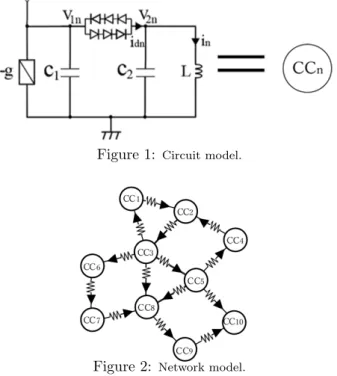
Figure 1 shows basic circuit. A proposed network model is shown in Fig. 2. In this study, chaotic circuits are applied to nodes of the network. Each node is coupled by resistance with buffers.

Figure 1: Circuit model.

Figure 2: Network model.

The nomalized circuit equations are given as follows:

 

˙ x = z

n

˙

y = αγy

n

αβf(y

n

z

n

) αδf (y

n

y

k

)

˙

z = βf (y

n

z

n

) x

n

.

(1)

Where the nonlinear function corresponding to the char- acteristics of the nonlinear resistor of the diodes and are described as follows:

f(y

n

z

n

) =

 

y

n

z

n

1 (y

n

z

n

> 1) 0 ( | y

n

z

n

| ≤ 1) y

n

z

n

+ 1 (y

n

z

n

< 1).

(2)

3. Simulation results

In this study, we fix parameters as α = 0.5, β = 20, γ = 0.5 and δ = 0.22 on all circuits. The simulartion re- sults are shown in Figs. 3 to 5. Figures 3 and 4 show the phase difference. We observe in-phase state, in CC1-CC2 to CC5 (Fig. 3.). However, we did not observe in-phase state in CC1-CC6 to CC10 (Fig. 4.). Figure 5 shows the voltage difference. We did not observe difference of voltage in CC1-CC2 to CC5. However, we observed difference of voltage in CC1-CC6 to CC10.

y

1

y

2

y

3

y

4

y

5

y

1

y

1

y

1

Figure 3: Phase difference (CC1-CC2, CC1-CC3, CC1-CC4, and CC1-CC5). δ = 0.22.

y 1

y 6 y 7 y 8 y 9 y 10

y 1 y 1 y 1 y 1

Figure 4: Phase difference (CC1-CC6, CC1-CC7, CC1-CC8, CC1-CC9, and CC1-CC10). δ = 0.22.

y 1 -y 2 y 1 -y 3

y 1 -y 4

y 1 -y 5

y 1 -y 6

y 1 -y 7

y 1 -y 8

y 1 -y 9 y 1 -y 10

Figure 5: Voltage difference. δ = 0.22.

4. Conclusion

We studied synchronization phenomena of coupled chaotic circuit in one direction. Synchronization phenom- ena were observed synchronized part of the circuit. In this study, we used ten chaotic circuits. We will use a number of chaotic circuits.

17

1-17

Figure 2: Network model.

参照

関連したドキュメント

Ntouyas; Existence results for a coupled system of Caputo type sequen- tial fractional differential equations with nonlocal integral boundary conditions, Appl.. Alsaedi; On a

In this paper we prove the existence and uniqueness of local and global solutions of a nonlocal Cauchy problem for a class of integrodifferential equation1. The method of semigroups

Arnold This paper deals with recent applications of fractional calculus to dynamical sys- tems in control theory, electrical circuits with fractance, generalized voltage di-

Arnold This paper deals with recent applications of fractional calculus to dynamical sys- tems in control theory, electrical circuits with fractance, generalized voltage di-

In order to observe generalized projective synchronization between two identical hyper- chaotic Lorenz systems, we assume that the drive system with four state variables denoted by

A variety of methods have been introduced for the synchronization of chaotic systems which include complete synchronization, generalized synchronization, phase synchronization,

Based on the results from [7,14,15] where the bifurcation mechanism of phase synchronization is related to the bifurcations of saddle periodic orbits embedded in a chaotic attractor,

One important application of the the- orem of Floyd and Oertel is the proof of a theorem of Hatcher [15], which says that incompressible surfaces in an orientable and