!
# "
# $ # #
# " " %#
# # " # #
%# #
$ $
#
# " %# %# "
# # $
# #
" # #
" $ #
$ # $
# # #
&'()*+,-./012 &'314(&5.-46 7/
-8.9:01
;<= >?@7AB=2>?@7CD8EFGHI JKLM1NOKP4Q R STUV.W61XYZ[Q\][ ^>?_@ ` 7AB= B 2ab7c ,de7fg FGHI7hi.jk1lZ ;<= RSTUV ` mnXo ` p 5= B 2>?qi@7 JKLM1NO.\][ rs2tu01lZ.vw 6 i@7AB=xyz*7{|.vwQ41
}5~=Z&5~=2r8>?i@7FeKLM1NO.\]016w r8>
?7UV `.XYK ~= }5= B &5= B 7Fe 8 .[ &5~=2}5~=F FZyKfg1.vw6
=7< {|.\]016w TUEU7UV `.X YKn7ZK= .¡-01¢ .£¤
.-4Q\][6 n7¥¤K¦§ =¡-(7m
¨.fg[6 &'.-46({|x3 ©77ª«Z¬2®¯1
°±² &' rs RST
# #
³´µ¶ ·¸¹º i»¼½
῍ ῌ
ῌ ῌ
ῌ ῌ
Abstract
AWAHIRA ATSUMOTO HIMODOZONO
Department of Rehabilitation and Physical Medicine, Kagoshima University Grad- .
uate School of Medical and Dental Sciences, Takachiho , Makizono-cho, Kagoshima , Japan.
Balneotherapy (or spa therapy) for patients with disabilities is one of the oldest forms of rehabilitative therapy. In order to examine the e ectiveness of balneotherapy for patients with disabilities, our rehabilitation methods in combination with balneotherapy were reviewed. We observed beneficial e ects of balneotherapy on controlling the spas- ticity of hemiparetic limb, in accomplishing repepetive facilitation exercise, and on the quality of life in patients with stroke and orthopedic disease. Rehabilitative treatment in association with both neuro-rehabilitation and traditional spa therapy will develop and contribute to welfares of the people.
Key words : Spa, Rehabilitation, Spasticity, Stroke
F
: F
;
-Item Short-Form Health Survey SF-
:
Kazumi K , Shuji M and Megumi S
Applications of Balneotherapy for Rehabilitation
+
+
+ + +
+ + +
233 00*- -3-* 1
-3-* 1 233
00*-
#
#
+
3 .* +/
+* +*
.+ +*
,
-. +2 / .+ +*
- .3
, . -0
-0
ῌ
!"# $ % ! &'()* + ,-./0 1 )*2 345 6789/0:;<5
=>?<@AB+) C D:EF GH : I!J 3 KLM CNO:EPM CQRBSTP?UVW )8XYZ[\@] ^F _`abcade fghi i :QRBSTPjk+)] l:mcnhopj@q r :st5P t
u-abcadefghi vw:)xy z{:|}~xy52 abca defghC.3 ! # @ :EF)8X C t 6:3 abcadefgh C6:57Ft
663 CNO N !|}~xy@abcadefgh) 8X ] uC .
673 eo ¡ho¢£e¤ )* ¥¦§¨© CP ª««S8¬ ®C¯3°¬ ±²8 N ³´µ¶´h 3 ·¸Fªt5 ¹ +)abcadefghº 34:t»+¼½)t : EFt
! "
#
!
$
ῌ
ῌ
Fig. Hypothesized mechanism of a newly designed facilitation exercise for the hemiplegic upper limb and fingers.
Neurons or neural circuits in the motor cortex or descending motor tracts related to the patient’s intention of movement do not discharge because of an insu cient excitation level in response to excitation from the prefrontal/premotor cortex. Premotor neurons that are disconnected due to apraxia or injury to descending motor tracts due to hemiparesis will respond to excitation and realize the patient’s intended movements when these neural circuits have been excited su ciently by facilitation techniques.
Thick arrow and thin arrow indicate manipulation for stretch reflex and light touch to maintain - linkage, respectively.
PNF,
+
$
$
,**3 ,**3
+
,
a g
!"#$%&'()*+,&-)./01 23456789(:;<=>?@ABC(D)EFGA#HI JK(LDMENO
P%QR#STU) BVMEIW#X YZ[\
]>^_`ab cd Xe( NOP%QR#]fM@
)*!"ghi#jk(lQRm[nop; qrstU)!"gu=vwh ijkR xy(hijk#z{U)|}~
E !"g~hijk]^_` >
]^_` #abU`_(
LDMENOP%QRST` !"g#-(E) X hijk.E;e( e(_;5#U`hi#j k(Rn ;hi#¡¢jkU`[ >£X`_E_ ¤-¥U`#
_)5~¦§`[n ¨E© ª«;[oElQR;e()* ¤-(hij k]Xg^EX(o>#U)
h>!"g5~Xg ¬®>#¯(°±²³´
µ(¶·#¸¹U)
ῌ
Fig. Improvements in isolation from synergy of the hemiplegic upper limb and hand, and the ability of manipulating objects during -week sessions of RFE or CR in all patients
Data for the BRS of the hemiplegic upper limb and hand, and the STEF of the upper limb in the first and second -week sessions of RFE or CR among all patients were combined. Data are shown as the median (and quartiles). Pre denotes the beginning of the indicated session. Post denotes the end of the indicated session. * . , ** . . Abbreviations : BRS, Brunnstrom stage ; STEF, Simple Test for Evaluating Hand Function.
p p
a, b Fig.
Figure Kawahira
Kawahira ;
Noma Matsumoto
Matsumoto et al.
et al.,
et al., et al.,
et al., ,
,
, ,-
* */ * *+
,*+* ,*+* +
, ,*+*
,**. ,**2
,**3 ,**0
,*+*
,*+*
,*+*
,*+*
-
! "# $%&
'()$*+, -./ 012345 67
34-89:;0<=> ?@A-8BC 0 DE/FGH5I0 JK
LM NOP8-QRSTU -V W0XY Z Z -L
M0[\H, S 0[J S -],E^; _670[\H
12345 67`a-bc] d d0eN$fg$hi UJ 0jE K& 0 Ykl-mn0op qr34- d./ 0 sGKJ& @tAEuu&BC 0L MY&5I vwxw yz {|}~wu 3 S 0yz$MG H, vwxw$<=>ET; H -$ 0?@ -!-BC 0L MY&5 0 Y&
EXYE 34- d./ S $ u
EG - @tABC u E
E GH k ku\H
34- d./- eN-R-Uuk./0 Y $
& ¡-¢;E\K£¤& ¥¦ !-WS E& d./ -eNk
§ES ?¨8- ¡©ª GKJ&«¬& ®¯ >kN $%& -
GK°¬& ± ku\H S E& - uEkku\H-
?@A-8BC 0LMY&²E<=>E -?@0 GH E\K ¡³´G S E& ¡ µ¶·GH-«¬&
¸¹ 4- ¡ µ¶·0 Y& ºKJ& -¶·0»¼>E6½GH
! "! # " $
%& '
( (
)
) ( )
) *
&
+
+ , - *
. * /
01 +
+ 2
+ 2 )
ῌ
Fig. Changes in STEF score and resistance power of elbow extension before and after bathing STEF score was increased significantly (p . ) after forearm bathing (n ). Resistance power of elbow extension ( /sec) was decreased significantly (p . ) after forearm bathing (n ).
STEF : Simple Test for Evaluating Hand Function being designed to evaluate the speed of ma- nipulation of objects using one upper limb including fingers.
: . : . .
Simple Test for Evaluating Hand Function : STEF
F F M : F M
Figure STEF . . .
. p . . . N . . N
p . F M
F F
-
* */ 3
3* * *+ 0
3 /0 3 +0 0 ,+ + ,+ ,
.* +/
0* 3*
- ., 3 ,2 * .1 2
,2 . * */ 3* . * + 2 - * + 3
* *+
+/
+
,
-
.
.
ῌ ῌ
ῌ ῌ
ῌ ῌ
!
"#$% & '( )* +,-./
/0 1234526
78 ! 9:"# ;
< => ? '(
!@A 1BCDEF GHI
"JKLMNO9: ;
< PQ,
R#S TUV $% >
WX 2 Y V P 2&Z >
TU126 [\ ] V ^GH _ ` ab` c _ d e Y f V Y V*g 0 123 h iA jkA 1 iA jkA /lm 6
*nopq* $% e !"#F (P_ rs6 h iA jk A iA jkA BCDEF*
t3uAPQv6 $% V !"#
h 1 w*x2 yxzBCDEF1 t !"#& w*k{
|v6
$% *p, '( ) }-./ / 3452 $% *pv3 &
xuo,~1/m $% & ( ) }* -PQ,~1/26 ) }
`yZ* *p,!E& 23 ,1+3,
$% / e* gq &Q,P '( '
*p,'( ) * /0 *234523,
'( *pv3 1 1 x2
P-.&¡¢o,~1/m3, LM#P~pq £¤¥|v6
~sZ ) }-./¡¢r¦,6m* >Z &h§[\ ) } *p, )
& }rs3,>* (¨w:/©ª,6m«¬ /gv3 /6~1
|Z ®¯[\ ° ± / o,~1&² 1+Zs,
! I"*p, : (³§´µr*³§:'g ¶·*p,¨w:¸
¹'1ys* q )*p,³§´µ& 23, : ( P ) }23 ¨w:uº»P (*"#w¼26³§/½2 o,~1&²
!
" #$
%
!
&
' ( )*(
( * + ,
-
.
) ,
ῌ
ῌ
tients ( ). Significant di erences : healthy Fig. Percentage changes from baseline in Fmean/M ratio and Fmax/M ratio after thermotherapy
Healthy controls ( ) and post-stroke pa- controls vs post-stroke patients. * P
. , ** P . . Matsumoto
F
: .
. : . . Brunnstrom
Stage : ;
. .
:
F : :
F F M
Figure
F F M
F F M
F F
:
F Matsumoto
F-wave amplitude F/M ration F et al.
et al.
# .
* *+ * */
,**0
+* .3 *
+/ * ,, + 2 *
. - /
+* .2 1 . .
.+ +*
-*
,*
-*
.
.*
.- +*
,*+* ,* -*
,**3 +
,
-
.
/ ῌ
ῌ ῌ
!"# $%&' ()*+,-./0 12"3 45"67 8$ 9:;<= >? @ A"BC DEF: G H A@A" IJKL M 49 4$ 9NO I G
A",-PQD RSTDU9:VWGX $67D;<=: YDZ $4L 4$
9NO "[\DU9:Z $]^=:;<=:9
_` G "ab G cG dG e f ghi j A"kZl mn0o pq rst *+ua
X "vwxyb$z{|}~ "HD L $|
w=N Xl$wDKN Ci""D=N v w210 C D 4O C D4O
C "DFN X "67D "VWG,- $ 9N
"X $5D 4O 4O "X $ DK ¡X"X 4O
9",-Wl¢£= ¤D ¥D¢£=NI 4O
¦^= 4O L"§ ¥¨FN ©X"X 4O D¢£"ª«I"D¬
4O 9",-Wl¦^"ª«I®MN U¯ G A!"O 4"O I 4"O E¯ G A"°¥G$±NDST(FN
G A" ¡©X $ Dw=NAvw=:²¯ ³´,-$C =N ,-µ¶02·¸¹NX A"°¥G"67L=:E9 "4O DEX
"º» "¼½¹N*+,-./012"3 45"67
ῌ
ῌ
ῌ
ῌ ῒῑ
ΐ
῎῍
῏ῐ
ῌ
Fig. Changes in the muscle strength of the knee extension and flexion after the cold water leg bathing and warm water leg bathing in the patients with spastic hemiparesis.
Results from the warm water leg bathing ( , min) showed an increase in muscle strength for both knee extension and flexion, but the cold water leg bathing ( , min) did not show these changes. The di erences in knee flexion between the warm water leg bath and the cold water leg bath are statistically significant.
Matsumoto
F
: : . . : .
. : . .
Fig.
Matsumoto et al.
et al.
/
.+ +*
+2 /
# ,**0 ,*+*
+332 ,**2
-. ,* +. /. 1 +, , 0, 2
+*3 3 1 1 + / -* .
0*** 3*
,+ ,. +*
+* +2 / .+ +*
- 0* 3* +2*
/
+2* 0* +,*
3*
,*+*
+
,
-
.
ῌ ῌ ῌ
ῌ ῌ ῌ
!" #$%& '()* +%,-)
. /0&123456723 89: ;<= )>?()
% @ABCD ' EF 3GHIJKL! MNO!P) ( Q RSD )T. D 'TUVNOW)!P)(
X /Y)
D )T. S !"IZ H NO/ [\> / Q DEF' ]?! ^_;. ` a ab D '(
. ^%IZ H ! MNO!P)( c'()
de/ f3G g hb a
; 23 ;/ 23 g hb a i_jk 23 g hb a lmno pq]r23
g hb a ;
3GJK& D fsS Q tuvwxRhby s Q h . ^ 'Thby s . h ! z' ]{OD fsS Q h . h; |'T
. / } ~D )(a ` ;) S
! 3G234IZ !( ` T bT . / ! =;/
= D M &1. q>?()
JK& z/ D ) IZ
Q IZ Z R
Z JKL m lm
Q 9 HJK @
!P)( z'T
JK& / !"! deZ! )(/ fs! ¡ Qh!(
% ¢!£¤' ¥!. D ^ 'T. h/ Qh"¦¥! ¢£¤
D'T §!'())% deD ¨ 3G©Si_jk233G©S! ª( |'(¦
)«?©¦( ! )(¦ fs" Qh! ¢£¤D' . b!
¥!£¤'( ]£¤/ ¢¬T !i_jk233G©;/Z R£¤% ¬T P® Q tuvwx¬ª;¦JK& /£¤% ]?!.
D S ¥!Z JKL m HJK%£¤?T
Q tuvwx!. D ^¯S!"( ¨ 3G4i_jk2 33GJK %¥!°±'T JQ²! )(. % ³4´µqD$H N OD ¯S% c?()% ¶ > !"BC$D ·' ()S¸M>?JK °±!^M(. ^!"(¥JK °±%
>?T/ ¹º V NOS¸M>? % »¼ S½
! "
" #
$
% & '( )* + , - . % /
/ 0 1
! #
2 3 4
,
2 3 ( #
! $
. $
4 56
!
,
7
8 9
:
; <= > ?
ῌ
ical functioning : PF Role physical : RP Bodily pain : BP F
: . . . .
. . . .
. . . . .
. . .
QOL
QOL -Item Short-Form Health Survey SF- Phys-
General health : GH Vitality : VT Social functioning :
SF Role emotional : RE Mental health : MH
QOL Fig.
QOL
QOL
QOL QOL
,**1
, .
.3 /2 0 +1 . ,, . +2 /
,* /, + ,* * +2 . +1 + ,+
0- 2 +, + +3 / +1 1 2 0+ -
+3 + .* * +/ .
-2 ,
+ -* 0*
-0 -0
2 -0
0
,**/
+
,
-
.
0
ῌ
!"#$%& '()*%&+,-./01%&234 567.89:;, <=%&>?@ABCCD=E9:;,FG+HIJK"
LMNLOPQRSTU&VWKXY(GZ[K-\-]" LMNLOPQRS^_
)*A`ab(cI- defgTabGc["Fh ijklmn+opqX K"
r V234#8BC`sTLMNLOPQRStuv9wxyz{ |}+~
J), 5672 9"LMNLOPQRS 9]Y]
" ,, (,FA`uab9h"Fh(V 9&]F./
01u`s ab9z,'(V`sLMNLOPQRSY&89h"
`]
WKJ(cI- defgT ]ab9¡,F¢umn+a b(£]-¤A`J¥(op(¦h"§¨©"
ῌ ῍ ῐ ῏ ῎
ῌ ῌ
ῌ
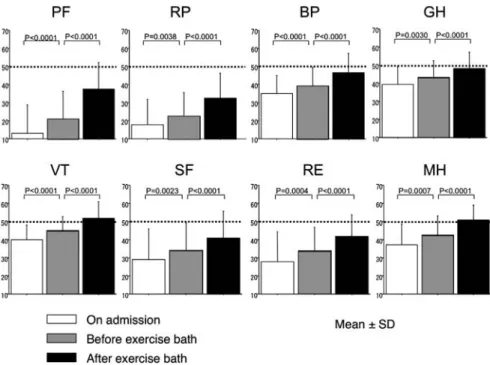
Fig. Changes in SF- scores on admission, and before and after exercise bath in all patients The subjects were treated by conventional rehabilitation including PT, OT, and ST for a month, followed by exercise bath ( for min, twice a week) in addition to conventional rehabilita- tion for a month. QOL was evaluated by SF- . Improvements in SF- scores were observed after both conventional rehabilitation and exercise bath. Those scores after exercise bath were significantly better than those after conventional rehabilitation.
PF : Physical functioning, RP : Role physical, BP : Bodily pain, GH : General health, VT ; Vitality, SF ; Social functioning, RE ; Role emotional, MH ; Mental health.
m
0 -0
-2 -*
-0 -0
0**
1
ῌ
!" #$% & '()*+,-./ 01(2 34 56789
:;<= >?@A B CDEF GHIJ KLMN OP Q R STU VWXY/ Z([\+]^ 56789
OP Q TU _`ab-. c def` c OPc /gh 8i jk l mn
OP Q "opq TU _`abrst uvwx4 0 t yz{ |} ~ /gh
OP Q GHIJ KLMN 8 01 8i
OP Q A :;<= ! TU KW -.()*+ ,y
(, F ]^ 56789
GHIJ KLMN :;<= OP Q ! -.
)' ([\+]^ 56789
A 3 :;<= KLMN A GHIJ OP Q
TU VWdef` c01 ¡
A 3 ¢m£¤A KLMN GHIJ :;<= OP Q TU VW Z¥¦.§¨ Z ©c/def` c/ª(«
+U / Zr¬01 ¡
®¯F °O ± T² ³#±´ µ ¶ ·¸¹º¸
» ¼½ mn
ῌ῏῎῍
ῌ
ῌ
ῌ ῌ
ῌ
ῌ ῌ
ῌ
ῌ
ῌ
ῌ
ῌ
ῌ
ῌ :
.
: .
a : ; p.
b : ;
Jpn. J. Rehabil. Med., , . :
.
Kawahira, K., Shimodozono, M., Etho, S., Kamada, K., Noma, T. and Tanaka, N. ( ) : E ects of intensive repetition of a new facilitation technique on motor functional recovery of the hemiplegic upper limb and hand. Brain Injury, , .
Kawahira, K., Shimodozono, M., Ogata, A. and Tanaka, N. ( ) : Addition of intensive repeti- tion of facilitation exercise to multidisciplinary rehabilitation promotes motor functional recovery of the hemiplegic lower limb. J. Rehabilitation Medicine, , .
:
.
Matsumoto, S., Kakahira, K., Etoh, S., Keda, S. and Tanaka N. ( ) : Short-term e ects of thermotherapy for spasticity on tibial nerve F-waves in post-stroke patients. Int. J. Bio- meteorol., , .
Matsumoto, S., Shimodozono, M., Etoh, S., Shimozono, Y., Tanaka, N., Kawahira, K. ( ) : Beneficial e ects of footbaths in controlling spasticity after stroke. Int. J. Biometeorol., ,
.
:
QOL .
: .
:
.
Noma, T., Matsumoto, S., Etoh, S., Shimodozono, M. and Kawahira, K. ( ) : Antispastic e ects of the direct application of vibratory stimuli to the spastic muscles of hemiplegic limbs in post-stroke patients. Brain Injury, , .
: pp.
,**/
+1/ +2*
,*+*
,.2 ,/.
,*+* ,,.
, ,*+*
-+/ -+3 ,**2
-2 .0
,*+* #
+,*, ++,+- ,**.
+/3 +0.
+332
01 1-
,**0 #
,.- ,/*
,*+*
# .0/ 1-
,**1 +*1 ++-
,**2 03/ 033
,**3
+-1 +.-
,**3
#
0,- 0-+
,**3 ,**3 ,30 ,33
02
1-
.1
+,
,.
-0
0+
/*
/.
1*
-0
-1
,- ῌ