Chapter I Significance of Artificial Insemination for Cattle and
Its Technical Development ……… 1
1. Introduction and history of artificial insemination ……… 1
2. Advantages and disadvantages of AI……… 2
(1) Advantages of AI ……… 2
(2) Disadvantages of AI ……… 4
References……… 4
Chapter II Male Reproductive Physiology ……… 5
1. Morphology and function of male genital tracts ……… 5
(1) Testis……… 5
(2) Epididymis ……… 6
(3) Accessory glands ……… 6
①Vesicular glands (Seminal vesicles) ……… 6
②Prostate ……… 6
③Cowper's glands ……… 6
2. Spermatogenesis……… 6
(1) Spermatogonia ……… 7
①Type A spermatogonia ……… 7
②Intermediate spermatogonia ……… 7
③Type B spermatogonia ……… 7
(2) Primary spermatocytes ……… 8
(3) Secondary spermatocytes……… 8
(4) Spermatids ……… 8
①Nucleus……… 8
②Cytoplasm ……… 8
3. Maturation of sperm ……… 8
4. Sexual maturation and breeding age……… 9
5. Sperm producing function ……… 9
6. Sexual behavior………10
(1) Sexual arousal and courtship ………10
(2) Erection ………10
(3) Leaking of secretions from accessory glands………10
[fall of a sexual desire] ………10
7. Ejaculation ………11
8. Reproductive failure in male ………11
(1) Reduced-to-complete lack of libido ………11
(2) Copulatory impotency………11
Artificial Insemination Manual For Cattle
Contents
①If the copulatory impotency of the bull is due to injuries of hind legs, the Injuries
must be cured. ………11
②In the case of impotency of the bull ………12
③In the case of troubles with the prepuce and penis ………12
(3) Sterility(related to the sperm production) in male ………12
①Aspermia………12
②Azoospermia ………12
③Oligospermia ………12
④Asthenozoospermia ………12
⑤Necrozoospermia ………12
(4) Testicular hypoorchida ………12
(5) Scrotal inflammation and testis orchitis………13
(6) Penitis………13
9. Physiology of semen………13
(1) Morophology and composition of sperm ………14
①Head………14
②Tail ………14
i Neck ………14
ii Middle piece………14
iii Principal piece………14
iv End piece ………14
(2) Function of sperm………14
①Motile function of sperm………15
②Metabolic function of sperm ………15
i Glicolysis ………16
ii Respiration ………16
③Viability and fertilizability of sperm………16
(3) Factors affecting the function of sperm in vitro ………16
①Temperature ………16
②Dilution ………16
③Osmolarity ………16
④pH………16
⑤Light, ultraviolet and radial rays………16
⑥Gases ………17
⑦Chemicals ………17
⑧Ions ………17
(4) Seminal plasma………17
①Fructose ………17
②Citric acid ………17
③Prostaglandin………17
④Substance called a "factor"………17
(5) Factors affecting the property of semen ………18
①Age ………18
②Nutrition………18
③Seasons ………18
④Exercise and sun bath………18
⑤Frequency of sperm collections ………18
⑥Sperm collection conditions ………18
References ………19
Chapter III Reproduction in Female Cows ………20
1. Anatomy and physiology of the female reproductive system ………20
(1) Vagina………20
(2) Uterus………20
(3) Oviducts ………21
(4) Ovary ………22
2. The estrus Cycle ………23
(1) Estrus ………23
①Mechanism of estrus………23
②Behavior during mating ………23
3. Turnover of corpus luteum and follicles during estrus cycle-follicular waves ………25
4. Mating, fertilization, implantation, pregnancy, and symptom of the pregnant cows ………26
(1) Mating………26
(2) Ovulation and corpus luteum formation………26
(3) Fertilization and implantation ………27
(4) Fetus and placenta development ………28
5. Pregnancy diagnosis and the duration………28
(1) Early pregnancy diagnosis………28
①The necessity of the early pregnancy diagnosis………28
②Possible gestation, preciseness and utility of the early pregnancy diagnosis……28
(2) Examination of fetus and placenta developments, and diagnosis of fetus survival …29 ①In the difficult case of pregnancy diagnosis by the rectal examination …………29
②In the case of abortion and the indication of stillbirth………29
(3) Gestation period ………29
6. Parturition and recovery of reproductive functions ………29
(1) Parturition………29
①Mechanism in approaching parturition ………30
②Signs of approaching parturition ………30
③Expulsion of fetus………31
④Initiation of spontaneous breathing of newborn calf ………32
(2) Recovery of ovarian functions and uterine involution after the parturition ………33
①Recovery of the ovary ………33
②Uterine involution………33
7. Obstacles in reproduction and the countermeasures ………34
(1) Anestrus after the parturition ………34
①Ingrown follicles ………34
②The first ovulation after the ovarian quiescence ………34
③Indistinct estrus (dull estrus, anestrus, feeble estrus, feeble estrus or short period estrus) ………34
④Missing the estrus (Problems in techniques for the detection of estrus)…………35
(2) Low fertility ………35
①Fertilization failure as a cause of the conception failure………36
i Inadequate timing of the insemination………36
ii Missing the estrus ………37
iii Failure of insemination………37
iv Ovulation failure………37
v Obstacles in oviducts ………37
②Early embryonic death as a cause of the conception failure and its Countermeasures ………37
i Too earlier or too later artificial insemination………38
ii Uterine infection………38
iii Malnutrition (proteins, energy, minerals and vitamins) ………38
iv Luteal subfunction ………39
v Body temperature increased by heat stress ………39
(3) Reproduction management program ………40
①Reproduction management after parturition………40
i Indexes for evaluating reproduction performances in group of cows …………40
(i) Indexes in the conventional method and their problems ………40
(ii) Reproduction indexes ………41
ii Consideration of the conventional reproduction management program and the newly developed program ………42
②Conclusion in reproduction managements ………43
References ………44
Chapter IV Semen Collection and Production of Frozen Semen ………45
1. Semen collection from bulls ………45
(1) Equipment and facilities for semen collection ………45
①Semen collection ………45
②Devices and apparatus for semen collection ………45
i . An artificial vagina and its composition ………45
ii. Dummy cow ………46
iii. Teaser cow………47
iv. Semen collection room ………47
(2) Techniques for collection of semen from a bull ………47
①Preparation for the semen collection ………47
i . Cleaning of bull ………47
ii. Preparation of dummy and teaser cow ………47
iii. Preparation of artificial vagina ………48
iv. Putting the warm water into the artificial vagina ………48
v. Cleaning of prepuce ………49
②Collection of semen ………49
i . Preparation for the collector………49
ii. Restriction of live mounting………49
iii. Collection of semen………50
iv. After the semen collection………51
(3) Frequency of the collection of semen from bull………51
①Interval of collection………52
②Number of times of the semen collections ………52
(4) Techniques for the bulls, in which the collection is difficult ………52
①Training of bulls to mount a dummy ………52
②Worked-out techniques for the bulls, which have a difficulty to mount or to collect semen ………53
i . Semen collection outside ………53
ii. Change of collector or change of semen collection side ………53
iii. Ideas on the modification of the artificial vagina ………53
iv. Use of influences from other bulls ………54
v. Smearing of urine or mucus of cows in heat………54
③Use of the electro-ejaculation and massage of the ductus deferens ………54
i . Electro-ejaculation ………54
ii. Massage of ampulla (Massage of rectum)………55
2. Evaluation of semen and sperm………55
(1) Macroscopic examination ………56
①Volume of semen ………56
②Color………56
③Odor………57
④Hydrogen-ion Exponent (pH)………57
(2) Microscopic examination………57
①Motility of sperm (spermatozoa) ………57
i . Methods for examination of sperm motility ………57
ii. Criteria for the motility of sperm ………58
iii. Viability index of sperm………59
iv. Measurement of percentage of living sperm using staining………59
②Sperm concentration………59
i . Measuring instrument method ………59
ii. Hemocytometer method………60
(i) Procedures………60
(ii) Counting chamber ………60
(iii) Method for calculation ………61
③Examination of morphology of spermatozoa (Carbol fuchsin staining method) …62 ④Abnormal spermatozoa ………62
(3) Records of insemination and examination of semen ………63
3. Methods for the production of frozen semen ………63
(1) Factors affecting the viability of sperm after freezing and thawing ………63
①Freezability of sperm ………63
i . Breed, individual, ages ………65
ii. Season ………65
iii. Frequency of semen collection………65
②Composition of diluents ………65
③Preservation time of spermatozoa at 5℃before freezing ………66
④Concentration of glycerin ………67
⑤Freezing rate ………67
⑥Thawing rate ………68
(2) Basic principal for freezing semen ………68
①Survival of spermatozoa and temperature………68
②Freezing process of spermatozoa ………69
i . Supercooling………69
ii. Formation of ice crystal………69
iii. Growth of ice crystal ………69
iv. Freezing at eutectic point ………70
③Cause of the damage of spermatozoa during freezing ………70
i . Damages at supercooling ………70
ii. Shock of the rapid freezing ………70
iii. Damages by extracellular freezing ………70
(i) Damages by condensation of salts, high osmotic pressure and dehydration…70 ( ii) Damages by the mechanical pressure………71
iv. Damages by intracellular freezing ………71
④Survival of spermatozoa during freezing and thawing ………71
(3) Freezing of semen………72
①Preparation of diluents for freezing ………72
i . Composition of diluent ………72
(i) The diluent containing egg yolk ………72
(ii) Diluent containing milk………73
ii. Preparation of the diluent………74
②Dilution of semen ………74
③Preparation of straw………76
④Filling and sealing of semen into a straw ………76
⑤Glycerol equilibration ………77
⑥Freezing ………77
i . Preparation of freezing ………77
ii. Freezing rate ………77
4. Examination of frozen semen………77
(1) Thawing of frozen semen ………78
(2) Examination of the viability of spermatozoa (motility, percentage of living spermatozoa)………78
(3) Criteria of passing grade of frozen semen ………78
5. Storage and transportation of the frozen semen ………79
(1) Storage of the frozen semen ………79
(2) Transportation of the frozen semen………79
6. Disinfection of the apparatus and devices ………80
(1) The principal for the disinfection………80
(2) Disinfection of the devices for the semen collection and treatment………80
①Physical disinfection………80
i . Disinfection by boiling water ………80
ii. High pressure steamed sterilization ………81
iii. Dry-heat sterilization………81
iv. Sterilization by flame………81
v. Sterilization by γray ………81
vi. Filter sterilization ………81
vii. Sterilization by ultra violet ray ………81
②Chemical disinfection ………82
i . Sterilization by ethylene oxide gas (EOG)………82
ii. Disinfection by alcohol ………82
iii. Disinfection by surfactant………82
References ………83
Chapter V Reproduction of Female by Artificial Insemination ………84
1. Age at first service (heifers) ………84
2. Detection of estrus and optimal timing of insemination ………84
(1) Detection of estrus ………84
(2) Optimal insemination time ………85
(3) Optimal insemination time after calving ………86
3. Methods for synchronization of estrous cycle………87
(1) History of the development of methods for the synchronization of estrus and ovulation………87
(2) Methods for synchronization of estrus and ovulation ………89
①Single injection of progesterone………89
②Single injection of PGF2α ………89
③Injection method with both GnRH and PGF2αand GnRH-PGF-GnRH-TAI method (Ovsynch method) ………89
④EB-P-PGF2α-EB methods ………90
(3) GnRH-PGF2α-GnRH-TAI (Ovsynch Method)---Current status and Problem ……90
(4) Modified methods of Ovsynch method………92
①Co-synch method ………92
②CIDR-Ovsynch method ………92
③Select-synch method………92
④Pre-synch-Ovsynch method ………92
⑤Heatsynch method ………92
(5) Methods for the synchronization of estrus and ovulation---Prospect in future……93
4. Methods of Artificial Insemination ………94
(1) Instrument and Facilities required for Artificial Insemination ………94
①Insemination equipment………94
②Alcohol cotton for disinfection ………94
③Benzalkonium chloride towel (paper) and paper towel ………94
④Tweezers and scissors for treating straw tube ………95
⑤Restraining stall ………95
(2) Disinfection on the occasion of operating artificial insemination………95
①Disinfection of the instruments………95
②Disinfection of bovine vulva ………96
(3) The way of thawing frozen semen ………96
(4) The methods of artificial insemination ………96
(5) Management of frozen semen ………98
5. Singles and diagnosis pregnancy ………98
(1) Signs of pregnancy ………98
(2) Pregnancy diagnosis by rectal palpation ………99
(3) Pregnancy diagnosis by real-time ultrasonic scanning method ………100
6. Newborn nursing and the delivery ………103
(1) The newborn watch ………103
(2) The delivery sign and time duration of delivery………104
①Opening period………104
②Expulsion period………106
③The afterbirth period ………107
(3) The dystocia and care of delivery ………108
〈Case and the dealing of difficult delivery〉 ………109
①Breach calf1 ………109
②When there is only a foreleg of the fetus ………109
③When a head is bent ………109
7. The improvement measure for the insemination record management and
the conception rate………110
(1) The reproductive history sheet and the way of recording according to individuals…110 (2) The way of the comparison of individual propagation ability ………112
References………113
Chapter VI Raising management of breeding bulls (Holstein breed)………114
1. General management of raising breeding bulls (single stall) ………114
(1) Raising management from calves to rearing stage………114
(2) Raising management from rearing stage to maturity stage ………114
(3) General management followed by growth of the bulls ………115
①Dehorning………115
②Attachment of a nostril ring………115
③Domestication and training ………115
④Exercises ………116
⑤Hoof protection (hoof cutting) ………116
⑥Shearing hairs………117
(4) Facilities for the management of breeding bulls………117
①Accommodation facilities ………117
i . Chase-in pen ………118
ii. A super calf hatch………118
iii. A single stall ………118
iv. A mooring method by a necktie or nostril ring ………121
②A frame place ………121
③Feeding facilities : hay ………121
④Cattle beddings and floor materials ………122
2. Feeding the breeding bull………123
(1) Rearing period………123
(2) Matured breeding bull ………123
(3) Supply of water, vitamins, minerals, etc.………124
(4) Nutrient allowance for the breeding bull………125
3. The cattle house environment including countermeasures for summer heat ………128
(1) Cattle house………130
(2) Cattle stall ………130
(3) Paddock………130
(4) Ventilation ………130
(5) The roof and wall of the cattle house………130
(6) Water sprinkling………130
(7) Air-conditioning system ………130
4. Countermeasures to the hygiene………131
(1) Health management ………131
①General health inspection………131
②Measurement of the scrotal circumference ………132
③Ultrasonic examination of the testes ………133
④General blood examination ………133
⑤Measurement of the body weight ………133
⑥Eradication of the parasites………133
(2) Management of the diseases ………134
①Infectious diseases ………134
i . Brucella disease………134
ii. Campylobacter disease………134
iii. Trichomonas disease………134
iv. Leptospira disease………135
②Noninfectious diseases ………135
i . Spinal disease………135
ii. Penis albuginea laceration ………135
iii. Fibrous papilloma………136
iv. Scrotitis ………136
v. Scrotitis and testitis………137
vi. Decrease or lack of the copulation desire………138
Reference ………139
Chapter VII Raising management for breeding cows ………140
1. General management for breeding cows ………140
(1) Nursing and rearing management………140
①Nursing period………140
i . At birth ………140
(i) Confirmation of the breathing………140
(ii) Disinfection of the umbilical cord ………141
(iii) Drying hairs ………141
(iv) Supply of foremilk………141
(v) Individual identification ………142
ii. Nursing period ………142
(i) Nursing house………142
(ii) Dehorning ………142
②After weaning ………144
i . Group raising………144
ii. Rearing house………144
iii. Body condition score………145
(2) Management for milking cows………145
①Milking cattle house and milking facilities ………145
②Milking ………146
③Dry period………147
2. Feed Supply (growth stage and reproduction stage, respectively) ………147
(1) Nursing period ………147
①Rumen development ………148
②Water supply ………148
(2) After weaning to reproduction start period………148
(3) Conception to delivery (the first birth) ………149
(4) Lactation period………150
(5) Dry period………151
3. Weaning………153
4. Cutting hooves………153
5. Countermeasures for summer heat………153
6. Countermeasures for hygiene ………155
(1) Main diseases in nursing and rearing stages ………156
①Diarrhea ………156
②Respiratory disease………156
(2) Main diseases of mature cattle ………156
①Mastitis………156
②Reproduction difficulty ………158
Reference ………160
Reference………161
1. Natural mating technology in beef cattle ………161
(1) The age of bulls, the its ratio versus the number of breeding female cattle and mating period in natural mating. ………161
(2) Advantage and disadvantage of natural mating………162
(3) Feeding management and health measures for bulls in natural mating…………162
Reference ………163
2. Reproduction Physiology of Zebu cattle and water buffaloes ………164
(1) Reproduction Physiology of Zebu cattle ………164
①Puberty and initial age (in month) for breeding ………164
②Conception rate ………165
③Gestation length ………165
④Recurrence days of estrus after parturition and calving interval ………166
i . Recurrence days of estrus after parturition ………166
ii. Calving interval………166
⑤Improvement measures of fertility from animal nutrition aspect ………167
i . Effect of poor nutrition on fertility in cattle ………167
ii. Improvement measures of cattle nutrition for enhancing fertility …………168
Reference ………169
(2) Reproductive physiology of water buffaloes………170
①Seasonal reproduction of water buffaloes………170
②Puberty and initial breeding age………170
③ Occurrence of estrus ………170
④Estrus duration and cycle………171
i . Estrus duration………171
ii. Estrus cycle………171
iii. Postpartum estrus………171
⑤Conception rate ………172
i . Conception rate ………172
ii. Period between calving and subsequent pregnancy………172
⑥Gestation length ………172
⑦Age (month) at first calving ………173
⑧Calving interval ………173
⑨Reproduction Difficulties ………173
Reference ………174
In recent years, Japan's Official Development Assistance for the livestock development in developing counties, has become diversified in terms of the number and technical field of cooperation.
In responding to this trend, the number of livestock experts from Japan has increased and their technical fields have also been diversified for cooperation.
The Japan Livestock Technology Association (JLTA) has published many Livestock Technology Manuals in English as well as in Japanese in order to respond to needs required from developing countries, which included technologies of artificial insemination. The first edition of "Artificial Insemination Manual in Cattle" was published in 1991.
Since then, related technologies of artificial insemination in the said edition have been much advanced and Japan's experiences in appropriate technologies in tropical areas have also been further accumulated.
Under these circumstances, JLTA revised parts of the first edition of the Artificial Insemination Manual and newly published for the convenience of users of this Manual.
We hope this will be useful for and widely utilized by relevant organizations and persons who are engaged in technical cooperation for livestock development in developing countries.
JLTA expresses its deep appreciation to every author and person of the National Livestock Breeding Center and the Japan Livestock Industry Association listed on the next page of this Manual for their strong support and dedication to the revising of the content.
JLTA also thanks the Japan Racing Horse Association (JRA) and Japan Racing Horse and Livestock Promotion Foundation (JRL) for their financial support to the revision of the Manual.
Tokyo, March 2004
Yoshihiro Yamashita President
Japan Livestock Technology Association
FOREWORD
(General editor) Dr. Jun-ichi Mori
(Writers)
Chapter 1 Sec. 1-2 Dr. Yasuo Shioya Chapter 2 Sec. 1-8 Dr. Katsuhiko Sasaki
Chapter 3 Sec. 1-9 Dr. Toshihiko Nakao
Chapter 4 Sec. 1-2 Mr. Zen-ichirou Kumada Chapter 4 Sec. 3-4 Dr. Katsuhiko Sasaki
Chapter 5 Sec.1-2, 4 Mr. Yasushi Sugawara Chapter 5 Sec. 3 Dr. Toshihiko Nakao Chapter 5 Sec. 5-7 Mr. Masatoshi Kuniyuki
Chapter 6 Sec. 1-2 Mr. Zen-ichirou Kumada Chapter 6 Sec. 3-4 Dr. Keishi Mizutani
Chapter 7 Sec. 1-6 Miss Makiko Ooi Referecne-1
Mr. Kazuhisa Fujita Reference-2
Dr. Hiroshi Nishimura Mr. Hiroshi Saito
Technical Advisor, japan Livestock Technology Association Professor Emeritus, Osaka Prefecture University Guest
Director, Department of Animal Breeding and Reproduction, national Institute of Livestock and Grassland Sciecnce Director, Reproduction laboratory, Maebashi Institute of Animal Science, Livestock Improvement Association of Japan Inc.
Professor, Laboratory of Theriogenology, Department of Veterinary Medicine, Faculty of Agriculture, Yamaguchi University
Director, Livestock Breeding 3rd Division, Tokachi Station National Livestock Breeding Center (NLBC)
Director, Reproduction Laboratory, Maebashi Institute of Animal Science, Livestock Improvement Association of Japan Inc.
Vice Director, Experimental Support Division, Technology Department, NLBC
- mentioned above -
Chief, Breeding Cow Section, Livestock Breeding Division, Niikappu Station, NLBC
- mentioned above -
Chief of Veterinarian, Morioka A. I Center, Livestock Improvement Association of Japan Inc.
Chief, Breeding Cow Section, Livestock Breeding Division, Iwate Station, NLBC
Director, 2nd Experiment Division, Technology Department, NLBC
Director, Overseas Technology Exchange Department, Japan Livestock Technology Association (JLTA)
JICA Expert assigned to the Water Buffalo and Beef Cattle Improvement Project in the Philippines
List of Writers of Manual
Name Managerial Position
1. Introduction and history of artificial insemination
Artificial Insemination (AI) is an animal reproductive technology consisted of collection of semen from male animal, dilution and freezing of semen and depositing it to female reproductive tracts, to bring female animal pregnant instead of direct mating between female and male animals. The first successful AI was reported by an Italian priest and scientist, L.Spallanzani in 1780. He injected seminal liquid of a young dog to the uterus of a water spaniel bitch and the bitch delivered three puppies.
AI in farm animals is based on AI technologies of horse and other animals developed by Russian scientist, Iwanoff. E. I. (1907). Japanese assistant professor, Ishikawa H. in Kyoto University visited Prof. Iwanoff (1912) and initiated research work with horse to study physiology of sperm and to improve horse breeding.
The early procedures of collecting semen were involved in taking the semen from the vagina of the naturally mated female with deposited sponge or aspiration by an injection syringe. Specially designed condom and vaginal pessary were developed including massaging method of the vesicular glands and ampullae and electric stimulating method (electroejaculator). Now an artificial vagina, a good imitation of the natural vagina, is used to collect semen with sanitary for mounting bull to ejaculate like a natural mating.
Although semen was stocked undiluted or diluted in the liquid which contained sugars etc. in early days of AI technology, the phosphate buffer solutions supplemented with egg yolk were first developed and found to be satisfactory. The defect of the solution is that the fat globules of the egg yolk in the phosphate buffer hinder from observing individual sperm under the microscope. This defect was overcome using sodium citrate dehydrate solution with egg yolk, to make the mixture transparent. The observation of individual sperm became easy and this prevailing diluter also prolonged the preservation period of sperm (1941). Many improvements in semen diluter were developed including an addition of antibiotics to control bacteria in the semen and sugar-rich diluter supplemented with egg yolk combined Tris (hydorxymethyl) aminomethane.
Although semen is preserved well in a low temperature, the greatest discovery is a freezing preservation technology. Polge, C. et al. discovered in 1949 that glycerol was protecting fowl sperm against freezing at -79 ºC . They developed this technology to apply to freeze bull semen, finally inseminated frozen-thawed semen to an estrous cow, and then succeeded in a calf production in 1952. Frosty, the first calf obtained from frozen semen was epoch-making. Semen was diluted and frozen in the egg yolk citrate supplemented with glycerol. Now sugar-rich diluter consisted of egg yolk combined with Tris (hydorxymethyl) aminomethane is prepared by adding glycerol for popular procedures of freezing. Liquid nitrogen has been used for freezing and storing of semen at -196 ºC since the 1960s in the world. Diluted semen was conventionally cooled slowly at
Chapter I Significance of Artificial Insemination for Cattle and
Its Technical Development
the rate of 1-3 ºC per minute, and Nagase H. et al. discovered that rapid cooling of sperm was effective for the survivability of sperm in 1963. Now it is common to freeze semen, which has been already cooled to 4 ºC, within 4 to 5 minutes at the cooling rate of over 15 ºC per minute. In addition, Nagase and Niwa invented the pellet method (1963), and it has been used widely in East Europe or South America until recently.
In the early days of AI technology, semen was put into glass ampules for storing and freezing. The plastic straw used for packing in Denmark was improved and manufactured by Cassou in France in 1964, and his small plastic tubes combined with the inseminating tool (Cassou AI-Gun) have become a common equipment for AI in the world. The inseminating tools were invented to fit the anatomy of the female reproductive tracts, and the recto-vaginal insemination method was developed by Danish veterinarians in 1930’, and has been used and become very popular in the world.
In Russia, AI was widely developed in the horse and other farm animals in the governmental institutes. An artificial insemination association was established to give AI services to dairy cows in Denmark in 1936. Many AI organizations were founded to breed cows all over the world, mainly in Europe and North America. In USA, about 60% of the dairy cows are artificially inseminated, and in the United Kingdom, France and Denmark, more than 90% of the dairy cows are artificially inseminated.
In Japan, the governmental and prefectural livestock stations began to apply AI to horse and cattle breeding at first, and the legal regulation aiming at the control of venereal diseases of cattle in 1939 prompted AI of cows to be popular and used in many farms. In 1950, the organization and qualification of AI and AI technician were enacted by the Livestock Improvement and Propagation Law. In 1965, the Livestock Improvement Association of Japan was founded to stock and distribute frozen semen of cattle widely on the national basis. In Japan, almost 100 % of dairy cows and over 90% of beef cows are inseminated artificially using frozen semen.
2. Advantages and disadvantages of AI
(1) Advantages of AI
①Superior male animals can be used very effectively.
The greatest advantage of AI technology is that semen from an elite bull can be used efficiently. The annual semen production is estimated to be enough to inseminate twenty thousand cows; if the bull is served two semen collections per week and ejaculates 6 ml of semen with a billion spermatozoa per one ml, it can produce 6 x 10¹¹(50 weeks x 2 x 6 ml x 109= 6 x 10¹¹) spermatozoa a year. And considering a fact that 30 million spermatozoa are needed for one AI, 20,000 times AI can be performed by one bull per one year (6 x 10¹¹/3 x 107 = 20,000). Actually as shown in Fig.I-1, one of the elite bulls produced over 200,000 heads of calves during his life time.
②A great genetic improvement of farm animals can be achieved.
The selection and efficient use of excellent bulls improve the production abilities of
farm animals. As shown in Fig.I-2, the increase of milk production of cows per year is positively related to the spread of artificial insemination.
③Genetic abilities can be determined more quickly and accurately.
Even semen from a young bull can be used for AI resulting in many calves on the ground. So many progenies can be used for the accurate estimation of transmitting genetic abilities of the bull, and for the detection of genetic diseases of the bull as well.
Young bulls are artificially inseminated according to the optimal progeny testing program both in beef and dairy cattle.
④AI controls venereal and other diseases.
One of the reasons that Japan regulated AI of cattle under the law in 1939 was to control many venereal diseases such as trichomoniasis and brucellosis. Since a male and a female do not contact each other directly by AI, many infectious diseases can be prevented.
⑤AI makes both of the long distance transportation and the usage of the semen, even after the death of a male from which it was collected, possible.
Fig I-1 No. of Progeny obtained by AI using frozen semen of Japanese Black Sires 250,000
200,000 150,000 100,000 50,000 0
MonjirouToshitaka
TakasakuraTadafuku
YasumikaneKitaguni7-8
Total No. of Progeny
Fig I-2 Changes in milk production per cow and spreading rate of AI in Japan
50 55 60 65 70 75 80 85 90 95 99 9,000
8,000 7,000 6,000 5,000 4,000 3,000 2,000 1,000 0
120
100
80
60
40
20
0
Milk, kg per cow Spreading rate of Ai (%)
Frozen semen is now traded and utilized worldwide. Frozen semen straws are much safer in hygiene and transportation and cheaper in cost than importing a living bull.
Moreover, frozen semen can survive after the death of male animals from which it was collected.
⑥AI has many other advantages.
AI offers a safe circumstance for farmers by the elimination of dangerous bulls on the farm, saving the cost of feeding and other managements for them. Some bulls are so big that they cannot naturally mate small heifers, or bulls with problems in foot or hoof cannot mount cows. AI can overcome such troubles easily. Summer sterility in bull (bulls are so sensitive to heat and humidity in summer that they produce semen with bad quality) can be solved by freezing the semen with high quality during winter and spring and storing it. Special flow cytometers for sexing sperm can separate DNA-stained spermatozoa into X and Y chromosome bearing spermatozoa. Now it is possible to get calves of the desired sex on the laboratory basis. AI has been used to mate inter/intra species, and many researches have been studying about sperm and seminal plasma to improve AI technology. Development of AI has promoted development of embryo transfer.
(2) Disadvantages of AI
There are few disadvantages of AI but not fundamental faults. The technicians and related people to AI need to understand those listed below profoundly and to use the technology correctly and effectively.
① AI is such an advanced and sophisticated technology that it needs advanced knowledge and equipments. Trained specialists are required to perform the technique.
② It is necessary to detect and hold estrous cows. Farmers or managers must check females in heat and capture them. The conception rate of AI is usually lower than that of natural mating.
③If a technician tries to be unjust to perform AI, injustice like a "fake semen" incident may happen. Venereal and other diseases can be transmitted by technician’s carelessness in farms.
④ AI using a limited number of elite bulls brings genetic improvements as well as reverse effects like an increase of inbreeding, resulting in a reduction of hereditary diversity, and apparent possibilities of prevailing genetic defects and diseases because of using bulls having such defects and diseases.
References
・Foote RH : Artificial Insemination. P. 1163-1170 : Encyclopedia of Dairy Sciences (ed.
Roginski H, Fuquay JW, Fox PF) Academic Press, Amsterdam. (2003)
・Niwa T, Monji Y, Hashizume T, Shioya Y : Artificial insemination and embryo transfer of livestock, (Japanese) 6th Revised Ed. Soubun, Tokyo. (2002)
・丹羽太左衛門、門司恭典、橋爪 力、塩谷康生 : 家畜の人工授精と受精卵移植(増補 改定6版)、 創文社、 東京 (2002)
1. Morphology and function of male genital tracts
Genital tracts consist of gonad and accessory glands. The male gonad is testis, and accessory glands are all the genital
tracts except for the testis. Accessory glands are divided into organs having a duct structure such as the epididymis, the ductus deferens and the urethra, and organs that pour their secretions into the urethra such as the prostate, the vesicular and bulbourethral glands, and the mating organ (the penis) (Fig II-1).
(1) Testis
The testes that lie outside the abdomen within the scrotum, which is a purse-like structure, consist of seminiferous tubules and interstitial tissues (Fig II-2). The main function of the testes is to produce sperm and to secret testosterone. Sperm are formed within the seminiferous tubles from spermatogonia or sperm mother cells which lie among the Sertoli cells on the basement membrane. Spermatozoa that detached from the Sertoli cells are floating in the lumen. And then sperm are transported to the cauda epididymis via the seminiferous tubule, the strait tuble, the rete testis and the efferent ductule. The blood vessels, lymphonodus and Leydig cells gather in the interstitial tissues, and the Leydig cells secret testosterone by the luteinizing hormone (LH) stimulation. The temperature of the testes is kept 4-7 ºC lower than the body temperature by the
Fig II-1 Diagram of the male reproductive tracts as seen in.left lateral dissections.
Chapter II Male Reproductive Physiology
a, Ampulla; bu, bulbourethral gland; cap.e, caput epididymidis;
caud.e, cauda epididymidis; cp, left crus of penis, severed from the left ischium; dd, ductus deferens; ds, dorsal diverticulum of sheath; es, external sheath; is, internal sheath; p, penis; pg, prostate gland; pr, prepuce; r, rectum; rp, retractor penis muscle; s, scrotum; sf, sigmoid flexure of penis; t, testis; up, urethral process; vg, vesicular gland. (Adapted from Popesko, 1968. Atlas der topographischen Anatomie der Haustiere.
Vol. 3, Jena, Fischer.)
Fig II-2 Schematic drawing of the tubular system of the testis and epididymis in the bull (for clarity the duct system of the rete testis is omitted).
cap.e, Caput epididymis; caud.e, cauda epididymidis; corp.e, coupus epididymidis; dd, ductus deferens; de, efferent ductule;
ed, efferent ductule; lb, lobule with seminiferous tubules; rt, rete testis; st, straight tubule; t, testis. (Simplified from Blom and Christensen, 1960. Nord. Vet. Med. 12, 453.)
thermoregulation system. However, when the temperature is so high with high humidity, the system does not work properly resulting in the abnormal sperm production.
(2) Epididymis
Three anatomic parts of the epididymis, the caput, corpus and cauda epididymis, are recognized (Fig II-2). The caput epididymis (head) in which 12-15 efferent ductules join the duct of the epididymis, forms a flattened structure applied to one pole of the testis. It is continued as the narrow corpus epididymis (body) which terminates at the opposite pole in the expanded cauda epididymis (tail) which connects the ductus deferens. The functions of the epididymis are to transport, condense, mature and deposit sperm and to secret epididymal fluids.
(3) Accessory glands
Most of seminal plasma consists of secretions from the accessory glands. Accessory glands develop under the influence of testosterone.
①Vesicular glands (Seminal vesicles)
These lie lateral to the terminal parts of each ductus deferens. They are a pair of lobulated glands. The duct of the vesicular glands and the ductus deferens may have a common ejaculatory orifice into the urethra. In the bull, fructose, sorbitol, citric acid and inositol are produced by the vesicular glands. The vesicular secretion of the bull contributes about half of the ejaculate and is often quite yellowish due to its riboflavin content. It has a weak acidic pH and a sticky character.
②Prostate
Two components are distinguished. There is a distinct lobulated external part or body (3-4 cm in diameter and 1 cm thick) which lies outside the thick urethral muscle surrounding the urethra and a second internal or disseminate part distributed along the length of the pelvic urethra below the urethral muscle. The duct of the prostate has an ejaculatory orifice into the urethra. Although the secretory activity of this gland is not high compared to vesicular glands, most components of semen are composed of secretions from both glands.
③Cowper’s glands
These are paired bodies lying dorsal to the urethra near the termination of its pelvic portion. They are as big as walnuts and each gland has each ejaculatory orifice into the urethra. The volume of Cowper’s glands fluid is not so large compared to that of the vesicular glands. Prior to ejaculation the Cowper’s glands fluid together with the prostate fluid play an important role of cleaning the urethra.
2. Spematogenesis
Sperm are formed within the seminiferous tubles from spematogonia or sperm mother cells which lie on the basement membrane (Fig II-3). The seminiferous tubles contain the
sperm cells (spematogonia, primary spermatocytes, secondary spermatocytes and spermatozoa) and Sertoli cells.
Spermatogenesis commences at puberty when the testes fully descend from the abdomen and both the seminiferous tubules and the interstitial cells become active. Sperm cells can be categorized into spematogonia, primary spermatocytes, secondary spermatocytes and spermatozoa according to their developmental stages. The process in which the primary spermatocytes obtained
by the division of the spematogonia undergo meiotic and mitotic division to become the secondary spermatocytes and spermatids, respectively, is called “Spermatogenesis”. The process of metamorphosis of the spermatids into sperm, while attaching to the Sertoli cells, without division is called “Spermiogenesis”. When this metamorphosis is completed, sperm gather but still remain in contact with Sertoli cells. And then they are finally released from the Sertoli cytoplasm and pass into the lumen of the seminiferous tubule.
(1) Spermatogonia
①Type A spermatogonia
Spermatogenesis begins with Type A spermatogonium. It contains an egg-like shaped nucleus having a big nucleolus, and the nuclear membrane is extremely thin. The characteristic future of this cell is the existence of evenly dispersed fine chromatins in the nucleus. Type A spermatogonium divides to be two intermediate spermatogonia. And then one of the intermediate spermatogonia becomes dormant, while the other intermediate spermatogonium (Type A2) undergoes mitotic division to be two intermediate spermatogonia.
②Intermediate spermatogonia
Intermediate spermatogonium is intermediate type of Type A and B spermatogonia. It contains a thick nucleus membrane, to which nuclear chromatins attach, and the chromatin granules are big. The nucleus transforms from an egg-like shape to a round one. The intermediate spermatogonium undergoes several mitotic divisions to be eight Type B spermatogonia.
③Type B spermatogonia
The nucleus of Type B spermatogonium has a small round nucleus. Type B spermatogonium undergoes mitotic division to be two primary spermatocytes.
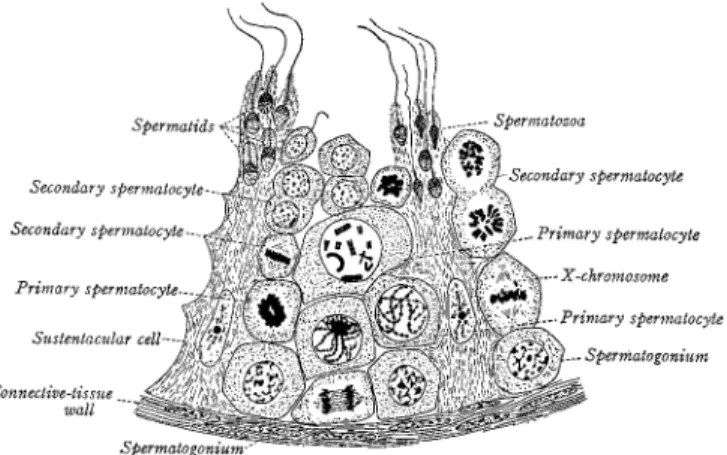
Fig II-3 Drawing of a transverse section through a seminiferous tubule of a mammal. ( X 900) Note that the spermatogonia lie against the basement membrane of the connective tissue wall and that the primary and secondary spermatocytes, spermatids and sperm-in that order-from layers extending to the lumen of the tubule. The cytoplasm of the large sustentacular or Sertoli cells is in intimate contact with all the other cells. (From Arey, 1954. Developmental Anatomy. Philadelphoa, courtesy of W. B. Saunders Co .)
(2) Primary spermatocytes
The primary spermatocyte undergoes meiotic division to be two secondary spermatocytes. This process is called “Maturation division”.
(3) Secondary spermatocytes
The secondary spermatocyte is bigger than the primary spermatocyte, and its chromosome number is halved from that of the somatic cell.
(4) Spermatids
Metamorphosis of a spermatid into sperm (spermiogenesis) is done without further division. This process, which is completed within 23 days, includes following changes;
①Nucleus
At the beginning of the metamorphosis, the nucleus of spermatid is round and the chromatins are evenly distributed. And then the nucleus is gradually elongated and the chromatins are granulated. Finally the nucleus is flattened to have an egg-like shape as matured sperm.
②Cytoplasm
In the end of spermiogenesis most of cytoplasm of sperm is cast off, and the sperm characteristic structures, such as the acrosome and the flagellum (tail) differentiate.
As described above, 64 spermetids are produced from a spermatogonium. This takes 32- 45 days. On the other hand, the dormant spermtogonium resumes dividing after 10 days of sleeping, and the same sperm production process as mentioned above is repeated. Thus the cycle of spermatogenesis is successive to produce sperm.
3. Maturation of sperm
The sperm produced in the seminiferous tubles functionally changes to mature during their passage through the epididymis. The sperm in the capt epidydimis is immotile and
Fig II-4 Diagram of Spermatogonisis
it acquires the motility during the passage to the cauda epididymis. The cytoplasmic droplet attaching to the neck of sperm moves toward the end of the tail, during the passage to the cauda epididymis, and is located in the end of the mid piece of the tail. An ejaculated sperm has no cytoplasmic droplet. When the ejaculated sperm has the droplet, it is considered to be immature. The sperm collected from the capt epididymis has no ability to penetrate an oocyte, but it acquires the ability in the hind part of the corpus epididymis. In the lumen of a duct of the epididymis sperm are highly concentrated. In the secretions of the epididymis, there is little energy source, such as saccharide, for sperm, O2 concentration is low, and CO2 concentration and the K/Na ratio is high. This condition inhibits sperm motility. Thus sperm in corpus and cauda epididymis and ductus deference are immotile just before ejaculation. The ability of sperm to fertilize an oocyte is well preserved in the cauda epididymis for 30 days in cattle.
4. Sexual maturation and breeding age
In the Holstein breed sperm appears in the seminiferous tubles at 6-7 months of age, and the first ejaculation is accomplished at 13-14 months of age. It is reported that the sexual maturation of the bull occurs at 14 months of age and the optimal age to begin to use for breeding is 15-20 months. It is also known that a low nutrition feeding during the rearing period of the bull delays its sexual maturation.
5. Sperm producing function
Sperm formed and released in the lumen of the seminiferous tubles pass through the straight seminiferous tubles, the rete testis and the efferent ductile, and reach the duct of epididymis. During the passage through the duct of epididymis, sperm acquire the ability to fertilize oocytes and mature. This coordinated function of the testis and epididymis is called “sperm producing function”. When the bull grows to the certain age and its body size reaches to the certain level, it acquires the function. This physiological achievement is called “puberty”, and it is defined that the puberty is the period when sperm can be seen in the lumen of the seminiferous tubules. When all the genital tracts develop functionally and produce sperm being capable of fertilization, the bull completes the sexual maturation resulting in a normal ejaculation, with the normal concentration and viability of sperm, and becomes eager for mating. Even after the sexual maturation, the genital tracts continue to develop and the production of sperm in the testis and the secretions of accessory glands increase. Considering the stable pregnancy rates, the optimal age of bull to use for fertilization is determined to be one month after the appearance of the puberty. Sperm producing activity of the bull fluctuates according to the seasons, and in general it is high during spring and low during winter and summer, especially hot summer.
6. Sexual behavior
The components of copulatory patterns of the bull are a series of sexual behaviors such as the sexual arousal, courtship, erection, penile protrusion, leaking of secretions from accessory glands, mounting, intromission, and ejaculation. The sexual behavior of the bull is based on the sexual arousal, and its induction is closely related to the secretion of testosterone.
The education of the sexual behavior to the bull during the rearing period influences its subsequent sexual behavior. When the bull is not easy to collect semen at the artificial insemination (AI) center, it is important to train up the bull, by an exposure to a cow and urine from a cow in heat etc., to have enough sexual arousal being able to ejaculate.
Smells have an effective stimulation on the induction of the sexual arousal, especially urine from a cow in heat is effective. When the practitioner collects semen from the bull by using a dummy and an artificial vagina for the first time, an exposure of urine from a cow in heat to the nose of the bull and/or to smear the urine to a dummy is effective for the successful collection of the semen.
The hot weather with a high humidity during summer makes the activity of the thyroid and the metabolism low resulting in the reduction of testosterone secretion, which lowers the sexual desire and causes the reduction of the fertility. The feeding with the extremely low and high nutrients and the excessive collection of semen lower the sexual desire of the bull
(1) Sexual arousal and courtship
When exposed to the smell of vulva and urine, the bull shows the restless behaviors such as stretching of the neck, licking and butting.
(2) Erection
The erection is induced by the accumulated bloods in the cavernous body of penis and corpus spongiosum penis. The blood pressure goes up to 15,000mmHg just before the ejaculation, because the ischiocavernous muscle restrains the blood flow.
(3) Leaking of secretions from accessory glands
When the erection occurs and the sexual arousal is so extreme, the bull leaks the transparent fluid of the accessory glands. This plays an important role in cleaning of the urethra preparing the suitable conditions for the intromittented sperm prior to the ejaculation.
[fall of a sexual desire]
The high temperature of a summer -- by the fall of a thyroid gland function and metabolism, the amount of secretion of testosterone becomes less, as a result, a sexual desire falls, and humid environment has a bad influence on breeding ability Moreover, too
much low nutrition and high nutrition, too much access, or copulation also causes the fall of a sexual desire.
7. Ejaculation
Ejaculation is a process of the emission of semen from the ductus deferens, and intromission in the bull lasts for about two seconds. The insertion of penis into a vagina or an artificial vagina exerts enough pressure on the glans penis resulting in the rhythmical contractions of the smooth muscle of epididymis, ductus deferens and urethra for the emission of sperm, and also in the construction movement of accessory glands for the secretion of their contents, and finally the mixture of sperm and the secretions is ejaculated as semen. The optimal pressure and temperature are required for this stimulation of the glans penis. Thus in case of using an artificial vagina to collect semen from the bull, the temperature of the rubber tube surrounding the glans penis is kept at 38 ºC and its pressure to the glans penis is kept optimal.
8. Reproductive failure in male
The request for the semen of the genetically elite bulls to enhance the cattle production is quite high. If such bulls have reproductive failures, not only the artificial insemination business but also farmers who want to use the semen from the sires suffer a great loss.
Thus it is necessary to find the reproductive failures at an early stage, and the suitable treatment must be done to cure the bull for the ultimate usage of the precious bulls’
genes.
(1) Reduced-to-complete lack of libido
There are bulls that have no interests to cows in heat, a difficulty to mount cows, no erection after mounting on cows, no emission of the penis into vagina after erection, and no ejaculation even after the emission, and take a long time to ejaculate.
[Remedy]
The improvement of the over-nourishment or under-nourishment in the feeding of the bull, an optimal exercise and a sun bath of the bull and the improvement of the barn are effective to cure the bull. It is necessary to avoid the excessive collection of semen from the bull. Hormonal treatments of the bull can cure the incomplete development of the testis and its reduced activities.
(2) Copulatory impotency
The copulatory impotency is defined as a status of the bull that shows libido but can not mate.
[Remedy]
①If the copulatory impotency of the bull is due to injuries of hind legs, the injuries
must be cured.
② In the case of impotency of the bull; if the cause of the impotency is due to the under-developments of penis and retractor penis muscle, there is no cure for it, because they are inherent. If the cause of the impotency is due to the mental problem of the bull such as a shock experienced by the injury of the penis during the artificial semen collection, the bull must be trained again after a long pause of the semen collection.
③In the case of troubles with the prepuce and penis; a light balanoposthitis can be cured by cleaning of the prepuce and the injection of potassium iodate and antibiotics into the prepuce.
(3) Sterility (related to the sperm production) in male
This sterility is defined as a status of the bull that shows libido and has the copulatory ability, but without pregnancy of the inseminated cows.
[Remedy]
①Aspermia: The bull with no ejaculation even after the mating belongs to this category. The causes of the inherent aspermia are thought to be closing or a stricture of the ductus dererens, and an under-development of the vesicular gland and the prostate gland. In this case there is no cure for the aspermia. The causes of the acquired aspermia are thought to be the seminal vesicultis, prostatitis, prostatic hyperplasia and prostatic tumor.
②Azoospermia:A bull that has the ability to mate and ejaculate but has no sperm in the semen belongs to this category. The causes of the azoospermia are the problems with the sperm production and closing of ducts, such as the ductud deferens, for the transportation of sperm. The problems with the sperm production include the inherent cryptorchism and the under-development of the testis, the testicular atrophy caused by the malnutrition and lacking of vitamins A, D in the feeds and the low level of GTH secretion, the testis orchitis resulting in the orchioscrirrhus, and the testicular tumor etc. The inspection of sperm in the epididymal fluid and the biopsy of the testis are effective to reveal the cause of the azoospermia.
③Oligospermia:The oligospermia is defined as a status of semen having an extremely low number of spermatozoa, less than 5 x 10⁸ spermatozoa/ml.
④Asthenozoospermia: When the semen just after ejaculation contain spermatozoa having a low motility, less than +++, this status is called the asthenozoospermia. The testicular insufficiency is accompanied with 3) and 4).
⑤Necrozoospermia: A status of semen with the normal volume and sperm concentration, but with dead spermatozoa is called the necrozoospermia. This happens in the bull having problems with the sperm production, and is also caused by the contamination of urine in the semen. This contamination is thought to be due to the inflammation of the accessory glands and the urethra.
(4) Testicular hypoorchida
A status of the bull that has a poor libido, but not so serious as the lack of libido, a poor product ability of sperm, but not so serious as the azoospermia, and a light necrozoospermia is called the testicular hypoorchida as a total of these three problems.
And when these three problems occur at once in a bull, its reproductive performance becomes low and the bull is called the low fertility male.
[Remedy]
In general the hormonal treatment using pregnant mare serum gonadotropin (PMSG) and human chorionic gonadotropin (hCG) is done to cure the bull showing the testicular hypoorchida. The treatments, however, is not effective all the time.
(5) Scrotal inflammation and testis orchitis
The scrotal inflammation is mostly caused by the external injuries made by a hard blow and a kick, and often accompanied by the edema and the hematoma. In summer the scrotal inflammation, caused by the blood-sucking of horseflies and sting flies, is sometimes responsible for the summer sterility.
The testis orchitis is mostly caused by a hard blow to the testis, the infection of tuberculosis, corynebacterium and actinomycetes, and the inflammation of the tissues surrounding the testis.
[Remedy]
In case of physical damages, a cold compress to the damaged place is effective, and in case of germ-diseases, the injection of the antibiotics into the bull is effective. Also it is important for the bull not to be stung by horseflies and sting flies.
(6) Penitis
The penitis is mostly caused by the external injuries. When the penis pushes the lower part of the vulva or the remaining hymen so hard at the mating that the cavernous body of penis ruptures resulting in bleeding, and then an acute penitis occurs. If the coagulation is not removed rapidly and the proper treatment is not carried out, the adhesion occurs and the bull becomes copulatively impotent. The glans of the penis sometimes injures and an inflammation occurs during the semen collection. Furthermore a ring made by lots of hairs surrounding the penis induces the penitis.
[Remedy]
If the penitis is caused by other diseases, firstly they must be cured, and at the same time the cleaning of the prepuce with saline and an injection or an ointment of antimicrobial drugs into the prepuce should be applied.
9. Physiology of semen
The semen is consisted of sperm and seminal plasma. Sperm are produced by the testis, and the seminal plasma is consisted of the secretions from the epididymis, the ductus deferens, the prostate, the vesicular and bulbourethral glands.
Sperm has an important role as a vehicle to introduce male genes into an oocyte. The ultimate purpose of sperm is to fertilize an oocyte, and this process completes within a relatively short time. Thus sperm doesn’t have to synthesize proteins like somatic cells for its functions and is equipped with only small organelles.
(1) Morphology and composition of sperm
The morphology of sperm is generally divided into the head and the tail in farm animals. The total length of bull sperm is 60-65 mm
①Head
The head is flat and has an egg-like shape. It consists of the nucleus, the acrosome which covers the anterior portion of the nucleus, and the post-nuclear cap which covers the posterior portion of the nucleus. The nucleus contains the basic protein called histon and DNA, and has a role to hand the genetic information down to posterity. The acrosome contains acrosin and hyaluronidase, the enzymes involved with fertilization. Acrosin distributes mainly on the inner acrosome membrane, and exists as pro-acrosin, an inactive precursor of acrosin. When the acrosome reaction is induced, released acrosin plays a role to digest the zona pellusida for sperm to go through it. Hyaluronidase distributes on the outer acrosome membrane and is easily released from the membrane.
Physiologically most of hyaluronidase is released from the membrane at the processes of the sperm capacitation and the acrosome reaction, and facilitates sperm penetration into an oocyte by dispersing cumulus cells that surround the oocyte.
②Tail
The tail is the apparatus for the movement and the energy production.
i Neck: Neck connects the head and the tail.
ii Middle piece: The middle piece is located between the neck and the annulus, and covered with the mitochondrial sheath. Here the axial fine fibrillar complex is surrounded by 9 outer dense fibrils, 9 inner fine fibrils and 2 central fibrils. This is called 2 + 9 + 9 structure. The mitochondrial sheath that covers this piece produces energy needed for the sperm motility and the maintenance of other sperm functions.
iii Principal piece: The portion from the annulus to near the end piece is called the principal piece. It has the same 2 + 9 + 9 structure as the middle piece and is covered with the tenacious fibrous sheath. The outer dense fibers become thinner towards the end piece and gradually disappear from the thinnest one.
iv End piece: The portion from the end of the fibrous sheath to the end of the tail is called the end piece. It consists of the axial fine fibrillar and the cytoplasmic membrane
(2) Function of sperm
The sperm ejaculated into the female genital tracts are transported to the ammpula part of the oviduct where the sperm meet and penetrate oocytes and the process of
fertilization completes. To accomplish these tasks sperm are equipped with the ability to move forward and several metabolic functions to support the motility. While transported along the uterus and the oviduct, sperm have to acquire the ability to fertilize oocytes.
This functional change of sperm is called “Capacitation”, and the acrosome, nucleus and sperm membrane must function normally to induce the sperm capacitation. The ability of sperm to penetrate (fertilize) oocytes is called the fertilizability.
①Motile function of sperm
Just after the ejaculation sperm show a very active forward motility. With the passage of time sperm show a slow motility, gradually changing their circular movement to the pendulum movement, and then become immotile. Sperm have characteristic functions such as the countercurrent movement against the fluid flow (rheotaxis), the adhesion to the surface of bubbles and alien substances (thigmotaxis) and the chemotaxis to penetrate into the cervical mucus and the follicular fluid that are composed with certain chemicals.
②Metabolic function of sperm:The main metabolic functions of sperm are the glycolysis and the aspiration.
Fig II-5 Diagram illustrating the structure of sperm
(Left: Adapted from Mann, 1964, Right: Adapted from Saacke & Almquist, 1964)
i Glycolysis
When ejaculated semen is preserved at room temperature, the pH of semen becomes low with the passage of time in face of the large amount of lactic acid which is formed from the fructose present in the seminal plasma. Sperm of the farm animals can frequently utilize the fructose, glucose and mannose, which produce lactic acid via the Embden-Meyerhof pathway. Under the aerobic condition a part of lactic acid is further oxidized to carbon dioxide and water via the TCA cycle. The fructolysis index (the amount of the fructose broken-down after the exposure to 1 x 10⁹ spermatozoa for 1 h: mg/cells・h ) is high for sperm in cattle, ovine and caprine, and low in equine and swine.
ii Respiration
Under the aerobic condition sperm obtain energy mainly by the respiration. The pathway of the respiration consists of the TCA cycle and its synergetic oxidative phosphorylation system, and the amount of the respiration (ZO2) is shown as the amount of O2consumption (mm3) by 1 x 108 spermatozoa cultured for 1 h at 37 ºC.
When sperm have a higher motility, their ZO2 is higher.
③Viability and fertilizability of sperm
It is known that semen having sperm with a high viability and motility has the high fertilizability. To maintain the fertilizability of sperm in vitro for as long as possible, the consumption of energy by sperm must be reduced by keeping sperm under the low temperature to inhibit the motility and metabolism of sperm reversibly. In general the fertilizability of sperm disappears earlier than its motility.
(3) Factors affecting the function of sperm in vitro
①Temperature
The optimal temperature for the sperm motility is 37-38 ºC. At the temperature higher than this sperm show the unusually high motility, and at 54-56 ºC sperm die at once. In contrast, when kept under 35 ºC, the sperm motility gradually decreases. The bull sperm cease moving reversibly at around 5 ºC accompanied with a low metabolism.
②Dilution
Excessive dilution (greater than 1 in 1000) depresses the sperm motility mainly because of the dilution shock.
③Osmolarity
Sperm can keep on moving for a long time in the medium which has the similar osmolarity (280-300mOs/kg) as semen. When sperm is incubated in the medium with a lower osmolarity than this, the number of sperm having a bent tail increases.
④pH
In general in the acidic medium the motility of sperm is reduced, while in the basic medium it is enhanced. The range of the pH, at which sperm can be motile, is around 4 to 8. In the basic medium sperm has a vivid motility, but its viability is shortened.
⑤Light, ultraviolet and radial rays
The direct rays of the sun and ultraviolet and radial rays are detrimental to sperm.
Especially the radial rays damage DNA of sperm even at the level that has no effects on the sperm viability.
⑥Gases
Oxygen promotes the motility and the metabolism of sperm, but the excessive oxygen is detrimental to sperm. Carbon dioxide reversibly inhibits the motility of sperm.
⑦Chemicals
The phosphodiesterases such as caffeine and theophiline, acetylcholine and adrenaline enhance the motility of sperm even at low concentrations. Vitamins A and B are effective for the maintenance of the sperm viability.
⑧Ions
The high concentration of potassium in the medium reduces the sperm motility and sodium neutralizes the effect. Thus the optimal ratio of K/Na is important for the maintenance of the sperm motility.
(4) Seminal plasma
The primary function of the seminal plasma is to act as a vehicle for conveying sperm from the male to the female reproductive tract. It constitutes a buffered medium containing a source of energy and its function is involved with the maintenance and induction of the sperm motility and fertilizability. It is produced by the accessory glands, and most of its chemical components are made from blood. The high concentrations of fructose and citric acid are characteristic of the seminal plasma in bull semen. These substances are produced in response to testosterone from the testes and their estimation in ejaculated semen, or directly in the glands, can be used as an index of accessory gland function.
①Fructose
Fructose is mainly produced by the seminal vesicle. It is the sugar found in the bull and derived from blood glucose. It is aerobically or anaerobically broken down by sperm and used as a source of energy for sperm.
②Citric acid
Citric acid is mainly produced by the seminal vesicle. It is scarcely used by sperm. It is thought that it maintains the pH of semen and acts as a buffer.
③Prostaglandin
Prostaglandin is mainly produced by the seminal vesicle. It stimulates the contraction of smooth muscle. So it is probable that it is involved with the ejaculation and the sperm transportation in the female reproductive tracts.
④Substance called a “factor”
The seminal plasma contains a factor called “de capacitation factor (DF)”, which inhibits sperm capacitation. DF is thought to cover the sperm membrane at ejaculation and transported into the uterus and oviducts.