The Japanese Society for Plant Systematics
NII-Electronic Library Service
The JapaneseSociety for Plant Systematics
Apri1, 1982 Acta Phytotax. Geobot. 23
HyPnum saitoi, a New Species of Moss from Japan"
Hisatsugu ANDo**
reslK.ts("* : HJ2is ee7x4 u"trntci)rapt Hypnum
saitoiMr. M. SAJTo
sent mefor
my monographic work oftopnum
many specimens ofthis
genus
whichhe had
col!ectedin Hokkaido,
northernrnost oftheJapanesefour
mainislands.
During
a study ofthose
specimens,I
encountered adistinct
samplethat
appeared muchIike L!>Pnum Plicatulum CLiNDB.) JAEG.
etSAuERB,, but
microscopicallydiflbred in
severalcharacters ofboth stem and
leaves. Similar p!ants
werefound
subsequentlyin collectionsfrom two
otherlocalities in
the central mountainous area ofHonshu.These
specimenswcre all sterile,
but they
seemedto
represent an undescribed species andI preliminarily
published it
underthe
name,IZ>Pnum
saitei,but left it
undescribed(ANDo, 1972).
Since then, I have
expectedto find fruiting
specimens ofthe sarne moss,but
regret-fu11y it
was notsuccessfu1. Even from
onlyits
.crametophyticfoatures, I
now conclusivelybelieve that this
mossis
a new species andhere decide to give
adescription.
Hypnum
saitoiANDo,
sp. nov.(Fig. 1)
IijPnntmsaitoi ANDo,
nom nud.,J. Hattori Bot. Lab. 35: 69,
£ 4, I972.
Dioicum, tenellum,
caespitosum,Caulis
repens,pinnatim
ramosus, ramis com-planatis. Pseudoparaphyllia filamentosa
vel subfilamentosa,longa. Felia
caulinafalcato-secunda
vel circinata, ovato- vel oblongo-]anceolata, subcordata, apice sensim acuminata, marginibus supernedistincte
serrulatis, nervisbinis,
obsoletis, cellulis medianislinearibus, (40-)50-60C-70) ptm longis
et34 pm latis,
superisinterdum
angulopapillose
extantibus,
basilaribus infimis Iuteo-fuscis,
alaribus subquadratis vel rectangularibus, amarginibus
3-5. Folia
ramea minora et an.crustiera.Fructus ignotus.
Dioicous. Plants
small,in
closelyinterwoven
mats,light yellowish-green, glossy.
Stems prostrate,
upto 4
cmlong,
ovalin
cross-section, with a slightlydeveloped
centralstrand, not
hyalodermous, loosely pinnate-branched; branches
spreading er ascending, comp!anate, unevenin length, 2-5mm long. Pseudoparaphyllia filarnentous to
sub-filamentous,
rarely narrow-lanceolate, ratherlong
anddistinctive. Stem leaves falcate-
secund
to
circinate, ovate- or oblong-lanceolate,1.2-1.5
mmlong, O.45-O.60
mm wide,*
Contribution from'th'e' Plly-t'otaxonomical & Geobotanical Laboratory, Hiroshima University, N. Ser.
No. 236.
**
Botanical Institute, Faculty
ofScience,Hiroshima University, Higashisenda-machi, Hiroshima 730.
73o JxuTtirt]gm=FNwr, Ei{uj<\mp\$tsig\&$
The Japanese Society for Plant Systematics
NII-Electronic Library Service
The JapaneseSociety forPlant Systematics
24 Acta Phytotax. Geobot. Vol. XXXM
tw 6,b £ glPSg-,t/ilio'E h
Sgoo.QCtPRE
gA
K
,//tt/(Su.
[)i-・ a
s.
'i'i
L( tzr
.. g
''",
- ii
/...fil,-
-,
u
-)
"t'?/',,//t'lt, ,.t/,/, '//t//t.,g.l/ ,.-,t..
E ''
'},{s L
"t.K, M
&sgJ
( III fo
P
z.R
x
l/'・g
1
:
Z
fi(fik
s F
u,Jtl1
c
)Q
T
H
-
-'n
-' a・
Kl
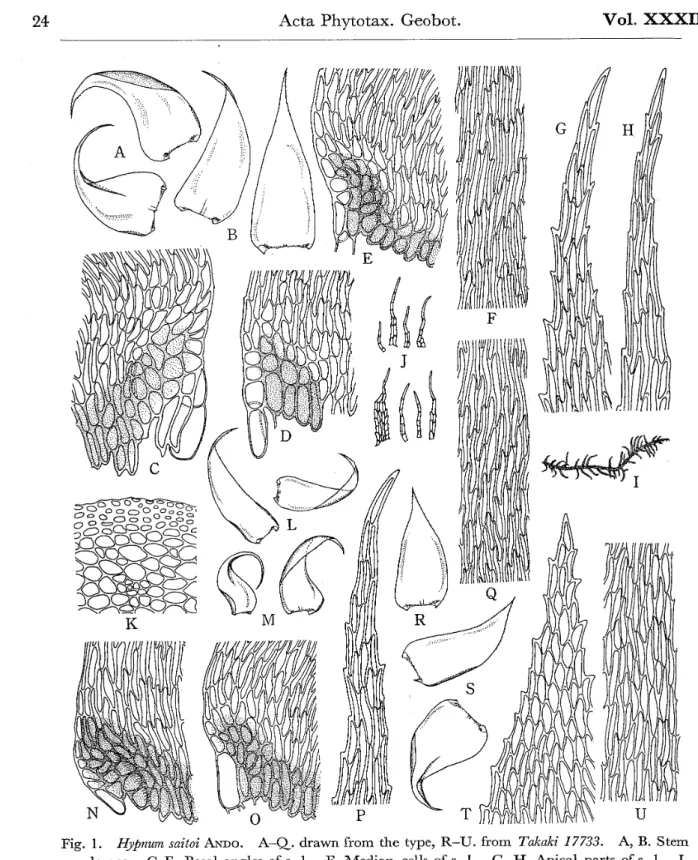
Fig. I. 2btPnuon
saitoiANDo. A-Q. drawn from
thetype, R,-U. from 72ikaki 17733.
Ieaves. C-E. Basal
anglcs ofs.-1.F. Medlan
cells efs.-1.G, H. Apical parts
ofs,-1.?lant. J. Pscudoparaphyllia, K. A part
of the cross-section ofstem.N,O.Basalanglesofb.-1. P,Apicalpartofbrl. Q.Mediancellsofb,-1
T. Apical part
ofs.-1. U.Median
cells ofs.-1.A, B, L, M, R, S,
×28; I,
others, ×270.
u
A, B. Stem
L
L,M. Branch leaves.
. R,S.Stemleaves.
×
1; J,
×67; the
sometimes more or
less
asymmetric atbase,
not or slightlydecurrent, from
a subcordatebase gradua!ly
narrowedinto
aIong,
rarely short acumen, scarcelyplicate;
marginssharply serrulate above,
plane,
sometimes slightly recurvedbelow;
costafaint
orindistinct;
The Japanese Society for Plant Systematics
NII-Electronic Library Service
The JapaneseSociety for Plant Systematics
April, 1982 Acta Phytotax, Geobot. 25
...-...-.- ...-... .. .t... ..
median cells
(40050-60(-70) psm long
and34 psm
widein lumen;
upper cells sometimespapillose
at upper angles;basal
cellsthicker-walled,
colored withyellow
atinsertion;
alar cells subquadrate to rectangular, usually
tinged
withbrown, 3-5
alongthe
margin,in 4-5
rows, sometimes accompaniedby
onete two larger, hyaline
cells atthe
extreme angles.Branch leaves
smaller and narrower oblong-lanceolate,O.9-1.2
rnmlong, O,25- O.35
mm wide; other characters almostthe
same asin
stemleaves. Sporophyte
unknown. Typus: Mt. Rakkodake-Mt. Tokachidake, 1370 m alt., Hokkaido, +Racomitrium
.f}zsciculare (Ieg. M. SAiTo; Aug. 4, l956; M, S,-26718 in HIRO).
Other specimens examined. Hokkaide. Mt. Rakkodake-Mt, Tokachidake,
+Raaomitriermfasciculare (leg. M. SAiTo; Aug. 4, 1956; M, S.-26720 in HIRO). Honshu.
Pref Nagano: Mt. Kisokoma,
nearthe
summit,2900
m alt., enhumus, +Dicranum
viridevar.
hakkodkense
andPohlia
sp.(leg. N. TAKAKi; July 22, 1957; AIL 7-:-17733 in HIRO);
Mt. Kimpuzan,
ongranite
rock underPinusPumila, +Pohlia
eruda(leg, I. NAGANo; July
26, 1952; L IVL-20I5 in HIRO).
Habitat. On
rocks orhumus in
the upper area ofthe subalpine zone wherePinus
Pumila
scrubspredominate.
Range. Endemic toJapan (Hokkaidoand Honshu) ;
apparently rare and diajunctive in
surnmit areas of high
mountains.
The specimens available for the
study are enly a few, but
they show some variations
in leaf features. A
collectionby Dr. N. TAKAKi from Mt. Kisokema includes plants in
which
leaves
are shorter-acuminate andlaminal
cells are sherter and wider,30-50 pam Iong
and4-5 pam
widein lumen (Fig. I
:R-U).
This
speciesis
not easyto
reco.crnize,but
a combination ofthe following
characters willprovide
aguide for identification: 1) plants
are small andloosely pinnate-branched;
2) leaves
are subcerdate and with sharply serrulate acumen;3) basal
cells ofleaves
areusually colored with
yellow to brown; 4)
alarparts
arediflerentiated,
consisting ofsub-quadrate to
rectangular cellsthat
are8-5
along the margin andin 4-5
rows;5)
upper cells ofleaves
are sometimespapillose
at upper angles;6) pseudoparaphyllia
arefilamen-
tous to
subfilamentous andlong.
In general
appearance,It7Pnum
saitoi most closely resemblesH. plicatulum (sect. Hamu-
losa)
which occupiesthe
samehabitat
onhigh
mountains ofJapan, andthe two
species are verydiMcult to
separatein
thefield, but H.
saitoiis distinguished
microscopicallyby
the
non-hyalodermous stem,the
marked!y serrulateleaves (almost
entirein H. plicatulum)
and
the better-differentiated
alar cells. As I once commented (ANDo, 1972), H,
saitei is
also comparable with South
American HL
skottsbergiiANDo (Chile
andArgentinai
sect.Plartilia), but the latter is diflerent in being
autoicous andhaving less
cordateleaves
narrowedinto
a moTe slenderacumen.
This
species, althoughits
sporophytehas
notbeen dctected, is
consideredto be placed
morc appropriately
in
sect.H)/Pnum
subsect.Lijpnum
whichis typified by HL
czipressijbrmeThe Japanese Society for Plant Systematics
NII-Electronic Library Service
The Japanese Sooiety for Plant Systematios
26 Acta
Phytotax .
Geobot . VoL
XXXIII
HEDw .
In
fact
, solne ofits characters are similarto
those
ofH.
cmψ
re∬7耀 ,
fbr
example ,pseudoparaphyllia
arc equally 且lamentous
to
subfilamentous , and alar cells ofthe
leaf
are well
differentiated
,fbrming
smallbut
clcarlyde
且ned areas.
In
the
small size ofplants
andthe
sharply serrulateleaves
with similar areolation ,H .
saitoibears
a
closest
resemb 至anceto .
仔.
cupre ∬の
侃 彦var.
fnamillatumBRiD .
alnong others , whichis
adistinct
raccd
圭stributedin
Europe
andthc
easternpart
ofNorth
America ,
hut
三t
differs
in
the
more conspicuously cordateleaves
andthe
lcss
dif
{brelltiated
alarparts
where subquadrate ce呈1s
are
3− 5
alongthe
margin as against7 − 12
in
∫H .
cupre∬zforme var.
mammillatum.
Acknowledgement
:Iam
grateful
to
Mr .
M
SAITo
whohas
kindly
supplied me with alarge
collection ofH )pnum
from
Hokkaido
andto
whomthe
name efthe new specieswas
dedicated .
斉 藤 実 氏 ( 元 北 海 道 立 教 育 研 究 所 長 )
より
,同
氏 が北 海
道各
地 で採 集
し たハ イゴヶ 属( Hyp −
num
)
の標 本
を多 数 分 け
て い た だいた が,
その中
に,外 観
はH ・plicatulum (
ミ ヤ マ チ リメ ン ゴヶ)
に極
めて よく 似
てい るが
,顕 微 鏡
で見
た茎
や葉
の形 質
は か なり異
っ て い る標 本 2 点
があ
っ た
。 共
に楽 古 岳 か ら十 勝 岳
にいた
る途 中
の海 抜 1370m
の地 点
で採 集 さ れ
たも
の であ
る。 その
後
,永
野巌 博 士 (埼
玉大 ) が 長 野 ・ 山 梨 県 境
にあ
る金 峰 山
の ハ イ マ ツ林 下
で,
ま た, 高 木 典 雄 博 士 (
元名 古
屋大
, 現愛 知 学 院 大 ) が 木 曽 駒
ケ岳
の頂
上付 近 (海 抜 2900m )
で採 集 さ れ
たも
の が同
じ種で あ る こと が分
っ た。 こ れ らの標 本
は いず れも不 実
であ
るた め,
胞子 体
の 形質
は不 明
であ る が, 配偶 体
の特 徴
だけ か ら
でも
,未 記 載
の種
であ
る と思 わ
れ た の で,Hypnum
saitoi と
命 名
して, 1972 年
に裸 名
のま ま 発 表
した( ANDo
,i
972 ) 。
そ
れ 以 来 , 胞 子 体
をつ けた標本
に出く
わ す こ とを期
待 して きた が, 1 点
の追加 標 本
す ら得
ら れ ない ま ま現 在
に至
っ た。 上 記の ハ イゴケ属
セ ン類
が新 種
で あ る とい う 確 信 は,世 界 中
の ハ イゴ
ヶ
属の研 究
を さ ら に進
め て き た今
で は一 層 強 く , ま
た完 全 標 本
が得 られ
る可 能 性
も少
い と思 わ れ
るの で, 配
偶体
だ けに基く も
の で あ る が, こ こ に 正式
に記 載 文
をつ けて発表
す る こ とに した
。先 述 し
た よう
に,本 種 は
,同
じく高 山
のハ イマ ツ林
な どに分 布
す るH .plicatulum
に よく似
て い る
が
, これ
は外 観 的
な相 似
にす ぎ ず
,顕 微 鏡 下
で は,茎
の最 外 層
の細 胞
が分 化
せず , 葉
に明 瞭
な鋸 歯
があ
り,方
形の翼 細 胞
が多
い こ とで は っき
り区 別
され
る( H .plicatulum
で は,茎
の
最 外 層
の細 胞
が内 側
に隣 接 す
る もの より大
きく
,薄 膜
であり
, 葉 は ほと
ん ど 全縁
で,翼 細 胞
の
分
化 が 少 ない)
。葉
の翼 部
が比 較 的
よ く分 化
し てい ること
,偽 毛 葉 が 糸 状
〜狭 披 針 形
であ
るこ と な どの点
で, 本 種
はH .
cupress 三forme (
ハ イ ヒノs’
ゴ ヶ
)
に近 縁であ り , 本
属 の分 類 体 系
の上
で は, それ と 同 じ
ハ イ ゴ ケ節
のハ イ ゴケ亜 節
に入
ると 思わ れ
る。H .
cupressiforme は熱帯
地 域 を除
い て世 界
の
両 半 球
に広 く分 布
す る 種で, し かも
セ ン類中 第 一
といわ れ
る程 多
型の種
であり
,
多 数
の変 種
や品 種
が発 表
さ れて い る が,
その中
の一
っ,
H .
cupressiforme var.
mammillatum(
ヨー
ロ ッパと
北 米 東 部
に分 布 し ,
日本
に は見 られ
ない)
が, 本 種
にも
っ とも
よく
似て いる よ うであ
る。 し か し, var.
mammillatum は,葉
の 基部
が本
種 ほ ど心臓 形
に ならず , 方 形
の翼 細 胞
が はるかに多
い( H .
saitoi では葉 縁
に沿
っ て3 〜 5 個
であ
る が var.
mammillatum で は7 〜12 個
であ
る) 点
で異
っ て い る。N工 工
一
Eleotronio LibraryThe Japanese Society for Plant Systematics
NII-Electronic Library Service
The Japanese Sooiety for Plant Systematios
April
,1982 Acta
Phytotax .
Geobot . 27
H .
saitoi は高 山
生で,今
の所
, 日本
の3 産 地
から知 られ
るの みで,極
めて稀
産の種 であ
る と 思わ れ
る。Reference
ANDo
,H . 1972 .
DiStributien
and speCiationin
thegenus
H
)pnum
in
the
circum−
Pacific region.
J .
Hattori
Bot ,
Lab . 35
;68− 98 .
小 山 博 滋
:ハ マグ
ルマと
オオハ マグ
ル マオ オハ マ グル マ はハ マ グル マ の
変 種
と して記載
さ れ た( MAKINO , 1917 )
が, そ れ よ り前
に( MAKINo , 1890 )
, 別 種 と して認 識 さ れ た も
の で ある。 52 年 後
に再
び種
とし て区
別 さ れて以来
,今 EI ま
で こ の扱
い( KITAMuRA ,1942 )
に対 す
る異論
は出
て い な い( HARA
,1952
;OHwI
,1956
;HATuslMA
,1975
;KITAM .
et aL ,1981
な ど)
。 ハ マグ
ル マ の分 布 域
が西
日本
から
,済 州 島
,琉 球
,小 笠 原
,台 湾
,中 国
,印 度 支
那, タ イ国
に 至 るのlc 対
し, オ オハ マグ
ル マ の それ
は狭 く ,
西
南
日本 か ら台 湾 ま
で であ
る。こ れ ら
両
者 は葉
の 形 と大 き
さお よ び質
, 頭花 数
,果 実
の大
き さにみ ら れ る 違 い によ っ て区
別 され
て い る が, ど ち ら とも
い い が たい標本
に し ば し ば出 会 う
。 オ オハ マグ
ル マ の葉
は卵 形
で,葉 身
の長 さ5cm
,巾 2 . 5
cm内 外
のも
のが 多 く
, ハ マグ
ル マ のそれ
は 長楕
円 形で長
さ3cm
,巾 Icm
位 のも
のが多
い 。 し か し,葉
の形
と大 き
さ は個 体 内
でも 匍匐 枝
と斜
上枝
とで異 な る など 変 異
が大
きい。葉
形 は 卵 形 か ら 長楕
円 形へ ,大
き さ は長
さ1c111
から 12
cmま
で連 続 的
に変 異
し, こ の間
にギ
ャ ップ
は認
められ
ない。斜 上 枝
に頂 生 す
る 頭花
は頂 芽
の み が 発 達 す る と1 個
と なり
, 側芽 も
それ ぞ れ 発 達す
る と3 個
と な る。 ハ マ グル マ で は1
個, オ オハ マグ
ル マ で は3 個
のも
のが 多
い が,個 体 内
で斜
上枝
に よっ て頭 花 数
が異
な ることが あ
る。3 個
の頭花 を
つけ
た斜 上 枝
と左
右の頭花
の代 り
に2 本
の側 枝 を
つけ
た斜
上枝
を 同一 個体
に見
るこ とが あ
る など
頭花 数 も中 間
型 が あ っ て連続 す
る。他
に両 者
を 明瞭
に区
別 し 得 る よ う な 形質
が見 あ
たら
ない ので , これ
ら
は 互に種 関 係
にあ
る という
より
,変 種 関 係
にあ
る と見
る方
が自 然
であ
ると 考
え る。な お, ハ マ
グ
ル マ の学 名
は命 名 規 約 第 72 条
に より
,Wedelia
prostrata
HEMsLEy
と し なけ
れ ば な ら ない 。
Wedelia prostrata
HEMsLEY
in
Journ .
Linn .
Soc .
Bot . 23
:434 ( 1888 )
;OHwI
,Fl .
Jap . 1200 ( 1956 )
,Eng .
ed. 900 ( 1965 )
;KITAM .
in
Acta
Phytotax .
Geobot . 24
:18 ( 1969 )
;HATuslMA
,Fl .
Ryukyus
,630 ( 1975 )
;LAuENER
in
Notes
Roy .
Bot .
Gard .
Edinb . 34
;349 ( 1976 )
,incl,
syn.
;LI
,FL
Taiwan
,IV
;961 ( 1978 );LING
, FI .
Reipub .
PopuL
Sin . 75
:
353 ( 1979 )
;KITAM .
et
aL (】olL
IIL
Herb .
Pl .
Jap . ( Sym . ) 64
,pL
20 − 151 ( 1981 ) .
Verbesina prostrata
HooK .
et ARN .
, Bot .
Beeche ゾ
s Voy .195 ( 1837 ), non I. .(1753 ).
var . robusta MAKINo in
Journ ・ Jap .
Bot ・ 1
:23
, fig ・ 2 ( 1917 ) ・
躍
.
robusta( MAKINo ) KITAM . Comp .
Jap .
III
:258 ( 1942 )
;HARA
,Enum 、
Sperm .
Jap .
II
:279 ( 1952 );OHwl
, Fl .
Jap . 1199 ( 1956 ), EIlg .
ed . 900 ( 1965 );HATusIMA
, Fl.
EIlg .
ed. 900 ( 1965 );HATusIMA
, Fl.
Ryukyus
,630 ( 1975 );KITAM .
et aL ColL
Ill .
Herb .
Pl .
Jap , ( Symp . ) Rev .
ed . 64 ( 1981 ) .
罪 .岬
or¢ DC . ’
:
MAKINo
in
Bot .
Mag .
Tokyo
4
:87 ( 1890)。
( H .KoyAMA )
N工 工