RIMS-1521 MATRIX FACTORIZATIONS AND REPRESENTATIONS OF QUIVERS II:
TYPE ADE CASE
HIROSHIGE KAJIURA, KYOJI SAITO, AND ATSUSHI TAKAHASHI
Abstract. We study a triangulated category of graded matrix factorizations for a polyno- mial of type ADE. We show that it is equivalent to the derived category of finitely generated modules over the path algebra of the corresponding Dynkin quiver. Also, we discuss a spe- cial stability condition for the triangulated category in the sense of T. Bridgeland, which is naturally defined by the grading.
Contents
1. Introduction 1
2. Triangulated categories of matrix factorizations 3
2.1. The triangulated category HMFA(f) of matrix factorizations 3 2.2. The triangulated category HMFgrR(f) of graded matrix factorizations 6 3. HMFgrR(f) for type ADE and representations of Dynkin quivers 10
3.1. Statement of the main theorem (Theorem 3.1) 10
3.2. The proof of Theorem 3.1 13
4. A stability condition on HM FgrR(f) 22
5. Tables of data for matrix factorizations of type ADE 24
References 35
1. Introduction
The universal deformation and the simultaneous resolution of a simple singularity are described by the corresponding simple Lie algebra (Brieskorn [Bs]). Inspired by that theory, the second named author associated in [Sa2],[Sa4] a generalization of root systems, consisting of vanishing cycles of the singularity, to any regular weight systems [Sa1], and asked to construct a suitable Lie theory in order to reconstruct the primitive forms for the singularities.
In fact, the simple singularities correspond exactly to the weight systems having only positive exponents, and, in this case, this approach gives the classical finite root systems as in [Bs].
Date: November 7th, 2005.
1
As the next case, the approach is worked out for simple elliptic singularities corresponding to weight systems having only non-negative exponents, from where the theory of elliptic Lie algebras is emerging [Sa2]. However, the root system in this approach in general is hard to manipulate because of the transcendental nature of vanishing cycles. Hence, he asked ([Sa4], Problem in p.124 in English version) an algebraic and/or a combinatorial construction of the root system starting from a regular weight system.
In [T2], based on the mirror symmetry for the Landau-Ginzburg orbifolds and also based on the duality theory of the weight systems [Sa3],[T1], the third named author proposed a new approach to the root systems, answering to the above problem. He introduced a triangulated category DbZ(Af) of graded matrix factorizations for a weighted homogeneous polynomial f attached to a regular weight system and showed that the categoryDZb(Af) for a polynomial of typeAl is equivalent to the bounded derived category of modules over the path algebra of the Dynkin quiver of type Al. He conjectured ([T2], Conjecture 1.3) further that the same type of equivalences hold for all simple polynomials of type ADE. The main goal of the present paper is to answer affirmatively to the conjecture.
One side of this conjecture: the properties of the category of modules over a path al- gebra of a Dynkin quiver are already well-understood by the Gabriel’s theorem [Ga], which states that the number of the indecomposable objects in the category for a Dynkin quiver co- incides with the number of the positive roots of the root system corresponding to the Dynkin diagram. The other side of the conjecture: the triangulated categories of (ungraded) matrix factorizations were introduced and developed by Eisenbud [E] and Kn¨orrer [K] in the study of the maximal Cohen-Macaulay modules. Recently, the categories of matrix factorizations are rediscovered in string theory as the categories of topological D-branes of type B in Landau- Ginzburg models (see [KL1],[KL2]). The category DbZ(Af) of graded matrix factorizations is then motivated by the work on the categories of topological D-branes of type B in Landau- Ginzburg orbifolds (f,Z/hZ) by Hori-Walcher [HW], where the orbifolding corresponds to introducing the Q-grading. In fact, in [T2], the triangulated categoryDbZ(Af) is constructed from a specialA∞-category withQ-grading via the twisted complexes in the sense of Bondal- Kapranov [BK]. Independently, D. Orlov defines a triangulated category, called the category of graded D-branes of type B, which is in fact equivalent toDZb(Af) (see the end of subsection 2.2). Though some notions, for instance the central charge of the stability condition (see sec- tion 4), can be understood more naturally in DbZ(Af), the Orlov’s construction of categories requires less terminologies and is easier to understand in a traditional way in algebraic geom- etry. Therefore, in this paper we shall use the Orlov’s construction with a slight modification of the scaling of degrees and denote the modified category by HMFgrR(f).
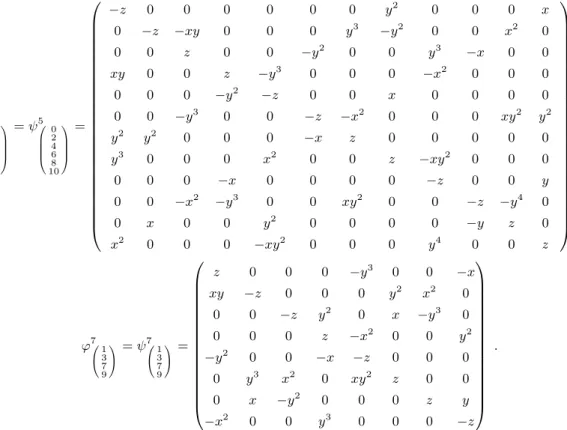
Let us explain details of the contents of the present paper. In section 2, we recall the construction of triangulated categories of matrix factorizations. Since we compare the category HM FRgr(f) with the ungraded version HMFO(f) in the proof of our main theorem (Theorem 3.1), we first introduce the ungraded versionHMFO(f) corresponding to that given in [O1] in subsection 2.1, and then we define the graded version HMFRgr(f) based on [O2] in subsection 2.2, where we also explain the relation of the categoryHM FRgr(f) with the category DbZ(Af) introduced in [T2]. Section 3 is the main part of the present paper. In subsection 3.1, we state the main theorem (Theorem 3.1): for a polynomial f of type ADE, HM FRgr(f) is equivalent as a triangulated category to the bounded derived category of modules over the path algebra of the Dynkin quiver of type of f. Subsection 3.2 is devoted to the proof of Theorem 3.1. The proof is based on various explicit data on the matrix factorizations; the complete list of the matrix factorizations (Table 1), their gradings (Table 2) and the complete list of the morphisms in HMFRgr(f) (Table 3). The tables are arranged in the final section (section 5). In section 4, we construct a stability condition, the notion of which is introduced by Bridgeland [Bd], for the triangulated category HMFRgr(f). One can see that, as in the Al case [T2], the phase of objects (see Theorem 3.6 or Table 2) and the central charge Z (Definition 4.1) can be naturally given by the grading of matrix factorizations in Table 2 (c.f.
[W]). They in fact define a stability condition on HMFRgr(f) (Theorem 4.2), from which an abelian category is obtained as a full subcategory of HMFRgr(f). In Proposition 4.3, we show that this abelian category is equivalent to an abelian category of modules over the path algebra C∆~principal, where ∆~principal is the Dynkin quiver with the orientation being taken to be the principal orientation introduced in [Sa5].
Acknowledgement : We are grateful to M. Kashiwara and K. Watanabe for valuable discussions. This work was partly supported by Grant-in Aid for Scientific Research grant numbers 16340016, 17654015 and 17740036 of the Ministry of Education, Science and Culture in Japan. H. K is supported by JSPS Research Fellowships for Young Scientists.
2. Triangulated categories of matrix factorizations
In this section, we set up several definitions which are used in the present paper. The goal of this section is the introduction of the categories HMFA(f) and HM FgrA(f) attached to a weighted homogeneous polynomial f ∈A following [O1],[O2] with slight modifications.
2.1. The triangulated category HMFA(f) of matrix factorizations.
Let A be either the polynomial ring R := C[x, y, z], the convergent power series ring O :=
C{x, y, z} or the formal power series ring ˆO:=C[[x, y, z]] in three variablesx, y and z.
Definition 2.1 (Matrix factorization). For a polynomial f ∈A, a matrix factorizationM of f is defined by
M :=
³
P0 p0 // P1
p1
oo
´ ,
where P0, P1 are right free A-modules of finite rank, and p0 : P0 → P1, p1 : P1 → P0 are A-homomorphisms such that p1p0 = f ·1P0 and p0p1 = f ·1P1. The set of all matrix factorizations of f is denoted by MFA(f).
Sincep0p1 andp1p0 are f times the identities, wheref is nonzero element ofA, the rank of P0 coincides with that of P1. We call the rank the size of the matrix factorization M. Definition 2.2 (Homomorphism). Given two matrix factorizations M := (P0
p0
//P1
p1
oo ) and M0 := (P00 p
00
//P01
p01
oo ), ahomomorphismΦ :M →M0is a pair ofA-homomorphisms Φ = (φ0, φ1) φ0 :P0 →P00 , φ1 :P1 →P10 ,
such that the following diagram commutes:
P0 p0 //
φ0
²²
P1 p1 //
φ1
²²
P0
φ0
²²
P00 p
00
// P01 p
01
// P00 .
The set of all homomorphisms from M toM0, denoted by HomMFA(f)(M, M0), is naturally an A-module and is finitely generated, since the sizes of the matrix factorizations are finite. For three matrix factorizationsM,M0,M00and homomorphisms Φ :M →M0and Φ0 :M0 →M00, the composition Φ0Φ is defined by
Φ0Φ = (φ00φ0, φ01φ1) .
This composition is associative: Φ00(Φ0Φ) = (Φ00Φ0)Φ for any three homomorphisms.
Definition 2.3 (HM FA(f)). An additive category HM FA(f) is defined by the following data. The set of objects is given by the set of all matrix factorizations:
Ob(HMFA(f)) := MFA(f) .
For any two objects M, M0 ∈MFA(f), the set of morphisms is given by the quotient module:
HomHM FA(f)(M, M0) = HomMFA(f)(M, M0)/∼ ,
where two elements Φ, Φ0 in HomMFA(f)(M, M0) are equivalent (homotopic) Φ ∼ Φ0 if there exists a homotopy (h0, h1), i.e., a pair (h0, h1) : (P0 → P10, P1 → P00) of A-homomorphisms
such that Φ0−Φ = (p01h0+h1p0, p00h1+h0p1). The composition of morphisms on HomHM FA(f) is induced from that on HomMFA(f) since Φ∼Φ0 and Ψ∼Ψ0 imply ΨΦ∼Ψ0Φ0.
Note that the matrix factorization M = (P0 p0 //P1
p1
oo ) ∈ MFA(f) of size one with (p0, p1) = (1, f) or (p0, p1) = (f,1) defines the zero object in HMFA(f), that is: one has HomHM FA(f)(M, M0) = HomHM FA(f)(M0, M) = 0 for any matrix factorization M0 ∈ MFA(f) or, equivalently, 1M ∈HomMFA(f)(M, M) is homotopic to zero.
Lemma 2.4. For any two matrix factorizations M, M0 ∈HMFA(f), the space of morphisms HomHM FA(f)(M, M0) is a finitely generated A/
³∂f
∂x,∂f∂y,∂f∂z
´
-module.
Proof. Since HomMFA(f)(M, M0) is a finitely generated A-module and the equivalence re- lation ∼ is given by quotienting out by an A-submodule, HomHM FA(f)(M, M0) is also a finitely generated A-module. On the other hand, the Jacobi ideal ³
∂f
∂x,∂f∂y,∂f∂z´
annihilates HomHM FA(f)(M, M0): that is, ∂f∂x(φ0, φ1) ∼ ∂f∂y(φ0, φ1) ∼ ∂f∂z (φ0, φ1) ∼ 0 for any mor- phism Φ = (φ0, φ1). This can be shown for instance by differentiating p1p0 = f · 1P0 and p0p1 = f · 1P1 by ∂x∂ . Then we have two identities ∂p∂x1p0 +p1∂p∂x0 = ∂f∂x · 1P0 and
∂p0
∂xp1+p0∂p∂x1 = ∂x∂f ·1P1. Multiplying φ0 and φ1 by these two identities, respectively, leads to
∂f
∂x(φ0, φ1)∼0, where (φ1∂p0
∂x, φ0∂p1
∂x) is the corresponding homotopy. In a similar way one can
obtain ∂f∂y(φ0, φ1)∼ ∂f∂z (φ0, φ1)∼0. ¤
Definition 2.5 (Shift functor). The shift functor T : HMFA(f) →HMFA(f) is defined as follows. The action of T onM = (P0 p0 //P1
p1
oo )∈HM FA(f) is given by
T³
P0 p0 // P1
p1
oo
´ :=³
P1 −p1 // P0
−p0
oo
´ .
For any M, M0 ∈HM FA(f), the action of T on Φ = (φ0, φ1)∈HomHM FA(f)(M, M0) is given by
T(φ0, φ1) := (φ1, φ0) .
Note that the square T2 of the shift functor is isomorphic to the identity functor on HMFA(f).
Definition 2.6 (Mapping cone). For an element Φ = (φ0, φ1) ∈ HomMFA(f)(M, M0), the mapping cone C(Φ)∈MFA(f) is defined by
C(Φ) :=
³
C0 c0 // C1
c1
oo
´
, where
C0 :=P1⊕P00 , C1 :=P0⊕P10 , c0 =
Ã−p1 0 φ1 p00
!
, c1 =
Ã−p0 0 φ0 p01
! .
The following is stated in [O1] Proposition 3.3.
Proposition 2.7. The additive category HMFA(f) endowed with the shift functor T and the distinguished triangles forms a triangulated category, where a distinguished triangle is a sequence of morphisms which is isomorphic to the sequence
M →Φ M0 →C(Φ)→T(M) for some M, M0 ∈MFA(f) and Φ∈HomMFA(f)(M, M0).
Proof. The proof is the same as the proof of the analogous result for a usual homotopic
category (see e.g. [GM], [KS]). ¤
2.2. The triangulated category HMFgrR(f) of graded matrix factorizations.
In this subsection, we study graded matrix factorizations for a weighted homogeneous poly- nomial f and construct the corresponding triangulated category, denoted by HM FgrR(f).
A quadrupleW := (a, b, c;h) of positive integers with g.c.d(a, b, c) = 1 is called aweight system. For a weight system W, we define theEuler vector field E =EW by
E := a hx ∂
∂x + b hy ∂
∂y + c hz ∂
∂z .
For a given weight system W, R becomes a graded ring by putting deg(x) = 2ah, deg(y) = 2bh and deg(z) = 2ch. Let R =⊕d∈2
hZ≥0Rd be the graded piece decomposition, where Rd:={f ∈ R | 2Ef = df} . A weight system W is called regular ([Sa1]) if the following equivalent conditions are satisfied:
(a) χW(T) :=T−h(Th(T−Ta−1)(Ta)(Thb−T−1)(Tb)(Tch−1)−Tc) has no poles except atT = 0.
(b) A generic element of the eigenspace R2 ={f ∈R | Ef =f} has an isolated critical point at the origin, i.e., the Jacobi ring R/
³∂f
∂x,∂f∂y,∂f∂z
´
is finite dimensional over C.
Such an element f of R2 as in (b) shall be called a polynomial of type W.
In the present paper, by a graded module, we mean a graded right module with degrees only in h2Z. Namely, a graded R-modulePe decomposes into the direct sum:
Pe =⊕d∈2
hZPed . (2.1)
For two graded R-modules Pe and Pe0, a graded R-homomorphism φ of degree s ∈ h2Z is an R-homomorphism φ : Pe → Pe0 such that φ(Ped) ⊂ Ped+s0 for any d. The category of graded R-modules has a degree shifting automorphismτ defined by 1
(τ(Pe))d =Ped+2
h .
For any two gradedR-modulesPe,Pe0 and a gradedR-homomorphismφ :Pe→Pe0, we denote the induced graded R-homomorphism by τ(φ) : τ(Pe) → τ(Pe0). On the other hand, an R- homomorphism φ :Pe →Pe0 of degree 2mh induces a degree zero R-homomorphism from Pe to τm(Pe0), which we denote again by φ:Pe →τm(Pe0).
Definition 2.8(Graded matrix factorization). For a polynomialfof typeW, agraded matrix factorization Mfof f ∈R is defined by
Mf:=
³ Pe0
p0
// eP1
p1
oo
´ ,
where Pe0, Pe1 are free graded right R-modules of finite rank, p0 : Pe0 → Pe1 is a graded R- homomorphism of degree zero,p1 :Pe1 →Pe0 is a gradedR-homomorphism of degree two such that p1p0 = f ·1Pe0 and p0p1 = f ·1Pe1. The set of all graded matrix factorizations of f is denoted by MFRgr(f).
Definition 2.9(Homomorphism).Given two graded matrix factorizationsM,f Mf0 ∈MFRgr(f), a homomorphism Φ = (φ0, φ1) :Mf→ Mf0 is a homomorphism in the sense of Definition 2.2 such that φ0 and φ1 are graded R-homomorphisms of degree zero. The vector space of all graded R-homomorphisms from MftoMf0 is denoted by HomMFRgr(f)(M,f Mf0).
For three graded matrix factorizations M,f Mf0,Mf00 ∈ MFRgr(f) and morphisms Φ : Mf → Mf0, Φ0 : Mf0 → Mf00, the composition is again a graded R-homomorphism: Φ0Φ ∈ HomMFgr
R(f)(M,f Mf00).
Definition 2.10 (HMFgrR(f)). An additive category HM FgrR(f) of graded matrix factoriza- tions is defined by the following data. The set of objects is given by the set of all graded matrix factorizations:
Ob(HMFgrR(f)) := MFRgr(f).
For any two objects M,f Mf0 ∈MFRgr(f), the set of morphisms is given by HomHM Fgr
R(f)(M,f Mf0) := HomMFgr
R(f)(M,f Mf0)/∼ ,
where two elements Φ, Φ0 in HomMFRgr(f)(M,f Mf0) are equivalent Φ ∼ Φ0 if there exists a homotopy, i.e., a pair (h0, h1) : (Pe0 → Pe10,Pe1 → Pe00) of graded R-homomorphisms such that
1Thisτ is what is often denoted (for instance [Y],[O2]) by (1),i.e. ,τ(Pe) =P(1).e
h0 is of degree minus two,h1 is of degree zero and Φ0−Φ = (τ−h(p01)h0+h1p0, p00h1+τh(h0)p1).
The composition of morphisms is induced from that on HomMFRgr(f)(M,f Mf0).
A graded matrix factorization is the zero object in HM FgrR(f) if and only if it is a direct sum of the graded matrix factorizations of the forms (τn(R) 1 //τn(R)
f
oo ) ∈ MFgrR (f)
and (τn0(R) f //τn0+h(R)
1
oo )∈MFgrR (f) for somen, n0 ∈Z.
Lemma 2.11. The category HMFgrR(f) is Krull-Schmidt, that is,
(a) for any two objects M,f Mf0 ∈HMFgrR(f), HomHM FgrR(f)(M,f Mf0) is finite dimensional;
(b) for any object Mf∈HMFgrR(f)and any idempotent e∈HomHM FgrR(f)(M,f Mf), there exists a matrix factorization Mf0 ∈HMFgrR(f) and a pair of morphisms Φ∈HomHM Fgr
R(f)(M,f Mf0), Φ0 ∈HomHM FgrR(f)(Mf0,Mf) such that e= Φ0Φ and ΦΦ0 = IdMf0.
Proof. (a) Due to Lemma 2.4, ⊕n∈ZHomHM Fgr
R(f)(M, τf n(Mf0)) is a finitely generated graded R/
³∂f
∂x,∂f∂y,∂f∂z
´
-module. Since the Jacobi ringR/
³∂f
∂x,∂f∂y,∂f∂z
´
is finite dimensional, the space HomHM Fgr
R(f)(M,f Mf0) is finite dimensional overC.
(b) Let R+ be the maximal ideal of R of all positive degree elements. Note that any graded matrix factorization is isomorphic in HMFgrR(f) to a graded matrix factoriza- tion whose entries belong to τn(R+) for some n ∈ Z. Thus, we may assume that Mf :=
(Pe0oo pp10 //Pe1)∈HM FgrR(f) is such a graded matrix factorization. Suppose thatMfhas an idem- potente∈HomHM FgrR(f)(M,f Mf),e2 =e. This implies that there exists ˆe∈HomMFRgr(f)(M,f Mf) such that
ˆ
e2−ˆe= (τ−h(p1)h0+h1p0, p0h1+τh(h0)p1) (2.2) for some homotopy (h0, h1) on HomHM FgrR(f)(M,f Mf). However, since each entry of p0 and p1 belongs to τn(R+), each entry in the right hand side also belongs to τn(R+). Let π : HomMFgr
R(f)(M,f Mf) → HomMFgr
R(f)(M,f Mf) be the canonical projection given by restricting each entry on R/R+ = C. Then, eq.(2.2) in fact implies that π(ˆe)2 −π(ˆe) = 0. Thus, for π(ˆe) =: (ˆe0,ˆe1), defining a matrix factorization Mf0 ∈HM FgrR(f) by
Mf0 :=
³ ˆ e0Pe0
ˆ e1p0ˆe0
// ˆe1eP1
ˆ e0p1ˆe1
oo
´ ,
one obtains a pair of morphisms Φ ∈ HomHM FgrR(f)(M,f Mf0) and Φ0 ∈ HomHM FgrR(f)(Mf0,Mf)
such that e= Φ0Φ and ΦΦ0 = IdMf0. ¤
One can see that τ induces an automorphism on HMFgrR(f), which we shall denote by the same notation τ : HMFgrR(f) → HMFgrR(f). Explicitly, the action of τ on Mf =
(Pe0oo pp01 //Pe1)∈HM FgrR(f) is given by
τ
³ Pe0
p0
// eP1
p1
oo
´ :=
³ τ(Pe0)
τ(p0)
// τ(eP1)
τ(p1)
oo
´ .
The action of τ on morphisms are naturally induced from that on graded R-homomorphisms between two graded right R-modules.
Also, we have the shift functorT onHMFR(f), the graded version of that in Definition 2.5. 2
Definition 2.12(Shift functor onHMFgrR(f)). Theshift functorT :HM FgrR(f)→HM FgrR(f) is defined as follows. The action of T onMf∈HMFgrR(f) is given by
T
³ Pe0
p0
// eP1
p1
oo
´
=
³ Pe1
−p1
// τh(eP0)
−τh(p0)
oo
´ .
For any M,f Mf0 ∈ HMFgrR(f), the action of T on Φ = (φ0, φ1) ∈ HomHM FgrR(f)(M,f Mf0) is given by
T(φ0, φ1) = (φ1, τh(φ0)) .
We remark that the square T2 of the shift functor is not isomorphic to the identity functor on HMFgrR(f) but T2 =τh.
Definition 2.13 (Mapping cone). For an element Φ = (φ0, φ1) ∈ HomMFRgr(f)(M,f Mf0), the mapping cone C(Φ)∈MFRgr(f) is defined by
C(Φ) :=
³
C0 c0 // C1
c1
oo
´
,where
C0 :=Pe1⊕Pe00 , C1 :=τh(Pe0)⊕Pe10 , c0 =
Ã−p1 0 φ1 p00
!
, c1 =
Ã−τh(p0) 0 τh(φ0) p01
! .
This mapping cone is well-defined. In fact, one can see that the degree of c0 and c1 are zero and two, since the graded R-homomorphisms p1 : Pe1 → Pe0 of degree two and p0 : Pe0 → Pe1 of degree zero induce graded R-homomorphisms −p1 : Pe1 → τh(Pe0) of degree zero and −τh(p0) :τh(Pe0)→Pe1 of degree two, respectively.
The following is stated in [O2] Proposition 3.4.
2The shift functor T is often denoted by [1].
Theorem 2.14. The additive category HM FgrR(f) endowed with the shift functor T and the distinguished triangles forms a triangulated category, where a distinguished triangle is defined by a sequence isomorphic to the sequence
Mf→Φ Mf0 →C(Φ)→T(Mf) for some M,f Mf0 ∈MFRgr(f) and Φ∈HomMFRgr(f)(M,f Mf0).
Proof. As in the case for HMFA(f), the proof is the same as the proof of the analogous result for a usual homotopic category (see e.g. [GM], [KS]). ¤
Let Mf = (Pe0 pp0 //Pe1
1
oo ) ∈ HMFgrR(f) be a graded matrix factorization of size r. One can choose homogeneous free basis (b1,· · · , br; ¯b1,· · · ,¯br) such thatPe0 =b1R⊕ · · · ⊕brR and Pe1 = ¯b1R⊕ · · · ⊕¯brR. Then, the graded matrix factorization Mf is expressed as a 2r by 2r matrix
Q=
à ϕ
ψ
!
, ϕ, ψ∈Matr(R) (2.3)
satisfying
Q2 =f·12r , −SQ+QS+ 2EQ=Q , (2.4) where S is the diagonal matrix of the form S := diag(s1,· · · , sr; ¯s1,· · · ,¯sr) such that si = deg(bi) and ¯si = deg(¯bi)−1 for i= 1,2,· · · , r. We call this S a grading matrix of Q.
This procedure Mf 7→ (Q, S) gives the equivalence between the triangulated category HMFgrR(f) and the triangulated category DbZ(Af) in [T2]. This implies that HMFgrR(f) is an enhanced triangulated category in the sense of Bondal-Kapranov [BK].
We shall represent the matrix factorization Mf= (Pe0 pp0 //Pe1
1
oo ) by (Q, S).
3. HM FgrR(f) for type ADE and representations of Dynkin quivers In this section, we formulate the main theorem (Theorem 3.1) of the present paper in subsection 3.1. The proof of the theorem is given in subsection 3.2.
3.1. Statement of the main theorem (Theorem 3.1).
The main theorem states an equivalence between the triangulated category HM FgrR(f) for a polynomial f ∈ R of type ADE with the derived category of modules over a path algebra
of a Dynkin quiver. In order to formulate the results, we recall (i) the weighted homogeneous polynomials of type ADE and (ii) the notion of the path algebras of the Dynkin quivers.
(i)ADE polynomials. For a regular weight system W, we have the following facts [Sa1].
(a) There exist integers m1,· · · , ml, called the exponents of W, such that χW(T) = Tm1 +
· · ·+Tml, where the smallest exponent is given by²:=a+b+c−h.
(b) The regular weight systems with ² >0 are listed as follows.
Al : (1, b, l+ 1−b;l+ 1) ,1≤b≤l , Dl: (l−2,2, l−1; 2(l−1)) ,
E6 : (4,3,6; 12) , E7 : (6,4,9; 18) , E8 : (10,6,15; 30) . (3.1) Here, the naming in the left hand side is given according to the identifications of the exponents of the weight systems with those of the simple Lie algebras. As a consequence, one obtains
² = 1 for all regular weight system with ² > 0. For the polynomials of type ADE, without loss of generality we may choose the followings:
f(x, y, z) =
xl+1+yz, h=l+ 1, Al (l ≥1), x2y+yl−1+z2, h= 2(l−1), Dl (l≥4), x3+y4+z2, h= 12, E6,
x3+xy3+z2, h= 18, E7, x3+y5+z2, h= 30, E8 . We denote by X(f) the type off.
(ii) Path algebras. (a) The path algebra C∆ of a~ quiver is defined as follows (see [Ga], [R] and [Ha] Chapter 1, 5.1). A quiver ∆ is a pair (∆~ 0,∆1) of the set ∆0 of vertices and the set ∆1 of arrows (oriented edges). Any arrow in ∆1 has a starting point and end point in ∆0. A path of length r ≥ 1 from a vertex v to a vertex v0 in a quiver ∆ is of the form~ (v|α1,· · · , αr|v0) with arrows αi ∈ ∆1 satisfying the starting point of α1 is v, the end point of αi is equal to the starting point of αi+1 for all 1≤i≤r−1, and the end point of αr is v0. In addition, we also define a path of length zero (v|v) for any vertexv in∆. The~ path algebra C∆ of a quiver~ ∆ is then the~ C-vector space with basis the set of all paths in ∆. The product~ structure is defined by the composition of paths, where the product of two non-composable paths is set to be zero.
The category of finitely generated right modules over the path algebra C∆ is denoted~ by mod -C∆. It is an abelian category, and its derived category is denoted by~ Db(mod -C∆).~
If ∆0 and ∆1 are finite sets and ∆ does not have any oriented cycle, then Db(mod -C∆) is a~ Krull-Schmidt category.
(b) A Dynkin quiver ∆~X of type X of ADE is a Dynkin diagram ∆X of type X listed in Figure 1 together with an orientation for each edge of the Dynkin diagram. It is known [Ga]
that the number of all the isomorphism classes of the indecomposable objects of the abelian category mod -C∆ of a quiver~ ∆ is finite if and only if the quiver~ ∆ is a Dynkin quiver (of~ type ADE).
•1 •2 · · · •b · · · · · •l−1 •l : X =Al ,
•l−1
•1 •2 · · · · · •l−3 •l−2 •l : X =Dl ,
•1
•5 •3 •2 •4 •6 : X =E6 ,
•5
•7 •6 •4 •3 •2 •1 : X =E7 ,
•8
•1 •2 •3 •4 •5 •6 •7 : X =E8 . FIGURE1. ADE Dynkin diagram
For a Dynkin diagram ∆X, we shall denote by ΠX the set of vertices. For later convenience, the elements of ΠX are labeled by the integers{1,· · · , l} as in the above figures, and we shall sometimes confuse vertices in ΠX with labels in {1,· · · , l}.
The following is the main theorem of the present paper.
Theorem 3.1. Let f(x, y, z) ∈ C[x, y, z] be a polynomial of type X(f), and let ∆~X(f) be a Dynkin quiver of type X(f) with a fixed orientation. Then, we have the following equivalence of the triangulated categories
HM FgrR(f)'Db(mod-C∆~X(f)) .
3.2. The proof of Theorem 3.1.
The construction of the proof of Theorem 3.1 is as follows.
Step 1. We describe the Auslander-Reiten (AR-)quiver for the triangulated categoryHM FOˆ(f) of matrix factorizations due to [E], [AR2] and [A] and give the matrix factorizations explicitly.
Step 2. We determine the structure of the triangulated categoryHMFgrR(f) of graded matrix factorizations (Theorem 3.6).
Step 3. By comparing the AR-quiver of the categoryHMFOˆ(f) with the categoryHM FgrR(f) we find the exceptional collections corresponding to∆~X(f)inHM FgrR(f) and complete the proof of the main theorem (Theorem 3.1).
Step 1. The Auslander-Reiten quiver for HMFOˆ(f).
We recall the known results on the equivalence of the McKay quiver for Kleinean group and the AR-quiver for the simple singularities [AR2], [A] and [E].
For a Krull-Schmidt categoryC overC, an object X ∈Ob(C) is calledindecomposableif any idempotent e∈ HomC(X, X) is zero or the identity IdX. For two objects X, Y ∈ Ob(C), denote by radC(X, Y) the subspace of HomC(X, Y) of non-invertible morphisms fromX toY. We denote by rad2C(X, Y) ⊂ radC(X, Y) the space of morphisms each of which is described as a composition Φ0Φ with Φ ∈radC(X, Z), Φ0 ∈radC(Z, Y) for some object Z ∈Ob(C). For two indecomposable objects X, Y ∈ Ob(C), an element in radC(X, Y)\rad2C(X, Y) is called an irreducible morphism. The space IrrC(X, Y) := radC(X, Y)/rad2C(X, Y) in fact forms a subvector space of HomC(X, Y). We call by theAR-quiver Γ(C) of a Krull-Schmidt category C the quiver Γ(C) := (Γ0,Γ1) whose vertex set Γ0 consists of the isomorphism classes [X] of the indecomposable objects X ∈Ob(C) and whose arrow set Γ1 consists of dimC(IrrC(X, Y)) arrows from [X]∈Γ0 to [Y]∈Γ0 for any [X],[Y]∈Γ0 (see [R],[Ha],[Y]).
On the other hand, for a Dynkin diagram ∆X of type X listed in Figure 1, we define a quiver consisting of the vertex set ΠX and arrows in both directions k oo // k0 for each edge of ∆X between vertices k, k0 ∈ΠX. The resulting quiver is denoted by∆↔X.
Note that the categoryHMFOˆ(f) is Krull-Schmidt (see [Y], Proposition 1.18).
Theorem 3.2. Let f be a polynomial f of type ADE, which we regard as an element of O.ˆ (i) ([AR2],[A],[E])The AR-quiver of the category HMFOˆ(f) is isomorphic to the quiver
∆↔X of type X(f) corresponding to f :
Γ(HMFOˆ(f))'∆↔X(f) .
(ii) According to (i), fix an identification ΠX(f) ' Γ0(HMFOˆ(f)), k 7→[Mk]. A repre- sentative Mk of the isomorphism classes [Mk] of the indecomposable matrix factorizations of
minimum size is given explicitly in Table 1. The size of Mk is2νk, where νk is the coefficient of the highest root for k ∈ΠX(f).
Proof. (i) This statement follows from the combination of results of [AR2] and [E], where the Auslander-Reiten quivers of the categories of the maximal Cohen-Macaulay modules over O/(fˆ ) for type ADE are determined in [AR2], and the equivalence of the category of Maximal Cohen-Macaulay modules with the category HMFOˆ(f) of the matrix factorizations is given in [E].
(ii) For each type X(f), since we have ](ΠX(f)) non-isomorphic matrix factorizations (Table 1), these actually complete all the vertices of the AR-quiver Γ(HMFOˆ(f)). ¤ Remark 3.3. In [Y], matrix factorizations for a polynomial of type ADE in two variables x, y are listed up completely. On the other hand, for type Al and Dl in both two and three variables, all the matrix factorizations and the AR-quivers are presented in [Sc], where the relation of the results in two variables and those in three variables is given. This gives a method of finding the matrix factorizations of a polynomial of type El, l = 6,7,8, in three variables from the ones in two variables case [Y]. For a recent paper in physics, see also [KL3].
Hereafter we fix an identification of Γ(HM FOˆ(f)) with ∆↔X(f) by k ↔[Mk].
Step 2. Indecomposable objects in HM FgrR(f)
Recall that one has the inclusion R ,→ O ⊂ O. We prepare some definitions for anyˆ fixed weighted homogeneous polynomial f ∈R.
Definition 3.4 (Forgetful functor from HM FgrR(f) to HMFOˆ(f)). For a fixed weighted homogeneous polynomial f ∈ R, there exists a functor F : HMFgrR(f) → HMFOˆ(f) given by F(Mf) := Mf⊗R Oˆ for Mf ∈ HMFgrR(f) and the naturally induced homomor- phismF : HomHM Fgr
R(f)(M,f Mf0)→HomHM FOˆ(f)(F(Mf), F(Mf0)) for any two objectsM,f Mf0 ∈ HMFgrR(f). We call this F the forgetful functor.
It is known that F : HMFgrR(f) → HMFOˆ(f) brings an indecomposable object to an indecomposable object ([Y], Lemma 15.2.1).
Let us introduce the notion ofdistancebetween two indecomposable objects inHM FOˆ(f) and in HMFgrR(f) as follows.
Definition 3.5 (Distance). For any two indecomposable objectsM, M0 ∈HMFOˆ(f), define the distance d(M, M0)∈Z≥0 from M toM0 by the minimal length of the paths from [M] to [M0] in the AR-quiver Γ(HMFOˆ(f)) of HMFOˆ(f). In particular, we have d(M, M0) = 0 if and only if M 'M0 in HMFOˆ(f).