INVITED PAPER
Special Section on Information and Communication System Security—Against Cyberattacks—RFID Authentication with Un-Traceability and Forward Secrecy in the Partial-Distributed-Server Model
Hung-Yu CHIEN†,Nonmember, Tzong-Chen WU††a),Member,andChien-Lung HSU†††,Nonmember
SUMMARY Secure authentication of low cost Radio Frequency Iden- tification (RFID) tag with limited resources is a big challenge, especially when we simultaneously consider anonymity, un-traceability, and forward secrecy. The popularity of Internet of Things (IoT) further amplifies this challenge, as we should authenticate these mobile tags in the partial- distributed-server environments. In this paper, we propose an RFID au- thentication scheme in the partial-distributed-server environments. The proposed scheme owns excellent performance in terms of computational complexity and scalability as well as security properties.
key words: authentication, RFID, anonymity, distributed servers, error correction code
1. Introduction
The popularity of Radio Frequency Identification (RFID) tags arouse people’s concerns about its security which in- cludes authentication and resistance to various attacks, and the potential infringement on the privacy of their carriers. To protect the privacy of the tagged objects and their carriers, anonymity, un-traceability and forward secrecy should be taken in account. Anonymity protects a tag’s identity from un-authorized access while un-traceability ensures that at- tackers have no way to link the communications from the same tag. The property of anonymity is covered by the achievement of the un-traceability property. A scheme that does not well protect its identity privacy from un-authorized access cannot provide un-traceability since attackers who derive the identities can trace the tags. On the contrary, a scheme that protects tag’s anonymity might be vulnerable to tracing attack, because an attacker might link two ses- sions to the same tag using the eavesdropped data. Forward secrecy further ensures that an attacker could not trace one tag’s past communications, even if we assume that the tag might be compromised in the future. To authenticate RFIDs with the security properties above is a big challenge, espe- cially for those low-cost cryptographic RFID tags like Mi- fare series [1]. In the rest of this paper, we assume low-cost cryptographic tags as our target; however, our scheme can
Manuscript received July 16, 2014.
Manuscript revised September 30, 2014.
Manuscript publicized December 4, 2014.
†The author is with the Department of Information Manage- ment, National Chi Nan University, Taiwan, R.O.C.
††The author is with the Department of Information Manage- ment, National Taiwan University of Science and Technology, Tai- wan, R.O.C.
†††The author is with the Department of Information Manage- ment, Chang Gung University, Taiwan, R.O.C.
a) E-mail: [email protected] (Corresponding author) DOI: 10.1587/transinf.2014ICI0001
be applied on other mobile devices.
Even though servers are much more computationally powerful in general and can support most cryptographic al- gorithms, we still should be careful in designing protocols to avoid unnecessarily heavy computations. Unfortunately, in some schemes like [2]–[5], the server must perform compu- tations and matching operations for all tags in the database to identify an anonymous tag. It is very inefficient. Given the possible exponential growth of the number of tags, this poor performance could be a big burden.
Conventionally, design of RFID authentication proto- cols concentrates on the single-server model where one cen- tral backend server run by a single organization owns all the data to authenticate tags (servers which are owned by the same authority, share and synchronize the same data can be regarded as a single logical server). This single-server model fitted many RFID applications scenarios before, but it gradually falls far behind satisfying as Internet of Things (IoT) are becoming more and more popular now.
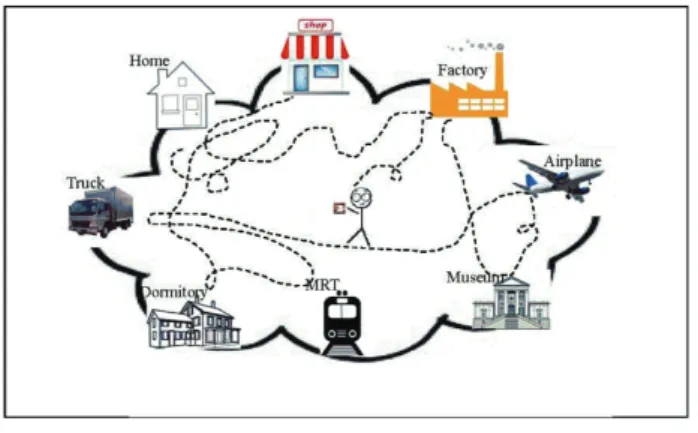
In IoT, a tag might be authenticated by several indepen- dent organizations (and their corresponding servers) during its lifetime, and the moving patterns of a tag might not be fully predictable. It means that any authorized server needs to authenticate these tags at any possible time without any pre-notification from other servers and not a single server can control the roaming patterns of tags. Figure 1 depicts the potential scenario of mobile tags roaming among inde- pendent servers; for example, Mifare card has been used as an access tokens for some transport system, as a cash card in stores, and as an access token for museum or exhi- bitions; Similarly, Suica card [7] in Japan serves as an ac- cess token (and a cash card) for many applications; however, anonymity and un-traceability are not considered in these applications now. This infringes user’s privacy and limits the potential of IoT. We call this scenario the distributed- server modelwhich could be further divided into two cases:
full-distributed-server model and partial-distributed-server model. The full-distributed-server model requires that all the servers are completely independent while the partial- distributed-server model calls for independent servers after initialization. The full-distributed-server model might be implemented using public-key-infrastructure (PKI), which is impractical for the current low-cost RFID scenarios. We, therefore, focus on the partial-distributed-server model in this paper.
In the partial-distributed-server model, the servers might co-operate and share some data of the tags in some Copyright c2015 The Institute of Electronics, Information and Communication Engineers
Fig. 1 Tags roam among domains.
ways, but it is inconvenient or unreasonable for these servers to synchronize the data and keys during the lifetime of tags, or to notify other servers which tags will be authenticated in the IoT scenarios. This makes the partial-distributed- server model different from a logical server consisting of several servers. We notice that it is not trivial to extend an extant scheme in the single-server model to the partial- distributed-server model while keeping all the desirable se- curity properties. We might naively duplicate and synchro- nize the database of one server to multiple servers without re-designing these protocols; however, this approach would compromise either forward secrecy property or feasibility of authentication between tag and server of existing schemes (details are listed in Table3).
RFID authentication has been intensively studied by re- searchers like [2]–[6], [11]–[26]. The security features of extant schemes have been improved to some extent, but only few of them simultaneously considered anonymity, un-traceability and forward secrecy. More importantly, all of the previous studies considered only the single-server model.
We, therefore, aim at proposing anonymous RFID au- thentication with un-traceability and forward secrecy in this partial-distributed-server model. Based on Rabin cryptosys- tem [8] and Error Correction Codes (ECC) [9], [10], this pa- per will propose a new RFID authentication protocol that satisfies the above-mentioned properties. The tags in our scheme only perform Pseudo Random Number Generator (PRNG) functions, squaring modulo and simple operations like XOR. The Combination of Rabin cryptosystem with ECC is one of the potential solutions. One another po- tential solution is those Rabin-based schemes with chosen- ciphertext-attack security like Hofheinz et al.’s scheme [39].
Compared to Hofheinz et al.’s scheme, one advantage of our scheme is that its computational complexity of tag is much lighter than two modular exponentiations in Hofheinz et al.’s scheme.
The merits of this paper include:
1. we highlight the security concerns in the partial- distributed-server model, which was previously ne- glected;
2. we propose a new RFID authentication scheme with anonymity, un-traceability and forward secrecy in the partial-distributed-server model;
3. the computation on tag is affordable on those low-cost cryptographic tags like Mifare series, and its excellent performance makes it attractive to IoT applications.
The remainder of this paper is organized as follows.
Section 2 gives some preliminaries on error correction codes and Rabin cryptosystem. Section 3 proposes our scheme.
The security analysis is given in Sect. 4, which is followed by the performance evaluation in Sect. 5. Finally, Sect. 6 states the conclusions and future work. In the rest of this paper, we interchange the terms organization and server, de- pending on which one fits the context better.
2. Preliminaries
2.1 Linear Block Codes
Linear block codes are commonly used to recover noises during transmission [9], [10]. A linear error correction code of length n, dimension k, and minimum distance d over GF(2) is denoted byC(n,k,d), and the codes can be defined by itsk-by-ngenerator matrixGk×noverGF(2). To transmit a message vectorm=(m1, . . . ,mk), a sender encodesminto c = m·G = (c1, . . . ,cn). Assume there are noises during the transmission, and we denote it as ˜c = c+e, wheree is the noise with|e| ≤tandt =(d−1)/2. Then, upon re- ceiving the transmission ˜c, a designated receiver who owns the parity matrixP(corresponding to the generator matrix G) can identify the noiseeand codewordc, and recovers the messagem. In our proposed scheme, the sender will add artificial noises such that only the designated receiver who owns the secret parity matrixPcan recover and verify the messagem.
2.2 Rabin Cryptosystem
The Rabin cryptosystem [8] is an asymmetric cryptographic technique, whose security has been proved to be as hard as integer factorization, and was proved in-distinguishability against chosen plaintext attack (IND-CPA) secure. How- ever, it has the property that each output of the Rabin func- tion can be generated by any of four possible inputs; for each output as a ciphertext, extra complexity is required on decryption to identify which of the four possible inputs is the true plaintext. The scheme consists of three algorithms - key generation, encryption and decryption as follows.
Key Generation:Choose two large distinct primes pandq withp=q=3 mod 4 to simplify the computation of square roots modulopandq. LetN =p·q. ThenNis the public key, and (p,q) is the private key.
Encryption:Letm∈[0, . . . ,N−1] be the plaintext. To en- cryptm, the sender computes the ciphertextC=m2modN.
Table 1 Notations.
Tl,IDTl TagTlwith with identityIDTl
R,IDRj Reader (Ri) with identityIDRj
S The backend server
g() Pseudo-random function
p,q,N pandqare two large primes, andN=p∗q , exclusive OR, string concatenation
C(n,k,d) A linear error correction code of lengthn, dimen- sionk, and minimum distanced
Gk×n k-by-ngenerator matrixGk×n
e the noise with|e| ≤tandt=(d−1)/2 cl a codeword belongs toC(n,k,d) Kl the assigned secret key to the tagTl
NR Random challenge from reader (or the server) VT,VS T Validation value from the tag; validation from the
server to the tag
Decryption:To decrypt the ciphertextC, the receiver who knows the private keys p andqcan apply the Chinese re- mainder theory to derive the four answers{m1,m2,m3,m4}.
To uniquely identify the plaintext, one common technique is to add some pre-defined padding in the plaintext or requires the plaintext conform to some pre-defined format.
3. The Proposed Scheme in the Partial-Distributed- Server Model
Based on Rabin cryptosystem and ECC, this sec- tion proposes a new RFID authentication scheme with anonymity, un-traceability and forward secrecy in the partial-distributed-server model, and it meets the resource limitation of low-cost cryptographic tags like Mifare series tags.
3.1 Assumptions
We assume that tags can only support simple functions like PRNG, squaring modulo, and simple bitwise operations (like addition, XOR, AND, and OR). The system consists of severalpartially independentdistributed servers, readers, and tags. Here independent servers mean that they might share public parameters and share some tags’ initial data;
but they operate independently and would not synchronize their data after initialization. Generally, it is reasonable to assume that the channel between a server and its correspond- ing readers is secure, since readers are resource-abundant to implement those conventional and well-studied crypto- graphic algorithms; we, therefore, use the notation ”reader (or R) to denote that the reader on behalf of the server per- forms the authentication functions.
3.2 The Scheme
The main idea of our scheme is that the sender randomly adds a noiseewith|e|=tto its pre-assigned codewordcto havem = c+e, and then applies the encryption of Rabin scheme to haveC = m2 modN, whereN = p·q. Upon receivingC, the designated receiver who knows the secrets pandq, can apply the Chinese remainder theory to get the
four possible answers{m1,m2,m3,m4}, uses the secret par- ity matrix (corresponding to Gk×n) to identify the noise e and to derive the corresponding codewordcfor eachmi, and then verifies which one satisfies the verification equation.
However, this simple scheme does not own many security properties we need; so the proposed scheme is introduced as follows.
The scheme involves three kinds of entities; servers (denoted as {Si}), readers (denoted as {Rj}), and tags (de- noted as{Tl}). The scheme consists of two phases - initial- ization and authentication.
Initialization Phase: Initially, the system chooses a pub- lic PRNG function g(), two large primes p and q, and a randomly chosen secret linear codeC(n,k,d) overGF(2), which is specified by its generator matrix Gk·n. The sys- tem publicly publishes g() and N = p · q, but secretly shares the values (p,q) and the linear codes specified byGk·n
among the set of servers{Si}. For each registered tagTl, 1 ≤l ≤2k−1, the system randomly chooses a keyKland an un-used non-zero codewordcl∈C(n,k,d) to tagTl. The system assigns tagTlthe attributes{IDTl,cl,Kl,indTl ←−1}, where IDTl is the tag’s identity, cl is the assigned code- word, Klis the assigned secret key (which will be updated per successful authentication), andindTl is the index indi- cating the number of successful authentications for this tag (also the number of key updating). The servers{Si}keep {IDTl,cl,Kl,pre,indTl,pre}for each tagTl, where Kl,pre = Kl
andindTl,pre = indTl = 1 initially. The values Kl,pre, Kl, indTl,pre, andindTlwill be updated separately byTland each individual serverSiin later authentication sessions.
The authentication phase:The authentication phase of the protocol is described as follows (and in Fig. 2).
1. R(S)→Tl:NR
The reader sends its Query message with a random challengeNRto tagTl.
2. Tl→R(S) :Ml
2.a. Tag Tl generates a random error vector el with Hamming weight t, and computes ˜cl = cl + el and VT = g(el
g(NR
Kl)), where cl is the codeword assigned to Tl and Kl is the as- signed secret key. Here we abuse the notation g(el
g(NR
Kl)), even if the length of el is distinct from the output of g(), and a necessary string expansion or shrinking is applied when the lengths of two operands are different. Tl further letsml=c˜lindTlVT and computesMl=m2l mod N.
2.b. TlsendsMltoR(S).
3. R(S)→Tl:VS T
3.a. The server S who knows p and q first applies the Chinese remainder theory to derive four an- swer{ml,1,ml,2,ml,3,ml,4}from Ml, whereml,u =
˜
cl,uindTl,uVT,u for u = 1,2,3,4 and one of them should be the right answer for ml, if VT,u
is valid. For each ˜cl,u, the server uses the par-
Fig. 2 Anonymous RFID authentication with forward secrecy and un-traceability in the partial- distributed-servers model.
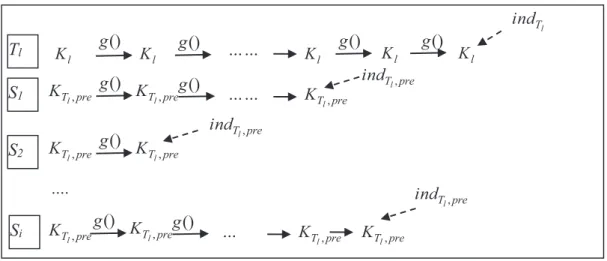
Fig. 3 One snapshot of key chains of a tag and those distributed servers.
ity matrix (which is corresponding to the gener- ator matrix) to decode ˜cl,uto get its corresponding codeword cl,u andel,u, identifies the correspond- ing tag (say ˜Tl), the index indT˜l,pre and the key Kl,preusingcl,u. It then checks whether the equa- tion indT˜l,pre ≤ indTl,u holds; if so, it computes Kl = gindTl,u−indTl,pre¯ (Kl,pre) = g(g(. . .g(Kl,pre))), where gindTl,u−indTl,pre˜ (Kl,pre) means applying the pseudo random function g() on Kl,preindTl,u − indT˜l,pre times. It then verifies whether VT,u = g(el,u
g(NR
Kl)) holds. For a valid response Ml, there is only one ml,u = c˜l,uindTl,uVT,u out of the four{ml,1,ml,2,ml,3,ml,4}satisfying the ver- ification, because only the right one with the cor- rect key Kl can satisfy the equation. When this
one is identified, the server identifies the corre- sponding tag Tl, its key Kl and the current in- dexindTl,u. S then prepares the responseVS T = g(NR
g(el,u
Kl)). It updatesKl,pre ←Kland indTl,pre←indTl,u.
3.b. The serverS sends the identity of the tagVS Tand toR, which forwardsVS TtoTl.
4. Tl:
Tl checks whether the verification equation VS T = g(NR
g(el
Kl)) holds to authenticate the reader (R) and the server (S). If OK, it accepts the server and the reader, and updatesKl=g(Kl) andindTl =indTl+1.
Note that the rational of combining Rabin cryptosys- tem and error correction codes is to ensure anonymity and
un-traceability. If we send ID and challenges separately and encrypt the ID only, then the cipher-text of the encrypted ID will be the same for the same tag, and the attackers can trace this tag. There existed some publications like [22], [30] that apply Rabin cryptosystem to encrypt ID and challenges, but some security weaknesses of them had been reported [26].
Previously proposed schemes do not satisfy all the security properties we need in the partial-distributed-server model.
The authentication is based on the challenge-and- response technique, applying on the secret code-word, the challenges, and the loosely-synchronized key chain among tags and partial-distributed servers. Figure 3 shows one pos- sible snapshot of the key chains of a tag and those partial- distributed servers, where one server’s index is one step be- hind that of the tag while other servers’ indexes are behind that of the tag in distinct steps, depending on how long they did not authenticate the tag. The ECC decoding and the Ra- bin decryption ofMlare performed only by the server. The tags perform only pseudo random function, additions, XOR, and squaring modulo.
4. Security Analysis and Privacy Property
The security of the proposed scheme is based on three mechanisms- Rabin cryptosystem, the secret linear codes decoding and the challenge-response technique using secret loosely-synchronized key chains. The ECC decoding part can be viewed as a secret-key-based authentication scheme, and the output of ECC encoding is further encrypted by the Rabin encryption. Rabin cryptosystem has been proved to be as secure as the integer factoring problem. There- fore, those chosen cipher text attacks [27] on the McEliece- like public key cryptosystems (which are ECC-based pub- lic key schemes), and the chosen plaintext attacks [28] on the ECC-based symmetric encryption schemes could not be directly applied on the proposed scheme. However, those message-resend attacks and related-message attacks [29] on the McEliece-like public key cryptosystems and on Chien- Laih’s ECC-based authentication [11] should be examined, as the same tag would be probed many times by either gen- uine readers or attackers. The security properties are exam- ined as follows.
Theorem 1: The proposed scheme achieves mutual au- thentication between genuine tags and readers (and the servers) respectively.
Proof:The security of the mutual authentication is based on the challenge-response applied on challenges (NR,el) and the secret key Kl. In order to be authenticated, one tag should generate valid responseVT = g(el
g(NR
Kl)) using the secret value Kl and the current challenge NR. On the other side, the server should correctly decode the transmission Ml to identify the tag, its current error vec- toreland retrieve the keyKlto generate the valid response VS T = g(NR
g(el,u
Kl)); It requires that the server should know the secret parameters pandq, the secret lin-
ear codesGk×nand the tag’s secret keyKl. So only the gen- uine tag and the genuine server who owns the secrets could generate valid responses and authenticate each other.
Theorem 2: The proposed scheme can resist replay at- tack, modification attack and other possible impersonation attacks.
Proof: (1) Resistance to replay attack. In each session, the server will issue a random fresh challenge NR and the tag will choose a fresh random error vectorelas challenge, and expect the communicating party can reply with correct re- sponsesVT andVS T, respectively. Therefore, a replay data which is based on obsolete challenges (NR,el) could cheat neither the server nor the tag. (2) Resistance to modification attack and other possible impersonation attacks. For any impersonation attacks (including modification attack) to be successful, attackers should generate correct responses VT
or VS T, of which the computation is based on the current challenges (NR,el) and the current secret keyKl. Attackers who have no knowledge ofKlhave no way to generate valid responses. This proves the theorem.
Theorem 3: The proposed scheme can resist de-synchro- nization attack (or called Denial of Service attack).
Proof:The authentication of the proposed scheme depends on tag’s and servers’ synchronization of the key chain. An attacker might try to modify the transmissions to desynchro- nize the key chain shared between a tag and the servers.
In our scheme, a server keeps the key Kl,pre, which is the matched key it had in the last successful authentication and this key might lag behind the key the tag keeps now. How- ever, a server learns the tag’s current key chain indexindTl
by decipheringMl; after that, it can synchronize its key with the tag by computingKl =gindTl,u−indTl,pre˜ . This mechanism ensures that each genuine server could synchronize its key with the tag, and ensures authentication between the tag and the servers. This proves this theorem.
Theorem 4: The proposed scheme achieves forward se- crecy.
Proof: Low-cost tags are simple devices and might be com- promised by attackers who capture a tag. Forward secrecy requires that, even if we assume a tag might be compro- mised in the future, an attacker who compromises the tag still could not trace the past communications from the same tag. In our scheme, attackers who compromises a tag could derive the identity, the index and the current secret key of the compromised tag; however, to verify whether one pre- vious transmission transcript (Ml,VT,VS T) came from the same tag, it is required that attackers should derive the cor- responding noise el and the corresponding keyKl used in that session; fortunately, it is infeasible to derive the previ- ous secret key from the compromised current key, because the key chain is securely updated asKl=g(Kl); and, it is in- feasible to derive the random noise without having the secret generator matrix. This proves the theorem.
Theorem 5: The proposed scheme can resist message- resend attack and related-message attack, and, therefore, protects anonymity and un-traceability.
Proof:In some ECC-based schemes like [11], [29], attack- ers may try impersonating readers and repeatedly probing the same tag several times to trace the tag. If the distance of the two responsesMisfrom two distinct sessions is less than 2t, wheret= (d−1)/2, then the attackers infer that the two responses may come from the same tag, since the tag adds a random noise with weight equaling t each time. How- ever, this attack is not applicable on our scheme, because the code-related valueml=c˜lindTlVT, where ˜cl=cl+el, is encrypted (squaring modulo) as Ml = m2l modN using Rabin cryptosystem. The randomness of added artificial er- ror vector islog2(t!(nn!−t)!). By choosing proper parameters (as two examples in Sect. 5.2), the added error vectors and inclusion of the secret valueindTlprovides enough random- ness as secret input to the PRNG function. The squaring operation further makes the difference between two outputs Mlsrandomly distributes, even if they come from the same tag. This proves the un-traceability.
The property of anonymity is covered by the achieve- ment of the un-traceability property. A scheme that does not well protect its identity privacy from un-authorized ac- cess cannot provide un-traceability since attackers who de- rive the identities can trace the tags. In our scheme, the only identity-related value is the code wordcl. A tag con- catenates its code word with the index valueindTi and the random valueVT, and then encrypts the concatenated value using Rabin encryption. This ensures the anonymity and un-traceability of our scheme.
5. Performance Analysis
We evaluate the performance of the proposed scheme and compare its performance with its counterparts. A general comparison of security properties, partial-distributed-server model support and scalability is discussed in Sect. 5.1. We then further examine the performance of several forward- secrecy schemes in the partial-distributed-server model in Sect. 5.2. Finally, Sect. 5.3 focuses on comparing the com- putational performance of several ECC-based schemes.
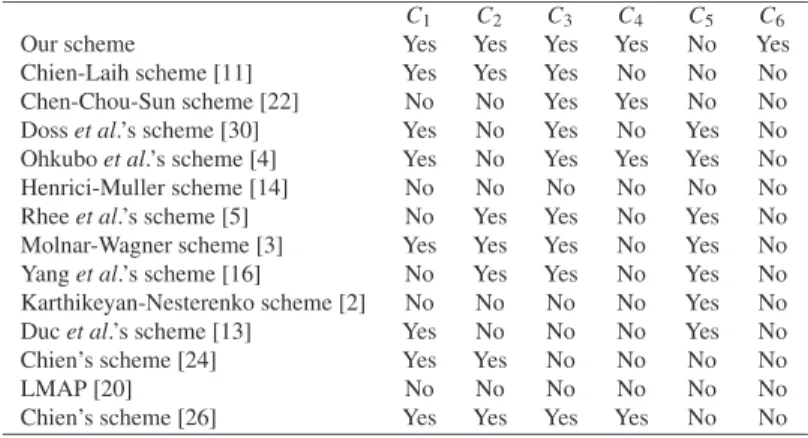
5.1 A General Comparison of Security Properties, Partial- Distributed-Server Model Support and Scalability In order to protect tag’s identity privacy, we note that some previous schemes like [2]–[5], [13], [16], [30] did not trans- mit tag-identity-related data in plaintext but they required the server performing some computations for all tags in the database to identify an anonymous tag; the cost of this pro- cess is very costly when the number of tags is large. We note this property as exhaustive computation and match- ingin Table 2. On the contrary, to identify an anonymous tag, the servers in our scheme only perform one Rabin- cryptosystem decryption (which involves two square root
computations (exponential modulo computations) and one Chinese remainder theorem computation), 2 ECC-decoding operations on average, and 5 pseudo random function com- putations. Compared to those schemes [2]–[5], [13], [16], [30] which require exhaustive computation and matching, our scheme is much more efficient, when the number of tags is large.
In our scheme, it is noted that only the servers are equipped with the decoding algorithms of ECC-decoding and the Chinese remainder theorem function. One ECC de- coding operation involves one matrix multiplication: which is quite efficient for server; or one can implement ECC de- coding by syndrome decoding, which is minimum distance decoding using a reduced lookup table (the time complexity isO(k2(n−k)) and the space complexity isrn−k for a code C(n,k,d) overFr(it is 2n−kforF2in our scheme) [10]. The large space requirement on server is a burden; luckily, as technologies advance, storage of that size is feasible. The functions required on tag are only squaring modulo, PRNG, and simple bit-wise operations like XOR. The cost of com- putations on tags is low.
Since all the previous schemes were designed for the single-server model, there is no obvious way to compare our scheme with them; however, the single-server model is just a special case of the partial-distributed-server model; we, therefore, give a general comparison of our scheme applied in the single-server model with some previous schemes which aimed at providing anonymity, un-traceability and forward secrecy in Table 2. In short summary, our scheme is the only one that simultaneously provides the merits: (1) it supports the partial-distributed-server model; (2) it resists all possible attacks; (3) it achieves forward secrecy; and (4) no exhaustive computation and matching is required to iden- tify an anonymous tag.
5.2 Discussion of Forward-Secrecy Schemes in the Partial-Distributed-Server Model
To further examine the performance of some previous schemes in the partial-distributed-server model, our com- parison focuses on those schemes that provided forward secrecy, because forward-secrecy-preserving protocols are usually stateful protocols and it is challenging to preserve forward secrecy, state synchronization and the feasibility of authentication in the partial-distributed-server model. One possible approach to extend these single-server schemes to their partial-distributed-server versions is naively duplicat- ing the single server and its database to multiple servers with individual duplicate databases; this naive approach might underestimate the potential of their other possible exten- sions, but it provides a basic insight of the performance of these schemes.
In Table 3, we apply this naive extension approach on Chenet al.’s scheme [22] and Ohkuboet al.’s scheme [4].
Apparently this naive extension of [22] could no longer pro- vide correct authentication between tags and servers, be- cause their servers would quickly lose synchronization of
Table 2 Comparisons among related security schemes for RFID.
C1 C2 C3 C4 C5 C6
Our scheme Yes Yes Yes Yes No Yes
Chien-Laih scheme [11] Yes Yes Yes No No No
Chen-Chou-Sun scheme [22] No No Yes Yes No No
Dosset al.’s scheme [30] Yes No Yes No Yes No
Ohkuboet al.’s scheme [4] Yes No Yes Yes Yes No
Henrici-Muller scheme [14] No No No No No No
Rheeet al.’s scheme [5] No Yes Yes No Yes No
Molnar-Wagner scheme [3] Yes Yes Yes No Yes No
Yanget al.’s scheme [16] No Yes Yes No Yes No Karthikeyan-Nesterenko scheme [2] No No No No Yes No Ducet al.’s scheme [13] Yes No No No Yes No
Chien’s scheme [24] Yes Yes No No No No
LMAP [20] No No No No No No
Chien’s scheme [26] Yes Yes Yes Yes No No
C1: Anonymity/un-traceability
C2: Replay attack/counterfeit attack resistance C3: DOS attack resistance
C4: Forward secrecy
C5: Exhaustive Computation and matching C6: Support of partial-distributed-server model
Table 3 Comparison of schemes in the partial-distributed-server model.
C1 C2 C3 C4 C5 C6
Naive extension of Ohkuboet al.’s scheme [4] Yes Yes No Yes Yes Yes Naive extension of Chen-Chou-Sun scheme [22] No No Yes Yes No Yes
Our scheme Yes Yes Yes Yes No Yes
C1: Accuracy of authentication in partial-distributed-server model C2: Anonymity/un-traceability
C3: replay attack/counterfeit attack resistance C4: DOS attack resistance
C5: Exhaustive Computation and matching
C6: Forward secrecy in partial-distributed-server model
their states with the tags after initialization. In [22], a server keeps two stateful values synchronized with that of each tag- one value is the possible next value of the state and the other is the last successful state; so if a server has been succes- sively authenticating a tag, then all the other servers lose their synchronization.
Interestingly, if we apply the same naive extension on Ohkuboet al.’s scheme, the extension still keeps its accuracy of authentication, anonymity, un-traceability, DOS attack resistance, and forward secrecy; it is because the authentica- tion in Ohkuboet al.’s scheme depends on two independent hashing chains so that any server could exhaustively trace down all the chains of all tags to identify an anonymous tag; but, we should notice that two main weaknesses of this approach- the poor computational performance of exhaus- tive search and the probability of successful replay attacks amplified in the partial-distributed-server environments. In the partial-distributed-server model, an eavesdropped ses- sion from one server could be used to launch replay attacks on any another server; and a server needs more efforts to re-synchronize and search a tag in the out-of-synchronized key chains of all possible tags in partial-distributed-server environments. From this table, we can see that it is more challenging to design an RFID authentication protocol with desirable properties in the partial-distributed-server model,
and our scheme achieves excellent performance in terms of security, efficiency, server’s maintenance, cost and scalabil- ity.
5.3 Computational Performance Comparison among ECC- Based Schemes
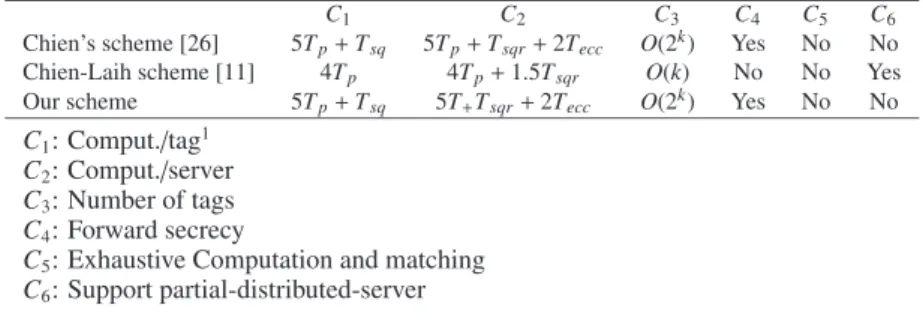
Now we make a simple comparison of computations among ECC-based schemes in Table 4, where TP denotes that for one PRNG,Tsqdenotes that for one squaring modulo,Tsqr
denotes that for one square root solving, andTECCdenotes that for one ECC decoding operation. From Table 4, Chien- Laih’s scheme can supportO(k) number of tags while our scheme can support O(2k) number of tags, wherekis the dimension of the codes. Chien-Laih’s scheme did not pro- vide forward secrecy while ours do. Our scheme addition- ally depends on Rabin cryptosystem, compared to Chien- Laih’s scheme; therefore, our scheme apparently demands one more squaring on tag, one more the Chinese remain- der theorem function and one more ECC decoding on the average on server. Since both the square root computation and the ECC decoding are simple for server, the additional computational cost on server is negligible. However, the improvement of the number of supported tags fromO(k) to O(2k) is very significant. Furthermore, our scheme supports
Table 4 Computational performance comparison among ECC-based schemes.
C1 C2 C3 C4 C5 C6
Chien’s scheme [26] 5Tp+Tsq 5Tp+Tsqr+2Tecc O(2k) Yes No No Chien-Laih scheme [11] 4Tp 4Tp+1.5Tsqr O(k) No No Yes Our scheme 5Tp+Tsq 5T+Tsqr+2Tecc O(2k) Yes No No C1: Comput./tag1
C2: Comput./server C3: Number of tags C4: Forward secrecy
C5: Exhaustive Computation and matching C6: Support partial-distributed-server
Table 5 Communication performance comparison among ECC-based schemes.
Number of steps Total message length
Chien [26] 3 LN+Lch+LPRNG
Chien-Laih [11] 3 2LN+Lch+5LPRNG
Our scheme 3 LN+Lch+LPRNG
forward secrecy while Chien-Laih’s scheme does not.
Regarding the communication, we consider both the number of steps and the length of the messages. To achieve mutual authentication, the optimal number of steps is three, and all the three ECC-based schemes require three steps only. LetLN denote the bit length of the public key of Ra- bin cryptosystem,Lchdenote the bit length of a challenge, LPRNGdenote that of a PRNG output, andLndenote that of a code word. The message length of both our scheme and the scheme [26] isLN+Lch+LPRNG, while that of the scheme [11] is 2Ln+Lch+5LPRNG. We take one possible set of pa- rameter setting as an example.Ln=256,Lch=LPRNG=80, andLN=1024. Then both our scheme and the scheme [26]
require 1184 bits totally, while the scheme [11] requires 996 bits. We can see that the difference of message length is not significant.
Consider the implementation requirement of key space and gate count of our scheme on low-cost cryptographic tags. If we select the linear code asC(n=128,k=58,d = 21), the key length is 80 bits and the Rabin modulus be- ing 1024 bits, then our scheme could support 258tags. The space requirement per tag of our scheme is 128+2∗80+ 1024=1312 bits, and the effective bit length of randomness of artificial error vectors is 47.7. Another case is that if we select the linear code asC(n =256,k =120,d =35), and the key length is 80, then the effective bit length of the ran- domness of artificial error vectors is 86.9, the key space is 1440 bits and the number of supported tags is 2120. Now we examine the storage space feasibility of our scheme on some popular RFID tags on the market like Gen2 [31], ISO 15693 [33] and Mifare S50 [32]. The memory of the popular Gen 2 tag on the market is 512 bits, ISO15693 could support 256 bytes∼8K bytes, and Mifare S50 and S70 respectively sup- port 1K and 4K bytes memory. This implies that the storage space on the current ISO 1569, Mifare S50 and S70 could support the space requirement of our scheme, but Gen2 does not. However, new Gen2 standard called Gen2V2 has been ratified in December 2013 [34], and it could support much larger space for practical implementation.
We further examine the feasibility of the computational requirement of our scheme on some low-cost cryptographic tags. In our scheme, the most computationally expensive operation on tag is modular squaring operation. According to [35], [36], a 512-bit modular multiplier could be imple- mented using around 12,500 gates, and a 1024-bit modular multiplier is estimated around 24,000 gates. A very low cost tag like Gen2 was estimated to have 7,500∼15,000 gates and 2,500∼5,000 gates of them could be used for security algo- rithms. Based on these figures, our scheme with N=512 or N=1024 bits are still infeasible for a very low cost tag like Gen2. However, we note that the encryption of Rabin cryptosystem is modulo squaring which is a special case of modulo multiplication; It is believed that a dedicated de- sign of modulo squaring would require much fewer gates than modulo multiplication. As the manufacturing technol- ogy advances and the large competing market emerges, the prices of some cryptographic tags like Mifare classic (which supports PRNG, 3-way handshake authentication and Mi- fare classic security [37]), Mifare DesFire (which addition- ally supports DES/3DES) and even Mifare SmartMx with RSA colud be dropped to less than 10 cents on Alibaba mar- ket [38]. Our proposed scheme is quite attractive to these low cost cryptographic RFID tags now.
6. Conclusions and Future Work
This paper has proposed the first RFID authentication scheme with anonymity, forward secrecy and un-traceability in the partial-distributed-server model. The proposed scheme not only requires moderate-lightweight computa- tions on tag but also eliminates the exhaustive computation and matching computations on servers to identify an anony- mous tag. The proposed scheme has good scalability perfor- mance: it could support the number of tagsO(2k).
Four interesting topics of future work are described as follows. The first is to explore other possible extensions (non-na ¨ive extension) of previous schemes to study whether they are suitable in the partial-distributed-server model. The second is to explore the possibility of simultaneously sup-
port RFID authentications and ownership transfer function in the partial-distributed-server model. That is, it would be desirable if we could authenticate RFIDs with the above mentioned properties in the partial-distributed-server model, while we also allow servers to transfer ownership of a tag from one server to another. Another issue is that, in our scheme and other previous schemes, if one server is com- promised, then the whole system is compromised. Since our scheme is targeted at partial-distributed-server model (mul- tiple independent servers), the third interesting open ques- tion is that whether we can keep the security properties even if some of the servers are compromised. The fourth one is to study formal model that well captures the security and privacy in the partial-distributed-server model.
Acknowledgments
This project is partially supported by the National Science Council, Taiwan, R.O.C., under grant no. NSC 101-2218- E-260 -001.
References
[1] The Mifare cards, http://www.mifare.net/[2013/5/1 accessed]
[2] S. Karthikeyan and M. Nesterenko, “RFID security without exten- sive cryptography,” Proc. 3rd ACM Workshop on Security of Ad Hoc and Sensor Networks, pp.63–67, Alexandria, VA, USA, Nov.
2005.
[3] D. Molnar and D. Wagner, “Privacy and security in library RFID:
Issues, practices, and architectures,” Proc. Conference on Computer and Communications Security - CCS’04, pp.210–219, Washington, DC, USA, Oct. 2004.
[4] M. Ohkubo, K. Suzki, and S. Kinoshita, “Cryptographic ap- proach to ’Privacy-Friendly’ tags,” Presented at the RFID Pri- vacy Workshop (MIT, Cambridge, MA, Nov. 15 2003); rfidpri- vacy.ex.com/2003/agenda.php.
[5] K. Rhee, J. Kwak, S. Kim, and D. Won, “Challenge-response based RFID authentication protocol for distributed database environment,”
Proc. International Conference on Security in Pervasive Computing - SPC, LNCS 3450, pp.70–84, Berlin, Germany, 2005.
[6] T.C. Yeh, C.H. Wu, and Y.M. Tseng, “Improvement of the RFID authentication scheme based on quadratic residues,” Comput. Com- mun., vol.34, no.3, pp.337–341, 2011.
[7] Suica: A rechargeable contactless smart card used as a fare card on train lines in Japan. http://www.jreast.co.jp/tc/pass/suica.html [2013/8/30 access].
[8] M. Rabin, “Digitalized signatures and public-key functions as in- tractable as factorization,” MIT Laboratory for Computer Science, Jan. 1979.
[9] S. Lin and D.J. Jr. Costello, Error control coding: fundamentals and applications, Prentice-Hall, Englewood Cliffs, NJ, 1983.
[10] R. Pellikaan, X.W. Wu, S. Bulygin, and R. Jurrius, “Error-correcting codes and cryptology,” to be published by Cambridge University Press, 2013, http://www.win.tue.nl/ruudp/2WC11.html [2013/6/10 accessed].
[11] H.Y. Chien and C.S. Laih, “ECC-based lightweight authentication protocol with untraceability for low-cost RFID,” J. Parallel and Dis- tributed Computing, vol.69, no.10, pp.848–853, 2009.
[12] G. Avoine, E. Dysli, and P. Oechslin, “Reducing time complexity in RFID systems,” Lecture Notes in Artificial Intelligence and Lecture Notes in Bioinformatics, LNCS 3897, pp.291–306, 2005.
[13] D.N. Duc, J. Park, H. Lee, and K. Kim, “Enhancing security of EPCglobal Gen-2 RFID tag against traceability and cloning,” Net-
worked RFID Systems and Lightweight Cryptography: Raising bar- riers to product counterfeiting, 1st ed., pp.269–277, Springer, 2008.
[14] A.D. Henrici and P. Muller, “Hash-based enhancement of loca- tion privacy for radio-frequency identification devices using varying identifiers,” Proc. PerSec’04 at IEEE PerCom, pp.149–153, 2004.
[15] A. Juels, “Strengthening EPC Tag against Cloning,” Proc. of WiSe
’05, pp.67–75, 2005.
[16] J. Yang, J. Park, H. Lee, K. Ren, and K. Kim, “Mutual authentication protocol for low-cost RFID,” Handout of the Ecrypt Workshop on RFID and Lightweight Crypto, 2005.
[17] T. Phillips, T. Karygiannis, and R. Kuhn, “Security standards for the RFID market,” IEEE Security & Privacy, vol.3, no.6, pp.85–89, 2005.
[18] N.J. Hopper and M. Blum, “Secure human identification protocols,”
Proc. Advances in Cryptology - ASIACRYPT 2001, LNCS 2248, pp.52–66, 2001.
[19] S. Piramuthu, “HB and related lightweight authentication proto- cols for secure RFID tag/reader authentication,” CollECTeR Europe Conference, 2006.
[20] P. Peris-Lopez, J.C. Hernandez-Castro, J.M. Estevez-Tapiador, and A. Ribagorda, “LMAP: A real lightweight mutual authentication protocol for low-cost RFID tags,” Proc. 2nd Workshop on RFID Se- curity, pp.137–148, 2006.
[21] T. Li and G. Wang, “Security analysis of two ultra-lightweight RFID authentication protocols,” IFIP SEC 2007, May 2007.
[22] Y. Chen, J.S. Chou, and H.M. Sun, “A novel mutual authentication scheme based on quadratic residues for RFID systems,” Comput.
Netw., vol.52, no.22, pp.2373–2380, 2008.
[23] Avoine’s RFID Security & Privacy Lounge, http://www. avoine.net/ rfid/. [2013/6/10 access]
[24] H.Y. Chien, “SASI: A new ultralightweight RFID authentication protocol providing strong authentication and strong integrity,” IEEE Trans. Dependable and Secure Computing, vol.4, no.4, pp.337–340, 2007.
[25] T. Cao, E. Bertino, and H. Lei, “Security analysis of the SASI proto- col,” IEEE Trans. Dependable and Secure Computing, vol.20, no.1–
6, pp.73–77, 2008
[26] H.Y. Chien, “Combining Rabin cryptosystem and error correction codes to facilitate anonymous authentication with un-traceability for low-end devices,” Comput. Netw., vol.57, no.14, pp.2705–2717, 2013.
[27] D.J. Bernstein, T. Lange, and C. Peters, “Attacking and defend- ing the McEliece cryptosystem,” Cryptology ePrint Archive: Report 2008/318.
[28] R. Struik and J. Tilburg, “The Rao-Nam scheme is insecure against a chosen-plaintext attack,” Proc. Advances in Cryptology - CRYPTO87, pp.445–457, Springer, Berlin, 1988.
[29] T.A. Berson, “Failure of the McEliece public-key cryptosystem un- der message-resend and related-message attack,” Proc. Advances in Cryptology - CRYPTO97, pp.213–220, Springer, Berlin, 1997.
[30] R. Doss, W. Zhou, W., S. Sundaresan, S. Yu, and L. Gao, “A min- imum disclosure approach to authentication and privacy in RFID systems,” Comput. Netw. vol.56, no.15, pp.3401–3416, 2012.
[31] EPCglobal, http://www.epcglobalinc.org/ [32] The Mifare cards, http://www.mifare.net/
[33] ISO/IEC FCD 15693-3. (2009). http://www.iso.org/iso/home/store/ catalogue tc/catalogue detail.htm?csnumber=43467.
[34] EPC Radio-Frequency Identity Protocols Class-1 Generation-2 UHF RFID Protocol for Communications at 860MHz - 960MHz, Version 1.2.0. EPCglobal Inc., Oct. 2008. www.gs1.org.
[35] J.H. Chen, H.S. Wu, M.D. Shieh, and W.C. Lin, “A new montgomery modular multiplication algorithm and its VLSI design for RSA cryp- tosystem,” Proc. ISCAS 2007, pp.3780–3783, 2007.
[36] K. Manochehri and S. Pourmozafari, “Fast montgomery modular multiplication by pipelined CSA architecture,” Proc. ICM 2004, pp.144–147, 2004.
[37] NXP Semiconductors, “Smart solutions to smart servuces,”
http://www.nxp.com/documents/line card/75016728.pdf.
[38] Alibaba on-line market, http://www.alibaba.com.
[39] D. Hofheinz, E. Kiltz, and V. Shoup, “Practical chosen ciphertext secure encryption from factoring,” J. Cryptology vol.2013, pp.102–
118, 2013.
Hung-Yu Chien received the B.S. degree in Computer Science from NCTU, Taiwan, 1988, the M.S. degree in Computer and Informa- tion Engineering from NTU, Taiwan, 1990, and the doctoral degree in applied mathematics at NCHU 2002. He was an assistant researcher at TL, MOTC, Taiwan, during 1992–1995, the di- rector of Computer Center at Nan-Kei College, and an associate professor of ChaoYang Univer- sity of Technology during 200309 200609. Now he is a member of the Chinese Association for Information Security, an IEEE member and a professor of National Chi Nan University, and was the department head of the Information manage- ment department 2008.8 2011.7. His research interests include cryptogra- phy, networking , network security and RFID security.
Tzong-Chen Wu received B.S. degree in Information Engineering from National Tai- wan University in 1983, M.S. degree in Applied Mathematics from National Chung Hsing Uni- versity in 1989, and Ph.D. degree in Computer Science and Information Engineering from Na- tional Chiao Tung University in 1992. Dr.
Wu joined the Department of Information Man- agement, National Taiwan University of Sci- ence and Technology (NTUST) in 1992, and he served as the professor from February 1997 to March 2014. From March 2014 till now, he serves as the distinguished professor in the Department of Information Management, NTUST. Profes- sor Wu is the members of IEEE, ACM, IEICE and the Chinese Cryptology and Information Security Association (CCISA). He served as the president of CCISA from June 2003 to May 2009. His current research interests include information security, mobile security, cryptographic protocols and related topics.
Chien-Lung Hsu received a B.S. degree in business administration, an M.S. degree in information management, and a Ph.D. degree in information management from the National Taiwan University of Science and Technology, Taiwan in 1995, 1997, and 2002, respectively.
He was an Assistant Professor and an Asso- ciate Professor in the Department of Information Management, Chang Gung University (CGU), Taiwan from 2004 to 2007 and from 2007 to 2011, respectively. Currently, he is a Professor in the Department of Information Management, Chang Gung University since 2011. He is also the director of Chinese Cryptology Information Security Association (CCISA, Taiwan), the chair of Education Promotion Committee of CCISA, the director of Program of RFID Applications in Lo- gistics Supply Chain Management of CGU, the director of Program of In- formation Security with Medical Applications of CGU, the director of Di- vision of Instructional Support of Computer Center of CGU, the researcher of Healthy Aging Research Center (HARC) of CGU, the researcher of El- der Industry Development and Research Center (EIDRC) of CGU. His cur- rent research includes cryptography, information security, wireless sensor network, mobile commerce, digital forensics, vehicular system security, healthcare system and user acceptance, smart home system, and etc.