INVITED PAPER
Special Section on Mathematical Systems Science and its ApplicationsE ff ectiveness and Limitation of Blockchain in Distributed Optimization: Applications to Energy Management Systems
Daiki OGAWA†,Nonmember, Koichi KOBAYASHI†a),andYuh YAMASHITA†,Members
SUMMARY A blockchain, which is well known as one of the dis- tributed ledgers, has attracted in many research fields. In this paper, we discuss the effectiveness and limitation of a blockchain in distributed opti- mization. In distributed optimization, the original problem is decomposed, and the local problems are solved by multiple agents. In this paper, ADMM (Alternating Direction Method of Multipliers) is utilized as one of the pow- erful methods in distributed optimization. In ADMM, an aggregator is ba- sically required for collecting the computation result in each agent. Using blockchains, the function of an aggregator can be contained in a distributed ledger, and an aggregator may not be required. As a result, tampering from attackers can be prevented. As an application, we consider energy manage- ment systems (EMSs). By numerical experiments, the effectiveness and limitation of blockchain-based distributed optimization are clarified.
key words: ADMM, blockchains, distributed optimization, EMS
1. Introduction
A blockchain has attracted in many research fields such as finance, healthcare, agriculture, logistics, computing, and power systems (see, e.g.,[1],[2],[5],[6],[11],[18],[21]).
A blockchain is defined as “an open, distributed ledger that can record transactions between two parties efficiently and in a verifiable and permanent way”[9]. In a blockchain, a peer-to-peer network, which adheres to a protocol for inter- node communication and validates new blocks, manages typically. Blocks in the chain contain information about transactions and so on. Each block is identified by a cryp- tographic hash, and carries a list of transactions and a hash to the previous block. Hence, a chain of blocks is formed, and tampering of the previous blocks from attackers can be prevented.
On the other hand, a distributed optimization method is well known as one of the methods to solve a large- scale optimization problem (see, e.g., [3], [4], [20]). In distributed optimization, the original problem is decom- posed, and the local problems are solved by multiple agents.
Hence, distributed optimization is appropriate for large- scale multi-agent systems such as power systems (see, e.g., [8], [12],[19], [23]). Distributed optimization is also ef- fective from the viewpoints of security and privacy, be- cause all decision variables/constants are not shared neces- sarily. In this paper, ADMM (Alternating Direction Method of Multipliers) is utilized as one of the powerful methods
Manuscript received April 10, 2020.
Manuscript revised July 11, 2020.
†The authors are with the Graduate School of Information Science and Technology, Hokkaido University, Sapporo-shi, 060- 0814 Japan.
a) E-mail: [email protected] DOI: 10.1587/transfun.2020MAI0001
in distributed optimization. When ADMM is applied in a practical scenario such as power systems, an aggregator is basically required for collecting the computation result in each agent (fully-distributed ADMM has also been pro- posed in e.g.,[13]). To prevent tampering from attackers, it is important to develop a method combining ADMM with blockchains.
In this paper, we clarify the effectiveness and lim- itation of blockchain-based distributed optimization. In [1],[11],[18], a blockchain-based distributed optimization method has been studied. However, both the effectiveness on the tamper-resistant properties and the limitation via the computation time have not been discussed. Furthermore, in[1],[11],[18], microgrid networks have been focused. In this paper, we focus on energy management systems (EMSs) as a new application. Analysis and design of EMSs have been extensively studied (see, e.g., [14]–[17], [19], [22]
and their references). An EMS studied here is a kind of multi-agent systems, and is composed of multiple agents such as factory agents and building agents. Here, we use a mathematical model of distributed EMSs proposed in[14]–
[17],[22].
In a similar way to[1],[11],[18], we use ADMM as a distributed optimization method. To the best of our knowl- edge, ADMM is frequently used in blockchain-based dis- tributed optimization. Using blockchains, the function of an aggregator can be contained in a distributed ledger. This is because an aggregator in ADMM performs only a sim- ple calculation (see Sect. 2.1 for further details). Hence, an aggregator may not be required, and as a result, tam- pering from attackers can be prevented. However, when blockchains are applied, calculating the hash values must be required, and the computation load becomes high. Then, the total computation time for solving an optimization problem becomes long.
In this paper, by numerical experiments, we compare the computation time in the case where a blockchain is used with that in the case where a blockchain is not used. Further- more, degradation of the convergence of ADMM by tam- pering is also validated. To the best of our knowledge, such a comparison has not been studied so far. From computa- tion results, we see that the total computation time becomes long by using blockchains. However, considering the time scale of EMSs, the growth of the computation time does not produce any difficulty in EMSs. Hence, we suggest that ADMM using blockchains is applicable to EMSs.
This paper is organized as follows. In Sect. 2, the opti- Copyright c2021 The Institute of Electronics, Information and Communication Engineers
a blockchain is also summarized. In Sect. 3, an EMS studied in this paper is explained. In Sect. 4, a blockchain-based dis- tributed optimization method is introduced, and is validated by numerical experiments. In Sect. 5, we conclude this pa- per.
Notation:LetRdenote the set of real numbers. For the finite setA, let|A|denote the number of elements inA. Let 0m×ndenote them×nzero matrix. For the vectorx, let x>
denote the transpose ofx. For the vectorx, letkxk2 denote the Euclidean norm ofx. For the vectorx, letx(i)denote the i-th element ofx.
2. Preliminaries
2.1 Exchange Problem and Its Solution Method
In this subsection, first, the exchange problem (EP), which is used as a simplified model of an EMS, is explained. Next, ADMM is explained as a solution method for EP.
2.1.1 Exchange Problem
LetI={1,2, . . . ,n}denote the set of agents. Letxi,Xi, and fi:Xi→ Rdenote the decision variable vector, the domain ofxi, and the convex objective function, respectively. LetM denote the finite set of markets. Letx(mi j), j∈ {1,2, . . . ,|M|}
(themj-th element ofxi) denote the scalar decision variable for the agenti in the market mj ∈ M. The vector xMi is defined byxMi :=[x(mi 1) xi(m2) · · · x(mi |M|)]>. We remark that each element ofxMi is contained inxi. Then, EP is given as follows:
(EP) find xi, i∈ I minimize X
i∈I
fi(xi) subject to xi∈ Xi, i∈ I,
X
i∈I
xMi =0|M|×1. (1) In EP, a sum of objective functions for agents is minimized under the condition that demand and supply are balanced in all markets. For the marketm ∈ M, the agentiis called a supplier ifx(m)i <0, and the agentiis called a consumer if x(m)i >0.
Next, the Lagrange function for EP is given by L(x, α)=X
i
fi(xi)+α>X
i
xMi ,
where α is a Lagrange multiplier, and corresponds to a shadow price in the market. For each agent, this Lagrange function can be decomposed to
Li(xi, α)= fi(xi)+α>xiM, i∈ I.
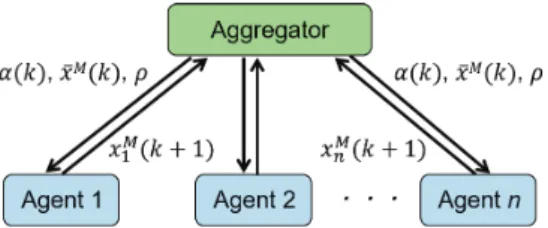
Fig. 1 Distributed optimization using ADMM.
2.1.2 Alternating Direction Method of Multipliers (ADMM)
In the case of using ADMM for EP,xiandαare updated as follows:
xi(k+1) :=arg min
xi∈Xi
Li(xi, α(k))+ρ
2kxMi −xMi (k) +x¯M(k)k22
, i∈ I, (2)
α(k+1) :=α(k)+ρx¯M(k+1), (3)
whereρis a penalty parameter, and ¯xM(k) = P
ixMi (k)/n.
See, e.g.,[4],[15]for further details.
In distributed optimization using ADMM, the whole system consists of the aggregator and n agents (see also Fig. 1). In the case of ADMM, the aggregator presents the shadow priceα(k) and the mean value ¯xM(k) to each agent, and collects xiM(k+1). In each agent, the individual local optimization problem (2) is solved. In the case of ADMM, the penalty parameterρmust be shared in the aggregator and agents.
2.2 Blockchain and Smart Contracts
In this subsection, the outline of blockchain technologies is explained. See also e.g.,[6],[18].
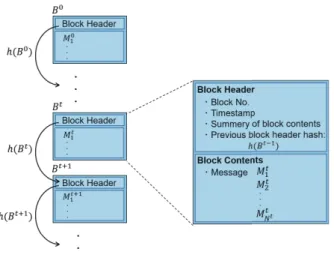
Figure 2 shows the data structure in a blockchain. Par- ticipants on the peer-to-peer network broadcast messages Mti, i ∈ {1,2, . . . ,Nt}, where t ∈ {0,1,2, . . .} is the dis- crete time, andNtis the number of messages. In each mes- sage, several commands such as control actions and account withdrawals are included. Participants store messages in the block Bt. The block header mainly consists of the times- tamp, a concise cryptographic hashh(Bt−1) of the contents of the previous block, and the results of a verification test that is computationally or economically difficult to forge.
The hash value h(Bt−1) can be regarded as a kind of fin- gerprints for messages. The contents of a message are pro- cessed through a cryptographic algorithm. As a result, a unique numerical value, i.e., the hash value that identifies the contents of the file is produced. If the contents are mod- ified in any way, the hash value also changes significantly.
The new block is transmitted to all participants on the net- work, where its validity is checked and nodes reach consen- sus.
In checking of validity, for example, a proof-of-work (PoW) system, which is one of the consensus mechanisms
Fig. 2 Data structure in a blockchain.
is used. In the PoW system, each agent finds a 32-bit value called a nonce such that the hash value of a new block is smaller than the target value (a nonce is contained in a new block). This calculation is called a PoW puzzle. The agent that firstly solved the PoW puzzle generates a new block.
The difficulty of the PoW puzzle affects the processing time of blockchains. In difficulty control, the processing time is controlled by tuning the target value (see, e.g.,[10]). If the target value is set to a larger value, then the processing time of blockchains becomes smaller. However, tamper-resistant properties are degraded, because an attacker can easily gen- erate a new block that contains the tampered information. If the target value is set to a smaller value, then the processing time of blockchains becomes longer, but tamper-resistant properties are enhanced. Thus, we must consider the trade- offbetween tamper-resistant properties and the computation time.
The utility of blockchains can be significantly ex- panded. One of the typical examples is a smart contract.
A smart contract in blockchains is a kind of functions (i.e., computer programs) to automatically update a certain vari- able using information which is contained in the block. Us- ing blockchains, smart contracts are guaranteed to be faith- fully executed on the network. When a blockchain is used in implementation of ADMM, the smart contract corresponds to update ofα, ¯xM, andρ.
3. Energy Management Systems
In this section, we formulate an EMS. Here, we use a math- ematical model of an EMS proposed in[14]–[17],[22].
Consider a special district that is composed of factory agents and building agents. These agents are independent.
Each agent has thermal and electrical demands given in ad- vance. For simplicity, we consider only a single period (but, we can easily extend it to a more general case). A factory agent has energy conversion equipments such as boilers and turbines, and can sell surplus energy to other agents. In a building agent, to satisfy its demand, energy from inside of
Fig. 3 Factory agent.
the district is purchased, and energy conversion equipments are operated. Each agent may purchase energy from outside of the district. Here, there are two markets, i.e., an electric- ity market and a heat market.
We explain the relation between EP in Sect. 2.1 and the EMS studied here. The set of agents Iis decomposed to IF (the set of factory agents) andIB (the set of building agents), whereIF∪ IB =IandIF∩ IB=∅. In addition, we definenF :=|IF|andnB:=|IB|(nF +nB=nholds).
First, we explain a factory agent (see also Fig. 3). Sup- pose that a factory agent has a gas cogeneration system (GT) and a gas boiler (BA). The optimization problem for a fac- tory agent is given as follows:
minimize αBEBE+αBGBG+αES EE+αHS HH (4) subject to S EE ≤0
S HH≤0 BE ≥0 BGGT≥0 BGBA≥0
0≤PEGT≤aGTEBGGT2 +bGTEBGGT
+cGTE (5)
0≤PHGT≤aGTHBGGT2 +bGTHBGGT
+cGTH (6)
0≤PHBA≤aBABGBA2 +bBABGBA
+cBA (7)
BE+PEGT+S EE=DE (8) PHGT+PHBA+S HH=DH (9) BG=BGGT+BGBA (10) BGGT≤BGGT≤BGGT (11) BGBA≤BGBA≤BGBA (12) where the index for each factory agent is omitted. Meaning of decision variables is given as follows:
• S EE,S HH: volumes of electrical and thermal energy purchased from inside of the district (if a factory is a supplier, then these are negetive),
• BE,BG: volumes of electrical and thermal energy pur- chased from outside of the district,
• PEGT,PHGT,PHBA: volumes of electrical and thermal energy generated by each equipment.
Meaning of constants is given as follows:
• αBE,αBG: unit price of electrical and thermal energy purchased from outside of district,
• αE, αH: unit price of electrical and thermal energy traded inside of district,
• DE,DH: electrical and thermal demand,
• a•, b•, c•: coefficients of input-output properties of equipments.
We remark here thatxi,xMi ,i∈ IF, andαin Sect. 2.1 cor- respond to
S EE
S HH
BE BG BGGT
BGBA
PEGT
PHGT PHBA
,
"
S EE
S HH
# ,
"αE
αH
# ,
respectively. (4) represents the energy cost, (5)–(7) repre- sent input-output properties of equipments (due to solver limitation, input-output properties are represented by in- equalities). (8)–(10) represent energy balances. (11) and (12) represent constraints for input energy.
Next, we explain a building agent (see also Fig. 4).
Suppose that a building agent has a gas boiler (BA). The optimization problem for a building agent is given as fol- lows:
minimize αBEBE+αBGBG+αEBEE+αHBHH
subject to BEE≥0 BHH≥0 BE≥0 BGBA≥0
0≤PHBA≤aBABGBA2 +bBABGBA+cBA BE+BEE=DE
PHBA+BHH=DH BG=BGBA
BGBA≤BGBA≤BGBA
where the index for each building agent is omitted. Meaning of decision variables is given as follows:
• BEE, BHH: volumes of electrical and thermal energy purchased from inside of the district (if a building agent is a consumer, these are positive).
Other decision variables and constants are the same as those of a factory agent. We remark here thatxiandxMi ,i∈ IBin Sect. 2.1 correspond to
Fig. 4 Building agent.
BEE
BHH
BE BG BGBA PHBA
, "
BEE BHH
# ,
respectively.
Finally, since we consider two markets, the equality constraint (1) in Sect. 2.1 is given by
nF
X
i=1
"S EiE S HHi
# +
nB
X
i=1
"BEiE BHHi
#
=
"
0 0
# ,
whereiis the index for agents. By this equality constraint, it is guaranteed that supply and demand in two markets (elec- tricity and heat markets) are equal.
4. Blockchain-Based Distributed Optimization In this section, first, a distributed optimization method using blockchains is introduced. Next, numerical experiments are presented.
4.1 Computation Method
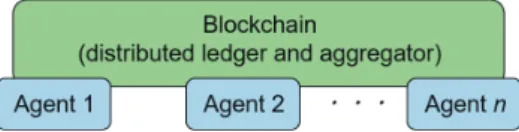
In blockchain-based distributed optimization, there is no aggregator. The function of the aggregator in ADMM is included in a blockchain, which is implemented in a dis- tributed way using a computer of each agent (see Fig. 5). In a similar way to the conventional ADMM, the local opti- mization problem (2) is solved by each agent.
The computation procedure is given as follows. First, each agent solves the local optimization problem (2), where some parameters are provided from the blockchain. Next, instead of communications to the aggregator, the agent that firstly solved the PoW puzzle generates a new block which contains information about the computation result (see also Sect. 2.2). Finally, based on the computation result of each agent, the smart contract is performed. The smart contract corresponds to update ofα, ¯xM, andρ. Forα, (3) is used.
For update ofρ, see the next subsection. By repeating this procedure, the optimal solution can be obtained.
Comparing Fig. 1 with Fig. 5, the aggregator in Fig. 5
Fig. 5 Blockchain-based distributed optimization, where the blockchain is implemented in a distributed way using a computer of each agent.
Fig. 6 Three computers in experiments.
Table 1 Energy price from outside from the district.
Price αBE [103JPY/MWh] 10.39 αBG [103JPY/102m3] 2.86
is included in the blockchain. Since in the blockchain, it is difficult to tamper a ledger, we can guarantee that a smart contract is correctly performed.
4.2 Numerical Experiments
To validate the effectiveness of blockchain-based distributed optimization, we consider solving the optimization problem in the EMS in Sect. 3.
4.2.1 Setting
In numerical experiments, we use a private Ethereum blockchain network[24]. We also use Python/CVXpy[7]
to solve the local optimization problem. Remote procedure calls through EthJsonRpc allows the Python scripts to com- municate with the smart contracts. Here, we use three com- puters (PC 1, PC 2, and PC 3). PC 1 is the desktop computer with CPU: Intel Core i7-6700 and Memory: 16GB. PC 2 is the laptop computer with CPU: Intel Core i5-6200U and Memory: 8GB. PC 3 is the same as PC 2. See also Fig. 6
Consider the EMS that is composed of two factory agents and single building agent. One computer is assigned to one agent. Table 1 shows the energy price from outside of the district. Table 2 shows energy demand and parame- ters. These parameters imply that the efficiency of a boiler is about 80%, and the electrical and thermal generation effi- ciency levels of a gas turbine are about 30% and about 20%, respectively.
Table 2 Energy demand and parameters.
Factory1 Factory2 Building1
DE [MWh] 3.2 2.4 11.0
DH [GJ] 5.0 8.0 17.1
aGTE [-] −0.001 −0.002 -
bGTE [-] 0.52 0.51 -
cGTE [-] −2.0 −2.5 -
aGTH [-] −0.001 −0.007 -
bGTH [-] 0.78 1.3 -
cGTH [-] −3.3 −6.0 -
BGGT [102m3] 46.4 27.5 - BGGT [102m3] 5.83 5.55 -
aBA [-] −0.4 −0.4 −0.5
bBA [-] 5.1 4.95 5.0
cBA [-] −1.0 −1.0 −0.5
BGGT [102m3] 2.75 1.36 1.84
BGGT [102m3] 0.405 0.23 0.12
Table 3 Optimal solution.
Factory1 Factory2 Building1
S EE [MWh] −9.64 −1.35 -
BEE [MWh] - - 11.00
BE [MWh] 0.00 0.00 0.00
PEGT [MWh] 12.84 12.84 -
S HH [GJ] −15.27 −1.74 -
BHH [GJ] - - 17.01
BGGT [102m3] 30.31 12.91 -
BGBA [102m3] 0.41 0.23 0.12
PHGT [GJ] 19.35 9.62 -
PHBA [GJ] 0.92 0.12 0.09
Energy cost [103JPY] 27.76 29.17 68.88
4.2.2 Computation Results We present the computation results.
In the use of ADMM, to converge computation faster, the parameterρin (3) is changed to a time-varying parame- ter as follows (see[4]for further details):
ρ(k+1) :=
2ρ(k) if 10ksM(k)k2<krM(k)k2, ρ(k)/2 if 10krM(k)k2<ksM(k)k2, ρ(k) otherwise,
whererM(k) :=P
i∈IxMi andsM(k) :=ρ(k+1)(xM(k+1)− xM(k)). If bothrM(k)< εandsM(k)< εare satisfied, then the computation procedure is terminated. In this example, we setε = 0.005. In addition, the initial values ofαEand αHare given by zero.
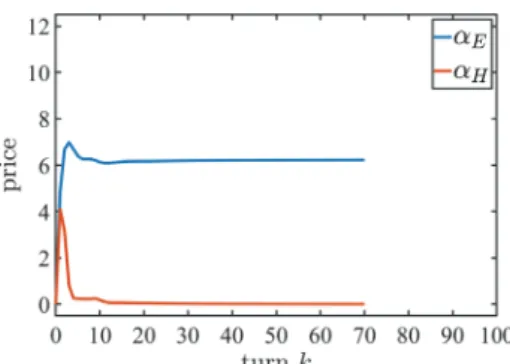
First, consider the normal case. Table 3 shows the op- timal solution. Figure 7 shows time evolution of prices of electricity and heat inside of the district. In this case, the computation procedure is terminated atk = 70. The com- putation results about the price in the conventional ADMM and the blockchain-based ADMM are the same. However, the results about the computation time are different (we will explain later).
Next, consider the case of tampering. We suppose here thatα(k+1) in (3) is tampered as follows:
α(k+1) :=α(k)+ρ(k)xM(k+1)+
"3.5 0
# .
Fig. 7 Prices of electricity and heat in the normal case.
Fig. 8 Prices of electricity and heat in the case of tampering.
In this simulation, we consider only the case of the conven- tional ADMM. Figure 8 shows time evolution of prices of electricity and heat inside of the district. From this figure, we see that the convergence of the time response is slow. In this case, the computation procedure is not still terminated at k=100. In addition, since 3.5 is always added toαE, even if the computation procedure is terminated,αE obtained is different to that in the normal case. In the case of the con- ventional ADMM, such tampering cannot be prevented. By the blockchain-based ADMM, prevention of tampering can be achieved.
Finally, we comment about the computation time. In the case where a blockchain is not used, the computation time in one update was about 0.09 sec, and the total compu- tation time was about 6 sec. In the case where a blockchain is used, the computation time in one update was about 8 sec, and the total computation time was about 567 sec. Thus, the blockchain technology provides tamper-resistant properties, but requires the long computation time. Hence, we must consider the trade-off between tamper-resistant properties and the computation time. Then, it is important to develop difficulty control in the PoW system (see also Sect. 2.2). In many cases of EMSs, the optimization problem is solved for every half hour or every hour (see, e.g.,[16],[17]). Hence, this computation result suggests that the blockchain-based distributed optimization method can be applied to EMSs.
5. Conclusion
In this paper, we discussed the effectiveness and limitation of blockchain-based distributed optimization through design
line of blockchains was also summarized. Next, an EMS that is composed of factory agents and building agents was introduced. Finally, by numerical experiments, the effec- tiveness and limitation of blockchain-based distributed opti- mization was clarified.
The experimental results in Sect. 4.2 suggest that blockchain-based distributed optimization can be utilizable for EMSs. These results also suggest that blockchain-based distributed optimization cannot be applied to faster dynam- ical systems such as mechanical systems. Faster distributed ledgers such as IOTA [25]has been proposed so far. It is important to consider utilizing such distributed ledgers for faster dynamical systems. As was explained in the previous section, it is also important to develop difficulty control for balancing security and computation time.
In numerical experiments of this paper, we considered optimization in only a single period (i.e., the optimization problem is solved only once). In general on-line optimiza- tion, the optimization problem is solved at each time step.
For also such cases, it is significant to clarify the effective- ness and limitation of blockchains. It is also one of the fu- ture efforts to consider more complex EMSs.
Acknowledgments
The authors would like to thank Dr. Toshiyuki Miyamoto, Osaka University for fruitful discussions.
This work was partly supported by JSPS KAKENHI Grant Numbers JP17K06486, JP19H02157, JP19H02158.
References
[1] T. AlSkaif and G. van Leeuwen, “Decentralized optimal power flow in distribution networks using blockchain,” 2019 Int’l Conf.
on Smart Energy Systems and Technologies, 2019.
[2] A. Azaria, A. Ekblaw, J.D. Halamka, and A. Lippman, “MedRec:
Using blockchain for medical data access and permission manage- ment,” Proc. 2nd Int’l Conf. on Open and Big Data, pp.25–30, 2016.
[3] D. Bertsekas and J.N. Tsitsiklis, Parallel and Distributed Computa- tion: Numerical Methods, Athena Scientific, 1997.
[4] S. Boyd, N. Parikh, E. Chu, B. Peleato, and J. Eckstein, “Dis- tributed optimization and statistical learning via the alternating di- rection method of multipliers,” Foundations and Trends in Machine Learning, vol.3, no.1, pp.1–122, 2011.
[5] M.P. Caro, M.S. Ali, M. Vecchio, and R. Giaffreda, “Blockchain- based traceability in Agri-Food supply chain management: A practi- cal implementation,” Proc. IoT Vertical Topical Summit Agriculture, 2018.
[6] K. Christidis and M. Devetsikiotis, “Blockchains and smart con- tracts for the internet of things,” IEEE Access, vol.4, pp.2292–2303, 2016.
[7] S. Diamond and S. Boyd, “CVXPY: A python-embedded modeling language for convex optimization,” J. Machine Learning Research, vol.17, no.83, pp.1–5, 2016.
[8] T. Erseghe, “Distributed optimal power flow using ADMM,” IEEE Trans. Power Systems, vol.29, no.5, pp.2370–2380, 2014.
[9] M. Iansiti and K.R. Lakhani, “The truth about blockchain,” Harvard Business Review, Jan.-Feb., pp.118–127, 2017.
[10] D. Kraft, “Difficulty control for blockchain-based consensus sys- tems,” Peer-to-Peer Netw. Appl., vol.9, no.2, pp.397–413, 2016.
[11] G. van Leeuwen, T. AlSkaif, M. Gibescu, and W. van Sark, “An integrated blockchain-based energy management platform with bi- lateral trading for microgrid communities,” Appl. Energ., vol.263, article 114613, 13 pages, 2020.
[12] W.-J. Ma, J. Wang, V. Gupta, and C. Chen, “Distributed energy man- agement for networked microgrids using online alternating direction method of multipliers with regret,” IEEE Trans. Smart Grid, vol.9, no.4, pp.2647–2657, 2018.
[13] Y. Matsuda, Y. Wakasa, and E. Masuda, “Fully-distributed accel- erated ADMM for DC optimal power flow problems with demand response,” Proc. 12th Asian Control Conf., pp.740–745, 2019.
[14] T. Miyamoto, T. Kitayama, S. Kumagai, K. Mori, S. Kitamura, and S. Shindo, “An energy trading system with consideration of CO2
emissions,” Electr. Eng. Jpn., vol.162, no.4, pp.54–63, 2008.
[15] T. Miyamoto, S. Kitamura, K. Mori, and Y. Izumi, “Distributed op- timization using alternating direction method of multipliers: Appli- cations to energy management systems,” Systems, Control and In- formation, vol.60, no.6, pp.219–224, 2016 (in Japanese).
[16] T. Miyamoto, K. Mori, S. Kitamura, and Y. Izui, “Solving distributed unit commitment problem with Walrasian auction,” IEEE Trans.
Syst., Man, Cybern., Syst., vol.46, no.8, pp.1088–1097, 2016.
[17] T. Miyamoto, M. Okada, T. Fukuda, S. Kitamura, K. Mori, and Y.
Izui, “Distributed day-ahead scheduling in community energy man- agement systems using inter-community energy trade,” IEEJ Trans.
Elect. Electr. Eng., vol.13, no.6, pp.858–867, 2018.
[18] E. Munsing, J. Mather, and S. Moura, “Blockchains for decentral- ized optimization of energy resources in microgrid networks,” Proc.
IEEE Conf. on Control Technology and Applications, pp.2164–
2171, 2017.
[19] T. Namerikawa, N. Okubo, R. Sato, Y. Okawa, and M. Ono, “Real- time pricing mechanism for electricity market with built-in incentive for participation,” IEEE Trans. Smart Grid, vol.6, no.6, pp.2714–
2724, 2015.
[20] D.P. Palomar and M. Chiang, “A tutorial on decomposition meth- ods for network utility maximization,” IEEE J. Sel. Areas Commun., vol.24, no.8, pp.1439–1451, 2006.
[21] G. Perboli, S. Musso, and M. Rosano, “Blockchain in logistics and supply chain: A lean approach for designing real-world use cases,”
IEEE Access, vol.6, pp.62018–62028, 2018.
[22] Y. Sugimoto, T. Miyamoto, S. Kumagai, K. Mori, S. Kitamura, and T. Yamamoto, “An energy distribution decision method in dis- tributed energy management systems with several agents,” Proc.
17th IFAC World Congress, pp.664–669, 2008.
[23] Y. Wakasa, M. Arakawa, K. Tanaka, and T. Akashi, “Decentralized model predictive control via dual decomposition,” Proc. 47th IEEE Conf. on Decision and Control, pp.381–386, 2008.
[24] Ethereum Foundation, Ethereum Frontier Guide, 2016.
[25] IOTA: The Next Generation of Distributed Ledger Technology, https://www.iota.org/
Daiki Ogawa received the B.E. degree in 2019 from Hokkaido University. He is currently a master course student at the Graduate School of Information Science and Technology, Hok- kaido University. His research interests include blockchains and distributed optimization.
Koichi Kobayashi received the B.E. degree in 1998 and the M.E. degree in 2000 from Hosei University, and the D.E. degree in 2007 from To- kyo Institute of Technology. From 2000 to 2004, he worked at Nippon Steel Corporation. From 2007 to 2015, he was an Assistant Professor at Japan Advanced Institute of Science and Tech- nology. Since 2015, he has been an Associate Professor at the Graduate School of Information Science and Technology, Hokkaido University.
His research interests include discrete event and hybrid systems. He is a member of IEEE, IEEJ, IEICE, ISCIE, and SICE.
Yuh Yamashita received his B.E., M.E., and Ph.D. degrees from Hokkaido University, Japan, in 1984, 1986, and 1993, respectively.
In 1988, he joined the faculty of Hokkaido Uni- versity. From 1996 to 2004, he was an Asso- ciate Professor at the Nara Institute of Science and Technology, Japan. Since 2004, he has been a Professor of the Graduate School of Informa- tion Science and Technology, at Hokkaido Uni- versity. His research interests include nonlinear control and nonlinear dynamical systems. He is a member of SICE, ISCIE, IEICE, RSJ, and IEEE.