The GRAID-annotated Jinghpaw Corpus: Annotations and Initial Findings
Kurabe, Keita
ILCAA, Tokyo University of Foreign Studies/University of Melbourne
The aim of this paper is two-fold: to explore an implementation of the GRAID glossing conventions to a corpus of Jinghpaw, a Tibeto-Burman language spoken in and around northern Burma; and to give initial findings drawn from the Jinghpaw corpus. Beginning with an overview of clause structures, annotations of referential expressions in terms of forms (NPs, pronouns, zeros), semantics (person and animacy), and functions (S, A, P, obliques, etc.), and types of predicates (verbal, nominal, copula, and non-canonical predicates) are explained. This is followed by a discussion of complex sentences, including complements, relative clauses, adverbial clauses, direct speech, and sentence-level coordination. This paper also explores annotations of constructions with special features, illustrating glossing of external possession, serial verbs, tail-head linkage, and repetition. These annotation conventions are followed by initial findings drawn from our corpus, especially focusing on Preferred Argument Structure, the discourse basis of ergativity, and referential density. Our findings show (a) that the crosslinguistically well-attested low lexicality of A can be replicated by our Jinghpaw data; (b) that the ergative alignment in discourse is not supported by our data;
and (c) that approximately half of argumental functions are not overtly expressed in our texts.
Keywords:Jinghpaw, corpus-based typology, GRAID, preferred argument structure, referential density
1. Introduction
2. Overview of clause structures 3. Referential expressions 4. Predicates
5. Complex sentences and direct speech 6. Constructions with special features 7. Initial findings
8. Conclusions
1. Introduction
The aim of this paper is two-fold: to outline an implementation of the GRAID glossing conventions (Haig and Schnell 2014) to Jinghpaw (ISO 639-3: kac), a language spoken in northern Burma (Myanmar) and neighboring areas of China and
Kurabe, Keita. 2018. “The GRAID-annotated Jinghpaw corpus: Annotations and initial findings”. Asian and African Languages and Linguistics12. pp.37–73. [Permanent URL: http://hdl.handle.net/10108/91142]
India; and to give initial findings drawn from the Jinghpaw corpus. The language is affiliated with the Tibeto-Burman branch of the Sino-Tibetan language family.
Within Tibeto-Burman, it is closely related to Luish (Asakian) languages such as Cak, Kadu, and Ganan, which are distributed in small discontinuous pockets situated across northwestern Burma, southeastern Bangladesh, and northeastern India. The linguistic data in our Jinghpaw corpus are based on a variety spoken in and around Myitkyina, the Kachin State of Burma, and it is considered to be the standard dialect of the language in Burma. The corpus data consist of traditional narrative texts, all of which are primary data, selected from 1,805 narrative recordings in Jinghpaw. They were collected in Burma by the author and local collaborators between 2009 and 2017 with the help of 196 native narrators. As of January, 2018, 939 stories have been transcribed by the author and native collaborators using the Jinghpaw orthography. All recordings and transcriptions are available online at PARADISEC (the Pacific And Regional Archive for Digital Sources in Endangered Cultures), and named in accordance with the PARADISEC file-naming convention that consists of CollectionID, ItemID, and ContentFile separated by hyphens, for example, KK1-0001-A (Kurabe 2017).
This paper is structured as follows. Beginning with an overview of clause structures in Section 2, Section 3 takes a closer look at Jinghpaw referential expressions with the GRAID glossing in terms of their forms, semantics, and functions. Annotations of predicates, including verbal, nominal, copula, and non-canonical predicates, are given in Section 4. Section 5 explores complex sentences in Jinghpaw, offering an implementation of the GRAID glossing to complement clauses, relative clauses, adverbial clauses, direct speech, and coordinate constructions. Our treatment of constructions with special features, including external possessor constructions, serial verb constructions, tail-head constructions, and repetition, is provided in Section 6.
Section 7 gives initial findings drawn from our corpus, especially focusing on Preferred Argument Structure, the discourse basis of ergativity, and referential density.
2. Overview of clause structures
A predicate, both verbal and non-verbal, is always placed at the end of a clause, as illustrated by the following examples with linguistic glosses and GRAID annotations.
1The two major clause types are verbal clauses headed by a verbal predicate as in (1a), and copula/nominal clauses headed by a nominal predicate with or without a copula as in (1b) and (1c).
(1) a.
##
shi 3sg pro.h:s
nta house np:g
=de
=all
=rn wa return v:pred
=ai
=decl
=rv
=da.
=hs
=other
‘She went back home, it’s said.’ (KK1-0319_051)
1The list of symbols employed in the GRAID convention is given in the appendix of Schnell and Schiborr (2018).
b.
##ds ndai this dem_pro:s
ngai 1sg
pro.1:poss
=na
=gen
=rn nga cow np:pred
nan exactly other
re.
cop cop
‘This is exactly my cow.’ (KK1-0272_040) c.
##ds ndai this dem_pro:s
ngai 1sg
pro.1:poss
=na
=gen
=rn nga.
cow np:pred
‘This is my cow.’ (elicited)
All nominal expressions, excluding afterthoughts, occur before predicates, as shown above. NPs, especially non-core arguments, are marked by postpositive case marking clitics to indicate their relationship to the predicate. The order of NPs, as seen in (2a) and (2b), is relatively free, being determined by pragmatic factors. Because predicates are the only obligatory constituents of clauses, references of arguments, when pragmatically retrievable from the context, are freely omitted in Jinghpaw, as seen in (2c).
(2) a.
##ds nang 2sg pro.2:a
ngai 1sg pro.1:p
=hpe
=acc
=rn grau more other
tsawra love v:pred
=ai
=decl
=rv
=i?
=q
=other
‘Do you love me more (than him)?’ (KK1-0262_066) b.
##ds
nanhte 2pl pro.2:p
=hpe
=acc
=rn ngai 1sg pro.1:a
tsawra love v:pred
=nga
=cont
=aux
=na
=irr
=aux
=yaw.
=sfp
=other
‘I will love you (always).’ (KK1-0474_026) c.
## 0.d:a 0.h:p nta house np:g
duhkra term other
hkan follow lv
shachyut chase v:pred
=ai
=decl
=rv
=da.
=hs
=other
‘(The spirit) chased (her) to her house, it’s said.’ (KK1-0319_066)
3. Referential expressions
Glossing of referential expressions is a fundamental part of GRAID annotations. This section, following Haig and Schnell (2014), explores Jinghpaw referential expressions in terms of their forms (3.1), semantics (3.2), and functions (3.3).
3.1. Form of referential expressions
The distinction between NP, pronoun, and zero is captured by the form glosses⟨np⟩,
⟨pro⟩, and⟨0⟩, respectively.
3.1.1. NP
In GRAID annotations, the form gloss⟨np⟩is given to what in the literature is labeled
“lexical mention/expression,” and so on (Du Bois 1987, Haig and Schnell 2014). As with other corpora, the most typical NPs glossed with the form gloss⟨np⟩in our corpus are those headed by common nouns. NPs are also headed by kinship terms, person and place names, and so on. These NPs are introduced with or without case-marking postclitics depending on their functions and/or semantic roles (see 3.3). Examples:
(3) a.
##
ndai this ln_dem
u-hka bird-crow np.d:s
=mung
=also
=other mau be.surprised v:pred
=mat
=compl
=aux
=na
=seq
=other
=she...
=then
=other
‘This crow was also surprised and...’ (KK1-0275_032) b.
#ac 0.h:a ganu mother np.h:p
=hpe
=acc
=rn bai again other
yu see v:pred
=dat
=away
=aux
=ai
=nmlz
=rv
shaloi when other
=wa...
=top
=other
‘When (he) saw his mother again...’ (KK1-0187_024)
Numerals also receive the form gloss⟨np⟩when they head NPs. Unlike neighboring classifier languages, such as Shan and Burmese, Jinghpaw numerals, displaying a similar distribution of common nouns, can occur in the absence of semantic heads and classifiers. Numerals, as such, can express different types of referents. The numeral masum ‘three,’ for instance, may denote ‘three persons,’ ‘three dogs,’ ‘three houses,’
‘three books,’ and so on, unlike other languages in the region.
(4)
##
wora that ln_dem
masum three np.h:s
=gaw
=top
=other yup sleep lv
rawt awake v:pred
=ai
=nmlz
=rv
=hte...
=com
=rn
‘The three (men) wake up and...’ (KK1-0271_038)
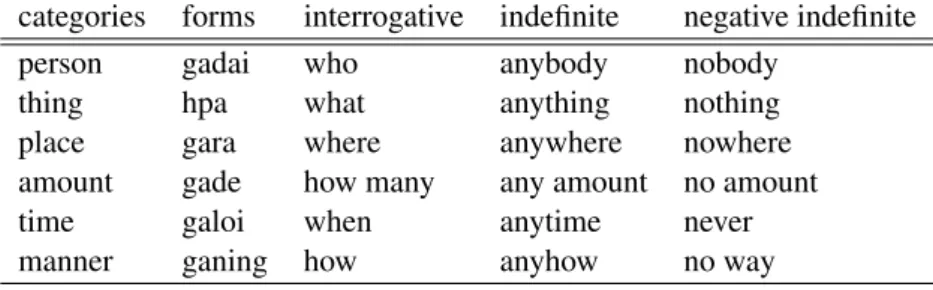
Interrogative pro-forms are also glossed with the form gloss ⟨np⟩ when they head NPs. Interrogatives, often followed by additive particles meaning ‘also,’ can be employed to express indefiniteness as well. The relationship between major interrogative and indefinite meanings is summarized in Table 1:
Table 1 The interrogative-indefinite relationship
categories forms interrogative indefinite negative indefinite
person gadai who anybody nobody
thing hpa what anything nothing
place gara where anywhere nowhere
amount gade how many any amount no amount
time galoi when anytime never
manner ganing how anyhow no way
Examples follow:
(5) a.
##ds 0.h:s ma child np.h:voc
=e
=sfp
=other gadai who np.h:obl
=ni
=pl
=rn
=hte
=com
=rn sa go v:pred
=na
=irr
=aux
=ma.
=q
=other
‘Child, who (pl.) will (you) go with?’ (KK1-0269_028) b.
##neg shi 3sg pro.h:a
=mung
=also
=other hpa what np:p
=ma
=also
=other
n-chye neg-know v:pred
=ai
=decl
=rv
=le.
=sfp
=other
‘He also knows nothing.’ (KK1-0269_213)
For complex NPs, the form gloss⟨np⟩is given to their heads, and other NP-internal subconstituents, excluding possessors that are specified for their own functions (see 3.4), are glossed as ⟨ln⟩ or ⟨rn⟩ depending on their relative positions to the head.
Typical NP-internal subconstituents in our corpus include: adnominal demonstratives, numerals, adjectives, and the pluralizing postclitic ni, which encodes additive, collective, and associative plural meanings. Examples:
(6) a.
##
dai that ln_dem
la man np.h:dt_s
masum three rn
dai that
dem_pro.h:s
=ni
=pl
=rn
=gaw...
=top
=other
‘These three men, they (are laborers and)...’ (KK1-0271_011) b.
#ac.neg 0.h:a nga fish np:p
gaba big rn
=ni
=pl
=rn n-lu neg-be.able lv
rim catch v:pred
=ai
=nmlz
=rv majaw...
because...
other
‘Because (she) could not get large fish...’ (KK1-0187_021)
In conjunctive coordination of NPs, whether monosyndetic (i.e., [A-co] [B]) or
disyndetic (i.e., [A-co] [B-co]), the form gloss⟨np⟩is given to the last coordinant in our corpus, and other coordinants to its left are glossed with the form gloss⟨ln⟩. Jinghpaw has various kinds of coordinators, including comitative case postclitichte‘with, and,’
additive particlemada‘also,’ and a special coordinatoryenthat is restricted to binary coordination of human beings.
(7) a.
##
makaw
firstborn.daughter ln
yen and rn
magam firstborn.son np.d:voc
daini today other
=gaw
=top
=other nan 2du pro.2:s nau...
sibling np.d:appos
‘Firstborn daughter and firstborn son, today, you siblings...’ (KK1-0263_017) b.
##
shannga deer np.d:dt
=ni
=pl
=rn
=gaw
=top
=other ayi female ln
mada also rn
ala male np.d:appos
mada also rn
nrung horn np:s grai
very other
tsawm be.beautiful v:pred
=na...
=seq
=other
‘As for deer, both male and female, their horns were very beautiful and...’
(KK1-0263_002)
3.1.2. Pronoun
Our corpus, following Haig and Schnell (2014: 9) who intend to capture “definite pronouns,” labels personal and demonstrative pronouns with the form gloss ⟨pro⟩. Examples of personal pronouns include:
(8) a.
##ds ngai 1sg pro.1:a
nang 2sg pro.2:p
=hpe
=acc
=rn
garum help lv
hpyi ask v:pred
=mayu
=desid
=aux
=ai.
=decl
=rv
‘I want to ask you for help.’ (KK1-0276_067) b.
##
shi 3sg pro.h:a
=gaw
=top
=other dai that dem_pro:p
=ni
=pl
=rn
=hpe
=acc
=rn hta pick lv
la take v:pred
=na
=seq
=other
=she...
=then
=other
‘He picked and took these (fish) and then...’ (KK1-0269_067)
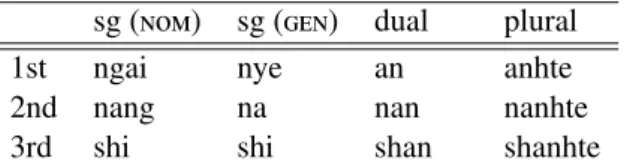
Jinghpaw personal pronouns are encoded as free pronouns with full forms whose systems exhibit three-way splits in person (1st, 2nd, 3rd) and in number (singular, dual, plural), yielding the paradigm given in Table 2. All personal pronouns, as can be seen, are formally distinguished, and there is no syncretism of person or number
contrasts. The dual/plural distinction is only found in personal pronouns. Separate genitive forms exist for singular, which have their diachronic sources in a contraction of singular personal pronouns plus the obsolete genitive case markera.
Table 2 Personal pronouns
sg (nom) sg (gen) dual plural
1st ngai nye an anhte
2nd nang na nan nanhte
3rd shi shi shan shanhte
Demonstratives, when they head NPs, also receive the form gloss⟨pro⟩. They are glossed with an additional gloss⟨dem⟩, which is combined with other glosses separated by an underscore, for example,⟨dem_pro.h:s⟩. Demonstratives in Jinghpaw function as free pronouns, and distinguish speaker-addressee orientation, relative distance, or relative height from the deictic center: ndai [proximate; speaker-centered]; dai [proximate; addressee-centered]; htora [distal; up]; wora [distal; level]; lera [distal;
down]. Demonstratives, in terms of qualitative features of the referent, are specified for inanimate by default, as in (9a), unless followed by the plural markerni, which turns demonstratives into neutral for humanness and animacy, as in (9b).
(9) a.
##
shi 3sg pro.d:a
=gaw
=top
=rn dai that dem_pro:p
=hpe
=acc
=rn lang hold v:pred
di lv other
=na...
=seq
=other
‘He held it (meat) and...’ (KK1-0275_010) b.
#ds ndai this
dem_pro.h:a
=ni
=pl
=rn
=gaw
=top
=other ngai 1sg pro.1:p
=hpe
=acc
=rn gara how other
=hku
=like
=rn wa
return lv
masusha deceive v:pred
=na
=irr
=aux
=i?
=q
=other
‘How will these ones come back and lie to me?’ (KK1-0271_050)
Complex NPs headed by pronouns, including personal and demonstrative pronouns, show reduced possibilities for their internal subconstituents. Unlike common nouns and numerals, they cannot take multiple types of adnominals, such as adjectives, demonstratives, genitives, and relative clauses. Typical complex NPs with pronoun heads in our corpus, as in (9b), are those with numerals and pluralizing markers.
3.1.3. Zero
Almost all references of arguments, when pragmatically recoverable from the context, can be freely omitted in Jinghpaw. In our corpus, zero arguments are assumed
when they are: (a) licensed by the argument structure of a verb; (b) recoverable from the discourse; and (c) not constructionally suppressed. Usually, these zero arguments can alternatively be expressed by overt forms. Zero arguments receive the form gloss
⟨0⟩. Because all NPs, as noted in Section 2, occur before predicates and their order is relatively free, it is impossible to determine the exact position of zero arguments.
Instead of arbitrarily determining their positions, we put all of them at the beginning of clauses regardless of their syntactic functions.
(10) a.
## 0.h:a shi 3sg pro.h:p
=hpe
=acc
=rn la wait v:pred
=taw
=cont
=aux
=ai.
=decl
=rv
‘(She) was waiting for him.’ (KK1-0187_060) b.
##ds 0:p nang 2sg pro.2:a
=gaw
=top
=other sa go lv
rim catch v:pred
=u.
=imp
=rv
‘You go catch (fish)!’ (KK1-0276_017) c.
## 0.h:a 0:p hpai carry v:pred
=wa
=ven
=aux
=na
=seq
=other
=she...
=then
=other
‘(He) carried (the fish) back home and then...’ (KK1-0269_071)
We assume a zero in the S position of imperative and hortative clauses, despite them often being omitted, as in (11a) and (11b), because they can alternatively be expressed by overt forms, as in (11c) and (11d). For cases where we do not assume a zero, see Section 4.3.
(11) a.
##ds 0.2:s
atsawm well other
rai lv other
=na
=seq
=other bai again other
wa return v:pred
=u
=imp
=rv
=yaw.
=sfp
=other
‘(You) come back carefully!’ (KK1-0269_038) b.
##ds 0.1:s mare village np:g
gaba big rn
=de
=all
=rn sa go v:pred
=mat
=compl
=aux
=ga.
=hort
=rv
‘Let (us) go to a large village.’ (KK1-0262_058) c.
##ds nang 2sg pro.2:s
atsawm well other
rai lv other
=na
=seq
=other bai again other
wa return v:pred
=u
=imp
=rv
=yaw.
=sfp
=other
‘You come back carefully!’ (elicited)
d.
##ds anhte 1pl pro.1:s
mare village np:g
gaba big rn
=de
=all
=rn sa go v:pred
=mat
=compl
=aux
=ga.
=hort
=rv
‘Let us go to a large village.’ (elicited)
3.2. Animacy and person of referential expressions
Four animacy and person glosses, that is,⟨h⟩,⟨d⟩,⟨1⟩, and⟨2⟩, are considered in the Jinghpaw corpus. Reference to speech-act participants, glossed with⟨1⟩and⟨2⟩, only occur in direct speech in our corpus because it consists of narrative texts. Examples include:
(12) a.
##
shi 3sg pro.h:a
ganu mother np.h:p
=hpe
=acc
=rn grai very other
tawngban apologize v:pred
=ai
=decl
=rv
=i.
=sfp
=other
‘He apologized to his mother a lot, OK?’ (KK1-0187_066) b.
##ds nang 2sg pro.2:a
ngai 1sg pro.1:p
=hpe
=acc
=rn grau more other
tsawra love v:pred
=ai
=decl
=rv
=i?
=q
=other
‘Do you love me more (than him)?’ (KK1-0262_066)
Because our corpus contains some fables that feature animals and spirits, the animacy gloss⟨d⟩is also employed to gloss anthropomorphized discourse participants. These referents are given human qualities, such as the ability to speak human language.
Examples:
(13) a.
##
shi 3sg pro.d:a
=gaw
=top
=other shi 3sg
pro.d:poss
=na
=gen
=rn
gasha child np.d:p
=hpe
=acc
=rn tsun say v:pred
=ai.
=decl
=rv
‘He (deer) said to his children.’ (KK1-0263_016) b.
##ds aba brother np.d:voc
ngai 1sg pro.1:s
wora that ln_dem
maling forest np:g
=de
=all
=rn agu uncle ln
wadu-brang boar-brother ln
=ni
=pl
=rn dumsi porcupine np.d:g
=ni
=pl
=rn
=kaw
=loc
=rn sa go lv
lam wander v:pred
=na.
=irr
=aux
‘Brother (deer), I will go wander to the forest, to uncle boars, porcupines, and others.’ (KK1-0263_031)
Animacy features are given depending on semantic role consideration of the referent rather than its form. Thus, the same noun may be assigned different animacy values
depending on its meaning in context. For example, a place noun mare ‘village’ is treated as a goal and receives no animacy feature in (14a), in contrast to (14b), where the same noun is metonymically used for those who live in the village.
(14) a.
## 0.h:s mare village np:g
langai one rn
mi one rn
=kaw
=loc
=rn du arrive v:pred
yang when other
=gaw...
=top
=other
‘(They) arrived at one village and...’ (KK1-0274_011) b.
#rc mare village np.h:a
ting whole rn
nga-nawng fish-pond np:p
jawm do.together lv
htawk remove v:pred
=ai
=nmlz
=rn
%
% nhtoi-lamang...
day-program np:p
‘a (festival) day program where the villagers removed water from a pond (to catch fish)...’ (KK1-0187_008)
3.3. Function of referential expressions 3.3.1. Core argument function
NPs, as noted in Section 2, may be marked by postpositive case marking clitics.
The case marking pattern, as shown in (15a) and (15b), is the nominative-accusative type (S/A vs. P), where the S and A functions occur without any overt case marker in contrast to the P, which may be case-marked by an accusative postclitic. The P function, as seen in (15c), may also be introduced without any overt marker (see below).
(15) a.
##ds ngai 1sg pro.1:s
sa go v:pred
=na
=irr
=aux
=law.
=sfp
=other
‘I will go.’ (KK1-0269_035) b.
##ds ngai 1sg pro.1:a
nang 2sg pro.2:p
=hpe
=acc
=rn
garum help lv
hpyi ask v:pred
=mayu
=desid
=aux
=ai.
=decl
=rv
‘I want to ask you for help.’ (KK1-0276_067) c.
##ds
raitimung but other
nang 2sg pro.2:a
hpaji knowledge np:p
naw still other
ra need v:pred
=ai
=decl
=rv
=yaw.
=sfp
=other
‘But, you still need knowledge.’ (KK1-0275_036)
The P function is obligatorily marked by the accusative when the P outranks or is equal to the A on the animacy hierarchy given in (16), and is left unmarked or optionally marked by the accusative when the P is lower than the A. This case marking pattern is well motivated by the need to differentiate between two potential agents by overtly
case marking the P with the accusative, leaving the A unmarked (Kurabe 2012). In other words, the P is case marked when there is a possibility that it may be misconstrued with the A otherwise, the situation of which arises when the P is equally high or higher than the A on the animacy hierarchy, as the prototypical P is lower than the A in animacy (Comrie 1981: 121).2
(16) Animacy hierarchy (Comrie 1981: 178) human>animal>inanimate
A similar case marking pattern is also observed for ditransitive constructions whose case frame is that the A remains unmarked, the recipient is obligatorily marked by the accusative, and the theme is left unmarked. This is due to the fact that the recipient is typically human; this is in contrast to the theme, which is typically non-human, and ranked lower than the agent and recipient on the animacy hierarchy.3To illustrate this, consider (17). In our corpus, the theme is glossed as⟨:p2⟩.
(17)
##ds nang 2sg pro.2:a
ngai 1sg pro.1:p
=hpe
=acc
=rn
manu-jahpu price-price np:p2
jaw give v:pred
=na...
=irr
=aux
‘You would give me the price...’ (KK1-0276_088)
3.3.2. Oblique function
Obliques are encoded by means of case-marking postclitics. As core arguments, obliques always precede verbal predicates with relatively free orders. Following the GRAID manual (Haig and Schnell 2014: 14–6), our corpus considers three types of adjuncts: locations ⟨:l⟩, goals⟨:g⟩, and other semantic roles⟨:obl⟩. Locations and goals can both be encoded by the locative casekawthat marks physical locations (18a), goals (18b), and sources (18c) (in the last case, with an ablative case). Examples follow:
(18) a.
##ds 0.1:s ndai this dem_np:l
=kaw
=loc
=rn
jahkring for.a.while other
mi one rn
naw still other
hkring rest lv la
take v:pred
=ga.
=hort
=rv
‘Let’s take a rest here for a while.’ (KK1-0271_019)
2This type of case marking employed for disambiguation of the P from the A is widespread among TB languages as well as is crosslinguistically common (LaPolla 1992, Malchukov 2008, and others). The definitness of the P function, although known to play some role in some languages, does not play a role in Jinghpaw. This can be seen in the fact that P arguments low in definiteness, such as interrogatives, can potentially be marked with the accusative.
3When equally-ranking recipient and theme NPs are involved, both of them must be case marked with the accusative. In such situations, the interpretation of the recipient and theme is determined by context, as scrambling of the recipient and theme NPs does not contribute to the meaning (Kurabe 2012).
b.
##
shi 3sg pro.h:s
=gaw
=top
=other lup grave np:g
=kaw
=loc
=rn du arrive v:pred
=ai
=nmlz
=rv
=hte
=com
=rn
=i...
=sfp
=other
‘He arrived at the grave and, OK?’ (KK1-0274_045) c.
##ds ma child np.h:voc
nang 2sg pro.2:a
ndai this dem_np:p
gara where np:l
=kaw
=loc
=rn
=na
=abl
=rn la take v:pred
=wa
=ven
=aux
=ai
=decl
=rv
=rai?
=q
=other
‘Child, where did you take this from?’ (KK1-0269_204)
Goals can also be marked by the allative case de, as in (19a), which, unlike the locative kaw, is sensitive to the animacy of the goal NP it marks: it can only mark inanimate goals, for example, nta de ‘to the house’ vs. *manang de‘to the friend.’
The allative can mark animate goals only by means ofhpang(originally a locator noun meaning ‘behind’), which is employed to “locationalize” animate nouns, as in (19b).
(19) a.
##ds 0.1:s mare village np:g
gaba big rn
=de
=all
=rn sa go v:pred
=mat
=compl
=aux
=ga.
=hort
=rv
‘Let’s go to a large village.’ (KK1-0262_058) b.
## 0.h:p
shanhte 3pl pro.h:a
=ni
=pl
=rn
hkawhkam-wa king-man np.h:g
hpang
locationalizer rn
=de
=all
=rn wa go lv sa
send v:pred
=ya
=ben
=aux
=na
=seq
=other
=she...
=then
=other
‘They sent him to the king and then...’ (KK1-0269_197)
Other obliques receive the function gloss ⟨:obl⟩, marking semantic roles, such as companion (20a), instrument (20b), and so on.
(20) a.
## 0.h:a gwi dog np:obl
=hte
=com
=rn rau together other
hpun wood np:p
hta pick lv
sa go v:pred
=na
=seq
=other
=she...
=then
=other
‘(He) went to pick up wood with his dog and then...’ (KK1-0269_113) b.
## 0.h:s
shupsheng cymbal ln
=hte
=com
=rn bau drum np:obl
=ni
=pl
=rn
=hte
=com
=rn
shangoi make.a.noise v:pred
=na...
=seq
=other
‘(They) made a noise with cymbals and drums and...’ (KK1-0269_234)
Circumstantial adjuncts, even when marked by the locative casekawlike locations, are given the function gloss ⟨:other⟩in accordance with the GRAID manual (Haig and Schnell 2014: 17), where obliques are glossed depending on semantic role considerations rather than their forms.
3.4. Other syntactic functions
Other glosses for syntactic functions considered in the Jinghpaw corpus include:
⟨:dt⟩ for dislocated topics, ⟨:voc⟩ for vocatives, ⟨:appos⟩ for appositionals, and
⟨:poss⟩ for possessors. The gloss ⟨:dt⟩ is given to NPs that occur outside clause boundaries. No distinction is made between right and left dislocation. The function of clause-internal coreferential elements, when relevant, is also marked for dislocated phrases.
(21) a.
##
dai well other
mare village np:dt_l
langai one rn
mi one rn
ndai this dem_np:l
=kaw...
=loc
=rn
‘Well, at one village, there...’ (KK1-0262_002) b.
##ds nang 2sg
pro.2:dt_s
=da
=hs
=other
#ac
#ac nang 2sg pro.2:s
gahpu elder.brother np.h:pred
re cop cop majaw...
because other
‘You, she said, because you are the elder brother...’ (KK1-0262_013)
The function gloss⟨:voc⟩is applied to vocative phrases, which are typically kinship terms. Examples:
(22) a.
##ds.neg 0.1:a 0:p adwi grandmother np.d:voc
n-matsing neg-remember v:pred
=s-ai.
=csm-decl
=rv
‘Grandma, (I) don’t remember (it) anymore.’ (KK1-0269_091) b.
##ds ma child np.h:voc
nang 2sg pro.2:a
ndai this dem_np:p
gara where np:l
=kaw
=loc
=rn
=na
=abl
=rn la take v:pred
=wa
=ven
=aux
=ai
=decl
=rv
=rai?
=q
=other
‘Child, where did you take this back from?’ (KK1-0269_204)
The function gloss⟨:appos⟩is given to appositional phrases, which are co-referent with juxtaposed phrases, adding additional information to the referent.
(23) a.
##ds anhte 1pl pro.1:s
shinggyim-masha human-person np.h:appos
=ni
=pl
=rn
=gaw...
=top
=other
‘We, human beings, (are)...’ (KK1-0319_004) b.
## 0.h:a 0:p2 shi 3sg
pro.h:poss
=na
=gen
=rn
gasha child np.h:p
magam-wa firstborn-man np.h:appos
=hpe
=acc
=rn jaw
give v:pred
=ai.
=decl
=rv
‘(The mother) gave (it) to her son, to the firstborn son.’ (KK1-0262_012) Possessors, which are typically encoded with the genitive case na, are glossed with the functional gloss⟨:poss⟩, which is the only NP-internal function in GRAID.
Separate genitive forms, as noted in 3.1.2, exist for singular personal pronouns, for example,na‘your (sg.).’
(24) a.
##ds ndai this ln_dem
gumra horse np:a
=wa
=top
=other anhte 1pl
pro.1:poss
=na
=gen
=rn
mam-nli rice-seed np:p
mahkra all rn sha
eat v:pred
=kau
=away
=aux
=ya
=ben
=aux
=s-ai.
=csm-decl
=rv
‘This horse ate all of our rice seeds.’ (KK1-0271_057) b.
##ds 0.h:s na 2sg.gen pro.2:poss
kashu grandson np.h:pred
she indeed other
rai cop cop
=s-ai
=csm-decl
=rv
=gaw.
=sfp
=other
‘(He) is indeed your grandson.’ (KK1-0269_250)
4. Predicates
This section provides the GRAID glossing of predicates in the Jinghpaw corpus, beginning with verbal predicates (4.1), followed by copula/nominal (4.2), and non-canonical predicates (4.3).
4.1. Verbal predicates
Predicates headed by verbs receive the form gloss ⟨v⟩and function gloss ⟨:pred⟩. The copula, although it is morphosyntactically a verb in Jinghpaw, is glossed differently with the gloss⟨cop⟩(see 4.2). Jinghpaw is an aspect- and mood-prominent language with no grammatical tense. Verbs are typically followed by mood-marking postclitics consisting of six paradigmatic values, for example,ai ‘decl’ andu‘imp,’ which mark the end of the verbal predicate. Mood markers, as illustrated by (25), are glossed with the form gloss⟨rv⟩. Elements occurring after mood markers, such as sentence-final particles, are elements outside the verbal predicate, and thus receive the form gloss
⟨other⟩, as in (25b).
(25) a.
##
shi 3sg pro.h:a
gasha son np.h:p
=hpe
=acc
=rn grai very other
tsawra love v:pred
=ai.
=decl
=rv
‘She loves her son very much.’ (KK1-0187_033) b.
##ds
raitimung but other
nang 2sg pro.2:a
hpaji knowledge np:p
naw still other
ra need v:pred
=ai
=decl
=rv
=yaw.
=sfp
=other
‘But, you still need knowledge.’ (KK1-0275_036)
Jinghpaw verbs fall into two primary lexical aspect classes: the active verb, which semantically encodes a dynamic situation or ‘something happens,’ and the stative verb, which encodes a stative situation or a non-happening. The importance of this classification primarily lies in the temporal interpretation of verbs with the declarative mood markerai. When followed by this marker, an active verb, as in (26a), normally indicates the time prior to the moment of speech, while a stative verb, as in (26b), normally indicates the present moment (although time reference is changeable with the help of temporal adverbs, such asshani shagu‘every day’ andmoi‘long ago’). Both active and stative verbs receive the gloss⟨v:pred⟩in our corpus.
(26) a.
##
shi 3sg pro.h:s
=gaw
=top
=other dai that dem_np:l
=kaw
=loc
=rn yup sleep v:pred
=ai.
=decl
=rv
‘He slept there.’ (KK1-0274_052) b.
##ds jan sun np:s
grai very other
ja be.hot v:pred
=ai
=decl
=rv
=law.
=sfp
=other
‘It’s very hot.’ (KK1-0271_018)
Many morphosyntactic properties show that words denoting property concepts, such asja‘be hot,’ can be best treated as stative verbs in Jinghpaw, being thus glossed with
⟨v:pred⟩. Note further that some stative verbs, especially those denoting the four
core semantic types of adjectives (Dixon 1977), unlike other stative verbs, have an additional ability to modify nouns in the post-nominal position without any marker of syntactic dependency. We label them as “adjectives” and treat them as a subclass of stative verbs. When functioning as predicates, adjectives receive the gloss ⟨v:pred⟩, and when functioning as modifiers, they receive the gloss⟨rn⟩. Compare:
(27) a.
##
ndai this ln_dem
nga fish np:s
=ni
=pl
=rn gaba be.big v:pred
=ai.
=decl
=rv
‘These fish are big.’ (elicited) b.
#ac.neg 0.h:a nga fish np:p
gaba big rn
=ni
=pl
=rn n-lu neg-get lv
rim catch v:pred
=ai
=nmlz
=rv
majaw...
because other
‘Because (she) could not get big fish...’ (KK1-0187_021)
Verbs may be followed by an array of optional auxiliaries, expressing meanings associated with aspectuality, modality, evidentiality, intensity, and so on. Auxiliaries are glossed with the form gloss⟨aux⟩in our corpus.
(28) a.
## 0.h:a shi 3sg pro.h:p
=hpe
=acc
=rn la wait v:pred
=taw
=cont
=aux
=ai.
=decl
=rv
‘(She) was waiting for him.’ (KK1-0187_060) b.
##
dai that ln_dem
ma child np.h:s
=gaw
=top
=other
manang friend np.h:obl
=ni
=pl
=rn
=hte
=com
=rn grai very other chyai
play v:pred
=mayu
=desid
=aux
=ai.
=decl
=rv
‘The child really wants to play with friends.’ (KK1-0269_016)
4.2. Verbless and copula predicates
Verbless predicates typically consist of nominal predicates. The relation, encoded by a nominal predicate, may be identity (equation), classification, and location, as illustrated by the following examples. The nominal predicate receives the gloss
⟨np:pred⟩. (29) a.
##
shi 3sg pro.h:s
=gaw
=top
=other anhte 1pl
pro.1:poss
=na
=gen
=rn
manang.
friend np:pred
‘He is our friend.’ (elicited)
b.
##
dai that ln_dem
namlap leaf np:dt_s
dai that dem_pro:s
=gaw
=top
=other ndai well other tsihkrungtsinan
elixir.of.immortality np:pred
=i.
=sfp
=other
‘The leaf is an immortality elixir, OK?’ (KK1-0269_086) c.
##
shi 3sg pro.h:s
=gaw
=top
=other ya now other
nta house np:l:pred
=kaw.
=loc
=rn
‘He is at home now.’ (elicited)
Nominal predicates show reduced morphosyntactic possibilities. They cannot express properties associated with verbs. For example, they cannot be negated, cannot be specified for aspect and mood, cannot be elaborated by auxiliaries, and cannot be modified by adverbs. These morphosyntactic properties must be encoded by means of a verb, in this case, the copula verb. All relations encoded by a nominal predicate, as shown below, can also be expressed with a copula. A copula, which has the function to relate the subject of a clause with a copula complement, receives a special gloss⟨cop⟩. In a copula clause, the copula complement always follows the copula subject. This is in contrast to a transitive clause, which also takes two core arguments, but they have a flexible order.
(30) a.
##ds ndai this dem_pro:s
ngai 1sg
pro.1:poss
=na
=gen
=rn nga cow np:pred
she indeed other
re cop cop
=gaw.
=sfp
=other
‘This is indeed my cow.’ (KK1-0272_033) b.
##ds 0:s
nat-ga
spirit-language np:pred
re cop cop
%
% nga say v:pred
=na...
=seq
=other
‘(They) said “(it) is a spirit language” and...’ (KK1-0319_017) c.
##
shi 3sg pro.h:s
=gaw
=top
=other ya now other
nta house np:l:pred
=kaw
=loc
=rn re.
cop cop
‘He is at home now.’ (elicited)
4.3. Non-canonical predicates
Predicates that exhibit reduced possibilities for government of verbal arguments receive the gloss ⟨vother:pred⟩(Haig and Schnell 2014: 22–3). Three predicates
heading dependent clauses fall into this category in the Jinghpaw corpus, all involving the core functions S and A. Because arguments are systematically suppressed, no zeros are assumed in the glossing for these cases. The first example comes from a predicate with the subordinatorlet, which forms a simultaneous adverbial clause. One constraint imposed on this construction is that the S or A argument in the dependent clause, which is always coreferential with the S or A argument in the main clause, must not be overtly expressed. Consider:
(31)
##
ganu mother np.h:a
=gaw
=top
=other
#ac
#ac grai very other
matsan be.poor vother:pred
=let
=sim
=other
%
%
=sha
=only
=other grai
very other
gasha child np.h:p
=hpe
=acc
=rn
baumaka take.care.of v:pred
=ai.
=decl
=rv
‘The mother, while being very poor, took care of her son very much.’
(KK1-0187_005)
The next example comes from a negated nominalized clause that forms an adverbial clause conveying the sense of privation. Again, the S or A in the dependent clause, being coreferential with the S or A in the main clause, is systematically suppressed.
(32)
##
shi 3sg pro.h:s
#ac
#ac.neg nba blanket np:p
n-hpun neg-wear vother:pred
=ai
=nmlz
=rv
%
%
=sha
=only
=other yup
sleep v:pred
=ai.
=decl
=rv
‘He slept without wearing a blanket.’ (observed)
The last example is illustrated by complementation verb serialization, where one serialized verb takes a clause headed by another verb as its complement. Only complement-taking transitive verbs are involved, where the S or A in the complement, which is always coreferential with the S or A argument in the main clause, must not be overtly expressed.
(33)
##
shi 3sg pro.h:a
=gaw
=top
=other ganu mother np.h:p
=hpe
=acc
=rn
#cc
#cc:p shat food np:p
shadu cook
vother:pred
%
% garum
help v:pred
=nga
=cont
=aux
=ai.
=decl
=rv
‘He is helping his mother cook food.’ (elicited)
5. Complex sentences and direct speech 5.1. Subordination and nominalization
The pervasive use and multifunctionality of clausal nominalization are prominent features of Jinghpaw grammar. A nominalized clause can be used not only nominally but also adnominally and adverbially, being exploited to form all the three major types of subordinate clauses: complement clauses, relative clauses (headed and headless), and adverbial clauses. Clausal nominalization is achieved by adding the nominalizer ai to a verb, which also marks the verb citation and declarative mood. Thus, an identical clause may occur as a well-formed main clause, complement clause, headed and headless relative clause, and adverbial clause, as illustrated by elicited examples in (34), respectively.
(34) a.
##
shi 3sg pro.h:a
shat food np:p
sha eat v:pred
=ai.
=decl
=rv
‘He ate food.’ (elicited) b.
##
ngai 1sg pro.h:a
#cc
#cc:p shi 3sg pro.h:a
shat food np:p
sha eat v:pred
=ai
=nmlz
=rv
%
% chye know v:pred
=ai.
=decl
=rv
‘I know that he ate food.’ (elicited) c.
##
#rc
#rc shi 3sg pro.h:a
shat food np:p
sha eat v:pred
=ai
=nmlz
=rv
%
%
lakung...
spoon np:s
‘The spoon that he ate food with (is)...’ (elicited) d.
##
#rc
#rc:obl shi 3sg pro.h:a
shat food np:p
sha eat v:pred
=ai
=nmlz
=rv
%
%
=hte...
=com
=rn
‘With which (spoon) he ate food...’ (elicited) e.
##
#ac
#ac shi 3sg pro.h:a
shat food np:p
sha eat v:pred
=ai
=nmlz
=rv
%
%
majaw...
because np:other
‘Because he ate food...’ (elicited)
Despite the fact that all the clauses in (34) are headed by the same verb form, we differentiate nominalized (subordinate) clauses from main clauses based on the fact that the former does not exhibit full-fledged properties of main clauses, for example, topic and sentence-final particles never occur within nominalized clauses.
5.2. Complement clauses
Complement clauses, as noted in 5.1, are formed by means of clausal nominalization.
The beginning of complement clauses is glossed by the clausal operator⟨cc⟩, and the end of them by a clause boundary marker ⟨%⟩. Complement clauses may function as the S or P argument, and are thus glossed in the same way as those of other referential expressions. Verbs that have the ability to take nominalized complements may be intransitive verbs from specific semantic classes, such as emotion (e.g.,pyo‘be fun’), difficulty (e.g.,yak‘be difficult’), speed (e.g.,lawan‘be quick’), and judgment (e.g.,teng‘be true’), or transitive verbs from such semantic classes as knowledge and acquisition of knowledge (e.g.,ce‘know’), conception (e.g.,shadu‘think’), perception (e.g., mu ‘see’), fearing (e.g.,hkrit‘fear’), preference (e.g.,ra ‘like’), demonstration (e.g.,sharin‘teach’), manipulation (e.g.,garum‘help’), and phrasal aspect (e.g.,ngut
‘finish’). Examples:
(35) a.
##
#cc
#cc:s 0.2:s
jawng school np:g
sa go v:pred
=ai
=nmlz
=rv
%
% pyaw be.fun v:pred
=ai
=decl
=rv
=i.
=q
=other
‘Is it fun for you to go to school?’ (observed) b.
## 0.1:a
#cc
#cc:p
marang rain(n.) np:s
htu rain(v.) v:pred
=ai
=nmlz
=rv
%
%
=gaw
=top
=other ra like v:pred
=ai.
=decl
=rv
‘(I) like rain.’ (observed)
Complement clauses, as demonstrated in 4.3, can also be formed by means of verb serialization, in which case, suppression of verbal arguments is observed, unlike nominalized complements, which do not exhibit them. Compare:
(36) a.
##
shi 3sg pro.h:a
=gaw
=top
=other ganu mother np.h:p
=hpe
=acc
=rn
#cc
#cc:p shat food np:p
shadu cook
vother:pred
%
%
garum help v:pred
=nga
=cont
=aux
=ai.
=decl
=rv
‘He is helping his mother cook food.’ (elicited) b.
##
shi 3sg pro.h:a
=gaw
=top
=other
#cc
#cc:p ganu mother np.h:a
shat food np:p
shadu cook v:pred
=ai
=nmlz
=rv
%
% garum
help v:pred
=nga
=cont
=aux
=ai.
=decl
=rv
‘He is helping his mother cook food.’ (elicited)
5.3. Relative clauses
Relative clauses, as noted in 5.1, are formed by means of clausal nominalization.
Relativization involves no explicit indication of the relationship between the head noun and the relative clause. A relative clause construction may be analyzed as a simple juxtaposition of a nominalized clause and a head noun. This is supported by the flexible position of a relative clause, as shown below, although a relative clause is most commonly prepositive.
(37) a.
##
#rc
#rc rc_0:s grai very other
gaba be.big v:pred
=ai
=nmlz
=rv
%
% hpun tree np:s
=ni
=pl
=rn moi before other grai
very other
nga be v:pred
=ai.
=decl
=rv
‘There were many trees which had been very big before.’ (elicited) b.
##
hpun tree np:s
#rc
#rc rc_0:s grai very other
gaba be.big v:pred
=ai
=nmlz
=rv
%
%
=ni
=pl
=rn moi before other grai
very other
nga be v:pred
=ai.
=decl
=rv
‘There were many trees which had been very big before.’ (observed)
The “gapped” argument of relative clauses, as in (37), receive the form gloss
⟨rc_0⟩followed by semantic and function glosses depending on the function of the coreferential head noun, which include not only core arguments such as agent, patient, recipient, and theme, but also obliques, such as companion, instrument, material, vehicle, location, source, goal, and so on. Examples from our corpus include:
(38) a.
##
#rc
#rc rc_0.h:s htora that ln_dem
lupwa grave np:l
=kaw
=loc
=rn yup sleep v:pred
=ai
=nmlz
=rv
%
% dai
that ln_dem
wa man np:s
=gaw
=top
=other dai that dem_np:l
=kaw
=loc
=rn yup sleep v:pred
=na
=seq
=other
=she...
=then
=other
‘That man who slept at the grave slept there and...’ (KK1-0274_058) b.
##ds
#rc
#rc 0.h:a rc_0:l ngai 1sg pro.1:p
=hpe
=acc
=rn lup bury v:pred
=da
=res
=aux
=ai
=nmlz
=rv
%
%
shara place np:l
=kaw
=loc
=rn
nampan flower np:s
langai one rn
pu bloom v:pred
=wa
=ven
=aux
=na
=irr
=aux re.
cop other
‘There will bloom a flower at the place where (they) bury me.’ (KK1-0474_030) The head noun is not always coreferential with an argument or adjunct of the modifying clause. In (39a), for example, the modifying clause expresses the content of the head noun, and thus the head noun cannot be interpreted as an argument or adjunct of the modifying clause. Another example comes from (39b), where the head noun, which is not coreferential with an argument or adjunct of the modifying clause, is characterized in relation to the event described by the modifying clause. These examples show that Jinghpaw is a language with a single construction that covers all ranges of the noun modifying clause expressions, which comes to be called the General Noun-Modifying Clause Construction (GNMCC) in the literature (Matsumoto, Comrie, and Sells 2017). These modifying clauses are “gapless,” and we assume no gaps (i.e.,
⟨rc_0⟩) for these examples.
(39) a.
#rc 0.h:a
bungli work np:p
=hpe
=acc
=rn
=mung
=also
=other
atsawm well other
rai lv other
galaw do v:pred
=ya
=ben
=aux
=mayu
=desid
=aux
=ai
=nmlz
=rv
%
% myit mind np:s
n-rawng neg-have v:pred
=ai.
=decl
=rv
‘They don’t have a mind that (they) want to work for (him).’ (KK1-0271_014) b.
##
ngai 1sg pro.1:a
=gaw
=top
=other
#rc
#rc shu frog np:s
ngoi
make.a.noise v:pred
=ai
=nmlz
=rv
%
% nsen sound np:p na
hear v:pred
=ai
=decl
=rv re.
cop other
‘I heard the sound of a frog making a noise.’ (observed)
Jinghpaw also has headless relative clauses whose semantic heads are phonologically null. Headless relatives are similar to nominalized complements in that they have a full constituent structure of clauses, and that they constitute an NP head. The empty semantic head of headless relatives may be virtually any semantic role, for example, agent, patient, companion, instrument, location, goal, cause, and so on. Headless relatives that take on argument positions are referential, and thus receive glosses in the same way as those of other referential expressions.
(40) a.
##
gaga other ln
#rc
#rc.h:s lusu be.rich v:pred
=ai
=nmlz
=rv
%
%
=ni
=pl
=rn
=mung
=also
=other sa go v:pred
=ai.
=decl
=rv
‘At that time, those who are rich also went (to the festival).’ (KK1-0187_015)
b.
##ds nang 2sg pro.2:s
=mung
=also
=other
#rc
#rc:l nang 2sg pro.2:s
kam be.willing v:pred
=ai
=nmlz
=rv
%
%
=kaw
=loc
=rn yup sleep v:pred
=u.
=imp
=rv
‘You also sleep where you like!’ (KK1-0274_035)
5.4. Adverbial clauses
Adverbial clauses, except afterthoughts, are preposed to or interposed within main clauses. Jinghpaw has two main strategies to form adverbial subordinate clauses: (a) to employ subordinators that directly follow verbs; and (b) to exploit nominalization-relativization as a subordination strategy with a head noun from generic nouns (e.g., ten ‘time’), locator nouns (e.g., hpang‘after’), and postpositions (e.g., majaw‘because’).
(41) a.
##
ganu mother np.h:a
=gaw
=top
=other
#ac
#ac grai very other
matsan be.poor vother:pred
=let
=sim
=other
%
%
=sha
=only
=other grai very other
gasha child np.h:p
=hpe
=acc
=rn
baumaka take.care.of v:pred
=ai.
=decl
=rv
‘The mother, while being very poor, took very good care of her son.’
(KK1-0187_005) b.
## 0.h:s
#ac
#ac 0.h:s
masusha lie v:pred
=ai
=nmlz
=rv
majaw because np:other
%
% grau more other pawt
get.angry v:pred
=mayu
=desid
=aux
=mat
=compl
=aux
=na...
=seq
=other
‘Because (they) lied, (he) wanted to get angry much more and...’
(KK1-0271_061)
5.5. Direct speech
Direct speech (or thought, content, intention, and so on), unlike the subordinate clauses described above, exhibits full properties of sentences, and is thus treated as a full-fledged sentence, not involving nominalization. Direct speech, as illustrated by (42), is introduced by the lexical verb ngu ‘say that.’ This quotative verb, when no addressee is involved, is treated as an intransitive verb as in (42a). It is treated as a transitive verb when, as in (42b), an overtly expressed addressee that is marked by an accusative case just like the P argument function (see 3.3.1) occurs. Direct speech is not analyzed as a P argument in our corpus, but is treated as independent clauses signaled
by a clausal operator⟨ds⟩. (42) a.
## 0.h:s
#ds
#ds 0.1:s oi intj other
sa go v:pred
=ga
=hort
=rv
%
% ngu say v:pred
=ai.
=decl
=rv
‘“Hey, let’s go,” (they) said.’ (KK-1861_014) b.
##
u bird np.d:a
=ni
=pl
=rn
=wa
=top
=other shi 3sg pro.d:p
=hpe
=acc
=rn
#ds
#ds 0.1:a anhte
1pl
pro.1:poss
=a
=gen
=rn mun feather np:p
=ni
=pl
=rn
shabai return lv
la take v:pred
=na
=irr
=aux
%
% ngu say v:pred
=nna...
=seq
=other
‘“We will take back our feather,” the birds said to him, and...’ (KK-1861_030) Direct speech is also introduced by means of a quotative complementizerngu. The complementizer, although apparently having a diachronic connection with the quotative verb, is treated as a particle, glossed⟨other⟩, based on the fact that it is followed by other verbs of utterance and conception, includingngu‘say that,’ and a full syntactic element may be interposed between complementizers and verbs. Example:
(43)
##
madujan wife np.h:a
=gaw
=top
=other
maduwa husband np.h:p
=hpe
=acc
=rn
#ds
#ds 0.1:a ndai this ln_dem
asi fruit np:p
=ni
=pl
=rn
yawnghkra all
rn
di pick lv
la take v:pred
=ga
=hort
=rv
%
% ngu quot other
tsun say v:pred
=ai
=decl
=rv
=da.
=hs
=other
‘The wife said to her husband, “Let’s pick all these fruits,” it has been said.’
(KK1-0269_158)
5.6. Coordination
Jinghpaw does not have a genuine sentence-level coordinating conjunction. A sequence of events is expressed by cosubordination (Foley and Van Valin 1984), where a sequential particle na (∼ nna) is directly added to verbs (or auxiliaries, if any), with only the final verb being marked for aspect and mood. All arguments involving cosubordination can be expressed overtly although often left unexpressed due to their redundancy. A cosubordinate clause, a dependent clause in a strict sense, is simply treated like an independent clause in the Jinghpaw corpus, with its beginning marked
by the leftward-boundary marker⟨##⟩. (44) a.
##ds ngai 1sg pro.1:s
agatsi be.silent other
=sha
=adv
=other lagu steal lv
sa go v:pred
=na
=seq
=other ## 0.1:s bai
again other
wa return v:pred
=na
=irr
=aux
=yaw.
=sfp
=other
‘I will go silently and secretly and (I) will come back.’ (KK1-0263_035) b.
## 0:a 0.h:p dai that dem_pro:l
=kaw
=loc
=rn rim catch v:pred
=na
=seq
=other ## 0:a 0.h:p sha
eat eat
=kau
=away
=aux
=ai
=decl
=rv
=da.
=hs
=other
‘(The tiger) caught (him) there and (it) ate (him), it’s said.’ (KK1-0265_073) Coordinating conjunctions are also expressed by means of subordinatorsyang, which form temporal (i.e., ‘when’) and conditional (i.e., ‘if’) clauses, as in (45a).4 This subordinator, often followed by the particle she ‘then,’ is further deprived of its semantic content, as in (45b), being merely used to coordinate successive events. In such case, the clause is often simply treated like an independent clause.
(45) a.
#ac.neg
nanhte 2pl pro.2:a
ngai 1sg pro.1:p
=hpe
=acc
=rn n-mu neg-see v:pred
yang when other
=mung...
=also
=other
‘Even if you don’t see me...’ (KK1-0474_030) b.
## 0.h:s bai again other
sa go v:pred
yang when other
=she
=then
=other ## 0.h:s
langai one np.h:l
mi one rn
=kaw
=loc
=rn bai again other
du arrive v:pred
yang when other
=gaw...
=top
=other
‘(They) went further, and (they) arrived at one person again, and...’
(KK1-0265_041)
A sequence of events, as shown below, is also encoded by means of serial verb constructions (SVCs). Unlike the abovementioned cases, an SVC is treated as a single clause because serialized verbs form a single predicate. The constraint against role-doubling (Durie 1997), by which a serial verb complex is blocked from containing duplicate roles, that is, two agents,two patients,two instruments, and so on, indicates
4This kind of neutralization between conditionals and temporal clauses, especially with predictive conditionals and future clauses, is cross-linguistically common since, as Thompson, Longacre, and Hwang (2007: 258) put it, the distinction between temporal and conditional clauses “is simply one of degree of expectability.”
that an SVC is monoclausal in contrast to the abovementioned biclausal constructions, which allow duplicate roles to occur within them. For more details of SVCs, see 6.2 below.
(46)
## 0.h:a shi 3sg
pro.h:poss
=na
=gen
=rn
manang-wa friend-man np.h:p
=hpe
=acc
=rn sa go lv
shaga call v:pred
=ai
=decl
=rv
=da.
=hs
=other
‘(He) went and called his friend, it’s said.’ (KK1-0274_060)
6. Constructions with special features 6.1. External possessor constructions
External possessor constructions are constructions where an NP that is semantically understood as the possessor is coded as a core grammatical relation of the verb (Payne and Barshi 1993). In our corpus, external possessors, as exemplified below, are treated as dislocated phrases.
(47) a.
##
shi 3sg pro.h:dt
=gaw
=top
=other hkum body np:s
gaba be.big v:pred
=ai.
=decl
=rv
‘As for him, his body is big.’ (elicited) b.
##
shi 3sg pro.d:dt
=gaw
=top
=other
kalangta suddenly other
nrung horn np:s
=mung
=also
=other
daw-daw be.broken-red v:pred re
lv other
=na
=seq
=other
=i...
=sfp
=other
‘As for her (deer), her horn was also suddenly broken and, OK?’
(KK1-0263_046)
6.2. Serial verb construction
The pervasive use of serial verb constructions (SVCs), where verbs are serialized productively in a single predicate without any marker of syntactic dependency, is one of the prominent features of Jinghpaw grammar. Serialized verbs are contiguous, and no syntactic elements are interposed between their components. SVCs describe (a) a sequential action, which is expressed by temporally iconic ordering of verbs, where recurrent semantic relationships held between component verbs are consecutivity, means, and cause-effect; and (b) a simultaneously occurring event where component verbs are related in concomitance and manner relationships. Serialized verbs, as a
single predicate, receive only one ⟨v:pred⟩gloss, which is given to the last verb in serialization. The remaining verbs preceding it automatically receive⟨lv⟩, regardless of the head of the serialized verbs. As a result of verb serialization, the argument structures of component verbs are conflated into a single structure, following the constraint against role-doubling (5.6). Overt expressions of duplicate roles are systematically suppressed, and thus, no zeros are assumed for them.
(48) a.
##
dai that ln_dem
gwi dog np:s
langai one rn
mi one rn
masha person np:a
=ni
=pl
=rn si die v:pred
=mat
=compl
=aux
=na
=seq
=other ## 0:p sa go lv
gabai throw.away v:pred
=da
=res
=aux
=ai
=decl
=rv
=le
=sfp
=other
=i.
=sfp
=other
‘(The dog) died and the men went and threw it away, OK?’ (KK1-0269_098) b.
##neg 0.1:s
n-marawn neg-shout lv
shaga speak v:pred
=ga.
=hort
=rv
‘Let’s not speak by shouting.’ (observed)
SVCs, as noted in 5.2, are also exploited for complementation strategies. The complementation serialization is asymmetrical (a term from Aikhenvald 2006) in that the last verbs in the serialization are drawn from a subset of complement-taking verbs, for example, lanyan ‘be slow,’ ra ‘like,’ and garum ‘help.’ SVCs also describe subevents linked by a purposive relationship. In purposive SVCs, as illustrated by (49b), the dependent clause headed by the preceding verb describes the purpose of the following verb in the main clause. Due to the constraint against role-doubling, overt expressions of duplicate roles are systematically suppressed, and, as noted in 4.3, no zeros are assumed for them.
(49) a.
#ac
buga-masha local-person np.h:dt
=ni
=pl
=rn
=gaw
=top
=other
#cc
#cc:s gaga other ln
kanbau-bungli living-work np:p lata
choose vother:pred
%
% yak be.difficult v:pred
=ai
=nmlz
=rv
majaw...
because np:other
‘Because it is difficult for locals to choose other work for a living...’ (observed) b.
## 0.h:s gwi dog np:obl
=hte
=com
=rn rau together other
#cc
#cc hpun wood np:p
hta pick
vother:pred
%
% sa
go v:pred
=na
=seq
=other
=she...
=then
=other
‘(He) went to gather firewood with his dog and...’ (KK1-0269_113)