シリア難民がトルココミュニティと政府の政策に与える影響
Syrian Refugees’ Impact on Turkish Communities and Government’s Policies
本稿の著作権は著者が保持し、クリエイティブ・コモンズ表示 4.0 国際ライセンス(CC-BY)下に提供します。
https://creativecommons.org/licenses/by/4.0/deed.ja
テルク ビビアン Vivian Turk
要 旨
本稿では、受入国に対する難民の影響およびこの影響と受入国の難民政策の関係につ いて検討する。各受入国は自国独自の政治的、経済的、社会的特徴を有しているため、
本稿では、トルコへの強制移住から今日に至るまでのトルコにおけるシリア難民の実例 を調査する。それと並行して、トルコの難民政策をオスマン帝国末期から詳細に検討し、
既存の政策を浮き彫りにする。本稿では、まず、トルコにおけるシリア難民が受入コミュ ニティに与える影響を考察する。コミュニティおよびトルコ政府自体における異なる当 事者の態度及び反応を検討した後、シリア危機初期のトルコ政府の当初の政策からどう シリア難民の問題に対処したかに至るまでを検討する。2011年から2015年までの政策の 推移を段階的に検討する。最後に、シリア難民に対する政策の背後にあるトルコ政府の 合理化の洞察を提示するが、それは何人かの政治評論家の洞察を再度繰り返すものであ る。
本稿では、関係的な観点アプローチから主題を取り扱う。本研究は、難民政策があら かじめ決定されたものであること、また、難民政策の寛容または不寛容の度合いが受入 国の政治戦略、経済戦略、国家戦略に制約されるものであることを前提としている。し かし、本研究では、難民と受入コミュニティの関係が政策に影響を与え、時間とともに徐々 にそれを変容させるその細部に着目する。全ての当事者、即ち、政府、政党、地方自治体、
権力と金をもった人々、市民、そして難民の相互作用が受入国の難民政策の変化を形作り、
制御しているのである。
This paper explores the impact of refugees on the host country and the relationship between this impact and the refugee policy of the host country. Since each host country has its own political, economic, and social characteristics, this paper takes into investigation the case of Syrian refugees in Turkey since the beginning of their forced migration into Turkey until today. In a parallel way, the Turkish refugee policy since the end of the Ottoman Empire is scrutinized to shed light on the existing policy. The paper, first, examines the impact of Syrian refugees on the host community in Turkey. It discusses the attitude and reaction of different actors in the community as well as the Turkish government itself. Then, the study explores the initial policy of the Turkish government right from the beginning of the crisis in Syria and how it handled the issue of Syrian refugees. It gradually examines the transitions that took place in this policy between 2011 and 2015. It finally offers an insight of the Turkish government rationalization behind its policy towards Syrian refu- gees, which resounds the insights of some political observers.
The paper engages in the subject from a relational approach. There are assumptions that refu- gee policies are predetermined, and the extent to which they become intolerant or accommodating towards refugees is limited to the host country’s political, economic, and national strategies. How- ever, the study here looks at the fine details at which the relationship between the refugees and the host communities affect the policy and gradually transforms it with time. The interactions among all concerned actors; the government, political parties, local authorities, people with power and money, citizens, and of course refugees, shape this shift in the refugee policy of the host country and harness it.
Abstract
Table of Contents
1. Introduction
1.1. Political Economy and Refugees a. Refugees as a negative weight b. Refugees as a positive drive
1.2. Instrumentalism in Approaching Refugees’ inflows a. Economic instrumentalism
b. Political instrumentalism c. Social instrumentalism 1.3. Turkey’s Refugee Politics 2. Background of the study 3. Analysis of the Study Findings
3.1. The Impact of Syrian Refugees on the Turkish Community
a. Social Impact b. Economic Impact
c. Political and Security Impact
3.2. The Turkish Society’s Reaction towards the Syrian Refugees
3.3. The Turkish Government’s Stance towards Refugees 3.4. The Refugees’ Impact vs. the Turkish Government’s Policy Changes
4. Conclusion Bibliography List of Figures
1. Introduction
Be it war, political unrest, or ethnic cleansing, thousands of refugees are forced to leave their home countries and seek refuge in neighbouring, or even further ones, on an annual basis since the end of Cold War. Opposite to some popular misconceptions, refugees do not march into other countries on their accord, but are forced to leave their countries and are mainly hosted by their neighbours. Hosting governments then often demand the international community to shoulder them in bearing the burden of accepting those refugees. However, not much is known about the impact of hosting refugees on the local communities and the losses, or maybe benefits, the hosting country is accounting for. With millions of refugees scattered worldwide in the past 20 years and with the temporary existence of refugee camps, researching the impact of refugees on the hosting country has not attracted much attention but it did actually influence some hosting governments to change their policies regarding incoming refugees. One can argue that hosting refugees is never a win-win situation. The case in this study suggests that it does not need to be a win-lose situation either.
This paper aims at examining the current situation of an individual case of refugees in the Middle East. It studies their impact on the local community, the interaction between the refugees and the local society, and how this interaction affects the policy of the hosting government. The argument suggests the existence of a close relationship between the impact of refugees on the host country and the government policy regarding them. This relationship partially stems from the attitude of the local community towards those refugees and the reaction towards their impact. Examining this relationship could shed light on some of the mechanisms in which state governments approach refugees in their policies. Knowing these mechanisms ultimately assists concerned organizations and agencies that deal with refugee aid and relief at conducting their operations and supporting refugees.
There have been several studies that backed up how refugees lay huge and critical burden on hosting communities, but only a few tackled the existence of some benefits gained by the host country (Whitaker, 1999: 2). The small number of studies in this regard is due to two reasons. One is the overwhelming negative side that counts towards the adverse impact of massive refugee influxes into poor neighboring countries. Second, refugees are meant to stay inside or outside camps inside the host country, for a particular period of time. This condition does not usually prompt researchers into conducting a comprehensive study of the refugee impact on the whole community (Whitaker, 1999: 3-6). Thus, this paper aims at adding to this latter spectrum some research that is going to inspect a current refugee case in the Middle East.
The current study qualitatively analyzes secondary materials that deal with the Syrian refugees in Turkey. It employs scholarly books and journals in addition to news articles and policy documents in English, Arabic, and Turkish languages.
Moreover, international organizations and NGOs’ quarterly feedback makes up an essential source for the information invested in this study. The analysis shreds to parts the current situation of the Syrian Refugees in Turkey while shedding light on the comparable situation of other refugees hosted by the Turkish government. Then, it converses the negative and positive impact of Syrian refugees on the host communities in Turkey from parallel perspectives in the Turkish society. Later, the analysis adds up a detailed inspection of the Turkish government policy on refugees and the recent changes occurring in this policy regarding Syrian refugees.
The study adopts a relational approach to investigate how refugees weigh on hosting countries and how consequently the hosting countries pull in or push back following their local, regional or international agendas. Turkey was chosen for this study for several reasons. First, Turkey is neither a developed country nor a poor country. It does not fall into the category of
countries that have full-fledged refugee policy or long experience in dealing with refugees. It is neither poor that it cannot even provide basic needs to its citizens. In fact, Turkey demonstrated a rapid economic growth in the recent 10 years that it could pay in 2013 the last installment of its loan to the International Monetary Fund (Harvey and Bilgic, 2014). Another reason is that Turkey has taken over Pakistan in 2015 as the country that hosts the biggest number of refugees, an estimation of two million Syrian refugees, without mentioning other refugees coming from Asia and the Middle East. Finally, the Syrian crisis is still developing and its impact is emulating in many countries, not only neighboring ones. All these reasons substantiate the choice of the case study’s level of analysis and actors.
1.1. Political Economy and Refugees
Originally, referring to the way in which production was done in countries that adopted the new capitalist system, ‘Political Economy’ was identified as the relation between the production system and the government system (Timimi, 2010). When it comes to refugees, and for the purpose of simplicity, the term ‘political economy’ in this paper refers to the relation between the government’s political decisions regarding incoming refugees and the country’s economic situation and needs.
As far as local economies are involved, the impact of refugees on host countries’ economies does not seem to have attracted very much research interest. Predominantly, Chambers (1986) is the first to have paid attention to this matter. Based on scattered evidence and ‘rural’ experiences, Chambers (1986: 249-256) argues that the existence of refugees in the host country has mixed consequences for the host community. Such effects range from an increase in prices, to wage competition, to competition for natural resources. The wealthier and more discernible hosts are more likely to gain from the presence of refugees and refugee programs. While by contrast, for the poorest hosts, competition over food, work, wages, services and common property resources is a much more serious issue. Chambers refers to these vulnerable hosts as ‘the hidden losers’. Since then, scholars such as Whitaker (2002), Kuhlman (1991), Landau (2004) in addition to several papers from the UNHCR’s Evaluation and Policy Analysis Unit have provided fieldwork support of this contrasted impact. Unfortunately, the state of knowledge is not much more advanced than the “scattered evidence” on which Chambers (1986) centers his analysis.
As recapped by Whitaker (2002: 2), “refugees are assumed to have a different impact on diverse classes, genders, sectors and regions within the host country, but little empirical evidence has been done on this issue.”
When it comes to economic development, hosting refugees entails other strategic political, economic consideration for the poorer hosts. However, not only poor hosts approach refugee inflows with such political, economic considerations. The wealthier hosts involve a great deal of thought of whether incoming refugees could strain their economy or not.
a. Refugees as a negative weight
The impact of refugees on the economy of the host country is variable with the numbers of these refugees. Sources reveal that competition between the local citizens and refugees sets off immediately after the latter’s arrival in the host country (Kuhlman, 1991). Considering the poorer host countries, the resources could be scarce already, and increasing the number of consumers only worsens the situation. The more the refugees continue camping in the host countries, the more the demand for natural resources increases as well, which results in having inflation of prices as well as depression in wages (Kuhlman, 1991).
The local administration of some host countries experiences strenuous moments following the presence of large numbers of refugees in rural areas (Whitaker, 2002). The national and regional authorities of host countries shifted their attention from their development to the welfare of refugees. They step in to ensure that those refugees remain alive and also lessen their sufferings besides safeguarding the security of the entire community. It is gratifying to note that most host countries are willing to meet these costs. However, most of them demonstrate a lot of reluctance if they have to foot the cost of additional infrastructure for accommodating refugees (Jacobsen, 2002).
Host countries have their hope in the international community to compensate them for the costs incurred in catering for refugees. There was no single government of a low-income country that was willing to secure loans for the purpose of supporting refugee needs (Kuhlman, 1991). Moreover, countries did not attempt to reallocate their previous development funds to support programs designed for looking into the refugees’ welfare. According to a study conducted by the World Bank, it cost Malawi a huge 25 million to fund an emergency assistance program in 1990-91 (Borjas, 1994). It is important to note that this amount did not include the international aid that Malawi received through UNHCR. The case study was applied to Malawi alone, if other refugee-hosting countries would come out and cite the amount spent on assistance programs, the figures could be surprising.
b. Refugees as a positive drive
Nevertheless, studies indicated that the presence of refugees did not always translate to negative effects on the host country.
There were many instances where their presence generated an economic stimulus leading to the development of host regions (Kerr and Kerr, 2011). The stimulus takes place in the form of inter alia, for example, purchasing food and non-food items locally. Other activities that translate to a positive economic stimulus include the purchase of shelter materials by agencies in charge of supply of relief items. Disbursements that aid workers made together with the assets in the possession of refugees translate to a positive economic incentive as well.
Further examples of economic stimulus include employment opportunities and income accrued to local populations either directly or indirectly through the assistance programs that took place in refugee areas (Borjas, 1989). The locals also benefit from the presence of refugees through the creation of employment opportunities. Moreover, line departments that specialize in refugee work and work hand in hand with UNHCR either at central or local levels are also beneficiaries (Black, 1994).
They become more efficient since they learn how to strengthen their coping and management capacities. They usually undergo training in capacity building, equipment supply, among others, to strengthen their competence in handling refugees.
The presence of refugees is also a tool for attracting development agencies to the host country (Whitaker, 2002). There are various developments that take place in host regions for the purposes of facilitating the work of host governments.
Additionally, these developments aim at facilitating the activities of UNHCR and its implementing partners. In the long run, these advancements act as a catalyst for exposing the host region to the outside world (Borjas, 1994).
It is evident that most refugees live poorly, and would do any available work for whatever small amount. As a result, investors take advantage and offer them work in their businesses (Black, 1994). However, the pay is usually very low, and the working conditions are horrible. Since businesses aim at maximizing profit, cheap labor is the gateway towards increasing the profit margin. The investors end up making numerous profits since they do not incur much in paying salaries and wages.
The profit enables them to open up more businesses that translate to economic development of the nation (Kuhlman, 1991).
Even though most refugees are low-income earners, there are few professionals in different fields. According to Whitaker (2002), when refugees interact with the locals, there is an exchange of business knowledge and ideas. As a result, the locals take advantage of the acquired knowledge to make a positive impact in their businesses.
In the recent past, relief agencies came in to help in minimizing tensions created by the presence of refugees by compensating the host country in different ways. For example, they conducted environmental programs and launched repairs of roads and other infrastructures (Van Damme, De Brouwere, Boelaert, and Van Lerberghe, 1998). On the same note, they offered supplemental health clinics as well as educational facilities for the local population. In other cases, UNHCR and other NGOs chose to integrate refugee services with national services (Borjas 1989). For that end, they joined hands with national ministries of health to establish local health services, which was the case of Eastern Zaire and Guinea in the 1990s (Black, 1994).
Moreover, the host country benefits from refugee assistance once refugees go back to their countries or are set for relocation. Significant resources such as transportation equipment and buildings change ownership to the hands of the local community (Borjas, 1994). For example, the completion of the Mozambican repatriation from Malawi in 1995 benefited the Malawi government in several ways. UNHCR handed over the refugee facilities such as schools, clinics, and vehicles to Malawi (Kuhlman, 1991). The total value of these assets was $35 million. Thus, Malawi reaped a great deal from this repatriation because, on top of the assets, it received $78 million from UNHCR for purposes of reforestation to offset the deforestation caused by the presence of refugees in the region (Borjas, 1989).
International refugee assistance is meant to be used by refugees in the camps. However, some of it land in the hands of the locals as well (Van Damme et al, 1998). International agencies have also come up with strategies for increasing the receptiveness of the host community, through which they provide transport, health, and agricultural infrastructure to cater for the refugees besides the locals (Kerr and Kerr, 2011).
Overall, studies are full of examples of how host countries received harm or benefit by the presence of refugees. In many situations, the direction of the impact of refugees depends on mere coincidence and circumstances, rather on the host countries’
authorities’ policies and decisions. Therefore, even with little control, it seemed that hosting refugees has been attractive for some states for obvious economic reasons.
1.2. Instrumentalism in Approaching Refugees’ Inflows
Instrumentalism has appeared in many developed countries’ policies that deal with refugees. It is not something new that states sometimes adopt an instrumentalist approach when it comes to how they handle refugees and asylum seekers. Some studies indicated that host countries benefited from the refugees economically, politically, and socially.
a. Economic Instrumentalism
It is evident that host countries use refugees to prosper in the development of local and national economy. One way of doing this is through hiking rental prices. Since the population size increases, the need for extra space notably picks up and thus landlords prosper while the low-income earners feel the pinch of the burden. Some of the wealthy refugees, such as
some Syrians in Turkey, can afford to pay high rent rates. Similarly, manufacturers and producers raise the prices of their commodities and services since the demand has gone up due to an increase in the population size, and there are some areas that record inflation rates that were above average (Whitaker 2003:13).
Moreover, host countries take advantage of refugees by offering them jobs in their companies at low wages (Kirişçi, 2000). In reality, most of these refugees lack work authorization permits but that is not any reason to stop employers from incorporating them in their firms (Whitaker, 2003:14). Some employers go as far as firing their local employees so that they could hire refugees whose bargaining powers are too low. Since salaries and wages consume a considerable amount of the firm’s returns, these employers are able to cut down on their costs significantly. In the long run, they manage to reap maximum profits since there is a decrease in the amounts assigned for salaries and wages (Biehl, 2009).
Not only their income, but also the refugees’ rights as employees were often neglected since they were non-legal workers in the first place. Therefore, the money set aside to look into the employees’ welfare such as medical coverage or damage insurance were additional benefits for the employers to enjoy. In fact, every business hopes to increase its profit margin regardless of the method, and some scholars justified the base for taking advantage of refugees this way. Since the host countries had used a lot of resources in accommodating the refugees, there was nothing wrong in seeking compensation through taking advantage of them (Ayata, 2011).
b. Political Instrumentalism
Some political figures used the issue of refugees instrumentally to fuel their political campaigns. For example, they joined hands with local investors so that they could offer jobs to refugees at a very low rate. These leaders were very wise in their approach since they hoped to incorporate many refugees in their companies (Kirişçi, 2000). As a result, many locals ended being unemployed after losing their positions to refugee workers. These political leaders used the statistics of jobless locals as a tool for attacking the governments. They accused the authorities of failing to provide job opportunities to their citizens.
Moreover, in their campaigns, some politicians promised the populations that if they voted them in, they would ensure creating job opportunities and that unemployment would go down drastically (Whitaker, 2003). According to Kagan (2009), some political leaders lost their positions since their opponents succeeded in convincing the locals that their unemployment is due to the inefficiency of their current leaders.
c. Social Instrumentalism
On a different note, some host countries took advantage of the humanitarian services provided by the international community to the refugees that were received in large numbers. Many facilities were hastily built for refugees in order to accommodate them and provide essential services to them. That was of a great benefit for host countries as those facilities would remain to the locals once refugees go back to their countries or are lucky enough to get resettled. For example, schools and health centers that had been constructed to care for the refugees changed ownership to the hands of the local government once there was a generation of a solution to the refugee issue (Ayata, 2011).
Additionally, most firms located within the border towns supplied humanitarian aid provided by UNHCR (Collins, 2009).
That was a sudden but positive boost for the business of those firms, as they had to produce and provide those services
and products to the refugees. However, most of these essentials never got to the refugees, and many of them were traded in the markets, which added to the overall economic gain in the country. Likewise, some governments set aside funds for development in various departments in order to build schools, hospitals, and other facilities for refugees. However, most of this money went to the pockets of the corrupt officials and only little was actually achieved for the welfare of refugees (Biehl, 2009).
Instrumentalism as a common practice
Finally, in the same way, refugee integration programs implemented in many western countries are sometimes argued to be of an instrumentalist approach. Though they officially claim to be the efficient tool for refugees to establish a real bond with the host community since it will be their new home, the most important component for these programs is learning the language and culture of the host country which usually comes at the expense of the refugees’. Intermarriages between host and home identities rarely succeeded; refugees either embraced the host community’s culture and fully integrated into the new society or held their own culture and identity while rejecting that of the host community. The latter created conflicts that were a reason for some western countries to reconsider their integration programs and, at times, their refugee policy in whole.
There have been hot and continuous arguments among scholars on the validity and morality of states embracing an instrumentalist approach when dealing with refugees. That was clearly the case in states with a long history of accepting refugees and asylum seekers such as Germany, Britain, Australia, and the United States.
On one side, supporters of this approach claim to be realists. They see that the states have the right to accept or reject refugees based on the country's needs. If states accept to host refugees, then they have every right to take advantage of their presence in every possible way. Dragojević (2014) takes this to a whole new level when she aims at theoretically honing the instrumentalist-constructivist approach of states accepting or rejecting refugees and asylum seekers based on ethnicity and identity factors. She suggests that the elites in some states politically mobilize collective identities to form public acceptance or rejection of the incoming refugees. On a similar note, Houston (2015) recapitulates on how many Northern countries deport refugees who are coming from the South because they are ethnically and culturally different and thus cannot be lucratively integrated in the society. He states that those states' policies regarding refugees are implemented on "instrumentalist, rather than moral grounds" (2015: 10).
On the other hand, there is a strong objection to this prejudiced approach in the field of refugee protection and relief. Being focused on immigration policies in Germany, Habermas (2000: 140-142) makes a slight distinction between refugees and immigrants but refuses the instrumentalist approach. He advises the practice of a liberal immigration policy in Germany that singles out refugees from immigrants and treats them according to their needs not according to the state’s needs.
Whichever side presented, host governments seem to sometimes use refugees instrumentally in various ways and for different purposes. Some scholars justify this behavior and others condemn it based on moral ethics towards vulnerable people in need. Either way can explain the attitude or policy that a given state would take towards a vast influx of refugees.
1.3. Turkey’s Refugee Politics
From the year 1923 to 1950s, the Turkish Republic continued to accept refugees in the absence of a refugee policy (Smith, 2005). Turkey had developed a soft approach towards ethnic Turks or Muslims in the Balkans. When the Second World War ended, there were changes in the international refugee regime, at which Turkey started to vaguely form its refugee policies.
The creation of the bipolar power structure was a significant factor in this achievement besides the emergence of the UN.
Turkey had not accepted the Geneva Convention until early 1950s when its relation with western countries became more organic. After signing the 1951 refugee convention and its 1967 protocol together with other countries, Turkey did not have a choice but to abide by them while maintaining geographical limitations (Kirişçi, 2000). In other words, Turkey had to offer protection to refugees coming only from the European countries.
During that period, movements from Asia and the Middle East were on the rise. The opinion of the Turkish officials was that these two regions had a history of political and economic instability thus becoming vulnerable to refugee movements. As a result, Turkey feared that refugee movements from the Middle East and Asia would pose a threat to its security as it did not have the economic resources necessary for supporting those refugees (Kagan, 2009).
Turkey classified refugees into three categories; conventional, non-conventional and national refugees. There were many refugees who fled from European countries and upon reaching Turkey; they fulfilled necessary requirements to acquire refugee status. Such groups fell under the category of international (conventional) refugees (Kirişçi, 2000). With such categorization, the Turkish government gave refugee status and asylum to victims of communist persecution in Eastern Europe, and later, it accepted victims of Cold War in the Soviet Union.
When Turkey granted refugee status to these communities, the assumption was that foreigners would eventually get settled in third countries. Turkey held this attitude for two reasons. First, its foreign policy during the Cold War and its support for the anti-communist policy were clear and they translated to helping East European refugees. Second, refugees from Eastern Europe were not in large numbers, and many western countries were too willful to resettle them within their borders. Therefore, these refugees did not pose any economic, political, or social problems to Turkey. Additionally, there were international bodies that took care of the needs of those refugees, such as UNHCR and the International Catholic Migration Commission. Considering all these conditions, Turkey had the will to accommodate them (Ayata, 2011).
On a different note, refugees coming from the Middle East fell into the category of non-conventional refugees and comprised of Iranians, Kurds, and Iraqis. They had continued to arrive in Turkey in small numbers until 1980s when their influx rose significantly. Turkey could not bring itself to open the doors for immigrants from the Middle East. It quoted the geographical limitation clause contained in the Geneva Convention to support its stand. However, when conditions in the Middle East deteriorated, it was only humane for Turkey to remove the barrier (Biehl, 2009).
To date, Turkey does not see foreigners from the Middle East as refugees. Despite this fact, these individuals reserved the right of applying for refugee status, and they could use UNHCR to seek resettlement. Turkey did not provide them with any rights to acquire a legal status, get a permission to work, or even get assistance for resettlement. However, these refugees could continue staying in Turkey while awaiting their solutions from UNHCR. It was the responsibility of UNHCR to interview those refugees and determine their status. However, there is an agreement that refugees can only stay in Turkey on temporal terms. Resettlement in a third country seemed the only way out for non-conventional refugees in need of protection (Eissenstat, 2011).
The last category included national refugees. For a migrant to qualify as a national refugee, they had to meet a given criteria. For example, they had to have a blend of cultural, historical, and religious factors besides social repressiveness. The Law on Settlement (No. 2510) handled governing migration into Turkey since 1934 (Kirişçi, 2000). The law dictated that one could only migrate, settle, and receive Turkish citizenship if they possessed a Turkish ethnic descent and were of Turkish culture.
In sum, Turkey had not faced a compelling refugee problem until late 2011 when the number of Syrian refugees increased massively and the influxes kept pouring through its southern borders with Syria. Therefore, Turkey needed to respond to these influxes taking into consideration its stance from the political regime in Syria and the role it is trying to play in the region.
2. Background of the study
Engaging in the study of Syrian refugees in Turkey, it is important to shed light on important facts about the timeline and conditions that surround this case. First, Turkey stands out as one of the countries that have experienced political, social and economic effects of the presence of Syrian refugees. The Disaster and Emergency Management Presidency (AFAD) is responsible for attending to the needs and issues affecting the Syrian refugees in Turkey (Juzdan, 2014). The body works hand in hand with the Ministry of Foreign Affairs and local civilian authorities. The latest reports confirm that Syrian refugees live in fifteen tent cities, one transitional reception center, and six container cities established in Turkey. According to UN sources, Syrian refugees have exceeded 3.9 million in 2015 and there is no end to the continuous flow of Syrians fleeing their country as the crisis inside Syria keeps evolving. Syrian refugees are over 600,000 in Jordan, 1.1 million in Lebanon, 240,000 in Iraq, and 1.7 million in Turkey, as the map below shows their distribution in the neighbouring countries (UNHCR, 2015).
Figure1: Map of Syrian refugees’ distribution in the neighboring countries (UNHCR, 2015)
As of April 2011, Turkey received Syrian refugees as ‘guests’. The lack of legal meaning in this term meant that Syrians were at risk of arbitrary treatment (İçduygu, 2015). According to reports by the Ministry of Foreign Affairs, the Article 10
of the 1994 Ordinance states that Syrians received the temporary sheltering status in October 2011. After that, the status of Syrians in Turkey had its first regulation contained in the no. 62 “Directive on Receiving and Sheltering the Syrian Arab Republic Citizens and Stateless Persons Living in the Syrian Arab Republic, Who Entered Turkey for the Purpose of Mass Sanctuary.” The directive was dated 30 March 2012 and defined the status of the Syrians as a temporary shelter that is still ongoing (Dinçer, Federici, Ferris, Karaca, Kirişci, and Çarmıklı, 2013). The principles contained within include open door policy, abstinence from forcing the return, and determination of individual status as well as the provision of shelter and basic services inside the camps (Juzdan, 2014).
The broad category of Syrian refugees living in Turkey further divides into two; those living in the camps and those outside the camps. The conditions of those in the camps are more conducive in terms of welfare and social opportunities compared to those outside camps (İçduygu, 2015). The international aid that Turkey receives cannot meet all the needs of Syrian refugees thus forcing Turkey to chip in with its resources. However, AFAD comes in handy, ready to help Turkey in the coordination procedures. As of April 2014, the expenses that Turkey had incurred surpassed 2.5 billion US dollars since it had only received 183 million US dollars from international aid (Sen, Al-Faisal, and Al-Saleh, 2013). However, even though Turkey bears this financial burden, it is also an opportunity to establish total control over the refugee camps.
A high number of Syrian refugees do not live in the camps (Tür and Hinnebusch, eds, 2013). Life outside the camps is not very good for the Syrian refugees. For example, they live in overcrowded rental rooms. When they run out of money that they had brought with them from Syria, they start working to make ends meet. However, employers take advantage of their desperation and offer them wages blow the ones on the market. Therefore, it becomes tricky for them to maintain basic living standards.
AFAD does not neglect the population of Syrian refugees outside the camps. There are programs aimed at improving their lives. Firstly, there is the registration process to make it easy to determine the requirements list. The project is called Aid Distribution System, and places all refugees in Turkey under biometric registry (Dinçer et al, 2013). After that, there is a generation of requirements list to guide any NGOs in determining what help to offer the Syrians (Beehner, 2015). Additionally, AFAD ensures that there is provision of health and education services. As long as a Syrian is registered, they can get free treatment in any state hospitals (Sen et al, 2013). There are other projects aimed at clearing Syrian children from the streets of Turkey. As a result, UNICEF has come in handy to build fifteen schools that shall admit Syrians only (Juzdan, 2014).
Turkey has had successive flows of refugees from different regions, though its policies have not been consistent in dealing with them. Different communities were viewed through different considerations and the humanitarian principle in accepting refugees was not always the norm. In the light of the Turkish experience with previous flows of refugees, the case of Syrian refugees in Turkey is unprecedented. It is the first to introduce such a mass influx of refugees. It is the first as well to force a change in the refugee policy of the Turkish government.
3. Analysis of the Study Findings
The case of Syrian refugees in Turkey proved to be an exceptional one, at least for Turkey. The following section focuses on key areas where Syrian refugees’ impact is rather visible. It divides those areas into social, economic, and security components. Then, the following section, in parallel to the first one, undertakes investigating the attitude of local actors in the
Turkish community towards Syrian refugees and the reaction to the changes caused by the presence of these refugees. Once enough layouts are placed, the subsequent sections closely examine the Turkish government policy towards Syrian refugees in particular and the transitions that have taken place until today.
3.1. The Impact of Syrian Refugees on the Turkish Community
Before the crisis escalated, Syrian refugees had not penetrated into the interior part of Turkey. Instead, they sought shelter in border cities. However, when the crisis advanced, they stretched across the entire country. Data from the Turkish Ministry of Interior confirms that there are only eight cities that have not witnessed the presence of Syrian refugees (Cagaptay, Soner, and Menekse, 2014). As it stands today, most Syrian refugees have settled in border cities whereas it is rare to find this population of Syrians in inner cities. The border cities have a population of approximately 10 million people, and it has been a challenge for them to accommodate the 1.7 million Syrian refugees (İçduygu, 2015). As a result, several issues have emerged in the border cities and less so in the inner cities of Turkey. The effects that the Syrian refugees have had on Turkey fall in various categories. They include social, economic, political, and security oriented effects.
a. Social Impact
Following the presence of Syrian refugees in Turkey, there has been an issue of social adaptation. Syria and Turkey are worlds apart in terms of culture, language, and lifestyle, though they have shared some history, religious beliefs, and physical vicinity. Some outcomes of this social adaptation include polygamy that further leads to high rates of divorce in the Turkish society. Moreover, there has been increased child and women abuse as well as social and sectarian polarization. Besides, an urban sprawl has materialized outside the camps in many different cities (Cagaptay et al, 2014).
Turkish border cities have the characteristic of a conservative culture more than those in the western part of Turkey. It is evident that the local communities are not ready to entertain any clash with their local culture. An example of a prominent change that has impacted the local culture is the intermarriages between Turkish men and Syrian women. It does not matter whether the parties involved in these marriages are young or old; both age groups have become consumed in these relationships (Dinçer et al, 2013).
However, these types of marriages are not so dominant since they take place under religious traditions thus leaving little chances for official registration. It is quite interesting to note that there is a market for developing these relationships. There are middlemen whose role is to arrange marriages between Turkish men and Syrian women after which they pay the dowry to the bride’s family (Cagaptay et al, 2014). Syrian families especially get involved in these marriages because it is a way of generating money besides securing their daughters’ future. Şanlıurfa and Kilis are notorious cities for engaging in this phenomenon. It is unfortunate and revolting to note that most of the Syrian brides are minors, and, therefore, there is a great deal of child abuse in these marriages.
Child labor is another effect of large refugee populations. The number of children outside camps who make it to school is very minimal. The Turkish government and NGOs, though working hard to provide it, have not managed to deliver sufficient education to refugee children. Moreover, most refugee parents prefer their children to work instead of being in school
(Beehner 2015). The social and economic desperation that Syrian families go through increases child labor. Consequently, the number of children working in factories besides begging in the streets is exceedingly high (Cagaptay et al., 2014).
Clearly, since Syrian refugees do not have the means to cater for high rents, they prefer to live in low-quality suburbs and neighborhoods. Some reports have traced out that it became common to find multiple families sharing one roof that is mostly in dreadful conditions. As a result, there is an increased construction of unplanned settlements as well as slums. Since the locals wish to earn extra income, they end up constructing illegal buildings in their compounds and rent them out to the Syrians. Therefore, it is not surprising to find the Turkish adding extra floors to their houses in order to gain benefit from this situation. In the long run, there is additional pressure on the city structures that are already irregular (İçduygu, 2015). These structures create an ideal environment for illegal activities by the Syrians where it is hard for the Turkish law forces to monitor, assess, and control.
At the same time, the rapidly changing demographics are a chief concern in border cities. Due to an increase in the flow of people, a feeling of insecurity has engulfed the local community (Dewachi, Skelton, Nguyen, Fouad, Abu Sitta, Maasri, and Giacaman 2014). Examples of cities that live with this fear include Hatay, Şanlıurfa, Kilis, and Gaziantep. Kilis bears this burden more than the rest because of the high number of Arab refugees that intimidates the locals by making them feel they are the minority in their own hometown. The Arab Alawite population in Hatay carries the same sentiments because the majority of Syrian refugees there is Sunni. The trend brings about a change in the demographical mosaic of the city creating a sense of insecurity among the Arab Alawite population.
b. Economic Impact
Economically, Syrian refugees have influenced Turkey both negatively and positively. However, it is evident that Syrians have played a significant role in the development of the local and national economy. For instance, there has been a significant increase in rental fees following an increase in the population size (Dinçer et al., 2013). The landlords are very grateful for this change; even though it is a grave matter to the low-income Turkish earners living in rental houses. For this reason, most renters lost access to affordable accommodation not only in border cities but in many other cities in Turkey.
Syrians who can somehow afford high rents became favorites of landlords. In fact, a widespread rumor going around indicates that landlords forcefully evict their Turkish tenants to pave the way for Syrians who could pay handsomely for accommodation. In the same context, the general cost of living has gone up significantly with basics getting highly priced due to an increase in their demand (Doocy, Shannon, Burnham, Biermann, and Tileva, 2011). In cities like Kilis and Gaziantep, for example, statistics clearly indicate inflation rates that are above average.
Industries, agriculture, and small businesses take advantage of Syrian refugees to offer illegal and cheap labor. According to a study of the Center for Middle Eastern Strategic Studies (ORSAM), 40% to 100% of the victims of job loss in border cities blame the misfortune on the presence of Syrians (Sen et al., 2013). Hence, they harbor ill feelings against Syrians since they think that Syrian refugees are stealing their job opportunities. Employers, on the other hand, are eager to accommodate Syrians in their workforce. However, they demand provision of regulations so that they can hire them through a legal system (İçduygu, 2015).
Local investors feel that once they employ Syrians, there will be an increase in social tensions and disturbances in the local community. They also fear that Syrians could encounter accidents in the workplace and attract legal procedures some
of which might be a threat to their business (Dinçer et al., 2013). Likewise, there is fear of the emergence of potential unduly competition between companies that hire Syrian workers on one side and those which do not on the other. In the long run, those companies that do hire Syrian workers would experience instabilities as the refugees presence in the future is unforeseeable (Beehner, 2015). Thus, both employers and employees feel worried by a job market characterized by such instability in job opportunities and their sustainability.
Gaziantep and Kahramanmaraş are examples of cities that have a high demand for workers. Even though the locals accuse Syrians of threatening their job opportunities, there are two sides to this story. Firstly, the locals are reluctant to take up job offers in factories and agriculture despite a high need for workers in these sectors. Therefore, it is conclusive to argue that Syrians are free of the allegations, since they are only stepping in to fill the available positions for unskilled labor. Secondly, locals complain that employers lay them off so that they can hire Syrians (Sen et al., 2013). However, from whichever side the situation is looked at, there will be adverse effects on the job market due to low wages paid to legal and illegal Syrian workers.
Nevertheless, the positive contributions of Syrians to the Turkish economy cannot be undermined. The Syrians in camps get humanitarian aid supplied by local companies. Besides, the International Community provides humanitarian assistance that it distributes through the firms situated in the border towns. In the process, there is a creation of job opportunities in textile and agriculture. There is also an increase in production as well as a recovery of exports from the sharp drops following the Syrian conflict. A solid example is the increase of exports from Gaziantep to Syria from 133 million dollars in 2011 to 278 million dollars in 2013 (Dewachi et al., 2014).
It is true that there has been an increase in capital flows in the border cities of Turkey. However, the country has missed significant opportunities to attract Syrian investments (Sen et al., 2013). According to the Gaziantep Chamber of Commerce, there was a transfer of around 25 billion dollars to Europe through Greek Cyprus banks. Despite the availability of opportunities for investments by Syrians, as of 2013, the Turkish business sector did nothing to attract it (Dinçer et al., 2013).
An additional economic impact is clear in how business people from Aleppo, a city in Northern Syria, generated a significant commerce in Turkey following their networks and relationships with other Middle Eastern countries. As a result, some Turkish products have found their way to some Middle Eastern countries, where otherwise they were supposed to be made for local consumption. Besides, Syrians have helped turn the economy of Turkey around by attracting visitors who are eager to take advantage of cheap labor offered by Syrians.
c. Security and Political Impact
Compared to the 76 million population of Turkey, a populace of around 2 million Syrian refugees does not seem to be of big trouble. However, since Syrian refugees are concentrating in five provinces in the southern part of the country as shown in the map below, it creates an overwhelming feeling to the population of those provinces (UNHCR, 2014). For example, in Kilis, the number of refugees is around 73,000 while the population of the city is only 85,000 (as of July 2014). It is important to note that these figures do not include refugees that are not registered yet. There is no wonder that the population in these provinces; Hatay, Kilis, Gaziantep, Şanlıurfa, and Mardin, felt overwhelmed and threatened (Dewachi et al., 2014).
Figure 2: Map that shows the density of Syrian refugee population in Southern Turkey (UNHCR, 2014)
Since locals have bitter feelings towards refugees, for the different reasons mentioned above, they could end up in conflict with them (İçduygu, 2015). In fact, such wrangles have already happened in some cities like Gaziantep and Kahramanmaraş in July 2014. It is likely that conflicts shall graduate to something major considering that some Syrians have organized themselves for purposes of providing their own security and justice. The majority of Syrian refugees are Muslim Sunni while the provinces they are settling in now have a wide range of diversity in ethnic and religious inclinations (İçduygu, 2015).
Turkey does not accumulate demographic data based on ethnicity. Therefore, it is hard to know how much this is of a problem.
The border policy also creates different security issues that Turkey tries to handle on a daily basis. Tensions with the Kurds in some southern provinces, especially Mardin, has intensified after Turkish security forces built a physical deterring barrier on the border to prevent Kurds from moving in and out to Syria freely in 2013 (İçduygu, 2015). Bombing and shelling confrontations with the Syrian regime took place on the borders too until the Syrian opposition seized control of the areas near the Turkish-Syrian borders in 2014. In late 2014, clashes between the Islamic State of Iraq and Syria (ISIS) and Kurdish fighters started taking place close to the border crossing of Kobani/Ayn Al-Arab. All these incidents make the population of Turks worry and accuse the Syrian refugees of being the reason behind the insecurity they live in now (Dewachi et al., 2014).
3.2. The Turkish Society’s Reaction towards the Syrian Refugees
Once refugees land in a host country, locals react with mixed emotions, ranging from sympathy to dismay. When Syrian refugees started flooding into Turkey, the response was not different. In this section, a thorough analysis of how the local community reacted to the influx of Syrian refugees in Turkey is presented. It explains how different groups felt about the presence of refugees in Turkey. These reactions of many actors; including the local people, employers, civil and human right organizations, local NGOs, and political parties, with an exception of the ruling party, are investigated.
Locals were not pleased with the idea of having Syrian refugees around them for many reasons. First, they felt they were a threat to their livelihoods. As refugees accepted to work for low wages out of desperation, wages in the entire Turkey have depressed. Some employers went as far as replacing their Turkish employees with Syrian workers. The locals complained that the presence of Syrians in big numbers had resulted in higher costs of living and were annoyed because the increase in prices
did not come with increased salaries and wages (İçduygu, 2015). Moreover, polygamous marriages started spreading among Turkish men and Syrian women. The Turkish women did not take this kindly when their husbands went as far as paying a bride price to the Syrian women when they took them as second wives and the rate of divorce soared after as a result (Koltas, Eroglu, Alabaz, and Uzun, 2014).
The locals feared that the presence of Syrian refugees could lead to the emergence of terrorist attacks. They did not have total trust in the refugees since they felt that some of them held bitter feelings towards Turkey and might want to provoke their host. Moreover, the locals held that individuals among the Syrian refugees had a close association with Assad, ISIS and the Kurdish Workers’ Party (PKK) (Koltas et al., 2014). If some Syrians had engaged in some terrorist activities, the locals viewed all the Syrians as evil people. This perception raised the security issue among the locals and made the Turks detest the Syrians significantly.
The refugees who dwell in the cities mostly stayed in the poorer suburbs that the locals considered as slums. Such an environment is a conducive platform for developing criminal vices (Dewachi et al., 2014). The levels of poverty that characterized most of these Syrians created a fear in the locals as they thought these refugees would end up getting involved in criminal activities. Locals raised a common voice to demand that there must be precautions to ensure that the poverty of Syrian refugees did not translate into the emergence of insecurity issues (İçduygu, 2015).
On another account, locals detested the fact that Turkey had its fair share of problems, but the government preferred to extend humanitarian support to Syrian refugees at the expense of the locals. The Turkish government set few provisions that angered the locals later. For example, whenever there was a quarrel between a Syrian and a Turk, the blame always rested with the local (Doocy et al., 2011). Additionally, many locals did not like that fact the Turkish government opened the door in front of Syrians to acquire the Turkish citizenship. Besides, the government went as far as allowing Syrians to open and run shops even without paying taxes (İçduygu, 2015).
In addition, some refugees who refused to stay in camps and preferred to dwell in urban areas aimed at touristic cities where they can get the sympathy of tourists to get some help. Many reports showed that many Syrians were roaming the streets of Bodrum and Antalya begging for some liras or asking for help. This angered the local people there as tourists were often disturbed, and the local governments saw the presence of Syrian refugees in those touristic sites harming. Police was reported to have moved Syrian refugees from parks and touristic sites on different occasions. Individuals in the local communities too organized themselves and went into the street to protest against the existence of Syrian refugees there (Korkut, 2015).
The civil and human rights organizations reacted responsibly to the influx of Syrian refugees in Turkey. Their primary aim is to provide maximum protection to vulnerable human beings. While Turkey continued to receive refugees and treat them well, civil and human rights organizations, such as MazlumDer in Istanbul, demonstrated that their effect was widespread.
They fought hard to ensure that Syrians did not have a rough time in Turkey. The local NGOs did not have enough resources to cater for the unstopping flows of refugees. Since they did not have the support of international community, they felt that the responsibility was too burdensome (Taşpınar, 2012).
Furthermore, some political parties were glad that there was a mass influx of Syrian refugees inside Turkey. They understood that a larger population meant a burden on the natural resources of the country and as there was an economic decline in the state of Turkey, they were eager to see what the ruling party would do to Syrians (İçduygu, 2015). They hoped that the government would not succeed in returning the Syrians back to their country. Thus, they could use this inability to convince the voters to vote out the Justice and Development Party (AKP) as a ruling party in the recent election (Koltas et
al., 2014). Besides, they wished that the refugees would keep flooding so the competition for job opportunities with the locals could increase. Politicians understand that one of the key expectations that citizens have on the government is the sufficient provision of jobs, and they would use the scarcity of jobs as a strategy to win the voters to their side (Beehner, 2015).
It is evident that there had been increased tensions between locals and Syrian refugees especially in Turkey’s southern provinces since most Syrians resided here. The reports provided by various polling research firms indicated that most people who had supported the AKP before had changed their opinion and set their interest in supporting the main opposition, CHP, in the recent elections (İçduygu, 2015). They explained that they would vote for the opposition because it promised them a brighter future. They hoped that the opposition would deliver its promise of taking Syrians back to their countries through making efforts to end the civil war in Syria. It is sure that voters would not wish to keep a government that did contrary to their expectations.
3.3. The Turkish Government’s Stance towards Syrian Refugees
The migration of Syrians to Turkey did not start with the recent crisis. It has been there since the 1920s. However, during this period, the migrants comprised of people characterized as having Turkish descent and culture. These people were mostly moving to settle in their relatives’ homes in Turkey ever since the creation of the Republic of Turkey back in the 1920s. The nationalistic immigration policies encouraged this kind of migration as a way of making the nation-building process more stable (Žmegač, 2005).
In the 1980s, immigration to Turkey took a different turn. The immigrants were mostly foreigners who were neither of Turkish descent nor Muslim. The change resulted from globalization that allowed the movement of people, goods, technologies, and finance from one country to another. Other factors that facilitated this form of immigration included political turmoil as well as economic transformations experienced in the Middle East (Arı and Pirinççi, 2010). Therefore, there was an increased desire among the masses to settle in developed countries in Europe. Turkey was the ideal passageway for this movement, and Syrian young people were no different.
Some countries did not look kindly on the movement of refugees into their territories, such as what happened in Afghanistan, Iran, and Iraq. In such countries, conflicts as well as draconian policies towards these minorities have emerged as a way of keeping them away. As a result, refugees saw Turkey as a haven and moved into the state in large numbers. Secondly, the refugees feared the Gulf crisis as well as the aftermath of the Iran-Iraq war. These factors made Turkey the most appealing to refugees (Smith, 2005). Besides, most people were hopeful of getting jobs in Turkey following the fall of the Soviet Union and socialist systems in Eastern Europe. In addition, Turkey’s political stability and economic prosperity appealed to the foreigners, such as retirees, professionals, students, and workers, whose hope was to settle in Turkey permanently (Aras and Polat, 2008).
Turkey was very fast to become embroiled in the Syrian crisis and took an unwaveringly anti-Assad stance. The approach reflected the concern of the government regarding the future of Syria. After all, Turkey had a positive attitude towards Syria considering that it is home to significant Kurdish and Turkmen populations (Aras et al., 2008). Moreover, Turkey wished to demonstrate that its role in the ongoing crisis was active and direct; eagerness that stems from Turkey’s desire to be an important player in the region.
Initially, it started with only a few Syrian refugees entering Turkey. However, the numbers increased in April 2011 when the Syrian government started using lethal force in its attempt to stop anti-government protests (Tür and Hinnebusch, 2013).
The number of Syrian refugees that had been sheltered in tent cities by early July 2011 was 15,000. Hatay region, near the border with Syria, was the popular territory for setting up the tents. However, by the time the month came to a close, five thousand Syrian refugees went back to their country when the situation appeared bearable. In fact, by the end of 2011, most Syrians had made it back to Syria leaving only 8,000 in Turkey (Tür et al., 2013). The Table down demonstrates the trend of Syrian refugees arriving in Turkey and leaving back to Syria in one year from 2013 until 2014. This movement back and forth explains the difficulty to have accurate numbers at times of how many refugees are still inside camps (UNHCR, 2014).
Figure 3: Number of arrivals and returns of Syrian refugees (UNHCR, 2014)
In 2012, refugees began to flow into Turkey in large numbers. For example, Hatay province had registered 15,000 displaced Syrians, and there was a possibility of many unregistered Syrians in other provinces by March 2012. The Turkish officials reacted to this increment by constructing additional tent cities. The collapse of ceasefire talks in mid-2012 led to an escalation of the clashes in Syria. As a result, more than 20,000 Syrians fled back to Turkey on a monthly basis. By the end of 2012, Turkey had registered more than 170,000 Syrian refugees with the number of monthly arrivals rising throughout 2013.
The figure went up to 55,000 monthly especially because of increased violence in both Syria and Iraq (Tür et al., 2013).
Looking at the fast increment of refugees, Turkish authorities have come up with informal approaches aimed at limiting new arrivals regardless of their reason to migrate to Turkey. One initiative taken by the Turkish government is empowering the NGOs that handle the management of camps. These camps are home to internally displaced Syrians located within Syria and near the Turkish border. The border authorities also have a role in limiting new arrivals. They are in strict observance of the “passage with careful control” policy (Tür et al., 2013). The policy aims at restricting unlawful and dangerous foreigners besides curbing new entrants.
Initially, the Turkish policies towards the Syrians sounded too accommodating. For example, the word refugee did not have a place in these systems. Instead, the term ‘guest’ was used. The authorities were positive that the conflicts in Syria would not last long and that the Syrians would leave Turkey soon (Tür et al., 2013). They maintained this attitude despite their experience with the Kurdish refugees coming from Iraq who are still staying in Turkey until this day. Turkish authorities tried to ignore the possibility of the Syrians overstaying in Turkey, and instead, they had their focus on providing them with necessities in the camps.
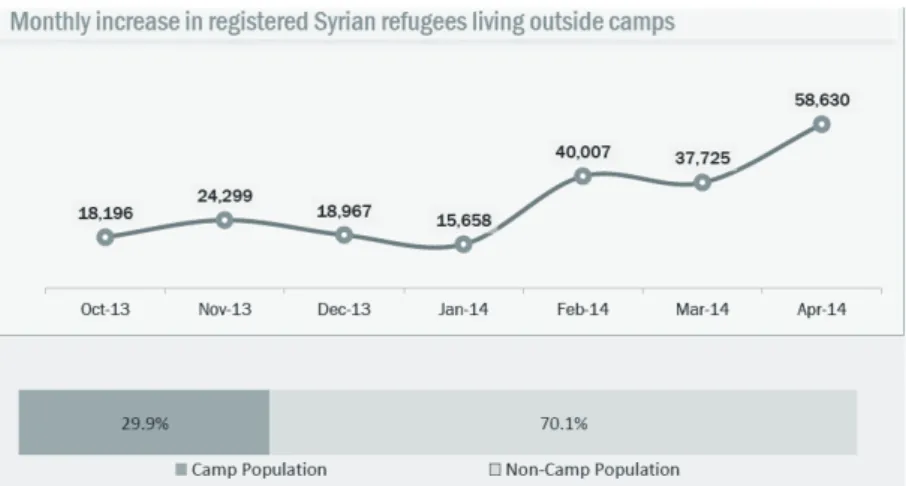
A considerable number of the Syrian refugees lived in the camps until early 2013. However, changes in the living conditions within the camps made most of them exit and settle outside. At the onset of 2014, half of the Syrian refugees did not reside in the formal camps anymore, and by late 2014, many Turkish towns and cities witnessed the presence of many refugees since four out of five refugees were registered there. The incoming number of refugees has steadily increased by time.
The table below displays a sample increment of Syrian refugees in Turkey inside and outside camps from the end of 2013 until April 2014. It is important to note as well the huge Syrian refugee population, around 70%, dwelling outside the camps, in contract to around 30% that became accommodated inside camps (AFAD, 2014).
Figure 4: Chart to point out the number of registered Syrian Refugees inside Turkey (UNHCR, 2014)
A recent report from AFAD confirmed that 24 camps in Southern Eastern Turkey are dispersed. Several domestic and international commentators such as UNHCR have given their views regarding the conditions in the camps. They point out that the camps have since become more comfortable and standardized with more control compared to the ones hosting Syrians in the neighboring states (UNHCR, 2015).
Turkish authorities together with civil organizations are facing a challenge since a considerable number of refugees in the city are unregistered unlike in the camps. According to the latest release by AFAD, one-third of the refugees living in the Turkish cities are unregistered (AFAD, 2015). As a result, their vulnerability to exploitation and lack of services increases.
It is unfortunate that they may remain vulnerable since the first step towards accessing essential services and protection is registration.
Turkey has settled on an open-door approach coupled with three other elements towards the Syrian crisis. These elements include extending temporary protection to the Syrians, a strict adherence to the principle of non-refoulement, and the provision of optimal humanitarian assistance. The political will to make these policies applicable to the Syrian refugees is strong.
However, the legal ground is shaky since the legislation dealing with mass influxes of refugees has not only proved a challenge to Turkey but the world at large.
The possibility of legislation weakness in Turkey is high considering that the country is undergoing a transitional period in its policies. The new Law on Foreigners and International Protection (LFIP), for example, came into force just recently;
on April 2014 (Korkut, 2015). It is sad to acknowledge the occurrence of a shift in the legal framework granting temporary protection to the Syrian refugees despite the declaration by the Turkish government to extend this service. The only valid
legal administrative tool to have a provision of temporary protection has been the 1994 Regulation on Asylum (Moustakis and Chaudhuri, 2005). However, the regulations scope has not managed to fully implement the open door policy. Even though sources indicate that there was a report issued by the government in March 2012, detailing the way to treat refugees, there was no publication of it.
The new 2014 legislation gives a precise legal status to the Syrians. Additionally, LFIP and TP (Temporary Protection) Regulation, effected on October 22, 2014, are expected to provide more hope on the fate of the Syrians. Hopefully, it shall address the legally established system that guarantees the Syrians a satisfactory protection and humanitarian assistance.
It is finally important to point out that Syrian refugees were treated differently from any other refugees coming from the same region, right from the beginning. They were separated upon arrival from other refugees and defined under the ‘temporary guest’ status. This ‘temporary guest’ status can never turn into citizenship although it gives the right to non-refoulement.
Other asylum seekers from Iraq, Iran, Afghanistan, Egypt and other African countries receive their asylum status through UNHCR only. They can apply to UNHCR offices in Turkey and while UNHCR search for them for a third country, they can get temporary residence in Turkey but with no rights. They cannot get work permission, access to health care or education services. Syrian refugees on the other hand, once they register themselves they can go to the police and get a residence permit card. They can accordingly have the right to get to the labor market and access education and health care services (Tür et al., 2013).
In sum, the Turkish government has showed willingness and exerted efforts to assist the Syrian refugees in their crisis.
However, it seemed like the government was only prepared to offer its assistance temporarily and it was keen on using the case of Syrian refugees as a bargaining chip in its internal and regional politics.
3.4. Refugees' Impact vs. Turkish Government’s Policy Changes
Clearly, Turkey never experienced a huge influx of refugees as it is experiencing now with Syrians. Earlier, there was no need to develop a thorough refugee protection policy as the two pieces of legislation; the 1951 Geneva Conventions and its Protocol and the 1934 Law on Settlement, were sufficient to handle refugees and asylum seekers (Mazlumder, 2014).
However, when Syrians started pouring into Turkey in 2011, Turkey took a different stance towards them. Some argue that the reason behind this unusual attitude was the long historical ties that Syrians had with the Ottoman Empire. Korkut (2015) used meta-analysis to show how these historical ties are still surviving in the discourse the Turkish government used when speaking about the Syrian refugees. Others argue that the role that Turkey played in supporting the Syrian opposition is the reason behind the special treatment that Syrian refugees have had in Turkey.
The policy of the Turkish government towards Syrians witnessed some changes during the past few years as a result of the changing conditions of the crisis inside Syria and the number of refugees crossing the Turkish borders. First, when Syrians started coming into Turkey in April 2011, the Turkish government opened the borders for them with few limits only.
The government asked the Turkish citizens to open their houses and host Syrians voluntarily until it constructed few camps near the borders (Cagaptay et al., 2014). Though AFAD was originally established to handle disasters’ management such as earthquakes, it was assigned to handle the Syrian refugees in 2011 since they were considered a sudden and temporary issue and there were no other authority that deals with refugee issues in Turkey at that time. The camps were soon built and