九州大学学術情報リポジトリ
Kyushu University Institutional Repository
好中球エラスターゼ阻害薬であるシベレスタットは ゲフィチニブ、ナフタレンが引き起こすマウスの急 性肺障害を軽減する
三雲, 大功
https://doi.org/10.15017/1866270
出版情報:Kyushu University, 2017, 博士(医学), 課程博士 バージョン:
権利関係:© 2017 The Authors. This is an open access article under the CC BY-NC-ND license
Neutrophil elastase inhibitor sivelestat ameliorates
ge fi tinib-naphthalene-induced acute pneumonitis in mice
Hironori Mikumo, Toyoshi Yanagihara
*, Naoki Hamada, Eiji Harada, Saiko Ogata-Suetsugu, Chika Ikeda-Harada, Masako Arimura-Omori, Kunihiro Suzuki, Testuya Yokoyama, Yoichi Nakanishi
Research Institute for Diseases of the Chest, Graduate School of Medical Sciences, Kyushu University, Fukuoka, Japan
a r t i c l e i n f o
Article history:
Received 6 March 2017 Accepted 11 March 2017 Available online 12 March 2017
Keywords:
Acute pneumonitis Gefitinib Neutrophil elastase
a b s t r a c t
Gefitinib, an epidermal growth factor receptor-tyrosine kinase inhibitor (EGFR-TKI), is an effective therapeutic agent for non-small cell lung cancer with EGFR mutations. It can cause severe acute pneu- monitis in some patients. We previously demonstrated that mice with naphthalene-induced airway epithelial injury developed severe gefitinib-induced pneumonitis and that neutrophils played important roles in the development of the disease. This study aimed to investigate the effects of the neutrophil elastase inhibitor sivelestat on gefitinib-induced pneumonitis in mice.
C57BL/6J mice received naphthalene (200 mg/kg) intraperitoneally on day 0. Gefitinib (250 or 300 mg/
kg) was orally administered to mice from day1 until day 13. Sivelestat (150 mg/kg) was administered intraperitoneally from day 1 until day 13. Bronchoalveolar lavagefluid (BALF) and lung tissues were sampled on day 14.
Sivelestat treatment significantly reduced the protein level, neutrophil count, neutrophil elastase ac- tivity in BALF, and severity of histopathologicfindings on day 14 for mice administered with 250 mg/kg of gefitinib. Moreover, sivelestat treatment significantly improved the survival of mice administered with 300 mg/kg of gefitinib.
These results indicate that sivelestat is a promising therapeutic agent for severe acute pneumonitis caused by gefitinib.
©2017 The Authors. Published by Elsevier Inc. This is an open access article under the CC BY-NC-ND license (http://creativecommons.org/licenses/by-nc-nd/4.0/).
1. Introduction
Gefitinib, an epidermal growth factor receptor-tyrosine kinase inhibitor (EGFR-TKI), is an effective therapeutic agent for non-small cell lung cancer with EGFR mutations[1,2]. However it can cause severe acute pneumonitis in some patients. Characteristics of pa- tients who developed interstitial pneumonia included old age, poor performance status, a history of smoking, and preexisting inter- stitial pneumonia[1,3].
Injuries to respiratory epithelium and alveolar epithelial cells are regarded as the initial phenomena of various respiratory ill- nesses, such as acute respiratory distress syndrome, interstitial pneumonia, and chronic obstructive pulmonary disease.
Neutrophil elastase is a protease produced by neutrophils.
Excessive neutrophil elastase can cause lung tissue damage by direct cytotoxicity to endothelial and epithelial cells and by degradation of key structural elements of connective tissue, such as elastin, collagen, and proteoglycan[4,5].
Sivelestat, a small molecule (529 Da), is a neutrophil elastase inhibitor developed and produced by Ono Pharmaceutical Com- pany in Japan[6]. In the animal models of acute lung injury (ALI), the beneficial effects of sivelestat have been reported in bleomycin- induced lung injury and pneumococcal pneumonia[4,7]. A phase 3 study in Japan demonstrated that sivelestat improved the investi- gator assessment of pulmonary function and significantly reduced the duration of intensive care required for patients with ALI asso- ciated with systemic inflammatory response syndrome (SIRS)[8].
Abbreviations:EGFR-TKI, epidermal growth factor receptor-tyrosine kinase in- hibitor; ALI, acute lung injury; SIRS, systemic inflammatory response syndrome;
LPS, lipopolysaccharide; BAL, bronchoalveolar lavage; BALF, bronchoalveolar lavage fluid; IL, interleukin; ELISA, enzyme-linked immunosorbent assay.
*Corresponding author. Research Institute for Diseases of the Chest, Graduate School of Medical Sciences, Kyushu University, 3-1-1 Maidashi, Higashi-ku 812- 8582, Fukuoka, Japan.
E-mail address:[email protected](T. Yanagihara).
Contents lists available atScienceDirect
Biochemical and Biophysical Research Communications
j o u rn a l h o m e p a g e : w w w . e l s e v i e r . c o m / l o c a t e / y b b r c
http://dx.doi.org/10.1016/j.bbrc.2017.03.031
0006-291X/©2017 The Authors. Published by Elsevier Inc. This is an open access article under the CC BY-NC-ND license (http://creativecommons.org/licenses/by-nc-nd/4.0/).
In 2002, sivelestat was approved in Japan for the treatment of ALI associated with SIRS[6]. After approval, a phase 4 study indicated that it contributed to early weaning from mechanical ventilation [6]. The beneficial effects of sivelestat have also been reported in several other models, including lipopolysaccharide (LPS)-induced lung inflammation, ozone-induced airway response, and bleomycin-induced pulmonaryfibrosis[7,9,10].
Pulmonary stem cells are important for tissue recovery. The club cell is a type of pulmonary stem cell found in the distal airway. Stem cell abnormality is considered to promote chronic lung injury and lungfibrosis[1,11]. Naphthalene has club cell-selective cytotoxicity [1,12,13]. Therefore, we previously used a naphthalene-induced lung injury model as an animal model containing a risk factor of gefitinib-induced pneumonia. We found that gefitinib administra- tion after naphthalene treatment prolonged ALI with neutrophil infiltration on day 14. Laser capture microdissection and microarray analysis of the terminal bronchial epithelial cells showed upregu- lation of the genes includeddS100a8, S100a6,Stfa3, Trim23, and Mug1, which are known to participate in inflammatory cell chemotaxis, activation, and migration[1,14,15]. Although the pre- cise mechanisms involved remain unclear, gefitinib treatment prolonged lung inflammation by upregulating neutrophil chemo- attractant genes from peripheral epithelial cells. Therefore, we hypothesize that sivelestat plays a protective role against gefitinib- induced lung injury by inhibiting neutrophilic inflammation.
2. Materials and methods
2.1. Animal treatment
The experiments were approved by the Committee on Ethics Regarding Animal Experiments of Kyushu University. C57BL/6 fe- male mice (7 weeks old; SLC, Inc, Shizuoka Japan) were used in all experiments. Naphthalene (Wako Pure Chemical Industries, Osaka, Japan) was injected intraperitoneally on day 0 (200 mg/kg). Gefi- tinib (Caymann Chemical, Arizona, USA) stirred into 1% Tween 80 (Wako) was daily administered orally on days 1 to 13. We administrated gefitinib at two doses: 1) 250 mg/kg as a tolerated dose and 2) 300 mg/day as the 50% lethal dose (LC50). The neutrophil elastase inhibitor sivelestat (Ono Pharmaceutical, Osaka, Japan) in saline was daily injected intraperitoneally on days 1e13 (150 mg/kg). A scheme of the administration schedule is shown in Supplemental Fig. 1.
2.2. Histopathological evaluation
Histopathology was performed as previously described [1,16].
The right lung wasfixed in 10% buffered formalin and embedded in paraffin, and the lung sections were stained with hematoxylin and eosin. The pathological grade of inflammation in the whole area of the midsagittal was evaluated under 200 magnification and determined according to the following criteria: 0¼no lung ab- normality; 1 ¼presence of inflammation involving <25% of the lung parenchyma; 2¼lesions involving 25e50% of the lung; and 3¼lesions involving>50% of the lung.
2.3. Bronchoalveolar lavage
The bronchoalveolar lavage (BAL) method and analysis was performed as previously described [1,16]. After counting the cell numbers in BALfluid (BALF), cells were cytospun and stained with Diff-Quick (Baxter Diagnostics, Dearfield, IL, USA) for classification.
The BALF supernatant was freeze-dried using a lyophilizer. The lyophilized samples were dissolved to determine total protein concentrations, interleukin-8 (IL-8), and neutrophil elastase
activity. Total protein concentrations in BALF were measured using the Bio-Rad Protein Assay.
2.4. Enzyme-linked immunosorbent assay (ELSIA) for assessment of IL-8 in the BALF
The concentration of IL-8 in BALF was determined using mouse cytokine ELISA kits (R&D Systems, Minneapolis, MN, USA).
2.5. Neutrophil elastase activity
Neutrophil elastase activity in BALF was determined using the highly neutrophil elastase-specific synthetic substrateN-methox- ysuccinyl-Ala-Ala-Pro-Val p-nitroanilide. Briefly, samples were incubated in 0.1-M Tris-HCl buffer (pH 8.0) containing 0.5-M NaCl and 1-mM substrate for 24 h at 37C. After incubation,p-nitro- aniline was measured spectrophotometrically at 405 nm, consid- ered to be a measure of neutrophil elastase activity[17,18].
2.6. Statistical analysis
The Student's t-test was used for the comparison of body weight, number of BALF cells, protein concentration, IL-8 concen- tration, neutrophil elastase activity, histopathological grade, and survival curves. P < 0.05 was considered significant. Statistical analysis was performed in the statistical software package JMP version 11 (SAS Institute, Cary, NC).
3. Results
3.1. Sivelestat improved the survival rate of gefitinib-induced pneumonitis in mice
The administration of 300-mg/kg gefitinib with 150-mg/kg sivelestat following naphthalene significantly improved the sur- vival rate on day 14 compared with that of 300 mg/kg gefitinib following naphthalene (Fig. 1).
3.2. Sivelestat ameliorated the loss of body weight due to gefitinib- induced pneumonitis in mice
We measured mice body weight to determine the general
Fig. 1.KaplaneMeier survival curve. Survival study of mice with the administration of 300 mg/kg gefitinib and 150 mg/kg sivelestat following naphthalene improved the survival rate compared with that of 300 mg/kg gefitinib following naphthalene (n¼10). *P<0.05. C, control; G, gefitinib; N, naphthalene; NþG, gefitinibþnaph- talene; NþGþS, naphthaleneþgefitinibþsivelestat.
H. Mikumo et al. / Biochemical and Biophysical Research Communications 486 (2017) 205e209 206
influence of ALI. Weight loss is a good marker for the severity of naphthalene-induced lung injury[1,19]. On day 7, the body weights of mice treated with naphthalene alone significantly decreased;
however, by day 14, the body weights returned to the level of the control injected with corn oil. On day 14, body weights of mice treated with 250 mg/kg gefitinib following naphthalene remained significantly decreased compared with that of mice treated with naphthalene alone, whereas the body weights of mice treated with 250 mg/kg gefitinib and 150 mg/kg sivelestat following naphtha- lene were significantly increased compared with that of mice treated with 250 mg/kg gefitinib following naphthalene (Fig. 2).
3.3. Sivelestat ameliorated the lung inflammation of gefitinib- induced pneumonitis in mice
3.3.1. Histopathological examination
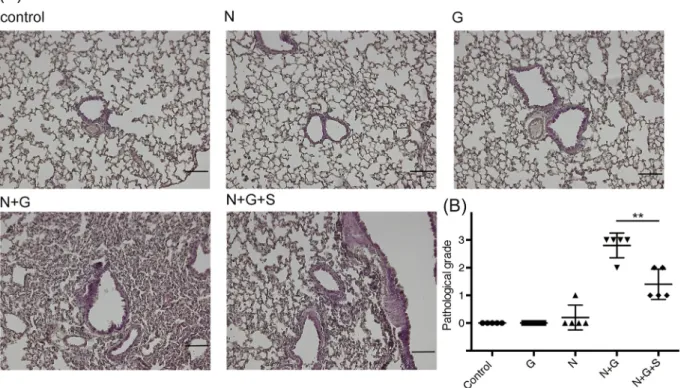
We used histologic cell analysis to examine the degree of in- flammatory cell infiltration. Naphthalene alone induced neutrophil infiltration on day 7 but not on day 14 in the lung tissue, as pre- viously described [1]. The administration of 250 mg/kg gefitinib following naphthalene aggravated neutrophil infiltration and induced alveolar hemorrhage on day 14 (Fig. 3A). In contrast, the administration of 250 mg/kg gefitinib with 150 mg/kg sivelestat following naphthalene significantly decreased the pathologic grade compared with that of 250 mg/kg gefitinib following naphthalene (Fig. 3B).
3.4. BALF analysis
On day 14, the number of neutrophils, total cell count, and protein concentration in BALF of mice treated with 250 mg/kg gefitinib following naphthalene were significantly increased
compared with those of mice treated with naphthalene alone. On day 14, the administration of 250 mg/kg gefitinib and 150 mg/kg sivelestat following naphthalene significantly decreased the num- ber of neutrophils, total cell count, and protein concentration in BALF compared with that with 250 mg/kg gefitinib following naphthalene (Fig. 4A and B).
In addition, the administration of 250 mg/kg gefitinib and 150 mg/kg sivelestat following naphthalene significantly decreased the level of IL-8 (Fig. 4C) and neutrophil elastase activity (Fig. 4D) in BALF compared with those resulting from the administration of 250 mg/kg gefitinib following naphthalene.
4. Discussion
As we have reported previously, the presumed sequence of the mechanism of gefitinibenaphthalene pneumonitis is as follows: 1) the upregulation of neutrophil chemoattractant genes in bronchi- olar epithelial cells; 2) neutrophil migration into alveolar space and interstitial tissues, and; 3) release of neutrophil elastase from neutrophils, resulting in lung tissue damage.
IL-8 is produced by alveolar epithelial cell line (A549), airway epithelial cells, and inflammatory cells, such as macrophages and neutrophils. IL-8 is a well-known neutrophilic chemoattractant.
Some studies have reported that gefitinib induces the production of IL-8 from alveolar epithelial cell line (A549). Neutrophil elastase induces the release of IL-8 from bronchial epithelial cells[4,20], which in turn recruits additional neutrophils. Our study indicated that administration of sivelestat decreased neutrophil elastase, which in turn inhibited the level of IL-8 in gefitinibenaphthalene- induced pneumonitis. In other words, sivelestat treatment could halt the negative spiral of lung injury. A limitation of the current study was that we could not identify the IL-8 producing cells
Fig. 2.Changes in mice body weight over time. Body weights of mice treated with naphthalene alone were significantly decreased on day 7; however, by day 14, the body weights returned to the level of the control. On day 14, the body weights of mice treated with 250 mg/kg gefitinib following naphthalene remained significantly decreased compared with that of mice treated with naphthalene alone, whereas the body weights of mice treated with 250 mg/kg gefitinib and 150 mg/kg sivelestat following naphthalene were significantly increased compared with those of mice at treated with 250 mg/kg gefitinib following naphthalene. Compared with control group at the same point (n¼7). *P<0.05, **P<0.01. G, gefitinib; N, naphthalene; NþG, gefitinibþnaphtalene; NþGþS, naphthaleneþgefitinibþsivelestat.
Fig. 3.Histologic assessment of lung tissues on day 14. (A) Hematoxylin and eosin staining. The administration of 250 mg/kg gefitinib following naphthalene significantly induced neutrophil infiltration and acute lung injury. The administration of 250 mg/kg gefitinib and 150 mg/kg sivelestat following naphthalene improved neutrophil infiltration compared with that with 250 mg/kg gefitinib following naphthalene (n¼5), Scale bars: 100mm. (B) Pathologic grade of lung tissues on day 14 (n¼5). **P<0.01. G, gefitinib; N, naphthalene;
NþG, gefitinibþnaphtalene; NþGþS, naphthaleneþgefitinibþsivelestat.
Fig. 4.Bronchoalveolar lavagefluid (BALF) analysis on day 14. (A) The administration of 250 mg/kg gefitinib following naphthalene significantly induced the upregulation of total cell count and neutrophil recruitment, which were decreased by administration of 250 mg/kg gefitinib and 150 mg/kg sivelestat following naphthalene (n¼5). **P<0.01. (B) The administration of 250 mg/kg gefitinib following naphthalene significantly induced the upregulation of protein concentration, which was decreased by the administration of 250 mg/
kg gefitinib and 150 mg/kg sivelestat following naphthalene (n¼5). **P<0.01. (C) IL-8 was increased by the administration of 250 mg/kg gefitinib following naphthalene and was decreased by administration of 250 mg/kg gefitinib and 150 mg/kg sivelestat following naphthalene (n¼5). *P<0.05. (D) Neutrophil elastase was increased by the administration of 250 mg/kg gefitinib following naphthalene and was decreased by administration of 250 mg/kg gefitinib and 150 mg/kg sivelestat following naphthalene (n¼5). **P<0.01. G, gefitinib; N, naphthalene; NþG, gefitinibþnaphtalene; NþGþS, naphthaleneþgefitinibþsivelestat.
H. Mikumo et al. / Biochemical and Biophysical Research Communications 486 (2017) 205e209 208
targeted by sivelestat; therefore, further studies are required.
A significant reduction in the number of club cells has been observed in the airway epithelium of chronic tobacco smokers[21].
The naphthalene-induced club cell injury in a mice model may be representative of patients at a high risk of gefitinib-induced pneumonitis. This suggests that the presence of peripheral airway damage may increase the susceptibility of patients with lung cancer to interstitial pneumonia during treatment with gefitinib.
In conclusion, we demonstrated a treatment strategy for ALI caused by gefitinib. Currently, new generation EGFR-TKIs, such as afatinib and osimertinib, are used for treating non-small cell lung cancer with EGFR mutations. It is well known that the new gen- eration EGFR-TKIs also induce pneumonitis; therefore, the current study should be repeated for the new generation EFGR-TKIs.
Competing interests
The authors declare no competing orfinancial interests.
Funding
This work was supported by JSPS Grant-in-Aid for Scientific Research (grant number 23591150) and the Health and Labor Sci- ences Research Grants on Diffuse Lung Disease from the Japanese Ministry of Health, Labour and Welfare.
Acknowledgements
We would like to thank S. Tamura for technical assistance and especially thank Ono Pharmaceutical Co, Ltd. for the provision of sivelestat as the study medication. We would like to thank Enago (www.enago.jp) for the English language review.
Transparency document
Transparency document related to this article can be found online athttp://dx.doi.org/10.1016/j.bbrc.2017.03.031.
Appendix A. Supplementary data
Supplementary data related to this article can be found athttp://
dx.doi.org/10.1016/j.bbrc.2017.03.031.
References
[1] C. Harada, T. Kawaguchi, S. Ogata-Suetsugu, M. Yamada, N. Hamada, T. Maeyama, R. Souzaki, T. Tajiri, T. Taguchi, K. Kuwano, Y. Nakanishi, EGFR tyrosine kinase inhibition worsens acute lung injury in mice with repairing airway epithelium, Am. J. Respir. Crit. Care Med. 183 (6) (2011) 743e751.
[2] T.S. Mok, Y.L. Wu, S. Thongprasert, C.H. Yang, D.T. Chu, N. Saijo, P. Sunpaweravong, B. Han, B. Margono, Y. Ichinose, Y. Nishiwaki, Y. Ohe, J.J. Yang, B. Chewaskulyong, H. Jiang, E.L. Duffield, C.L. Watkins, A.A. Armour, M. Fukuoka, Gefitinib or carboplatin-paclitaxel in pulmonary adenocarcinoma, N. Engl. J. Med. 361 (10) (2009) 947e957.
[3] S. Kudoh, H. Kato, Y. Nishiwaki, M. Fukuoka, K. Nakata, Y. Ichinose, M. Tsuboi, S. Yokota, K. Nakagawa, M. Suga, H. Jiang, Y. Itoh, A. Armour, C. Watkins, T. Higenbottam, F. Nyberg, J.T.R. Group, Interstitial lung disease in Japanese patients with lung cancer: a cohort and nested case-control study, Am. J.
Respir. Crit. Care Med. 177 (12) (2008) 1348e1357.
[4] K. Yamada, K. Yanagihara, N. Araki, Y. Harada, Y. Morinaga, K. Izumikawa, H. Kakeya, Y. Yamamoto, H. Hasegawa, S. Kohno, S. Kamihira, In vivo efficacy of KRP-109, a novel elastase inhibitor, in a murine model of severe pneu- mococcal pneumonia, Pulm. Pharmacol. Ther. 24 (6) (2011) 660e665.
[5] W.L. Lee, G.P. Downey, Leukocyte elastase: physiological functions and role in acute lung injury, Am. J. Respir. Crit. Care Med. 164 (5) (2001) 896e904.
[6] N. Aikawa, A. Ishizaka, H. Hirasawa, S. Shimazaki, Y. Yamamoto, H. Sugimoto, M. Shinozaki, N. Taenaka, S. Endo, T. Ikeda, Y. Kawasaki, Reevaluation of the efficacy and safety of the neutrophil elastase inhibitor, Sivelestat, for the treatment of acute lung injury associated with systemic inflammatory response syndrome; a phase IV study, Pulm. Pharmacol. Ther. 24 (5) (2011) 549e554.
[7] Q. Yuan, Y.W. Jiang, Q.H. Fang, Improving effect of Sivelestat on lipopolysaccharide-induced lung injury in rats, APMIS 122 (9) (2014) 810e817.
[8] S. Tamakuma, M. Ogawa, N. Aikawa, T. Kubota, H. Hirasawa, A. Ishizaka, N. Taenaka, C. Hamada, S. Matsuoka, T. Abiru, Relationship between neutro- phil elastase and acute lung injury in humans, Pulm. Pharmacol. Ther. 17 (5) (2004) 271e279.
[9] K. Matsumoto, H. Aizawa, H. Inoue, H. Koto, H. Nakano, N. Hara, Role of neutrophil elastase in ozone-induced airway responses in Guinea-pigs, Eur.
Respir. J. 14 (5) (1999) 1088e1094.
[10] A. Takemasa, Y. Ishii, T. Fukuda, A neutrophil elastase inhibitor prevents bleomycin-induced pulmonaryfibrosis in mice, Eur. Respir. J. 40 (6) (2012) 1475e1482.
[11] A. Gazdhar, P. Fachinger, C. van Leer, J. Pierog, M. Gugger, R. Friis, R.A. Schmid, T. Geiser, Gene transfer of hepatocyte growth factor by electroporation re- duces bleomycin-induced lungfibrosis, Am. J. Physiol. Lung Cell Mol. Physiol.
292 (2) (2007) L529eL536.
[12] L.S. Van Winkle, A.R. Buckpitt, S.J. Nishio, J.M. Isaac, C.G. Plopper, Cellular response in naphthalene-induced Clara cell injury and bronchiolar epithelial repair in mice, Am. J. Physiol. 269 (6 Pt 1) (1995) L800eL818.
[13] B.R. Stripp, K. Maxson, R. Mera, G. Singh, Plasticity of airway cell proliferation and gene expression after acute naphthalene injury, Am. J. Physiol. 269 (6 Pt 1) (1995) L791eL799.
[14] M.A. Raquil, N. Anceriz, P. Rouleau, P.A. Tessier, Blockade of antimicrobial proteins S100A8 and S100A9 inhibits phagocyte migration to the alveoli in streptococcal pneumonia, J. Immunol. 180 (5) (2008) 3366e3374.
[15] K. Ozato, D.M. Shin, T.H. Chang, H.C. Morse, TRIM family proteins and their emerging roles in innate immunity, Nat. Rev. Immunol. 8 (11) (2008) 849e860.
[16] N. Hamada, T. Maeyama, T. Kawaguchi, M. Yoshimi, J. Fukumoto, M. Yamada, S. Yamada, K. Kuwano, Y. Nakanishi, The role of high mobility group box1 in pulmonaryfibrosis, Am. J. Respir. Cell Mol. Biol. 39 (4) (2008) 440e447.
[17] T. Hagio, S. Matsumoto, S. Nakao, T. Abiru, H. Ohno, K. Kawabata, Elastase inhibition reduced death associated with acid aspiration-induced lung injury in hamsters, Eur. J. Pharmacol. 488 (1e3) (2004) 173e180.
[18] K. Yanagihara, Y. Fukuda, M. Seki, K. Izumikawa, Y. Miyazaki, Y. Hirakata, K. Tsukamoto, Y. Yamada, S. Kamhira, S. Kohno, Effects of specific neutrophil elastase inhibitor, sivelestat sodium hydrate, in murine model of severe pneumococcal pneumonia, Exp. Lung Res. 33 (2) (2007) 71e80.
[19] R.D. Verschoyle, J. Martin, D. Dinsdale, Selective inhibition and induction of CYP activity discriminates between the isoforms responsible for the activation of butylated hydroxytoluene and naphthalene in mouse lung, Xenobiotica 27 (8) (1997) 853e864.
[20] H. Nakamura, K. Yoshimura, N.G. McElvaney, R.G. Crystal, Neutrophil elastase in respiratory epithelial liningfluid of individuals with cysticfibrosis induces interleukin-8 gene expression in a human bronchial epithelial cell line, J. Clin.
Invest. 89 (5) (1992) 1478e1484.
[21] H. Nomori, R. Kobayashi, R. Iga, G. Fuyuno, S. Morinaga, C. Torikata, Clinico- pathological examination of the relation between Clara cells and smoking, Kyobu Geka 47 (11) (1994) 888e891.