Searching for the Best Medium of Instruction:
Japanese University Students’ Views on English-Only Instruction in EAP Courses
Masakazu Mishima
Abstract: This exploratory research examined the perceptions of freshman EFL students about English-only instruction in English for Academic Purposes (EAP) courses offered at a suburban private university in Japan. An attitudinal survey containing 12 questions was administered to 44 students in order to elicit their responses in relation to the following topics: 1. English language learning motivation, 2. strengths and weaknesses of English-only instruction, 3. student perceived impact of English-only instruction on their English language learning, 4.
necessity of English-only classes, and 5. preferred forms of Japanese language support. The results show that participants consider English-only instruction is necessary and particularly conducive to developing their listening skills. However, they also expressed the need for instructional support in Japanese as they experienced a variety of diffi culty in classes conducted in English-only where the use of Japanese is institutionally discouraged. The fi ndings suggest that the institutionally sanctioned English-only policy may put less profi cient students at a disadvantage especially when the contents of classes are cognitively challenging.
Based on the fi ndings, the study discusses the potential ways in which the Japanese language can be used as an additional resource to facilitate English language instruction.
Keywords: English-only instruction, L2 learner attitude, bilingual education, SLA, language education policy
Introduction
A shift to a more communicatively oriented teaching in recent years has led many universities to enact an English-only policy in their respective English language teaching programs (McMillan & Rivers, 2010). This policy is widely supported under the belief that the constant use of L2 would maximizes the target language input and facilitates the effective acquisition of the target language (Cook, 2001; Ford, 2009; Kim & Elder, 2005;
Macaro, 2001; Stephens, 2006; Stroch & Wiggleworth, 2003). However, Hawkins (2015) voiced her concern for the unquestioned acceptance and practice of English-only instruction in the context of Japanese higher education and argued that there is no solid empirical evidence supporting the superiority of the target language only instruction over other instructional approach, which involves the use of students’ L1 in the
classroom (I.E. dual-language instruction). In fact, many research studies reported that the use of L1 in the language classroom can be highly benefi cial for both the instructor and learner (Atkinson, 1987; Butzkamn, 1998; Auerbach, 1993; Carson & Kashihara, 2012; Critchley, 2003; Ferguson, 2009; Macaro, 2009; Tian & Macaro, 2012; Turnbull &
Arnett, 2002; Stephens, 2006).
Against the contextual backdrop presented above, an important question to be raised is whether or not English-only instruction deserves the privileged status to the point of being institutionally encouraged to implement as part of curriculum standards.
In order to gain a further insight into this issue, the present research was conducted at a university in Japan where some of its English language classes employ what Macaro (2001) calls, the virtual position wherein the use of students’ L1 is strictly prohibited and English is the only medium of instruction. While the previous research study in this thread examined teachers’ beliefs in regard to an English-only policy (McMillan &
Rivers, 2010), there have been virtually no research studies which examined students’
perspectives toward EAP classes taught only in English. Hence, the present study attempted to examine students’ views on English-only medium of instruction in order to consider if the English-only policy promoted at the university can justify its pedagogical role from the viewpoints of the recipients of educational service—the student.
Method
Data collection
An attitudinal survey in Japanese (see Appendix) was administered to students in two freshman EAP English classes which used English as the only medium of instruction. The survey contained 12 different items including, 10 close-ended questions and two open-ended questions. These questions were primarily intended to elicit participants’ responses in terms of the following topics:
1. Motivation for English language learning 2. Strengths of English-only instruction 3. Weaknesses of English-only instruction 4. Necessity of English-only instruction 5. Roles of L1 in English language learning Data analysis
Participants’ responses to close-ended questions were analyzed through frequency analysis. Then, responses to text-response questions were open-coded to summatively represent their comments, while minimizing data attrition (Yin, 2003). This open-coding analysis led to the development of thematic categories which summarize participants’
comments under common threads. In this process, identical comments were excluded.
For the presentation of results, representative comments1 from participants were translated from Japanese to English after all participants’ comments were categorized and classifi ed.
Participants
Basic demographic information. A total of 44 freshman students responded to the survey. Table 1 summarizes the sex and study majors represented by the respondents. As can be seen in Table 1, participants’ sex was evenly distributed (I.E., Male=22, Female=22), and the number of Business Management majors (n=23) slightly exceeded the number of Law majors (n=21).
English language profi ciency. In regard to English language profi ciency, participants received on average a total score of 400 on the TOEIC Listening and Reading test within the six-month period. As additional information, all participants were regarded as intermediate-level students at the university given their test scores on the TOEIC.
Results
English-only instruction and student motivation for English language learning Table 2 presents a summary of participants’ responses to the question:
Q. Do you think English-only instruction facilitates your motivation for English language learning?
As shown in Table 2, approximately 60% of students considered that English-only instruction had a positive impact on their motivation for English language learning.
However, about one third of the responses is accounted for by “Not sure,” which suggests that some students were not entirely certain if English-only instruction was conducive to their language learning motivation. It is also important to note that six students or approximately 14% of responses expressed a clear “No,” to the said question.
1 Representative comments refer to responses provided by at least 35 participants (approximately 80% of participants) or above. Thus, each representative comment indicates a recurrent theme in a majority of participants’ responses.
Table 1
Participants’ Sex and Majors
Frequency
Total
Male Female
Law 11 10 21
Business Management 11 12 23
Total 22 22 44
Strengths of English-only instruction
As mentioned earlier, participants’ textual responses were open-coded to summatively represent their responses. As the result, 11 different threads of comments were identifi ed. Table 3 below presents participants’ perceived benefi ts of English-only instruction:
Referring to Table 3, it is perhaps not surprising that participants mentioned that English-only instruction helped them develop communicative language skills: listening and/or speaking as these were the typical areas of focus in classes taught only in English.
Participants also positively valued the unique opportunity that English-only classes can bring to them—“It is a good avenue for trying out what I have learned in other English classes,” or “It helps me to work together with my classmates” (Table 3).
In addition, participants viewed somewhat forcible nature of English-only instruction—
students were also expected to use English at all times—as a good driving force to make them “attentive to lectures,” or “think and speak in English.”
Weaknesses of English-only instruction
The previous section has presented the strengths of English-only classes as perceived by participants. This section, in contrast, presents what participants perceived
Table 2
English-Only Instruction and Student Motivation
Frequency Percent Cumulative Percent
Response
Very much 6 13.6 13.6
Yes 20 45.5 59.1
Not sure 12 27.3 86.4
No 6 13.6 100.0
Total 44 100.0
Table 3
Strengths of English-Only Instruction in EAP courses Representative Comments 1. It is good for listening skill improvement.
2. You cannot rely on Japanese so it helps me to get used to the English speaking environment.
3. It is good for speaking skill improvement.
4. It raises my awareness to the importance of the English language.
5. It is a good avenue for trying out what I have learned in other English classes.
6. It forces me to be attentive to lectures.
7. It forces me to think and speak in English.
8. It helps me to work together with my classmates.
9. It helps students realize how poor their English is.
10. It is more practical.
11. I can learn how to use words in different contexts.
as the weaknesses of English-only instruction. Table 4 presents 11 comments in regard to the weaknesses of English-only instruction.
As Table 4 shows, participants’ responses highlight their concerns associated with English-only instruction. For instance, participants expressed diffi culty in keeping up with lectures, understanding English, and asking questions in English. One of the comments also indicated the potential mismatch between students’ level of English profi ciency and English-only instruction, “I don’t think there is any value…” (Table 4).
Considering that a majority of participants were at the level of 400 on the TOEIC, it could be the case that their English profi ciency is not suffi cient enough to study academic English in the English-only environment without a signifi cant challenge.
Necessity of English-only instruction
Table 6 presents participants’ responses in regard to the necessity of English-only instruction. Participants responded to the question:
Q. Do you think that English-only instruction is necessary?
As presented in Table 6, a vast majority of participants (89%) believe that English- only instruction is necessary.
Although participants clearly valued the role of English-only instruction in their
Table 4
Weaknesses of English-Only Instruction in EAP courses Representative Comments
1. My English is not good enough to understand what the instructor is saying.
2. There is no value for those who cannot understand anything in English.
3. There is a clear gap between students who can understand English and those who cannot.
4. It hurts my motivation especially when I cannot understand.
5. There are times that I don’t understand what we are doing in class.
6. Classes just continue on even when I don’t understand.
7. It doesn’t help develop vocabulary knowledge as much.
8. I want to ask questions especially when I’m lost, but I just don’t know how.
9. When I ask questions, I can’t understand responses from the instructor.
10. There is a possibility of being left stranded especially if you are not good at English.
11. I don’t think there is any value for students whose TOEIC score is below 500 because it is too hard.
Table 6
Necessity of English-Only Instruction
Frequency Percent Cumulative Percent
Response
I think so 39 88.6 88.6
I don’t think so 2 4.5 93.2
Not sure 3 6.8 100.0
Total 44 100.0
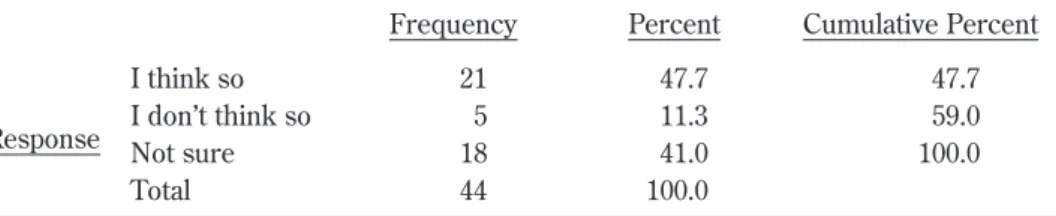
learning and considered that this type of instruction is necessary, their responses do not seem to indicate English-only instruction is more effective in learning English compared to other English classes where Japanese, or English and Japanese are used as the medium of instruction (see Table 7). Table 7 below summarizes participants’ responses to the question:
Q. Do you believe that English-only instruction is more effective in learning English compared to Japanese, or Japanese and English as a medium of instruction?
As can be seen in Table 7, participants’ responses are clearly divided.
Approximately a half of students answered, “I think so,” confi rming that they believed that English-only instruction is more effective. However, about 41% of students had a mixed attitude and 11% of responses indicated a defi nitive no.
The role of L1 in English language learning
Three questions in the survey elicited participants’ responses directly relevant to the potential use of the Japanese language in English-only classes. Table 8 shows that more than 50% of students indicated they needed some form of support in Japanese in their English-only EAP courses. Additional 11% indicated “Very much needed.” About 20% of students responded, “Not sure.” Students who selected “Not really needed”
amounted to approximately 14%. Only one participant responded, “not needed at all.”
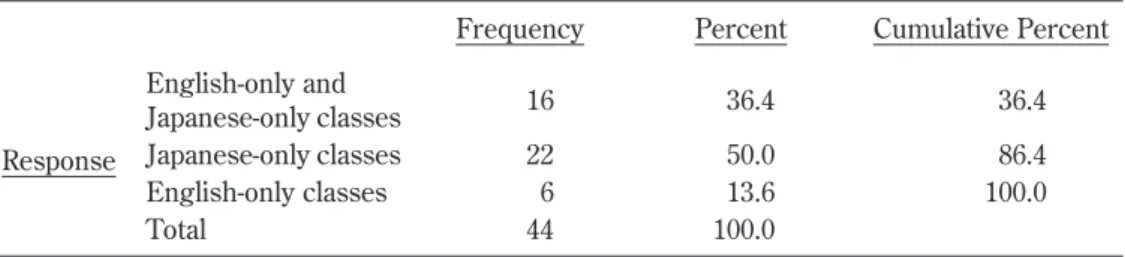
Table 9 presents participants’ responses in regard to their preferred medium of
Table 7
English-Only Instruction and Its Impact on English Language Learning
Frequency Percent Cumulative Percent
Response
I think so 21 47.7 47.7
I don’t think so 5 11.3 59.0
Not sure 18 41.0 100.0
Total 44 100.0
Table 8
Necessity of Instructional Support in Japanese
Frequency Percent Cumulative Percent
Response
Very much needed 5 11.4 11.4
Needed 24 54.5 65.9
Not sure 8 18.2 84.1
Not really needed 6 13.6 97.7
Not needed at all 1 2.3 100.0
Total 44 100.0
instruction for English language learning. 50% of students indicated their preference for EAP classes taught in Japanese, and about 36% responded a combination of classes taught only in English and only in Japanese was desirable. In contrast, approximately 14% of students showed preference toward English-only instruction.
The last of the three survey questions concerning the medium of instruction elicited participants’ opinions about types of Japanese intervention they would desire in the English-only EAP classroom. Participants selected their responses from four different forms of Japanese instructional support. These forms were described in the survey as follows:
Form 1: Use materials with explanations and translations in Japanese.
Form 2: Give lectures in both Japanese and English.
Form 3: Use Japanese and English only when explaining the specifi cs of homework and other assignments, but everything else should be in English.
Form 4: Instructors use Japanese only when replying to student e-mails.
In addition, participants were allowed to write individual responses when none of the forms above accurately represented their opinions.
Table 10 shows a summary of participants’ desired forms of Japanese intervention in English classes. Since participants were allowed to choose more than one option, the total number of responses exceeded the actual number of participants. Be noted that percentage values shown are a ratio against the total number of participants, but not of responses.
Table 9
Preferred Medium of Instruction in EAP courses
Frequency Percent Cumulative Percent
Response
English-only and
Japanese-only classes 16 36.4 36.4
Japanese-only classes 22 50.0 86.4
English-only classes 6 13.6 100.0
Total 44 100.0
Table 10
Desired Forms of Instructional Support in Japanese
Frequency Percent
Response
Form 1 21 47.7
Form 2 15 34.1
Form 3 23 52.3
Form 4 11 25.0
Other 2 4.3
Total 72 N/A
Respondent Total 44 100.0
The most popular form of Japanese instructional support was Form 3 (52%) followed by Form 1 (48%), and Form 2 (34%). The least popular form was Form 4 (25%).
Two students chose “Other” (4%), but both of them mentioned that there is no need for any Japanese language support. While there were varying responses as to which forms of instructional support in Japanese were desirable in EAP classes, what is clear is that almost all participants wished to have some form of intervention in Japanese except for the two participants who clearly indicated no Japanese language intervention would be needed.
Discussion
The importance of L1 use in English language learning
The results of the present research show that students value English-only medium of instruction and consider EAP classes taught only in English are necessary. However, the results also suggest that students need some form of instructional support in Japanese rather than strictly English-only. The university at which the present research was conducted promotes the virtual position (Macaro, 2001) by mandating the use of English as the only medium of instruction for its EAP classes. Under this curriculum- level demand, instructors are unable to help students in Japanese even when such intervention is regarded as the best course of action. In addition, teachers who use Japanese to help students when the occasion demands may feel “undue guilt” for refl ectively responding to the students’ needs, as Hawkins (2015) argued:
Teachers and institutions espousing such a view [English-only policy] undermine language learning progress by engendering undue guilt for responsive and responsible teaching, inhibiting creative pedagogy, and discouraging teachers from acting as realistic bi/multilingual role models (p.30).
It is also important to note that the virtual position is the strongest form of English language instruction in which the use of students’ L1 is typically considered defi cit (Cook, 2001). However, there is little empirical support for the superior effectiveness of English-only instruction compared to less strong forms of instruction where some types of L1 interventions are allowed or even encouraged (Auerback, 1993; Critchley, 2003;
Macaro, 2009). In fact, a number of research studies show the benefi ts of L1 use in the language classroom especially for students who are less profi cient and less motivated (DiCamilla & Anton, 2012, McMillan & Turnbull; Swain & Lapkin, 2013). For instance, the use of student L1 reduces student anxiety (Carson & Kashihara, 2012). It signifi cantly improves “the fl ow of interaction” in the language classroom (Hosoda, 2000, p.89).
Studying academic contents in the English-only classroom
It appears that many participants considered that their English profi ciency were not suffi cient enough to study academic contents in an English-only classroom. For example, students expressed their insuffi cient English language profi ciency—“I don’t think there is any value for students whose TOEIC scores are below 500.” Similar to
many other universities in Japan, the university where the research was conducted uniformly uses the TOEIC reading and listening test as a means to gauge students’
English profi ciency and place them in varying levels of English-only classes despite the fact that the TOEIC test is not a general English profi ciency test. Furthermore, the test is not designed to measure examinees’ English speaking and/or writing profi ciency.
Although ETS claims the TOEIC is a valid and reliable measurement of English communicative skills based on two ETS funded studies (Willson, 1993; Woodford, 1982), independently conducted studies reported that productive skills are not well represented by the TOEIC (Cunningham, 2002; Hirai, 2002). These studies have shown that TOEIC listening and reading scores may not accurately refl ect English communicative ability of test takers. Despite this limitation of the TOEIC listening and reading test, the test scores were used to place participants in the EAP classes in which they were required to discuss academic contents, write essays, and give presentations in English—the focus of the classes were on speaking and writing. If the TOEIC is not an accurate measurement of communicative ability of students, the use of the TOEIC as a placement test may increase a chance of misplacement of students. Coupled with this potential issue, the specifi c demands of EAP courses may have been the reason why many participants in the present study expressed the need for instructional support in Japanese.
Pedagogical Implications
Considering the results and fi ndings presented, curriculum developers and other relevant stakeholders in Japanese higher education may well need to revisit how their English-only policies are implemented and consider a possibility for a more nuanced approach to offering English-only classes. This is certainly not to say that English-only instruction is universally problematic, but it can be when universities place the institutional demand of English-only instruction irrespective of students’ levels of English language profi ciency and of the nature of contents taught in the English-only classroom.
On a side note, it is important to recognize that the ideology of English-only does not refl ect the increasingly accepted multilingual perspective in second language studies—students’ L1 is not baggage but it can be a signifi cant asset for language learning. If Japanese higher education institutions continue to support the virtual position, it should be justifi ed by presenting sound pedagogical justifi cations and empirical support as Auerbach (2016) rightly pointed out that “this taken-for-granted insistence on using only English was rooted in regimes of ideology rather than in evidence-based findings regarding its effectiveness for English acquisition” (p.1), or English-only may be regarded as convenient “promotional tactics” (Hawkins, 2015, p.31).
Limitations
One major limitation of the study is its apparent lack of generalizability given the small sample size and that the study was institution-based. In addition, student participants were all from EAP courses. Therefore, the fi ndings reported may be relevant only to EAP courses but not to other courses taught in English. Furthermore, how EAP courses are taught may well differ from one instructor to another. While classes offered at the university use a unifi ed syllabus and the data were collected from students in two different sections of the EAP course taught by the same instructor, this does not necessarily mean that all EAP classes are taught in the exact same manner. A further study should be conducted to examine if the students’ views presented in this paper and fi ndings reported apply to a wider population in the context of Japanese higher education.
References
Atkinson, D. (1987). The mother tongue in the classroom: A neglected resource? ELT Journal, 41, 241 247.
Auerbach, E. R. (1993). Reexamining English only in the ESL classroom. TESOL Quarterly, 27, 9 32.
Auerback, E. R. (2016). Refl ections on Auerback (1993), “Reexamining English only in the ESL classroom”. TESOL Quarterly, 50, 1 4.
Butzkamnm, W. (1998). Code-switching in a bilingual history lesson: The mother tongue as a conversational lubricant. International Journal of Bilingual Education and Bilingualism, 1, 81 99.
Carson, E., & Kashihara, H. (2012). Using the L1 in the L2 classroom: The students speak. The Language Teacher, 36, 41 48.
Cook, V. (2001). Using the fi rst language in the classroom. The Canadian Modern Language Review, 57, 402 423.
Crawford, J. (1992). Hold your Tongue: Bilingualism and the Politics of ‘English Only.’
Reading, MA: Addison-Wesley.
Critchley, M. (2003). The role of L1 support in communicative ELT: A guide for teachers in Japan. In M. Swanson & K. Hill (Eds.), JALT2002 Conference Proceedings (pp.119 126). Tokyo: JALT.
Cunningham, C. R. (2002). The TOEIC test and communicative competence: Do test score gains correlate with increased competence? A preliminary study. MA thesis from University of Birmingham Retrieved on November, 1, 2015 from http://
www.cels.bham.ac.uk/resources/essays/Cunndiss.pdf
DiCamilla, F., & Anton, M. (2012). Functions of L1 in the collaborative interaction of beginning and advanced second language learners. International Journal of Applied Linguistics, 22, 160 188.
Ferguson, G. (2009). What next? Towards an agenda for classroom codeswitching
research. International Journal of Bilingual Education and Bilingualism, 12, 231 241.
Ford, K. (2009). Principles and practices of L1/L2 use in the Japanese university EFL classroom. JALT Journal, 31, 63 80.
Hawkins, S. J. (2015). Guilt, missed opportunities, and false role models: A look at perceptions and use of the fi rst language in English teaching in Japan. JALT Journal, 37, 29 42.
Hirai, M. (2002). Correlations between active skills and passive skill test scores. Shiken:
JALT Testing & Evaluation SIG Newsletter, 6, p.2 8.
Hosoda, Y. (2000). Teacher codeswitching in the ELF classroom. JALT Journal, 22, 69 93.
Kim, S., & Elder, C. (2005). Language choices and pedagogic functions in the foreign language classroom: A cross-linguistic functional analysis of teacher talk.
Language Teaching Research, 9, 355 380.
Macaro, E. (2001). Analysing student teachers’ codeswitching in foreign language classrooms: Theories and decision making. The Modern Language Journal, 85, 531 548.
Macaro, E. (2009). Teacher use of codeswitching in the second language classroom:
Exploring ‘optimal’ use. In M. Turnbull & J. Dailey-O’Cain (Eds.), First language use in second and foreign language learning (pp.35 49). Bristol, UK: Multilingual Matters.
McMillan, B., & Rivers, D. (2011). The practice of policy: Teacher attitudes towards
“English only.” System, 39, 251 263.
McMillan, B., & Turnbull, M. (2009). Teachers’ use of the fi rst language in French immersion: Revisiting a core principle. In M. Turnbull & J. Dailey-O’ Cain (Eds.), First language use in second and foreign language learning (pp.15 34). Bristol, UK:
Multilingual Matters. MEXT (Ministry of Education, Culture, Sports, Science and Technology). (2009). The revision of the Courses of Study for elementary and secondary schools. Retrieved from http://www.mext.go.jp/english/elsec/__
icsFiles/afi eldfi le/2011/03/28/1303755_001.pdf
Stephens, M. (2006). The use and abuse of Japanese in the university English class. The Language Teacher, 30, 13 18.
Storch, N., & Wigglesworth, G. (2003). Is there a role for the use of the L1 in an L2 setting? TESOL Quarterly, 37, 760 770.
Swain, M., & Lapkin, S. (2013). A Vygotskian sociocultural perspective on immersion education. Journal of Immersion and Content-Based Language Education, 1, 101 129.
Tian, L., & Macaro, E. (2012). Comparing the effect of teacher codeswitching with English-only explanations on the vocabulary acquisition of Chinese university students: A lexical focus-on-form study. Language Teaching Research, 16, 367 391.
Turnbull, M., & Arnett, K. (2002). Teachers’ use of the target and fi rst languages in second and foreign language classrooms. Annual Review of Applied Linguistics, 22, 204 218.
Willson, K. (1993). Relating TOEIC scores to oral profi ciency interview ratings.
Princeton, New Jersey: ETS.
Woodford, P. E. (1982). An introduction to the TOEIC: The initial validity study.
Princeton, New Jersey, ETS.
Yin, R. K. (2003). Case study research: Design and methods (3rd ed.). Thousand Oaks, CA:
Sage Publications.
Appendix
英語のみによる授業に関する学生アンケート
本学では英語のみで受講する英語の授業が多数ありますが、本アンケートはこの授業形式に関し て学生の意識調査を目的としたアンケートです。本アンケートへの回答に要する時間は約
20分程 度となっています。本アンケートへの回答及び非回答は自由です。答えたくない設問は飛ばしても 構いません。尚、本アンケートへの回答による授業評価への影響は一切ありません。また個人情報 が共有される事はありません。
1.
性別(どちらかに○をつけてください)
男 ・ 女
2.
現在大学何年生ですか。 (該当する項目に○をつけてください)
a
.
1年生
b.
2年生
c.
3年生
d.
4年生
3.
所属学部と学科を記入してください。
( )学部 ( )学科
4. TOEIC
試験を受けたことがありますか。 (ある場合は得点と取得年月を記入してください)
a
.ある
b.ない 得点( ) 取得年月( 年 月)
5.
英語のみの授業は英語学習へのモチベーションがあがりますか。
(該当する項目に○をしてください)
a
.非常にあがる
b.あがる
c.どちらともいえない
d.あまりあがらない
e.まったくあがらない
6.
英語のみの授業で教員による日本語でのサポートが必要と感じますか。
(該当する項目に○をしてください)
a
.非常に必要
b.必要
c.どちらともいえない
d.あまり必要ない
e.まったく必要ない
7.
英語のみの授業と日本語での英語の授業と、どちらが自分の英語学習に好ましいと感じます か。 (該当する項目に○をしてください)
a
.日本語のみが好ましい
b.どちらも好ましい
c.英語のみが好ましい
8.
英語のみの授業に関して良い点をできるだけ具体的に記入してください。
9.
英語のみの授業に関して悪いと思う点をできるだけ具体的に記入してください。
10.
英語のみの授業の方が学習効果が高いと感じますか。
a
.思う
b.思わない
c.どちらともいえない
11.
英語のみの授業は必要だと思いますか。
a
.思う
b.思わない
c.どちらともいえない
12.
英語のみの授業で日本語でのサポートを導入する場合、どのような形のサポートを希望します か。 (複数選択可)
1
.日本語訳や日本語での説明を付与した教材を使用する
2.講義全般を英語と日本語両方で行う
3
.宿題や課題の説明のみ英語と日本語で行うがそれ以外は全て英語で行う
4.
Eメールで教員に質問した際のみ日本語で回答してもらう
5
.その他(希望する内容を下記に記入してください。複数可)
その他:
以上でアンケートは終了です。ご協力ありがとうございました。