氏 名 奥村 耕一 学位の種類 博士(学術)
学位記番号 博甲第269号 学位授与の日付 2019年3月12日 学位授与大学 東京外国語大学
博士学位論文題目 中学校段階における英語の後置修飾による名詞句の習得に関する研究
―タスク型の言語活動による名詞句の構造理解の促進―
Name Okumura, Koichi
Name of Degree Doctor of Philosophy (Humanities) Degree Number Ko-no. 269
Date March 12, 2019
Grantor Tokyo University of Foreign Studies, JAPAN Title of Doctoral
Thesis
The Acquisition of Postmodified Noun Phrases by Japanese Lower Secondary School Students: The Role of a Battery of Task-based Language Activities in the Comprehension of English Postmodified Noun Phrases
The Acquisition of Postmodified Noun Phrases by Japanese Lower Secondary School Students:
The Role of a Battery of Task-based Language Activities in the Comprehension of English Postmodified Noun Phrases
中学校段階における英語の後置修飾による名詞句の習得に関する研究
―タスク型の言語活動による名詞句の構造理解の促進―
奥村耕一
名詞句の構造理解をどの程度促すかを検証しようとした研究に関するものである。本研究の目的 は,日本の中学生にとって定着が極めて難しい文法事項としてとらえられている後置修飾の定着 を狙ったタスク型の言語活動の有効性を調査することであった。
後置修飾の定着に関する最近の調査によると,多くの中学生が後置修飾の学習を終えていない ことがうかがえる。また,多くの高等学校の生徒は,語順を理解し,与えられた文をくりかえす ことによって再現することはできるが,とりわけ,後置修飾を伴う文を自分で創り出して発話す ることは多くの高校生にとって難しい。一方,中学校で学んだ英語自体を高校生が産出すること すら困難さを抱えているという報告もある。他方,タスク型の言語活動が後置修飾の文の産出に 効果が示されている報告がある。政府(文部科学省)が検定した中学校教科書には,後置修飾を 伴う文の出現率は高くはなく(13.2%),より多くの後置修飾の使用機会を供給するような教育的 介入が必要である。
本研究は,第二言語習得理論の考えにもとづいており,特にインプット処理教授(VanPatten, 1996; 2004; 2012)は,第二言語習得の過程でインテイク(インプットの取り込み)を起こすき っかけとなり,タスクを基盤とした言語教育(task-based language teaching (Ellis, 2003))がイ ンテイクされたものの内在化を深め,アウトプットを促すことから採り入れられた。加えて,イ ンプットからアウトプットまでの過程が示されている第二言語習得のモデル(Gass, 1997)が後 置修飾の定着への過程としてみなされた。
以上の考えにもとづき,本研究は計画された。まず,本調査における言語活動として,タスク を志向した言語活動(Task-Oriented Activity (以下TOA))を2種類,特定の構造に特化したイ ンプットを処理する言語活動(structured input activity (以下SIA))を1種類,タスク活動(Task Activity (以下TA))を採用した。TOAとTAは,髙島(2000; 2005)が提案しているコミュニケ ーション活動のひとつであり,タスクを基盤とした言語活動を日本の EFL 環境に応用したもの である。TOAとTAの相違点は,活動をする際に,ダイアログが与えられているかによるもので あり,TA では生徒がダイアログを与えられることなく,メッセージを創り出さなければならな い。SIA は,VanPatten(1996;2004;2012)によるインプット処理教授の考えに基づいた言語 活動で,形式と意味の結びつきを誘発させる,受容的な言語活動を基盤としている。TOAとSIA は,特に類似した構造で異なる意味を比較することに焦点を置くことによって,生徒がそれらの 違いを,言語活動を通じて認知するようにデザインされた。これは,後置修飾による名詞句内に は,2つの名詞が含まれており,ひとつは修飾する側にもう一つは修飾される側に含まれている。
仮にそれが入れ替わると,修飾と被修飾の関係が逆になり,意味が変わってしまうことから,名 詞句内部の語順と意味との結びつきが意図的に意識されるように言語活動がデザインされた。TA では,TOA とSIA で認知された,後置修飾による名詞句の意味と形式の知識を活用して,メッ セージのやり取りを通じて与えられた課題を解決することにつながった。
本研究の参加者は,公立中学校2学年の生徒91人で,当該文法事項の構造理解について,事 前2回,事後2回と追加1回の計5回のテストによって測定された。追加テスト以外のそれぞれ
は,日本語の音声を聞き,聞こえてきた日本語の意味を表す英文になるように,与えられた語句 を並べ替えて,名詞句を作る問題が8問与えられた。テストCでは,あらかじめ与えられた日本 語の文を読んで,その意味を表す英文を産出するために与えられた語句を並べ替えて,後置修飾 を伴う文全体を作る問題が8問与えられた(そのうち1問は,前置詞句が副詞句として使われる ダミー問題)。追加テスト(テストD)は,先行研究で行われた,前置詞句・現在分詞・過去分詞 の3つの後置修飾を伴う文法事項を用いた英文の意味を4つの日本語の選択肢から選ぶ問題が 12問与えられ,統制群と実験群を設けられなかった本研究で,得られたデータを過去に実施さ れたデータと比較することにより,本研究で実施した言語活動の有効性を見ようとした。すべて のテストから,得られたデータをテストA~Cについては,一元配置分散分析によって,事前テ ストと事後テストの平均値の差を見出そうとした。また,テスト(A・B・C)同士のそれぞれの 関連性を測ることを目的に,相関係数を算出した。追加テストは,先行研究で行った分析方法と 同じ二元配置の分散分析(実施年度間と文法間)で平均値の差を見出そうとした。
研究過程は,事前テスト1回目実施翌日に,2種類のTOAと1種類のSIAをそれぞれ2回ず つ行い,その翌日に事前テスト2回目を行った。その1週間後にTAを行い,事後テスト1回目 を TA 実施の翌日に行った。事後テスト2回目は1回目の6週間後に行った。各テストは,A・
B・Cそれぞれ3種類の大問の中で小問の順番を入れ替えて,同じ問題を課した。テストDは,
事後テスト2回目実施の11か月後に実施した。
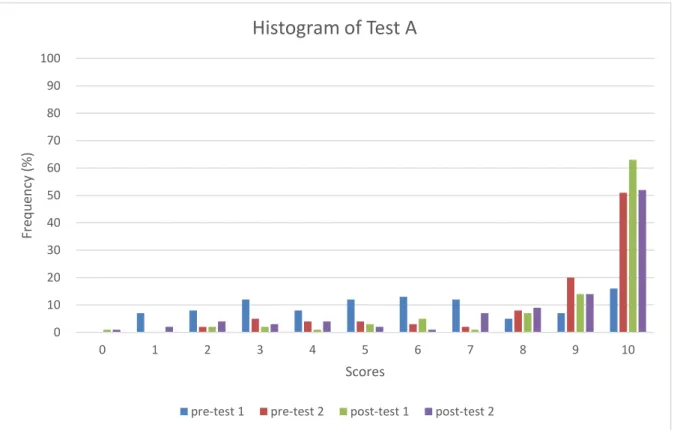
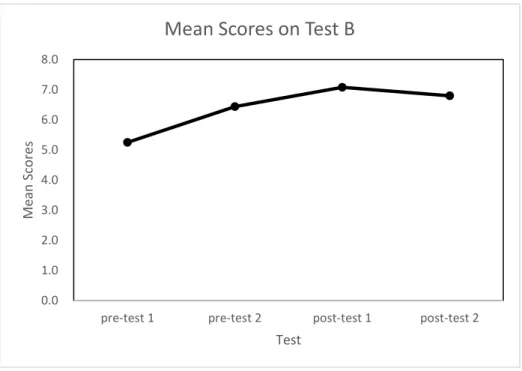
結果から,TOAとSIAの実施後に,テストAとBの事前テストと事後テストの平均値に有意 差が見られ,それらの言語活動実施の有効性が見られた。その後TAを実施したのち,平均値は 事後テストの2回目まで下がらなかったことから,TA が得られた知識を維持したことが示唆さ れる。しかし,テストCの平均値は,TOAとSIA実施後もTA実施後も有意に伸びることがな かった。このことから,TAでは,与えられた課題を解決するために文を産出することは試みられ たものの,文全体を語句の並べ替えによって産出するテストでは,定着に向かうことはなかった ことが示唆された。事後テスト2回目の11か月後の追加テストの結果では,事前に意図的な教 育的介入による後置修飾に特化した言語活動を行わなかった過去の集団と比べて(実施年度間), 有意差が見られた。4回実施したテストA・B・Cのエラー分析をすると,テストAの事前テス トでは,文の主語としての名詞を後置修飾する前置詞句を文末に置く文を選ぶ傾向が強かったり,
名詞句内部の2つの名詞の順番が逆になって意味内容が異なったりしていたが,それらの傾向が 徐々に改善された。しかし,1割から2割程度の生徒が最後まで,前置詞句を文末に置く傾向が 見られた。またテストBでは,文の主語として機能する名詞句の中の2つの名詞の置かれる順番 が,事前テスト1回目では理解できなかった生徒が,言語活動実施後には改善されるようになっ た。テストCでは,テストAと同様に前置詞句を文末に置く傾向が強く影響したためか,TAに よって文全体を産出するよう促す言語活動を行ってもわずかな改善しか見られなかった。テスト AとB,BとC,CとAの関係性については,テストAでよくできた生徒はテストBでもよく でき,テストBでよくできた生徒はテストAでもできるという関係性は有意に見られた。また,
以上のことから,本研究の目的である,後置修飾された名詞句の構造理解は,意図的な教育的 介入による言語活動の効果は見られたが,それによる文全体の産出の向上までの影響が及ばなか ったという結果となった。Greenberg (1963)の言語類型論研究では,基本語順と修飾の関係性を 見出していることから,英語の基本語順がSVOで後置修飾を伴い,日本語の基本語順がSOVで 前置修飾を伴うこれらの関係性がほぼ逆であることを考えられる。仮にそのような関連が実際に 強いならば,基本語順も修飾のシステムの両方の側面からの構造理解がないと文の産出は難しい と考えられる。このことから,次のような教育的示唆が見出される。
1つ目は,後置修飾の定着にあたり,早期に後置修飾による名詞句の構造理解を促すことはで きるが,後置修飾を伴う文全体の構造理解にあたっては,基本語順を理解させるための日頃の教 育的介入が新たに必要になる。2つ目は,TAのようなアウトプットを促す言語活動を行うとき,
生徒の誤りに対して修正のフィードバックを与えることができるが,それが文全体の構造理解に どのように作用するかが,本研究では,焦点が置かれなかったので,今後の研究課題になり得る。
3つ目は,本研究が中学2年生の後期に行われたが,高等学校における後置修飾の促進が報告さ れている(例えば,今井,2012)ことを鑑みると,後置修飾の教育的介入の時期が適切であった か,あるいはどの程度の頻度で行ったらよかったかなど,解明できていない点が見られる。以上 3 点の示唆から,後置修飾定着のための最適なプロセスと言語活動の扱い方を見出すためには,
さらなる研究が必要となる。
Acknowledgements
I would like to thank the many people who have assisted me with this study. First, I would like to express my sincerest gratitude to my supervisor, Dr. Hideyuki Takashima, who has been my mentor in TESOL research methodology. In his graduate seminar, and on many other occasions, I have learned a lot about English education from his vast academic knowledge.
His instruction has always been a great encouragement to me. This dissertation would not have been completed without his support.
I am also grateful to Dr. Masashi Negishi and Dr. Asako Yoshitomi at the Tokyo University of Foreign Studies, who have given me valuable advice regarding my studies and future work in English education.
I am deeply grateful to my colleagues, Mr. Shunsuke Watanabe, Ms. Mie Konishi, Mr.
Matthew Perkins, Mr. Darius Copeland, and Mr. Andrew Barnes, and my students, for their kindness and cooperation in letting me conduct my research. If the present study contributes to English education in junior high schools, I hope they will feel rewarded.
Lastly, I want to thank all the other people who supported and encouraged me, especially the principal, vice principal, teachers, and students in the school where I worked;
they gave me this precious opportunity to study at the Graduate School of Tokyo University of Foreign Studies. I also greatly appreciate Dr. Jeffrey Herrick’s invaluable feedback in helping me complete my dissertation.
Abstract
This study examined the extent to which a battery of task-based language activities helped L1 Japanese lower secondary school students comprehend the construction of L2 English postmodified noun phrases. The purpose of this study was to investigate the effects of task-based language activities on acquiring English postmodification, regarded as an extremely difficult grammar item for L1 Japanese lower secondary school students to acquire.
Basically, English has an SVO sentence structure, and Japanese has an SOV sentence structure. According to a linguistic typological survey (Greenberg, 1963), the modifying mechanisms are different; SVO languages tend to have postmodification and SOV languages tend to have premodification. Therefore, L1 Japanese speakers have difficulty processing L2 English postmodification as well as the SVO sentence structure.
According to recent surveys on acquiring English postmodification, many Japanese lower secondary school students do not develop an adequate understanding of it, and many Japanese upper secondary school students do not overcome this deficiency. It is notoriously difficult for them to formulate sentences with postmodification when speaking. Another survey showed the effects of task-based language activities on students’ production of postmodification. The number of sentences with postmodification in lower secondary school textbooks approved by the government (MEXT) is low (13.2%); therefore, more opportunities
to use postmodification should be provided through instructional intervention.
This study relied on recent SLA research to develop means of effective intervention.
In particular, input processing instruction (VanPatten, 1996; 2004; 2012) can trigger intake, and task-based language teaching (Ellis, 2003) can help students enhance their integration and output. The SLA model from input to output in Gass (1997) provides clear procedures to help students acquire postmodification.
Based on a review of the literature, this study was designed as follows. Four language activities (two Task-Oriented Activities, one structured input activity, and one Task Activity were adopted, and four tests were administered. Task-Oriented Activities and Task Activities are types of task-based language activities that Takashima (2000; 2005) proposed as useful communicative activities in the Japanese EFL context.
Task Activities differ from Task-Oriented Activities in that they contain a predetermined dialog. In Task Activities, students must create messages without predetermined dialogs. A structured input activity is a language activity based on processing instruction (VanPatten, 1996; 2004; 2012), an interpretation-based activity to induce form-meaning mapping. Task Activities were specially designed by focusing on different meanings of similarly constructed postmodified noun phrases with their nouns in alternately switched positions. This kind of manipulation was added because intentionally switching nouns in a
postmodified noun phrase was expected to help students notice differences in the construction according to different meanings.
Ninety-one Japanese public lower secondary school students participated in this study, and their comprehension of the construction of postmodified noun phrases was assessed by pre- and posttests on three tests (Test A, Test B, and Test C) and one additional test (Test D).
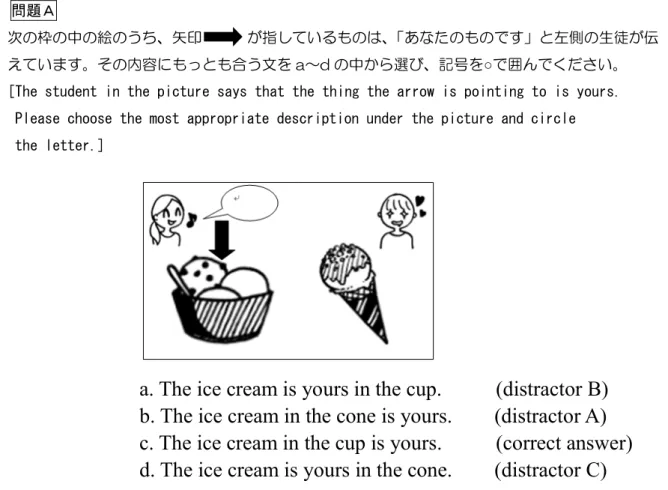
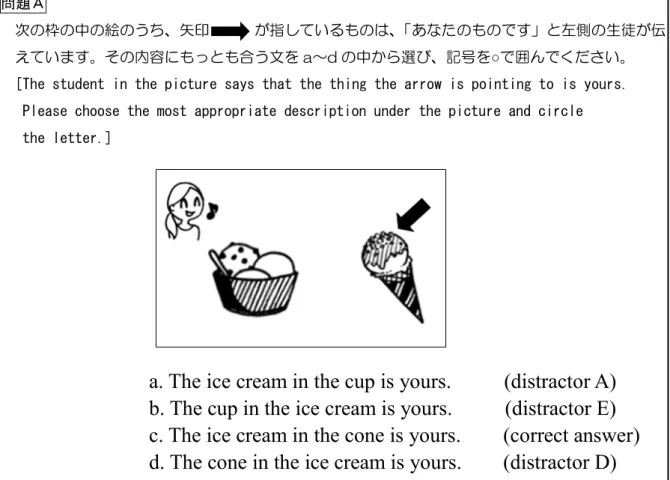
Test A measured their interpretation of the construction of sentences with postmodification.
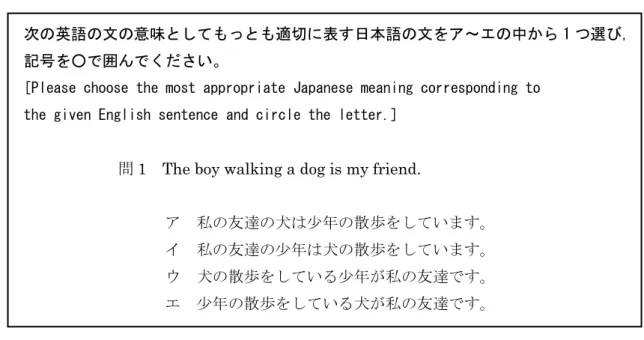
Four choices were offered as descriptions of a corresponding picture. Test B measured their ability to correctly produce a postmodified noun phrase by listening to a Japanese phrase and rearranging given words to make a corresponding English phrase. Test C measured their ability to produce sentences with postmodification. Here they read Japanese sentences and rearranged given words or phrases to make corresponding English sentences. Test D was administered to compare the grammatical knowledge attained in the language activities with that which preceded the treatments. This was a multiple-choice translation test, in which they read English sentences and chose the most appropriate Japanese sentences corresponding to their meaning.
A one-way ANOVA and correlation analyses of the results on Tests A, B, C were performed to examine the extent to which the language activities promoted comprehension of the construction of postmodified noun phrases. A two-way ANOVA was performed in Test D.
The results showed that the Task-Oriented Activities and the structured input activity
helped the participants to understand the meaning and construction of postmodified noun phrases (e.g., to distinguish between “the book on the notebook” and “the notebook on the book”), and the Task Activity helped them retain their knowledge. However, when the participants attempted to create complete sentences with postmodification (e.g., The snow domes at Deuprix were 10 euros), in the Task Activity, they did not do well. Eleven months later, after the administration of posttest 2, an additional survey to investigate the same participants’ recognition of postmodified noun phrases was conducted. The mean score on Test D in the additional survey was compared with examples in the literature of cases in which no treatments were administered. The results showed significant differences that confirmed the utility of the treatments in this study.
In conclusion, this study confirmed that implementing a battery of task-based language activities is effective when attempting to provide Japanese lower secondary school students with opportunities to use postmodification. Switching nouns in postmodified noun phrases involves understanding the meaning and construction of these phrases, and having L1 Japanese learners notice noun phrases in complete sentences contributes to their comprehension and acquisition. Still, the treatments in this study did not completely succeed in helping the students to formulate their own sentences. To resolve this problem, further studies are required to investigate the effects of corrective feedback and to identify other techniques that can help in the acquisition and retention of postmodification.
Keywords: input processing instruction, noun phrase, postmodification, task-based language
activity
Table of Contents
Page
1. Introduction 1
1.1 Background 2
1.1.1 Recognizing Postmodification 3
1.1.2 Relationship between Modification Mechanisms and Linguistic Typology 8
1.1.3 Consideration of Second Language Learning 14
1.1.4 Input from Lower Secondary School Textbooks Approved by MEXT 18
1.1.5 Cognitive Comparison in Language Acquisition 26
1.1.6 Processing Input and Input Processing Instruction 27
1.1.7 Effect of Processing Instruction in Japan 35
1.1.8 Necessity of Output-based Instruction for Japanese EFL Learners 39
1.1.9 Definition of Task-based Language Activity 41
1.1.10 Effects of Task Activities 48
1.2 Review of the literature on Acquisition of Postmodification 50
1.2.1 Study of the Recognition of Postmodified Noun Phrases and Effectiveness of Early Practice 50
2. Methodology 55
2.1 Purpose of the Study 55
2.2 Research Questions 55
2.3 Experiment 57
2.3.1 Form-focused Language Activities 58
2.3.1.1 Activity 1 59
2.3.1.2 Activity 2 60
2.3.1.3 Activity 3 62
2.3.2 A Message-focused Language Activity 62
2.3.3. Tests 64
2.3.3.1 Test A 65
2.3.3.2 Test B 70
2.3.3.3 Test C 70
2.3.3.4 Administration of the Tests in the Present Study 73
3. Results 77
3.1 Test A 77
3.2 Test B 84
3.3 Test C 90
3.4. Test D 97
3.5 Correlation of the Results on the Tests 100
4. Discussion 104
4.1 Research Question 1 104
4.2 Research Question 2 109
4.3 Research Question 3 111
4.4 Effectiveness 114
5. Conclusion 115
5.1 Summary of Findings 115
5.2 Pedagogical Implications 119
5.3 Limitations of This Research and Suggestions for Future Research 121
References 124
Footnotes 134
Appendices 136
Appendix A 136
Appendix B 138
Appendix C 140
Appendix D 146
Appendix E 149
Appendix F 155
Appendix G 159
Appendix H 162
List of Figures
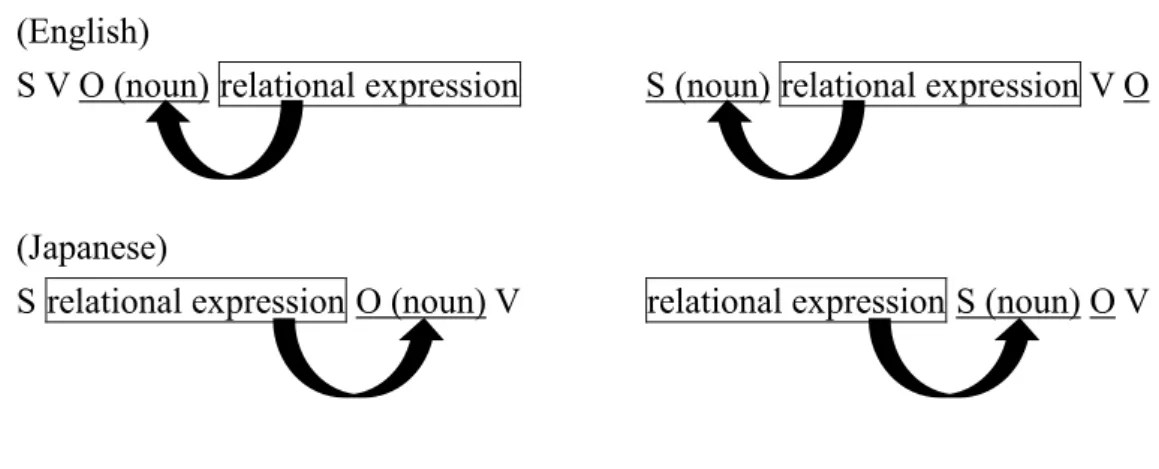
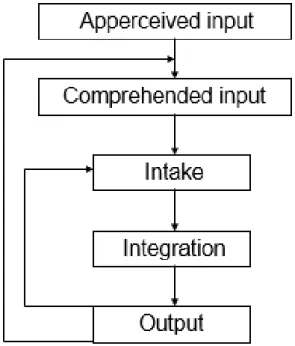
Figure 1 Differences between English and Japanese Mechanisms of Modification Involving the Basic Sentence Structure and the Position of Relational Expressions 13 Figure 2 An Integrated Model of Second Language Acquisition 16 Figure 3 Processing Instruction in Foreign Language Teaching 40 Figure 4 Traditional Explicit Grammar Instruction in Foreign Language Teaching 41
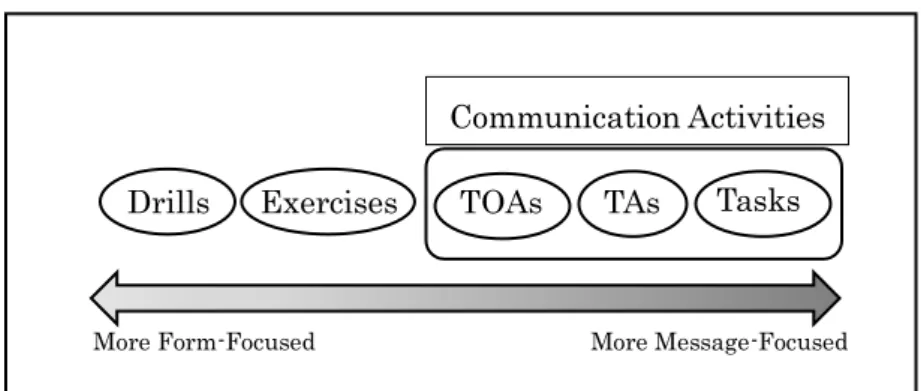
Figure 5 Types of Communication Activities 45
Figure 6 One Test Item in the Previous Study 66
Figure 7 Distractors in Test A 68
Figure 8 Another Pattern of Choices in Test A 69
Figure 9 Mean Scores on Test A 79
Figure 10 Histogram of Test A 80
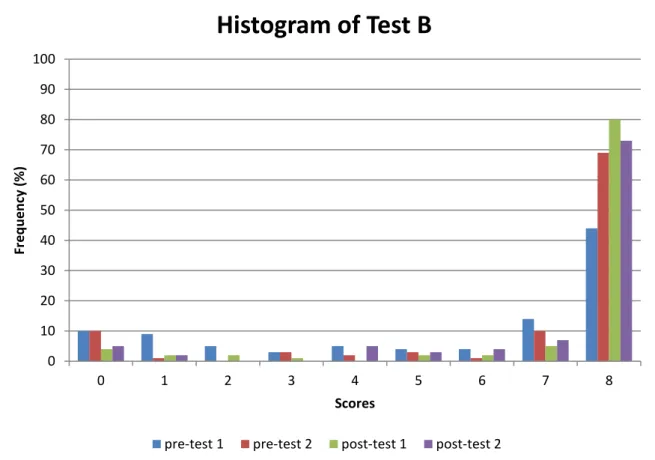
Figure 11 Mean Scores on Test B 86
Figure 12 Histogram of Test B 87
Figure 13 Mean Scores on Test C 92
Figure 14 Histogram of Test C 93
Figure 15 Response Rates on Correct Answers in Each Year 98 Figure 16 Classified Proportion of Frequency Rates of Scores 100
Figure 17 Scatter Diagram of theRelationship between Scores on Test A and Test C in Posttest 2 101 Figure 18 Scatter Diagram of the Relationship between Scores on Test B and Test C in
Posttest 2 102 Figure 19. Scatter Diagram of the Relationship between Scores on Test A and Test B in
Posttest 2 103
List of Tables
Table 1 Relationships between the Basic Sentence Structure and the Positions of Adjectives
and Nouns 10
Table 2 Relationships between the Position of a Relative Clause and the Basic Sentence
Structure 12
Table 3 Relationships between the Position of a Relative Clause and a Preposition or
Postposition 14
Table 4 Frequency of Sentences with Postmodification in Various Textbooks 19 Table 5 Frequency of Postmodifying Phrases in Various Textbooks 20 Table 6 Frequency of Phrases Postmodifying Head Nouns in Various Textbooks 24
Table 7 Research on Processing Instruction 34
Table 8 Research on the effects of Task Activities 48
Table 9 Cronbach’s Alpha of Each Test 65
Table 10 Details and Characteristics of the Items in Test C 73 Table 11 Administration Schedule of the Present Study 74
Table 12 Descriptive Statistical Data on Test A 78
Table 13 Response Rates of the Correct Answers on the Items in Each Test 81
Table 14 Response Rates in Pretest 1 82
Table 15 Response Rates in Pretest 2 83
Table 16 Response Rates in Posttest 1 83
Table 17 Response Rates in Posttest 2 84
Table 18 Descriptive Statistical Data on Test B 85
Table 19 Response Rates of Correct Answers on Each Test 88 Table 20 Response Rates of Correct and Incorrect Answers on Pretest 1 89 Table 21 Response Rates of Correct and Incorrect Answers on Pretest 2 89 Table 22 Response Rates of Correct and Incorrect Answers on Posttest 1 89 Table 23 Response Rates of Correct and Incorrect Answers on Posttest 2 89
Table 24 Descriptive Statistical Data on Test C 91
Table 25 Response Rates on Each Item in Each Test 94 Table 26 Response Rates on Frequent Answers to No. 1 from Pretest 1 to Posttest 2 95 Table 27 Response Rates on Frequent Answers to No. 2 from Pretest 1 to Posttest 2 95 Table 28 Response Rates on Frequent Answers to No. 3 from Pretest 1 to Posttest 2 96 Table 29 Response Rates on Frequent Answers to No. 4 from Pretest 1 to Posttest 2 96 Table 30 Response Rates on Frequent Answers to No. 6 from Pretest 1 to Posttest 2 96 Table 31 Response Rates on Frequent Answers to No. 8 from Pretest 1 to Posttest 2 96 Table 32 Descriptive Statistical Data Categorized into Grammar Items 97 Table 33 Descriptive Statistical Data Categorized by Year 98
Table 34 Correlations between Test A, Test B, and Test C on Posttest 2 101
1. Introduction
Acquiring postmodification is extremely difficult for Japanese learners of English due to differences in the noun-modifying systems of English and Japanese. Native Japanese speakers have no system of postmodification in their first language (L1), as its modifying system is precisely premodification. Additionally, it has been observed that Japanese learners do not learn English postmodification sufficiently in the classroom (e.g., Takashima, Murakami, Imai, Sugiura, and Kiryu (2013) and Kanatani, Koabayashi, Tsuge, Nieda, and Hayama (2015)).
Most English teachers in Japan are aware of their students’ difficulties in learning postmodification; however, teachers present the concept of postmodification but do not promote its use. The content in all Japanese public lower secondary school textbooks, which is approved by the Ministry of Education, Culture, Sports, Science, and Technology of Japan (MEXT), comprises units with reading materials that present new grammar items in each unit.
Teachers generally use a textbook to teach their students. Students also use this textbook to practice new grammar material according to the teacher’s instructions. Notably, the literature in this field (Section 1.1.1) indicates that many students enrolled in lower secondary schools in Japan do not obtain a complete understanding of postmodification and have insufficient opportunities to learn this concept in upper secondary schools. They do not even recognize postmodification, let alone acquire it.
Postmodification is a system that is not inherent in Japanese; therefore, teachers must understand the mechanism of postmodification and how students should process this concept while learning it. This dissertation offers effective learning materials and approaches for students to understand postmodification and discusses why these materials and approaches are more effective in promoting their recognition of the construction of postmodified noun phrases than standard methods. Section 1.1 outlines the contemporary literature, learning circumstances in Japan, linguistic aspects of postmodification, and the perspective of second language acquisition (SLA) theory.
1.1 Background
In this dissertation, “postmodification” is defined as representative of certain grammar items with postmodifying noun phrases. In the textbooks approved by MEXT, prepositional phrases, to-infinitive verb phrases, present participial phrases, past participial phrases, and relative pronoun clauses, including contact clauses, are presented as postmodification. Relative pronoun clauses are excluded from our discussion in this dissertation because of their complexity, and because their acquisition has already been examined from different perspectives (e.g., Tanaka (1998), Hashimoto and Hirai (2007), and Shimada (2017)). The focus is on the learning of English postmodification by lower secondary school students in Japan and on the background of the actual learning of
postmodification.
1.1.1 Recognizing Postmodification
A major investigation on recognizing postmodification was conducted by the National Institute for Educational Policy Research (NIER) (2012). This study examined Japanese lower secondary school students’ writing ability, including basic grammar knowledge, vocabulary, and technique when writing a simple sentence and a short paragraph.
For this investigation, approximately 3,300 participants (101 schools) were randomly selected from national, public, or private lower secondary schools in Japan. The survey method was primarily a paper-based test and a questionnaire.
The test comprised seven sections to assess basic writing ability, focusing on: (1) how students use letters and marks to write, (2) which word students put into a blank, (3) how students write their opinion on a topic based on their comprehension of it, (4) how students write their opinion on a given topic, (5) how students pay attention to word order to complete sentences, (6) how students complete a letter based on a given situation and document, and (7) how students write about and contrast their own opinion when given contradictory opinions.
The results demonstrated that the Japanese lower secondary school students had various problems in their writing. In particular, the passing rate for arranging arrays of words
(under the tree/that cat/is/cute) to create a sentence that included postmodification was approximately 40%. The correct response was “That cat under the tree is cute1.”
NIER (2012) suggested that to resolve this problem, teachers should provide students with opportunities to practice sentences that included postmodification by playing a
game called karuta (a Japanese card game) in the classroom. In this game, when a player
reads a card, for example, with the phrase “the girl skating on the ice,” players attempt to pick-up a card with a picture of a girl skating on ice. After one player picks up the card, they must think of a sentence that includes the phrase, such as “The girl skating on the ice is my friend,” and write the sentence on a worksheet, thus indicating a recognition of the structure of postmodification. Notably, the effectiveness of this activity has not been verified.
Although a prediction might be that learners could recognize certain postmodification mechanisms by listening to the phrases, what part of the mechanisms they recognize by writing the sentences remains unknown.
Takashima, Negishi, and Murakami (2007) investigated Japanese lower secondary school students’ progress in producing simple sentences by having them use their grammatical knowledge to rearrange given words or phrases. This investigation was conducted six times across 3 years on the same sample of students. A paper-based test comprising 12 target structures of rearrangement, testing items including postmodification, was administered. The data were analyzed, and the results indicated that the students’
knowledge of structures for production increased. However, ninth grade students did not attain 70% accuracy for subject–verb–object–object (SVOO) and postmodification.
Regarding postmodification, 43% of the participants completed the sentence, “The notebook on the table is new.” According to the textbooks approved by MEXT, postmodification is introduced in the second-half of the seventh grade. Notably, the students are taught to comprehend the meaning of the content but not how to produce postmodification. The students are supposed to learn postmodification production in the second-half of the ninth grade, but this topic is not presented as crucial to learning English2.
Kanatani, Kimura, and Kobayashi (2010), Kanatani, Katsuda, Kobayashi, Tsuge, Nieda, and Hayama (2012), and Kanatani et al. (2015) investigated how Japanese lower secondary school students recognized noun phrases in simple sentences, what noun phrase structure type was easy or difficult to recognize, and how well the participants performed when tasked with recognizing noun phrases. This investigation was conducted eight times across three years with the same sample of students. The test was paper-based, comprising twelve items. It asked the students to insert be-copula verbs between a subject and object or complement, and translate sentences into their L1 to assess whether they understood the meaning. It included four noun phrase structure types: (1) demonstrative pronoun + noun (e.g., This window), (2) interrogative + noun (e.g., Which book), (3) noun + preposition + noun (e.g., The new DVD about Kyoto), (4) noun + to-infinitive verb (e.g., The park to play
baseball). Notably, (1) and (2) were premodified noun phrases and (3) and (4) were postmodified noun phrases.
The data were analyzed, and the results showed that the means on type (1) ascended from 28.2% (first time) to 53.9% (eighth time) (the maximum mean was 63.1%), the means on type (2) ascended from 22.9% (first time) to 45.2% (eighth time) (the maximum mean was 50.0%), the means on type (3) ascended from 29.3% (first time) to 40.9% (eighth time) (the maximum mean was 52.1%), and the means on type (4) ascended from 36.1% (fifth time) to 40.8% (eighth time) (the maximum mean was 48.9%). These results show that the sample of Japanese lower secondary school students did not recognize the four types of noun phrases sufficiently before their graduation.
The findings of this investigation indicate that the students do not recognize noun phrases after they learn postmodification3. In other words, Japanese learners of English have difficulty in producing a noun phrase as part of a sentence with postmodification.
Takashima et al. (2007) and Kanatani et al. (2010; 2012; 2015) demonstrated that Japanese lower secondary school students did not adequately learn some aspects of postmodification, namely, they did not recognize its syntax or the existence of postmodified noun phrases, before their graduation. The question of whether students adequately learn postmodification after entering upper secondary school was addressed by Takashima et al.
(2013). This investigation was conducted with the same sample of students in the eighth and
ninth grades (lower secondary levels), and the tenth (upper secondary level) grade at a secondary school (a combined junior and senior high school), across three years.
The survey used a paper-based test (a rearrangement test) and two performance tests (Speaking Tests 1 and 2). In Speaking Test 1, the participants looked at illustrations and read Japanese sentences explaining the illustrations. After the Japanese sentences were removed4, the participants had to produce English sentences that indicated the meaning of the Japanese sentences and illustrations within 10 seconds.
Speaking Test 2 was a sentence repetition test in which the participants repeated the sentences they listened to while looking at relevant pictures. They were asked to identify the following grammar points: postmodification by preposition, to-infinitive verbs, present participial, and past participial phrases. The results on the paper-based test and Speaking Test 2 indicated that the mean scores on all the grammar items were greater than 80% on the final test (when the participants were in the tenth grade). The result of Speaking Test 1 showed that the mean scores on all the grammar items, except subject–verb–object–complement (e.g., Friends call me Aki.) and SVOO (e.g., Jane showed me her new computer.), were less than 80%. In summary, the findings indicated Japanese upper secondary school students had much more difficulty creating simple English sentences orally than with reproducing simple sentences by rearranging given words and retaining given simple sentences in their short-term memory.
Based on these findings, an assumption cannot be made that Japanese learners of English in upper secondary school acquired or retained the grammar items taught in lower secondary school. Referring to sentences with postmodification by prepositional phrases (e.g., The man on the left is very tall. The bird by the window is very small.), the learning period is one of the longest; it required more time to achieve a mean score of 80% on the rearrangement test than it did with the other grammar items.
Takashima et al. (2013) asserted that Japanese learners of English in Japan had no opportunities to learn the form, meaning, and function of postmodification by prepositional phrases when such sentences were presented in the textbooks approved by MEXT; in fact, none of the Japanese lower secondary school textbooks of English present explicit information on postmodification by prepositional phases5. Thus, teachers must determine a satisfactory time to provide the information through practice or “teacher talk,” as Takashima et al. (2013) suggested. To facilitate Japanese learners’ acquisition of the skills required to produce postmodification, Japanese teachers of English must determine the level of difficulty involved in acquiring these skills, identify and apply the approaches required for learners to acquire these skills, and consider the differences between the English and Japanese modification systems when creating curricula to teach these skills.
1.1.2 Relationship between Modification Mechanisms and Linguistic Typology
The basic sentence structure of English and Japanese is different [i.e., subject–verb–
object (SVO) and subject–object–verb (SOV)]. So L1 Japanese learners of second language (L2) English have psychological difficulty when processing L2. Regarding the differences between the English and Japanese modification systems, learners have difficulty processing English postmodification. A comparison of the two languages shows the following characteristics:
(English)
The book on the desk is mine.
(Japanese)
Tsukue (the desk) no-ue-ni (on) aru hon (the book) wa watashinomono (mine) dearu (is)
The basic sentence structure of English is SVO, so English has a preposition (e.g., on), and a noun (e.g., book) that precedes a phrase that modifies it (e.g., on the desk). In contrast, the basic word order of Japanese is SOV, so Japanese has a postposition particle (e.g., ni), and a phrase that modifies a noun (e.g., Tsukue no-ue-ni aru) that precedes it (hon).
Japanese teachers and researchers have to be conscious of these differences when considering methods of dealing with English postmodification.
Greenberg (1963) classified 30 languages [Basque, Serbian, Welsh, Norwegian, Modern Greek, Italian, and Finnish (European); Yoruba, Nubian, Swahili, Fulani, Masai,
Songhai, and Berber (African); Turkish, Hebrew, Burushaski, Hindi, Kannada, Japanese, Thai, Burmese, and Malay (Asian); Maori and Loritja (Oceanian); and Maya Zapotec, Quechua, Chibcha, Guarani (American Indian)] and put them into categories based on factors such as the basic sentence structure (VSO, SVO, and SOV), the position of qualifying adjectives in relation to a noun, prepositions and postpositions, and the positions of a relative clause that modifies a noun (after or before a noun). The number of languages using the three basic sentence structures were as follows: 6 (VSO), 13 (SVO), and 11 (SOV). The primary relationships among (1) basic word order, (2) position of adjectives, and (3) prepositions and postpositions are presented in Table 1. The symbols for these categories are (1) I (VSO), II (SVO), and III (SOV); (2) A (adjective precedes noun) and N (noun precedes adjective); and (3) Po (postposition) and Pr (preposition).
Table 1
Relationships between the Basic Sentence Structure and the Positions of Adjectives and Nouns (Greenberg, 1963, p. 61)
I II III
Po-A 0 1 6
Po-N 0 2 5
Pr-A 0 4 0
Pr-N 6 6 0
Type I was strongly related with Pr-N and type III with Po-A. Type II was more strongly related with Pr-N than with Po-A. In conclusion, adjective position was less closely related to types I, II, and III than the Pr–Po contrast. Though English was not included in Greenberg’s (1963) survey, compared with Japanese, those different types of languages can be considered as follows:
(English)
Type II-Pr-A (e.g., I saw a beautiful view in this town.) (Japanese)
Type III-Po-A (e.g., Watashi-wa (I) konomachi (this town) de (in) kireina (beautiful) keshiki-wo (view) mita (saw))
In both languages, an adjective (beautiful: kireina) precedes a noun (view: keshiki). In
contrast, English has a preposition (in) and Japanese has a postposition (de).
The relationships between the position of a relative clause and the basic sentence structure and between the position of a relative clause and the preposition and postposition are presented in Tables 2 and 3. Table 2 shows the tendency of type II (SVO) to have a noun preceding a relational expression and the tendency of type III (SOV) to have a relational expression preceding a noun. Table 3 shows the tendency of prepositional languages to have a noun preceding a relational expression and the tendency of postpositional languages to have a relational expression preceding a noun. English, one of the type II and prepositional languages, has a noun preceding a relative clause; by contrast, Japanese, one of the type III
and postpositional languages, has a relative clause preceding a noun. Based on these tendencies, there should be a relationship among the basic sentence structure, the existence of prepositions or postpositions, and the positions of relative clauses including postmodified phrases.
Table 2
Relationships between the Position of a Relative Clause and the Basic Sentence Structure (Greenberg, 1963, p. 71)
I II III
Relational expression precedes noun 0 0 7
Noun precedes relational expression 6 12 2
Both constructions 0 1 1
From Table 2, the differences between English and Japanese can be presented as follows:
(English)
e.g., I saw a beautiful view which my friend had recommended.
(Japanese)
e.g., Watashi-wa (I) yujin-ga (my friend) susumeta (had recommended) kireina keshiki-wo (a beautiful view) mita (saw)
The underlined clauses are the relational expressions, namely relative pronoun clauses. As
seen in these examples, in English, the noun “view” precedes the relative pronoun clause. In
contrast, in Japanese (in italics), the relational expression “yujin-ga (my friend) susumeta
(had recommended)” precedes the noun “keshiki”. In Japanese, there is no word corresponding to the English relative pronoun “which.” As Figure 1 shows, a relational expression modifies a noun in different ways. Therefore, depending on the positions of relational expressions and nouns, the mechanisms of modification determine premodification or postmodification. Figure 1 shows that English has postmodification and Japanese has premodification. When modifying a noun used as a subject, a relational expression is embedded between that noun and the main verb of the sentence. That is why it is extremely difficult for Japanese speakers of English to understand the correct placement of the postmodified noun phrase in the construction.
(English)
S V O (noun) relational expression S (noun) relational expression V O
(Japanese)
S relational expression O (noun) V relational expression S (noun) O V
Figure 1. Differences between English and Japanese Mechanisms of Modification Involving the Basic Sentence Structure and the Position of Relational Expressions
Table 3
Relationships between the Position of a Relative Clause and a Preposition or Postposition (Greenberg, 1963, p.71)
Pr Po
Relational expression precedes noun 0 7
Noun precedes relational expression 16 4
Both constructions 0 2
Here we see that English (SVO, Pr-A) differs from Japanese (SOV, Po-A) in the basic sentence structure and the position of relational expressions. For Japanese speakers of English to overcome the difficulty in processing such constructions, Japanese researchers and teachers need to consider how to help L1 Japanese learners of L2 English grasp this difference.
1.1.3 Consideration of Second Language Learning
Observably, Japanese students have considerable difficulty in learning postmodification in the classroom, due to differences between basic sentence structure (e.g., SVO or SOV) and pre- and postmodified noun phrases. Since the objective when learning a target language should primarily be acquisition, minimizing this difficulty is necessary. Ellis (2008) proposed a model of L2 acquisition in Gass (1997) which incorporates hypotheses of
SLA [e.g., input hypothesis (Krashen, 1985), output hypothesis (Swain, 1985; 1999), interaction hypothesis (Long, 1983; 1996), and noticing hypothesis (Schmidt, 1990; 1994, 2001). Based on these broad approaches to studying the roles of input and interaction in L2 acquisition, Gass (1997) proposed that there are five stages in the conversion of input to output (Figure 2).
The first stage of input utilization, called apperception, is the recognition that something can be learned. Apperceived input is defined as a bit of language noticed by the learner because of particular recognizable features. In the context of English as a foreign language (EFL) in Japan, the input is from Japanese textbooks approved by MEXT and teachers in the Japanese classroom, not from native speakers outside the classroom. For example, a sentence with postmodification, “I’m shooting a video about my life here,” is presented in one textbook for seventh graders (Columbus 21, approved by MEXT). When this information is presented, the Japanese learners read it and notice whether or not they have knowledge regarding its parts (e.g., vocabulary and/or pronunciation).
Figure 2. An Integrated Model of Second Language Acquisition (Ellis, 2008, p. 267)
The second stage of input utilization is comprehended input, that is, the meanings and/or structures are understood by the learners. If the learner perceives that the agent was shooting a video not about Japanese culture, but about the agent’s life, they might understand only the noun phrase “a video about my life.” Gass (1997) posited that the level of comprehension represents a continuum of possibilities that range from semantics to detailed structural analyses. Therefore, learners might understand only part of the meaning of a sentence.
Intake, regarded as the component of mental activity that moves learners from input to their interlanguage grammars (Gass, 1997), is the third stage. Ellis (2008) says that intake
occurs when noticing-the-gap or cognitive comparisons occurs. In the classroom, learners notice the difference between a new grammatical rule, the comprehended input, and their basic knowledge. For example, L1 Japanese learners of L2 English may notice that the word order of the noun phrase “a video about my life” is different from that in Japanese, watashino
(my) seikatsu (life) nitsuiteno (about) bideo (a video), and/or that in English, the
prepositional phrase “about my life” postmodifies the noun phrase “a video.” By contrast, in Japanese, “watashino seikatsu nitsuiteno” premodifies “bideo.” Notably, by referring to the basic word order (Section 1.1.2), learners in an EFL context such as Japan have difficulty taking in this structure from reading alone, because they cannot usually apperceive other input sufficiently, even if it has the same construction.
The fourth stage is integration. Gass (1997) and Ellis (2008) summarized four possibilities of integration, as follows: acceptance or rejection of an existing interlanguage hypothesis; use of a comprehended feature to strengthen an existing interlanguage hypothesis; nonimmediate incorporation, or storage, of a comprehended feature in the interlanguage system that is—instead—treated as an item placed in the learner’s lexicon; and failure to use the comprehended feature. In the classroom, although L1 Japanese learners of L2 English may comprehend a sentence with postmodification, they cannot produce it immediately but—instead—can produce “I like sports” or “I don’t like sports” easily.
The final stage is output. Gass (1997) asserted that output is not a true stage in
acquisition but does influence this process. At this stage, as learners create a particular hypothesis in the production stage, they may receive feedback regarding the intake component and modify their original hypothesis (Figure 2). By referring to the case of comprehensible output in Swain (1985), we can say the feedback learners receive requires a loop to comprehended input. In an EFL context, at least in the classroom, teachers should provide learners with output language activities to facilitate the provision of feedback regarding the stage of comprehended input or intake. Based on this model of second language learning, one effective learning procedure would emphasize a cycle in which learners pass many times from output back to comprehended input or intake, rather than a one-way process that starts at apperceived input and ends with output. Teachers and researchers should observe the stages at which learners acquire a target language feature.
1.1.4 Input from Lower Secondary School Textbooks Approved by MEXT
Japan is an EFL country; thus, most students in Japan are not exposed to input outside the classroom. Because of the limited learning time in the classroom, the main source of input provided to the students is textbooks approved by MEXT. These textbooks comprise units that include reading material (a main essay or dialog), language activities (e.g., exercises), and introduction of new grammar items.
“Postmodification” is introduced as the modification system of nouns by means of
prepositional phrases, to-infinitive verb phrases, present and past participial phrases, and relative pronoun clauses. This material is presented in the middle of textbooks for ninth graders (the terminal grade of lower secondary school). Until postmodification is introduced, each of the phrases, except prepositional, is introduced in separate units. Prepositional phrases are used in the main essay or dialog in each unit without introduction. Therefore, Japanese lower secondary school students comprehend the content of the essay or dialog without knowledge of postmodification, that is, they read the text while using their knowledge of vocabulary and do not practice using prepositional phrases that postmodify noun phrases. The frequency of use of postmodified noun phrases is shown in Table 4.
Table 4
Frequency of Sentences with Postmodification in Various Textbooks Name of
textbook
Number of
sentences (Token)
Number of sentences (Type)
Number of sentences with postmodified noun phrases (%)
Columbus 884 741 60 (8.1)
New Crown 797 759 111 (14.6)
New Horizon 771 697 90 (12.9)
One World 786 742 97 (13.1)
Sunshine 733 663 92 (13.9)
Total 779 704 93 (13.2)
According to Table 4, the frequency of use of sentences with postmodified noun phrases is 8.1%–13.9%; these numbers were recorded by using the following method: all the sentences in all the units in each textbook were counted regarding type and token usage. Even one word, such as “Hi” or “Yes,” was regarded as a sentence. In addition, the same sentences were used repeatedly in each textbook. For example, “Hi,” including “Hi, Tina,” was used 19 times in the set of textbooks that covered the 3 years of lower secondary school. Among these textbooks, the sentences used most often were basic idiomatic expressions, such as “Thank you,” “Don’t worry” and “I see.” Table 5 presents the frequency of use of the four types of postmodifying phrases or clauses in all the textbooks.
Table 5
Frequency of Postmodifying Phrases in Various Textbooks Name of
textbook
Prepositional phrases
To-infinitive verb phrases
Present and past participial phrases
Relative
pronoun clauses
Columbus 43 10 2 5
New Crown 82 9 3 17
New Horizon 68 8 4 10
One World 71 7 7 12
Sunshine 60 6 16 10
Total 72 3 6 12
As presented in Table 5, prepositional phrases modifying nouns are the most frequently used of the four types of postmodifying phrases or clauses. One reason for this is that the use of prepositional phrases is introduced the earliest in all these textbooks, and these phrases are repeated from the beginning to the end of the eighth- and ninth-grade textbooks.
The other phrases (to-infinitive verb phrases and present and past participial phrases) and relative pronoun clauses are repeated less often. Furthermore, prepositional phrases modifying nouns are not introduced in postmodifying structures until the middle of the ninth grade. Therefore, many Japanese lower secondary school students do not notice how prepositional phrases can modify nouns, and instead notice how adverbial phrases can modify verbs, such as in “I played soccer in the park.” Even if the number of prepositional phrases used is greater than any other type of phrase, Japanese lower secondary school students have few opportunities to comprehend their use in postmodifying nouns. Even if other phrases or clauses that postmodify nouns are introduced by the textbook, the level of understanding is insufficient. Thus, because prepositional phrases that postmodify nouns are not intentionally introduced and practiced, few Japanese learners can recognize postmodified noun phrases. So the usage of the other phrases or relative pronoun clauses should be increased.
Regarding the difficulty of learning the construction of postmodification, Takashima (1994) investigated a hierarchy according to the position of a relative pronoun clause. The participants were Japanese university and upper secondary school students who were asked to
complete a questionnaire after translating pairs of sentences [e.g., The dog that has black hair runs fast. (SS) The cat that I have likes sleeping. (SO)] with relative pronoun clauses. The result indicated that the most difficult type was found to be SO. The focus of this investigation was limited to relative pronoun clauses, providing learners with various levels of difficulty in processing compared to other postmodifying phrases (e.g., prepositional, to-infinitive verb, and present and past participial).
Hashimoto and Hirai (2007) measured Japanese university students’ comprehension and reading time, given sentences with relative pronoun clauses and present and past participial phrases, to determine a hierarchy of difficulty for the following 10 types of clauses and phrases: SS, SO, SC, SPR, SPA, OS, OO, OC, OPR, and OPA (here C stands for a contact clause, PR stands for a present participle, and PA stands for a past participle).
Examples of test items for these ten types of clauses and phrases are shown in the brackets below.
SS: The nurse [who kisses the doctor] treats the patient SO: The nurse [whom the doctor kisses] treats the patient.
SC: The nurse [the doctor kisses] treats the patient.
SPR: The nurse [kissing the doctor] treats the patient.
SPA: The nurse [kissed by the doctor] treats the patient.
OS: The doctor treats the patient [who kisses the nurse].
OO: The doctor treats the patient [whom the nurse kisses].
OC: The doctor treats the patient [the nurse kisses].
OPR: The doctor treats the patient [kissing the nurse].
OPA: The doctor treats the patient [kissed by the nurse].
The results showed that SO and SC were by far the lowest in comprehension [F = 4.32, df = 9,
p < .01], and that SC was the slowest [F = 5.31, df = 9, p < .001], SPR the second slowest,
and SO the third slowest in reading time.
These two investigations indicate that even university students face difficulty in processing a sentence with the head noun postmodified. This shows the extreme difficulty of processing postmodifying clauses or phrases embedded in the center of a sentence for EFL learners. Notably, according to Takashima (2000a), the frequency of occurrence of the SO type was the smallest of the four types of relative clauses in the Nijmegen corpus [χ2 =
6.56539, df = 1, p = .01040]. Table 6 presents the frequencies of postmodification in each
Japanese lower secondary English textbook approved by MEXT. As observed in Table 6, the frequency of each grammar item is low (approximately 19.7% in the case of prepositional phrases), so Japanese lower secondary school students have few opportunities to comprehend and process noun phrases postmodifying head nouns.
Table 6
Frequency of Phrases Postmodifying Head Nouns in Various Textbooks Name of
textbook
Prepositional phrases
To-infinitive verb phrases
Present and past participial phrases
Relative
pronoun clauses
Columbus 3/43 0/10 1/2 1/5
New Crown 9/82 1/9 0/3 2/17
New Horizon 10/68 0/8 1/4 2/10
One World 14/71 0/7 3/7 1/12
Sunshine 9/60 0/6 3/16 1/10
Total 13/72 0/3 1/6 2/12
Note. Denominators are the total number of each grammar item.
This shows the limited quantity of input in textbooks approved by MEXT, even in classes where Japanese teachers of English appreciate the value of learners processing input.
Even though a Course of Studies (determined by MEXT) exists, class management differs by teacher.
Imai and Takashima (2015) claimed that the postmodification exercises in the textbooks approved by MEXT are insufficient to use outside the classroom and suggested that the exercises should include problem-solving tasks. They presented examples where problem-solving tasks replaced tasks from the textbooks that provided exercises for grammar items without situations or usage objectives. Both the quantity and quality of postmodifying
phrases are crucial for classroom acquisition of postmodification. Another claim involves a
“time gap” between teaching and acquisition (Kanatani, 1994), suggesting that learners do not acquire a particular grammar item when teachers teach it, but acquire it later. In actuality, most Japanese lower secondary school learners do not acquire an understanding of postmodification by the time they graduate (Takashima et al., 2007; Takashima et al., 2013;
Kanatani et al., 2015). And Japanese upper secondary school learners do not sufficiently use the English studied in Japanese lower secondary school (Kanatani et al., 2017). In conclusion, learning postmodification in Japanese lower secondary school requires better input from teachers, sufficient time to learn, and effective learning materials.
For Japanese learners of English to acquire postmodification, Japanese teachers of English should provide their students with opportunities to build a firm foundation in Japanese lower secondary school. This foundation needs to provide the students with sufficient input regarding postmodification and with language activities for intake, integration, and output. As Table 5 shows, though the most frequent form of postmodification presented in textbooks is prepositional phrases, student recognition of prepositional phrases postmodifying noun phrases is insufficient (Takashima et al., 2007; Takashima et al., 2013;
Kanatani et al., 2015). Problem-solving language activities such as those mentioned in Imai and Takashima (2015) would help overcome this. These activities would convert mere exposure to postmodification into effective use of it.
1.1.5 Cognitive Comparison in Language Acquisition
In SLA, as we have seen, (Gass, 1997) (Section 1.1.3), the third stage, intake, is where noticing-the-gap or cognitive comparison occurs (Ellis, 2008). Cognitive comparison is a crucial activity at the intake stage in second language learning. According to Nelson’s (1981) rare-event cognitive comparison theory, a cognitive comparison occurs only when children note a codable discrepancy between structures already present in their system and certain partially contrasting structures used by others. To fully master syntactically governed language, children must engage in active communication in appropriate contexts with partners fluent in the language and proficient in a full range of grammatical structures (adults or older children). Those partners do not directly teach young children to use syntactically well-constructed sentences, because they do not have the skills to perform such teaching.
Actually, codable discrepancies are rarely noted by children because of their limited memory, attention-span, and motivation, and because most of the highly specific types of new sentences children require for comparison do not occur frequently in input. In short, a few infrequent events in the midst of a vast amount of language interchange, and a small amount of the right type of input information that children closely attend to and analyze, comprise the core of syntax development. This theory was first proved in a language context (Nelson, 1981).
In an EFL environment, learners have difficulty engaging in active communication
in appropriate contexts and meeting partners fluent in English who have a full range of grammatical structures. Cognitive comparison occurs when a codable discrepancy is noted by EFL learners between the structures already acquired and new syntactical structures noticed in the classroom. Therefore, teachers must provide learners of foreign languages a greater number of opportunities to use syntactically well-constructed sentences in the classroom than L1 learners, because even L1 learners rarely notice codable discrepancies.
As mentioned above, the typology of Japanese and English differs considerably; in particular, the modification system of English has a high degree of discrepancy that Japanese learners need to notice. If teachers compensate for the shortage of input of a particular structure in the textbooks approved by MEXT, cognitive comparison would occur between the Japanese and English postmodification systems. Therefore, teachers and researchers must investigate how teachers can encourage learners to compare input information cognitively in an EFL context.
1.1.6 Processing Input and Input Processing Instruction
The amount of input available to EFL learners is extremely limited, basically only what is provided in textbooks and classroom explanations. Very little external input is available in an EFL society. Yet few teachers notice how students process and produce input, Instead, they focus only on adhering to a rigid schedule and a limited syllabus. Thus they tend
not to notice how much, or how little, students have learned.
According to VanPatten (2012), input processing emerged as a field of inquiry in the mid-1980s. Before that, L2 researchers had been investigating the global role of input in the context of input modification and negotiation, not psycholinguistically in terms of processing.
Input processing focuses on the linguistic data learners handle and on what constrains or guides their processing.
Currently, input processing has not been addressed by many classroom teachers in Japan. Processing has been defined as making a connection between meaning and function, as distinguished from perception, noticing, and other terms used in the SLA literature (see e.g., Schmidt, 1990). For example, a learner may notice a third-person -s at the end of a verb but not connect this suffix to any function or meaning. When L2 learners process input, they attempt to comprehend, that is, they search for the easiest way to obtain the meaning. This phenomenon is called the Primacy Of Content Words Principle. It means that learners begin input processing in an L2 by attempting to isolate words in a speech stream. From this perspective, learners do not connect grammatical form to meaning or function. So it can be said that by processing postmodified noun phrases, learners attempt to obtain the meaning of words, but do not attempt to obtain grammatical forms. Hence, the question of whether learners can notice the form of postmodified noun phrases as they study is questionable.
VanPatten (2012) questioned whether learners connect what they notice with
meaning or function. So he posited the Lexical Preference Principle, arguing that learners do not process forms in input until they have processed the corresponding lexical items. In the case of processing postmodified noun phrases (e.g., the book on the desk), it is possible to say that learners process the meanings of the content words “book, on, desk” and understand the meaning as “the book that is put on the desk” without processing the word order, distinguishing the difference between “the book on the desk” and “the desk on the book.”
This view is related to two subprinciples: the Lexical Semantics Principle and the Event Probabilities Principle.
The Lexical Semantics Principle asserts that learners use their knowledge regarding the semantics of prepositions when processing. For example, Japanese learners of English understand that when interpreting “on” something, the position represented by the preposition requires an object that can logically exist in that position; thus, when considering the nouns
“book” and “desk” in a noun phrase, they are likely to choose “the book” as the noun that exists on top of or inside the larger noun because desks are normally larger than books.
A similar view is that a book is more likely to be placed on a desk than other nouns.
For example, if “notebook” is used instead of “desk,” they cannot rely on event probabilities to obtain the meaning of a noun phrase such as “the book on the notebook.” In other words, if they cannot connect the form of the postmodified noun phrase to the meaning, they cannot distinguish the difference between “the book on the notebook” and “the notebook on the