Forming Farmers' Coalition for Better Water
Management
著者
YOSHINAGA Kenji
著者別名
吉永 健治
journal or
publication title
Journal of regional development studies
number
17
page range
137-157
year
2014-03
URL
http://id.nii.ac.jp/1060/00006597/
How Effective to Rebuild Water Democracy as Adaptation Measure
against Climate Change?
‐Forming Farmers’ Coalition for Better Water Management‐ Kenji YOSHINAGA*
Abstract: The paper discusses water management for efficient water use and allocation among farmers in irrigation system which could contribute to reduce a risk of effects by climate change. To this end, it analyzes possible formation of farmers’ coalition by applying coalition game theory, the result of which indicates higher efforts for water management made by farmers upstream, midstream and downstream could produce a profit allocation for farmers. The paper also discusses a rebuilding of Water Democracy as a democratic approach for water conflict resolution as well as consensus development for an adaptation measure against climate change by efficient water management.
Key words: Water management, Water Users’ Association (WUA), Water Democracy, Irrigation system, Coalition game, Adaptation measure, Climate change
1. Introduction
Agriculture sector has been a dominant water user in many countries. In particular, Asian monsoon countries including Japan have traditionally produced rice as a major crop. Rice production requires abundant water through its path of growth. It is a prerequisite for farmers to make an effort to use and allocate limited water efficiently and reduced waste water as possible as they can. At the same time, exogenous factors around agricultural water uses have given a pressure to reduce a loss of water and waste water, thus to a total amount of water use in agricultural sector. Those factors include; uncertain effects by climate change, an increasing water demand for other sectors and biodiversity and ecosystem, a change of people’s behavior toward water conservation, and a public awareness on value of water among stakeholders. The emerging recognition among the people has influenced water uses in irrigation system and a performance of farmers for water management. Water management in irrigation system has been developed according to predetermined rules on water use and allocation for which Water Users’ Association (WUA)1) has played its roles. Better water management practice through WUA has contributed not only to increase a yield of rice but also strengthen a fabric of community and promote mutual communication among local people. In past decades, however, a rapid change of rural social and economic situations have negatively contributed to rural ________________________________________________________________________________
* 東洋大学地域活性化研究所:Institute of Regional Vitalization Studies, Toyo University
How Effective to Rebuild Water Democracy as Adaptation Measure
against Climate Change?
-Forming Farmers’ Coalition for Better Water
community, thus organizational structure of WUA and its water management in irrigation system. As a result, it causes a conflict around water use and allocation between farmers upstream and downstream. A solution for such conflict has increasingly desired a democratic approach by Water Democracy2), with participation of farmers and other stakeholders.
The paper aims at discussing water management based on rules of Water Democracy for efficient water use and equal water allocation among farmers upstream, midstream and downstream in irrigation system. It also analyzes formation of coalition by applying coalition game theory for cooperation of farmers toward better water management. With the result of analysis, the paper further discusses on how to rebuild of Water Democracy could be effective as an adaptation measure against climate change.
The paper refers to several existing papers. It includes Dixit and Skeath (2004) , Muto (2001), Okada (2008), Osbone (2004) for game theory, Shiva (2000), Kulkarni et al. (2012) for Water Democracy and Participatory Irrigation Management (PIM), and Yoshinaga (2009, 2012, 2013a, 2013b) for water management in irrigation system.
The paper is consisted of six chapters. Followed by the chapter 1 of introduction, the chapter 2 discusses a functional decay of WUA with various factors behind it. It also mentions over possible rebuilding of WUA for better water management. The chapter 3 argues on comparative analysis of Water Democracy and Participatory Irrigation Management (PIM) including Integrated Water Resource Management (IWRM). The chapter 4 analyzes a formation of farmers’ coalition for effective water use by applying coalition game theory. With results of these chapters, the chapter 5 discusses on Water Democracy against climate change mainly focusing on water management as an adaptation measure. The last chapter 6 concludes above discussion and analysis on water management in irrigation system and its effectiveness against effects by climate change.
2. Functional Decay of Water Users’ Association
Traditionally, but even at present, WUA has played various roles for water management in agricultural sector in many Asian monsoon countries where major crop is rice. Those include; efficient water use in a period of water shortage, operation and maintenance of irrigation facilities, irrigation fee collection, and collective works such as cleaning a canal and cutting and removing weeds in a canal and along a farm road. These activities, in turn, could have contributed to strengthen functions of WUA and also does for a tight fabric of community. On top of that, farming practice using water in agricultural sector has deeply implicated in cultivating a local intrinsic culture, skills and knowledge including various types of festivals such as those
related to harvesting. This means that well organized function, role and responsibility of WUA have been involved in various activities and livelihoods of local people not limited those to farming practices. In a sense, their activities have provided positive externality with an invisible value (or non-use value) for the people including urban people, in particular.
Having that said, organizational structure and function of WUA in recent years have decayed due to various negative factors, some of which are common and others are intrinsic for regions or countries depending upon their situations under an emerging and progress of globalization. Common factors can be easily nominated because those are observed every rural area not only in Japan but many Asian countries such as Philippines, Thailand and Indonesia. It includes those such that; farmers become the aged, the young leave for urban and don’t succeed farming, preservation of environment in marginal area is neglected, insufficient labor is available for continuing farming practice, and so forth. Intrinsic factors are more specific in such area as close to or involved in urban area, agricultural land is easily transferred to other purposes such as road, railway and residential developments, and farming practice is given up in unfavorable mountainous area where requires a heavy labor despite a low yield.
All factors, either common or intrinsic, have badly promoted to a decay of WUA’s function and role and other related activities once well worked. Farmers upstream is in a locational advantage to access water easily and could often neglect water management if they are willing to use their time and labor for higher opportunity cost. A lesser effort for water management reduces available water for farmers downstream and causes a conflict between both streams, even if not always. Once such conflict has occurred, its effects extend over other activities not only in the irrigation system but community activities including relation and behavior of local people. It will finally enforce farmers themselves as well as local people to bear a cost in such ways to reduce income, worsen human relations and weaken community activities.
One of responsibilities of WUA is related to a conflict resolution against confronted issues around water allocation and use among farmers in irrigation system. If famers upstream and downstream are in conflict around equal water allocation, it is responsible for WUA to organize a meeting of farmers to communicate and discuss the best way to allocate limited water for farmers downstream as an end user. It is a democratic way to try to find a way out though a dialogue and mutual consensus by which has cultivated knowledge and enhanced recognition on efficient water use and value of water for farming practice, community use, biodiversity and ecosystem. This is discussed in this study as called “Water Democracy” for better water management. A reducing function of WUA puts Water Democracy in a risk of disappearance. Against these situations, there are many issues for WUA to tackle with improvement of water
management against unfavorable expected effects by climate change. Many irrigation systems in Asian countries constructed in 1970’s ~1980’s have become a good time for rehabilitation and modernization. An impact of climate change involves much uncertainty against which needs, inter alia, an adaptation measure to encounter and reduce a risk of certainty, for example, by investing in rehabilitation and improving water management in irrigation system. These actions should be based on a decision-making adopted in a democratic process. It is an exact task and responsibility of WUA for which requires to renew and rebuild its organizational structure and function.
3. Water Democracy and Participatory Irrigation Management 3-1 Water Democracy
The word of “Water Democracy” can be referred to Shiva (2000) who raises nine elements for its definition. Those includes; (a) water is nature’s gift, (b) water is essential to life, (c) life is interconnected through water, (d) water must be free for sustenance needs, (e) water is limited and can be exhausted, (f) water must be conserved, (g) water is commons, (h) no one holds a right to destroy, (i) water cannot be substituted. These elements are only to be effective and preserved if stakeholders use water efficiently and recognize a value of water. To this end, agreement and consensus on these elements among stakeholders are necessary through a democratic dialogue, discussion and negotiation.
Upon applying these elements for water use in irrigation system, it needs to redefine in more adaptable way. The water use in irrigation system focuses mainly on factors such as efficiency, equal allocation and recognition of water value. In particular, it is the best approach to adopt a democratic solution for problems such as the case as farmers are confronted with a conflict around water uses. As a typical example, a conflict between farmers upstream and downstream is related to a shortage of water3)due to a negligence of water management by farmers upstream, in particular. This sort of conflict should be settled down though a dialog or communication among farmers in a democratic way. In this process, it is noted that WUA is in a position to play a catalytic role for solving a conflict through democratic way. Given this, this study defines “Water Democracy” so as to be as a conflict around water uses in irrigation system should be solved in democratic ways such as mutual dialogue and communication among farmers involved with catalytic roles played by Water Users’ Association. The redefined Water Democracy could be applied to improve and enhance water management for efficient and equal water allocation among farmers in the irrigation system.
For better water management, it requires WUA to play Water Democracy in its decision-making on water use and allocation. It goes without saying that Water Democracy should be applied to a
dialogue and communication at individuals, a group of farmers and community levels. How could farmers discuss and agree with better water management to be effective as an adaptation measure against climate change? It is underlined that adaptation measures should be taken at local level, here at level of irrigation system. Farmers are asked to have an accurate knowledge and information on effects by climate change and how to encounter it by improving water management. In this situation, it is indispensable for WUA to apply Water Democracy in a process of getting consensus and agreement on how to use water efficiently by which could contribute to reduce a risk of effects by climate change.
3-2 Participatory Irrigation Management
Participatory Irrigation Management (PIM) is a similar concept as redefined Water Democracy above for water management in irrigation system. PIM is originated in the initiative of World Bank and ADB in 1980’s with a background of which the public sector has badly confronted with financial support for operation and maintenance of irrigation system. It accompanies with institutional reform of irrigation system management which intends to involve farmers as beneficiary giving them ownership for management. It emphasizes farmers’ knowledge and collaboration as a group based on traditionally cultivated local culture and custom which are beyond a control by public sector. To this end, WUA has played significant roles to encourage farmers to join and organize participation in operation and maintenance of irrigation system. According to ADB (2012), participation is defined as “a process through which stakeholders influence and share control of development initiatives and of decisions and resources that affect them”. Kulkarni, et al.(2012) point out that “the philosophy of PIM is hinged around developing cooperation with and involvement of farmers in operation, management, and maintenance of irrigation systems at secondary and tertiary levels through the Water Users Associations”. This makes a clear that WUA is a major player for planning, implementing and evaluating PIM in irrigation system. Put it differently, farmers belong to WUA should follow its principle and rule for water management otherwise participation of farmers to PIM activities would be ineffective. In recent decades, an actual application of PIM has been experienced in many Asian countries such as Philippines, Thailand, Indonesia, India and Vietnam. In Vietnam, JICA P-PIMS Project has contributed to promote PIM activities in collaboration with the Vietnamese government. The project aims to develop capacity on planning and implementing PIM targeting farmers in three pilot sites with an expectation of disseminating outcomes of activities throughout Vietnam. The project evaluation survey at a final stage in 2013 indicates high farmers’ satisfaction to PIM exercise and increased area without water distribution problems 4) 5). It seems that a key of success in implementing PIM is a close dialogue among farmers and communication with local or regional government officers for solving confronted problems of water uses. In such countries as
Philippines and Thailand, the evolution of PIM has caused a shift it to Irrigation Management Transfer (IMT) by initiative and ownership of WUA6).
As such, Integrated Water Resource Management (IWRM) is a comprehensive approach to use water efficiently for equal allocation among stakeholders who utilize the same water resource. It defines IWRM such that “is a process which promotes the coordinated development and management of water, land and related resources in order to maximize economic and social welfare in an equitable manner without compromising the sustainability of vital ecosystems and the environment” (GWP, online). Further, the World Summit on Sustainable Development in 2002 at Johannesburg confirmed that IWRM should be applied to every country for planning efficient water uses at a basin level with a full participation of stakeholders. It is considered that PIM is a part of exercises of IWRM in keeping a close relationship and creating synergy with other stakeholders besides farmers.
3-3 Water Democracy, IWRM and PIM
It should clarify a relationship between Water Democracy, IWRM and PIM though these are closely interacted each other. By keeping this in mind, here discusses its relationship in a broader sense. Firstly, it is a clear that PIM is a part of IWRM exercises since the latter target water management at a basin level while the former does at irrigation system level. It is also noted that IWRM likely targets all stakeholders whose water uses are competitive depending on
Water Democracy: Water Resource Level(*)
・Democratic approach for efficient water uses and equal water allocation ・Democratic way of thinking on water scarcity
・Democratic solution for conflicts and problems around water uses. IWRM: Basin Level
・Efficient, equitable and environmentally sustainable use of resources.
・Transparent and inclusive participation of all stakeholders.
・All stakeholders cooperate in jointly operating, managing, and protecting a common water resource.
・Developing cooperation with and involvement of farmers in operation, management, and maintenance of the
irrigation system.
PIM: System Level
Fig.1: Relationship of Water Democracy, IWRM and PIM
the same water resource. Major goals of both IWRM and PIM are common in using water efficiently and enhance a productivity per unit water. A principle and rule of Water Democracy should be applied to conflict and problem for its solution in planning and implementing IWRM and PIM. It is made through promoting dialogue, communication and negotiation in a democratic way, thus with mutual agreement and consensus among stakeholders. These relationships of Water Democracy, IWRM and PIM are shown in Fig. 1.
4. Formation of Farmers’ Coalition for Water Management
One of approaches to promote Water Democracy is to form a coalition among stakeholders, namely, here are farmers. A formation of farmers’ coalition in the irrigation system could build a foundation for dialogue and communication on confronting water use and sharing issues. It also produces benefits, either for a group of farmers or for the community, through mutual cooperation by farmers on water management practice in irrigation system. The benefit includes not only increase of production but invisible values accrued from, for example, strengthening a fabric of community and function of WUA and preserving local culture and skills in linkage with water uses. Such benefit would be strong incentive for farmers to use water efficiently and notice a value of water.
4-1 Cases and Assumption for Analysis
In what follows is an attempt to analyze effort allocation for water management among farmers upstream, midstream and downstream by applying coalition game theory. The coalition game aims to analyze to maximize a profit accrued by forming coalition between and among players. In other words, it maximizes a total profit of players of which could be allocated among coalition members. Here defines a set of player to be
N
and characteristic functionv
, namely, set characteristic game
N,v which is basis to analyze a profit for each coalition of players.The set of players is
N
U
,
M
,
D
which presents three players, that is,U
for farmers upstream, M for farmers midstream andD
for farmers downstream, respectively. An option for effort made for water management is given to farmers in each stream which is classified such as;H
for high level effort,N
for normal level effort, andL
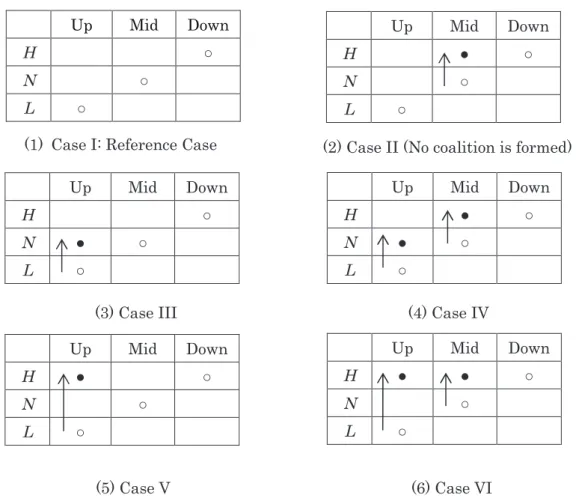
for low level effort, respectively. In usual year, available water is sufficient for a whole irrigation system if all farmers in each stream make an effort at normal level (as business as usual) for water management. The Reference Case set for the analysis in the following is supposed thatU
makes an effort at low levelL
for preferably choosing an opportunity cost, then M at normal levelN
andD
at high levelH
as shown in Fig. 2 (1). These levels are set forth taking into account actual situations of advantageous or disadvantageous access to available water according to their locations and water management performance in irrigation system.Up Mid Down
H ○
N ○
L ○
Note:
(1) H, N and L mean high effort, normal effort and low effort made for water management, respectively. And Up, Mid and Down means each stream along a canal of irrigation system.
(2) In each case, it shows that marks of ○ and ● are effort levels for enhancing water management practice by farmers upstream and midstream.
In the case analysis below, it is supposed that
D
keeps always an effort at high levelH
whileM and
U
would enhance a level of efforts from the Reference Case which creates five cases (namely, Case II to VI) with different combinations of effort byU
and M for the comparative analysis (see Fig. 2 (2)~(6)). Here, some assumptions are incorporated for the analysis. Upon enhancing one level higher effort fromN
, it increases a profit of5
points which includes not only benefits for farmers of coalition but also for water preservation in irrigation system as a whole 7). On top of that, a social benefit
is taken into consideration in cases whereU
andM make efforts to improve water management. A social benefit is set
0
in Case I (i.e. Reference Case) and
10
in Case VI where bothU
and M including D make efforts at high level, and
5
for the rest cases.Up Mid Down H ● ○ N ○ L ○ Up Mid Down H ○ N ● ○ L ○ Up Mid Down H ● ○ N ● ○ L ○ Up Mid Down H ● ● ○ N ○ L ○ Up Mid Down H ● ○ N ○ L ○
(1) Case I: Reference Case (2) Case II (No coalition is formed)
(3) Case III (4) Case IV
(5) Case V (6) Case VI
The characteristic function
v
in Case I is firstly discussed as Reference Case. Now, consider one player’s coalition which could not contribute to any additional improvement of water management if none of effort is made. Consequently, it does not accrue benefit to him (or her), thus a coalition of v
i 0, where i U,M,D, v
0. Then, two players’ coalition is presented as a combination of two players’ cooperation by which brings about a profit by forming coalition. The benefit of coalition should be more than that of summing up each player’s profit in the case without coalition. This is also the same for coalition formed by other number of members. And full players’ coalition U,M,D , should produce more profit than other types of coalition which satisfies a superior addiction condition8).A possible allocation of profit for
U
,M
and D presents with the profit vectorx
xU,xM,xD
in which exists a core C
x for solution. The profit vector satisfies a full players’ coalition rationality, xU xM xD v
U M D
as well as individual coalition rationality,
0,
0
0 v U x v M and x v D
xU M D . In addition, it should also satisfy every
coalition rationality besides full players’ coalition, xU xM ,
x
M
x
D
, xU xD and xU 0, xM 0, xD 0. 4-2 Case I as Reference Case
In Case I shown in Fig. 2(1) where
U
would negatively contribute to water availability for M and especially D by utilizing time and labor for opportunity cost instead of water management. By using time and labor for opportunity cost, it assumes thatU
gets benefit of5
. This results in sacrificing D with a loss of
5
points in addition to a loss of
5
points byU
of neglecting water management for which a social benefit 0. Given these situations, the characteristic functions are presented as follows;
U 0, v
M 0, v
D 0 v
U M D
505 10 where 0 v
U M
50 5 v
M D
05 5 v
U D
55 10 vIn Case I (i.e. Reference Case), a coalition could not be formed because profits for full players’ coalition as well as two players’ coalition are negative. This presents a situation where effort for water management by
U
in particular is neglected and D suffers from insufficient water availability as a consequence. This is also true for Case II shown in Fig. 2 (2) where no coalition could be formed due to the same reason above. Therefore, a coalition game analysis below could be applied only to Cases of III, IV, V and VI.The reason behind why Case I is set as Reference Case for the analysis is that a real case has been observed in many, if not all, irrigation systems not only in Japan but other Asian rice producing countries. The Reference Case (Case I) is a basis for analyzing other four cases of Case III to VI. Each case presents that U and M would enhance their efforts level toward H . 4-3 Coalition in Case III
In the Case III shown in Fig. 2 (3) where D enjoys own profit
5
points owing to a normal effort made byU
for water management with point of 09). In other words, it means thatU
loses5
points equivalent to opportunity cost. Given this, characteristic functions are set as follows;
U 0, v
M 0, v
D 0 v
U M D
005 10, where 5 v
U M
000 v
M D
05 5 v
U D
05 5 vAssuming that allocation of profit by full players’ coalition to each player is presented
D M
U x and x
x , for U , M and D, with profit vector x
xU,xM,xD
, thus it should satisfy theequation (1) subject to constraint of inequalities (2). 10 M D U x x x ………..…….……. (1) 0 M U x x …...… (2)
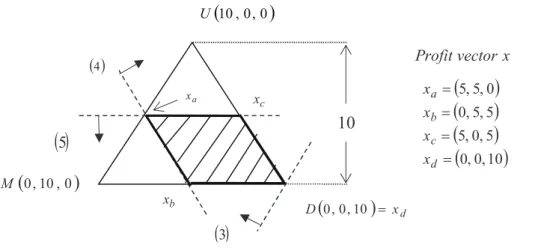
Solving these equations results in; 10 0 xD ……….…….……….. (3) 5 0 xM ……….………...………... (4) 5 0 xU ……….…………. (5)
xCaseIII
x
xU,xM,xD
0xD10, 0xM ,5 0xU5
C ………... (6)Using result above, the core C
xCaseIII of allocation forU
,M
and D is presented with the lozenge-type area circled in the bold line as shown in Fig. 3. As a next step, it is to seek a nucleolus for the solution by comparing various cases of allocation to minimize dissatisfaction of players participated in a coalition. Here, however, try to find possible allocation by using Fig. 3 taking into account its levels of efforts ofU
, M and D for water management. In this case, let’s consider four profit vectors of x
xU,xM,xD
which are; xa
,5 ,50
, xb
,0 ,55
, xc
,5 ,05
5 D M x x 5 D U x x 0 , 0 , 0 M D U x x x
10,0,0
Uand xd
0,0,10
as shown in Fig. 3. Now, sinceU
makes normal effortN
for water management, its profit is enjoyed downstream farmers of M and D. If so, the best allocation would be xb
0,5,5
. The profit allocation of xc
5,0,5
could be understood in a way that D could be compensated for the loss of opportunity cost of 5 points by makingN
for water management. In doing so, D still gets 5 points equivalent to the benefit otherwise could get by using time and labor for opportunity cost. The rest of allocationxa
,5 ,50
is less meaningful except a consideration that D is sacrificed due to improvement of access to water owing toN
made by D. Furthermore, if values become further less than 5 in both inequalities (4) and (5), more profit goes to D up to 10 whereU
and M have no allocation any more.4-4 Coalition in Case IV
In Case IV shown in Fig. 2 (4) where
U
makes normal effortN
while M enhances the effort level fromN
to H . As a result,U
contributes to increase the profit of5
points and thenD remains the profit of
5
points. Given this, characteristic functions are set as follows;
U 0, v
M 0, v
D 0 v
U M D
055
15, where
5 v
U M
05 5 v
M D
5510 v
U D
05 5 vThen, allocation of profit vector x
xU,xM,xD
is set by solving the following inequalities;0 , 0 , 0 , 15 M D U M D U x x x x x x ……….. (7) 5 M U x x
10
D Mx
x
…………..……. (8) 5 D U x x10
0
x
D
……….…….. (9)
0,10,0
M
xd D 0,0,10 10
4
5
3Fig. 3: The Core in Case III a x b x c x x vector rofit P
0,0,10
5 , 0 , 5 5 , 5 , 0 0 , 5 , 5 d c b a x x x x10
0
x
M
……….……...… (10) 5 0 xU ………...….. (11)
xCaseIV
x
xU,xM,xD
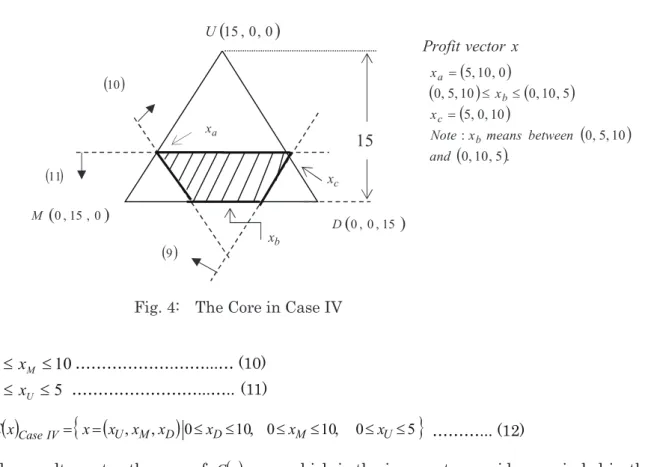
0xD10, 0xM 10, 0xU5
C ………... (12)The result creates the core of C
xCaseIV which is the inverse trapezoid area circled in the bold line shown in Fig. 4. This means that if values in both inequalities (9) and (10) become further less than 10 up to 57 , it will converge to the profit vector. x
0,7. ,57.5
as one of cores. This means that a profit by effort made by M shares between M and D. However, if values exceed over 7.5, there is no more existence of a core. Another possibility is that if the value in inequality (11) is equal to0
, then the allocation xb will be between
0,10,5
and
0,5,10
benefited for M and D. These allocations are advantageous for M and D because increased profit owing heavily to effort made by M. In general sense, the more profit should go to D given a risk of water shortage for downstream farmers. Therefore, a coalition of v
M D
brings about profit to D, thus the profit vector xb
0,5,10
. 4-5 Coalition in Case VIn Case V shown in Fig. 2 (5) where U enhances effort level from
L
to H while both M and D keep effort levels at the level of Reference Case. A high effort H made by U contributes to increase a profit of coalition with U . Consequently, full players’ coalition and each coalition of two players provide profits with 15 and 5 or 10 points, respectively.
U 0, v
M 0, v
D 0 v
UMD
50515, where5 v
UM
505 v
MD
055 v
15,0,0
U
0,15,0
M D
0,0,15
15
10
11
9 a x b x c xFig. 4: The Core in Case IV
x vector rofit P
0,10,5
. 10 , 5 , 0 : 10 , 0 , 5 5 , 10 , 0 10 , 5 , 0 0 , 10 , 5 and between means x Note x x x b c b a
U D
5 510v
Then, allocation of profit vectorx
xU,xM,xD
is set by solving the following inequalities;0 ,0 ,0 , 15 M D U M D U x x x x x x ……… (13) 5 M U x x 5 D M x x …….………….. (14) 10 D U x x 10 0 xD ……….. (15) 5 0 xM ….……….. (16) 10 0 xU ..……….. (17)
xCaseV
x
xU,xM,xD
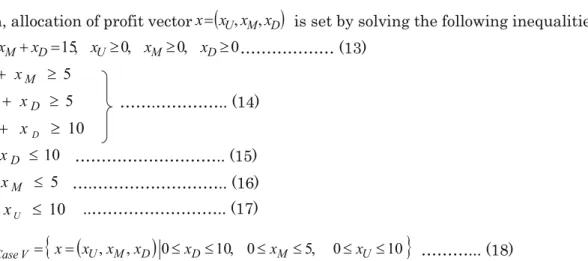
0xD10, 0xM 5, 0xU 10
C ………... (18)The core of C
xCaseV is presented with the trapezoid area circled in the bold line shown in Fig. 5. The profit by an effort made by U could be mainly enjoyed by M and D. The result of coalition formation in Case V is similar to Case IV. The basic analysis could be referred to that mentioned in the previous section. In equations of (15) and (17), it could make D to enjoy the highest profit because M could be further easier to access available water owing to high effort H made by U . This consideration leads a coalition of v
U D
with the profit vector
,5 0 10
x which is a desirable core. It is, however, noted that U could be compensated, if any, for high effort H by D. Given this, suppose that the payment x is transferred from D to U for effort made up to H. It will be possible within 0 x 5 and depends on a willingness to pay by D but where it is x2.5 in order to secure the profit relation of x D xU.
15,0,0
U
0,15,0
M
0,0,15
D15
16
17
15 a x b x c x x vector rofit P
5,0,10
. 5 , 0 , 10 : 10 , 0 , 5 5 , 0 , 10 10 , 5 , 0 0 , 5 , 10 and between means x Note x x x c c b a 4-6 Coalition in Case VI
In Case VI shown in Fig. 2 (6) where all of
U
,M
and D make effort at H and a social benefit is set with 10. This creates the highest profit of 25 points for full players’ coalition while incurs a profit of 15 points for both two players’ coalitions of v
MD
and v
U D
which are beneficial for D.
U 0, v
M 0, v
D 0 v
UMD
55525 where 10 v
U M
5510 v
M D
5510 v
U D
5510 vThen, allocation of vector profit x
xU,xM,xD
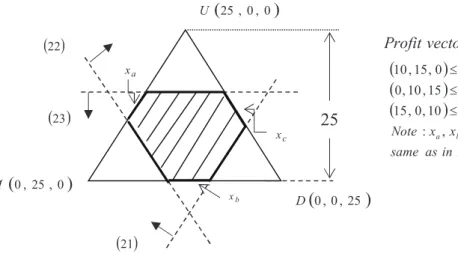
is set by solving the following inequalities;0 , 0 , 0 , 25 M D U M D U x x x x x x ……….. (19) 10 M U x x 10 D M x x ……....….…… (20) 10 D U x x 15 0xD ……….… (21) 15 0xM ……….… (22) . 15 0xU ………..….. (23)
xCaseVI
x
xU,xM,xD
0xD15, 0xM15, 0xU15
C ………... (24)As shown in Fig.6, the core of C
xCaseVI is presented with the hexagonal area circled in the bold line. Firstly, consider the case where all ofU
,M
and D could get equal benefit taking into account H made by participation of all farmers. This requires them to reduce a profit 2.5 points in inequalities (21), (22) and (23) which results in a profit vectorx
253,253,253
. Next,
25, 0,0
U
0,25,0
M
0,0,25
D25
22
23
21 a x b x c x x vector rofit P
. 4 . , : 15 , 0 , 10 10 , 0 , 15 10 , 15 , 0 15 , 10 , 0 0 , 10 , 15 0 , 15 , 10 Fig in as same the mean x and x x Note x x x c b a c b a examine the case where a profit of D could be kept atD15
15 points and profits of bothU
and M have to be reduced up to a profit of 5 points by which a profit vector would be changed to x
5,5,15
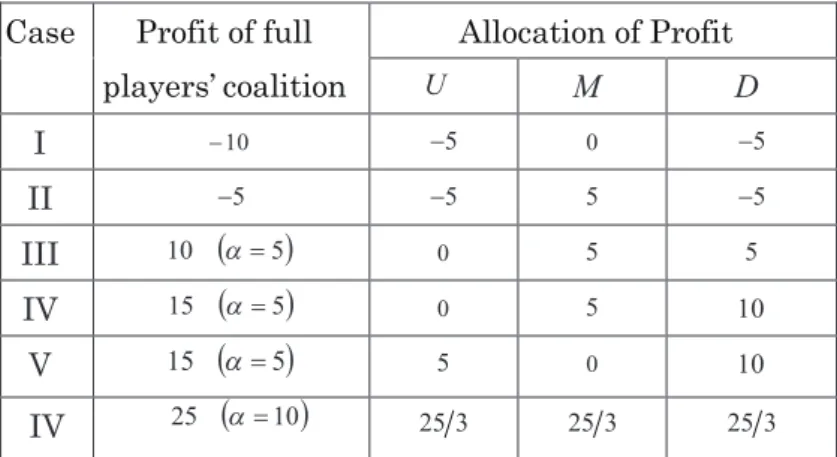
. This gives the highest profit to D though it is not reasonable profit allocation given a situation where H is made by full cooperation of all farmers. This will be not until full agreement for implementing better water management could be reached among all farmers. 4-7 Allocation of Profit in Each CaseFollowing up the results of analysis above, here summarizes and evaluates it for further discussion. The allocation of profit accrued by full players’ coalition to
U
, M and D which is one of cores in each case is consolidated in the Table 1. In allocating the profit, a priority is given to D by taking into account that farmers downstream are in a disadvantageous position in terms of physical location and end user in irrigation system. By facilitating D to form coalitions withU
and/orM
, it analyzes how it could make D possible to access water.An improved effort made by farmers in each stream could contribute to increase the profit of full players’ coalition from 10 points in Case III to 25 points in Case VI. Each case brings about different allocation of profit but higher effort made by farmers produces high as well as equal, even if not necessary, allocation among
U
,M and D. It is noted that a particular attention should be paid to the relation betweenU
and D. Put it differently, farmers downstream D depend heavily on water management made by farmers upstreamU
. Better water management upstream could contribute for D to make access to available water. In this situation, farmers downstream D might be asked to compensate or pay for an effort made byU
if applying an idea of Coase Theory. In the analysis, this sort of compensation or payment is not counted in a visible way. It could be, however, possible in Cases IV and V within a range where the profit ofD
is not less than that ofU
. As mentioned, the allocation shown in Table 1 is one of coresCase Profit of full players’ coalition Allocation of Profit U M D I 10 5 0 5 II 5 5 5 5 III 10
5
0 5 5 IV 15
5
0 5 10 V 15
5
5 0 10 IV 25
10
253 25 3 253 Note: 1. Farmers upstream Uchooses an opportunity cost in Cases of I and II. 2. A social benefit is presented with.based on certain assumptions such as a priority given to
D
in allocating profit by higher effort made by farmers in upstream ofU
and M.5. Water Democracy against Climate Change
5-1 Better Water Management as Adaptation Measure
As generally well known, two measures that are mitigation and adaptation have been adopted against climate change accompanying with various approaches at global, national and local levels. Major mitigation measures have been planned and carried out at global level as seen in Kyoto Mechanism and requires more investment than adaptation measures. Adaptation measures need both different and common approaches across sectors with scientific knowledge and technologies, but of importance is to enhance public awareness to reduce a risk against effects by climate change. It goes without saying that both mitigation and adaptation measures should be promoted hand in hand and requires a short, medium and long-term perspective strategies.
How could better water management at irrigation system level be effective as an adaptation measure against climate change? There exist small and large scale irrigation systems over the world involving different number of beneficiaries. Those are mostly man-made infrastructure and operated as well as maintained by farmers and WUAs except those under control by public sector. It means that water management performance could be governed by farmers as beneficiary and WUAs as a group of farmers. A first step to be taken for adaptation measure is to reduce a risk of status quo under certainty such as deteriorated facilities and a negligence of efficient water use which are visible and foreseeable facts. A risk of water shortage could be reduced by water management to a large extent but it depends on willingness to act by farmers. A collective action needs to build consensus and agreement among stakeholders in its decision-making process. Better water management originates in a collective action by farmers upstream, midstream and downstream in irrigation system. As analyzed in the previous chapter, a formation of farmers’ coalition among different streams could enable for them to take a collective action for improving water management. It is a vital to recognize that the conserved water particularly during a period of drought could be available not only for farmers downstream but for allocations for other sectors and biodiversity and ecosystem.
5-2 Adaptation Measure at Local Level
Adaptation measures for climate change require an integrated approach with participation and visible action of stakeholders at local, national and global levels. Of significance are adaptation measures taken at local level where people are involved in their daily performances and actions,
but of which are often neglected. It needs less investment, instead does more education and public awareness for local people who are not well informed of necessary measures against effects by climate change. It would be more acceptable for local people to adopt adaptation measures which involve many people with a lesser cost. It is not exaggeration to say that a success of adaptation measure depends on successful practices at local level. It is a public good if practices and rules are exercised among local people for reducing a risk of effects by climate change.
A water management practice in irrigation system is no doubt identified as an adaptation measure at a local or community level. Approaches to water management by IWRM and PIM are surely a part of activities at a basin or local level. Dialogue and communication among stakeholders are prerequisite for planning and implementing IWRM and PIM which are only possible with participation of farmers and other stakeholders. By the same token, an establishment of easy access to information and early warning system, for example, enables for local people more positively to adopt adaptation measures at local level.
5-3 Rebuilding of Water Democracy against Climate Change
In recent years, a decay of Water Democracy in operation and management of irrigation system would negatively contribute to efficient water use and allocation. Consequently, it results in a negligence of adaptive activities for expected effects by climate change. These negative factors cause visible and invisible costs not only for farmers themselves but a society of community. People in many rural communities in Asian countries depend their livelihoods on agriculture of which farming practices are inseparable from water use. It is a historical path in which Water Democracy has evolved in keeping a close linkage to various activities in community such as culture, custom and skills related to water. Such intrinsic, but invisible, values will disappear if farmers continue to neglect and weaken Water Democracy in their water related activities. Given this situation, it is an urgent task for farmers and WUA to examine their water management practices in viewpoint of Water Democracy. It probably needs a list of portfolio for examining necessary factors in practices even if those are different from one irrigation system to another10). Having this said, it should pay an attention to common factors such as necessity of mutual dialogue among farmers, formation of consensus or agreement for a conflict resolution, participation of farmers for water management and efficient water uses. Based on results examined, farmers and other stakeholders are required to meet together for discussing existing problems toward how to rebuild Water Democracy. To this end, a breakthrough leadership is expected for a representative among farmers or WUA in the event to rebuild Water Democracy. A rethink and rebuilding of Water Democracy will be valid to enhance capacity and tackle
against effects by climate change. Actual, but effective, actions for planning and implementing adaptation measure needs mutual consensus among stakeholders through dialogue and communication in a participatory basis. But of course democratic approach should be adopted in a process of decision-making otherwise a decision will not be kept or neglected among stakeholders. This process is a true for rebuilding Water Democracy for better water management in irrigation system. It is also noticed that an intervention by the public sector should be limited, if any, in this process.
Better water management based on Water Democracy calls for a cooperation of farmers who are belonged to the same irrigation system. Farmers upstream and downstream often encounter with a conflict around their efforts made for water management. The best approach for such conflict resolution is to promote communication with full participation of farmers under a strong initiative by a representative of farmers or WUA. A decision-making for adaptation measures through efficient water management needs collective action among farmers because it requires a change of organizational behavior, thus a change of individual farmer’s behavior on water uses. It cannot be realized without taking a democratic approach. An agreement reached through democratic process would be “public good” for developing an adaptive measure against effects by climate change.
6. Conclusion
It is pointed out that actual implementation of adaptation measures is rather delayed comparing to mitigation measures. One of reasons is that most adaptation measures, by nature, should be planned and implemented in national level, let alone at local level. It includes that improved water management in irrigation system could be conducive to reduce a risk of effects by climate change. The conserved water by water management could be allocated to biodiversity and ecosystem and other sectors besides agriculture.
With these backgrounds, the paper discusses Water Democracy in relation to IWRM and PIM of which are similar approaches to use water efficiently. An adaptation of Water Democracy requires a change of behavior and performance toward water use and sharing in a democratic way for which WUA plays significant roles. It is noted that better water management in irrigation system, namely, at local level could be effective to be adaptation measure against climate change.
The paper discusses on formation of farmers’ coalition for improving water management by applying coalition game theory. The result shows that higher effort made by farmers brings about high profit for water allocation among them. But of course a priority is given to farmers
downstream who often suffer from a shortage of water due to a negligence of farmers upstream. The farmers’ coalition would be basis for collective action to encounter prevailing problems around water use and allocation.
Finally, it is noted that a rebuilding of Water Democracy in water management would be effective approach to strengthen a fabric of community and vitalize rural activities preserving traditional culture, knowledge and skills related to water uses. It produces positive, but often invisible, effects to people in rural community beyond solely efficient water use and sharing.
Note for gratitude: It is noted here that this study is supported by the Grants -in-Aid for Scientific Research by Japan Society for the Promotion of Science. The subject is “A rebuilding of Water Democracy as an adaptation measure against climate change” (Research subject No. 23651041) which was adopted in 2011.
Notes:
1) The word of “Water Users’ Association (WUA)” is used in this paper. There exist several different expressions such as “Irrigators’ Association (IA)” in Philippines and “Land Improvement District (LID)” in Japan. 2) It is discussed in section of 3-1.
3) A water shortage is defined in terms of physical water shortage, financial water shortage and institutional water shortage (Yoshinaga, 2012)
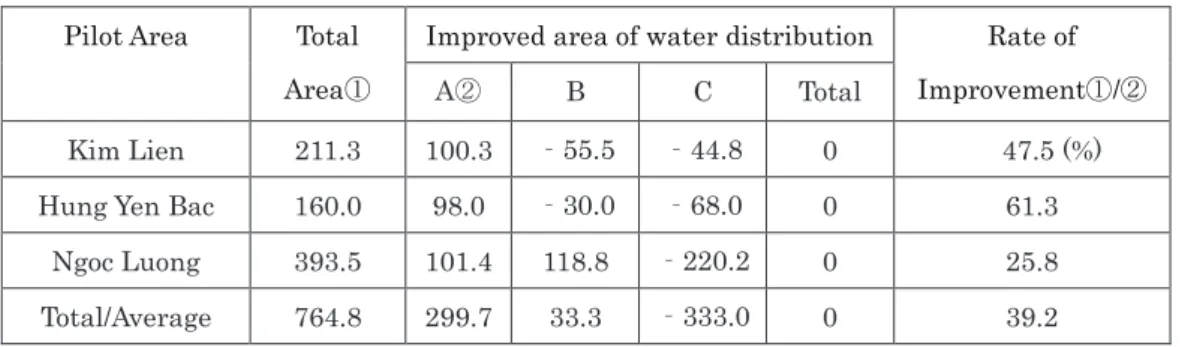
4) The questionnaire survey was carried out targeting farmers in three pilot sites by JICA team. The result shows a degree of farmers’ satisfaction for improving water management by applying PIM as shown in Table 1. In addition, Table 2 shows reduced areas confronted with water distribution problems through exercise of PIM at field level (JICA, 2013).
Pilot Area No. of Farmers①
Change of Satisfaction Rate of Improvement①/②
C→B B→A C→A Total②
Kim Lien 71 0 41 23 64 90.1 (%) Hung Yen Bac 71 1 43 18 62 87.3
Ngoc Luong 75 13 18 19 50 66.7 Total/Average 217 14 102 60 176 81.1
Note: A, B and C present, Satisfied, Relatively unsatisfied, Strongly unsatisfied, respectively. Table 1: Change of Satisfaction by PIM Activities
5) Author visited to the pilot site (Ngoc Luong) of JICA P-PIMS Project on 19 September 2013 to have interview and exchange views with farmers and local officers (called, “Hamlet”). The meeting with experts at JICA project office in Hanoi on 20 September was fruitful to know a detail about the project and to get necessary information. Here expresses author’s gratitude for experts and farmers joined in the interview and meeting.
6) For example, a small-scale irrigation system is transferred its operation and maintenance to irrigators’ association from National Irrigation Administration (NIA) based on an agreement (or contract) of both sides (Yoshinaga, 2009)
7) An increased profit by effort made by farmers for water management in each stream would write it off as benefit for them which includes effective contribution for irrigation system as a whole.
8) As additional notes, in characteristic function game, coalition value v
N for a full players’ coalition N could be allocated to each player x and its allocation should be more than each player’s value ofi
iv as shown in equation (1). The equation (2) means that the same conditions are applied to other coalition S , in other words, allocationx satisfied equation (2) will be accepted for each player. A core C
v satisfies equations (1) and (2) which is presented in equation (3). N where x v i i n here i U M D v x i n i i 1,2,... , , , 1
……….. (1)
S i i v S S N x ……….…..…… (2)
N i i S i i n x v N x v S S N x x x x v C = 1, 2,... , ….…... (3)9) Effort made by D being back from L to N means the point of 0. Since D keeps H , it remains to be point of 5.
10) The list would include such those as a number of occurrence of water shortage, a way of water conflict resolution, a rate of irrigation fee, a collective actions such as cleaning canal, a way of farming practice for preservation of water, and so forth.
Pilot Area Total Area①
Improved area of water distribution Rate of Improvement①/②
A② B C Total
Kim Lien 211.3 100.3 ‐55.5 ‐44.8 0 47.5 (%) Hung Yen Bac 160.0 98.0 ‐30.0 ‐68.0 0 61.3
Ngoc Luong 393.5 101.4 118.8 ‐220.2 0 25.8 Total/Average 764.8 299.7 33.3 ‐333.0 0 39.2
Table 2: Improved Area of Water Distribution by PIMActivities
Note: A presents area without water distribution problems, B for area with minor water distribution problems and C for with serious water distribution problems, respectively.
References:
(1) Avinash Dixit and Susan Skeath (2004): Games of Strategy, W.W. Norton & Company
(2)JICA (2013): Based on ①Summary of the questionnaire about farmers’' satisfaction and ②Summary of improved area about water distribution in the Completion Report on the Project for Promotion of Participatory Irrigation Management for Sustainable Small-Scale Pro-Poor Infrastructure Development in Vietnam, Hanoi project office, JICA
(3) Martin J, Osbone (2004): An Introduction to Game Theory, Oxford University Press (4) Mutou, S (2001): Introduction to Game Theory, Nikkei Shinbunsya
(5) Okada. A (2008): Introduction to Game Theory: Understanding Human Society, Yuhikaku Co.Ltd. (6) On line: Global Water Partnership (website):
http://www.gwp.org/en/The-Challenge/What-is-IWRM/IWRM-Principles/ (refered on 5 Nov. 2013) (7) Shiva, V. (2000): Water Wars, South end Press
(8) Suresh A. Kulkarni, and Avinash C Tyagi (2012):Participatory Irrigation Management: Understanding the Role of Cooperative Culture, ICID
(9) Yoshinaga. K. (2009):Analysis on Incentives and penalties for Optimal Allocation in Irrigation System -Taking the Balanac River Irrigation System in Philippines as the Case Study-, Journal of Regional Development Studies, Vol. 12, pp.1-20
(10) Yoshinaga. K. (2012): Sustainable Water Management for Food Security –Theoretical Considerations –, Journal of Regional Development Studies, Vol.15, pp.151- 176
(11)Yoshinaga, K.(2012): Study on Economic Measures for Resolution against Water Conflict -Taking water conflict between upstream and downstream in irrigation system as the case analysis -, Graduate Program of Regional Development Studies, Vol.49, 2012, pp. 79-96
(12) Yoshinaga, K. (2013a): Study on Evolution of Water Management Practice and Institutional Design in Irrigation System -Role and Responsibility of Water User’s Association for Equal Water Allocation-, Journal of Regional Development Studies, Vol.16 , pp.73-88
(13) Yoshinaga, K. (2013b): Analysis on Water Sharing Practice in Irrigation Canal-Analysis based on Theory and Field Survey in Philippines and Lao PDR-, Journal of Regional Development Studies, Vol.16 , pp. 89-116