Irrigation System : Referring to the Case in
Philippines as an Example
著者
YOSHINAGA Kenji
雑誌名
国際地域学研究
号
18
ページ
115-135
発行年
2015-03
URL
http://id.nii.ac.jp/1060/00007092/
Creative Commons : 表示 - 非営利 - 改変禁止Analysis on Incomplete Contract under Asymmetric Information
in Establishing PPP in Irrigation System
―
Referring to the case in Philippines as an example
―
Kenji YOSHINAGA*
1. IntroductionIn recent years, public and private partnership (PPP) has drawn attention among stakeholders concerned, either in public sector or private sector. There are various reasons behind why PPP has been promoted which include such those as inefficiency in public expenditure, old-fashioned thought and management in public sector, opportunistic policy performance, and hindrance of vertical bureaucracy. These elements also have caused a government failure by which has brought about negative benefit to a society as a whole. It is well recognized that the effectiveness of PPP have been identified in different fields such as transportation, energy supply and urban water supply since PPP substantially initiated in early 1990’s. It has contributed for efficient resource allocation, adoption of skills backed by innovative knowledge and ideas injected into enhancing efficiency in various fields under PPP.
There are, of course, advantages and disadvantages in PPP; a successful PPP contributes to reduced public expenditure and improved institutional arrangements and processes by which accrued benefits are for a society. Both players participating in a PPP (i.e.public and private sector) could enjoy benefits under a win-win situation. On the other hand, PPP involves some risks given asymmetric information between the two players. In this situation, the contract has to be incomplete without a necessary binding force. A moral hazard problem results where the private sector as the agent performs in a way which reduces the achievement to a lower level against the target goal. In addition, participants of private sector in bidding competition of the contract would be limited if its system and qualification are not well understood among the potential participants for PPP.
The paper focuses on the possibility of establishing a PPP for maintenance and operation and management (M-O&M) services of an irrigation system with the case of the Philippines as an example. Many irrigation systems constructed in 1970’s to 1980’s have been close to or beyond physical life which now needs rehabilitation and modernization. There are limited cases of PPP in irrigation sector in countries such as in Africa and South America1), but it is a new challenge
* Visiting Researcher, Institution of Reginald Vitalization Studies, Toyo University
Analysis on Incomplete Contract under Asymmetric Information
in Establishing PPP in Irrigation System
―Referring to the Case in Philippines as an Example―
Kenji YOSHINAGA*
to apply PPP in irrigation system in Asian countries. The World Bank (2013) recently completed PPP study for the irrigation sector in the Philippines provides a framework for potential PPPs2). It discusses the potential of a viable PPP between the public sector, i.e. National Irrigation Administration (NIA)3) and Irrigators’ Associations (IAs)4) for M-O&M services in irrigation system.
The discussion and analysis on the possibility of establishing PPP between NIA as the public sector and IAs as the private sector have still been on-going among concerned professionals and experts5). The qualification of the IAs to be a partner with the public sector requires that they should be an independent organization as the private sector, hereafter refer it as Irrigation System Management Company (ISMC). Traditionally, NIA and IAs have been co-managing national irrigation systems where in most cases, the IAs have been largely dependent on NIA’s support despite formation and registration with the Securities and Exchange Commission as independent associations. The dependence is largely due to the insufficiency of the irrigation service fee (ISF) collection to fully finance operation and maintenance. The co-management has been formalized through the Irrigation Management Transfer (IMT)6) which defines the both the sharing in functions and the corresponding incentives provided by NIA. Under the IMT program, different degrees of principal-agent relationships between NIA as the principal and IAs as the agent are defined.
However, in establishing PPP for M-O&M services in irrigation system, ISMC should be independent apart from traditional relationships with NIA and perform duties given in the contract made under a competitive bidding. In principle, any contract should be complete and accompany with a binding power but the difficulty exists in the contract in PPP for M-O&M services because, by its nature, there are unclear services involved in M-O&M in terms of scope and quality levels. In particular, those include services such as maintenance of irrigation facilitates, watching water management, and ISF collection, that is called here, soft-skillworks. The soft-skill works are often difficult to estimate its costs and evaluate its achievements comparing to hard-skill works such as rehabilitation of irrigation facilities. This is due to a presence of asymmetric information on effort made by the agent at the field level after the contact and thus setting quality level required in the contract given uncertain effort level made by the agent.
Keeping the above in the context, the paper focuses the analysis on what effects are expected under asymmetric information in PPP contract and implementation for M-O&M services in irrigation system. The analysis was made by applying the principal-agent theory supposing the public sector (i.e. NIA) as the principle and private sector as the agent (i.e. ISMC) among considerable alternatives of principal-agent relationships in implementing M-O&M services in
irrigation system. It is expected that the analysis will provide materials for discussion toward the establishment of PPP for M-O&M services in irrigation system not only in Philippines, taken up here as example case, but also in other Asian countries. It is noted that hereafter it uses words of the public sector and NIA interchangeably taking into account different contexts. Upon making the paper, it was referred to existing technical books and related papers such as Ito,H. (2003), Ito,H. and Osano,H. (2003), Bernard Salanie(2005), Kreps, D.M. (1990), Laffont, J-J. (1993), and Sakai et al. (2008). The papers related to PPP issues are Zhang, X. and Chen, S. (2013), J-E de Bettignies and Ross, T.W. (2009), Dunn-Cavelty, M. and Suter, M. (2009) but limited to the papers analyzing asymmetric information issues in PPP contract such asZhang, X. and Chen, S. (2013). With regard to papers discussing PPP in Philippines, it includes World Bank (2013) and PPP Center in Philippines (2012, 2014) for references.
The paper consists of seven sections that follow this introduction. The second section discusses the situation upon the contract of PPP for M-O&M services in irrigation. The PPP contract includes soft-skill works which causes asymmetric information in designing the contract and evaluating achievements made by the agent. It also includes the principal-agent relationships in implementing the contract for M-O&M services under asymmetric information. The third section takes up the three types as possible principal-agent relationships observed if establishing PPP for M-O&M services which is basis for the analysis in the following sections. The fourth section examines the three problems, namely adverse selection, hold-up and moral hazard observed in principal-agent relationships under symmetric information. In the fifth section, by applying moral hazard model to the PPP contract for M-O&M made by the public sector as the principal and ISMC as the agent. The model analysis is made both cases under symmetric information and asymmetric information to find the first best solution in the former case while the second best solution in the latter case. It identifies the social loss accrued if asymmetric information exists in designing the contract and evaluating the achievement made by the agent. The sixth section discusses that necessary incentive and institutional arrangements should be put in place in the contract to encounter moral hazardous behavior under symmetric information. It also includes analysis on signaling and screening to reduce asymmetric information for improving moral hazardous behavior by the agent. Finally, in the seventh section concludes the discussion and analyses made in the above section. It concludes that PPP contract for M-O&M services in irrigation system is a challenge for a new type of PPP for the public sector to reduce its expenditure and enhance efficiency of M-O&M services management by the private sector.
2. Contract under Asymmetric Information
Usually, in making the contract, both players involved would share with a common information about necessary conditions which is a basis for a fair and agreeable contact. It could also reduce the trouble around the contract between players after signing the contract. Symmetric information is prerequisite for designing the detailed items and providing the complete contract with a binding power which makes players to keep rules and obligation described in the contract. In competitive bidding, all participants are in equal position for sharing common information so that they could estimate the cost depending on their own capability together with own assets such as related technological equipment. A winner of bidding (i.e.contractor) would promote the works according to the contract but choosing most efficient measures with a least cost to fill sufficiently the contact which contributes to increase the benefit for the contractor. In this way, symmetric information provides both contractee and contractor with benefits through the contract.
On the other hand, the contact under asymmetric information is often imperfect which would bring about different advantages or disadvantages to both players involved in the contract. For example, if the contractee lacks the information (or data) to estimate accurately the cost for the contract will cause unfair bidding for contractor in the case where the cost is underestimated, and vice versa. The problem is the complexity to examine the estimated cost whether it is accurate or not due to prevailing asymmetric information. It makes the contract more complex because of the difficulty to predict the occurrence of various risks under asymmetric information which are unknown at contract design. It is often unclear which player, either the contractee or the contractor, bears the responsibility and risks (or cost) if there will be problems with the contract. Also, it is often not the case to give a binding power for the contract under asymmetric information, as a result of which would loosen the relationships between both players, then causes moral hazard problem by the contractor in the worst case.
The soft-skill works in M-O&M cover such services as guidance and watching for water management by farmers, maintenance of irrigation facilities, and ISF collection. It is not easy to set the targeted levels of quality in these services and evaluate its achievements without any reference levels agreed in advance between both players. However, it costs for the contractee to set the reference level in each activity and it is consequently reflected in the bidding cost. For example, how does one estimate the cost for guidance and monitoring of water management by farmers at the field level? In usual case, it counts necessary time and labor used for such services by contractor. However, it cannot accurately reflect those elements in the cost estimation under asymmetric information as far as there exists a mixed presence of farmers made with a high effort H
E and a low effortL
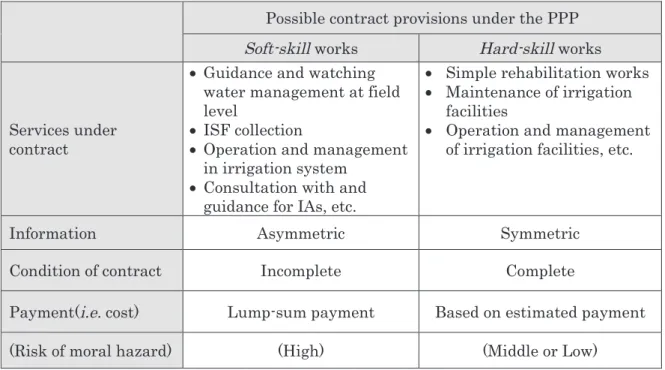
E for their daily management practices.Given this, it is preferable for the contractee to adopt a lump-sum type payment which puts the agent, in turn, in a position of easily neglecting the required levels of services. The contractor could get the same payment regardless of their efforts made and quality levels achieved. This is another element for the contractor to take moral hazardous behavior under asymmetric information. All in all, the contract of PPP for M-O&M services in irrigation system has to be made under asymmetric information because most soft-skill works in M-O&M services are not easy to decide its scope and quality level required in its services. Thus, the contract under asymmetric information has to be incomplete. Table 1 shows the supposed situation of contract of PPP for M-O&M services in irrigation system.
Once the contract is constituted, it becomes the basis for the principal-agent relationships where the public sector is the principal and the ISMC plays the role of agent. A presence of asymmetric information would negatively contribute to the principal-agent relationships upon carrying out the works under the contract. The agent is in a position to use asymmetric information for his (or her) own benefit, for example, by reporting a false achievement.
There are two options for the agent in conducting works under the contract; one option is to make a high effort and the other option is to make a low effort if the quality of achievement could not be evaluated by the principal. There are options for the agent to choose the effort level, either H
E or L
E and quality levels achieved, either a high quality H
Q or a low L
Q , which creates four combinations, namely, the cases for (1) H
E and H
Q , (2) H
E andPossible contract provisions under the PPP Soft-skillworks Hard-skillworks
Services under contract
Guidance and watching water management at field level
ISF collection
Operation and management in irrigation system
Consultation with and guidance for IAs, etc.
Simple rehabilitation works Maintenance of irrigation
facilities
Operation and management of irrigation facilities, etc.
Information Asymmetric Symmetric
Condition of contract Incomplete Complete
Payment(i.e.cost) Lump-sum payment Based on estimated payment
(Risk of moral hazard) (High) (Middle or Low)
QL , (3) L
E and H
Q , and (4) L
E and L
Q . If the principal-agent relationship is under symmetric information, the agent would report all cases honestly and the principal could examine its reporting whether it is correct or not. However, under asymmetric information, the agent will report the case (3) for his (or her) benefit, against which the principal has no way of checking the veracity of the report by the agent. This results in a loss for the principal and the agent could get a margin (or rent) of cost difference of H
E –L
E .3. Principal-Agent Relationships in PPP for M-O&M Services in Irrigation System
The principal-agent relationships could be observed in PPP for M-O&M services in irrigation system if it is actually realized. There are three players in PPP contract and implementation who are the public sector (i.e. NIA), private sector (i.e. ISMC) and IAs7). Here, consider their roles and relations between players of the public sector and ISMC upon making PPP contract and implementing M-O&M services. The contract in PPP for M-O&M services in irrigation system covers soft-skill works and hard-skill works which are often difficult to estimate cost and evaluate achievements because different degrees of necessity for M-O&M services at the field level and rehabilitation works of different irrigation facilities. In addition, an invisibility of quality works achieved, particularly in soft-skill works would contribute negatively to make things further complex. These are reasons for the contract under asymmetric information to be incomplete.
Three possible types of principal-agent relationships are briefly discussed below. The first two types are the relationships between the public sector as the principal and ISMC as the agent, but the first type focusses on its relationship prior to the contract while the second type does after the contract. The third type is in the case where ISMC makes sub-contract with IAs for concession of services which are directly related to farmers’ performance such as water management. All types are more or less in the principal-agent relationships, each of which is briefly is introduced below in view of its relationships.
Type 1:Public sector as the principal and ISMC as the agent in implementing soft-skill works In PPP contract, both public sector and private sector are usually in an equal position for better cooperation to achieve the targeted work. However, if one player (here, public sector) stands for advantageous position than other player (here, private sector) in terms of finance and power of control and management, the principal, for example, needs accurate information on the agent’s performance or behavior for an appropriate payment. Here, consider soft-skill works such as collection of ISF which is main task of ISMC in PPP contract. Suppose that there are two types of ISMC; one type makes a high effort (
H
Type
) and the other type does a low effort (L
Type
) for collection of ISF. The principal has less information on the actual type of agent,then he (or she) needs measures such as screening to get more information on the agent upon establishing the PPP. Both
H
Type
andL
Type
try to signal to the principal who decides which candidate to be acceptable as a partner in the PPP that they areH
Type
. In fact, the principal will not know whether the agent will make a high effort or not in collecting ISF. It is also hard to judge a result of high or low collection rate of ISF which is due to effort made by the agent or not.Type 2:Public sector as the principal and ISMC as the agent in implementing hard-skill works This is the case after the establishment of PPP where the agent is implementing hard-skill works such as rehabilitation of irrigation facilities8). The facilities needed for rehabilitation are scattered over beneficiary area with different degrees of the rehabilitation required. The principal (i.e. public sector) investigates the irrigation facilities needed the rehabilitation in advance and creates an inventory for the contract with the agent (i.e. ISMC). However, the agent can choose either spending a high cost (
H
Type
) or a low cost (L
Type
) in actual rehabilitation works. Against this, the principal is uncertain about either the agent belongs toType
H
orL
Type
. There exists asymmetric information around their performance in actual implementation of rehabilitation works.Type 3:ISMC as the principal and IAs as the agent in implementing soft-skill works
Suppose the case where ISMC is responsible for operating and managing irrigation system in PPP implementation. At the field level, ISMC could not tackle with every soft-skill works without participation of IAs who know actual management based on traditional rules and farmers’ behavior. Taking this situation into account, ISMC could make concession of traditionalsoft-skill works such as watching around water delivery and efficient water use (e.g. avoid to steal water) to IAs through the sub-contract. However, IAs are classified into a high effort-made group (
H
Type
) and a low effort-made group (L
Type
) for a daily watching works. Against a presence of two types of IAs, ISMC as the principal cannot distinguish the group which belongs to either of groups because ISMC has no accurate information on their performance. Each IA as the agent tries to send a signaling of which they are belong toType
H
group to have appointment for the sub-contract. While, ISMC tries to screen the agent for selectingH
Type
group by ruling incentive and penalty items in the contract. The Type 3 is in the head and tail relation of coin with the Type 1.As the types shown in the above, the principal-agent relationships could be observed in actual activities under the contract of PPP for M-O&M services in irrigation system. It should note that the principal-agent problem is caused by a presence of asymmetric information among public sector, ISMC and IAs. If the principal-agent problem includes adverse selection, hold-up and moral hazard problems in PPP implementation, it results in a failure of the contract if not
all part of contract. This means that every process in designing and implementing the contract of PPP should be transparent for both public sector and ISMC including IAs.
4. Three Problems: Adverse-Selection, Hold-up and Moral Hazard
As the cases shown in the above, the principal-agent relationships could be observed in actual activities under the contract of PPP for M-O&M services in irrigation system. The principal-agent relationships would encounter the performance of principal-agent under different situations of information, particularly in asymmetric information. A performance of the agent under contract would affect a utility level of the principal not limited to that of the agent. Typical examples are relationships between the insurer and the insured or between employer and employee9). In these relationships it is often intractable for the principal to get accurate information about the agent, namely his (or her) performance and capability for achieving the target under the contract. If the principal would try to get necessary information about the agent, it requires a high cost which becomes a dead cost if information is not effective or a sunk cost even if it is effective for the principal.
There is a limitation to improve completely the situation under asymmetric information even if different types of measures and institutional arrangements are provided for the agent to perform likely in a way under symmetric information. Also, measures such as signaling by the agent and screening by the principal are taken as an effort for reducing asymmetric information. However, if the agent intentionally sends a false signal, it makes further the situation worse for the principal so as to distinguish its signaling to be either correct or wrong.
Under such asymmetric information, the contract between the principal and the agent is not the first best solution but the second best solution10). Under the second best solution, consequently, it would bring about suboptimal resource allocation by which causes a social loss. Asymmetric information is used to be advantage for the agent to perform strategically for maximizing his (or her) own benefit under the contract. Namely, it causes problems such as adverse selection, hold-up and moral hazard which are specific in the principal-agent relationships. In what follows is to briefly examine these three problems taking into consideration the relations between the public sector and ISMC.
4-1. Adverse Selection Problem
If there exists asymmetric information, the principal cannot get complete information about the agent’s characteristic and performance prior to the contract. The principal could know it only after the contract. In this situation, there happens that the agent with a low quality (or capability) could hide their own level of quality to enter in the market while the agent with a
high quality (or capability) cannot correctly send a signal to the principal. Akerlof (1970) pointed out that the agent (i.e. supplier) with a high quality will be crowded out from the market if only the agent with a low quality could enter in the market11), then which causes a failure of the market. In other words, this causes adverse selection where only the agent with a low quality would enter in the market and the quality level goes to the bottom. The relationships between the insurer and the insured could clarify the adverse selection in an understandable way.
There is a possibility of adverse selection problem in a PPP contact under asymmetric information. If many competitors participate in the competitive bidding by reporting a false qualification with a cheaper proposal cost and did success to make contact, competitors with a high proposal cost but with a high qualification will be gradually crowded out from PPP bidding competition. This results in reducing a quality of services and failing achievement of a targeted goal, as a result of which the contract costs on the principal and causes a social welfare loss. 4-2. Hold-Up Problem
When a problem occurred after the incomplete contract made is to be solved, actions taken (in particular, investment made) in advance affect its solution. In particular, it relates to asset specialty. This problem will occur when some asset is transferred to other purposes which could be measured by loss of values (say, quasi-rent). Prior to actual investment, there are usually many potential transaction partners. However, once the relation-specific investment was made with a specific partner, the cost for canceling the transaction becomes higher for one or both of partners due to an increased degree of monopolistic power given for the principal. If the contract made in advance is incomplete, renegotiation would be done under these situations in which the problem to impede an efficiency occurs with a higher possibility (Ito, 2003).
Now, consider the following case; suppose that ISMC made investment in human-resources development in prior to the contract with the public sector which requires qualified staff for a provision of M-O&M services. In actual contract, there was not made a clear description on human-resources investment in the contract under which ISMC could achieve the quality services required for M-O&M services. Given this, ISMC tries to renegotiate with the public sector to compensate the investment cost for human-resource development by insisting that its achievement is due to efforts made by the qualified staff. The public sector, however, could not agree with the request by ISMC with the reason that the achievement of quality service is not sure whether it is due to the investment in human-resource by ISMC under asymmetric information. Although the hold-up problem is not necessarily related to PPP for M-O&M services in irrigation system, the case as the above would be treated as a part of hold-up problem.
4-3. Moral Hazard Problem
Moral hazard is the problem that is related to a posteriori asymmetric information occurred between the principal and the agent which is against the case of adverse selection. The principal cannot observe or evaluate the agent’s performance after making the contract. Moral hazard problem will be observed if PPP contract is realized even for M-O&M services in irrigation system. There is a possibility that ISMC as the agent would take opportunistic behavior if observation or evaluation by the public sector as the principal is not enough and thus reduce the achievement of targeted goals. In particular, services for M-O&M services in a large-scale irrigation system cover similar works over the total service area which make troublesome for the principal to observe or evaluate every performances taken by the agent. The principal knows the achievement by the agent but unclear whether it depends on effort made by the agent to what extent. The achievements of M-O&M services by ISMC are unclear for the principal as far as he (or she) cannot directly observe and examine the agent’s actual performance. Under these situations, the agent is in a position to take opportunistic behavior for maximizing own benefit, thus here again causes a social welfare loss.
The following section focuses on analyzing the moral hazard problem by applying the principal-agent theory and taking into account the relationships between the public sector and ISMC under a PPP contract for M-O&M services in irrigation system.
5. Moral Hazard Model
Now, consider the contract made between the public sector (i.e. NIA) and ISMC for M-O&M services in irrigation system under PPP (i.e. both cases of Type 1 and Type 2). Suppose that there exists asymmetric information about ISMC’s performance and actual achievements whether it was obtained by their high effort H
E or low effort L
E . The model is analyzed by setting objective function subject to constraints, namely individual rationality constraints and self-selection constraints. The former constraint is a necessary condition for the agent (i.e. ISMC) to participate in a PPP contract that is also called participation constraint. While the latter constraint is for the agent to avoid taking a false performance for their own benefits. 5-1. Contract Model: Public Sector and ISMCIt is often in distress for the principal to supervise and evaluate ISMC’s performance in M-O&M services, in particular if their service area is large and involve different activities. There exists asymmetric information between the public sector and ISMC by which causes the case where ISMC with a high effort typeH
E loses due benefit and ISCM with a low effort typeL
Egains benefit. This leads moral hazardous behavior in actual M-O&M services in irrigation system which ends up with social loss for beneficiaries who bear the cost through ISF12).
Here, suppose that the benefit through better M-O&M services depends on ISMC with H
E while ISMC withL
E could reduce the benefit which are the matter of whether ISMC takes action by keeping contract or not. Let set objective function and both constraints of individual rationality and self-selection. The objective functionF
for the public sector as the principal is concave and possible with partial differentiation consisting of benefit functionM
and cost functionC
which are functions of effort variablee
. The principal tries to maximize the benefit while minimalizing cost, that is, payment to the agent. Then, set the objective (i.e. profit or income) functionF
as follows;
e
1
2
C
e
2M
F
………… (1)Now, the agent is asked whether he (or she) could participate or not in the PPP contract with own participation criteria, namely based on individual rationality constraint. As a condition for participation, ISMC needs payment
p
Cby the principal that should be more than his (or her) reservation price otherwise the agent would not participate in the PPP contract. Those relations are presented as follows; ifp
H
e
p
C
p
H
r
for ISMC with H
E while
r
p
e
p
p
C
L
L with L
E , where pH
e and pL
e present benefit accrued by effort made by ISMC with H
E and L
E , respectively, while pH
r and pL
r present reservation prices for each type of ISMC;
0
p
r
p
C H ……….. (2)
0
p
r
p
C L …………..……… (3)Inequalities (2) and (3) show that payment is higher than reservation prices as individual rationality constraints. Given this, in what follows is to analyze the first best solution under symmetric information and followed by the second best solution under asymmetric information. 5-2. Model: Under Symmetric Information
If the principal has enough information on ISMC’s performance and the quality of services, and accordingly the relation between effort made and achievement obtained, it is possible to find the best solution. Further, note that set
p
C
p
H
e
for ISMC with H
E andp
C
p
L
e
with
EL and as well efforts made by ISMC, either H
E and L
E , are known under symmetric information. Then, functionF
could be solved subjective to constrains (2’) and (3’).
e 1 2C
e 2 M F ………. (1’)
0
.
.
t
p
p
r
s
C H ……… (2’)
0
p
r
p
C L ……… (3’)Formalizing
F
toLagrangianfunction and takes partial derivative withe ,
He
L,
1,
2;
e
C
e
p
p
r
p
p
r
M
F
1
2
2
1 C
H
2 C
L
'
0
'
F
e
HM
e
HC
e
H ………….…... (4)
'
0
'
F
e
LM
e
LC
e
L ………….……. (5)
0
1
F
p
Cp
Hr
………...….……(6)
0
2
F
p
Cp
Lr
……..……….… (7)where
1 and
2
1
2 0
are Lagrangian coefficients. Equations (4) and (5) result in( ) ( )
e
HC
e
HM
' = ' andM
'( ) ( )
e
L =C
'e
L which means a marginal income is equivalent to a marginal cost as the first best solution for the principal. Put it differently, as the public sector could identify that ISMC is either with H
E or L
E under symmetric information, it could make the contract with the chosen ISMC in a way, at least, as a marginal income to be equal a marginal cost (i.e. payment) by which they could avoid a risk of excess payment. Also, in equations (6) and (7), it leads top
C
p
H
r
andp
C
p
L
r
which means that the paymentC
p
by principal is equivalent to reservation price of each type of ISMC which is at minimum level. The contract under symmetric information could be complete which makes possible a fair bidding, thus better resource allocation.5-3. Model: Under Asymmetric Information
In PPP contract for M-O&M services in irrigation system, there exists asymmetric information between the public sector and ISMC. In particular, in the case where the contract has to cover soft-skillworks as mentioned in Table1, there are some difficulties to clarify the detailed duties for a provision of services in terms of its scope and degree of quality level to be achieved by ISMC. It also makes things more complex due to an implication of those services with farmers’ behavior as an end user in irrigation system, in particular, facilities at the tertiary level. Given this, the public sector must encounter such difficulties in examining and evaluating the achievements attained by ISMC at field level.
In these situations under prevailing asymmetric information, the contract cannot help encountering the vagueness to overcome actual situations. This often allows for ISMC with
EL to send a false signaling upon execution of the contract by which they could get a certain amount of rent accrued by getting high payment regardless of actual effort level. Under the presence of asymmetric information, it will fail to seek the first best solution, instead tries to find the second best solution in applying the model.
The model consists of the objective function
F
and self-selection constraints in addition to individual rationality constraints. It is noted that the payment by principal and reservation pricesp
C,
p
H
r
,
p
Lr
are now set to be constant values, then their orderings are
e
p
e
p
p
C
H
L andp
C
p
H
r
p
L
r
.
e
1
2
C
e
2M
F
….……...…….….. (1’).
.t
s
0
p
r
p
C H ……….. (2’)
0
p
r
p
C L ……….……….. (3’)
0
p
e
p
C H ……….…….…...… (8)
0
p
e
p
C L ……….…….. (9)
r
p
p
r
p
p
C
H
C
L ……… (10)
e
p
p
e
p
p
C
H
C
L ……… (11)Formalizing
F
as a Lagrangian function and solving the partial derivative with 6 5 4 3 2 1, , , , , , , L
H e e ;
…
...
.
(11)
2
1
6 5 4 3 2 1 2e
p
e
p
r
p
r
p
e
p
p
e
p
p
r
p
p
r
p
p
e
C
e
M
F
L H L H L C H C L C H C
'
'
'
0
' 6 3
F
e
HM
e
HC
e
H
p
He
p
He
…….….(12)
'
'
'
0
' 6 4
F
e
LM
e
LC
e
L
p
Le
p
Le
……….(13)
0
1
F
p
Cp
Hr
……….………….…. (14)
0
2
F
p
Cp
Lr
………...…….…...………...(15)
0
3
F
p
Cp
He
…..…….………..………...……… (16)
0
4
F
p
Cp
Le
……….……….…..(17)
0
5
F
p
Hr
p
Lr
……….…...……… (18)
0
6
F
p
He
p
Le
………...…..……..…. (19)Equations (14) and (15) result in
p
C
p
H
r
,p
C
p
L
r
which imply that the best payment for the principal is equivalent to the reservation price. Equations (16) and (17) result in
e
p
p
C
H andp
C
p
L
e
, respectively, which means that the best payment is equivalent to cost of effort made by the agent. It is, however, noted that the agent with L
E sends a false signaling by which he could get the rent equivalent top
C
p
L
e
13). Then, equations (18) and(19) lead to pH
r pL
r and pH
e pL
e , respectively, both of which are distorted by a false signaling by the agent with L
E . In both equalities, the agent with L
E attains the same reservation price and cost for effort made as the case with H
E . This is the result of that the agent with L
E sends a false signaling to the principal who cannot distinguish whether the agent is H
E or L
E type.Now, arrange equations (12) and (13) as follows and examine their implications;
e
C
e
p
e
M
' H
' H
6
3 H' …….…………. (20)
e
C
e
p
e
The arranged equations (20) and (21) identify that the first best solution could not be achieved under the presence of asymmetric information between the principal and the agent. The equations show that the marginal income is not equal to the marginal cost (i.e. payment) but equivalent to reduced (or increased)14) p
eH' and pL'
e with a certain rate of
i,
i
3
,
4
,
6
.Namely, under asymmetric information, the principal cannot clarify the effort made by each type of agent so that income for the principal is affected by effort levels of the agent with H
E orL
E . It could be examined that marginal income for the principal is underestimated in case of the agent with H
E if
6
3
0
and overestimated if
4
6
0
in case of the agent withL
E . Accordingly, the contract has to be incomplete, that is, the second best contract which can be advantageous and disadvantageous to both the principal and agent depending on the situation15).Further, suppose that in equations (20) and (21),
6
3
0
and
4
6
0
, respectively, which leads toM
'( ) ( )
e
H =C
'e
H andM
'( ) ( )
e
L =C
'e
L which are the best solutions, but it is also difficult to set the Lagrangian coefficients to be
6
3
4under asymmetric information. 6. Measures and Incentives: Against Asymmetric InformationUpon executing the contract between the principal and the agent under the presence of asymmetric information, each player takes necessary action for maximizing own benefits. In other words, the agent tries to send a signaling to the principal depending on his (or her) position, either advantage or disadvantage, for affecting a decision-making by the principal. The agent with L
E intends to send a false signaling to change his (or her) disadvantage while the agent with H
E will try to send a correct signaling to enable the principal to see his (or her) advantage. Both players make efforts to reduce the risk of their positions under asymmetric information by adopting strategic signaling measures that increase or maintain the probable benefit.Against actions taken by the agent, the principal makes the effort to identify correct signaling through adoption of some screening measures. The principal provides different screening measures to distinguish a false or correct signaling sent by the agent through interview, examination, and qualified certification which aim at identifying the agent’s qualification, job or experience, knowledge and performance. The screening costs the principal and finally its cost will be a sunk cost regardless of whether the principal accepts the agent’s signaling or not. A failure of screening by the principal against a false signaling sent by the agent causes moral hazard, adverse selection and hold-up problems discussed above.
In what follows, the signaling by the agent (i.e. ISMC) and the screening by the principal (i.e. public sector) in establishing PPP for M-O&M services in irrigation system are discussed.
6-1. Signaling
Here, the ISMC is categorized into two groups, one of which makes a high effort H
E and the other makes a low effort L
E in implementing M-O&M services. If both types of agent are identical, the principal’s task of choosing the ISMC partner for the PPP becomes easy. In actual situation under asymmetric information, however, there exists a mix of agents with H
E and
EL so that the principal has to be deliberative for choosing capable ISMC as the agent of PPP. Now, suppose that an efficiency in M-O&M services by ISMC could be measured by its productivity (i.e. cost measured by unit of time and labor16)). The productivity of ISMC with
EH could be presented with
x
H while L
E does withx
L . Given this, set an average productivity for both types of ISMC to bex
a
x
H
x
L
2
17) by which the payment under contract is decided. Here notes thatx
Hx
a andx
Lx
a. Accordingly, ISMC with H
E would encounter a lower contract payment but ISMC with L
E could enjoy a higher contract payment if actual bidding is executed.In this situation, ISMC with H
E would have an incentive to send a signaling on their capability for a high quality provision of M-O&M services. On the contrary, ISMC with L
E prefers to leave asymmetric information as it is for their benefit without any signaling to the principal. What is important is the utility obtained by a signaling should be higher than its cost spent for a signaling. It is usual, however, for ISMC with L
E that the cost of signaling exceeds utility if they actually try to be qualified. Now, set U
H
E
and U
L
E
18) to be utilities and costs CH and CL, where C L CH , for ISMC with H
E and L
E , respectively19). This leads to the following relation between utility and cost.
H E
U
L
E
CH U ………(22)
H E
U
L
E
CL U ………(23)The inequalities (22) and (23) means that the cost for ISMC with H
E should be lower than difference of utilitiesU
E
H
U
E
L
while it is higher for ISMC with L
E . Put it more concrete way, for example, suppose that the utility
for a high quality M-O&M services by the agent with H
E and for a low quality services by the agent with L
E where value difference of both type of ISMC is
0
(if the utility could be presented in monetary term). And, consider the costsc
,c
for achieving a high quality services for both types of ISMC for which
c
and
c
should be consistent because utility obtained by achieving a high quality services is higher than the cost for ISMC with H
E but the cost is higher than utility obtained for ISMC with L
E .6-2. Screening
If ISMC made a high effort for M-O&M services, a high benefit accrues for the system as whole while if effort made is at a low level, it would reduce its benefit. Now, suppose the situation where the principal is uncertain about effort made by the agent. Then the principal believes that if the ISMC with H
E makes effort, it results in a high benefit H
B with the probability
and low benefit L
B with the probability1
. On the other hand, in the case of ISMC with
EL are H
B with1
and L
B with
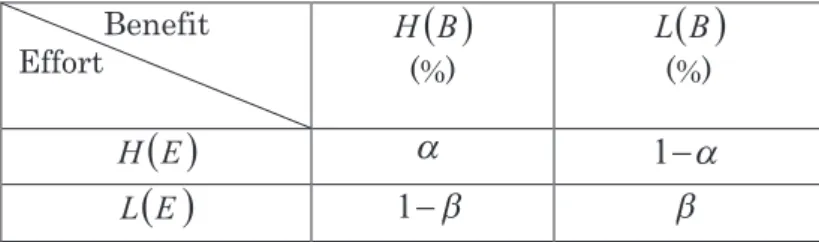
, respectively. In Table 2, these relations are shown in the probability matrix.Given the probability between effort levels made and benefits obtained, the expected payoffs for the principal in effort levels of H
E and L
E , respectively, are calculated as follows;
EH =
H
B +
1
L
B
EL =
1
H
B +
L
BSocial benefit
S
b (i.e.benefit for mainly beneficiaries in irrigation system) is obtained by,b
S
=H
E L E =
H
B 1
L B
1
H B
L
B
=
1
H B L B
………. (24)In the equation (24), if the information between the public sector and ISMC is symmetric where
1
, it results inH
B L B 0 which presents social benefitS
b. If the information available is asymmetric, the probabilities of
and
are uncertain by whichS
bwill be reduced depending on the order of the allocated probabilities. For example, let set the probabilities of
and
are 0.8 and 0.9, respectively. Social benefitS
bwill be;b
S
=
1
H
B L B
0.80.91
H
B L B
7
.
0
H
B L B
This case means that social benefit will be reduced by 30% if the probability (or belief) for effort made by agent is under asymmetric information. In other words, the principal is required to collect information on the agent’s performance by adopting screening measures such as past
Benefit Effort H(%)
B L(%)
B
E H
1
E L1
data and monitoring their activities in the field in order to make their belief to be close to 1, namely
1
1.Here, consider whether the agent with H
E can produce H
B as expected or not by applying Bayses’ Theorem. It discusses, for example, that the probability of agent H
E given H
B obtained, which is shown in the following formula.
B H p E H p E H B H p B H E H P r r r r ) ( …………. (25)Now, suppose that probability whether the agent is H
E or L
E is 1/2, the probability of a high benefit H
B obtained by H
E is 0.8, then calculate the posterior probability H
E given the probability H
B as follows;
0
.
8
5
.
0
2
.
0
5
.
0
8
.
0
5
.
0
8
.
0
)
)
(
(
B
H
E
H
P
rUnder this assumption, the probability of attaining H
E given H
B is 0.8. This result confirms the probability shown in Table 2. Put differently, it becomes clear through the screening taken by the principal that a high benefit H
B links to a high effort H
E made by the agent.6-3. Incentive and Institutional Arrangements
If there exists asymmetric information between the principal and the agent, it costs both players in a different ways. It costs the principal if he (or she) would reduce the level of asymmetric information upon designing the contract and evaluating the agent’s performance and quality of achievements. A concept of such costs is a similar to that of transaction cost if the principal uses his (or her) time and labor for specific purposes of examining accurate terms for the contract and supervising and evaluating the levels of quality in achievements. Its opportunity cost is extremely high comparing to the benefit obtained and in addition, there is a certain limitation to reduce the level of asymmetric information. Further efforts beyond its limitation would increase a marginal cost against a unit of reduction level of asymmetric information. Given this, the contract has still to be incomplete and problems accrued under asymmetric information remains unchanged but with a different degree.
Taking this situation into account, the principal could set forth the incentive and penalty in designing the contract in order to reduce the cost wasted due to a presence of asymmetric information. Here, consider possible incentives in case of PPP contract for M-O&M services in irrigation system. It includes payment (or compensation) and penalty corresponding to a quality level achieved in implementing services by the agent. If the quality level exceeds over the
reference point determined under the contract, the principal will pay or compensate for effort made by agent with a unit of amount per a service. While, if the quality level is below the reference point, the principal imposes a penalty with lesser unit of amount payment per a service. However, even in adopting these incentive and penalty, it costs the principal to examine the quality level achieved by real effort made by the agent. One of ways to reduce the cost asks a help by farmers as beneficiaries of services through a simple questionnaire survey to examine the quality (i.e.their satisfaction) of M-O&M services made by the agent.
With regard to institutional setting, it is limited to such measures as a joint monitoring and evaluating the achievements by the agent under the contract. The principal could jointly implement monitoring on the quality level of soft-skill works achieved by the agent through a sample survey by confirming farmers on a degree of their satisfaction for services made by the agent. Based on the monitoring result, the principal could evaluate the agent’s performance and achievements whether those could satisfy the conditions of contract or not. Then, incentive and penalty rules would apply to the agent depending on the results of monitoring and evaluation. It is prerequisite to combine both measures of incentives and institutional arrangements for efficient and effective control and management of the agent’s behavior. Yet, institutional arrangements also entail cost in actual implementation at the field level.
7. Conclusion
The paper discussed the possibility of establishing a PPP for M-O&M services in irrigation system by taking the case in Philippines as an example where research and discussion have been developed in recent years toward its realization. In principle, the cost for M-O&M services should be funded by ISF collection except the cases such as serious damages on main facilities by unexpected disasters. However, in many irrigation systems in Asian countries, M-O&M services have been covered by public expenditure. A challenging PPP contract could be possible between the responsible public sector and IAs (here, refer to ISMC) if they could be qualified as the private sector. If it were realized, it could contribute to improve M-O&M services and enhance efficiency of water use for better water allocation. The result will be reflected in ISF collection through which the public sector could reduce the public expenditure.
In PPP for M-O&M services, the agent has to undertake soft-skill works such as water management, simple repair of irrigation facilities, ISF collection, and consultation and guidance for farmers on efficient water use and allocation. These services are often made under asymmetric information which makes the principal unable to examine and evaluate the achievement in terms of quality and quantity under the contract. This results in incomplete PPP contract. Then, if the agent takes moral hazardous behavior, PPP contract will fail without
achieving the targeted goal which costs both players, thus causes a social loss.
The paper analyzed the moral hazard problem by applying the principal-agent theory between the public sector and ISMC in establishing PPP contract for M-O&M services. It identified that if there exists asymmetric information in this relationships, the contract has to be incomplete which leads to the second best solution for a balance of benefit (i.e. income) for the principal and cost (i.e. effort made) for the agent. It includes analysis on signaling and screening measures for reducing asymmetric information even with a limited effectiveness. It also pointed out that a combination of incentive and institutional arrangement are prerequisite in designing the PPP contract and evaluating the achievements by the agent under the presence of asymmetric information.
It is a challenging task to establish a PPP for M-O&M services in irrigation system which would contribute to reducing public involvement and expenditure. A good practice in PPP encourages ISMC to be completely independent private sector so as to manage irrigation system as a business in the future.
[Acknowledgement]
Upon writing the paper, I had useful advices on Public and Private Partnership (PPP) by both professors, Arlene Inocencio and Marites Tiongco, School of Economics of De La Salle University, Philippines. I participated in the joint project on PPP in Irrigation Sector in my period of visiting professor from May to September 2014. Here, I would like to express my sincere gratitude to both professors.
[Notes]
1) There are cases of PPP in irrigation sector in countries such as Morocco, Egypt, Chile, Ethiopia, Jordan, China, Mexico, Albania, Niger, Brazil, France, Senegal, Madagascar, and Mauritania. 2) PPP refers to a range of possible contractual arrangements (long-term) between the public and
the private sectors targeted towards financing, designing, implementing, and operating infrastructure services and facilities that were traditionally provided by the public sector (Public-Private Partnership Center, Philippines, 2012).
3) NIA was established in 1963 and was called “the best organization in irrigation sector among Asian countries” in 1970’s to 1980’s. After completing construction of major irrigation systems, NIA gradually has shifted the work territory to M-O&M by improving irrigation service fee (ISF) collection as a financial source for their M-O&M activates.
4) There are different naming for water users’ association among Asian countries even though their activities are almost common in each country. The Irrigators’ Association is used in Philippines.
5) By virtue of Executive Order No.8, 2010, the PPP Center is mandated to be the overall facilitator and catalyst of the Philippines PPP Program, in the pursuit and delivery of PPP projects (PPP Center in Philippines, 2012).
6) The IMT aims at the following (NIA 2008): (1) establishing duly organized and functional IAs; (2) improving performance of the NISs including equitable water distribution, timely and reliable water deliveries, higher irrigated cropping intensity, and higher collection efficiency of ISF; (3) creating opportunities to NIS farmers for better and more profitable agricultural production; (4) contributing to the sustainability and financial viability of the IAs and the overall O&M of the NIS; and (5) contributing to the sustainability and financial viability of NIA. 7) Farmers as the other player in these principal-agent relationships if they are good payer of
irrigation fee for the service. In this case farmers will play a role as the principal and payer for M-O&M services.
8) Here suppose that ISMC will undertake simplehard-skillworks at the beginning in terms of its implementing capability.
9) In these relationships, the insurer and employer are the principal and the insured and employee are the agent. For example, the employer often has not sufficient information about his (or her) ability of employee for the work to be assigned both before recruiting and after recruited.
10) A difference of cost attained between the first best solution under symmetric information and the second best solution under the asymmetric information is defined as agency cost. Agency cost is consisted of signaling cost by the agent, control cost by the principal and welfare loss. 11) It is well known that Akerlof showed it by using the “lemon” model in his paper of The Market
for Lemons: Quality Uncertainty and the Market Mechanism.
12) In current situation of many large-scale irrigation systems in Philippines, perfect ISF collection has not been achieved. This means that the cost is partly paid by farmers but the rest is paid by the government, namely taxpayer.
13) The rent is accrued by sending a false signaling both reservation price and efforts made of which are calculated as
pC pL
r
pL pL
r
pC pL as well as
pL e pC
pL
e pL
pLpC.14) It depends on
i j
whether the reduced or increased cost is adopted.15) For example, it makes possible for the principle to estimate bidding cost lower, then increase costs by evaluating the achievements by the agent. But, this includes a risk that causes moral hazard by the agent for saving their efforts for opportunity cost.
16) Productivity here means that provision of ISMC’ service is efficient in terms of quality service per unit of time (i.e. per hour). Accordingly, H
E group could give high quality service per unit of time whileL
E group, low quality service in exceeding unit of time.17) Productivity of xHand xLcould be presented with a real number for an average calculation. 18) Here, suppose that the utility can be presented in monetary terms for comparison.
19) CH and CLinclude the cost for enhancing the capability as well as quality of provision of M-O&M services.
[References]
1. Bernard Salanie(2005): The economics of the contract, 2nd version The MIT Press (Japanese
2. George Arthur Akerlof (1970): The Market for Lemons: Quality Uncertainty and the Market Mechanism, Quarterly Journal of Economics,1970
3. Ito Hideshi (2003): A course of in contract theory, Yuhikaku
4. Ito Hideshi and Osano Hiroshi (2003): The economics of incentive design, Keiso-syobo
5. Jean-Etienne de Bettignies and Thomas W. Ross (2009): Public-private partnerships and the privatization of financing: An incomplete contracts approach,International Journal of Industrial Organization 27 (2009), pp. 358–368, ELSEVIER
6. Kreps, D.M. (1990): A course in Microeconomic Theory, Harvester Wheatsheaf
7. Laffont, J-J. and Tirole, J. (1993): The Theory of Incentives in Procurement and Regulation, The MIT Press
8. Myriam Dunn-Cavelty and Manuel Suter (2009): Public-Private Partnerships are no silver bullet: An expanded governance model for Critical Infrastructure Protection, International Journal of Critical Infrastructure Protection, pp. 179-187, ELSEVIER
9. Public-Private Partnership Center (2012): Understanding PPP Concepts and Framework, PPP Center in Philippines
10. Public-Private Partnership Center (2014): PPPs@PH–Investment Opportunities–, PPP Center in Philippines
11. Sakai Toyotaka, Fujinaka Yuji and Wakayama Takuma (2008): Mechanism design: Design for institution of resource allocation and incentive, Minerva-shyobo
12. Xueqing Zhang and Shu Chen(2013): A systematic framework for infrastructure development through public private partnerships,IATSS Research 36 (2013), pp. 88–97, ELSEVIER
13. World Bank (2013), Philippines: PPP Options in Irrigation Sector. Technical Assistance to the Philippines’ Department of Agriculture for the Development of an Analytical Framework on Public-Private Partnership in the Irrigation Sector. Sustainable Development Department, East Asia and Pacific Region
14. Yoshinaga Kenji (2007): Optimal Policy Design on Agricultural Land Use for Preserving Ecosystem Service Functions,Journal International Regional Studies, No.10, pp.153-170