
Induced minor free graphs: Isomorphism and clique-width
6
0
0
全文
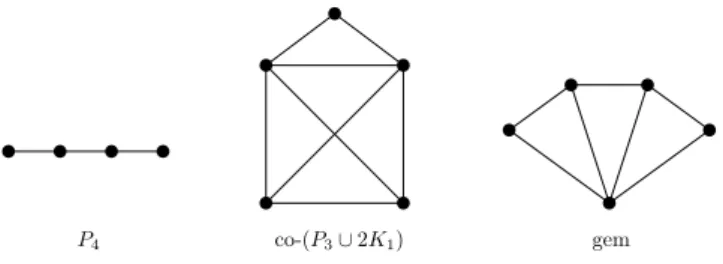
(2) Vol.2015-AL-153 No.12 2015/6/13. IPSJ SIG Technical Report. instead use a reduction of the problem to the 2-connected case for which we provide a polynomial time isomorphism test. To extend Ponomarenko’s theorem to the disconnected case, we provide a reduction structurally different from the ones used previously, allowing us to treat the case where H consist of a cycle with an added isolated vertex. Overall we extend Ponomarenko’s results to obtain the following theorem (see Figure 1 for the graphs that are mentioned).. co-(P3 ∪ 2K1 ). P4. Fig. 1. gem. The small graphs used in our main theorems.. Theorem 1.1. Let H be a graph. The Graph Isomorphism problem on H-induced-minor-free graphs is polynomial-time solvable if H is complete or an induced subgraph of P4 , co-(P3 ∪ 2K1 ) or the gem, and GI-complete otherwise. Our proofs rely on structural descriptions that also allow us to determine exactly which classes characterized by one forbidden induced minor have bounded clique-width. Theorem 1.2. Let H be a graph. The clique-width of the Hinduced-minor-free graphs is bounded if and only if H is an induced subgraph of P4 , co-(P3 ∪ 2K1 ), or the gem. While it is still open whether Graph Isomorphism is polynomial time solvable for graph of bounded clique-width, our theorems are in accordance with the seemingly reoccurring pattern that the isomorphism problem for graphs of bounded cliquewidth is polynomial time solvable, while there are graph classes with unbounded clique width on which Graph Isomorphism is polynomial-time solvable. Additionally, note that H-free graphs have bounded clique-width if and only H is an induced subgraph of P4 and that H-minor-free graphs have bounded clique-width if and only if H is planar. Recently, Paulusma and Dabrowski gave a dichotomy for the clique-width of bipartite H-free graphs [7], and initiated the study of clique-width on graphs that forbid two graphs as induced subgraphs [8]. Structure of the paper. We first summarize well known observations about induced-minor-free graphs, isomorphism and clique-width (Section 2). We then consider classes that are characterized by one forbidden induced minor of size at most 5 (Section 3). Finally we show that the observations of Sections 2 and 3 resolve all cases with forbidden induced minors of size at least 6 (Section 4). In this paper all graphs that are considered are finite. Throughout the paper, we use standard notation and terminology from Diestel [10].. 2. Basic observations In this section, we summarize a few well-known basic observations about graph classes closed under induced minors and cliquewidth.. c 2015 Information Processing Society of Japan ⃝. 2.1 Clique-width In [6], Courcelle and Olariu introduced the clique-width of graphs as a way of measuring the complexity of minimal separators in a graph. Similarly to graphs of bounded treewidth, it has been shown that a large class of problems can be solved efficiently on graphs of bounded clique-width [5]. However, while Graph Isomorphism has long been known to be solvable in polynomial time on graphs of bounded treewidth [22], it is not currently known whether the problem is tractable on graphs of bounded clique-width. For any given graph G, the clique-width of G, denoted by cw(G), is defined as the minimum number of labels needed to construct G by means of the following 4 operations: (i) Creation of a new vertex v with label i (denoted i(v)); (ii) Forming the disjoint union of two labeled graphs G1 and G2 ; (iii) Joining by an edge every vertex labeled i to every vertex labeled j, where i , j; (iv) Renaming label i to label j. In the remainder of the paper, we will be using the following well-known observations to derive upper and lower bounds on the value of clique-width of H-inducedminor-free graphs. See e.g., [12] for an overview of clique-width. Theorem 2.1 ([6]). Let G be a graph and G its edge complement, then cw(G) ≤ 2 · cw(G). Observation 2.2. Let G be a graph and S a subset of vertices of G. We have cw(G \ S ) ≤ cw(G) ≤ 2cw(G\S )+|S |+1 − 1. Let G be a graph and u a vertex of G. The local complementation of G at u is the graph obtained from G by replacing the subgraph induced by the neighbors of G with its edge complement. The following observation follows from the well-known facts that for any graph G, we have cw(G) ≤ 2rw(G)+1 −1 (see [21]), where rw denotes the rank-width, and that rank-width remains constant under local complementations [20]. Observation 2.3. Let G and G′ be two graphs such that G′ can be obtained from G by a sequence of local complementations, ′ then cw(G) ≤ 2cw(G )+1 − 1. Theorem 2.4 ([4]). Let G and G′ be two graphs such that G′ can be obtained from G by a sequence of edge subdivisions, i.e., re′ placing edges with paths of length 2. Then cw(G) ≤ 2cw(G )+1 − 1. Observation 2.5 ([1]). Let G be a graph and B the set of its biconnected components. It holds that cw(G) ≤ 2t+1 − 1, where t = maxB∈B {cw(B)}. Finally, note that for any graph G, the clique-width of G is at most 3 · 2tw(G)−1 , where tw(G) denotes the treewidth of G [3]. 2.2 Some tractable cases Lemma 2.6. If H is a complete graph, then Graph Isomorphism for H-induced-minor-free graphs can be solved in polynomial time. Lemma 2.7. Let H be a complete graph Kk . The H-inducedminor-free graphs have bounded clique-width if and only if k ≤ 4. Note that the lemma above is used to prove Theorem 1.2, but K4 is not explicitly mentioned in the statement, due to the fact that K4 is an induced subgraph of co-(P3 ∪ 2K2 ). Lemma 2.8. If H is an induced subgraph of P4 then Graph Isomorphism for the H-induced-minor-free graphs can be solved in linear time. It is well known that P4 -free graphs are exactly the graphs of 2.
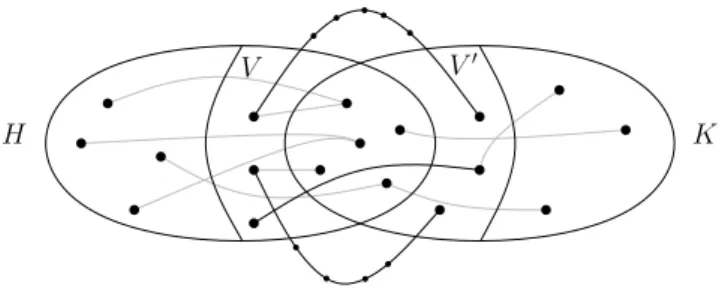
(3) IPSJ SIG Technical Report. clique-width at most 2 (see [14]). 2.3 Some intractable cases A split partition (C, I) of a graph G is a partition of V(G) into a clique C and an independent set I. A split graph is a graph admitting a split partition. A split graph is of restricted split type if it has a split partition (C, I) such that each vertex in I has at most two neighbors in C. Note that a non-complete split graph of restricted split type has minimum degree at most 2. The classes of co-bipartite graphs and restricted split graphs are closed under vertex deletions and edge contractions, and thus under induced minors. As also argued in [22] and [16], the standard graphisomorphism reductions to split graphs and co-bipartite graphs explained in [2] imply the following lemmas. Lemma 2.9. If H is not of restricted split type and co-bipartite, then Graph Isomorphism for the H-induced-minor-free graphs is GI-complete. The reductions used in the lemma can be achieved by performing edge subdivisions and subgraph complementation. Subgraph complementation is the operation of complementing the edges of an induced subgraph. The clique-width of graphs in the class obtained by applying subgraph complementation a constant number of times is bounded if and only if it is bounded for graphs in the original class [14]. Together with Theorem 2.4, this implies that restricted split graphs and co-bipartite graphs obtained by the reductions from general graphs have unbounded clique-width. Corollary 2.10. If H is not of restricted split type and cobipartite, then the H-induced-minor-free graphs have unbounded clique-width.. 3. Graphs on at most 5 vertices In this section we study graph classes characterized by a forbidden induced subgraph H that has at most 5 vertices. 3.1 The graph K3 ∪ K1 We show that Graph Isomorphism is GI-complete on graphs that do not contain K3 ∪ K1 as an induced minor. Additionally, we show that these graphs have unbounded clique-width. Theorem 3.1. The Graph Isomorphism problem is isomorphism complete on graphs that do not contain K3 ∪ K1 as an induced minor. We now prove that K3 ∪ K1 -induced-minor-free graphs do not have bounded clique-width. Theorem 3.2. The class of graphs that do not contain K3 ∪ K1 as an induced minor does not have bounded clique-width. 3.2 The gem We now consider the class of graphs that do not contain the gem as an induced subgraph (see Fig. 1). In [22] this class is also considered, however, there is an issue with the proof for the fact that the isomorphism problem of graph in this class is polynomial-time solvable. More precisely, a common misunderstanding of how the reduction to three connected components by Hopcroft and Tarjan [13] is to be applied has happened. Indeed, the techniques of Hopcroft and Tarjan do not show that graph isomorphism in a graph class C polynomial-time reduces to graph. c 2015 Information Processing Society of Japan ⃝. Vol.2015-AL-153 No.12 2015/6/13. isomorphism of 3-connected components in C, even if C is a minor closed graph class. If this were the case then the class of split graphs of restricted type would be polynomial-time solvable since the only 3-connected graphs of this type are complete graphs. Additionally to C being minor closed, for the techniques to be applicable it is necessary to solve the edge-colored problem for 3-connected graphs in C. However, edge-colored isomorphism is already GI-complete on complete graphs. We now provide a proof that isomorphism of graphs not containing the gem as an induced subgraph is polynomial-time solvable without alluding to 3-connectivity. For this we first need to extend the structural considerations for such graphs performed in for 3-connected graphs [22] to biconnected graphs. Let C be a subgraph of G. We say a vertex v in a vertex set M ⊆ V(G) \ C has exclusive attachment with respect to C among the vertices of M if N(v) ∩ C , ∅ but there is no vertex v′ ∈ M \ {v} with (N(v) ∩ C) ∩ (N(v′ ) ∩ C) , ∅. That is, no other vertex of M shares a neighbor in C with v. Lemma 3.3. Let G be a biconnected gem-induced-minor-free graph. Suppose C is a biconnected subgraph of G with at least 3 vertices and M is a component of G − C such that N(M) ∩ C , C. If v ∈ M is a vertex with |N(v) ∩ C| = 1 then v has exclusive attachment. Lemma 3.4. Let G be a biconnected gem-induced-minor-free graph. Suppose C is a biconnected subgraph of G and M is a component of G − C with N(M) ∩ C , C and |N(M) ∩ C| ≤ 3. If there is no vertex x in M with |N(x) ∩ C| = 1 then every vertex of M has a neighbor in C, and M is a P4 -free graph. We call a vertex of a biconnected graph G a branching vertex if it has degree at least 3. Lemma 3.5. Let G be a biconnected gem-induced-minor-free graph that contains the path P4 as an induced subgraph. Then at least one of the following two options holds: • G has a subgraph H which is an induced path containing at most 2 inner vertices that are branching vertices of G such that G − H is disconnected, or • G has a subgraph H that is a cycle containing at most 3 branching vertices of G such that for every connected component M of G − H we have N(M) ∩ H , H. Let G be a graph with subgraphs H and K. We say that G is sutured from H and K along V ⊆ V(H) and V ′ ⊆ V(K) if G is obtained in the following way. First we require that |V| = |V ′ |. We also require that V(H) ∩ V(K) = V ∩ V ′ . The graph G must then be formed from K ∪ H in the following way. We add edges that form a perfect matching between vertices in V \V ′ and V ′ \V. Finally we may subdivide the edges in the matching an arbitrary number of times (See Figure 2). Lemma 3.6. Let G be a biconnected gem-induced-minor-free graph. There exists an induced subgraph H of G which is isomorphic to either a path or a cycle, contains at most 4 branching vertices, and such that for every component M of G−H the following holds: the graph G[M ∪ H] is sutured from H and some graph K along V and V ′ such that K \ V ′ is P4 -free. Moreover |V ′ | ≤ 4 and every vertex of K − V ′ has a neighbor in V ′ . Theorem 3.7. The Graph Isomorphism problem can be solved in polynomial time on gem-induced-minor-free graphs. 3.
(4) Vol.2015-AL-153 No.12 2015/6/13. IPSJ SIG Technical Report. V. V0. H. K. Fig. 2. A suture of two graphs H and K.. Proof. It is folklore that graph isomorphism of a hereditary graph class C reduces to isomorphism of vertex-colored biconnected graphs in C (see for example [9] or [19]). We thus assume that the input graphs are colored and biconnected. If G is such a biconnected graph, we search for a subgraph H that satisfies the assumptions of Lemma 3.6, that is, H is a path or a cycle with at most 4 branching vertices such that for every component M of G − H we know that G[M ∪ H] is a suture of H with a graph K such that K \ V ′ is P4 -free, where V ′ are the attachments in K. Moreover |V ′ | ≤ 4 and every vertex in K −V ′ has a neighbor in V ′ . Each H is determined by the branch vertices, the leaves (if H is a path) and choices of the paths of non-branching vertices connecting such vertices. Suppose now G1 and G2 are biconnected input graphs to the isomorphism problem. Since there are only polynomially many possible choices for H, we can find a graph H1 in G1 with said properties and test for every H2 in G2 whether there is an isomorphism that maps H1 to H2 . To do so we iterate over all isomorphism φ from H1 to H2 , there are only polynomially many, and check whether such an isomorphism extends to an isomorphism from G1 to G2 . To check whether such an isomorphism extends, it suffices to know which component M1 of G1 − H1 can be mapped isomorphically to which component M2 of G2 − H2 such that the isomorphism can be extended to an isomorphism from G1 [H1 ∪ M1 ] to G2 [H2 ∪ M2 ] such that H1 is mapped to H2 in agreement with φ. Note that the mapping φ determines how vertices with exclusive attachment in H1 must be mapped. Repeatedly increasing H1 by these vertices and H2 by their images we end up at a part of M1 that is P4 -free and adjacent to at most 3 vertices to which images have already been determined. The isomorphism problem for vertex-colored P4 -free is solvable in polynomial time (see [23]) and thus the problem for graphs obtained from P4 -free by adding a bounded number of vertices can be solved in polynomial time ([15], Theorem 1). Using this algorithm the theorem follows. □ Theorem 3.8. If H is an induced subgraph of the gem, then the H-induced-minor-free graphs have bounded clique-width. 3.3 The graph co-(P3 ∪ 2K1 ) In the following we will analyze the graphs that do not contain an induced minor isomorphic to co-(P3 ∪ 2K1 ), the graph obtained from K5 by removing two incident edges. While it has already been shown in [22] that isomorphism for such graphs reduces to isomorphism of graphs not containing the gem (and is thus polynomially solvable), we provide refinement of the proof in [22] for this. We do this to obtain a finer structural description. c 2015 Information Processing Society of Japan ⃝. of the graphs, allowing us also to bound the clique-width in the graph class. Suppose G is a co-(P3 ∪ 2K1 )-induced-minor-free graph. If G does not have a Kt minor for some fixed t then G is in particular in the minor closed graph class of Kt -minor free graphs, and, as described in the introduction, the isomorphism problem can be solved in polynomial time for such graphs. Our strategy is thus to find a Kt minor and use this to analyze the structure of G. In general, of course, there is no constant bound on the number of vertices required to form a Kt minor. However in a co-(P3 ∪2K1 )induced-minor-free graph there is such a bound. We call a Kt minor compact if every bag has at most 2 vertices. Lemma 3.9. If a co-(P3 ∪ 2K1 )-induced-minor-free graph G has a Kt minor for t ≥ 5 then G has a compact Kt minor. Proof. Let M1 , . . . , Mt be the bags of a Kt minor in G such that the Mi are inclusion minimal with respect to forming a Kt minor. That is, removing a vertex from one of the Mi yields a minor different from Kt . We analyze the structure of the minor. We say a vertex v is adjacent to a bag M j if there exists a vertex v′ ∈ M j that is adjacent to v. For a vertex v ∈ Mi define Mdeg(v) = |{M j | j , i, N(v) ∩ M j , ∅}| to be the number of bags different from Mi adjacent to v. Using several steps we will show that Mdeg(v) ≥ t − 2 for all v ∈ M1 ∪ M2 ∪· · ·∪ Mt . We first argue that in case Mdeg(v) > 1 then Mdeg(v) ≥ t − 2. Indeed, if Mdeg(v) > 1 then consider the minor obtained by removing all vertices from Mi different from v. If Mdeg(v) < t − 2 we can choose 2 bags which have vertices adjacent to v and two bags which do not have such vertices. Using these bags and the vertex v we obtain the forbidden induced minor co-(P3 ∪ 2K1 ). We call vertices with Mdeg(v) = 0 inner vertices, those with Mdeg(v) = 1 low degree vertices and we call vertices with Mdeg(v) ≥ t − 2 high degree vertices. Next we argue that there are at most 2 high degree vertices in each bag. Indeed, if there are at least 2 such vertices, we can pick two high degree vertices v, v′ in Mi which are not adjacent to exactly the same bags such that there is a path from v to v′ in Mi that does not contain any other high degree vertex. Since every bag different from Mi is adjacent to v or v′ , removing all vertices different from v and v′ and not lying on the path yields a Kt minor. Since the bags M1 , . . . , Mt were chosen to be minimal, we conclude that there are at most 2 high degree vertices in each bag. We further argue that there is no low degree vertex in Mi . Indeed, in case there is at least one low degree vertex in Mi , we can choose a low degree vertex v ∈ Mi and a vertex v′ ∈ Mi adjacent to a bag M j with j , i such that v is not adjacent to M j and such that there exists a path in Mi of inner vertices connecting v and v′ . We remove all vertices in Mi different from v and v′ and not on said path connecting them. We then move the vertex v′ from Mi to M j . We obtain the induced minor co-(K1,t−3 ∪ 2K1 ), which contains co-(P3 ∪ 2K1 ) since t > 2. Finally we argue that there are no inner vertices. Indeed, by minimality we can assume that every inner vertex v lies on a path between two high degree vertices v1 and v2 , say. We again remove all vertices different from v1 and v2 not on the path. We then move v1 to an adjacent bag M j and v2 to an adjacent bag M j′ such 4.
(5) Vol.2015-AL-153 No.12 2015/6/13. IPSJ SIG Technical Report. that j , j′ . This is possible since the vertices have high degree. Again we obtain a forbidden induced minor co-(K1,t−3 ∪ 2K1 ) as above. Since there are only high degree vertices and since each bag can only contain two such vertices, the minimal minor is compact. □ Lemma 3.10. If G is a biconnected co-(P3 ∪2K1 ) induced-minorfree graph and M is a compact Kt minor with t ≥ 5 then G − M is (K2 ∪ K1 )-free. Corollary 3.11. If a biconnected co-(P3 ∪ 2K1 )-induced-minorfree graph G has a K8 minor then G is (K2 ∪ K1 )-free. Since the gem is biconnected, and thus every occurrence of a gem as induced minor must occur within a biconnected component of a graph, the corollary is a refinement of Ponomareko’s result [22] that says that if a co-(P3 ∪ 2K1 )-induced-minor-free graph G has a K218 +4 -minor then it does not contain a gem as induced minor. Theorem 3.12. Graph isomorphism for co-(P3 ∪ 2K1 )-inducedminor-free graphs can be solved in polynomial time. To show that the co-(P3 ∪2K1 )-induced-minor-free graphs have bounded clique-width, we need the following fact, which was indirectly proven by van ’t Hof et al. in the proof of Theorem 9 in [24]. Theorem 3.13 ([24], Proof of Theorem 9). For any graph F and for any planar graph H, there exists a constant cF,H such that an F-minor-free graph of treewidth at least cF,H has H as an induced minor. Theorem 3.14. If H is an induced subgraph of co-(P3 ∪ 2K1 ), then the H-induced-minor-free graphs have bounded cliquewidth. 3.4 The remaining graphs on at most 5 vertices Now we study the remaining small graphs of at most five vertices. We show that every case here can be reduced to some case we have solved already. Lemma 3.15. Let H be a non-complete graph of 5 vertices. If H is neither co-(P3 ∪ 2K1 ) nor the gem, then Graph Isomorphism for the H-induced-minor-free graphs is GI-complete. Lemma 3.16. Let H be a graph of at most 4 vertices. The Graph Isomorphism problem for the H-induced-minor-free graphs is polynomial-time solvable if H is an induced subgraph of either co-(P3 ∪ 2K1 ) or P4 . Otherwise, it is GI-complete. The two lemmas above together imply the following theorem. Theorem 3.17. Let H be a non-complete graph of at most 5 vertices. Then Graph Isomorphism for the H-induced-minor-free graphs is polynomial-time solvable if H is an induced subgraph of P4 , co-(P3 ∪ 2K1 ), or the gem; otherwise, it is GI-complete. The reductions we used above in order to show the GIcompleteness preserve the property that the clique-width is unbounded (see Subsection 2.3). Thus we have the following corollary. Corollary 3.18. Let H be a non-complete graph of at most 5 vertices. Then the H-induced-minor-free graphs have bounded clique-width if and only if H is an induced subgraph of P4 , co(P3 ∪ 2K1 ), or the gem.. c 2015 Information Processing Society of Japan ⃝. 4. Non-complete graphs on at least 6 vertices In this section, we show that if H is not a complete graph and has at least six vertices, then Graph Isomorphism for the Hinduced-minor-free graphs is GI-complete. Lemma 4.1. If H is non-complete and contains a clique of size 5, then Graph Isomorphism for the H-induced-minor-free graphs is GI-complete. Theorem 4.2. If H is a non-complete graph of size at least 6, then Graph Isomorphism for the H-induced-minor-free graphs is GI-complete. Since the reductions that we used above in order to show the GI-completeness preserve the property that the clique-width is unbounded (see Subsection 2.3), we have the following corollary. Corollary 4.3. If H is a non-complete graph of size at least 6, then the H-induced-minor-free graphs have unbounded cliquewidth. References [1] [2] [3] [4] [5] [6] [7] [8] [9] [10] [11] [12] [13] [14] [15] [16] [17] [18] [19] [20] [21] [22]. R. Boliac and V. V. Lozin. On the clique-width of graphs in hereditary classes. In ISAAC 2002, pages 44–54, 2002. K. S. Booth and C. J. Colbourn. Problems polynomially equivalent to graph isomorphism. Technical Report CS-77-04, Computer Science Department, University of Waterloo, 1979. D. G. Corneil and U. Rotics. On the relationship between clique-width and treewidth. SIAM J. Comput., 34(4):825–847, 2005. B. Courcelle. Clique-width and edge contraction. Information Processing Letters, 114:42–44, 2014. B. Courcelle, J. A. Makowsky, and U. Rotics. Linear time solvable optimization problems on graphs of bounded clique-width. Theory Comput. Syst., 33(2):125–150, 2000. B. Courcelle and S. Olariu. Upper bounds to the clique width of graphs. Discrete Applied Mathematics, 101:77–114, 2000. K. K. Dabrowski and D. Paulusma. Classifying the clique-width of H-free bipartite graphs. In COCOON, pages 489–500, 2014. K. K. Dabrowski and D. Paulusma. Clique-width of graph classes defined by two forbidden induced subgraphs. Accepted at CIAC 2015, 2015. S. Datta, N. Limaye, P. Nimbhorkar, T. Thierauf, and F. Wagner. Planar graph isomorphism is in log-space. In IEEE Conference on Computational Complexity, pages 203–214, 2009. R. Diestel. Graph Theory. Springer Verlag, Electronic edition, 2005. M. Grohe and D. Marx. Structure theorem and isomorphism test for graphs with excluded topological subgraphs. In STOC, pages 173– 192, 2012. P. Hlinen´y, S. Oum, D. Seese, and G. Gottlob. Width parameters beyond tree-width and their applications. Comput. J., 51(3):326–362, 2008. J. E. Hopcroft and R. E. Tarjan. Isomorphism of planar graphs. In Complexity of Computer Computations, pages 131–152, 1972. M. Kami´nski, V. V. Lozin, and M. Milaniˇc. Recent developments on graphs of bounded clique-width. Discrete Applied Mathematics, 157:2747–2761, 2009. S. Kratsch and P. Schweitzer. Isomorphism for graphs of bounded feedback vertex set number. In SWAT, pages 81–92, 2010. S. Kratsch and P. Schweitzer. Graph isomorphism for graph classes characterized by two forbidden induced subgraphs. In WG 2012, pages 34–45, 2012. D. Lokshtanov, M. Pilipczuk, M. Pilipczuk, and S. Saurabh. Fixedparameter tractable canonization and isomorphism test for graphs of bounded treewidth. In FOCS 2014, pages 186–195, 2014. Y. Otachi and P. Schweitzer. Isomorphism on subgraph-closed graph classes: A complexity dichotomy and intermediate graph classes. In ISAAC, pages 111–118, 2013. Y. Otachi and P. Schweitzer. Reduction techniques for graph isomorphism in the context of width parameters. In SWAT 2014, pages 368– 379, 2014. S. Oum. Rank-width and vertex-minors. J. Comb. Theory, Ser. B, 95(1):79–100, 2005. S. Oum and P. D. Seymour. Approximating clique-width and branchwidth. J. Comb. Theory, Ser. B, 96(4):514–528, 2006. I. N. Ponomarenko. The isomorphism problem for classes of graphs. 5.
(6) IPSJ SIG Technical Report. [23] [24]. Vol.2015-AL-153 No.12 2015/6/13. closed under contraction. Zapiski Nauchnykh Seminarov Leningradskogo Otdeleniya Matematicheskogo Instituta, 174:147–177, 1988. Russian. English translation in Journal of Soviet Mathematics 55 (1991), 1621–1643. P. Schweitzer. Towards an isomorphism dichotomy for hereditary graph classes. In STACS, 2015. to appear. P. van ’t Hof, M. Kami´nski, D. Paulusma, S. Szeider, and D. M. Thilikos. On graph contractions and induced minors. Discrete Applied Mathematics, 160:799–809, 2012.. c 2015 Information Processing Society of Japan ⃝. 6.
(7)
図
関連したドキュメント
Likewise we show that any decomposition of the complete graph into strongly regular graphs of (negative) Latin square type is an amorphic association scheme.. We study strongly
Many interesting graphs are obtained from combining pairs (or more) of graphs or operating on a single graph in some way. We now discuss a number of operations which are used
The first bit can be either zero or one (2 choices). Threshold graphs are perfect. Therefore, the chromatic number is the size of the maxi- mum clique of the graph. However, the size
From this, one can easily find an induced splitting of the computational energy space V n , where the condition number is independent of the anisotropy of the problem and
In Section 3, we show that the clique- width is unbounded in any superfactorial class of graphs, and in Section 4, we prove that the clique-width is bounded in any hereditary
Kilbas; Conditions of the existence of a classical solution of a Cauchy type problem for the diffusion equation with the Riemann-Liouville partial derivative, Differential Equations,
In contrast to the q-deformed vector space, where the ring of differential operators is unique up to an isomorphism, the general ring of h-deformed differential operators Diff h,σ
Having established the existence of regular solutions to a small perturbation of the linearized equation for (1.5), we intend to apply a Nash-Moser type iteration procedure in
